Glide

Russia drops record number of glide bombs on Ukraine as casualties pile up | Russia-Ukraine war News

The General Staff of the Armed Forces of Ukraine has claimed that Russia’s army suffered 42,800 casualties in July, which, if accurate, would be the highest rate of losses so far this year estimated by Kyiv.

At the same time, Russia has responded to its poor battlefield performance and domestic energy crises by doubling down on the two weapons Ukraine has not found an adequate defence to – glide bombs and ballistic missiles.

Recommended Stories

list of 4 itemsend of list

Russia unleashed 8,300 glide bombs in July, more than in any other month of the war, said Ukraine’s defence ministry.

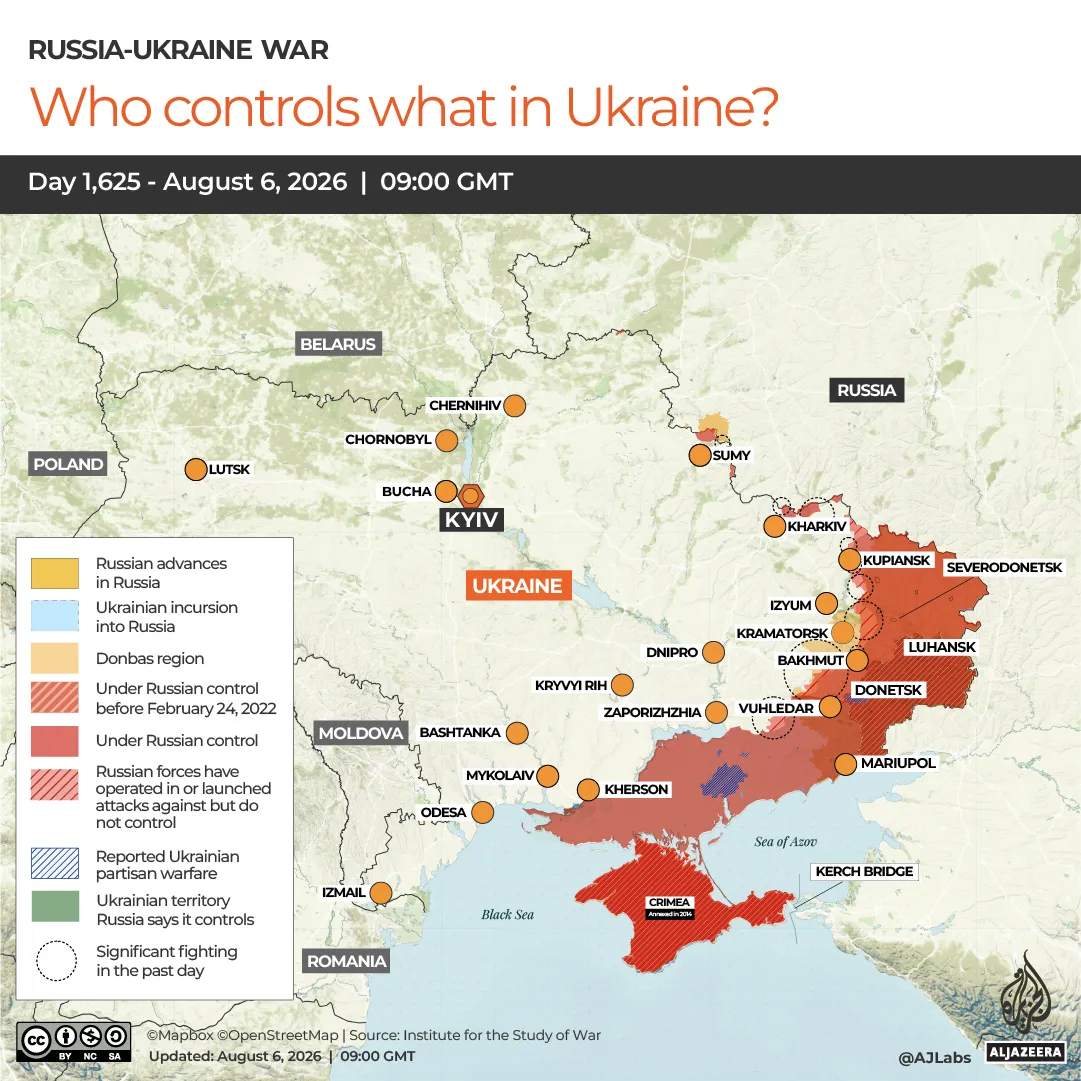
INTERACTIVE-WHO CONTROLS WHAT IN UKRAINE-1786023985
(Al Jazeera)

Ukraine’s kill rate is rising to meet what President Volodymyr Zelenskyy believes will be a call-up of up to half a million Russian reservists in October.

Al Jazeera is unable to independently verify either side’s claims of casualties in the war, now raging on in its fifth year.

Russian President Vladimir Putin has so far refrained from using regular army conscripts and reservists in what he calls his Special Military Operation in Ukraine, fearing a political backlash. Should Ukraine force him to do so, it could mark a political inflexion point in Putin’s popularity at home.

As for Ukraine’s casualties, Zelenskyy recently told Fox News they amounted to 450,000, of whom 50,000 are fatalities.

The Center for Strategic and International Studies (CSIS) has recently estimated that “the Russia-Ukraine casualty rate has likely risen to nearly 8:1 in the first half of 2026, up from between 2:1 and 3:1 for much of the war, in large part due to Ukraine’s use of drones”.

Drones were responsible for 30,272 of Russia’s casualties in July, said Zelenskyy.

Russia in retreat

Russia’s rising casualty rate is accompanied by a falling rate of performance on the battlefield.

The Institute for the Study of War, a Washington-based think tank that assesses territorial control using geolocated open-source material, estimates that Russia occupied a total of 37.85sq km (15sq miles) of Ukraine in July, compared with 455,000sq km (176,000sq miles) in July of 2025.

That is demonstrative of Russia’s poor showing this year.

The ISW estimates that on balance, Russia has lost 183.5sq km (70sq miles) of Ukrainian territory this year, compared with the 2,198sq km (848sq miles) it seized during the first seven months of 2025.

Moscow has succeeded in infiltrating areas of Ukraine – a tactic of sending individual troops to pre-position themselves and await reinforcements, thus placing Ukrainian control of territory in dispute, if not firmly controlling it.

Russia infiltrated 121.6sq km (47sq miles) in July, according to the ISW, bringing total infiltrated territory for the year to 379.9sq km (147sq miles).

Many of these infiltrations have been reversed by the Ukrainian military, but they may yet prove effective in Kostiantynivka, the southernmost of Ukraine’s fortress cities, where Ukrainian defenders have recently expressed doubt about their ability to hold the city for more than a few more months.

Strike campaign renewed

Ukraine has also been holding its own in the air.

Zelenskyy declared a 40-day air strike campaign a success and renewed it on August 4.

The three-tiered campaign aimed to hit military production and oil refining inside Russia, energy and weapons flows in occupied territories close to the front line, and front-line positions.

Ukraine’s Security Service (SBU) said it had struck 14 refineries, dozens of oil depots and loading terminals, 14 aircraft and four airfields over 40 days.

Many of those strikes took place in the past week, when Ukraine set fire to a Lukoil refinery in Volgograd, three refineries in the city of Ufa, 1,600km (994 miles) from Ukraine, the Slavneft-Yanos oil refinery in Yaroslavl, the Engels 2 and Saratov airfields, and a factory in Izhevsk manufacturing Shahed drones.

Unlike the larger Shahed factory in Alabuga, which relies on Chinese parts, this one uses almost exclusively Russian parts, said military technology expert Serhii Beskrestnov.

Ukraine has destroyed about a third of Russia’s actual refining capacity, a recent Financial Times analysis of satellite photographs found.

Ukraine has been launching close to 10,000 long-range drones a month to achieve these results.

Moscow mayor Sergei Sobyanin said 6,225 Ukrainian drones flew towards Moscow in July, representing approximately two-thirds of all Ukrainian long-range strikes on Russian soil.

When Ukraine launched its drone campaign at the end of 2023, its goal was to manufacture 11,000 long-range drones in all of 2024. It has since contracted agreements with nine allies to manufacture drones on their soil, sending 50 percent of production to Ukraine, and says 15 more agreements are pending.

The results of the 40-day campaign have been most dramatic in occupied Crimea, where Ukraine has struck 201 electricity substations.

“The Crimean Peninsula’s power grid faced an unprecedented load and operated in critical mode. Rolling blackouts occurred in all Crimean districts,” said the Kremlin’s ambassador-at-large, Rodion Miroshnik.

Things were not much better in the adjacent occupied territories of Kherson and Zaporizhia, where he said “large-scale power outages … were recorded throughout the week in all regions”.

Ukraine said it has also sunk or disabled 206 Russian tankers and ferries carting oil and war materiel to Crimea across the Black and Azov seas. The head of its unmanned systems forces said it had run out of targets.

The energy crisis has forced the Kremlin to spend billions of roubles subsidising the peninsula, including placing a 100 rouble ($1.20) price cap on petrol in the past week.

Meanwhile Ukrainian strikes have continued, levelling a 60,000-tonne petroleum products tank farm in Taman, on the Russian side of the Kerch Strait, used to supply Crimea, and causing a catastrophic fire on July 31. Ukraine followed up by striking aircraft hangars in Yevpatoria, a naval boat yard in Chornomorske and an artillery brigade’s supply base, all in Crimea.

Russia’s response

Russia’s glide bombs are inertial ordnance fitted with fins giving them extra range and accuracy, so they can be dropped at safe distances of 20 to 30km (12 to19 miles) from the front lines.

Some carry three tonnes of explosives. They fly too fast to be intercepted by drones and cannot be disoriented by scrambling.

As well as glide bombs, Russia also unleashed its greatest monthly tally of missiles against Ukrainian cities – 376 in July, compared with a previous record of 288 in March. Of these, 120 were ballistic, and their density has depleted Ukraine’s stock of Patriot interceptors – the only missile that has proven effective against them.

During the past week, Ukraine stopped only one out of 51 Iskander-M ballistic missiles.

The Russian penetration rate translated directly into hits and civilian deaths – at least nine on August 1 and 17 on August 5 in Kyiv alone.

A man walks near bodies of killed residents in body bags at a railway station, the site of Russian air strike, amid Russia's attack on Ukraine, in Kyiv region, Ukraine August 5, 2026. REUTERS/Stringer TPX IMAGES OF THE DAY
A man walks near body bags at a railway station, at the site of an alleged Russian air strike, in Ukraine’s Kyiv region on August 5, 2026 [Reuters]

Russian production of Iskander-Ms is estimated at 70 a month, but North Korean ballistics may now be coming into play.

A missile fired at Radushne, Ukraine last month was of Korean manufacture, claimed Zelenskyy – only the second such missile to be used in the war.

Zelenskyy has pleaded for countries to send some of their stockpiles of an estimated 4,000 to 5,000 Patriot interceptors.

“The United States knows what we need. Europe knows what we need. Anti-ballistic missiles must protect people – not sit in stockpiles,” he said.

Ukraine’s vulnerability is clear from figures shared by its air force. It has intercepted 4,626 missiles of various types since the beginning of the war, but only 437 ballistic missiles.

Source link

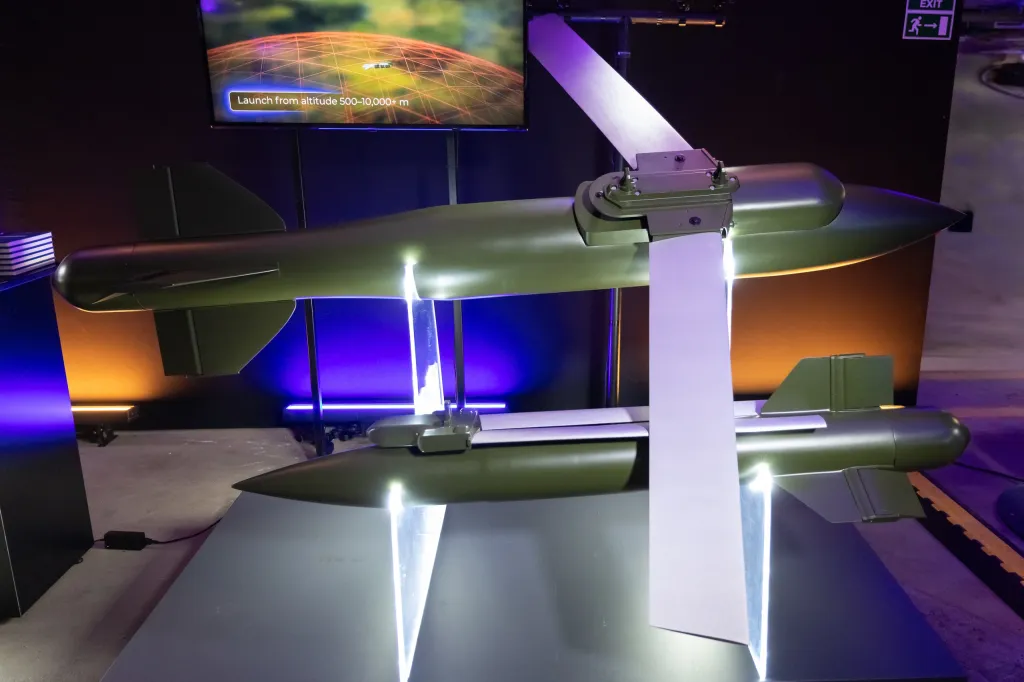
Ukraine’s Homegrown Glide Bomb Breaks Cover

Ukraine has provided imagery of its first homegrown glide bomb, which it says is now ready for combat. Developments by both sides in the Ukraine conflict underscore the fact that standoff munitions of all kinds are in particularly high demand, to counter the increasing density and lethality of enemy air defenses.

According to the Ukrainian Minister of Defense, Mykhailo Fedorov, the development of the weapon — the name of which hasn’t been revealed — took 17 months. A product of Brave1, the defense tech arm of the Ukrainian government, the weapon is said to carry a 250-kilogram (551-pound) warhead, to which is attached a wing kit and some kind of guidance system, the nature of which has not been disclosed.

The first Ukrainian glide bomb from @BRAVE1ua is ready for combat deployment. Development took 17 months. The warhead weighs 250 kg. The Ukrainian glide bomb features a unique design created specifically for the realities of modern warfare.

Pilots are currently rehearsing… pic.twitter.com/Pnr15iTG9L

— Mykhailo Fedorov (@FedorovMykhailo) May 18, 2026

In a statement today, Brave1 said the glide bomb “has completed all required trials,” and has now been declared ready for combat. The weapon is said to be able to hit targets “dozens of kilometers behind enemy lines.”

Ukraine had no guided aerial bomb. Now it does.

DG Industry, a Brave1 participant, has completed all required trials and declared the weapon ready for combat after 17 month of development. The bomb carries a 250 kg warhead, hits targets dozens of kilometers behind enemy lines,… pic.twitter.com/EXP0PiLOHl

— BRAVE1 (@BRAVE1ua) May 18, 2026

With the Ukrainian Ministry of Defense having placed a first order, pilots are now said to be training with the weapon, meaning that combat deployment is “imminent.”

Ukrainian authorities claim that the weapon was designed from scratch and was “not copied from Western or Soviet systems.”

A close-up of the Ukrainian glide bomb (painted red for testing) in flight. Ukrainian Ministry of Defense screencap

An accompanying video shows the release of the weapon from a Ukrainian Air Force Su-24 Fencer swing-wing attack jet. The bomb is then seen with its range-extending wings deployed; interestingly, these are seen extended immediately after release. Otherwise, the weapon also features notably large cruciform tailfins. The apparent lugs seen under the body of the munitions suggest that, like Russian glide bombs, the weapon ‘topples over’ to assume the correct profile before the wings deploy.

A Russian UMPK glide bomb strapped on a Su-34. Russian Ministry of Defense

We have reached out to Brave1 for more details on the glide bomb.

It is also worth noting that a previous video, from August 2024, showed another type of air-launched munition, apparently also homegrown, being released from a Ukrainian Su-24, as you can read about here.

A full view of the Su-24 carrying the mystery munition that appeared in 2024. @UkrAirForce/Telegram capture

👀👀👀

A Ukrainian Sukhoi Su-24M bomber spotted with (I believe) previously unseen munition installed under its wing.

According to the original source, the video is dated to August 2024. The description says: “A bomber conducts a test flight to test a new guided aerial bomb.”… pic.twitter.com/LZsX5I4PxM

— Status-6 (War & Military News) (@Archer83Able) September 6, 2024

Again, we have reached out to Brave1 to better understand if there is any relationship between these weapons. However, the development of the new weapon officially began in December of 2024, several months after the mystery munition appeared.

As for the Ukrainian Air Force, the new glide bomb should provide an important addition to Western-supplied weapons in this class.

Ukraine already employs the Joint Direct Attack Munition-Extended Range (JDAM-ER) and AASM-250 Hammer bomb supplied by the United States and France, respectively. The Ukrainian Air Force also makes extensive use of the U.S.-supplied Small Diameter Bomb (SDB), which also has pop-out wings.

A Ukrainian MiG-29 carrying a JDAM-ER glide bomb. This one carries a slogan commemorating the birthday of the then Ukrainian Armed Forces commander-in-chief, Valerii Zaluzhnyi. Ukrainian Air Force

At the same time, the new weapon helps Ukraine match similar weapons that are proliferating in the Russian inventory. The Russian Aerospace Forces have, for several years now, been making extensive use of increasingly larger dumb bombs fitted with add-on precision guidance kits. Russia has also been working to refine its glide bombs, making them more effective than the original, fairly crude designs.

Based on Ukraine’s experience with its expanding roster of longer-range kamikaze drones and glide bombs currently in service with both sites, a satellite navigation-assisted inertial guidance system would be used to direct the glide bomb to a specific set of coordinates. Additional seekers are possible, but not probable at this time.

It is not clear if the new Ukrainian weapon has any kind of powerplant. Ukraine has already been employing multiple types of jet-powered kamikaze drones. More importantly, Ukraine’s French-supplied Hammer precision-guided bombs also feature a rocket booster. This feature is of unique utility for Ukraine, which often slings its glide bombs via pop-up launch profiles from low level executed by its fighter and attack aircraft. This is due to the extremely heavy air defenses near the front lines. Even without a motor, however, the weapon provides an important capability and one that is increasingly important as stocks of Western-supplied munitions are eroded or their supply is otherwise interrupted.

A video compilation provides a look at the French-made Hammer munition being used by Ukrainian Su-25 attack jets, including low-level toss bombing:

ЖАБА. ЗСУ Су-25 . З Новим роком , друзі ! thumbnail

ЖАБА. ЗСУ Су-25 . З Новим роком , друзі !


We will likely have to wait to see the weapon in action before establishing whether it can be launched from platforms other than the Su-24, although this would seem almost guaranteed.

While Ukraine’s Su-24s are the country’s launch platforms for stealthy Storm Shadow and SCALP-EG air-launched cruise missiles provided by the United Kingdom and France, its MiG-29 Fulcrums and Su-27 Flankers have been the primary carriers for other Western-supplied air-launched precision air-to-ground munitions like the JDAM-ER, SDB, and Hammer bombs, as well as AGM-88 High-speed Anti-Radiation Missiles (HARM). The size of the weapon would allow it to be carried by any of these platforms, as well as Su-25 Frogfoot attack jets, which also deliver Hammers.

A video of the moment of release of two French-supplied AASM-250 Hammer guided bombs from a Ukrainian MiG-29 fighter jet.

The pilot of this particular airframe, 27-year-old Captain Oleksandr Myhulia, perished while performing a combat mission on August 12, 2024.… pic.twitter.com/yNEbbaFUPt

— Status-6 (War & Military News) (@Archer83Able) August 14, 2024

Whatever the launch platforms and the new weapon’s exact capabilities, its biggest advantage is that it offers a domestic source of air-launched precision-guided munitions with some kind of standoff range. The longer-range Storm Shadows and SCALP-EGs were provided only in relatively limited quantities to Ukraine. They can only be launched by the Su-24 and are reserved for more strategic targets.

A Ukrainian Su-24 carrying a SCALP-EG cruise missile. Ukrainian Ministry of Defense

Meanwhile, the JDAM-ER has never been in widespread use with the U.S. military or other foreign armed forces, so the quantities available are questionable.

An inert JDAM-ER in flight after release. Royal Australian Air Force

To help meet the shortfall, the U.S. Air Force launched a project to develop a new, relatively low-cost precision-guided air-launched standoff munition focused primarily on meeting Ukrainian demands for weapons of this kind. In August of last year, it was reported that Washington had approved the transfer of thousands of these Extended Range Attack Munitions (ERAM) to Ukraine. As well as the Rusty Dagger from Zone 5 Technologies, CoAspire developed the Rapidly Adaptable Affordable Cruise Missile (RAACM) under the ERAM program. 

However, evidence of these weapons being employed by Ukraine has yet to emerge.

A full, unedited view of the Rusty Dagger Extended Range Attack Munition live-fire test on Jan. 22, 2025, at Eglin Air Force Base, Florida. via U.S. Air Force

There is also the fact that a domestically developed standoff weapon can be used without restriction against any kind of target. Previously, longer-ranged Western-supplied weapons have come with restrictions on their employment. As a result, Ukrainian officials have repeatedly and publicly called for more flexibility in striking targets inside Russia proper. This became especially critical during the Ukrainian incursion into the latter country’s Kursk region.

The apparent rapid pace of development of Ukraine’s first homegrown glide bomb suggests that this is an urgent requirement and one that may well have been driven by problems in the availability of equivalent Western munitions. With that in mind, combined with claims that the weapon is now ready for combat, we may not have to wait too long for evidence of it being used in action.

Contact the author: thomas@thewarzone.com

Thomas is a defense writer and editor with over 20 years of experience covering military aerospace topics and conflicts. He’s written a number of books, edited many more, and has contributed to many of the world’s leading aviation publications. Before joining The War Zone in 2020, he was the editor of AirForces Monthly.


Source link