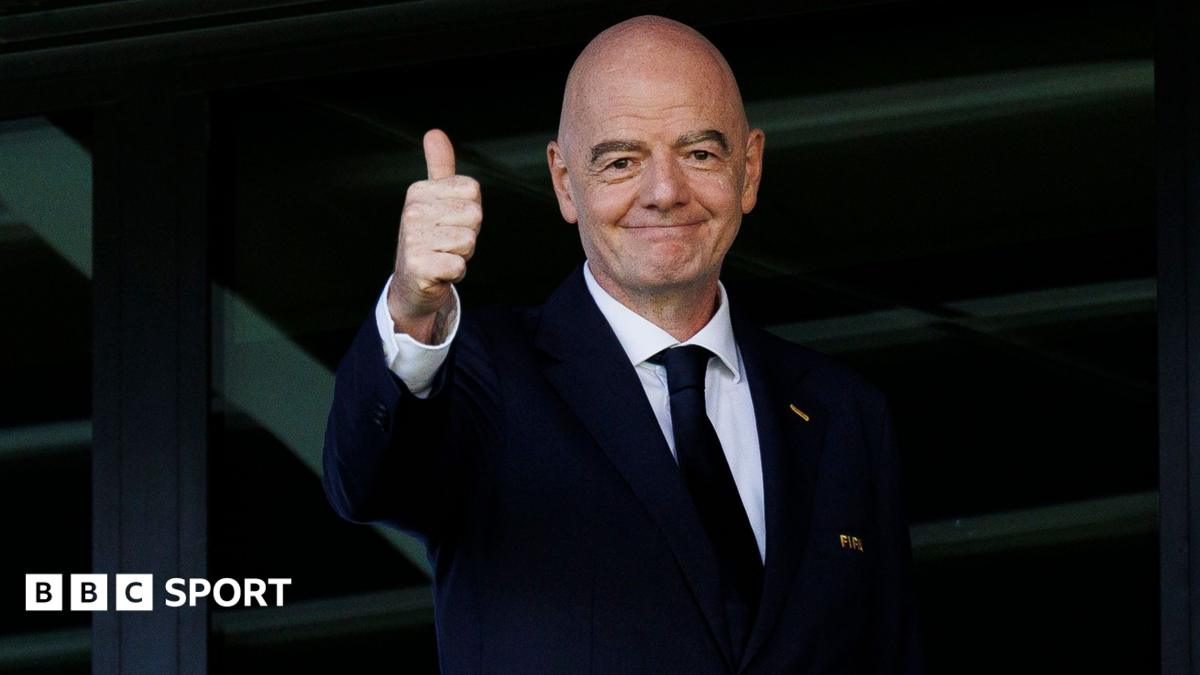
Gianni

World Cup 2026: Gianni Infantino tells Fifa critics to ‘meditate, pray or watch football’

Infantino also addressed criticism surrounding the standard of officiating at the tournament, in particular concerns about political interference after USA forward Folarin Balogun was made available for their last-16 tie when his one-match ban was suspended by Fifa – following the intervention of US President Donald Trump.

Of the 191 other red cards shown at a men’s World Cup, only one other player has escaped a suspension.

Uefa said the decision had “crossed a red line”, labelling it “unprecedented, incomprehensible, and unjustifiable”, while the Norwegian Football Federation is considering filing a formal complaint to Fifa’s ethics committee.

Infantino, however, argued that such decisions are not out of the ordinary, claiming similar rulings are “routine and widely accepted in some of the biggest leagues worldwide”.

He added: “It’s curious that the same countries employing these practices are the ones criticising.”

The International Olympic Committee has said it will not investigate Infantino for any possible breaches of political neutrality, stating the complaint levelled by human rights campaign group FairSquare falls outside the jurisdiction of its ethics commission.

Infantino’s advice to his opponents was “to show some love” and “respect” to a tournament where “people came together as families, as fans, as one”.

“To everyone who missed our beautiful game, the emotions, the celebrations, the laughter, the crying, the deception and the joy. To all of you who missed watching kids, babies, grandparents and parents come together for the beautiful game… sorry that you were so consumed by hate and criticism that you missed it all,” Infantino wrote.

“While they celebrated, you were busy planting seeds of hate. Our world needs love, not hate; tolerance, not division; celebration, not mourning.

“To those spending their time and energy hating us, please take a moment to reflect, meditate, pray or watch a football match and truly observe the faces, the eyes, the emotions.

“Because only our beautiful game can deliver such an extraordinary show, a show where everyone becomes one and reconnects as humans.

“I am incredibly proud, as Fifa President, to have contributed, even a little, to this show. It’s a great feeling.”

Source link

World Cup 2026: Could Gianni Infantino push through a 64-team tournament?

A 64-team tournament has two main plus points: a more natural format, and more opportunities for emerging nations.

It is the latter which Infantino is championing, especially after the heroics of Cape Verde.

Fifa faced criticism before the tournament, with suggestions the additional teams would not be competitive.

Then Cape Verde drew with Spain and Uruguay to finish second in their group. And the Blue Sharks gave Argentina an almighty scare by taking them to extra time in the last 16, before losing 3-2.

But the fairytale stories must be balanced with the competitive edge of the tournament.

Haiti, Iraq, Jordan, Panama, Tunisia and Uzbekistan failed to pick up a point – and this summer’s group stage had minimal jeopardy for the top nations.

Add more teams and it would be difficult to see a repeat of top-four seeds like Belgium (2022), Germany (2018), Spain (2014), Italy (2010) and France (2002) failing to make to knockout stage.

Then there is the question of where the extra places would go.

Based on this year’s qualifying, these are the additional countries who would have made it into a 64-team World Cup 2026 (with their Fifa ranking at the start of the tournament in brackets):

AFC: Indonesia (118), Oman (79), United Arab Emirates (68).

Uefa: Denmark (21), Italy (12), Poland (36).

Concacaf: Honduras (65), Jamaica (71), Suriname (125).

Conmebol: Bolivia (77), Venezuela (49).

OFC: New Caledonia (151).

Africa: Burkina Faso (62), Cameroon (44), Gabon (86), Nigeria (26).

Six of those teams are from the top 50 of Fifa’s world rankings – three from Europe, two from Africa and one from South America.

And therein lies the problem. Asia and Concacaf are weaker confederations, as was proven by performances this year.

Nine of Africa’s 10 countries got out of the group stage. But only two of nine Asian countries advanced, and just three of the six Concacaf countries – the co-hosts – made it through.

New Zealand, who got one point and finished bottom of their group, are the only country from Oceania in the world’s top 150.

There is an argument that if you extend again, you should give a greater weight of places to Europe just for competitive balance.

But, on the other hand, there are those who would argue that bringing more teams into the World Cup ultimately allows the game to develop further in those countries.

Infantino will sell the expansion as being good for the global game, but there have to be doubts that it is good for the competition.

Almost a third of Fifa’s 211 nations would be present.

Would the group stage not simply become a glorified pan-confederation qualifying competition for what is, essentially, a knockout tournament?

Source link

World Cup 2026: Gianni Infantino says hydration breaks bring no extra revenue for Fifa’

Managers and coaching staff are allowed to discuss tactics with their players while the breaks are taking place.

Infantino said: “The main reason [for the breaks] is the heat, but we also have to understand that in a competition like the World Cup, played over 39 days, with teams potentially playing eight matches in those 39 days, having a moment to rest is extremely important.

“What matters even more to us is ensuring that all teams, in every match, are playing under the same conditions.

“And it’s very difficult to accept that a coach might have the opportunity to influence a match by making adjustments simply because it is hotter, while in another match, where the temperature is slightly lower, the same coach does not have the same opportunity.

“We want to ensure equal conditions for everyone and that’s why these breaks are implemented in every match.”

Experts have told BBC Sport an average 30-second World Cup advertising slot on Fox Sports costs between $200,000 (£152,000) and $300,000 (£227,000), rising to $750,000 (£567,000) during USA matches and the final stages.

That means advertising during hydration breaks is likely to generate more than $250m (£189m) in the USA alone.

Source link