geo group

Dodgers fulfill $1-million pledge in response to ICE raids

The Dodgers’ decision to deny U.S. Customs and Border Protection agents access to Dodger Stadium wasn’t the way the team intended to first address the surge of federal immigration enforcement a year ago.

Pressed by religious, labor and community leaders to take a stand, the Dodgers had prepared a response to Immigration and Customs Enforcement and Border Patrol raids that triggered widespread protests — only to shelve the announcement as the team went public with their refusal to let federal agents onto stadium grounds. A day later, on June 20, the Dodgers unveiled their plan, centered on $1 million “toward direct financial assistance for families of immigrants impacted by recent events in the region.”

In total, the Dodgers donated $1.1 million, representatives for California Community Foundation and Labor Community Services — the two nonprofits that received the funds — told The Times.

“The Dodgers have been in L.A. for 68 years,” said Joseph Tomás McKellar, executive director of PICO California. “They’re beloved among immigrant communities in a way that no other sports team is. That gives the Dodgers cultural and financial power in the region. We applaud what they did, but they could do even more by exercising leadership.”

PICO California, the state’s largest faith-based organizing network, was behind a petition delivered to the Dodgers, the contents of which were largely addressed by the team’s $1-million commitment. But as the last of the money flowed to immigrant families in need in late August, another petition circulated that demanded Dodgers owner Mark Walter sell his “company’s stake in ICE jails and deportation flights.”

Walter’s massive investment firm, Guggenheim Partners, owned more than a million shares of GEO Group, valued at nearly $12 million. By the end of 2025, Guggenheim’s interest in GEO Group had fallen to around 10,000 shares. And by the end of March of this year, Guggenheim no longer owned any shares of the prison company that also assisted in the deportation of immigrants, according to SEC filings reviewed by The Times.

Walter also faced criticism over the partnership announced last year between Palantir Technologies and TWG Global — of which Walter is chairman and chief executive officer. Palantir provides AI and analytics software to ICE, tools the American Civil Liberties Union said “form the backbone for ICE’s mass deportation regime.”

There are no indicators as to why Guggenheim Partners divested from GEO Group. The Dodgers declined comment. Guggenheim Partners did not respond to The Times’ request for comment. GEO Group referred questions to Guggenheim Partners.

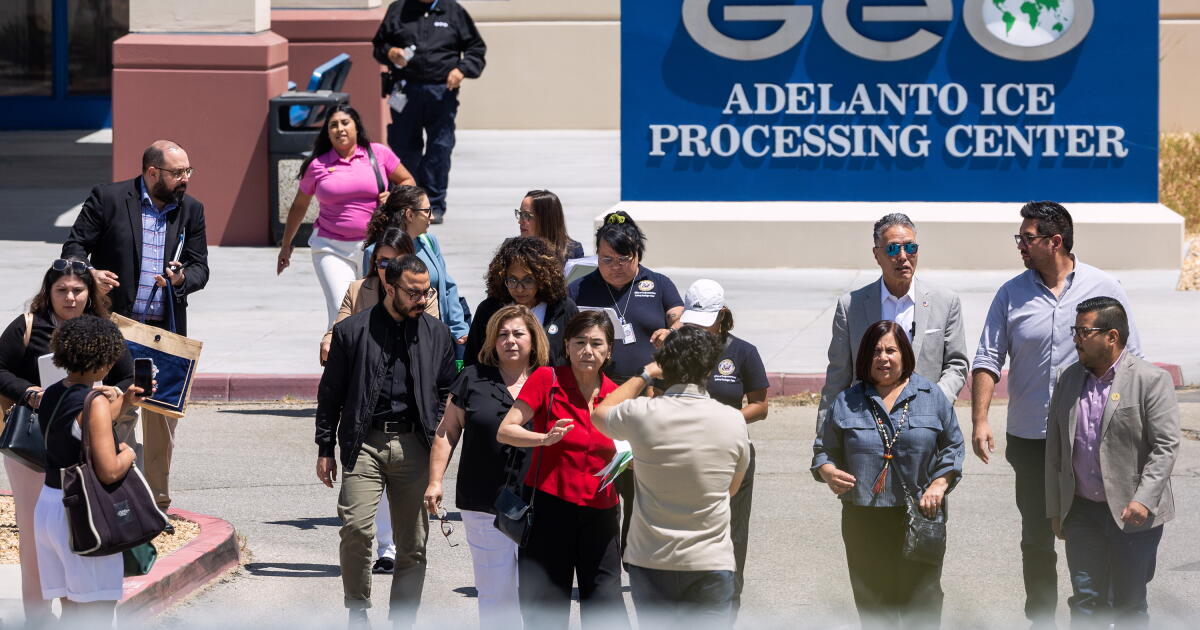
In January, Coalition for Humane Immigrant Rights, or CHIRLA, filed a federal lawsuit against federal officials over the condition of the Adelanto ICE Processing Center in San Bernardino County, a facility operated by GEO Group. In the complaint, CHIRLA alleged “detained individuals face dangerous conditions and pervasive abuses — disease and illness are rampant, mold grows on the walls, and detained individuals are denied sufficient food, clean drinking water, proper medical care, and disability accommodations.”

Donald Trump’s reelection has been a major driver of profits for GEO Group. GEO Group founder, chairman and chief executive George Zoley said in a May earnings call the company was “awarded new or expanded contracts that represent up to approximately $520 million in new incremental annual revenues, which represents the largest amount of new business we have won in the single year in our company’s history.” Former GEO Group exec David Venturella is the acting director of ICE.

“It’s really good to know [of the Guggenheim divestment],” said Rabbi Susan Goldberg, a longtime immigrants rights activist and founder of Nefesh, a Jewish spiritual community in Echo Park. “We showed up so often at its [regional] headquarters in Culver City that they moved. We don’t know where they are located in the area now.”

The California Community Foundation received $1 million, which worked with Los Angeles city officials to distribute $1,000 in direct relief to 1,000 households impacted by the immigration raids. The money was distributed through cash cards, according to the foundation. The Dodgers’ gift amounts to a quarter of the $4 million the foundation has raised for its Los Angeles Neighbors Support Fund, $3.3 million of which has been “deployed to impacted communities with new investments continuing to roll out,” according to the nonprofit.

The Dodgers also donated $100,000 to Labor Community Services, a partner of the Los Angeles County Federation of Labor, that provided more than 4,000 families with food assistance with the team’s donation.

“The Dodgers’ generous donation has enabled us to reach and assist more families throughout Los Angeles County with dignity and compassion, providing critical food assistance at a time when it is needed most,” Labor Community Services Executive Director Norma López said in a statement to The Times.

A spokesperson for Labor Community Services said no other pro sports team outside the Dodgers made a similar donation to help impacted immigrant families.

“The Dodgers have a unique responsibility and they are an example of something we want to continue to see, especially as the World Cup and the Olympics come to L.A.,” said Carlos Martin Rodriguez, director of organizing for L.A. Voice, a multifaith coalition that organized several vigils and demonstrations when the raids were at their height. “I hope this wasn’t a singular moment, but the beginning of a movement.”

Source link

Former private prison executive will become ICE’s acting leader

David Venturella, a former executive at a private prison operator, will serve as the acting head of U.S. Immigration and Customs Enforcement, the Trump administration says, after the agency’s current leader steps down at the end of the month.

A spokesperson for the Department of Homeland Security said late Tuesday that Venturella would succeed Todd Lyons, who led the agency through much of the administration’s tumultuous crackdown on immigration. ICE did not immediately respond to an email seeking additional information Wednesday.

Venturella left the Geo Group in early 2023 and has been working at ICE leading the division that oversees detention contracts, members of Congress wrote in a public letter earlier this year.

At the Geo Group, which houses around one-third of ICE detainees, Venturella served in a number of posts, including executive vice president overseeing corporate development, according to a Securities and Exchange Commission filing. He also oversaw removal operations for ICE in 2011 and 2012 after working for federal contractors, including one that specializes in security clearances and background checks.

Geo has benefited from President Trump’s mass deportation push, garnering big contracts to open three shuttered facilities. Among them was a $1-billion, 15-year deal for a detention center in New Jersey’s largest city.

“Last year was the most successful period for new business wins in our company’s history,” Geo’s CEO George Zoley said during an earnings call last week.

Geo owns and operates 23 ICE detention facilities, with about 26,000 available beds. Zoley also said that ICE’s air transportation subcontract had continued to steadily increase and that it secured a new contract last year for electronic monitoring.

Venturella will lead ICE at a time when the public mood has soured on Trump’s immigration crackdown, which sent surges of federal immigration officers into American cities to round up immigrants. Those raids sent tensions soaring and prompted clashes between protesters and law enforcement, leading to the fatal shootings of two U.S. citizens in Minneapolis earlier this year.

Trump returned to the White House on a promise of mass deportations, and ICE has been a central executor of that vision. Under Lyons’ leadership, the agency used a massive infusion of cash to expand hiring and detention capabilities, and it ramped up arrests to meet demand from the Republican administration.

Federal officials announced Lyons’ departure last month from ICE, which had gotten $75 billion from Congress to fulfill Trump’s mass deportation campaign.

Venturella’s appointment comes as Homeland Security Secretary Markwayne Mullin settles into his role atop the Cabinet agency overseeing ICE. Mullin has promised to keep his department out of the headlines and has indicated a softer tone on immigration, although he is expected to align with the president’s priorities on mass deportations.

One contentious issue confronting Homeland Security now is a plan for converting warehouses into immigrant detention centers. Conceived while Kristi Noem led the department, the effort has encountered multiple lawsuits and intense community blowback, including in Republican-led states.

The $38.3-billion plan would increase detention capacity to 92,000 beds and mean acquiring eight large-scale facilities, capable of housing 7,000 to 10,000 detainees each, and 16 smaller regional processing centers.

Those, and other sites, were supposed to be running by the end of November. But after Noem’s departure, the department paused the purchase of new warehouses as it scrutinizes all contracts signed during her tenure.

Last month a judge extended a pause on transforming a massive Maryland warehouse into a processing facility for immigrants, and there are signs that federal officials are scaling back the plans.

This could be good news for Geo. The Florida-based company has about 6,000 idle beds at six company-owned facilities, Zoley said last week.

Zoley had offered a note of skepticism about the warehouse plan during an earlier earnings call in February, noting that renovating a warehouse is “more complicated than you may think.” At that point, he said the company was “cautiously” looking at whether to bid to help operate some of them.

Hollingsworth writes for the Associated Press.

Source link