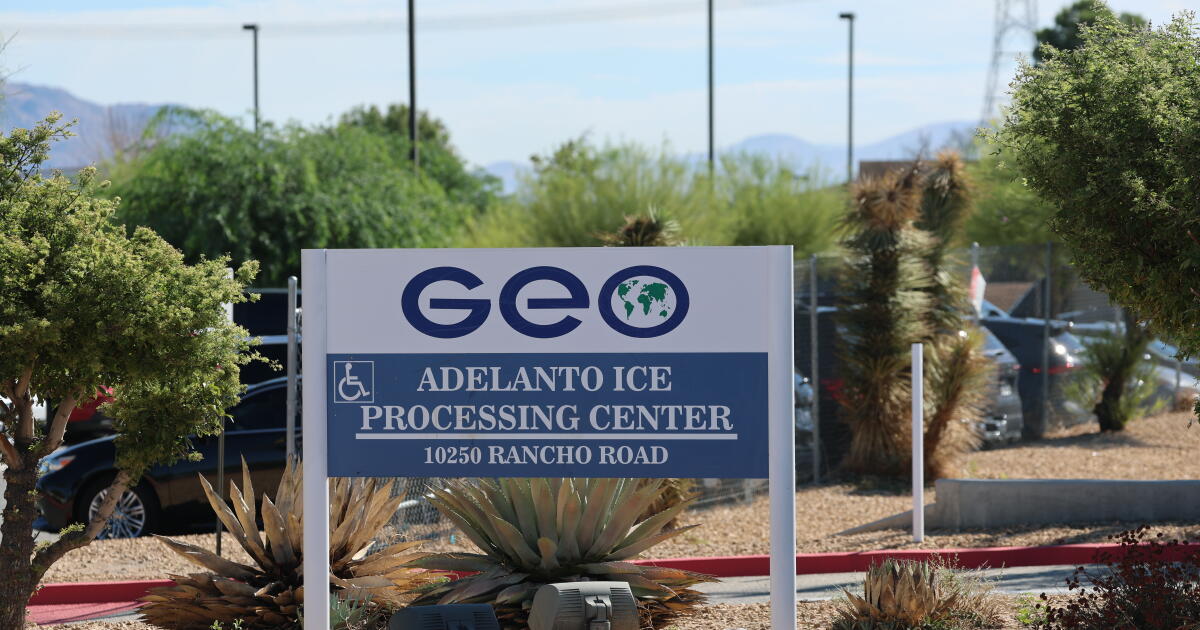
ICE detainees who were sprayed with a cleaning agent reach settlement
WASHINGTON — Six years after he was released from a California immigrant detention facility, Wilfredo Gonzalez Mena has to sleep with his back propped up by pillows, nearly in a seated position, to avoid gasping for air.
He blames his lasting medical issues on the 10 months he spent in custody until September 2020 at the Adelanto ICE Processing Center, about 60 miles northeast of Los Angeles, during which guards sprayed him and fellow detainees nearly around the clock with a concentrated disinfectant meant to guard against COVID-19.
Now Gonzalez Mena, who is one of six named plaintiffs in a class-action lawsuit filed in 2023 over the use of the cleaning solution, is expected to get a six-figure payout as part of a proposed settlement in the case, which was given preliminary approval on Sept. 25 by a federal judge in Riverside. The settlement applies to around 2,700 people detained at the Adelanto facility between March 11 and Sept. 30, 2020, who were exposed to the disinfectant called HDQ Neutral.
“When you least expected it, you would feel the mist,” Gonzalez Mena said. “They would spray us like we were animals.”
The Adelanto facility is operated by the GEO Group, a Florida-based private prison corporation that has faced criticism for years over conditions at its immigrant detention facilities. The company has also pushed back against California laws seeking to increase oversight of its facilities and inform the public about health and safety shortcomings.
Under the settlement, GEO Group and Spartan Chemical Co. Inc., the company that manufactures HDQ Neutral, acknowledged that HDQ Neutral — which is classified as a pesticide — can cause symptoms including blistering, chemical burns, vomiting, permanent eye damage, and damage to the respiratory tract, throat and stomach.
Those findings can now be used by class members who weren’t named plaintiffs and may pursue their own lawsuits, the settlement says.
Neither GEO Group nor the Department of Homeland Security responded to requests for comment. After the lawsuit was filed, GEO Group denied its allegations and said cleaning products are used safely and securely, in accordance with the manufacturer’s guidelines and sanitation standards, at all detention centers.
At the time, a GEO Group spokesperson called the allegations “part of a radical politically motivated campaign to attack ICE contractors, abolish ICE and end federal immigration detention.”
The company later swapped HDQ Neutral for a different cleaning product.
Lawyers from the Los Angeles-based civil rights nonprofit Trial Impact Project who are representing the former detainees called the settlement a victory.
Executive Director Sara Haji referenced other pending lawsuits addressing allegations such as medical neglect, retaliation and substandard food and water. Each one is a different lens into the same problem, she said.
“When a company like GEO settles instead of defending itself at trial, and when it admits that the pesticide it sprayed everywhere can cause serious health problems, it should cause us all to sit up and pay attention to what detained people have been telling us about the everyday cruelty of immigration detention,” Haji said.
The lawsuit alleged that GEO Group engaged in a “months-long poisoning” of detainees when its employees sprayed HDQ Neutral inside the facility. Before the pandemic, staffers had used it as a cleaning product. But as COVID-19 spread, they began spraying the concentrated solution across wide areas, “directly into the air and on all types of surfaces,” the lawsuit said.
Detained immigrants quickly began experiencing the effects, the lawsuit claimed, including nosebleeds, headaches and dizziness.
Spartan Chemical warns that inappropriate exposure can cause the types of effects detainees experienced. Long-term exposure has been linked to asthma and, in laboratory studies on animals, reproductive issues and birth defects.
In 2021, the Environmental Protection Agency found that GEO Group had violated federal law by misusing HDQ Neutral. The report found that staff and detainees were instructed to apply the pesticide inside the facility as often as every 30 minutes, without proper ventilation and at a dilution rate of 2 ounces per gallon of water, which is double the amount allowed for disinfectant use.
In September 2021, a federal judge ordered GEO Group to discontinue use of HDQ Neutral at the Adelanto facility, writing that it had been used “with a callous disregard for the safety of Adelanto’s detainees.”
Among the more than 100,000 pages of documents released during discovery for the lawsuit was an email from a nurse at the facility to Wendy Baca, who was acting health services administrator at the Adelanto facility for Wellpath, the company providing its medical care at the time.
The nurse wrote that patients were arriving with headaches, rashes and blisters, “we believe, due to the chemicals being used to spray.”
“Some of the officers have also reported ‘feeling burned’ after touching their skin with the same gloves that were used to handle the chemical. Please look into this so we do not endanger everyone we are trying to protect,” the nurse wrote.
Baca appeared dismissive of the nurse’s concern. She forwarded the email to GEO Group’s chief of security, asking him to look into it.
“Please also remind them not to put metal into light sockets, run with scissors, or anything usually avoided with a little common sense,” she wrote.
Mark Anthony Ferretiz, a former GEO Group cook supervisor who worked at the Adelanto facility for 14 years until March 2025, wrote in a declaration that his team was told to spray the red chemical “like Lysol.”
“I could taste the spray in my mouth when I used it, and it felt heavy in my lungs,” he wrote.
At some point, the facility’s safety manager brought men from HD Supply to talk to the staff about HDQ Neutral. After learning how often the chemical was being sprayed, one of the men told Ferretiz that it was “rat poison” and that “you’re going to kill someone like that,” he said.
Years later, former detainees such as Gonzalez Mena say they’re still living with the fallout. The former long-haul truck driver said his health deteriorated so significantly while he was detained that, afterward, he could no longer pass the required physical assessment because of his vision and breathing issues.
To make ends meet, he has turned to online resale.
“My wife says that after I was released, I didn’t go back to being the same person,” he said. “I’ve had depression and I often dream that I am there, in that place, and I want to get out.”