Gazas

Joy and desire for change as Gaza’s Deir el-Balah holds elections | Elections News

Deir el-Balah, Gaza – Early this morning, Salama Badwan, his wife and daughter headed to a polling station in Deir el-Balah, central Gaza, to participate in the municipal elections, which are taking place for the first time since 2006.

The 43-year-old said he was delighted to be casting a vote after such a long absence, and overjoyed that his daughter, who recently turned 18, could vote for the first time in her life.

Recommended Stories

list of 3 itemsend of list

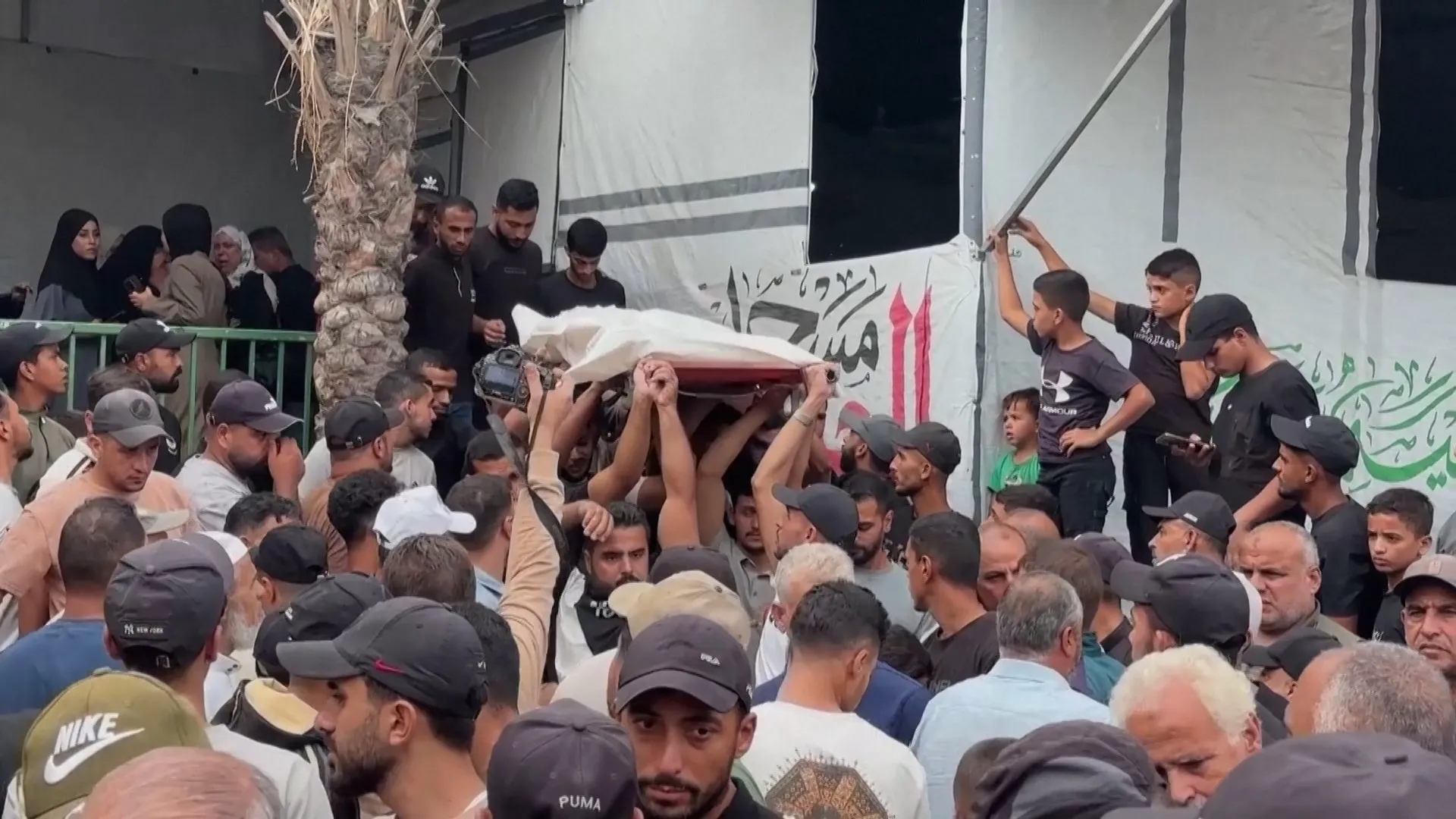
The vote is also the first since a “ceasefire” took effect in Israel’s genocidal war against Palestinians in the Gaza Strip. The war has affected all aspects of life, including the electoral process itself. With many of Deir el-Balah’s buildings damaged or destroyed during the war, polling stations have been set up in temporary fibreglass tents on open land.

“I am very happy today, because this is a truly Palestinian democratic celebration. Many generations have been deprived of it for more than 21 years, and today my daughter is voting for the first time,” Badwan told Al Jazeera.

For him, the importance of the elections is providing Palestinians in Gaza with a chance to achieve change through peaceful and democratic means.

“We must change everything through the ballot box … whoever wins, it is their right, but not through inheritance … change must be in the hands of the people.”

Dunia Salama, 18, came to vote in her first-ever election experience in Deir Al-Balah [Abdelhakim Abu Riash/ Al Jazeera]
Dunia Salama, 18, came to vote in her first-ever election experience in Deir el-Balah [Abdelhakim Abu Riash/ Al Jazeera]

But despite this enthusiasm, the reality in Deir el-Balah, in central Gaza, remains complex amid the ongoing “ceasefire”.

The city, which Badwan describes as “always calm,” has become a refuge for hundreds of thousands of displaced people from across Gaza, putting unprecedented pressure on its infrastructure.

“The city received large numbers of displaced people, each coming with different ideas, circumstances, and harsh suffering … This created enormous pressure on water networks, sewage systems, and waste management, and exhausted the previous municipality.”

Deir el-Balah was given the opportunity to hold elections because its infrastructure was less damaged than that of other cities in Gaza during the war.

Badwan places his hopes on a new municipal council capable of handling the scale of the crisis left by the war, away from the political divisions that have swept the Gaza Strip between Hamas and Fatah, the two main rival factions.

“We want a very strong municipal team that does not belong to any faction … one that can secure support from donor countries and meet people’s needs, because today Deir el-Balah is hosting all.”

On the street, he describes the atmosphere of the elections as “positive and enjoyable”, despite general frustration with the political class.

“People are fed up with politicians and unfulfilled promises,” he says, adding that he encouraged those around him to participate in the elections in the hope of creating change.

“I told my friends and children we must go and vote … we cannot just sit at home and wait for change.”

Awda Abu Baraka, 73, votes at a polling station center in Deir al-Balah [Abdelhakim Abu Riash/ Al Jazeera]
Awda Abu Baraka, 73, votes at a polling station centre in Deir el-Balah [Abdelhakim Abu Riash/ Al Jazeera]

‘I finally have a voice’

Standing beside her father, Dunia, Salama’s 18-year-old daughter, did not hide her joy at casting a vote, despite the exceptional circumstances surrounding her.

“I’m very happy that I can vote in my country and my city, Deir el-Balah … and that I, like others in my generation, can finally participate and have a voice,” said Dunia, a first-year nursing student at Al-Aqsa University.

“Honestly, I had never voted before and didn’t have a clear idea … but when the elections came, my father explained how things work and how our voices could help change the difficult reality we live in, even a little,” she said.

Around 70,000 voters are eligible to participate in the elections held in Deir al-Balah [Abdelhakim Abu Riash/ Al Jazeera]
Approximately 70,000 voters are eligible to participate in the elections held in Deir el-Balah [Abdelhakim Abu Riash/ Al Jazeera]

Like many of her peers, Dunia’s motivations are practical and directly tied to daily life, which has sharply deteriorated since Israel launched the war in October 2023. She chose a candidate list composed mostly of young people, describing them as “capable and experienced in their work,” reflecting her hope for a more efficient municipal administration.

“The reality the city is living after displacement is far from stable… the situation is tragic, especially cleanliness, public streets, healthcare, and even education … everything is in very bad condition.”

“I hope these elections help create a situation where students return to schools, and new housing alternatives and camps are provided for displaced people instead of using schools,” she said.

“We want things to go back to how they were … schools should return to students instead of being shelters, hospitals should improve, and streets should be cleaned,” she says.

A long-delayed moment

For Awda Abdel Karim Abu Baraka, 73, the elections represent an opportunity to choose those capable of “reviving society and institutions that have been stalled for years”.

He believes that the local elections could carry broader significance beyond Deir el-Balah. “They are part of a larger system … the West Bank and Gaza,” he explains.

“Holding elections today in Deir el-Balah shows the world that we are a democratic people, and we choose our representatives without imposition,” he adds, expressing hope that “the international community will support this path.”

He also stressed the need for the winners of the vote to respect the city’s residents who have suffered for years amid Israel’s war. “There must be real programmes, not high slogans that later fall … the citizens must be respected, and their dignity and humanity – violated by war – must be restored.”

Despite recognising the scale of challenges, he remains committed to gradual change. “We know the challenges are big and that change takes time … a long journey begins with a single step, and hopefully, this is the first step on the way.”

‘Born out of nothing’

Meanwhile, Mohammad Abu Nada, coordinator of the Deir el-Balah electoral district, moved between voters and staff inside tents set up in place of school polling stations, describing an electoral process that was “born out of nothing”.

He recalls greeting the initial announcement of the elections by the Central Elections Commission in the West Bank with a mix of surprise and a sense of responsibility.

“At first, the news was unexpected … there was joy that we were returning to work after two and a half years of suffering under war, but at the same time, there was a strong sense of responsibility.”

That feeling quickly collided with the complex logistical reality in a city suffering from widespread destruction and severe shortages of resources.

“Capabilities are extremely limited … even this place was just empty land. We relied on tents from international organisations to use as polling stations,” he says, noting that most schools have been turned into shelters for displaced people.

Mohammad Abu Nada, coordinator of the Deir al-Balah electoral district [Abdelhakim Abu Riash/ Al Jazeera]
Mohammad Abu Nada, coordinator of the Deir el-Balah electoral district [Abdelhakim Abu Riash/ Al Jazeera]

Despite these challenges, polling centres were set up across the city, in a task he describes as far from easy.

The difficulties did not stop there. Essential electoral materials, usually transported from Ramallah, were prevented from entering Gaza.

Abu Nada explains the challenges in securing logistical items such as ballot boxes, stamps, papers, and campaign materials.

“We had to rely on our local capabilities … ballot boxes were designed and manufactured here in Deir el-Balah, and they served the purpose fully.”

Even electoral ink was unavailable after being denied entry by Israeli authorities. “We used ink previously used by the World Health Organization during vaccination campaigns … we tested it, and it stays on the finger for days and worked well,” he explains.

Amid shortages and soaring prices – “multiplied 10 times” – work continued intensively.

“We worked day and night … everything was difficult, from papers to stamps, but in the end we managed,” he says, noting that approximately 70,000 voters are eligible in the city.

While turnout appeared to be limited in the early morning, it picked up later in the day, Abu Nada said, attributing the slow start to people’s focus on meeting basic needs.

“People are standing in lines for water and bread … but we expect turnout to increase.”

The choice of Deir el-Balah for holding elections was not random, but due to its relatively better conditions compared to other areas.

“It is impossible to hold elections in completely destroyed areas like northern Gaza or Khan Younis … so the decision was to start in an area with minimal capacity, hoping to expand later.”

Still, the challenges facing the upcoming municipal council remain significant.

“Deir el-Balah today is not what it was before the war … population pressure is huge, and expectations from the new municipality are high,” he says.

As for the campaign, Abu Nada explains it was conducted in record time and with intense efforts.

“We worked like a beehive … organised more than 20 awareness workshops, worked with local institutions and influencers, and distributed posters and materials explaining how to vote and encouraging participation.”

At the end of his remarks, he expresses a sense of achievement despite the difficulties.

“Today, in front of everyone, we are exercising our electoral right despite all conditions … and that in itself is a success,” he says.

“And hopefully, this is the first step on a longer road.”

Source link

Living in the dark: Gaza’s struggle for electricity | Israel-Palestine conflict News

Deir el-Balah, Gaza Strip – Every morning, Abdel Karim Salman begins his routine by heading out carrying his own phone and his wife’s phone, both completely drained of charge. He walks to a nearby charging point to plug them in and recharge them again.

Throughout the night, Abdel Karim relies entirely on the torches from the phones to light the inside of the tent he lives in with his family in central Gaza’s Deir el-Balah.

Recommended Stories

list of 3 itemsend of list

Abdel Karim, 28, a former civil engineer at the Beit Lahiya municipality in northern Gaza, was displaced to Deir el-Balah a year and a half ago with his wife and two children, along with about  30 members of his extended family.

His family home was completely destroyed on October 9, 2023, in the first few days of Israel’s genocidal war on Gaza.

Abdel Karim and his family have been on a difficult journey of displacement since then, with little in the way of normality, and in particular, a regular source of electricity for a bulb in his tent.

So he looks for alternatives to light up the structure, namely the phones, despite the rapid battery drain caused by keeping the torch function on.

“I charge my phone and my wife’s phone, and we use them for lighting at night, especially since my children are under five years old and they get scared if they wake up in the dark,” he says.

Abdel Karim says that the suffering caused by electricity shortages in Gaza is one of the largest “silent” forms of suffering that receives little attention.

For Abdel Karim, the charging process itself has turned into a daily, exhausting burden.

He walks between 150 and 200 metres every day to reach a charging point, paying between two and four shekels ($0.65 to $1.30) per charging session, twice a day.

“That means about eight to 10 shekels ($2.55 to $3.20) per day just for charging phones,” Abdel Karim explains, equivalent to approximately 270 to 300 shekels ($86 to $95) per month, a large amount given the lack of income among displaced families in Gaza amid the territory’s war-driven economic crisis.

“Many days and nights we sleep in darkness inside our tent. When we can’t charge the phones, they turn off, and we are unable to recharge them.”

Abdel Karim Salman heads daily to the charging station to charge his phone and his wife’s phone, which they use as a source of light in their tent throughout the night [Abdelhakim Abu Riash/ Al Jazeera]
Abdel Karim Salman heads daily to the charging station to charge his phone and his wife’s phone, which they use as a source of light in their tent throughout the night [Abdelhakim Abu Riash/Al Jazeera]

Few options

With municipality-supplied electricity absent for two years in Gaza, several temporary alternatives have emerged, such as solar-powered lamps, but they remain unaffordable for most residents, having increased tenfold to about 300 shekels ($95) during the war.

As for solar energy systems, they are even more expensive, reaching $420 per panel, and with the additional cost of a battery – about $1,200 – and an inverter. All these items are also scarce due to severe Israeli restrictions on their entry into the Gaza Strip since the beginning of the war.

For Abdel Karim, who lost his job soon after the war began, those sums are out of his reach.

Among the alternative solutions introduced during the war are private generator-based electricity systems operating on diesel fuel.

However, those are also unaffordable for many, and their services have fluctuated due to irregular fuel supplies through the crossings.

And so, with most options simply too expensive, that leaves many in Gaza in the same boat as Abdel Karim.

The impact of the power cuts is not limited to lighting or charging, but extends to every detail of daily life, especially for families with children.

“There is no refrigerator, no washing machine … even baby milk cannot be stored for more than two or three hours,” Abdel Karim explains, as he remembers his previous life, when his home was filled with electrical appliances and reliable power.

“The phone charging socket used to be right beside my bed. I could plug it in whenever I wanted. Today, that has become a dream inside this tent,” Abdel Karim adds.

He also says his children have been psychologically affected, especially his eldest son, due to the lack of any means of electronic entertainment or distraction from his grim surroundings.

“There is no TV or screen. He keeps asking for the phone all the time just to calm down, but that also needs charging. Everything is dependent on electricity.”

According to Abdel Karim, his suffering is not an exception. He believes almost all of the people in Gaza are living the same reality, noting that even families in nearby camps who tried to pool resources to buy energy systems have been unable to afford them.

“We hope God brings relief … because we are truly left without any solutions, as if we were abandoned in the desert.”

Abdel Karim Salman, his wife and his two children
Abdel Karim Salman lives with his wife and two children in a tent [Abdelhakim Abu Riash/Al Jazeera]

Longstanding problem

On October 7, 2023, Hamas launched an attack on southern Israel, and Israel then began its war on Gaza.

More than two years on, Gaza has been decimated by Israeli attacks – on top of the more than 75,000 Palestinians killed.

But even before the war, Gaza faced daily rolling blackouts due to limited power imports from Israel and fuel shortages.

Israel, despite withdrawing its illegal settlements from Gaza in 2005, continued to control access into and out of the Palestinian enclave, and repeatedly attacked it.

And so, even in normal conditions, most households only received a few hours of electricity per day, relying on a fragile mix of imported supply and Gaza’s one power plant.

The situation escalated sharply after October 7, when Israel declared a “complete siege” on Gaza, cutting electricity supply and blocking fuel imports.

Within days, Gaza’s power plant shut down due to fuel depletion, and by October 11, 2023, the territory entered a full electricity blackout, according to United Nations agencies.

With no fuel entering and transmission lines cut, homes, hospitals, water systems and communication networks lost reliable access to power, shifting to limited and increasingly unsustainable generator use.

Since then, Gaza’s electricity infrastructure has continued to deteriorate due to both fuel shortages and widespread physical destruction of the grid. Generators remain the primary alternative but are severely constrained by fuel scarcity, affecting essential services such as healthcare, water production and telecommunications.

During the time between 2025 and 2026, Gaza’s power system is widely described as effectively non-functional, with electricity access fragmented, inconsistent and largely dependent on emergency solutions rather than a stable grid.

An opportunity

The severe electricity crisis has created an indirect source of income for Jamal Musbah, 50, who runs a mobile phone charging station powered by solar energy and a generator line.

Before the war, Jamal worked as a farmer and owned two agricultural plots on the eastern borders of Deir el-Balah. Today, they have been bulldozed and fall under Israeli control.

His charging station has instead become his main source of income, supporting his eight children.

“I had an energy system consisting of six panels, batteries, and a device, which I used for pumping water and irrigating the remaining land around my house before the war,” Jamal says to Al Jazeera.

As an alternative income source after the war and the electricity blackout in Gaza, Jamal repurposed his solar system to provide basic phone charging services to residents, though this came with major challenges.

“The demand for charging was extremely high, and my batteries were exhausted within the first months, as electricity became very scarce at home,” he adds.

However, things worsened when a neighbouring house was targeted, destroying four of his six solar panels, significantly reducing his capacity and income.

At the beginning of the service, Jamal also offered food refrigeration services alongside phone and battery charging, but after the damage and battery depletion, he had to stop those services.

“We used to charge about 100 to 200 phones daily. Now we only manage 50 to 60 at most due to reduced efficiency of the solar panels,” Jamal says, attributing this also to weather conditions, clouds and the winter season, when solar efficiency drops significantly.

“In winter, you look for alternatives to solar panels and turn to generators that barely work … the electricity crisis makes you feel like you are running in a never-ending cycle of suffering.”

His charging station now operates with a small system of two panels and one battery.

People from nearby areas, including university students and displaced families, rely on it due to a lack of alternatives and the inability to afford generator-based electricity subscriptions.

“My sons are university graduates and earn their living from this station. We charge 1 to 2 shekels per phone.”

Even though Jamal is able to make some money out of the crisis, he ultimately faces the same hardships as others in Gaza do.

“Economic hardship has affected all of us … even basic services like phone charging have become a heavy burden. There are no local solutions to this crisis.”

“The only real and lasting solution is the official restoration of electricity to the Gaza Strip.”

Source link

‘Substantial evidence’ of double-tap strike in killing of Gaza’s Hind Rajab | Israel-Palestine conflict News

In the final hours of her life on January 29, 2024, Hind Rajab’s feeble voice could be heard desperately pleading with her mother and emergency workers for help, as she was trapped in a car surrounded by the bodies of six of her relatives.

After finally getting clearance from the Israeli military in Gaza City, a Red Crescent ambulance raced to save the five-year-old girl. But two paramedics were killed when their marked vehicle – whose sirens were blaring – came under Israeli tank fire. The remains of the nine victims were recovered 12 days later.

Recommended Stories

list of 4 itemsend of list

Two years after the tragedy, a report claims this was a “double tap” attack by the Israeli army. A double-tap strike essentially means carrying out two strikes on the same target, often wounding or killing medics and civilians who are coming to the aid of people harmed in the first attack.

Analysis by the legal campaign group Avaaz has found evidence that the killings contravened international combat law under the Geneva Conventions and the Rome Statute.

“By reconstructing the coordination and timing around the approved ambulance mission, it shows that there is substantial evidence of a deliberate ‘double-tap’ tactic – an initial military strike followed with a deliberately timed second strike targeting emergency responders and medical personnel who arrive to help,” Avaaz says in its report exclusively shared with Al Jazeera. “The brief brings together the timeline of events up to and beyond Hind’s death, showing what Israeli forces must have been aware of at each stage, and the frequent opportunities they had to pull back from murder.

“It documents over 40 human rights violations and ties together how those violations are evidence of a double-tap attack on the hospital workers. Each violation builds to an alarming possibility: Israel is not only killing Palestinians – it is systematically killing those who try to save them. The message is clear: If the medical community tries to help, it will be extinguished.”

More than 1,500 healthcare workers have been killed during Israel’s genocidal war on Gaza, including several since a so-called “ceasefire” came into effect in October.

Avaaz, building on previous investigations by Al Jazeera in partnership with the Hind Rajab Foundation and other media organisations, claims there is clear evidence that this double strike constituted a war crime. The campaign group is now urging the International Criminal Court (ICC) to bring those responsible to justice.

At the time of publishing, the Israeli military had not responded to Al Jazeera’s request for comment.

‘I am absolutely convinced that this is another case of double tap’

Al Jazeera, in partnership with the Hind Rajab Foundation, last year revealed evidence of deliberate killings.

The Israeli government initially claimed that none of its forces was present at the time, later asserting that the 335 bullet holes found in the family’s car were the result of an exchange of fire between Israeli soldiers and Palestinian fighters.

However, a subsequent investigation of satellite imagery and audio from that day by the multidisciplinary research group Forensic Architecture, based at Goldsmiths, the University of London, identified only the presence of several Israeli Merkava tanks in the vicinity of the family’s car and no evidence of any exchange of fire.

The Avaaz report highlights that the ambulance obtained permission from COGAT, an arm of the Israeli military, to go to Hind’s aid, so Israeli forces knew exactly when the first responders would arrive and the route they would take. About three hours passed between the initial shooting of the family vehicle and the attack on the ambulance, indicating the Israeli army had ample opportunity for “situational awareness, communication, and command decision-making”, the report adds.

Avaaz says the ambulance was attacked by a tank in a way that could not have been a warning shot if the military had any reason to believe it was not there to rescue Hind. Instead, the assault “points to lethal targeting”.

The Israeli army gave no warning before attacking the ambulance, previous investigations have found.

“I have taken the investigations done by a number of independent journalistic outfits. I was really struck by the evidence at the end of the whole horrendous incident,” said Sarah Andrew, legal director of Avaaz, who added that as a mother, Hind’s death made her think of her own daughter. “In particular, the kind of weaponry that was used on the ambulance, the timing and the fact that no warning was given – it immediately triggered a question in my mind, and I am absolutely convinced that this is another case of double tap.”

She told Al Jazeera: “It is something that has not had attention, and we would like to take this with [an independent legal] partner to the ICC.”

“What I have done is establish a legal framework for the previous investigation. I think it is very important that we also look at what happened to the ambulance workers as well as what happened to Hind and her family.”

The report says, “Even where an attacking force claims it suspects misuse of a medical vehicle, international humanitarian law requires warnings and an opportunity to comply before an attack can be lawful.”

Andrew said the Israeli military has yet to explain why a tank fired on an ambulance.

“We have not heard from the people responsible. I want them to appear before the ICC and hear what on earth was in their mind when they ordered 120mm tank rounds to be fired into an ambulance,” she said. “Justice is first of all bringing the light of attention into this crime and secondly seeing the persons responsible being accountable for their actions.”

Professor James Sweeney, from the University of Lancaster, who is an expert on human rights and conflict, said in double-tap attacks, the second strike is usually within five to 10 minutes.

It can also mean letting off a small explosion to induce rescuers to respond, then exploding another bomb once they are near.

“The [Avaaz] brief says that the attack on the ambulance should be considered a double tap, but usually the second attack would be within five to 20 minutes and would be considered a trick,” he told Al Jazeera. “It would seem that [in this case] the passage of time was greater, but that does not take anything away from the fact that the attack on the ambulance was so unlawful. You could see it as a form of double-tap, but it is not my normal understanding of it. But in any case, it does not take away from the fact that these were war crimes.”

The Hind Rajab Foundation said in a statement, “The double tap arguments are consistent with our analysis as well. We are continuously preparing for new filings against responsible soldiers in various jurisdictions.

“We have 24 names of responsible perpetrators. We are open to work together with Avaaz on a filing specifically regarding the attack on the ambulance.”

Source link

Amid ruins, Palestinians struggle to preserve Gaza’s historic markets | Israel-Palestine conflict News

Khan Younis, Gaza Strip – Historic landmarks often withstand centuries of volatile change, but when rockets and missiles fall, even the most enduring stones become fragile.

For generations of families in Gaza’s southern city of Khan Younis, the Grain Market was the first stop when they went shopping.

Recommended Stories

list of 3 itemsend of list

Reaching it meant walking past the historic Barquq Castle, a centuries-old structure dating back to 1387 and the very foundation of Khan Younis.

But for residents, the castle was more than an old monument; it was a familiar landmark marking the entrance to one of the city’s liveliest commercial spaces.

The aromatic scent of spices and dried herbs would accompany any walk towards the Grain Market.

But that was before Israel’s genocidal war on Gaza began. Israeli attacks inflicted heavy damage on the Grain Market and the Barquq Castle. The market has now been reduced to shattered alleys, with dust and heavy silence filling the air.

Sitting in his store along a row of damaged old shops, 60-year-old Nahed Barbakh, one of the city’s oldest and most well-known traders of staple food supplies, spent decades watching customers stream through the market. Now, only a handful pass by his shop.

“I’ve been in this spot for decades, day in and day out, watching people bring life to this place,” Nahed said. “Look at it now – it’s empty. These days, there shouldn’t even be space to walk because of the crowds preparing for Eid.”

He paused before gesturing towards the nearby castle.

“We always felt the weight of history here because we are so close to Barquq Castle. Now that history and life itself have been struck by the occupation.”

But Israeli fire did not take into account the market’s historic status. The Grain Market, long considered the economic heart of Khan Younis, was also among the first sites of destruction during the second month of Israel’s genocidal war on Gaza. More than two years of Israeli bombardment and repeated waves of displacement have left the market unrecognisable.

“The occupation killed many of our friends who worked here,” Nahed said quietly. “Those who survived have been financially broken. That’s why you see most of these shops are still closed.”

He pointed to some shelves behind him.

“My shop used to be fully stocked with goods at its high capacity. We even had extra warehouses to supply what people needed, especially during the busiest seasons.”

Before he could finish his sentence, a deafening blast interrupted him — the sound of an Israeli tank fire.

“And this is the biggest reason people are afraid to return,” Nahed said abruptly. “The yellow line is only a few hundred metres away from this street. At any moment, bullets can reach here.”

The yellow line is the name given to the demarcation line behind which Israeli forces withdrew as part of the first phase of October’s ceasefire agreement. It effectively divides Gaza into two, and Palestinians have repeatedly been shot for approaching it.

The yellow line has divided Khan Younis, dramatically reshaping the city’s geography. Israel has repeatedly shifted the line, moving it deeper into Gaza.

The Grain Market, once firmly at the centre of urban life, now sits close to the yellow line.

What used to be the city’s commercial heart has effectively turned into its edge, where people hesitate to walk, leaving the revival of daily commerce life a distant prospect.

Nahed Barbakh, 60, shop owner and trader, sits at a table in front of his store
Nahed Barbakh, a 60-year-old shop owner and trader, sits at a table in front of his store [Ahmed al-Najjar/Al Jazeera]

Centuries of endurance

The Grain Market traces its origins to the late 14th century, when the Mamluk ruler Younis al-Nawruzi established Khan Younis in 1387 as a strategic stop along the trade route linking Egypt and the Levant.

Built as an extension of the Barquq Castle, which functioned as a caravanserai for travelling merchants, the market became a central commercial hub where traders and travellers exchanged goods, moving between Africa, the Levant and beyond.

The Grain Market occupies roughly 2,400sq metres (25,830sq feet). Its single-floor shops line a central street running east to west, intersected by narrow alleys branching towards smaller courtyards. The buildings preserve elements of their original construction, including sandstone walls and traditional binding materials that have survived centuries of repairs and modifications.

Over time, the market evolved into the primary commercial centre of Khan Younis, adapting to modern commerce while retaining its historic character.

But today, many of its shops stand damaged or shuttered.

According to Gaza’s Ministry of Tourism and Antiquities, the market is now among more than 200 heritage sites damaged in attacks by Israeli forces across the Gaza Strip since October 2023.

At the southern end of the Grain Market, where rows of vegetable stalls once overflowed with fresh produce, only one makeshift stand has opened.

Om Saed al-Farra, a local, stepped cautiously towards the stall, inspecting the small piles of vegetables laid out on a wooden crate. The expression on her face reflected more than surprise; it was disbelief at what the market had become.

“The market is deplorable now,” she said. “There used to be many stalls here and many choices for people.”

She gestured towards the empty stretch of the market’s vegetable section, once one of its busiest corners.

“These days were once filled with extensive joyful preparations for Eid, when families crowded the market to shop for food and essentials,” al-Farra said. “Now the market feels unusually gloomy, its stalls largely empty and its familiar vibrance gone. Everything is limited. Even if you have money, there are hardly any places left here for us to buy from.”

Rows of damaged and closed shops in the market
Rows of damaged and closed shops in Khan Younis’s Grain Market [Ahmed al-Najjar/Al Jazeera]

Economic collapse under fire

Although parts of the market’s infrastructure remain physically standing, many traders have not returned.

According to Khan Younis Mayor Alaa el-Din al-Batta, the Grain Market was once one of the city’s most vital economic lifelines.

“Just as it once connected continents, even under blockade, it continued to connect people across Gaza,” al-Batta said. “It holds a deep place in the memory of our residents. But once again, the occupation has brought destruction, targeting both our history and a critical lifeline for the people.”

For nearly two decades, Israel has controlled Gaza’s land crossings, airspace and coastline under a strict blockade. Since the genocide began in October 2023, restrictions have tightened further, pushing businesses and trade to collapse.

In a narrow western alley where scattered stones cover the ground, two cloaks hung outside a small shop. Inside, 57-year-old tailor Mohammad Abdul Ghafour leaned over his sewing machine, carefully stitching a torn shirt.

His shop was the only one open in the grey alley.

“I’ve been here since childhood,” Abdul Ghafour said. “My father opened this shop in 1956, and I grew up learning the profession right here in the market.”

Israel’s bombardment not only destroyed the place where he worked; it also killed dozens of his family members.

“On December 7, 2023, Israel committed a horrific massacre against my family,” he said. “I lost my father, my brothers, and more than 30 relatives.”

Burying his family members was only the beginning of the long, painful separation from the market and his shop.

“We were forced into displacement more than 12 times. I had many chances to leave as two of my children live in Europe,” Abdul Ghafour said. “But all I could think about was returning to my shop.”

When Israeli forces withdrew to the yellow line, he came back alone.

“I cleaned the street by myself. And if I had to do it again, I would. Whoever loves his land never abandons it,” he said. “I charge my batteries for my machine and come every day. My return encouraged some residents to come back too. But people still need shelter, water, and basic services before more families return.”

Resident Mohammad Shahwan stood in Nahed’s shop checking a list of items he hoped to buy.

“We left the crowded al-Mawasi as soon as we could to return to our damaged home,” he said, referring to the stretch of coastal Khan Younis that thousands of Palestinians have been forcibly displaced to. “But the number of residents here is still very small because of the destruction and lack of services.”

Still, Mohammad Shahwan said he was relieved to find the shop open at all.

“For the first time in two years, we’ll make traditional Eid biscuits,” he said, holding the list of ingredients. “The last two Eids were dark for my family after we lost my 17-year-old son, Salama. He and his aunt were killed by an Israeli strike.”

He could have bought the now-expensive supplies elsewhere, he said, but returning to the Grain Market carried its own meaning. “I wanted to buy them from here, just like we always did.”

Mohammad Abdul Ghafour, 57, Palestinian tailor.
Mohammad Abdul Ghafour, 57, a Palestinian tailor in Khan Younis [Ahmed al-Najjar/Al Jazeera]

Waiting for restoration

According to Mayor al-Batta, restoring the historic market will require a major reconstruction effort.

“The Grain Market needs a comprehensive restoration process to function again,” he said. “So far, our work has only been limited to clearing rubble and delivering limited water supplies for returning residents.”

The rebuilding process will require specialised materials and expert restoration work to preserve what is left of the historic structure. Municipal workers have already collected leftover stones from the ruins in the hope that they can one day be used in rebuilding parts of the market.

But reconstruction remains impossible under current conditions.

“More than five months have passed since the ceasefire began, yet not a single bag of cement has entered Gaza,” al-Batta said.

“We want to restore our historic identity and revive life for our people. But neither can happen while Israeli restrictions and violations continue.”

Source link