gateway

How Disneyland became SoCal’s unlikely gateway to tiki culture

Tiki, an offshoot of the Midcentury Modern movement, flourished in the ’40s, ’50s and ’60s, but began to experience a decline in the ’70s. Thus, by the ’90s, there were concerns at Disney that the Enchanted Tiki Room — the pivotal 1963 attraction that pioneered audio-animatronics — was no longer in vogue, its singing birds, totems and flowers a relic of another era.

You’re reading Mr. Todd’s Wild Ride newsletter

Todd Martens’ newsletter delivers news and commentary on the past, present and future of theme parks, right from the theme park capital of the world — Southern California.

The company explored some early concepts to remake the Enchanted Tiki Room. One idea was to transform it into an ecological, save-the-rainforest show. Another was to redesign it with a “Lion King” theme.

“Let me tell you, we hated it,” says artist and designer Kevin Kidney of the latter concept.

Kidney, who worked in Disneyland’s art department in the ’90s, says he and his longtime collaborator Jody Daily were “terrified” the Enchanted Tiki Room would disappear, so much so that they began making fliers to advertise the show and putting them up all over L.A., in restaurants, bars and museums. “We started an underground movement to save the Tiki Room even while we were working on these projects. We tried to frame it in a cool, hip way, like, ‘Everyone needs to go and re-experience this amazing show.’”

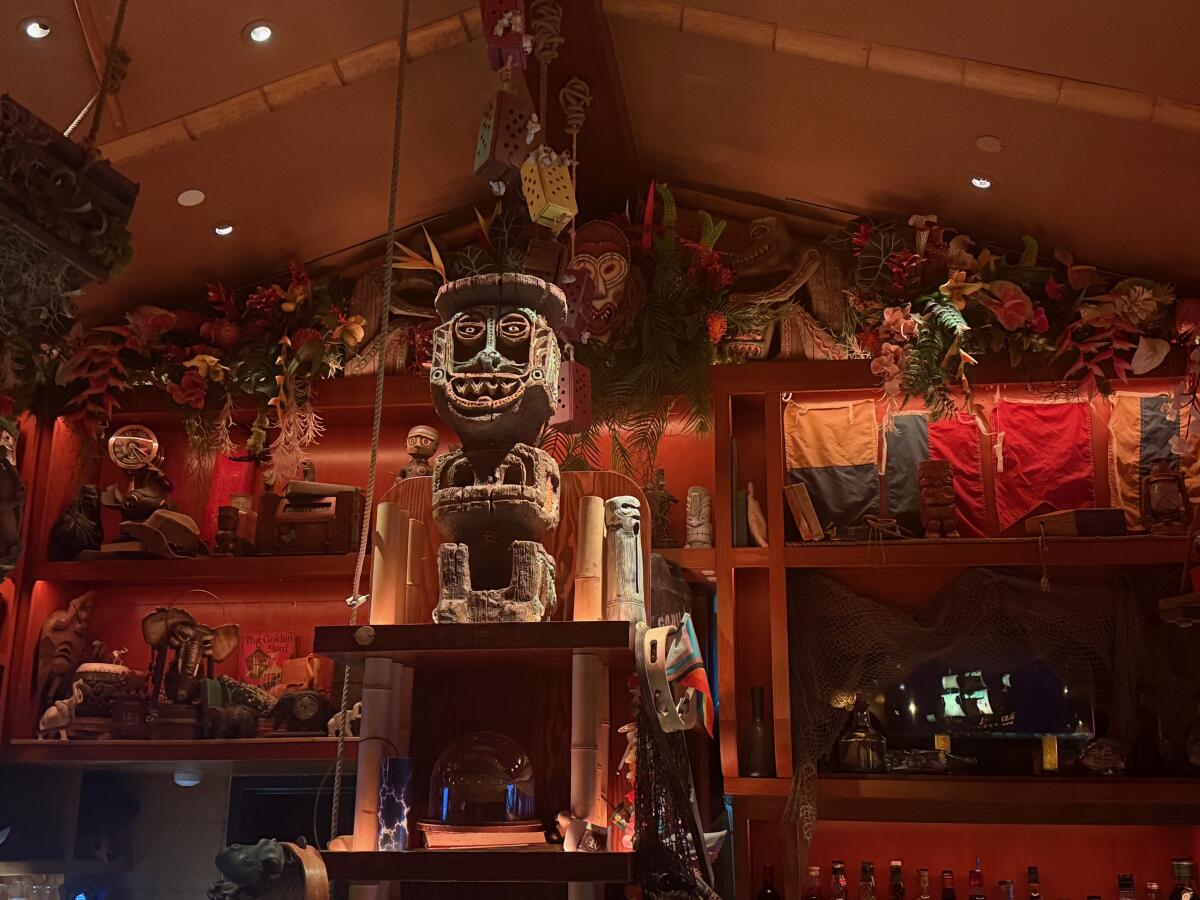
A bar with a tiki god overlooking it.

Trader Sam’s Enchanted Tiki Bar took its influence from Disneyland’s Adventureland attractions, namely the Enchanted Tiki Room and the Jungle Cruise.

(Todd Martens / Los Angeles Times)

Thankfully, cooler heads prevailed, and the Enchanted Tiki Room remains to this day a vital piece of Disneyland history. And now with the modern tiki revival, it’s no longer an archival curiosity. In fact, the connection between Disney and tiki may be as strong as it has ever been, as this spring the Disneyland Hotel’s Trader Sam’s Enchanted Tiki Bar turned 15. Trader Sam’s took its cues heavily from the Adventureland attraction, its bar flanked by tiki totems with slowly wandering eyes. And watching over guests and bartenders is a re-creation of one of the show’s tiki gods.

“The totem pole on the bar, and Koro up in the rafters above the bar, are all original designs and sculpts for the Tiki Room at Disneyland,” Kidney says. “They made new castings for the bar off of the elements from the attraction.”

Kidney and Daily collaborated with Walt Disney Imagineering, the arm of the company devoted to theme park experiences, on some of the early designs for Trader Sam’s. It’s their mug collection, for instance, that was seen in the bar on opening day. And the pair designed a magnificent glowing ship in a bottle, which thanks to a Pepper’s ghost illusion, occasionally looks as if it’s breaking apart and sinking.

Trader Sam’s, says author and historian Sven Kirsten, writer of “The Book of Tiki,” is one of the more influential bars on the modern tiki landscape. Though it didn’t kickstart today’s movement, says Kirsten, it often serves as “a gateway,” introducing Disney’s millions of guests to the scene.

Kirsten says Trader Sam’s has rightfully earned its place among SoCal’s most respected tiki bars. And most popular. An unofficial Instagram page devoted to the bar, keeping tabs on its mug releases and off-menu bartender creations, has more than 39,000 followers.

The erupting volcano "windows" of Trader Sam's Enchanted Tiki Bar.

The erupting volcano “windows” of Trader Sam’s Enchanted Tiki Bar.

(Todd Martens / Los Angeles Times)

“In the early 2010s the craft cocktail revival brought forth these so-called tiki bars that thought if they had a tiki cocktail menu they were a tiki bar,” Kirsten says. “But it was basket lamps and palm leaf wallpaper and that was it. Places like Trader Sam’s and Strong Water and Royal Hawaiian are floor-to-ceiling fully decorated. They’re what a tiki bar should be.”

Before the Disneyland Hotel had Trader Sam’s, the space was home to Hook’s Pointe, which was lightly themed to “Peter Pan.” Yet about a decade after the Walt Disney Co. completed a purchase to assume control of the Disneyland Hotel, Hook’s Pointe was earmaked for renovation.

“We were designing a Caribbean-style bar where Trader Sam’s is now, and that was where I said, ‘Let’s rethink this,’” said Kyle Barnes, an Imagineer who was instrumental in the creation of Trader Sam’s. Barnes was speaking at a recent event hosted by Disney’s fan club D23 on the history of Adventureland and Trader Sam’s.

“I said, ‘That’s more East Coast. This is West Coast.’ Hawaii and Midcentury really fit together with the tiki theme,” Barnes said, noting that the park’s Enchanted Tiki Room was initially pitched as a restaurant and once sat next to the Tahitian Terrace, a Polynesian-themed restaurant complete with hula dancers.

Trader Sam’s is home to many show elements. In addition to the sinking ship, there are bar seats that will begin to drop the longer guests sit in them. Also, there are two theatrical windows looking out toward a volcano, which will erupt when guests order a specific drink. The ship in a bottle and dipping barstools, said Barnes, were inspired by the Adventurers Club at Florida’s Walt Disney World, while the volcano windows were influenced by Florida’s version of the Enchanted Tiki Room.

The Kungaloosh cocktail at Trader Sam's Enchanted Tiki Bar.

The Kungaloosh cocktail at Trader Sam’s Enchanted Tiki Bar.

(Todd Martens / Los Angeles Times)

The Adventurers Club closed in 2008, but I was fortunate enough to visit it as a child, and it was instrumental in my love of Disney, theater and, well, bars. Full of actors, puppets and walls filled with artifacts that seemed to spring to life, the Adventurers Club was a place of play, and I still remember as a kid being asked by one of the actors to join the imaginary guild. It was a glimpse into a grown-up world full of revelry, silliness and colorful cocktails.

Trader Sam’s fills a similar niche for me today, and as part of its 15th anniversary, it added the Adventurers Club signature drink, the sweetly tropical Kungaloosh, to its menu. As a kid, I longed to enter an adult world. As a grown-up, I love an adult world with a childlike playfulness.

Tiki bars aren’t perfect, and have occasionally come under criticism as escapist fantasy that appropriates Hawaiian or Polynesian iconography. As such, Trader Sam’s has changed over the years. Shrunken heads, for instance, that once hung from the walls, were years ago removed.

Progress, and part of Trader Sam’s enduring appeal. “The jokes that we accepted long ago, they were jokes for only a part of the population,” says Kidney.

And Trader Sam’s remains full of absurdities — spend some time just soaking up the puns and ephemera that dot the walls. Just be prepared to duck when you see the bartenders reach for a spray bottle.

So cheers to another 15 years, and I hope to see you at the bar.

This week in SoCal theme parks

Space Mountain at night.

Space Mountain at night.

(Paul Hiffmeyer / Disneyland Resort)

  • A refreshed cartoon world. Magic Mountain will on Saturday unveil its new kid-targeted Looney Tunes Land, which is a makeover of its previous Bugs Bunny-focused area. Expect a brand new live show, and spaces designed to represent the personality of characters such as Bugs, Daffy Duck, the Tasmanian Devil, and Wile E. Coyote and Road Runner. Each of the attractions, such as calming train and balloon rides, has received a tune-up. I’ll take a closer look next week!
  • ‘The Odyssey’ comes to Universal. While theme park fans await the opening date of Universal Studios Hollywood’s new “Fast & Furious” coaster, the park is zooming ahead with its Mega Movie Summer promotion. As part of the latter, a ship from Christopher Nolan’s “The Odyssey” will be added to the park’s tram tour. Elsewhere, Minions from “Minions & Monsters” will start meeting with guests, and various dining locations will receive light makeovers to represent films such as “Jaws” and the “Fast & Furious” franchise.
  • Changes afoot at CityWalk. Universal’s CityWalk is in the midst of a multiyear transformation. New spaces, such as one from Malibu Brewing Co., are on the way, while some legacy retailers are unfortunately disappearing. The latest: Publisher Dark Horse Comics is closing its Things From Another World retail location. The pop-culture shop is slated to close in September. No word yet on what may move into the space.
  • Space Mountain is back! After a brief overlay as the “Star Wars”-themed Hyperspace Mountain, Disneyland’s classic Space Mountain has returned just in time for the busy summer season. The coaster, which tops off at about 32 mph in near total darkness, should be back in all its vintage glory as of today.
  • A renewal perk. The Disneyland Resort in a move to create more loyalty among its Magic Key passholders is offering a bonus for those who opt to stick around for another year. A dining promotion, in which annual passholders can receive a dining gift card for as much as $100 if they choose to re-up, is underway through May of next year.

Tell us your stories. Ask us your questions.

Have a theme park tale to share? Whether it was a good day or less-than-perfect day, I would love to hear about it. Have a question? A tip? A fun photo from the parks to share? Email me at todd.martens@latimes.com. I may feature your note in an upcoming newsletter.

Ride on,

Todd Martens

P.S.

I’m curious if any longtime Disneyland fans have any memories of the Carousel of Progress. I’d love to hear them. The theater show, built around a rotating auditorium, debuted at the 1964 World’s Fair before making its way to Disneyland in 1967. It was moved to Florida’s Walt Disney World in 1975.

In case anyone missed it, the Walt Disney Co. announced last week that Carousel of Progress would be undergoing a top-to-bottom overhaul to update the show. No longer will it begin in the distant past, as the refreshed attraction will now start in the 1960s and take guests into the ’80s, the late ’90s and beyond. An ode to technological optimism, the original show was overseen by Walt Disney, but had undergone multiple changes throughout the decades, most notably in its final scene.

I’ll miss its glimpses of the 1920s and 1940s, but concede the attraction was notable today more for its Disney history than its cultural relevancy. Thus, I’m cautiously hopeful that this makeover can ensure the Carousel of Progress remains a Disney staple for decades to come.


Source link

Gateway to the South Downs: take the train to a picture-perfect village with a cracking pub | Sussex holidays

Wisteria and clematis hang from weathered cottage walls. Tulips and pink apple blossom spill out of several gardens. Thatched animals decorate the rooftops. There’s a Norman church, a medieval castle and an 80-hectare (200-acre) nature reserve. Amberley is the kind of place people assume you can only reach by car, but the village has its own railway station with regular direct trains, along the scenic Arun Valley line, from Bognor, Horsham and London Victoria.

This spring, the Black Horse pub reopened in Amberley. The new owners are the gourmet Gladwin brothers, Oliver and Richard, returning to their Sussex roots near Nutbourne Vineyards. Having founded five Local & Wild restaurants in London, the Black Horse is their first country pub and first place with rooms.

I’ve walked through Amberley numerous times, but never stopped to explore. It’s the midpoint of the South Downs Way, a 100-mile route from Winchester to Eastbourne, with views for much of its length in both directions: north across the Weald and south towards the sea.

Black Horse pub in Amberley. Photograph: Dave Watts

Trains leave London every half an hour and take about 1hr 20mins to get to Amberley. The scenery outside gets steadily lovelier, passing blackthorn-bordered fields and bluebell woods. Beyond Pulborough, the railway enters the South Downs national park. There are herds of deer, chalk-hill views and the winding River Arun.

My first stop is Amberley Museum (two for the price of one with a voucher if you travel by train). Sprawling across more than 14 hectares (36 acres) of former chalk pits, it has impressive disused lime kilns and demonstrations of everything from broom-making to printing.

It’s right opposite the railway station and I’m planning a 45-minute whiz round before strolling into the village. Three hours later, I’m still there, riding the narrow-gauge railway and chatting to volunteers with encyclopedic enthusiasms for various traditional crafts. Visitors can hear the rattle of old machines and smell the printers’ ink, pine shavings, brick dust and engine oil. There’s a whole building about communications through time, from horse-drawn post carts to fibre-optic cables. The Tools & Trades History Society has intricate displays involving bee-smokers, hoop drivers, moulding planes, straw splitters and spindle grinders.

Above the museum’s main site, a nature trail leads up, through banks of bluebells and primroses, to a hilltop bench. Across the chalk cliffs of the old quarry and tall sycamores with their nesting rooks are views of the fortified walls of Amberley Castle, a bishops’ residence dating mainly from the 14th century.

I pass the castle on my 20-minute amble into the village and stop off at neighbouring St Michael’s church to admire the zigzagged Norman arch, oak leaf-carved doorway and graveyard cowslips. I check into the Black Horse, then head out again to explore Amberley Wildbrooks nature reserve, an area of boggy woods and tussock-sedged wetland, which starts two minutes’ walk away from the pub.

A pair of birders with a proper scope show me their photo of the resident white-tailed eagle, then I stroll through golden evening shadows serenaded by linnets and skylarks. No sign of the eagle, but I’m happy to hear warblers in the reedbeds and a woodpecker drumming for bugs. (Next day, I learn one of the area’s best eagle-spotting sites is The Sportsman, Amberley’s community pub, with binoculars on its terrace). I walk for miles along the single boggy track, following the Wey-South Path, a 34-mile (55km) route to Guildford mostly along canal towpaths, before finally heading back.

With bedrooms offering real milk and coffee, Amberley pottery and homemade biscuits, the Black Horse is hospitable. There are wooden beams, hilly views and fresh flowers. Plenty of pubs claim to be haunted by a “grey lady”; the Black Horse reports sightings of a spectral “woman in lavender … fleeting as the mist that settles over the Downs”.

Arundel Castle and the River Arun. Photograph: Adam Burton/Alamy

The renovated pub’s wood-panelled restaurant has an emphasis on local, foraged and sustainable food. Wild garlic season is ending and local asparagus has arrived. Grilled green spears in lemon with purple onion flowers look beautiful and taste better. Salad is dressed with gingery magnolia. There’s squid from Worthing, free-range lamb from the third Gladwin brother and farmer, Gregory, and wines from the family vineyards five miles north.

Many of the diners live locally (some on their second or third visit), while the early breakfasters next morning are mostly hiking the South Downs Way. The chalky hills look tempting in the spring sunshine, but I have other plans. In Arundel, four minutes’ journey south by rail, the nearly 1,000-year-old fortress (£17, gardens only) is hosting its huge annual tulip festival when I visit, having planted more than 1.4m bulbs over the past decade and won Historic Houses’ garden of the year in 2025, among other awards.

From pretty Arundel station, a bee-friendly path leads cyclists and walkers under the railway and beside a field to a safer stretch of pavement. Local community group Greening Arundel has won awards for this path, which is lined with celandines, murals and bug hotels.

Arundel Castle’s gardens. Photograph: Jesus Maria Erdozain Gomez/Alamy

There’s a queue to get into the castle gardens, but it’s easy to see why people come here. With fountains, thatched gazebos and historic walls as a backdrop, there are sweeping beds of multicoloured blooms, banks of scarlet by the moat, lush tubs of peony-style doubles, elegant lily-flowered cultivars and striped Rembrandts among a soft haze of forget-me-nots and the last of the narcissi.

Included in garden entry is the monument-filled 14th-century Fitzalan chapel, where pairs of marble knights and ladies lie side by side. On one of my teenage South Downs’ hikes, I spent hours with a friend searching every church in town for the stone effigies featured in Philip Larkin’s 1956 poem An Arundel Tomb, only to find them later in Chichester Cathedral.

After walking around the gardens, I climb the narrow-stepped Norman keep for views that stretch to the sea. There’s plenty to look at inside the castle, too: paintings by Van Dyck and Canaletto, rooms full of crossbows and rapiers, lion pelts in the Great Hall, antlers in the corridors.

From Arundel station, I can see the hilltop church and castle, framed by woods and marshes. The scene is up there with England’s other great views from railway stations, such as Durham Cathedral or St Michael’s Mount. Rich in history and wildlife, the trip feels longer and more rewarding than a simple overnight break. Outside the train windows, herons guard the waterways and swans are nesting in the reeds.

Accommodation was provided by the Black Horse pub, doubles from £110 room-only. Train travel was provided by Southern

Source link

F-35s Quarterbacking Drones Seen As Gateway To USMC’s 6th Gen Fighter

The U.S. Marine Corps says it is making good progress toward fielding Collaborative Combat Aircraft (CCA) type drones, starting with a landing gear-equipped version of Kratos’ XQ-58 Valkyrie. The service sees those aircraft, and potentially other CCAs, paired with its F-35s as a “bridge” to an entire family of next-generation air combat capabilities, which could include a sixth-generation crewed fighter.

Marine officials discussed the service’s CCA plans and broader future aviation vision during a panel discussion at the Navy League’s Sea Air Space 2026 exhibition, at which TWZ is in attendance. The Corps’ CCA efforts currently fall under a program called Marine Air-Ground Task Force (MAGTAF) Uncrewed Expeditionary Tactical Aircraft (MUX TACAIR). The MAGTAF is the primary organizing concept around which the service deploys air and ground forces.

“So, with the MUX TACAIR effort, I think we’re meeting our testing goals. I would say that it’s on track,” Marine Col. Dan Weber, the Unmanned Aerial Systems Branch Head in the office of the Deputy Commandant for Aviation, said. “From a funding and demand power perspective, I think we’ve got great support. We’ve got good partners. We’ve got good relationships right now to keep that program on track, and I expect that we’re going to meet all of our milestones and goals.”

A landing gear-equipped version of Kratos’ XQ-58 Valkyrie, like one seen rendered here, is set to be the Marine Corps first operational CCA-type drone. Kratos

“From the F-35 side, the vision ultimately is we want the F-35 to be a quarterback with CCAs as attritable mass, as enablers to ensure the MAGTAF can project power, the sensing, the lethality, [and] all of the intangibles that kind of go along with that,” Marine Col. Thomas Bolen, the Tactical Aviation (TACAIR) Branch Head, another one of the panelists, also said. “How we integrate with CCAs is going to be extremely important, and that will bridge us down the road to kind of the sixth-generation family of systems.”

One of the “main things in our portfolio that will be enduring and developing over the next couple years” is “man-unmanned teaming,” Marine Col. Richard Rusnok, head of the Cunningham Group, who was also on the panel, added. “We’re laying the foundation for that with our first foray into Collaborative Combat Aircraft, the MQ-58.”

The Cunningham Group, which also falls under the office of the Deputy Commandant for Aviation, is charged with plotting out the overarching future vision for Marine Corps aviation.

MQ-58 refers to Marine-specific variants of Kratos’ Valkyrie now in development. Last year, the Corps announced that it was transitioning what had originally been experimental work with a small fleet of XQ-58s into a full program of record to acquire an operational platform. Kratos has since partnered with Northrop Grumman to deliver these uncrewed aircraft.

A Marine XQ-58 flies together with a pair of US Air Force F-35As during a test. USAF

Marine Valkyries will have built-in landing gear, unlike the original version of the drone, but will still be capable of making rocket-assisted takeoffs from static launchers. This means the uncrewed aircraft will retain a valuable degree of runway independence, but that there will also be tradeoffs, as TWZ has previously explored here.

In January, Kratos told TWZ it was hoping to see the first flight of a landing gearing-equipped Valkyrie in early 2026, but there has been no official announcement yet of that milestone being reached. The Marine Corps’ unclassified 2026 Aviation Plan presents the MQ-58 as a capability arriving in the 2026 to 2030 timeframe.

The Marine Corps included this graphic in its 2026 Aviation Plan showing general timelines for various planned capabilities, including multiple tranches of MUX TACAIR drones. USMC

The Marines have also said previously that they expect the MQ-58 to be just the first in a planned series of CCA “increments,” which might entail the future acquisition of completely different types of drones. The service has said in the past that MUX TACAIR, broadly speaking, “will enhance Marine Corps Aviation’s lethality and ability to support the Stand-in Force (SiF) by delivering air-to-ground, reconnaissance, and Electronic Warfare (EW) capabilities.”

The Corps has also already chosen to use General Atomics’ YFQ-42A Dark Merlin at least as a surrogate to test new autonomy technologies and other mission systems under the umbrella of the MUX TACAIR program. The YFQ-42A is also one of two drones under development as part of Increment 1 of the U.S. Air Force’s CCA program. Dark Merlins have been flying since August 2025, but General Atomics announced an indefinite pause in flight activities earlier this month after one of the drones suffered an accident on takeoff.

A YFQ-42A seen during a flight test. General Atomics

Speaking on the panel today, Col. Thomas Bolen did not elaborate on what the Marine Corps’ “sixth-generation family of systems” might consist of. However, Marine Lt. Gen. William Swan, the Deputy Commandant for Aviation, said his service was beginning to explore what it might want in a future sixth-generation crewed combat jet during a press roundtable last week, as first reported by Breaking Defense.

“Last year’s Av[iation] Plan didn’t have six-gen on there, and I made the team put it on, because we need to think about that,” Swan said at that time. “We’re not there yet. We’re fast following with the Air Force, right? They got the F-47. The Navy’s looking at F/A-XX, and they’re just starting on that. So we are going to watch.”

A rendering of Boeing’s submission for F/A-XX. Boeing is also the prime contractor for the US Air Force’s F-47. Boeing

“We want to be an all Block 4 F-35 fleet, and that’s probably going to take another 10 years. So we’re probably five to 10 years away from ultimately making that decision. And we’ll see what they have, see what the threat looks like,” Swan continued. “I think right now, if you had to say, ‘hey, what is it going to look like?’, I think it’ll look a lot more like what the Navy’s doing, because we still fly off the carriers, we’re part of the Department of the Navy.”

“I don’t know that we’re going to get high-end, and that’s really not a Marine Corps mission; it’s the Air Force,” he added. “So I think if I had to – if you said, make a decision right now, it would be yes, some amount to augment the fifth-gen [F-35] force, and it would probably look something like the F/A-XX, or whatever the Navy ends up being [sic; acquiring].”

A rendering of Northrop Grumman’s F/A-XX proposal. Northrop Grumman

Lt. Gen. Swan, who served as the moderator for today’s panel at Sea Air Space, as well as Col. Bolen, again stressed the importance of the Block 4 upgrades for the F-35, including for future teaming with CCAs. The Block 4 effort has been mired in delays and cost growth, even after a revision in the fielding strategy last year to focus first on a truncated portion of the planned capability improvements. The full package for all three Joint Strike Fighter variants is eventually expected to include a new AN/APQ-85 radar and electronic warfare suite, replacements for the AN/AAQ-37 Distributed Aperture System (DAS) and Electro-Optical Targeting System (EOTS), and a host of other improvements. A particular point of concern now is that new production F-35s might soon start being delivered without any radars at all, as a result of issues tied to the development of the APG-85.

As the Marine’s top aviation officer noted last week, it could be 10 years before his service at least sees all of its F-35s fully upgraded to the Block 4 standard. That, in turn, could have serious impacts on the service’s broader plans to acquire and field new crewed and uncrewed aircraft.

A view of the F-35 production line. Lockheed Martin

Marine Corps interest in whatever the Navy chooses for F/A-XX could be an important factor for the future of that program, as well. In response to a question from TWZ at a roundtable on the sidelines of Sea Air Space this morning, Chief of Naval Operations Adm. Daryl Caudle said he is now hoping to see the selection of the winning design in the F/A-XX competition by August. The program has been in bureaucratic purgatory since the Pentagon moved to effectively shelve it indefinitely last year, with Congress subsequently intervening to keep it funded. How the Navy’s next-generation carrier-based fighter plans will proceed now still very much remains to be seen.

If nothing else, the vision the Marines have put forward today clearly frames Block 4 F-35s ‘quarterbacking’ fleets of CCAs as a key stepping stone to the service’s next-generation aviation capabilities.

Contact the author: joe@twz.com

Joseph has been a member of The War Zone team since early 2017. Prior to that, he was an Associate Editor at War Is Boring, and his byline has appeared in other publications, including Small Arms Review, Small Arms Defense Journal, Reuters, We Are the Mighty, and Task & Purpose.


Source link