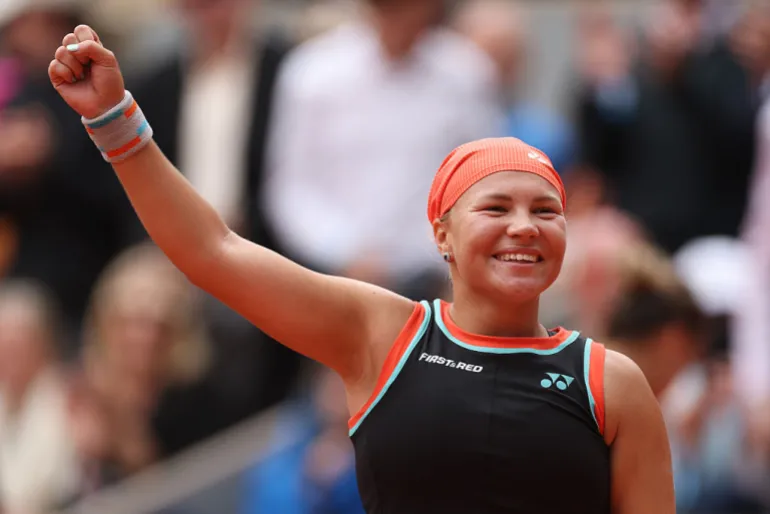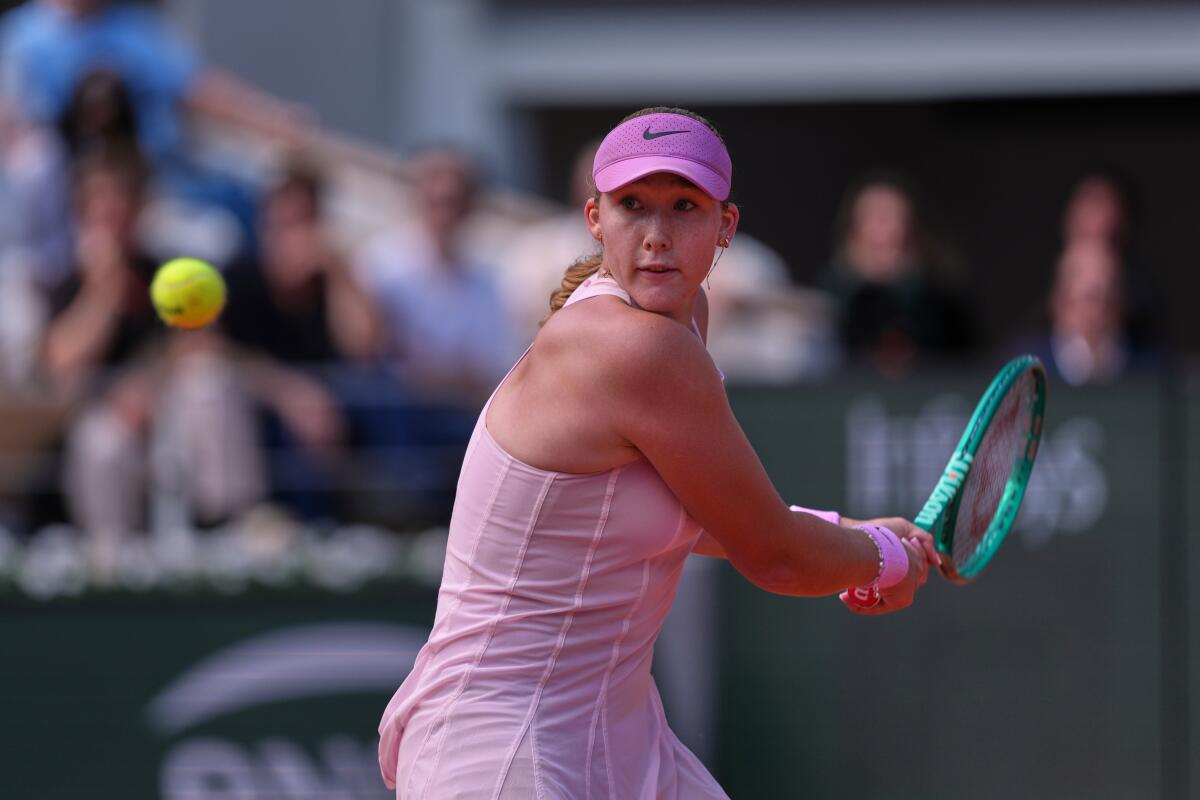
No handshake and no photo as Mirra Andreeva of Russia beats Marta Kostyuk of Ukraine to reach French Open tennis final.
By Kevin Hand, News Agencies and The Associated Press
Published On 4 Jun 20264 Jun 2026
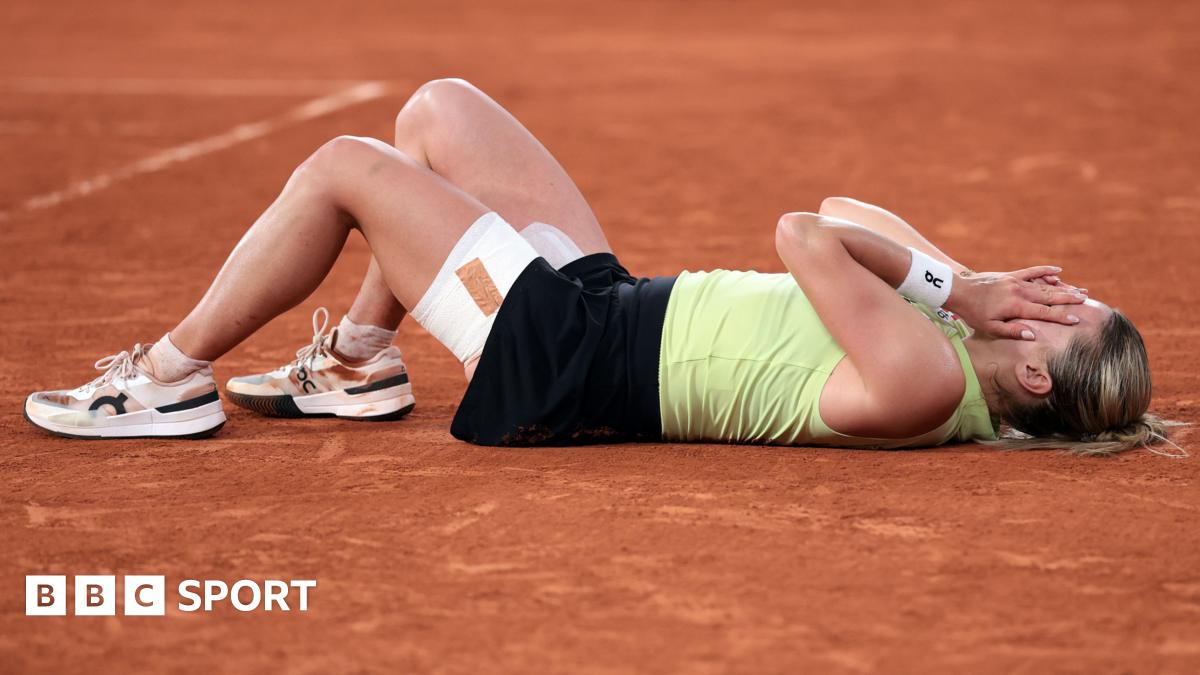
Russian teenager Mirra Andreeva reached her first Grand Slam final by beating Marta Kostyuk of Ukraine 6-1, 6-3 in a tense encounter at the French Open.
Andreeva converted her first match point when she served for the tennis match on Thursday.
Recommended Stories
list of 4 itemsend of list
There was no post-match handshake between the pair, however, and Kostyuk walked off quickly, turning only to wave and blow kisses to the crowd at Court Philippe-Chatrier, where some fans were draped in Ukrainian flags.
The atmosphere beforehand was somewhat tense as the players had separate photos taken as they each stood next to two children on their respective sides of the net. Usually, the players pose for the same photo, standing right next to each other by the net.
Kostyuk and countrywoman Oleksandra Oliynykova have spoken out during the tournament about the impact Russia’s four-year invasion of Ukraine is having on their country.
The eighth seed seized control from the outset and never loosened her grip on the contest, overwhelming Kostyuk with her depth and aggression on Court Philippe-Chatrier to set up a title clash against compatriot Diana Shnaider or Polish qualifier Maja Chwalinska.
Andreeva, 19, raced into a 4-0 lead in the opening set and barely looked back in the third meeting between the two players, the Ukrainian having won the first two.
Kostyuk briefly threatened to make a contest of it in the second set, but the Russian swiftly snuffed out any hopes of a comeback before serving out the match to complete a dominant display.
“I’m still very nervous, very nervous coming to this match as she’s had an amazing season, she hadn’t lost on clay, so that put pressure,” said Andreeva.
“She’s an amazing player, a tough opponent, so I’m super happy with the way I played. I’m happy I got revenge for the Madrid final, and to reach my first Grand Slam final.
“All of these feelings combined, I’ve never felt anything like this. I’m very excited about the last match here in Paris.”
Top-seeded Sara Errani and Andrea Vavassori of Italy won the mixed doubles final earlier Thursday, beating Gabriela Dabrowski of Canada and Evan King of the US 4-6, 6-3, 10-4.
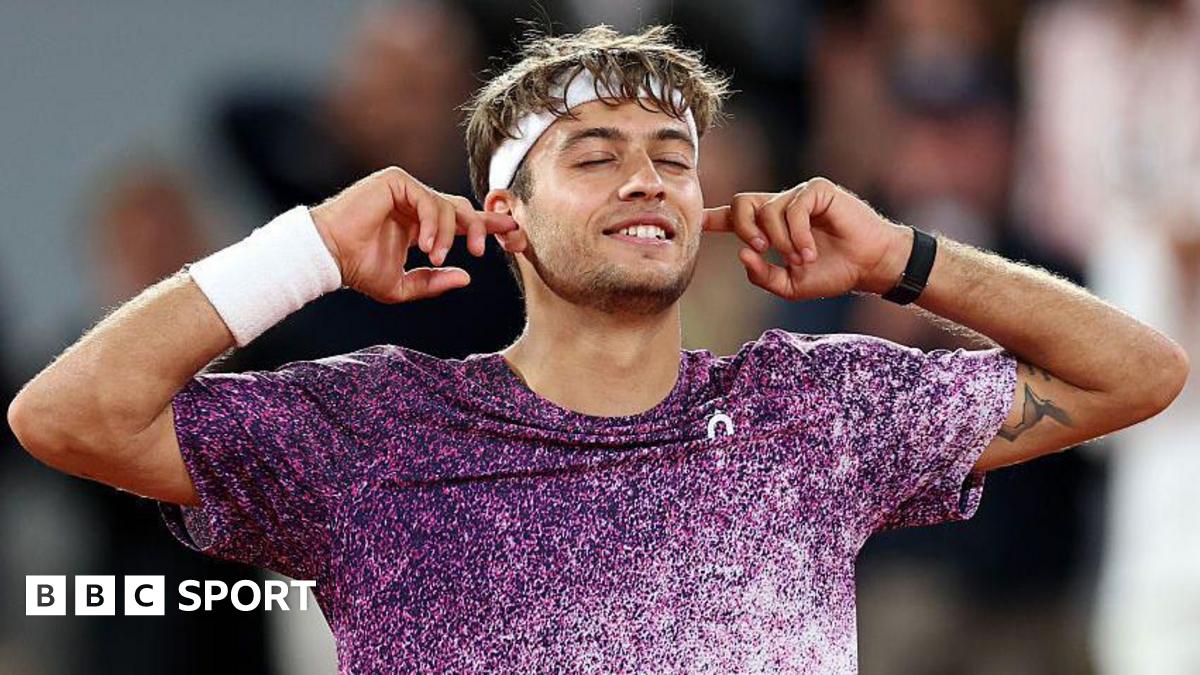
An Italian is guaranteed to be in Sunday’s men’s French Open singles final, with Flavio Cobolli facing fellow Italian Matteo Arnaldi on Friday in the first Grand Slam semifinal for both players.
After letting another big lead slip with an error-strewn performance at the French Open, top-ranked Aryna Sabalenka felt like getting as far away from the courts as possible.
“Just want to quit tennis right now,” Sabalenka said after wasting a lead of a set and two breaks in a 3-6, 7-5, 6-0 loss to Diana Shnaider in the quarterfinals on Wednesday.
Recommended Stories
list of 4 itemsend of list
“We’ll see in a few days. Hopefully, I’ll get back on track mentally.”
Sabalenka’s wait for a first French Open title continues despite the four-time major winner leading 4-1 in the second set and being two points from victory while serving for the match at 5-4.
What followed was a complete collapse as she lost 12 of the last 13 games against a player appearing in her first Grand Slam quarterfinal, looking increasingly frustrated and forlorn in the windy conditions.
Just like her loss to Coco Gauff in last year’s final, when she won the first set before becoming undone with a slew of unforced errors, this one will take some time to get over.
“You know those rooms where you just go in and you smash everything,” Sabalenka said. “Probably I will spend a whole day over there destroying stuff. Maybe it will help, maybe not.”
Shnaider next faces Maja Chwalinska, who extended her remarkable Roland Garros run by beating 22nd seed Anna Kalinskaya 7-6 (3), 6-3.
Sabalenka’s missed opportunities
The world number one stood still and screamed after losing a point to fall 0-30 down in the sixth game of the decider. Although she saved two match points at 0-40 down, she lost when she sent a shot into the net.
“I just think it’s [a] combination of everything,” Sabalenka lamented. “You overthink, then you make easy mistakes, then you miss opportunities.”
Her struggles were reminiscent of the match against Gauff, when she remonstrated loudly, shouting to herself and glaring at her team box.
“I just have to sit back and openly think about what’s going on in my head in those tough moments,” Sabalenka said, recalling that match. “Because I’m quite an experienced player. I have been through so many things, and I [have] overcome so many things.”
Sabalenka had already looked agitated when serving for the first set, but still looked in control as she served for the match in the second, holding a 30-15 lead.
“Of course I saw some moments of her frustration,” Shnaider said. “I know Aryna that she’s a very emotional person.”
Shnaider, who was already on her best run at a major, broke Sabalenka before taking complete control.
“Well, honestly, I am speechless. Super happy,” she said. “I feel like I was trying to focus point by point. Not thinking about the score. She is the world number one, so I [am] just trying to do my best. I just had to fight for every point.”
Sabalenka looked increasingly frustrated as the third set wore on, and when she missed a volley at the net in the fourth game of the decider, she crouched and rested her head on her racket.
Diana Shnaider shows appreciation to the fans after victory at Roland Garros [Dan Istitene/Getty Images]
Another French Open upset
It was another big upset in a tournament, with defending champion Gauff (third round) and four-time winner Iga Swiatek (fourth round) already out.
Jannik Sinner, last year’s men’s singles runner-up, served for the match in a second-round defeat, and 24-time major winner Novak Djokovic wasted a two-set lead in a third-round loss.
That opened things up for lesser-known players. According to sports analytics company Opta, this year’s French Open is the first major tournament without a former men’s or women’s singles major champion in the semifinals since the 1977 French Open.
The unseeded Chwalinska came through three qualifying rounds to become only the second Polish woman to reach the semifinals at Roland Garros, along with Swiatek.
Chwalinska said British player Emma Raducanu’s run to the 2021 US Open title as an 18-year-old qualifier had inspired her.
“It was such an impressive run, you know,” Chwalinska recalled. “Also, she was so young.”
When Kalinskaya’s big forehand from the back of the court went out, the 24-year-old had her biggest win, having never been beyond the second round at any major before this tournament.
Chwalinska’s total prize money heading into Roland Garros was $864,030, and reaching the last four here earns her 750,000 euros (about $872,000).
The roof was open on Court Philippe-Chatrier, and there was a lot of wind.
“I don’t know why would they keep the roof open when it was crazy windy,” Sabalenka said. “It was very dirty tennis. I don’t know how people could actually just sit there and watch me play.”
Kalinskaya also struggled.
“I feel like I was fighting against the wind,” she said. “It was cold today, so the ball was going slower. I couldn’t use my speed, my power.”
Men’s singles exits
In the men’s quarterfinals, 10th-seeded Flavio Cobolli beat number four Felix Auger-Aliassime 4-6, 6-4, 6-4, 6-4 and will face fellow Italian Matteo Arnaldi for a spot in the final.
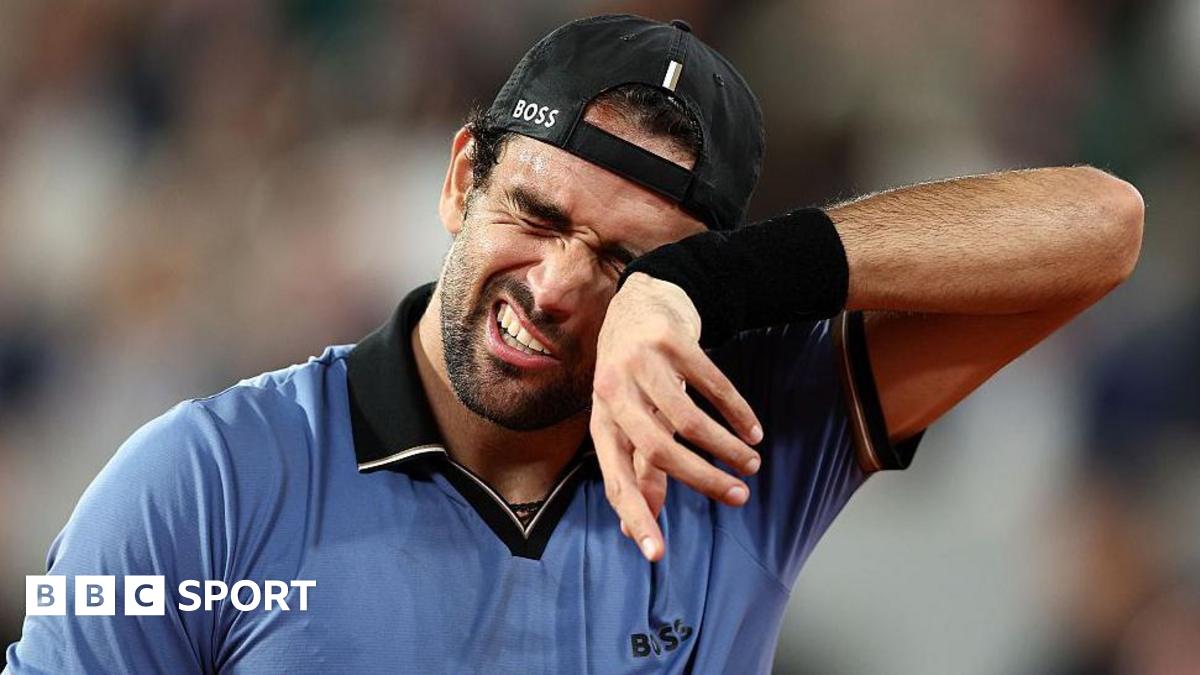
Arnaldi advanced when Matteo Berrettini, yet another Italian, retired due to a left hip injury, with Arnaldi leading 7-5, 5-2.
Berrettini had his hip treated during a medical timeout earlier in the second set.
The strong Italian showing comes despite top-ranked Sinner getting stunned in the second round.
Second-seeded Alexander Zverev and number 26 Jakub Mensik will meet in the other semifinal.
Having revealed several superstitions in his on-court interview – thanking the crowd in French, maintaining the same racquet tension no matter the conditions and keeping the same post-match routine – Cobolli was asked about them in his press conference.
“I’m a little bit [superstitious] but not crazy – this week I’m a little bit more crazy than the others,” he said. “I just go to the same restaurant, the same menu, the same shower.”
Cobolli then recalled a moment at a previous French Open when he was using the shower and Nadal knocked on the door asking him to hurry up because he was waiting to use that particular cubicle.
“He told me that it was his shower since 14 years,” continued Cobolli. “So I think the best thing that I’m doing is the shower.”
Cobolli recovered from losing the first set to beat Auger-Aliassime 4-6 6-4 6-4 6-4 and he will make his top-10 debut on Monday if Jakub Mensik, who faces Alexander Zverev in the other semi-final, fails to win the title in Paris.
Arnaldi’s win in Wednesday’s night session means an Italian finalist is guaranteed, even after the shock second-round exit of overwhelming favourite Jannik Sinner and Lorenzo Musetti being ruled out of the tournament because of injury.
Berrettini’s only previous retirement from a Grand Slam match was at the 2023 US Open.
He also made an early exit from the 2021 ATP Tour Finals because of an abdominal injury, while last season he had to pull out midway through matches in Madrid and Rome in the run-up to the French Open.
But the former world number six, who had missed the previous four French Opens because of injury problems, is determined to take the positives from reaching a seventh Grand Slam quarter-final in his first outing at Roland Garros since 2021.
Now ranked 105th, he added: “I have to take the good stuff that I did in this tournament, because a few weeks ago or a few days ago, it would have been crazy to think about me in the quarter-finals, and so I’ll try to go back home with a smile on my face.
“It’s going to be tough but that’s how I like to approach these two weeks, and of course I’m disappointed, I’m sad, but I’m also proud of the way I fought through this tournament.”
Speaking on court after his win, Arnaldi said: “You never wish for someone to end the tournament like this.
“He did an amazing tournament. I am sorry for him and I hope he recovers because soon it is the grass and he is going to be very tough to play.”
Arnaldi, ranked 104th in the world, is the lowest-ranked male player to reach a French Open singles semi-final since Filip Dewulf did so in 1997 when ranked 122nd.
He will play another Italian, 10th seed Flavio Cobolli, on Friday for a place in Sunday’s final.
Clay is not Sabalenka’s strongest surface even though she has won three times in Madrid, where the high altitude makes the conditions similar to a hard court.
Nor did she have a good build-up to Roland Garros. Six match points were squandered in a quarter-final defeat by Hailey Baptiste in Madrid in April, before she let a set and a break lead slip against Romanian veteran Sorana Cirstea in Rome.
But, given her quality and pedigree compared to the other Paris quarter-finalists, it is hard not to think another golden opportunity has slipped through Sabalenka’s fingers.
Sabalenka’s four Grand Slam singles titles – two Australian Open and two US Open triumphs, all on hard courts – are more than most people can dream of.
But she has also lost four finals and six major semi-finals, despite a consistency on the biggest stages that is unrivalled among her peers.
Sabalenka has the proud record of not losing before the quarter-finals of a Grand Slam since the start of the 2023 season.
However, she has not always dealt well with the pressure of the latter stages – particularly during the period where she has clearly been the best player in the world.
Sabalenka was the heavy favourite to beat underdog Madison Keys in the 2024 Australian Open final, but came unstuck. Twelve months later, she reached another Melbourne final – and a flurry of mistakes saw her squander a break lead in the deciding set against Elena Rybakina.
At last year’s French Open Sabalenka played what she described as the “worst final” of her life, hitting 70 unforced errors in windy conditions as she lost from a set up.
Against Shnaider, Sabalenka looked in control at 6-3 4-1 up before losing 12 of the final 13 games.
“I just think that there is something in specific moments during the match [where] I lose control,” said Sabalenka, whose 57 unforced errors outweighed her 46 winners.
Alexander Zverev ensured his pursuit of an elusive Grand Slam title remained on track with a comprehensive victory over highly-rated teenager Rafael Jodar to reach the French Open semi-finals.
Second seed Zverev is the highest-ranked man left in the singles draw after a series of shock exits in Paris.
The German has long been tipped for Grand Slam glory but has struggled in the pressure moments, suffering defeat in three finals and seven semi-finals.
He came up short against Carlos Alcaraz in the 2024 French Open final, despite leading by two sets to one, and has fallen four times in the Paris last four alone.
Tuesday’s meeting with 19-year-old Jodar was billed as a potentially tricky tie, with the Spaniard tipped to be a future star.
But Zverev, 10 years Jodar’s senior, used all his experience to come through 7-6 (7-3) 6-1 6-3.
“I want to keep going and win the matches ahead of me – that is my goal and my aim,” Zverev said.
“Today was a very good test against a very good player.
“I am happy to be in the semi-final but for now, that is it.”
Kostyuk was overcome with emotion following her historic meeting with Svitolina, which came a day after one of Moscow’s largest assaults on Ukraine in recent months.
She has been vocal in her criticism of Russian players who have failed to denounce the war and, like her compatriots, has maintained a policy of not shaking hands with opponents from Russia and its ally Belarus.
On the apparent reluctance of her Russian counterparts to speak about the war, Kostyuk said: “For me, it’s not frustrating anymore. They are all grown-ups.
“They are clearly aware of what’s going on. If this is something that they want to avoid talking about, they have to live with this, not me.
“I don’t know how you can sleep at night peacefully when you know that this is going on and you have nothing to say about it.”
Asked about facing a Ukrainian player next, Andreeva told the media: “It doesn’t matter who I play. I really try to play against the ball that is coming at me and focus on the game.”
Driven to deliver the title for Ukraine, Kostyuk will head into her semi-final on a 17-match winning streak on the clay this season.
“I still think it [the title] is very far. I have two matches to play and hopefully you will come and support me on Thursday,” Kostyuk told the crowd, who gave her a standing ovation and waved Ukrainian flags.
Asked if she would perform another backflip at Roland Garros, just as she did after beating Andreeva to win the Madrid Open last month, Kostyuk added: “In Madrid I practised the day before the final.
“I don’t need to practise here – I did it a month ago – but I promised I will only do it again when I win a final.”
Tournament director Amelie Mauresmo, herself a former women’s world number one, had regularly pointed to the possibility of short two-set matches as the reason for often overlooking the women.
“The match-ups are always interesting for both men and women, but there are multiple factors for us to make the choice,” Mauresmo said earlier on Monday.
“As you know, the potential length of the matches is something that we are also looking at.”
On picking Sabalenka against Osaka, she added: “It was obvious that it should be a night match tonight.”
There was a school of thought that Mauresmo might have looked elsewhere, though, had men’s world number one Jannik Sinner still been in the tournament.
Sinner would have been scheduled to play on the same day, but without him the men’s matches taking place on Monday lacked star power.
If Sabalenka against Osaka did not take place under the lights, then which women’s match would conceivably ever be picked?
With that came a sense of expectation.
If the match ended up being a dud, then it could have been used by critics as a stick to beat the women’s game with.
That, others argue, was a situation created by the French Open’s reluctance to showcase its female stars in the first place.
Was the burden which it placed on Sabalenka and Osaka to represent the women’s game fair?
“I don’t really care. There are so many different things to put pressure on myself – that was the last thing on my mind,” said Osaka.
“Shout out to the tournament for trusting us – I hope it was entertaining for people.”
When the two players met in Madrid in April, it was Osaka who won the opening set, and she started quickly once again, breaking Sabalenka in her opening service game.
However, it proved to be the only moment of uncertainty on serve for the top seed, who only conceded four points on her own delivery across the remainder of the first set and finished the match with 12 aces to Osaka’s two – and an 83% win rate behind her first serve.
Osaka, by contrast, invited pressure on herself, being taken to deuce after leading 40-15 in three first-set service games and landing just 53% of her first serves. Sabalenka routinely stepped inside the baseline to receive second serves and won 21 points from a possible 35.
Sabelenka’s canny shot selection also proved effective, winning 10 of her 11 points at the net and hitting five drop shots among her 39 winners as she avoided being drawn into endless baseline slog-fests.
She made the decisive break in the 11th game of the opening set before closing it out with a hold to love, and her relentless pressure told again in the second.
Osaka saved a break point in the fifth game but was broken to 15 in her next two service games, with Sabalenka converting match point with a trademark booming forehand.
With Iga Swiatek’s early French Open exit meaning new men’s and women’s champions will be crowned, BBC Sport analyses how the draws have been blown open.
Amid the excitement of youth, world number three Zverev underlined his status as favourite for the men’s singles title with a clinical straight-set win over Jesper de Jong, which sent him through to the quarter-finals at Roland Garros for the sixth consecutive year.
The second seed, 29, has long been earmarked as a future Grand Slam champion but despite reaching finals at three of the four majors – and leading Carlos Alcaraz by two sets to one at the French Open in 2024 – he is still searching for his maiden title.
However, with world number one Jannik Sinner and Djokovic both eliminated in the first week, plus defending champion Alcaraz absent because of injury, the German’s route to the title has opened up.
De Jong, ranked more than 100 places below Zverev, went toe-to-toe with the heavy-hitting German in the opener, racing into a 3-0 lead and later leading 3-0 in the tie-break before Zverev reeled off seven consecutive points to take the set.
Zverev had to be patient in the second, waiting until the 10th game to convert one of only two break-point opportunities offered to him, but was too strong for his opponent in a 24-minute third set, completing a 7-6 (7-3) 6-4 6-1 win.
Relentless on serve in the final two sets, he conceded just six points across nine service games while also showing his formidable touch at the net, winning 29 of 38 points.
“It was a bit difficult in the beginning,” Zverev said on court. “I didn’t start strong and he started really fast. But once I found my rhythm, I was comfortable.
“My game is there. It’s about showing it on the match courts.”
Zverev is one of only three top-10 seeds left in the draw, one of just two players with experience of playing in a major final and is competing on a surface on which he has won nine of his 24 ATP titles.
Perhaps most crucially, while many of his rivals have battled through multiple five-set matches, he has won three of his four matches in straight sets.
In each of the past three years, questions have been raised about whether the French Open should do more to showcase the women’s game.
“I don’t think they have daughters, because I don’t think they want to treat their daughters like this,” said Jabeur.
The lack of action prompted recently appointed WTA chief executive Valerie Camillo to seek answers from French Open tournament director Amelie Mauresmo – a former women’s world number one – when they met at Roland Garros this week.
In what the WTA describes as an open and productive conversation, Camillo underlined her belief that women’s players have delivered some of the “most exciting and dynamic competition in global sport” over recent months and years.
It remains to be seen whether Camillo’s call for action is listened to.
Mauresmo has consistently argued that the danger of women’s matches going “really fast” is the justification behind the choices.
With tickets ranging from €60 to €280 (£50 to £240), tournament organisers think the possibility of a short two-set women’s match does not represent value for money.
Mauresmo has insisted the night sessions will not be extended to two matches – like the Australian Open and US Open – in fear of creating late finishes.
Will the French Open be swayed? It refused to waver last year, despite pressure from players, the women’s governing body and – according to reports, external – broadcasters.
Former world number one Osaka will meet Aryna Sabalenka – the current top women’s player – in the last 16 on Monday.
The Japanese player said she did not know if that blockbuster match would be under consideration for the night session, but added she felt the slot was reserved for “popcorn matches”.
If Osaka against Sabalenka does not fulfil the French Open’s criteria, it feels like nothing will.
“I hope it will change,” added Ostapenko.
“Even if it’s not me playing, I would like to see some women’s matches there. But I don’t know that we will.”
Defending champion Coco Gauff is the latest big name to exit the French Open after a third-round defeat by Anastasia Potapova.
In a match with multiple big swings of momentum, American fourth seed Gauff lost 4-6 7-6 (7-1) 6-4 to Austria’s Potapova.
The win over two-time Grand Slam champion Gauff means Potapova is into the fourth round at Roland Garros for the first time.
Gauff follows men’s top seed Jannik Sinner and 24-time Grand Slam champion Novak Djokovic in being knocked out in the first week in Paris.
The 22-year-old beat Aryna Sabalenka in last year’s final but came into Roland Garros having not won a title in 2026.
Potapova’s magnificent defence caused problems for Gauff throughout and the 25-year-old was seen clutching her shoulder after the match, following a number of bruising rallies.
“I’m cramping a little bit but it’s OK, it’s all good. I don’t have any words now, I’m extremely happy,” said Potapova.
“The fight we could show, both of us – Coco is such a champion and I respect her so much.
“I’m unbelievably proud of myself that I stayed there, that I was fighting until the last point.”
Potapova will play Russian 22nd seed Anna Kalinskaya in the last 16 after her 6-3 0-6 6-2 victory over Camila Osorio.
Earlier on Saturday, American sixth seed Amanda Anisimova exited the tournament – losing to France’s Diane Parry.
Fonseca has long been touted as the next big thing, first garnering attention when he followed in the footsteps of Sinner and Alcaraz to win the 2024 ATP Next Gen finals – the end-of-season showpiece for players under the age of 21 – before bursting into the spotlight with his victory over Rublev in Melbourne barely a month later.
He clinched his maiden ATP title on the clay courts of Buenos Aires in February 2025 before reaching the third round on his French Open debut, where he lost to Britain’s Jack Draper. And wherever he went, a carnival of Brazilian flags followed.
Twelve months after making his bow in Paris as the world number 65, he returned as the 28th seed but, while there have been flashes of promise in that period – reaching the third round at Wimbledon, a second career title at last October’s Swiss Indoors, and a quarter-final at the Monte-Carlo Masters – there was a sense he hadn’t quite lived up to his precocious talent.
No more. At the sixth time of asking, Fonseca is through to the second week of a major.
He’s gone where no teenager has gone before in beating Djokovic at a Grand Slam, and is only the sixth to do so at any ATP Tour-level event.
He is the first player since Philipp Kohlschreiber, in 2009, to knock Djokovic out before the quarter-finals at the French Open and the first to do so at any Slam since the 2024 US Open.
“Joao Fonseca has definitely announced himself now,” Annabel Croft said on BBC Radio 5 Live. “He can proudly say he has lived up to the hype, because everyone was saying he hadn’t done much since the hype.
“When all the Brazilians and South Americans were running to the courts to watch him play a couple of years ago, now we know why.”
“It took time for him to find his feet, and the crowd was going to play such an important part if he could get them going, and it literally ended in fireworks,” added former French Open semi-finalist Jo Konta on TNT Sports.
“It was exactly the situation Joao needed to bring out that level of tennis.
“He just played one of the biggest matches we’ve seen for some time.”
Instead, he must now reset and recharge to go again at Wimbledon next month.
Given he is a seven-time champion on a grass surface which younger players have struggled to master, Djokovic will always fancy his chances at the All England Club.
Djokovic can never be ruled out of becoming the oldest major men’s singles champion in the Open Era, but Father Time has been sat waiting on his shoulder for a good while.
By rights, he should probably be basking in a post-retirement glow by now.
Coaching a young compatriot away from the public glare like Andy Murray, perhaps. Doing a promotional tour for a new Netflix documentary like Rafael Nadal, maybe.
While his long-time rivals move into the next phase of their lives, Djokovic was retching at the side of a court in an attempt to summon the energy to beat a teenager.
It is a testament to his superpower that he still wants to push himself to such limits against much younger opponents.
As we have seen time and time again, Djokovic’s insatiable appetite for the sport’s biggest prizes will never diminish.
But, having reached at least the semi-finals at the past five Grand Slams, this was the clearest sign yet that the ageing process was finally catching up with him.
Djokovic looked in complete control as he moved two sets ahead, but could not maintain his level as Fonseca proved he is the real deal.
“It would be nice if it was best-of-three,” Djokovic smiled.
“I just ran out of gas, to be honest. I didn’t feel good at all on the court in the next couple of sets.”
Djokovic has always thrived in the best-of-five format of the majors, beating almost anybody who has stood in his way for the best part of two years.
The only exceptions have been Sinner, Alcaraz and the muscle injury which forced him to quit against Zverev at last year’s Australian Open.
Everyone else has not been good enough, or not had the mentality, to see veteran Djokovic off.
Novak Djokovic’s wait for a record 25th Grand Slam singles title goes on after teenage star Joao Fonseca produced a stunning fightback to win a five-set epic in the French Open third round.
The Serb was the only player left in the draw who had won a major title and was arguably the favourite to go all the way after world number one Jannik Sinner lost on Thursday.
But after winning the first two sets, Djokovic was gradually overpowered by 19-year-old Fonseca, who hit back to force a decider.
In front of a raucous crowd, Fonseca battled back from 3-1 down in the fifth set to win 4-6 4-6 6-3 7-5 7-5 after a gruelling four hours and 53 minutes.
Fonseca is the first teenager to beat the Serb at a major – a testament to the coolness he showed under pressure against one of the game’s all-time greats.
It is only the third time in 22 appearances that Djokovic has failed to reach the second week at Roland Garros.
With Sinner out and Carlos Alcaraz skipping the clay-court major with injury, Djokovic will be left wondering if his best opportunity of winning that elusive 25th Grand Slam has been wrenched from his grasp.
Fonseca, who will face either two-time finalist Casper Ruud or American 24th seed Tommy Paul in round four, is joined in the second week by fellow 19-year-old Rafael Jodar, who has emerged as a genuine title contender after winning 18 of his 21 clay-court matches in 2026.
KELLY Brook showed she and husband Jeremy Parisi are as loved up as ever as she packed on the PDA on their French getaway this week.
The couple soaked up the sun during a beach day in Saint-Tropez, with Kelly, 46, showing off her famous curves in a patterned swimsuit while hugging her Italian other half.
Sign up for the Showbiz newsletter
Thank you!
Kelly Brook showed off her curves in stunning swimwear as she hit the beach in Saint-TropezCredit: BackGridThe model and actress appeared smitten with her husband of four years as she hugged him by the shoreCredit: BackGrid
Appearing in high spirits, Kelly pulled her brunette locks into a ponytail while taking a dip in the sea with Jeremy.
The couple were snapped beaming while sharing a hug at the busy shorefront.
Staying at the luxury wellness hotel Lily Of The Valley, Kelly and Jeremy have been enjoying the South Of France sunshine over the last week.
Alongside relaxing beachside, the couple have been hitting the gym and focusing on wellness during the trip.
The couple have been enjoying a French getaway over recent weeks, spending the last few days at a five-star wellness resort in luxe resort town Saint-TropezCredit: BackGridThe couple appeared in high spirits as they enjoyed a dip in the sea during the tripCredit: BackGridKelly looked stunning in a patterned swimsuit for the dipCredit: BackGridThe couple have also been celebrating Jeremy’s birthday during the holiday, with the model turning 41 earlier this monthCredit: Rex
And showing it’s clearly the place to be, Kelly has bumped into fellow celebs Amanda Holden and Piers Morgan during her trip.
The trio, who were all holidaying in the destination separately, bumped into one another by chance at beach hotspot Club 55.
Kelly shared a snap with Amanda and Piers from the beach restaurant to her Instagram as they all caught up.
The posh resort town is hours away from where Jeremy grew up in Paris, despite originally hailing from Italy.
And it seems he and Kelly have been touring around the country, first heading to Cassis, a fishing town east of Marseille, before making their way to Saint-Tropez.
The trip was to mark Jeremy’s birthday, with the male model turning 41 during their stay in Cassis.
“Dress shabbily and they remember the dress; dress impeccably and they remember the woman.” ― Coco Chanel
Apropos of Paris. Apropos of the French Open.
That’s all the context necessary to appreciate Naomi Osaka removing a ceremonial black skirt and sleeveless beaded bodice ahead of her opening match at the Roland-Garros Complex this week, revealing a sequined gold playing dress.
Osaka was playing all right. With sensibilities. With tradition. With her opponents, who she summarily dispatched with victories in the first and second rounds.
Naomi Osaka arrives on Court Suzanne-Lenglen to play her singles match against Laura Siegemund.
(THOMAS SAMSON/AFP via Getty Images)
And it was clear the four-time Grand Slam champion was playing with all of us when she said of her dress, “It’s very couture. You know the Eiffel Tower at night when it’s sparkly? I kind of think I look like that a little bit.”
Countless LinkedIn pages spout something about residing at the intersection of sport and fashion. Osaka locates that intersection at tennis tournaments worldwide, looks both ways and boldly steps into the street.
Last year at the U.S. Open she adorned her ponytail with red roses and attached a Labubu to her tennis bag that she named Billie Jean Bling.
At the Australian Open in January, she entered the court in a tie-dye turquoise and green palette with flowing tendrils. Her face was concealed by a veil, a wide-brim hat and a white parasol that she said was inspired by an image of a jellyfish that excited her 2-year-old daughter.
Naomi Osaka walking onto the court in a jellyfish-inspired ensemble ahead of her first-round match at the 2026 Australian Open in Melbourne.
(Quinn Rooney/Getty Images)
It’s all great fun. Yet continued fashion statements depend on her performance on the court. Osaka wins, she earns another grand entrance. She loses, nobody cares what she wears on the ride home.
At the U.S. Open, Osaka shined, reaching the women’s singles semifinals. Seeded as an also-ran at No. 23, she upset Coco Gauff and Karolina Muchova before falling in a tight three-set match to Amanda Anisimova.
Seeded No. 16 in Australia, she won two matches before withdrawing because of an abdominal injury suffered during her three-set victory against Sorana Cîrstea.
Fast forward to the French Open. Osaka advanced to the third round for the first time in seven years Thursday with a 7-6 (7/1), 6-4 win against Croatia’s Donna Vekic and will take on teenager Iva Jovic on Saturday.
What she will wear walking in is anybody’s guess. An effortless chic aesthetic courses through Paris. Advancing to the French Open round of 16 for the first time would require the opposite, Osaka toiling through another step in her return to form after giving birth to her daughter.
And creating another opportunity to have fun with fashion.
World number one Jannick Sinner beaten by 56th-ranked Argentinian opponent Juan Manuel Cerundolo at Roland Garros.
Published On 28 May 202628 May 2026
Jannik Sinner’s bid for a maiden French Open title and career Grand Slam went up in smoke as he experienced physical issues in his second-round match against Juan Manuel Cerundolo and fell to a 3-6 2-6 7-5 6-1 6-1 defeat.
Sinner arrived in Paris as the favourite for the title, having lifted claycourt titles in Monte Carlo, Madrid and Rome, with his main rival and defending champion Carlos Alcaraz ruled out with injury and Novak Djokovic searching for his best form.
Recommended Stories
list of 4 itemsend of list
But Cerundolo tore up the script in a dramatic clash on a scorching Thursday where he held his nerve even as last year’s runner-up Sinner crumbled while on the verge of a big win, sending shockwaves through Roland Garros.
As the temperature climbed over the 30 degrees Celsius (86F) mark for the first time in the afternoon, Sinner had already breezed through the first set on the back of a solitary break, and the 24-year-old Italian looked to be in cruise mode.
Cerundolo offered resistance towards the end of the second set, but the 56th-ranked Argentinian was left with a mountain to climb after Sinner unleashed a huge forehand winner to double his lead in the match for the loss of only five games.
The four-time Grand Slam champion cooled off with an ice towel in the break and turned up the intensity on his unseeded opponent in the third set to go 5-1 ahead, before he began to struggle and halted play when serving at 5-4.
Sinner returned from an off-court medical timeout five minutes later and was immediately broken for 5-5, and dropped the next two games to hand the set to his opponent, who sensed the chance to pull off a major upset.
Still not at his best, Sinner surrendered the fourth set tamely and was broken early in the decider, as Cerundolo took full advantage to leave the Grand Slam without its title favourite.
It is a bitterly disappointing way to exit the tournament for Sinner, whose favourite tag was enhanced further with defending champion and great rival Carlos Alcaraz missing with injury.
With 24-time Grand Slam-winner Novak Djokovic also nearing the end of his illustrious career, fitness was expected to be one of the biggest obstacles to Sinner’s bid for glory.
Paris has seen unseasonably hot weather, with temperatures topping 34C, and Sinner has struggled previously in extreme heat.
Sinner was also on a 30-match winning streak, having won five Masters 1000 titles in a row over the past three months on hard and clay courts.
He cramped badly in temperatures close to 40C at this year’s Australian Open, and admitted he “got lucky” when the heat rule was enforced in his third-round match against Eliot Spizzirri in Melbourne.
After opening his campaign against Clement Tabur in Tuesday’s cooler night session, Sinner was first on court against Cerundolo in a rare move by Roland Garros organisers.
The last time a men’s number one opened proceedings on Court Philippe Chatrier before the semi-final stage was 10 years ago, when Novak Djokovic beat Tomas Berdych in the quarter-finals.
Although Sinner seemed to benefit initially from the early start, the physical issues that have hampered his display in previous matches in extreme heat resurfaced.
Elsewhere, three-time former champion Novak Djokovic faced Frenchman Valentin Royer on Court Philippe Chatrier, which has a roof, and was on court for three hours and 44 minutes.
The 39-year-old Serb lost a tight third set on a tie-break but regrouped to win 6-3 6-2 6-7 (7-9) 6-3.
In his post-match press conference, Djokovic suggested scheduling matches at Grand Slams later in the evening could be “something to consider” as a potential alternative if extreme conditions are expected.
French Open organisers monitor the temperature through two wet bulb sensors – one on Chatrier and another on Court 14.
If the threshold is reached, a 10-minute break may be introduced after the second set of women’s matches and the third set of men’s matches.
If temperatures continue to rise, matches can be suspended until the heat drops.
No French Open match has ever been halted because of extreme heat.
Women’s 15th seed Marta Kostyuk said the conditions so far this week are not quite as bad as those she experienced when playing at the same venue for the Olympics in 2024, but added: “It’s still hot and it’s very dry. I always felt like I need to drink, I want to drink more and more. It was tough.”
On Monday, former finalist Casper Ruud said he felt he was “walking around like a zombie” and feared he had heat stroke after struggling with cramping in 33C temperatures.
One player who escaped the worst of the conditions on Wednesday was men’s second seed Alexander Zverev, who played in the night session when temperatures had dropped to about 18C.
A runner-up at Roland Garros in 2024, Zverev continued his bid for a maiden Grand Slam with a dominant display to beat Czech player Tomas Machac 6-4 6-2 6-2 in one hour and 48 minutes.
World number two Elena Rybakina suffered a surprise second-round defeat by world number 55 Yuliia Starodubtseva in the biggest French Open upset so far.
Despite winning the opening set, Rybakina looked far from her clinical best as Starodubtseva mounted an impressive comeback to win 3-6 6-1 7-6 (10-4).
Known for her big serve and precise hitting, reigning Australian Open champion Rybakina committed 71 unforced errors and landed just 53% of her first serves.
It is the first time Kazakhstan’s Rybakina has failed to reach the third round at Roland Garros since 2020.
Rybakina’s early exit also means Aryna Sabalenka will keep her world number one ranking regardless of her result at Roland Garros.