The United States has fallen to a “historic low” in the Reporters Sans Frontieres (RSF), or Reporters Without Borders, annual press freedom tracker, continuing a decade-long decline, the organisation has said.
The report on Thursday recorded a global drop in press freedom indicators in 2025, with, for the first time, more than half of the world’s countries labelled as “difficult” or “very serious”.
Recommended Stories
list of 3 itemsend of list
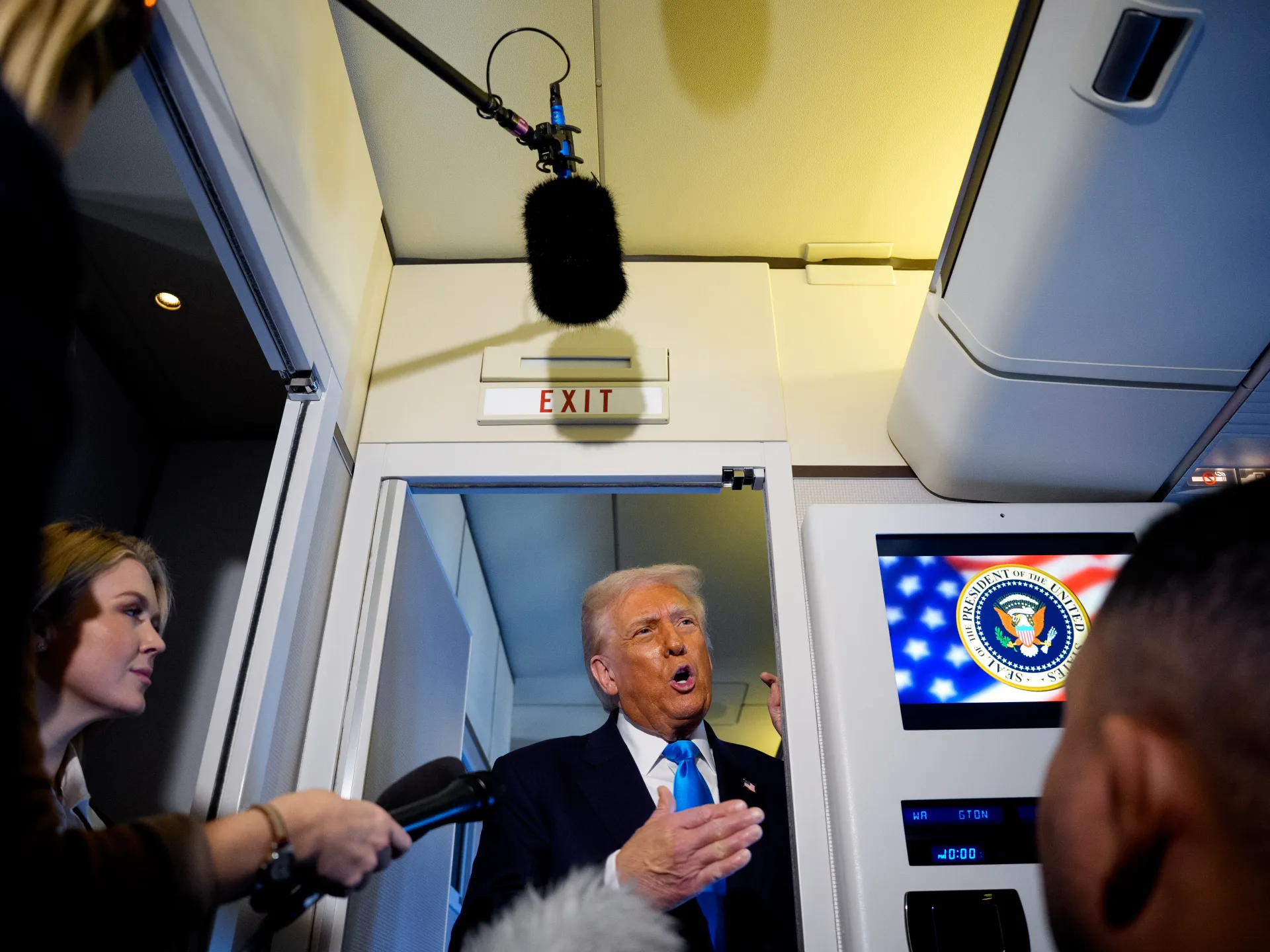
While the US, during the first year of US President Donald Trump’s second term, remained in the “problematic” category, it dropped seven spaces from 57th in the world to 64th. Norway led the list, with Eritrea ranked lowest among 180 countries.
In a statement, Clayton Weimers, executive director of RSF’s North America office, said the US was experiencing a “press freedom crisis”.
“Trump and his administration have carried out a coordinated war on press freedom since the day he took office, and we will live with the consequences for years to come,” he said in a statement.
“Our message is clear: Protect legal rights, ensure accountability for attacks on media professionals, and support independent media to restore American press freedom.”
The report pointed to both Trump administration policies and the wider consolidation of media companies in the US, which critics say opens the door to stifling certain points of view.
That has included Skydance Media’s acquisition of Paramount Global, which includes CBS News. Skydance is owned by David Ellison, whose father, Larry Ellison, is a confidant of Trump’s.
Paramount Skydance is also currently acquiring Warner Bros, which owns CNN.
All told, just six companies control most US media: Comcast, Walt Disney, Warner Bros Discovery, Paramount Skydance, Sony, and Amazon.
While Trump has long had an adversarial relationship with journalists, press freedom observers say the head of the Federal Communications Commission (FCC) has accelerated pressure on media figures and journalists during the president’s second term.
In March, FCC chair Brendan Carr said he would revoke the licences of broadcasters that are “running hoaxes and news distortions”, and that do not “operate in the public interest” in their reporting on the US-Israel war with Iran. Trump said he was “thrilled” by Carr’s statements.
Carr has also threatened to revoke the licenses of broadcasters for their coverage of Trump’s immigration policies, which critics say can have a chilling effect on local news organisations.
The effort has extended to television talk show hosts, who have been threatened by the FCC over jokes.
Most recently, Carr announced an investigation into several ABC channels.
That came days after the network’s flagship late-night host, Jimmy Kimmel, made a joke about the White House Correspondents Dinner (WHCD).
Kimmel had quipped that First Lady Melania Trump had the “glow of an expectant widow” before the event.
Days later, a gunman attempted to storm the WHCD in Washington, DC, which Trump was attending for the first time. The Trumps later connected Kimmel’s joke to the attack, calling for Kimmel’s firing.
Kimmel has said the joke was about the 79-year-old president and the 56-year-old first lady’s “age difference” and not a call for violence.
Critics of the FCC’s move included Republican Senator Ted Cruz, who said he does “not believe the FCC should operate as the speech police”.
The White House has repeatedly called Trump the most “transparent” president in US history, pointing to his regular news conferences.
Freedom of the press around the world has fallen to its lowest level in a quarter of a century, according to the leading Paris-based press freedom NGO, Reporters Sans Frontieres (RSF), or Reporters Without Borders.
Every year, RSF publishes a World Press Freedom Index used to compare the level of freedom enjoyed by journalists and media outlets in 180 countries. Its ranking uses a five-point scale to assess a country’s level of press freedom, ranging from “very serious” to “good”.
Recommended Stories
list of 3 itemsend of list
For the first time since RSF started producing the index in 2002, more than half of the world’s countries fall into the “difficult” or “very serious” categories for press freedom – “a clear sign that journalism is increasingly criminalised worldwide”.
Only seven mostly Nordic countries are ranked with “good” press freedom, with Norway, the Netherlands and Estonia in the top three. France ranks 25th with a “satisfactory” score, while the United States ranks 64th with a “problematic” score, falling seven places since President Donald Trump took office.
RSF reports that Trump “has turned his repeated attacks on the press and journalists into a systematic policy”, citing the detention of Salvadoran journalist Mario Guevara, who was later deported, while he was documenting a protest against immigration raids, as well as the suspension of several notable public media institutions.
In Latin America, RSF highlighted the dramatic fall of Javier Milei’s Argentina (98th, -11) and of El Salvador (143rd), which has dropped 105 places since 2014 following the launch of a war against the Maras criminal gangs.
The press freedom NGO said that “Eastern Europe and the Middle East are the two most dangerous regions for journalists in the world, as they have been for 25 years”, notably putting Russia (172nd) and Iran (177th) in the bottom 10.
It added that wars and restrictions on access to information are some of the driving factors for the decline in press freedom. It cited Israel’s attacks on journalists in Gaza, the occupied West Bank and Lebanon as an example of this, ranking Israel 116th.
“Since October 2023, more than 220 journalists have been killed in Gaza by the Israeli army, including at least 70 who were slain while carrying out their work,” it said.
Broadly speaking, RSF reported that “the criminalisation of journalism, which is rooted in circumventing press law and misusing emergency legislation and common law, is proving to be a global phenomenon”.
It reported that more than 60 percent of countries – 110 out of 180 – have criminalised media workers in various ways, notably citing India (157th), Egypt (169th), Georgia (135th), Turkiye (163rd) and Hong Kong (140th) as prime examples of state-imposed crackdowns.
“Although attacks on the right to information are more diverse and sophisticated, their perpetrators are now operating in plain sight,” Anne Bocande, RSF’s Editorial Director said.
She cited “authoritarian states, complicit or incompetent political powers, predatory economic actors and under-regulated online platforms” as the main causes “for the global decline in press freedom”.
Bocande called on democratic governments and citizens to do more to end this global criminalisation of journalists, particularly through “firm guarantees and meaningful sanctions”.
“Current protection mechanisms are not strong enough; international law is being undermined and impunity is rife,” she said. “Inaction is a form of endorsement,” while concluding that “the spread of authoritarianism isn’t inevitable”.
The U.S. Navy’s Undergraduate Jet Training System (UJTS) competition to replace the T-45 Goshawk is accelerating toward one of the most consequential training decisions in decades. The Navy has now issued its eagerly-anticipated Final Request For Proposals – an inflection point in the long-running effort to field 216 modern jet trainers for the next generation of naval aviators.
Amid this pivotal moment, SNC is leading a powerhouse team that has developed the only clean-sheet design in the running: the Freedom Trainer. Built specifically to address the Navy’s evolving carrierborne training needs, the Freedom Trainer aims to deliver modern capability at significantly reduced lifecycle cost.
An artist rendition of two SNC Freedom Trainers. SNC
SNC is partnering with Northrop Grumman, General Atomics Aeronautical Systems, Inc., and CAE, leveraging advanced production, manufacturing, and synthetic training expertise to create a comprehensive, integrated family of training systems.
“SNC’s Team Freedom brings the agility of a disruptor and the reliability of our well-established defense partners to bear so that we can deliver what the Navy wants, on the aggressive timeline it set,” says Jon Piatt, executive vice president at SNC.
Why the Navy’s training model is changing
Core requirements for the T-45 replacement have shifted dramatically. Advances in automated carrier landing technologies and increasingly capable simulation environments have altered the Navy’s perspective on how student naval aviators should be trained. The service has already removed carrier qualifications from the T-45 syllabus, one of the most significant training changes in decades, and plans for UJTS could further reshape how training occurs ashore.
A major driver of this debate centers around Field Carrier Landing Practice (FCLP), the land-based surrogate for shipboard carrier landings. Traditionally performed to touchdown, these aggressive, un-flared landings, or “bouncing,” replicate the forces and precision required aboard the carrier. But for UJTS, the Navy has removed the requirement for FCLP-to-touchdown, instead calling only for FCLP-to-wave off.
The Freedom Trainer is designed to be able to fly FCLP-to-touchdown. SNC
This change dramatically broadens the aperture for competitors. Trainers designed for land-based operations can meet wave-off profiles without requiring the structural upgrades typical of Navy aircraft. But this also introduces concerns about the long-term impact on aviator proficiency, and whether foundational carrier skills can be taught effectively without actual touchdown repetition.
The FCLP equation and its implications for the fleet
FCLP has long been considered essential for preparing student naval aviators for the demands of carrier aviation. A Navy spokesperson reaffirmed to TWZ in August 2025 that “Field Carrier Landing Practice landings ashore are still required for graduation,” though did not specify whether touchdown was still necessary.
Touchdown landings impose tremendous structural loads on an aircraft, particularly landing gear and associated components. Removing this requirement opens the competition to off-the-shelf trainers such as the T-7 Red Hawk, Korean-built TF-50N, and the Italian M-346N. These jets can perform FCLP-to-wave-off but not repeated unflared touchdowns without extensive structural reinforcement.
SNC argues that this shift elevates readiness and cost risk. “FCLP-to-touchdown is a tried and trusted method to train naval aviators,” says Derek Hess, vice president of strategy at SNC. “Not performing carrier qualification or FCLPs-to-touchdown essentially defers that training to the fleet replacement squadrons with their 4th-, 5th-, and soon, 6th-generation fighters which would be a very expensive use of those precious assets.”
In other words: the Navy can remove the requirement, but the fleet will still pay the bill.
Why a clean-sheet matters
The Navy’s decision not to mandate touchdown capability fundamentally changes the nature of the competition. Legacy trainers can now be offered at lower upfront cost, but at the expense of performance characteristics essential to naval aviation.
SNC is blunt on this point: the Freedom Trainer is the only aircraft in the field that can perform FCLP-to-touchdown without major modification because it is purpose-built to meet Navy training standards. SNC believes this is the defining advantage of a true naval trainer.
Where its competitors adapt land-based jets for a naval training mission, the Freedom Trainer is engineered from inception for the pounding, the control margins, and the durability required for FCLPs-to-touchdown.
A view of the Freedom Trainer’s tandem cockpit arrangement. SNC
Clean-sheet means a whole new approach
The Freedom Trainer offers improvements over the T-45, while delivering dramatically lower lifecycle costs. Hess explains that lifecycle economics are central to SNC’s approach: only about 10 percent of lifecycle cost is tied to research, development, test and evaluation (RDT&E) and 30 percent for procurement, while roughly 60 percent stems from operations and sustainment.
“From a business perspective, you can pay more in the RDT&E phase and still dramatically reduce your lifecycle costs,” Hess says. “We’re employing a more businesslike approach to training that balances training costs holistically across the lifecycle of the aircraft.”
To achieve this, SNC leverages advanced digital engineering to reduce risk and ensure real-world fidelity. “Digital engineering has evolved significantly over the last 10 years,” Hess says, pointing to Northrop Grumman’s work on the B-21 Raider as a benchmark for its modeling environment.
The Freedom Trainer’s mission systems architecture is built using Model Based Systems Engineering (MBSE) and is delivered with full technical and data rights – ensuring the Navy retains long-term control and interoperability.
Designed for the mission: performance and durability
The aircraft’s design reflects a deliberate choice to provide representative fighter performance at dramatically lower cost. The Freedom Trainer’s design reflects a deliberate philosophy: deliver the handling qualities and durability of a fighter‑representative aircraft without imposing fighter‑level sustainment costs. Rather than itemizing features in a list, SNC emphasizes that the jet’s airframe, engines and performance envelope all work together to meet the Navy’s demanding syllabus.
The Freedom Trainer is designed to provide fighter-like performance at lower cost. SNC
At its core, the Freedom Trainer is built around a 16,000‑hour airframe that’s engineered to withstand up to 35,000 carrier‑style landings. This level of durability is essential for repetitive FCLP operations, especially un-flared touchdowns that impose loads far more intense than standard runway operations. By designing the structure from day one to accept these stresses, SNC ensures the aircraft can train pilots to full carrier‑representative standards while avoiding the costly structural fatigue associated with modifying older, land‑based designs.
Power comes from a pair of Williams FJ44‑4M engines, selected not only for reliability but also for their lower operating cost compared to legacy trainer engines. These efficient turbofans help reduce support burdens by an estimated 40 percent relative to the T‑45, while enabling longer sorties on less fuel than the competition.
Performance‑wise, the Freedom Trainer provides the maneuvering capabilities student naval aviators must master before transitioning to fleet aircraft. With a −3 to +8 G envelope and angles of attack (AoA) reaching up to 27 degrees, the aircraft exposes students to the high‑AoA handling characteristics relevant to modern 4th‑ and 5th‑generation fighters. Yet SNC deliberately designed the jet to avoid the transonic regime, which typically demands larger thrust margins and higher fuel consumption to accomplish the same training maneuvers. By staying sub‑transonic, the aircraft maintains fighter‑representative handling qualities while keeping lifecycle costs far below those of high‑performance jets.
“You don’t need a fighter to learn how to fly a fighter,” Hess notes. “You need a trainer engineered for Navy training missions that create graduates who are ready for FRS training and beyond.”
The Freedom Trainer features twin Williams FJ44-4M engines. SNC
LVC: The synthetic backbone of modern training
Live, Virtual, and Constructive (LVC) training is now central to the Navy’s future training enterprise. The service intends to offload many carrier operations scenarios into synthetic environments as part of its modernization journey.
The Freedom Trainer’s LVC environment, developed with CAE, includes synthetic radar, targeting pods, and augmented reality tactical scenarios that replicate beyond visual range (BVR) and within visual range (WVR) engagements. Hess notes that many mission training functions can be downloaded from frontline squadrons, producing far more capable pilots at much lower cost.
“Ultimately, flying 4th- and 5th-gen fighters with modern flight control systems isn’t hard these days,” Hess says. “The tough part is employing the aircraft. That’s where we excel with our LVC capabilities.”
Turning clean-sheet into reality: timeline and industrial base
The final RFP envisions Engineering and Manufacturing Development (EMD) beginning with up to two contract awards in 2027, delivering four EMD aircraft followed by seven low-rate production jets beginning in 2032. The goal is initial operating capability in 2035.
Hess is confident SNC can meet the timeline. With a restructured Navy acquisition enterprise and strong industrial partners, the Freedom Team argues it is well positioned to deliver a future-focused foundation for Navy training.
“Our primary focus is to deliver a trainer that meets the demanding needs of naval aviation with zero compromise,” Hess says. “We believe the next-generation navy trainer must enable efficient sortie generation, evolve with technology, and strengthen the nation’s industrial base.”
The bottom line: improving training while reducing cost
SNC positions the Freedom Trainer as a solution that protects naval aviation’s most critical training standards while delivering significant lifecycle savings. The company argues that deferring essential skills like FCLP-to-touchdown to the fleet imposes an unnecessary cost and readiness burden.
The Freedom Trainer is designed to lower lifecycle costs for the Navy. SNC
“If aviators aren’t learning these key skills while they’re earning their Wings of Gold,” Hess says, “they will have to learn it in a much more complex, more expensive, and more scarce resource – frontline gray jet fleet fighters.”
A compelling candidate for the future fleet
The Navy’s next trainer will shape every aviator who enters the fleet for generations to come. The Freedom Trainer’s clean-sheet approach positions it as a contender capable of improving Naval training capabilities while reducing cost.
For a decision as consequential as UJTS, SNC’s argument is clear: choose a trainer designed for the Navy’s mission – not adapted to it.
Press freedom advocates have warned of hostile rhetoric towards journalists and increasingly restrictive policies under Milei.
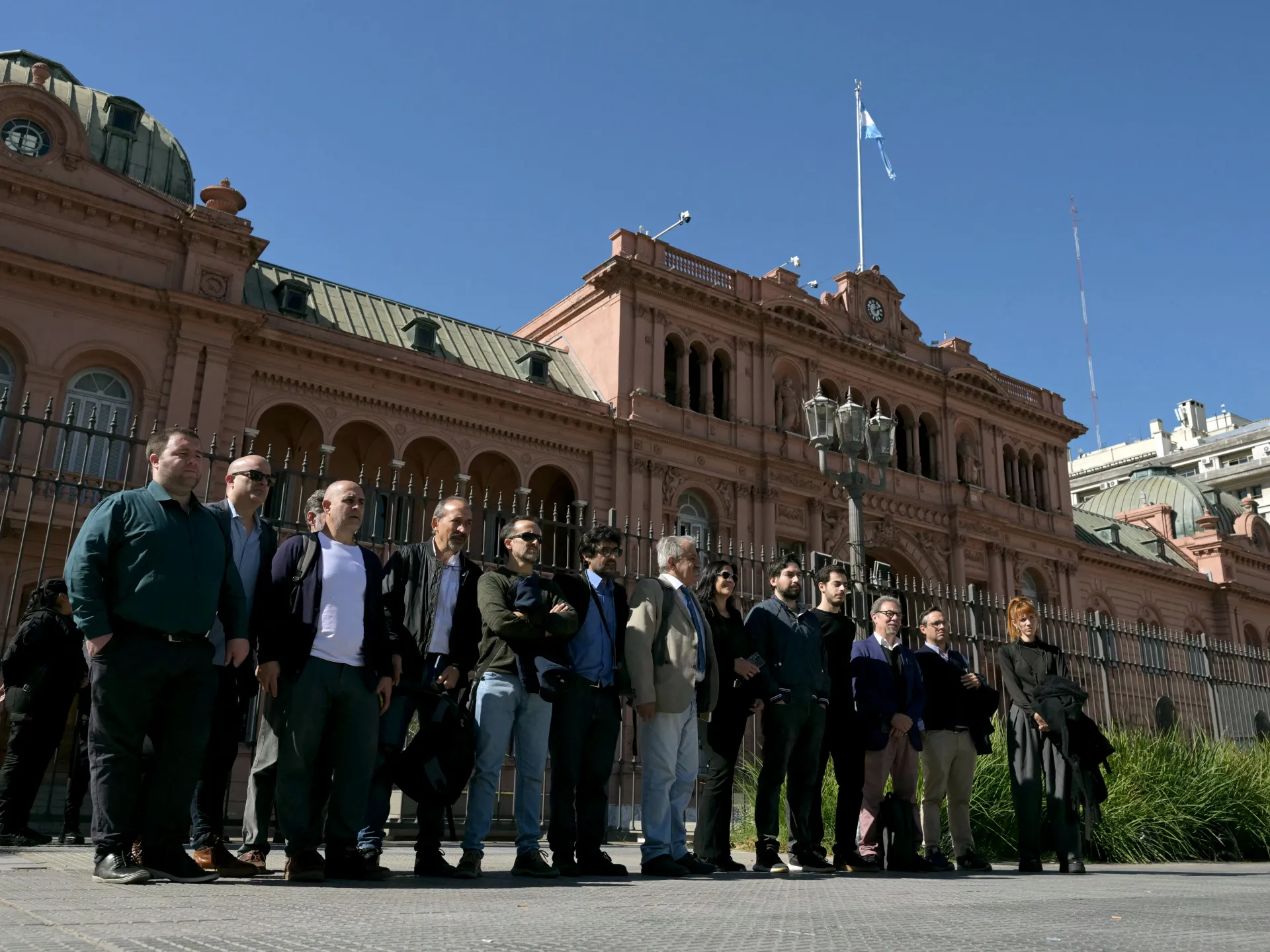
The administration of Argentina’s Javier Milei has restricted access to the presidential palace, the Casa Rosada, as part of an escalating feud with the country’s journalists.
Accredited journalists reportedly arrived at the Casa Rosada on Thursday and attempted to enter the building through fingerprint scanning, as they usually would.
Recommended Stories
list of 3 itemsend of list
But they were unable to pass the scan. As confusion hit the news corps, the head of Argentina’s Secretariat of Communication and Press issued a clarification that their press accreditation had not been revoked.
“The decision to remove the fingerprints of journalists accredited to the Casa Rosada was taken as a preventive measure in response to a complaint filed by the Military Household regarding illegal espionage,” Secretary Javier Lanari wrote on social media.
“The sole objective is to guarantee national security.”
Lanari’s post cites an incident wherein two journalists from the Argentinian channel TN were accused of secretly filming inside the government palace.
After their report was broadcast, the Milei administration accused the journalists of endangering government security by showing parts of the Casa Rosada that were reportedly off limits.
On Wednesday, Milei himself took to social media to call the journalists “repugnant trash”. He then challenged other members of the news media to justify their actions.
“I would love to see that filthy scum — the 95% who carry press credentials — come out and defend what these two criminals did,” Milei wrote on X.
Since then, the president has repeatedly reposted messages critical of the news media, often accompanied by the acronym “NOLSALP” or “NOL$ALP”. It stands for: “We don’t hate journalists enough.”
“Someday, that filthy journalistic scum (95%) will have to understand that they are not above the law. They abused legal precedent. It does not come without a price,” Milei added in one of his posts on Thursday, as he continued to slam the news media.
This week’s actions are the latest in a series of policy changes under Milei designed to tighten restrictions on journalists.
Last year, for instance, his government capped entry to certain rooms in the Casa Rosada and placed other areas out of bounds.
Critics say the policies are part of a wider broadside against journalism in Argentina. The media advocacy group Reporters Without Borders (RSF) has said that, since Milei took office in 2023, the country has seen “a sharp decline in press freedom”.
And PEN International, an organisation for writers, warned last year of a “serious deterioration” in free-speech rights.
It pointed to legislation that further restricted which government documents could be made public and to Milei’s dismantling of public media, as well as the installation of a “mute” button to silence journalists during news conferences.
Already, the decision to bar journalists from entry into the Casa Rosada has faced pushback, including from Argentinian lawmakers.
Marcela Pagano, a former journalist turned deputy in Argentina’s legislature, announced on Thursday that she had filed a criminal complaint against Milei.
“The Casa Rosada is not private property,” Pagano wrote in a statement.
“Still less does a head of state — or his henchmen officials — have the authority to decide whether the press may access the building.”
She called Thursday’s incident “an unprecedented occurrence since the return of democracy” in Argentina in 1983.
“Prohibiting journalists from exercising their freedom of expression is the first step toward silencing any dissenting voice — a situation that we in Argentina have experienced during our country’s darkest moments,” she added. “THEY WILL NOT SILENCE US.”