Rwanda’s controversial Formula One GP leads Lewis Hamilton to call for freedom for DR Congo, while renewing Palestine plea.
Published On 23 Oct 202623 Oct 2026
Seven-time Formula One champion Lewis Hamilton has renewed his call for freedom for Palestine when pressed on the controversial decision to award a Grand Prix to Rwanda.
The 41-year-old is the only Black competitor in the motorsport and said an African race would make people more aware of the continent, but recognised there were concerns and used the issue to expand on his stance on humanitarian issues across the world.
Recommended Stories
list of 4 itemsend of list
Human rights campaigners Amnesty International recently accused Formula One of hollow words and offering Rwanda a “sportswashing prize” – an accusation levelled at countries perceived to be using sport to improve a tarnished image abroad.
Hamilton, who was speaking before Sunday’s US Grand Prix, has long called for a Gaza ceasefire amid Israel’s genocidal war and returned to the matter – as well as other conflicts – when asked about a Grand Prix in Rwanda.
“I think we need to make sure we’re pushing to free Congo, free Sudan, free Syria, free Palestine,” Hamilton said.
“There’s a lot of peace that I’m hoping we get to at some stage.”
Rwanda in the spotlight after Formula One GP award
Rwanda President Paul Kagame has been accused of repressive methods to keep his grip on power, with opponents dying in prisons, independent media muzzled, and other abuses.
Neighbouring Democratic Republic of the Congo (DRC) joined the criticism of Formula One’s decision to award a race to Rwanda, which is accused by the DRC, the United States and United Nations experts of backing the M23 rebels fighting in the DRC.
“Of course, I don’t get to choose where we go,” Hamilton continued.
“Naturally, there are problems all over the world today, so I’ve seen many of the stories. But I think we really have to approach it with humility.
“Of course, going there doesn’t mean that you neglect the things that are happening there.
“So hopefully many people start to educate themselves a little bit more about what is happening there and what has happened there for hundreds of years. I hope that does spark the conversation.
“Growing up in England, they never taught us anything about Africa. It needs to be on the curriculum.
“A lot of the problems they have there are still results of colonialism and the West intervening.”
Formula One’s return to Africa has been Hamilton’s dream
Hamilton said a race in Africa was a dream that could keep him going longer in the sport now that Formula One has done a deal with Rwanda for a Grand Prix in the early 2030s.
The Ferrari driver will be 42 in January and has a contract for 2027. Fernando Alonso, the oldest active F1 driver, is 45 and recently signed up for another season with Aston Martin.
“I’m now forced to stay a lot longer because we have a race in Africa, and that’s been my dream, to be able to race in Africa,” Hamilton said on Thursday in a news conference alongside championship leader Kimi Antonelli.
“I have to keep fighting to try and stay fit. If I can still punch out good results over the next year, we’ll keep it going.”
Antonelli, who replaced Hamilton at Mercedes last season and is still only 20 years old, encouraged him: “You got to do at least the first one.”
Hamilton, the sport’s first and only Black champion, has long campaigned for a race in Africa – a continent that last hosted a race at South Africa’s Kyalami circuit in 1993 – and spoke of his efforts.
“Countless meetings with the stakeholders, so many meetings with (F1 CEO) Stefano (Domenicali) at his office in London, but also on race weekends, countless calls: ‘What’s happening? Where are we going? Who are you meeting with?’
“Many meetings with different presidents from different countries. Lots of phone calls with different presidents from different countries within Africa,” he recalled.
“I think for me, it’s a place that deserves to have a Grand Prix. It’s about more than just one country. It’s about the continent itself.”
The slogan of the 1933 Chicago World’s Fair, which plays a prominent role in the new LACMA exhibition “Home of the Future, 1925–1985: Designing Domestic Utopias,” was blunt: “Science Finds, Industry Applies, Man Conforms.”
Those words capture a central tension in the sprawling show, which occupies interconnected galleries at the far end of the museum’s Resnick Pavilion. Many of the beautiful, sometimes ingenious products and technologies developed with the rise of the modern era gripped the popular imagination and made life easier, healthier and more connected. But they didn’t free people from domestic labor or deliver the prosperity and security heralded by their promoters. They instead often raised expectations, forced dependency and gave rise to a vision of progress that reinforced social exclusion, bred anxieties about status, and concealed the environmental costs of a culture built on consumption.
Sound familiar?
The desire for these transformative products was never innate, and LACMA’s exhibition zeroes in on that idea from the start. “Good design is seldom accepted. It has to be sold,” Midcentury photographer Julius Shulman is quoted as saying in the catalog.
The show traces the hard sell of a domestic utopia via world’s fair posters, model home catalogs, magazine advertisements, television specials and science-fiction imagery — along with close to 200 physical objects of every sort, including kitchen appliances, electronics and furniture. In each of its four documented eras — pre- and post-Depression, post-World War II, the height of the Cold War, and the counterculture ’60s and ’70s — promoters dressed the same promise in new terms, whether through cleanliness, leisure, security or freedom.
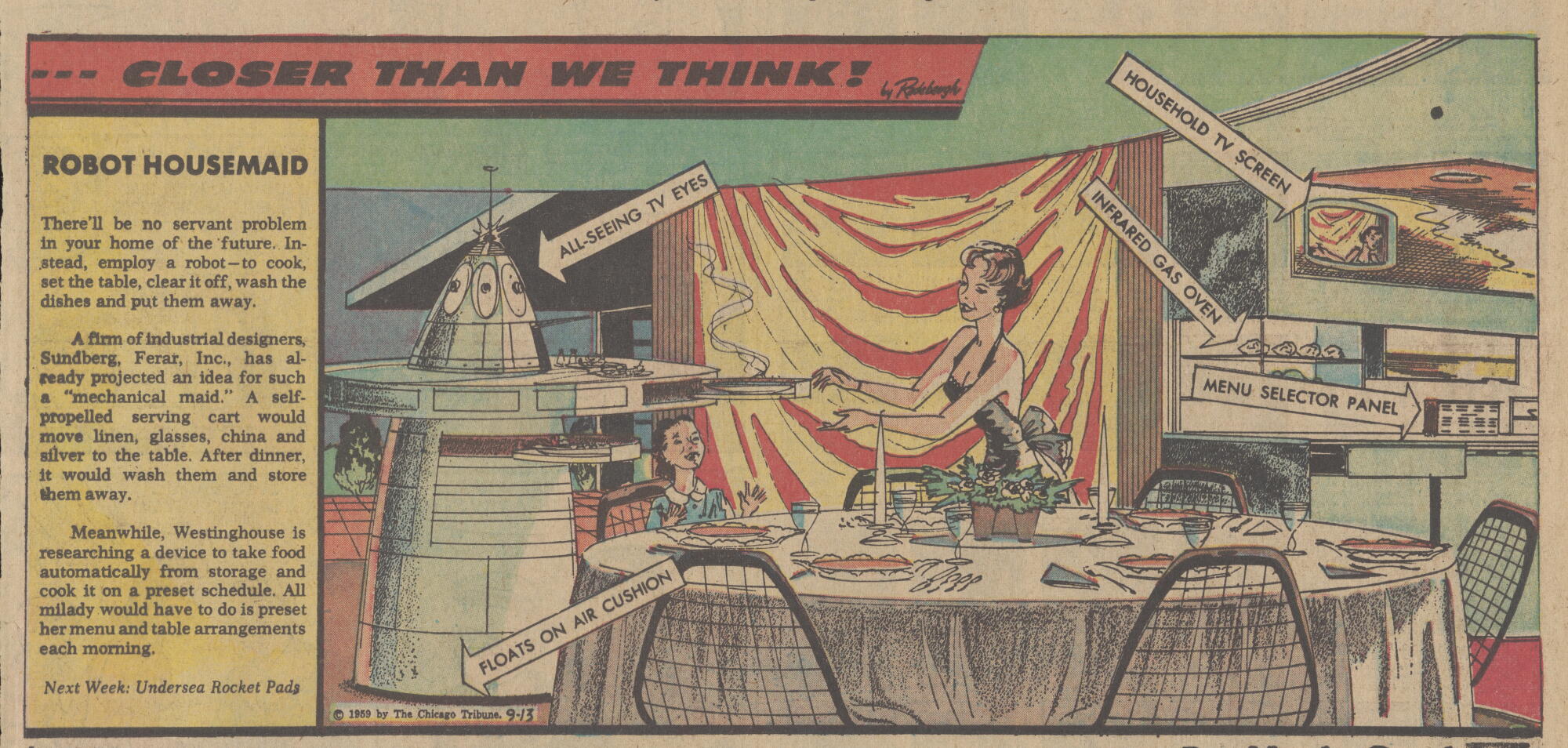
Arthur Radebaugh, “Closer Than We Think! Robot Housemaid,” 1959.
(Chicago Tribune / TCA, photo courtesy San Francisco Academy of Comic Art Collection, Billy Ireland Cartoon Library and Museum, Ohio State University)
At every turn a vision of a better life was made to seem desirable and, just as important, inevitable. Like any good advertising, it worked best when soothing our anxieties and tapping into our fantasies.
In the 1920s and ’30s, new discoveries about hygiene inspired products by soaring talents in the nascent field of industrial design who set out to create clean, easily maintained homes — laboratories for healthy living in an age still ravaged by diseases like polio and tuberculosis. Mathias J. Weber and Russell E. Vanderhoff’s seductively streamlined Health-o-Meter scale gave the illusion that homeowners could be scientists, for the first time monitoring their own weight and growth. Kohler’s Integra, introduced as “the toilet of the future” at the Chicago fair, had a dramatic black finish made to equate sanitation with modern design. And Bruce Goff’s gleaming Vitrolite kitchen for Libbey-Owens-Ford glass company, shown in Charles Turzak’s rendering, integrated pigmented structural glass counters and cabinets into a polished, easily cleaned whole.
American Stove Co., Magic Chef stove, series 1400, introduced 1935.
(Lynton Gardiner / The Wolfsonian–Florida International University )
Vast expansions in electricity, telecommunications and production promised to connect the country and ease the tedious work of cooking, washing and cleaning. The American Stove Co.’s Magic Chef stove, one of the first ovens to be equipped with a clock, recast kitchen work as something that could be measured and controlled. Frank G. Brotz’s Kohler Electric Sink, which incorporated a motorized dishwasher into the familiar basin, promised release from the “thrice-daily drudgery” of washing dishes. Western Electric’s clear-cased Model 302 telephone enticed gawkers with an impressively complex system of wires and mechanisms.
George R. Lum for Western Electric Co., Telephone, model 302, desk set 1938.
(AT&T Archives and History Center)
Many of the names who dreamed up these wonders are now etched in design history. Isamu Noguchi created a baby monitor before baby monitors were a thing: the Radio Nurse, a dark Bakelite receiver resembling an abstract face. Walter Dorwin Teague gave corporate products a precise, machine-age polish, while Raymond Loewy brought the same sleek optimism to objects like the globe-shaped New World radio for Colonial Radio Corp., molded in glossy, heat-resistant Catalin and embodying quite literally the new reach of communications.
Selling this promise of a technological future to those clinging to the dream of American prosperity was an especially potent exercise during the Depression. In his illustrated 1932 manifesto “Horizons,” Norman Bel Geddes cast “new design” as a path toward “economy, efficiency, comfort and happiness.” As the economy faltered, an orderly, healthy home could be sold as a form of salvation, with prosperity seemingly within reach. At the Chicago fair, corporations sponsored full-scale model homes and filled them with products already available or soon to be. For rural households still without electricity, Lester Beall’s 1937 Rural Electrification Administration poster “Wash Day” turns federal infrastructure into a household fantasy. Inside the black silhouette of a farmhouse, a pristine white washing machine appears at an almost monumental scale, set against flat fields of saturated color.
Irving Harper of George Nelson and Co. for Herman Miller Inc., Marshmallow Love Seat, model 5670, designed 1956, this example made c. 1960s.
(Jonathan Urban / Museum Associates / LACMA)
By the ‘40s and ‘50s, the postwar home and its many accouterments — powered by wartime advancements, growing abundance and an ethos of “buy now, pay later” — amplified the promise. Plastic, prefabrication and push-button convenience suggested that mass production could bring elegant, futuristic living — and freedom from drudgery — within reach of the masses. George Nelson treated furniture as a flexible system, producing (with designer Irving Harper) the candy-colored Marshmallow Love Seat; replacing conventional upholstery with 18 brightly colored circular cushions mounted on a spare steel frame. Eero Saarinen produced the molded-fiberglass Pedestal chair, sweeping the seat and stem into a single sculptural form intended to eliminate what he called the “slum of legs” beneath tables and chairs.
Eero Aarnio for Asko Oy, Ball Chair, designed 1963.
(Jonathan Urban / Museum Associates / LACMA)
Architects attempted to make the home itself into a sexy product. At Disneyland, Monsanto’s House of the Future, designed by architects Richard Hamilton and Marvin Goody, was a gleaming, cross-shaped structure of molded plastic, raised above the ground on cantilevered supports and partnered (in renderings) with a plastic heliport. Its kitchen featured molded surfaces and electric appliances. Promotional images and films conjured a playful, adaptable and benevolent house — plastic as the building block of family happiness.
Buckminster Fuller’s Dymaxion house was an aluminum, factory-made “dwelling machine” that could be delivered by air and assembled almost anywhere. Its unified form, modular furnishings, water-recycling system and labor-saving technology promised a more efficient life, less tied to conventional building and household routines.
Hamilton & Goody Architects, Monsanto House of the Future, 1956.
(MIT Museum)
Institutions like the Museum of Modern Art and magazines like Arts & Architecture promoted prototype homes from now legendary industrial designers and modernist architects like Saarinen, Charles and Ray Eames, Marcel Breuer, Albert Frey, Gregory Ain and even Frank Lloyd Wright.
Effective pitches could turn a product, whatever size, into a fantasy of freedom. In the General Motors film “Design for Dreaming” (1956), directed by William Beaudine, a woman enters a fabulous kitchen as if in a magical dream. The promise, said curator Wendy Kaplan, was that the fictional woman would have more time for “tennis and hanging with … friends.” The dream even hinted at a life beyond domesticity — perhaps even freedom to “actually have a profession,” Kaplan added.
But the housewife in these displays was still expected to remain responsible for the home. Liberation came through a more efficient kitchen, not a change in who cooked. And appliances that reduced some labor often raised the bar: more frequent washing, more cleaning, more elaborate meals, as University of Chicago home economics professor Hazel Kyrk described in “Economic Problems of the Family.”
Frank G. Brotz for Kohler Co., Electric Sink, introduced 1926, this example 1928, Kohler Co.
(Kohler Archives)
That universal “everyone” did not, however, include everyone. Government-backed home ownership and the suburban boom excluded many Black, Latino and Asian Americans through redlining, restrictive covenants and discriminatory lending — a fact reflected in the almost complete absence of minorities in these vast selling campaigns.
A few welcome exceptions on the creators’ side are architect Paul R. Williams’ “Small Home of Tomorrow,” which proposed a simple, well-designed home fitted with gee-whiz appliances; Arthur Elrod and William C. Raiser’s swirling, vivid orange Ebony test kitchen, which treated cooking as creative craft; and the proposed multiracial community of Soul City, founded by Floyd McKissick, which imagined homeownership as a claim to economic autonomy that segregation denied.
The vision of a utopian domestic future took a strange turn during the Cold War, marrying the breathless excitement of the space age with the existential dread of nuclear annihilation. The same scientific power that had transformed lives now produced weapons capable of destroying humanity. The home was imagined as both shelter and command center.
Office of Donald Deskey Associates. Drawing, design for Undersea Lounge: Scheme 3 Interior Perspective, ca. 1960s. Designed by Russell Heston (b. 1929).
(The Estate of Donald Deskey, courtesy Cooper Hewitt, Smithsonian Design Museum / Art Resource, NY)
As the age’s potent mix of terror and delirium spun on, designers and illustrators proposed ways to live comfortably in space, underwater or in underground bunkers. Paul László’s “Atomville, U.S.A.,” a vision of suburbia half a century in the future, buried the family home beneath an earthen shell that doubled as a helicopter landing pad. Its sunken gardens and swimming pool promised comfort, while a blast door, escape hatches and air filtration protected against nuclear fallout. Donald Deskey Associates imagined a hypnotic “Undersea Lounge,” a self-contained interior for living beneath the water, while NASA illustrator Rick Guidice vividly depicted physicist Gerard K. O’Neill’s proposed Stanford Torus — an enormous, wheel-shaped suburb in space.
Bob Lerner for LOOK Magazine, Anne Anderson in RCA Whirlpool Miracle Kitchen, 1959, kitchen designed 1956.
(Library of Congress, Prints and Photographs Division, LOOK Magazine, Photograph Collection / Robert S. Lerner Photography, LLC)
An endless array of products leaned into the public’s awe at the age’s sci-fi possibilities. This included prescient pieces ahead of their time, like the video-enabled AT&T Picturephone, and those that would never come to pass, such as the RCA Whirlpool Miracle Kitchen. The latter’s spread in Look Magazine (displayed for crowds at the 1959 American National Exhibition in Moscow) showcases a Roomba-like vacuum and other astonishing appliances that seem to work by themselves. But men hidden behind two-way mirrors actually operated them. Others, like the two-wheeled Ford Gyron Remote Control Car of the Future, only managed to come to life as children’s toys; and some were just plain ridiculous, like Honeywell’s H316 Kitchen Computer, which required a two-week training course just to retrieve a recipe.
By the late 1960s, confidence in technological progress was fraying. Environmental damage, plastic waste and the conformity of suburbia prompted designers and countercultural communities to imagine other ways of living — up to a point. The residents of Drop City, a Colorado artists’ community, built domes from the curved steel tops of salvaged cars. Architects Barry Simpson and Charles Hosford made a folding stool that could serve as a seat, stepstool or side table. Small, portable, multipurpose designs, from inflatables to cardboard furniture offered a life with fewer possessions. The Whole Earth Catalog, founded by writer and editor Stewart Brand, promoted ecological knowledge and self-sufficiency, but was still a compendium of things to buy.
Companies, too, found ways to sell all natural products, flexibility and individual expression. Zanotta advertised the first beanbag chair, the polystyrene-filled “Sacco,” as “A Big Bag, a Soft Seat.” Its formless body accommodated slouching, lounging or lying down, selling freedom from both conventional posture and the bourgeois living room. Even resistance to consumerism could be packaged as a new consumer ideal.
The pairing of objects with their promotional campaigns is the show’s most illuminating contribution, shedding light on the massive, often strange apparatus needed to drive these incredible designs — some icons, some welcome surprises — forward in each age. It reveals how the country’s 20th century manufacturing prowess expanded into the production of dreams. Corporations, government and the media taught consumers what progress should look like, which anxieties a product might soothe, and what kind of future to desire.
Isamu Noguchi; Zenith Radio Corporation, Radio Nurse receiver and Guardian Ear transmitter with original box, 1937.
( Museum Associates / LACMA)
But the sheer abundance of objects — I haven’t even mentioned the fascinating companion show-within-the-show, “The Kitchen and Its Discontents” — leaves less room for examining those campaigns and the work they performed. The excellent catalog follows those connections further, tracing how often hypnotic visions of the future home both reflected and shaped ideas about lifestyle, progress, gender, race, labor and consumption; in the galleries, those ideas remain largely suggestive.
Still, the exhibition offers a revelatory history — and a telling roadmap to our present. While the future imagined here made life easier, cleaner, more beautiful and more exciting, it did not arrive as advertised. The plastic home didn’t remake housing; the automated kitchen didn’t free women from domestic work; the self-sufficient home gave way to new forms of reliance. Yet a similar techno-utopian pitch survives in today’s smart homes and domestic technologies, from assistants like Alexa to artificial intelligence marketed as a way to make life easier. These tools may offer real benefits even as they addict and distract us. And while the systems sustaining our comfortable, consumption-driven lives launch us toward climate disaster.
These rooms powerfully evoke what Kaplan in the catalog calls America’s “restless forward motion, powered by the conviction that tomorrow’s design would solve today’s problems.” That ingenuity is worth celebrating. But its promises deserve open-eyed scrutiny.
Paramount Skydance has completed its takeover of Warner Bros Discovery, bringing CNN and CBS News under the same corporate ownership, in a deal that has raised concerns about editorial independence and freedom of speech.
The acquisition, worth about $110bn including debt, combines two of Hollywood’s biggest studios after months of legal challenges lodged by state attorneys general and unions.
Recommended Stories
list of 4 itemsend of list
The new company, Skydance Corporation, brings together HBO, CBS, Nickelodeon, Showtime, Comedy Central, DC Studios and Food Network, alongside streaming services Paramount plus and HBO Max.
But its control of two major US news organisations has drawn particular scrutiny. David Ellison, Skydance’s chairman and chief executive, has promised to preserve their editorial independence, but his father, Oracle cofounder Larry Ellison is a major financial backer of the deal, and has previously donated funds to US President Donald Trump and Israel.
Asked about the takeover on Tuesday, Trump welcomed it. “They’re terrific people, and it’s going to be a great company,” he said.
Why was the merger challenged?
The takeover faced initial opposition from Hollywood workers, politicians and state prosecutors concerned about the mounting concentration of power in an industry already dominated by a handful of companies.
Netflix initially reached an agreement to buy part of Warner Bros Discovery. Paramount then launched a competing bid, prompting a bidding war before Netflix walked away.
A California-led coalition of 12 state attorneys general sued to block the deal, saying that it would reduce competition and raise prices. The Writers Guild of America brought a separate challenge.
Both cases were settled in September when Paramount agreed to commitments relating to film production, support for displaced workers and protections for the news networks, including the creation of a new editorial independence board.
But the settlement did not end opposition to the deal. “This merger will stifle creativity, weaken free speech and cost people their jobs,” actor and activist Mark Ruffalo has said.
Democratic Senator Elizabeth Warren linked the takeover to Trump’s efforts to restrict media access. “As Trump tries to ban CNN from the White House, it would be a massive mistake to cave on the Paramount merger,” she said, referring to the US president’s so-far thwarted attempt last month to bar reporters from several news organisations, including CNN, from accessing the White House.
Can an editorial independence board protect CNN and CBS?
One condition of the settlement requires Skydance to establish a “News Editorial Independence Board” within 180 days of completing the takeover.
The five-member body is to include active or retired journalists with at least 10 years of experience. It is intended to establish editorial principles and address disputes involving the news networks and corporate management.
However, its members will be appointed by, and will report to, Skydance’s board of directors, which Ellison chairs. Two members can belong to the same political party, and there is no requirement to publish its findings.
The condition has left critics with a multitude of questions, including: How can a member of an independent editorial board be a member of a political party? How can there be scrutiny if its findings are not public? How can it be independent if it is appointed by a board of directors, themselves appointed by the CEO of the company?
Seth Stern, chief of advocacy at the Freedom of the Press Foundation, said, “A Paramount-appointed editorial independence board for CNN and CBS is worthless. The fish rots from the head, and this particular fish is headed by a compromised oligarch with a history of throwing journalists under the bus to advance his business interests.”
Stern also questioned whether government enforcement of the settlement could itself threaten press freedom. “The editorial board creates the same First Amendment problems it’s supposed to solve – the government meddling in the news.”
The First Amendment provides constitutional protection for freedom of speech and the press.
Ellison argues that the two networks will continue to operate independently. “We’re going to make sure that CNN and CBS News are completely editorially independent,” he said on Tuesday.
On Monday, Skydance announced that Mark Thompson would remain CNN’s chairman and editor-in-chief, while Bari Weiss will continue as CBS News’s editor-in-chief, easing previous fears that Weiss would immediately take charge of both networks.
Why are there fears for editorial independence?
The takeover gives the Ellison family control of CNN less than a month before the November 3 US midterm elections, and follows Trump’s repeated attacks on the network as it seeks to hold the US president to account.
Shortly after Paramount launched its bid in December, Trump accused CNN of spreading “poison and lies” and said it was “imperative” that it be sold, while the Trump administration has moved to bar CNN from reporting in certain areas of the White House.
Ellison donated roughly $45m to a political nonprofit group supporting Trump’s election efforts in 2024, while he donated $16.6m to Friends of the Israel Defense Forces, a charity supporting Israeli soldiers – its largest single donation at the time.
Earlier this year, the White House criticised CNN’s coverage of the US-Israeli war on Iran, while Defence Secretary Pete Hegseth told reporters that “the sooner David Ellison takes over that network, the better.”
Sovereign wealth funds from Saudi Arabia, Qatar and the United Arab Emirates also hold indirect financial interests in the combined company. They have no voting stakes, although their involvement adds another layer of scrutiny over its funding.
Concerns about the future for editorial integrity, however, intensified after Skydance acquired Paramount in 2025, and layoffs followed, alongside the closure of CBS News Radio and changes to CBS News flagship investigative programme 60 Minutes.
High-profile firings enacted under CBS News Editor-in-Chief Bari Weiss and Skydance Media CEO David Ellison included correspondents Sharyn Alfonsi and Cecilia Vega, as well as 60 Minutes executive producer Tanya Simon.
The programme’s September season premiere attracted about 21 percent fewer viewers than a year earlier.
In 2025, Paramount also agreed to pay Trump $16m to settle a lawsuit over the editing of a 60 Minutes interview with then-presidential candidate Kamala Harris.
In a June 2 letter, nine advocacy groups, including Reporters Without Borders, the Freedom of the Press Foundation and the Committee for the First Amendment, warned that CNN could face similar upheaval and firings.
“Bari Weiss’ shameless actions fulfil the Ellisons’ commitment to President Trump to remake CBS to his liking,” they alleged, referring to the firings and changes at 60 Minutes.
“Larry Ellison has reportedly promised to do the same at CNN if allowed to take control through the pending Paramount-Warner Bros. Discovery merger. Not because it makes any business sense, but because they seek to control the public discourse.”
The groups described the proposed takeover as an “existential threat to the free press, independent media, and free speech in this country and beyond”.
Even Fox News, one of President Trump’s preferred media outlets, isn’t exempt from his go-to term for any woman he dislikes.
“She can be so nasty,” was how Trump recently described the conservative-leaning network’s senior White House correspondent Jacqui Heinrich.
Never one to hold back, the president has also had harsh words for her spouse, Rep. Brian Fitzpatrick of Pennsylvania, a moderate Republican congressman. “Her husband votes against me all the time,” Trump once said. “Can you imagine?”
The double-barreled attacks don’t bother Heinrich, who as president of the White House Correspondents Assn. is leading the fight against Trump’s ban on CNN, MS NOW and Politico. When Trump delivered his insult at the WHCA’s dinner in July, Heinrich just shrugged and smiled.
“You don’t get into journalism to be well liked by the subject that you’re covering,” Heinrich said in a recent phone interview. “As long as I’m doing my job, which is to get the story and tell it fairly and fully, the rest of it is not really my business to care about. It’s probably not the last time I’ll upset him. The president still takes my calls.”
Heinrich’s durability is being put to the test as she delivers the public and private messaging on the latest battle with the White House over press freedom. Trump banned the three outlets from the White House grounds due to what he believes is their constant negative coverage.
A federal judge issued a temporary restraining order to block the move, calling it viewpoint discrimination and a violation of the outlets’ 1st Amendment rights. But the administration continues to prevent CNN from serving in the press pool that follows the president at all times. More court hearings are ahead.
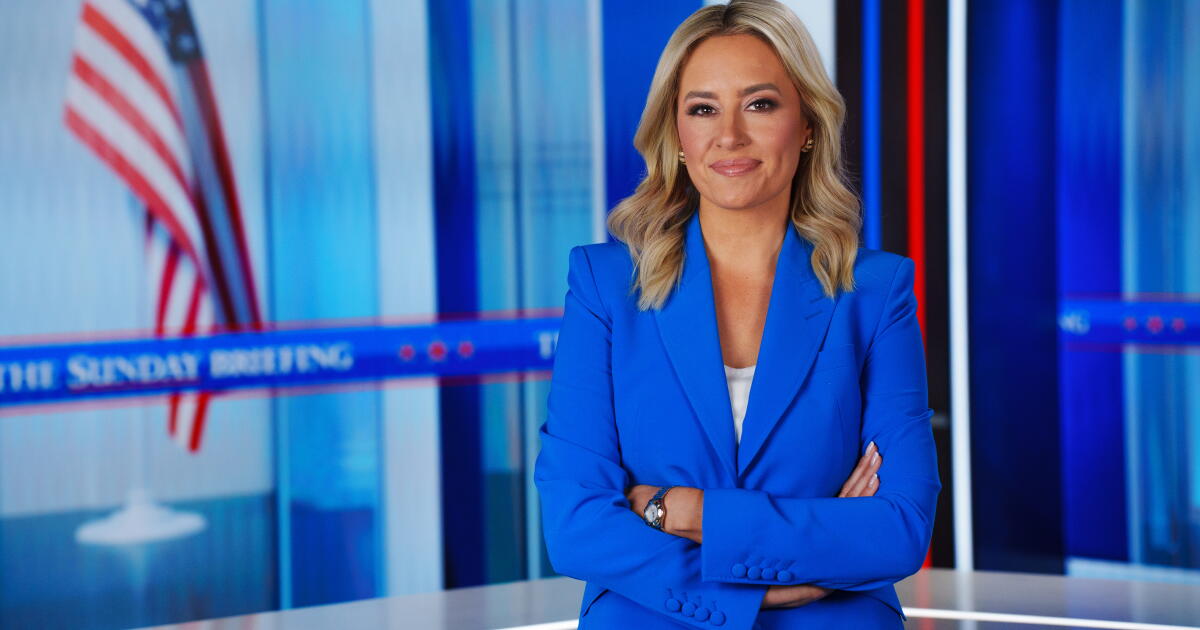
Over the last 10 days, Heinrich has issued public statements condemning the ban, monitored the legal proceedings and held back channel conversations with the White House in an effort to get Trump’s decision reversed. It’s a second job on top of covering the president and co-hosting a weekend program “The Sunday Briefing.”
Executives and journalists say privately that it’s helpful to have someone from a Trump-friendly outlet lead the organization to restore the press credentials of outlets the president views as hostile. The WHCA exists to maintain and facilitate access to the White House for its 900 members across 250 news organizations.
But for Heinrich, it’s logical that 1st Amendment arguments transcend any political leanings of any media outlet. If Trump’s ban stands, conservative news organizations could find themselves facing similar restrictions the next time a Democrat is in the Oval Office.
“When you empower the president to select who is allowed to ask them questions, it shrinks the room,” Heinrich said. “It shrinks the perspective and it hands over that same authority to the next administration, who will surround themselves with only voices that approve of or are supportive or friendly toward what they’re doing.”
Eugene Daniels, a co-host at the progressive-leaning MS NOW and a former White House Correspondents Assn. president, said the organization’s members from Fox News and the further right-leaning Newsmax were always supportive of 1st Amendment and press access issues during his tenure.
“A lot of our news organizations understand intrinsically that at some point the shoe could be on the other foot,” Daniels said. “The solidarity matters.”
Daniels has also known Heinrich since the two worked together years ago at a TV station in Colorado Springs, Colo., and believes she is well-equipped to push the WHCA’s cause.
“She’s clear eyed about the role of White House correspondents in covering any president,” he said. “She is very tough and always has been since we’ve met. She stands 10 toes down when it comes to what’s right.”
Heinrich’s respect for journalistic principles has even extended to her personal life. When Fitzpatrick first asked her out on a date five years ago, he had to wait several weeks for an answer. Heinrich checked with her Fox News bosses to see if dating an elected official was a conflict even though she was no longer assigned to covering congress.
“He was very patient,” Heinrich said. The couple was married at New York’s St. Patrick’s Cathedral in June.
Heinrich is among the correspondents at Fox News — which this week will mark 30 years on the air — whose reporting doesn’t adhere to the leanings of its opinion hosts and commentators.
In 2020, Heinrich reported on Trump’s false claims of voter fraud in the election he lost to Joe Biden, while commentators, hosts and guests on the network continued to raise doubts about the results. Her reporting angered hosts such as Tucker Carlson and Sean Hannity, who were concerned that her work was alienating viewers loyal to the president.
Carlson called on Fox News Media Chief Executive Suzanne Scott to fire Heinrich in a text that came to light three years later when Dominion Voting System filed its defamation suit against the network. Dominion claimed Fox News deliberately aired false statements about the company’s role in the 2020 election, settling the suit for $787 million.
But Heinrich said she was unaware of the conversations before they were revealed in a legal brief in February 2023. (Carlson was fired from Fox News two months later.) She has been promoted twice since 2020.
“My bosses never interfered with my reporting,” she said.
Heinrich, 37, studied international affairs at George Washington University and wanted to pursue a career in the State Department before internships at MSNBC and WRC-TV in Washington led her to journalism. After working at several local TV stations she became a Fox News correspondent in New York in 2018. She covered Congress and the 2020 presidential campaign before moving to the White House beat in 2021.
Heinrich was raised in New England in what she describes as a politically diverse family. Her parents divorced when she was young, and she split her time between a conservative father in New Hampshire, a politically moderate mother in Maine and a Bernie Sanders-supporting stepfather from Vermont. She believes her upbringing was excellent training for her profession.
“It was ‘Live Free or Die’ and socialism all under two roofs but one family,” she said. “We have developed a really keen ability to listen. I think that’s one of the most important parts of journalism, is hearing and understanding someone’s perspective enough that you can describe it to someone else in a way that is fair and complete.”
Once Heinrich gets past the current conflict with the White House, she’ll have to plan the association’s annual dinner. (The event was cut short and rescheduled this year after a gunman attempted to enter the ballroom at the Washington Hilton.)
Heinrich said even with the president’s open hostility toward the press, he will be welcomed to the event in 2027.
“We have invited the president every single year for the last 115 years and that’s not going to change just because of President Trump,” Heinrich said. “We uphold laws, norms, and traditions around here and we intend to keep it that way.”
Aditi Subramanian joined protests after the alleged gang rape of a teenager in New Delhi, calling for women’s safety without more restrictions or surveillance. As she and hundreds of others tried to reach the planned protest site, they were detained. This piece was produced in collaboration with Jigyasa Mishra.
The Venezuelan government and opposition delegations met at the 5-star Meliá Hotel in Caracas. (National Assembly)
Caracas, September 28, 2026 (venezuelanalysis.com) – The Venezuelan government and delegates representing a defunct, opposition-majority parliament concluded, on September 25, a second round of US-backed talks focused on political and judicial reforms.
The negotiations produced preliminary agreements focused on judicial reform and loosening administrative restrictions on several opposition-aligned news outlets.
The primary advance in the negotiations centered on a comprehensive proposal to restructure Venezuela’s Supreme Court of Justice (TSJ).
According to official statements, both delegations established a seven-person committee to review the qualifications of Supreme Court justice candidates. The two parties also agreed to create a Judicial Nominations Committee within the National Assembly to oversee the selection process for new magistrates.
This committee will oversee applications from legal scholars, public sector workers, and civil society members, subjecting applicants to rigorous constitutional criteria before submitting a final list of recommended nominees for a plenary vote in the legislative body.
Speaking at the close of the talks at the Meliá Hotel in Caracas, National Assembly President and head of the government delegation, Jorge Rodríguez, highlighted the consensus achieved regarding judicial reform.
“We have reached concrete agreements to strengthen our democratic institutions, starting with a transparent process to evaluate and appoint magistrates to the Supreme Court,” Rodríguez stated to reporters. “This dialogue demonstrates that through constitutional channels and mutual respect, Venezuelans can resolve their differences without foreign interference.”
Representatives from the opposition delegation similarly acknowledged the priority of reforming the judicial branch.
Dinorah Figuera, president of the faction from the defunct National Assembly elected in 2025, claimed that the ongoing negotiations are aimed at “re-institutionalizing” the country.
“If the TSJ and the CNE move forward alongside political and civil guarantees, social issues and the health sector must also be linked to this process of re-institutionalization.”
The two sides launched a dialogue process in August, with a first round of talks launching the Supreme Court overhaul as well as a joint initiative to recover Venezuelan gold reserves frozen by the Bank of England. The 31 tons of gold, valued at around US $4 billion, will reportedly be transferred to the US before being used for earthquake reconstruction efforts with oversight from US authorities.
The Trump administration has endorsed the negotiations, with the State Department calling it a “unique opportunity” for a “political transition” in Venezuela. In a press conference last week, US Secretary of State Marco Rubio affirmed that the ongoing talks will “create the groundwork and rebuild the institutions necessary in order to have free and fair elections.”
In addition to the latest judicial reforms, both delegations agreed to lift long-standing administrative sanctions against select media organizations such as El Pitazo, Efecto Cocuyo, EFE Agency, among others.
Several outlets had been subjected to legal investigations or broadcast suspensions after being accused of endorsing or broadcasting content linked to past coup attempts and violent anti-government demonstrations.
The lifting of the administrative bans is intended to restore legal broadcast licenses and digital accessibility to several platforms. Government negotiators emphasized that while media outlets are expected to operate within the bounds of national laws regarding public safety, anti-hate regulations, and constitutional order, the agreement serves as a good-faith gesture to expand freedom of expression and media pluralism in the country.
As the closing of the second round of talks, both the Venezuelan government and opposition negotiators indicated that technical commissions will continue working in the coming weeks to finalize the nomination guidelines for the TSJ magistrates and monitor the administrative implementation of the media agreements. They will begin a third round of talks in October.
Washington’s backing for the 2015 National Assembly to take part in dialogue with the government has exposed rifts among the Venezuelan opposition, particularly with a far-right sector led by María Corina Machado.
A longtime endorser of international sanctions and aggressive regime-change strategies, Machado has reportedly attempted to return to Venezuela in recent weeks after a long hiatus abroad.
According to multiple sources, the attempts to enter Venezuelan territory have been frustrated by transportation-related technical issues; in both air and sea travel attempts, the companies involved cancelled the trips due to operational problems.
Despite a long absence from Venezuela, Machado has retained support in the US political establishment. The United States Senate has scheduled an urgent committee meeting to address the political situation in Venezuela, with lawmakers explicitly placing Machado’s return to Venezuela and her political eligibility at the top of the agenda.
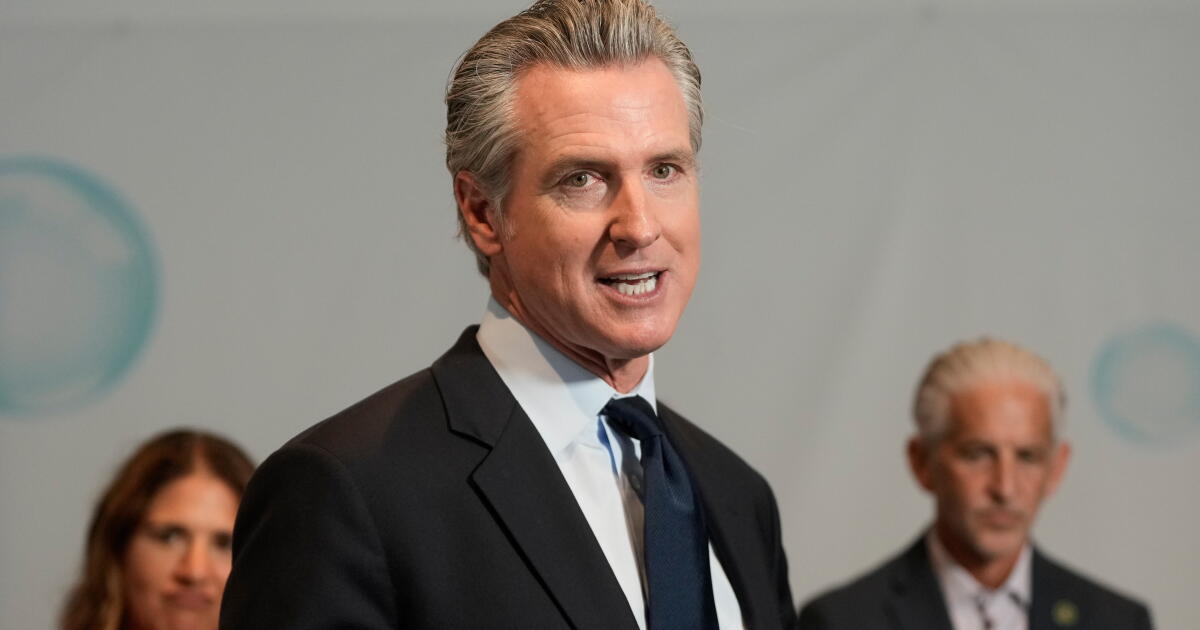
Gov. Gavin Newsom has signed a package of bills that he says are intended to build on California’s record of protecting reproductive rights and expanding access to care.
One of the measures, sponsored by Assemblymember Catherine Stefani (D-San Francisco), increases access to medication abortion by making it available on community college campuses.
Another bill, sponsored by Assemblymember Jacqui Irwin (D-Thousand Oaks), focuses on military veterans, aiming to address a gap in their healthcare after the Trump administration largely banned the U.S. Department of Veterans Affairs from providing abortion services. The measure enables California veterans to access abortion and contraception services through a state program.
“Freedom means being able to make deeply personal decisions without elected officials inserting themselves in pursuit of a political agenda,” Newsom said. “California is protecting that freedom and showing the nation, particularly under increasingly severe attacks by the Trump administration, what is possible when we put patients and people first — not politics.”
The governor announced the signing of the bills on Sunday, saying they will strengthen reproductive healthcare in the state.
One of the bills, introduced by Stefani, expands the ability of certified nurse-midwives to provide care for pregnant and postpartum patients by specifying that supervision by a physician is not required when providing certain services.
The legislation also included a bill sponsored by Assemblymember Celeste Rodriguez (D-San Fernando) that aims to expand access to breast pumps and services for nursing mothers through Medi-Cal.