fraud

Steve Ballmer blasts Aspiration co-founder’s bid for lenient sentence

As many as a dozen letters — including one from the NBA — were submitted by the attorney for Aspiration Partners co-founder Joe Sanberg ahead of his sentencing Monday in an effort to persuade the judge to trim the 17 years prosecutors have requested for each of the two counts of fraud.

Sanberg pleaded guilty in October to the federal charges of conspiring to bilk investors out of $248 million for portraying the now-defunct Aspiration as a “socially-conscious and sustainable banking services and investment products” firm.

Another letter was also submitted, however, and it wasn’t intended to assist Sanberg.

Clippers owner Steve Ballmer’s attorney David N. Kelley of O’Melveny and Myers wrote that Ballmer was defrauded of a $60-million investment in Aspiration and that the harm to his reputation is “immeasurable.”

The five-page Victim Impact Statement concludes: “Mr. Ballmer’s losses are not measured solely, or even primarily, on a balance sheet. They are measured in the reputational damage that will take years to remediate, and in the chilling effect on future endeavors intended to do good at scale.

“We ask the court to impose a sentence that accounts for those harms, promotes respect for the law, and deters those who would seek to appropriate the reputations of others to advance fraudulent aims.”

The letter states that the Clippers lost out on a $300 million sponsorship agreement with Sanberg in exchange for the team to wear Aspiration jerseys patches. Also lost was about $20 million the Clippers paid for carbon offset purchases and the $60 million Ballmer invested in the company.

Ballmer, a former long-time CEO of Microsoft, accused Sanberg of targeting him for his well-known interest in environmental sustainability and exaggerating their relationship to convince others to invest in the fraudulent company. In the letter, Ballmer says he met Sanberg only once.

Ballmer was added in November as a defendant in an existing civil lawsuit against Sanberg and several others associated with Aspiration. Ballmer and the other defendants are accused by 11 investors in Aspiration of fraud and aiding and abetting fraud, with the plaintiffs seeking at least $50 million in damages.

The letter dismisses the allegations in the lawsuit as “nonsense,” stating Ballmer was added as a defendant because of his “visibility and resources,” and reiterates that Ballmer himself is a victim of fraud. The action has damaged his reputation, the letter states, “and has further linked Mr. Ballmer to Sanberg’s fraud in the eyes of the public.”

The letter to the court, however, makes no mention of the $28-million contract Clippers star Kawhi Leonard signed with Aspiration for endorsement and marketing work. Players are allowed to have separate endorsement and other business deals, but at issue is whether the Clippers participated in arranging the side deal beyond simply introducing Aspiration executives to Leonard.

Leonard has addressed the accusations only once, denying wrongdoing and saying, “I understand the full contract and services that I had to do. Like I said, I don’t deal with conspiracies or the click-bait analysts or journalism that’s going on.”

The arrangement could be considered circumventing the NBA salary cap, a serious violation of league rules. Ballmer steadfastly denies arranging the deal between Aspiration and Leonard, who by all accounts performed no duties for Aspiration.

The NBA is investigating the complicated relationships between Ballmer, Leonard and Aspiration. One of the letters submitted by Sanberg’s attorney to the judge is from the law firm conducting the probe, and it states that the disgraced executive provided documentation and information helpful to the NBA investigation during two in-person interviews.

“In all our dealings with Mr. Sanberg, both directly and through his counsel, he provided information that was consistent with our review of contemporaneous documents and other evidence,” wrote Dave Anders of Wachtell Lipton. “Mr. Sanberg’s cooperation substantially assisted our investigation, including our ability to develop a more complete understanding of key events.”

Eventually the ledger will include the results of the NBA investigation into the allegations against Ballmer and Leonard. And that finding might impact the reputation of both more than Sanberg’s fraudulent dealings.

Source link

Justice Department indicts Southern Poverty Law Center on financial fraud charges

April 22 (UPI) — Federal prosecutors Tuesday evening announced an 11-count indictment against the Southern Poverty Law Center, accusing the non-profit of defrauding donors by using their money to pay informants within hate groups they were monitoring.

Acting Attorney General Todd Blanche announced the indictment from a Montgomery, Ala., grand jury during a press conference, alleging that between 2014 and 2023, the SPLC paid more than $3 million to informants in hate groups the organization had vowed to dismantle.

“As the indictment described, the SPLC was not dismantling these groups, but it was instead manufacturing the extremism it purports to oppose by paying sources to stoke racial hatred,” he said, alongside FBI Director Kash Patel.

The indictment, which was returned by an Alabama grand jury just minutes before the press conference, details payments to informants in groups such as the neo-Nazi National Alliance and the Ku Klux Klan, but does not detail extensive evidence that the money was “used to fund the leaders and organizers of racist groups.”

Federal prosecutors allege that the SPLC obtained money via donations by making “‘materially false representations and omissions about” what the money would be used for and utilized bank accounts linked to “fictitious entities” to covertly pay their field sources.

One SPLC informant is described in the court document as a member of the online leadership chat group behind the 2017 Unite The Right protest in Charlottesville, Va., where one person was killed when a car rammed counterprotesters.

This informant was paid more than $270,000 between 2015 and 2023, according to the indictment, which alleges that they attended the Unite the Right event “at the direction of the SPLC,” made “racist postings under the supervision of the SPLC and helped coordinate transportation to the event for several attendees.

Another SPLC informant described by federal prosecutors as being affiliated with the neo-Nazi National Alliance organization stole 25 boxes of documents from the headquarters of a violent extremist group, copied the materials for the SPLC and returned the originals. The court document alleges that the SPLC paid the informant more than $1 million between 2014 and 2023.

Blanche told reporters during the press conference that the informants were paid via pre-paid cards with funds from donors that were moved from bank accounts that the SPLC created for five fictitious organizations in order to shield the source of the funds.

“They attempted to hide their criminal activity from our financial banking network,” Patel said.

“They set up shell companies and entities around America so that the financial system that we rely on as everyday Americans were deceived into believing that money is not coming from the Southern Poverty Law Center in the perpetration of this scheme and fraud but rather fictitious entities they stood up to perpetuate this ongoing fraud.”

The indictment charges the SPLC with six counts of wire fraud, four counts of bank fraud and one count of conspiracy to commit money laundering.

Ahead of the press conference, SPLC CEO Bryan Fair announced in a video statement that the organization and its employees were the target of a federal investigation focused on its use of informants, though they had yet to know all the details.

He defended the SPLC’s use of informants as necessary to protect themselves and the public after decades of being “engaged in unprecedented litigation to dismantle the Klan and other hate groups.”

Information the SPLC gained from the informants was frequently shared with local and federal law enforcement, including the FBI, he said, adding that they did not broadly share their use of informants to protect their identities.

“While we no longer work with paid informants, we continue to take their safety seriously. These individuals risked their lives to infiltrate and inform on the activities of our nation’s most radical and violent extremist groups,” he said, vowing to fight the allegations.

“We will not be intimidated into silence or contrition, and we will not abandon our mission or the communities we serve.”

The SPLC has long faced criticism from some Republicans and conservatives, who say the prominent anti-hate nonprofit has drifted from its mission of fighting extremism and White supremacy by labeling several right-wing organizations as hate groups.

In October, Patel announced that the FBI severed ties with the SPLC, accusing it of having “long abandoned civil rights work and turned into a partisan smear machine.”

Democrats, SPLC supporters and critics of the Trump administration lambasted the indictment as politically motivated, with the American Civil Liberties Union calling it “another example of the Trump administration’s extreme attempts to silence its critics.”

“Let’s be clear about what’s happening here. This administration is using the full weight of federal prosecution to target an organization whose mission is rooting out violent extremism,” Sen. Cory Booker, D-N.J., said online.

“This is part and parcel of Trump’s assault on free speech, on nonprofits and on anyone who dares to disagree with him.”

House Majority Leader Hakeem Jeffries, D-N.Y., called the indictment “baseless and illegitimate.”

“These partisan hacks who continue to weaponize the criminal justice system against perceived opponents will never intimidate us,” he said.

Source link

A vaccine standoff and other key moments from RFK Jr.’s first congressional hearing in months

Health Secretary Robert F. Kennedy Jr. on Thursday faced federal lawmakers for the first time since September as he sought to defend a more than 12% proposed cut to his department’s budget and dodge arrows from angry Democrats along the way.

In his testimony before the House Ways and Means Committee, kicking off an expected sprint of seven budget hearings he’ll attend across congressional committees and subcommittees over the next week, Kennedy emphasized the administration’s work to reform dietary guidelines and crack down on waste, fraud and abuse.

Republicans on the committee praised Kennedy as a “breath of fresh air” and asked him to promote his department’s recent actions. Democrats, who have been furious over Kennedy’s sweeping overhaul of the U.S. Department of Health and Human Services, largely had a different agenda.

They needled Kennedy on what they viewed as the Trump administration’s hypocrisy on fraud, demanded to know why he was cutting budgets for various programs and slammed his efforts to pull back vaccine recommendations and messaging, which they said have caused unnecessary deaths.

Kennedy fired back, often raising his voice as he accused the Democrats of misrepresenting his work and past statements.

Here are three standout moments from Thursday’s hearing:

A standoff over measles

One heated exchange early in the hearing came between Kennedy and Rep. Linda Sanchez. The California Democrat decried recent measles outbreaks across the U.S. and asked Kennedy to answer for the fact that under his leadership, the Centers for Disease Control and Prevention pulled back public health messaging supporting vaccination.

“As a mother, this horrifies me,” Sanchez said. “Did President Trump approve your decision to end CDC’s pro-vaccine public messaging campaign?”

Kennedy repeatedly refused to answer, saying first he wanted to respond to the “misstatements that you’ve made” and later praising the Trump administration’s record on preventing measles, although protections against the disease have eroded in some parts of the country as vaccination rates have dropped.

“That’s not answering my question,” Sanchez said as the two talked over each other.

But Sanchez also got Kennedy, a longtime anti-vaccine activist before he entered politics, to acknowledge that a 6-year-old who died of measles last year in West Texas could have potentially been saved with vaccination.

“Do you agree with the majority of doctors that the measles vaccine could have saved that child’s life in Texas?” she asked.

“It’s possible, certainly,” Kennedy said.

RFK Jr. denies talking about Black children being ‘re-parented’

A fight erupted between Kennedy and Rep. Terri Sewell, a Democrat from Alabama, when Kennedy vehemently denied making remarks he’d said in 2024.

The comments dated back to when Kennedy was a presidential candidate. On the “High Level Conversations” podcast last July, he said, “Psychiatric drugs — which every Black kid is now just standard put on Adderall, SSRIs, benzos, which are known to induce violence, and those kids are going to have a chance to go somewhere and get re-parented to live in a community where there’ll be no cellphones, no screens, you’ll actually have to talk to people.”

“Have you ever re-parented, or parented, I should say, a Black child?” Sewell asked, as her staff held up a poster featuring an abbreviated version of the quote.

“I don’t even know what that phrase means,” Kennedy said. “I’m not going to answer something I didn’t say.”

“You’re making stuff up,” he later claimed.

A recording of the podcast shows he made the comments during a conversation about free rehabilitation facilities he was proposing opening at the time in rural areas around the country.

Health and Human Services spokesperson Emily Hilliard said Kennedy before joining the administration was referring to spaces where young people facing alienation, mental health challenges and despair could get re-parented, which she said was a psychotherapy term for “developing the emotional regulation, discipline, boundaries, and self-worth that may not have been established in childhood.”

For Kennedy and his former party, civility is the exception

Kennedy spent most of his life as a Democrat, the scion of one of the nation’s most famous political families. Both Republicans and Democrats during the hearing began their remarks by expressing their admiration of Kennedy’s relatives, among them former President John F. Kennedy.

But again and again throughout Thursday’s hearing, the fraying of bonds between Kennedy and his former party was on full display as spiteful comments were passed back and forth.

The Health secretary grew defensive and visibly agitated. He repeatedly criticized Democratic lawmakers for not giving him a word in edgewise.

“They’ve all shut me up,” Kennedy said at one point. “They give a little speech that they can go and market, you know, for fundraising, and they don’t allow me to answer the question.”

On a few rare occasions, the exchanges were civil. One representative, Gwen Moore of Wisconsin, used humor to make that happen.

“I promise to give you easy, comfortable questions if you don’t yell at me and hurt my feelings,” she told Kennedy. He promised he wouldn’t.

Swenson writes for the Associated Press.

Source link

Founder of Chinese property giant Evergrande admits theft, fraud, bribery

Hui Ka Yan, the founder and former chair of troubled Chinese property giant, Evergrande Group, pleaded guilty to a slew of charges on Tuesday in a showcase trial in the southern province of Guangdong. File photo by Wu Hong/EPA

April 14 (UPI) — The founder and former chairman of Chinese property giant China Evergrande Group pleaded guilty Tuesday to a slew of charges, including embezzlement, securities fraud and corporate graft at a trial in the southern city of Shenzhen.

Hui Ka Yan admitted “illegally absorbing public deposits” where buyers’ down payments on apartments off-plan were used to fund hundreds of other projects in the case in which Evergrande Real Estate Group also faced a similar set of charges, the Intermediate People’s Court of Shenzhen said in a statement online.

Evergrande took in millions of dollars from buyers that, instead of being used to complete the properties they were purchasing, were diverted to new developments, the court heard.

Hui also admitted fundraising fraud, illegal issuance of loans and unauthorized disclosure of “important information” during the high-profile two-day trial, which was attended by deputies from the National People’s Congress, the Chinese People’s Political Consultative Conference of which he was once a standing committee member, and investors.

The court statement said China Evergrande Group and Evergrande Real Estate Group were also indicted on charges of illegally collecting public deposits, fundraising fraud, illegal issuance of loans and fraudulent issuance of securities.

The downfall of the business tycoon, once Asia’s richest with a net worth of more than $42 billion, began in 2021 when the property empire he founded 25 years earlier collapsed after a massive Chinese property bubble burst, leaving 1,300 half-finished Evergrande developments financed with $300 billion of debt.

Hui was placed under house arrest in September 2023, prompting the suspension of trading in Evergrande shares by market regulators across the border in Hong Kong, only a month after trading had resumed following a 17-month suspension.

The company was also the subject of a winding-up petition in a Hong Kong court brought by creditors and had sought protection from being made bankrupt in the United States in a New York court the previous month.

Hong Kong regulators initially suspended Evergrande for failing to issue financial results for two years. When it did report in July 2023, it said it had lost $81.1 billion total in 2021 and 2022, mostly through payments to suppliers and lenders, as it battled to finish thousands of housing projects across 280 Chinese cities.

In January 2024, after repeated reprieves to allow it time to come up with a viable plan to restructure liabilities that had by then grown to at least $325 billion, the court in Hong Kong placed Evergrande into liquidation.

Hui was handed a $6.5 million fine in March 2024 for Evergrande, stating in its results that revenue was $78 billion more than it actually was and was handed a lifetime ban from participating in China’s capital market.

The final blow came in August 2025 with the delisting by regulators of Evergrande shares from the Hong Kong Stock Exchange, almost 16 years to the day after it was the most oversubscribed IPO of 2009 with a valuation in excess of $50 billion.

The ban was imposed after an 18-month deadline for Evergrande stock to resume trading passed the previous month, with the company opting not to appeal the decision.

Hui had led a 15-year drive to grow Evergrande into one of China’s largest businesses, spending billions expanding into tourism and recreation, healthcare, finance, EV manufacturing and infrastructure, entertainment and agribusiness.

In 2020, it began work on a new $1.7 billion, 100,000-seat stadium for Guangzhou FC, the soccer club it had purchased 10 years earlier.

However, the company’s growth was delivered through massive borrowing, much of it highly leveraged, with the result that six years on the stadium, like many of Evergrande’s projects, it remains incomplete after it was seized by the government in November 2021.

Children race to push colored eggs across the grass during the annual Easter Egg Roll event on the South Lawn of the White House in Washington on April 21, 2025. Easter this year takes place on April 5. Photo by Samuel Corum/UPI | License Photo

Source link

Fraud, fires, federal cuts: What’s in L.A. County $48.8-billion budget

L.A. County officials want to put $2.7 million toward beefing up the team of people investigating fraud within a deluge of recent sex abuse lawsuits, suggesting a broadening probe at the district attorney’s office.

The funding allocation, part of the county’s $48.8-billion budget proposal unveiled Monday, would bring on 10 new people to the small team prosecuting alleged fraud within the county’s historic $4-billion sex abuse settlement. L.A. County Dist. Atty. Nathan Hochman announced the probe last November following a Times investigation that found nine people who said they were paid to sue.

The county has agreed to pay billions to settle more than 11,000 claims of sex abuse in juvenile halls and foster homes, a flood of lawsuits spurred by a 2020 law changing the statute of limitations. Since those settlements, more than 5,000 new lawsuits have been filed with an average of 150 new claims coming in per month, according to the county, raising the prospect of future costly payouts.

Acting Chief Executive Joseph Nicchitta said Monday the new filings would continue to be an “anchor” around the county’s finances.

“It is something that’s going to weigh on us going forward,” he said at a news conference announcing the new spending plan.

Hochman said in a statement that the investigation was a priority for his office and the money would be used to “pursue every credible lead and hold fraudsters accountable.”

“It is our pledge to the real survivors of childhood sexual abuse that we will root out and prosecute those who manufactured false claims and profited or tried to profit from those lies,” Hochman said. “As for those who filed fraudulent claims of sex abuse, the time is growing short for you to turn yourselves in before you are arrested, prosecuted and punished.”

Nicchitta made a pitch for legislative change, noting the county was looking to Sacramento to “eliminate loopholes allowing abusive practices by attorneys that inject weak and potentially fraudulent claims into settlement pools.”

The push by the county to change the law has been hotly criticized by some advocates who accuse government officials of trampling on victims’ rights.

“These reforms that we are seeking are anti-fraud,” said Nicchitta. “They are not anti-survivor.”

The payouts are yet another cloud looming over the budget proposal, along with rising labor costs and federal funding cuts. The recommended budget represents a 7% decrease in spending compared to the current plan.

But Nicchitta said Monday it wasn’t all doom and gloom, with the county managing to stave off layoffs and program cuts.

The upcoming budget proposal, he said, represented the calm before the next big wave of potential rollbacks.

“Remember, we’re in the eye of the hurricane,” he said.

The budget forecast was notably rosier than last year’s, in which the county was saddled with $2 billion in new wildfire costs and had made the first round of slashes to finance the sex abuse payouts. The county froze hiring at the time and made most departments shrink their budgets by 3%.

Those cuts, Nicchitta said, went deep enough that they can avoid major slashes this upcoming fiscal year, though he warned the fallout from the Trump administration’s “One Big Beautiful Bill” will soon wreak fresh havoc on the county’s finances. Health officials say they expect more than $2 billion to be cut from the budget for health services over the next three years.

Costs from wildfire will also continue to weigh on the county’s coffers. Officials say the federal government has yet to respond to a February request for rebuilding aid. Nicchitta said he was “optimistic” the money would soon be made available.

Growth from property taxes has given the county a small new pot of funds, which will be used largely to pay for increased salaries for county workers. An additional $12 million will go to public defenders, who say they’re buckling under untenably heavy caseloads, while the Office of Emergency Management will get roughly $10 million to add 44 positions, according to the proposal.

The office, which is responsible for coordinating during emergencies, was under scrutiny following the alert failures of the Eaton fire, and officials had promised in the aftermath to revamp the small office.

The supervisors will be briefed on the budget plan Tuesday.

Source link

Trump administration admits a glaring error in its New York health fraud accusations

President Trump’s administration this week acknowledged it made a significant error in figures it used to help justify a fraud probe into New York’s Medicaid program, a glaring mistake that undercuts a federal campaign to tackle waste, mostly in Democratic-led states.

The error, which the administration admitted first to the Associated Press, prompted health analysts to question how many of the Republican administration’s sweeping anti-fraud efforts around the country were based on faulty findings. One of a few mischaracterizations the administration made about New York’s Medicaid program, the error also reflected a common criticism that’s been made of Trump’s second administration — that it tends to attack first and confirm the facts later.

“These numbers could have been cleared up in a phone call, so it’s really slapdash,” said Fiscal Policy Institute senior health policy adviser Michael Kinnucan, whose recent analysis called attention to the Trump administration’s inaccurate claim.

The mistake appeared in comments made last month by Dr. Mehmet Oz, the administrator of the Centers for Medicare & Medicaid Services, or CMS, in a social media video and in a letter to New York’s Democratic governor announcing the fraud investigation.

Oz claimed that New York’s Medicaid program last year provided some 5 million people with personal care services, which assist people in need with basic activities like bathing, grooming and meal preparation. That would add up to nearly three-fourths of the state’s 6.8 million Medicaid enrollees.

“That level of utilization is unheard of,” Oz said in the video, adding in his post that New York needs to “come clean about its Medicaid program.”

But the real number of New Yorkers who used those services last year was about 450,000, or between 6% and 7% of total enrollees, CMS spokesman Chris Krepich told the AP this week. He said the agency misidentified New York’s approach to applying billing codes and had since refined its methodology.

“CMS is committed to ensuring its analyses fully reflect state-specific billing practices and will continue to work closely with New York to validate data and strengthen program integrity oversight,” he said in an emailed statement.

Krepich said the probe was ongoing as the administration still has concerns with New York’s oversight of personal care services and the Medicaid program and is reviewing the state’s response to last month’s letter. CMS had raised other flags about New York’s program, including that it spends more per beneficiary and per resident than the average state, has high personal care spending and employs so many personal care aides that the job category is now the largest in the state.

Health analysts said the state’s high spending reflected both high costs for services in New York and a policy choice to provide robust at-home care. Cadence Acquaviva, senior public information officer for the New York Department of Health, called Oz’s initial mischaracterizations “a targeted attempt to obscure the facts.”

“New York State remains committed to protecting and preserving vital Medicaid programs that deliver high-quality services to New Yorkers who depend on them,” she said.

In a statement, a spokesperson for Gov. Kathy Hochul said, “The initial claim by CMS was patently false, and we are glad they now admit it.”

“Governor Hochul has been clear that New York has zero tolerance for waste, fraud and abuse in Medicaid, or any other state programs, and will continue her efforts to root out bad actors, protect taxpayer dollars, and safeguard the critical programs that New Yorkers rely on,” spokesperson Nicolette Simmonds said.

New York probe is part of a larger crackdown

The Trump administration’s investigation into New York comes as it has similarly approached at least four other states, including California, Florida, Maine and Minnesota, with investigations into potential healthcare fraud. The anti-fraud effort appears to be expanding as voters in the upcoming midterm elections say they’re concerned about affordability.

Trump last month signed an executive order to create an anti-fraud task force across federal benefit programs led by Vice President JD Vance. As part of that project, Vance announced the administration would temporarily halt $243 million in Medicaid funding to Minnesota over fraud concerns, a move over which the state has since sued.

Kinnucan, the analyst with expertise in New York’s Medicaid program, said he’s concerned that the Trump administration’s adversarial approach to targeting fraud in some states “politicizes” a conversation that should be a team effort.

“We want to think collaboratively among all the stakeholders in the program about how we can actually fix it,” Kinnucan said. “We don’t want to have fraud be this political football.”

Oz made other claims New York advocates say are inaccurate

In his video, Oz made at least two other claims about New York that Medicaid advocates and beneficiaries say distorted the facts.

In one instance, he said the state recently made its screening for personal care eligibility “more lenient by allowing problems like being ‘easily distracted’ to qualify for a personal care assistant.”

Rebecca Antar, director of the health law unit at the Legal Aid Society, said the opposite was true — that the state in a rule change that went into effect last September instead made its program requirements more stringent. She said being “easily distracted” doesn’t appear anywhere among them.

Krepich said the administrator was referring to whether New York’s standard for personal care services was “sufficiently rigorous.”

“When standards are overly permissive, it risks diverting resources away from individuals with the highest levels of need and placing long-term pressure on the sustainability of the Medicaid program,” he said.

Oz in the video also referred to personal care services as “something that our families would normally do for us, like carrying groceries.”

Kathleen Downes, a 33-year-old who has quadriplegic cerebral palsy and uses personal care services in New York’s Nassau County, said she was offended by the notion that all Medicaid beneficiaries have family members who are willing and able to help.

Downes, who has been disabled since birth and needs personal care help for things like showering, using the toilet and eating, said she hires both her mother and outside assistants for personal care services, so her aging mother doesn’t have to take on those tasks full time. She said her mother did the labor unpaid for years, precluding her from pursuing other career opportunities.

“He’s assuming that everybody wants to and can just do it for free forever,” Downes said. “And that’s not feasible for a lot of people.”

Swenson writes for the Associated Press. AP writer Anthony Izaguirre contributed to this report.

Source link

Colorado court orders resentencing for former county clerk in election fraud scheme

A Colorado appeals court ruled Thursday that a former county clerk convicted in a scheme that sought to prove fraud in the 2020 presidential election should be resentenced because a judge wrongly punished her for statements protected as free speech.

Tina Peters is serving a nine-year prison term after being convicted of state crimes for sneaking in an outside computer expert to make a copy of her county’s election computer system during a software update in 2021. A photo and video of confidential voting system passwords were later posted on social media and a conservative website.

Calls for Peters’ release have become a cause celebre in the election conspiracy movement. President Trump has sought unsuccessfully to pardon Peters and pressured Colorado to set her free.

Judges on the Colorado Court of Appeals upheld her conviction in a 74-page ruling that rejected the notion that Trump has authority to pardon her state crimes. But they said a lower court judge should not have considered Peters’ continued promotion of election fraud conspiracies when he sentenced her in 2024.

One of Tina Peters’ lawyers, John Case, said the court’s ruling affirmed the importance of free speech.

“Tina Peters was punished for words that she used to criticize our insecure and illegal voting system,” Case said. “The decision affirms that people are free to speak what they believe in Colorado as well as the rest of the United States of America.”

Case said he would likely ask at resentencing for Peters to receive the approximately 540 days she’s served already. That would allow her to be freed.

Democratic Colorado Gov. Jared Polis, who has been considering granting clemency to Peters, praised the court’s decision for rejecting Trump’s pardon but upholding her free speech rights.

“This case has been very challenging and a true test of our resolve as a state to have a fair judicial system, not just for people we agree with but a fair system for Coloradans that we vehemently disagree with,” Polis said in statement.

Peters was the former clerk in Mesa County, in the far western part of Colorado, and convicted by jurors in the Republican stronghold that has supported Trump.

She was unapologetic when she was sentenced by Judge Matthew Barrett and insisted that she tried to unearth what she believed was fraud for the greater good. He ripped into her, calling her a “charlatan” who had used her position to “peddle snake oil.”

The appeals court found that Barrett violated her rights to free speech by punishing Peters for persistently alleging fraud in the 2020 election. They noted that because Peters is no longer serving as an election clerk, she can no longer engage in the conduct that led to her conviction.

“The trial court obviously erred by imposing sentence at least partially based on Peters’ protected speech,” Judge Ted Tow wrote in Thursday’s ruling.

The court sent Peters’ case back to a lower court for a judge to issue a new sentence.

Trump has threatened to take “harsh measures” against Colorado unless the state releases Peters. In February, Trump said Colorado was “suffering a big price” for refusing to release her.

Colorado Atty. Gen. Phil Weiser, a Democrat who is running for governor, has accused the Trump administration of waging a revenge campaign by choking off funds and ending federal programs over the state’s refusal to free Peters.

Weiser said in response to the ruling that the original sentence had been “fair and appropriate.”

“Whatever happens with her sentence, Tina Peters will always be a convicted felon who violated her duty as Mesa County clerk, put other lives at risk, and threatened our democracy. Nothing will remove that stain,” Weiser said in a statement.

The Justice Department inserted itself into Peters’ bid to be released while her state appeal was considered. The federal Bureau of Prisons also tried to get Peters moved to a federal prison. After both efforts failed, Trump in December announced a pardon for Peters.

However, the appeals court judges said they could find no prior example of a president pardoning someone for a state crime. And they rejected her attorney’s claims that Peters actions had been carried out while “defending a federal interest.”

“We have found no instance where the presidential pardon power has been stretched in such a way as to invade an individual state’s sovereignty,” they said, adding that the president’s pardon has “no impact” on the state’s case against Peters.

The Associated Press left messages with the White House for comment.

She was convicted of three counts of attempting to influence a public servant and one count each of conspiracy to commit criminal impersonation, first-degree official misconduct, violation of duty and failure to comply with the requirements of the secretary of state.

Peters’ lawyers didn’t deny that she used the security badge of a local man she pretended to hire to allow an associate of MyPillow CEO Mike Lindell to make a copy of the Dominion Voting Systems election computer server during an annual software update in 2021.

But they said she only wanted to preserve election data and find out whether any outside actor had accessed the system while ballots were being counted. They said she didn’t want the information made public.

Slevin and Brown write for the Associated Press.

Source link

Vance holds first meeting of a new anti-fraud task force targeting benefit programs

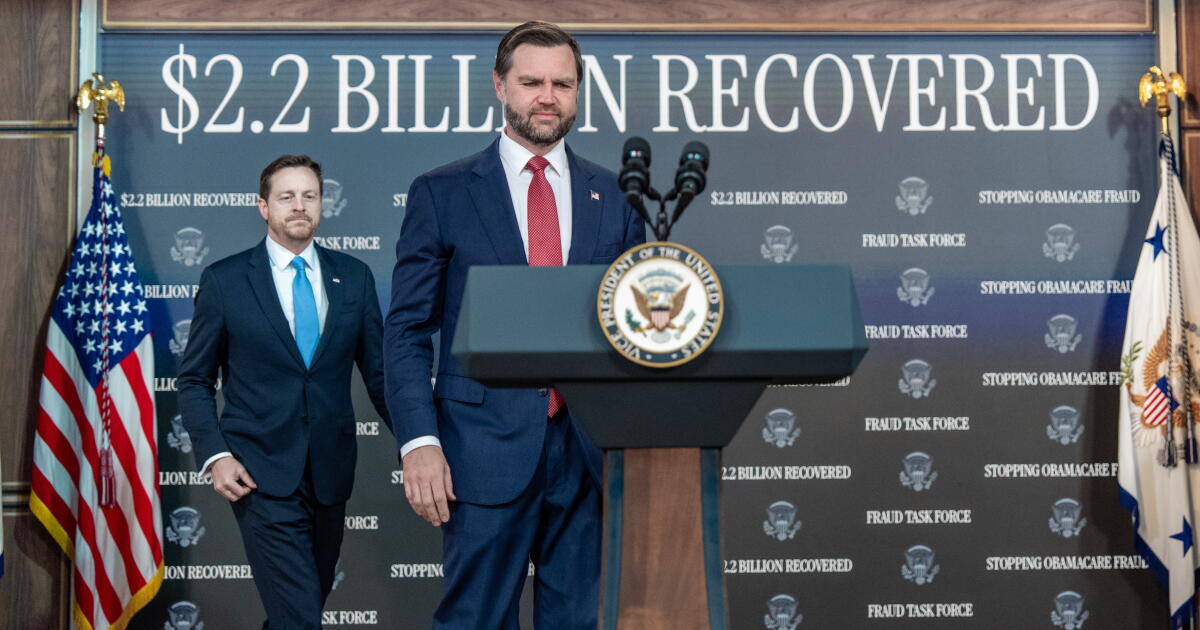
Vice President JD Vance on Friday held the inaugural meeting of a new anti-fraud task force he’s leading as the Trump administration seeks to show it’s cracking down on potential misuse of social programs.

Vance, speaking Friday before the task force held a closed-door meeting, said that the federal government for decades had not taken the issue of fraud seriously and that it needed to be tackled with “a whole-government approach.”

“This is not just the theft of the American people’s money,” Vance said. “It is also the theft of critical services that the American people rely on.”

President Trump, a Republican, has made a crackdown on fraud part of his chief domestic focus as voters have said they’re concerned about affordability ahead of November’s midterm elections. That effort comes after allegations of fraud involving day-care centers run by Somali residents in Minneapolis prompted a massive immigration crackdown in the Midwestern city, resulting in widespread protests.

Vance cited some of the Minnesota allegations on Friday. Last month, he held a news conference to announce a temporary halt of some Medicaid funding until the state took actions that federal officials said would address their concerns.

Minnesota Gov. Tim Walz, a Democrat who faced Vance as a vice presidential candidate in 2024, has called it a “campaign of retribution” and said the Trump administration was “weaponizing the entirety of the federal government to punish blue states like Minnesota.”

The task force is also the most visible assignment to date that Trump has given to Vance, who is seen as a potential 2028 presidential candidate.

Vance and the task force, which includes about half the president’s Cabinet, the leader of a new Justice Department division focused on prosecuting fraud and Federal Trade Commission Chair Andrew Ferguson, are set to meet regularly to look at rooting out potential fraud and waste in federal benefit programs.

Ferguson, who is vice chair of the task force, cast the issue of fraud as a dire crisis facing the country and said it “shreds the social trust on which these programs and our entire nation depend.”

“This fraud crisis is thus existential,” he said. “If we fail to address it, the fabric of our nation will swiftly unravel.”

Joining the task force was Colin McDonald, a top aide to the Justice Department’s second in command. He was recently confirmed as the assistant attorney general overseeing the new division at the department focused on prosecuting fraud.

The Justice Department has long prosecuted fraud nationally through its Criminal Division, but the Trump administration says the new division is needed to crack down on rampant fraud.

Price writes for the Associated Press.

Source link

Bianco’s fraud crusade is a campaign stunt. It’s also dangerous

Voter fraud conspiracies are like methamphetamine running through MAGA veins, stirring up equal parts passion and paranoia.

President Trump, of course, is the king pusher of this particular addiction, pathologically certain he won the 2020 presidential election (he did not). In his second term, and in advance of the November election, Trump has supercharged voter fraud lies; installed election deniers in key positions; and is attempting through the so-called SAVE America Act to disenfranchise poor and female voters.

Here in California, the seductive power of Trump’s crusade can be seen in Riverside County, where gubernatorial candidate and Sheriff Chad Bianco is definitely not pursuing a vote fraud investigation for political reasons.

“From the very, very beginning, Chad Bianco didn’t say this was political,” Bianco told me, referring to himself in the third person. “Chad Bianco said we have an allegation of fraud with numbers that don’t add up, and no one has an exact reason why. So we have to find out the exact reason why. It’s plain and simple. Plain and simple.”

If you’re clueless as to what Bianco is talking about, let me give you the short version. A citizens group of election “auditors” claimed that in the last election over Proposition 50 in November, there were about 45,800 more ballots counted than cast.

The Riverside County Registrar of Voters, Art Tinoco, a highly respected election official, gave a long presentation explaining why that number was not accurate. He said that the actual difference in ballots cast and counted is only 103, within the acceptable margin of error for the 1.4 million voters in his area.

But unhappy with that answer, the group apparently took their concerns to Bianco, who decided to use his powers of criminal investigation to circumvent the many established avenues for vote audits through his own county and the California secretary of state (though he hasn’t revealed publicly exactly what led to the investigation).

Using a secret, sealed warrant — so none of us actually know what he’s alleging — he seized more than half a million ballots. The court has apparently appointed a special master to count those ballots, though Bianco at first said his deputies would do their own counting. But we don’t know who that special master is, or even if he or she has yet been appointed.

Here’s what we do know, and why it counts as a danger not just to Riverside, but also to American democracy writ large, when a politically ambitious lawman decides to run elections himself.

The fraud fiasco

So where did the citizen-auditors get their 45,800 number? Like many California counties, Riverside tallies ballots as they come in. So for the 11 days voting was happening (and for the mail-in ballots that came later) someone was making a handwritten note for every ballot that the county received.

Yes, I said handwritten, for more than 600,000 ballots going through 2,500 workers and volunteers. It’s often inaccurate and not every ballot is going to end up being a good one — some lack signatures, for example.

Tinoco, the registrar, called these handwritten logs “raw data” that also are missing ballots from other sources that increases the final tally, such as people who register on the day they vote. So no one who understands elections expects this number to be accurate or final.

Once all these ballots are checked to make sure they should be counted, they are sent to an entirely separate system, which reads them electronically and provides the election results.

When the number of vetted ballots is compared with the number of ballots that are counted by the second system, the difference is 103, Tinoco said.

So no fraud, only human frailty with the difficult business of counting by hand.

Matt Barreto, a UCLA political science professor and director of its Voting Rights Project, said Bianco’s actions were similar to what happened in Fulton County, Ga., where the FBI seized ballots after Trump’s debunked claims of fraud — despite plain and simple explanations from election officials.

“In both cases, Georgia and Riverside, independent elections offices had already verified the accuracy of the ballot count, and in both cases the results had been certified by the Secretary of State,” Barreto said. “It is worrisome that a very partisan law enforcement officer is questioning the integrity of an election, perhaps because he did not support the results.”

The investigation

Bianco has been investigating the 45,000 claim for months, but it came to a head in recent weeks, in no small part thanks to a news conference he held. Bianco’s office, as first reported by the Riverside Record, served a warrant on the election office one day before Tinoco made his presentation to the Board of Supervisors in early February.

Since then, the California secretary of state, which handles elections, and the state Department of Justice have both tried to intervene to stop Bianco from taking ballots or doing his own recount, Pillow Guy-style. But they’ve had little luck.

Secretary of State Shirley Weber called the allegations “unsubstantiated” and questioned the legality — and common sense — of having deputies hand count ballots. Now, her office is trying to make sure folks trained in elections are involved in whatever happens next.

“The sheriff’s assertion that his deputies know how to count is admirable,” Weber said. “The fact remains that he and his deputies are not elections officials.”

Separately, California Atty. Gen. Rob Bonta has gone to the courts to try to keep Bianco from spiriting away the ballots. Bonta’s office went straight to the California Court of Appeals to ask it to force the sheriff to comply with their requests to take no further action and supply the Justice Department with the probable cause evidence used to obtain the search warrant — basically tell them exactly what proof he’s using to claim a crime might have been committed.

The appeals court declined to intervene until Bonta went to the lower Riverside County Superior Court. But in the meantime, Bianco went back to his judge and asked for another secret, sealed warrant — which he got.

The bigger problem

And that brings us to why we should all be concerned about Riverside County.

First, why all the secrecy? Shouldn’t elections and everything about them be transparent, so we all can feel confident any investigation is on the up and up?

I asked Bianco why the warrants are sealed, and he told me I didn’t understand investigations.

“In an ongoing investigation, we never unseal the warrants,” Bianco said. “No, I can’t say never. I can’t say never. Why are you coming at me like I’m the bad person here, instead of like a rational person?”

When I asked him why a sheriff needed to be involved, rather than allowing the state officials who handle elections to investigate, he told me this was a crime investigation just like any other — domestic abuse or murder, for example.

“It’s called fraud,” he said. “Let me ask you this: Do we just let, do we let doctors investigate themselves for medical malpractice?”

The implication there is that election officials are in a conspiracy to commit an actual crime — fraud — and can’t be trusted. That jumps the shark from maybe election staff counting sloppy in their handwritten tallies of ballots received, to a — yes, folks, here it is — a conspiracy of Democrats, from those volunteers up to the highest state officials.

That is a political vendetta, straight from Trump, and has little to do with tracking down crime — which, by the way, Bianco’s office is not great at. It has some of the lowest clearance rates in the state.

“Oh, please,” Bianco said regarding my questions on whether this was, in fact, political. “I’m the sheriff of Riverside County, and my investigators are responsible for crime. I have nothing to do with this investigation.”

His news conference would beg to differ.

And now we have a precedent for a politics-driven sheriff seizing ballots, maybe to make headlines, maybe to please Trump, maybe both. What happens if other Republican sheriffs across the country decide to do some ballot seizing of their own in swing states or contested races come November?

Is it all fair game now for whoever can physically take the ballots to be the arbitrator of results?

“The political corruption in California just gets bigger and bigger,” Bianco said on social media recently.

On that, we can agree.

You’re reading the L.A. Times Politics newsletter

George Skelton and Michael Wilner cover the insights, legislation, players and politics you need to know. In your inbox Monday and Thursday mornings.

What else you should be reading

The must-read: Landmark L.A. jury verdict finds Instagram, YouTube were designed to addict kids
The deep dive:He’s an election skeptic. And he’s in charge of elections in Shasta County
The L.A. Times Special: Court denies AG’s petition to block Republican sheriff’s investigation of 650,000 ballots

Stay Golden,
Anita Chabria

P.S. Here’s Bianco on social media not long ago, once again definitely not espousing partisan voter conspiracies.

Was this newsletter forwarded to you? Sign up here to get it in your inbox.

Source link

Californians may need to mail ballots early as Supreme Court signals support for new election day deadline

Californians may be forced to put their ballots in the mail well before election day to be certain they will be counted.

That’s the likely outcome of a Republican challenge to mail ballots that came before the Supreme Court on Monday.

The court’s six conservatives sounded ready to rule that federal law requires that ballots must be received by election day if they are to be counted as legal.

In the 19th century, Congress set a national day for federal elections on a Tuesday in early November, but it did not say how or when states would count their ballots. The Constitution leaves it to states to decide the “times, places and manners for holding elections.”

California and 13 other states count mail ballots that were cast before or on election day but arrive a few days late. And most states accept late ballots from members of the military who are stationed overseas.

By law, California counts mail ballots that arrive within seven days of election day. In 2024, more than 406,000 of these late-arriving ballots were counted in California, about 2.5% of the total.

Other Western states — Washington, Oregon, Nevada and Alaska — also count late-arriving mail ballots.

But President Trump has repeatedly claimed that voting by mail leads to fraud, and the Republican National Committee has gone to court to challenge the state laws that allow for counting the legally cast ballots of citizens which are postmarked on time but arrive late.

GOP lawyers argued that the phrase “election day” has always meant ballots must be in the hands of election officials on that day. In their questions and comments, all six conservatives agreed.

Justice Samuel A. Alito Jr. saw a real prospect of fraud. There could be “a big stash of ballots” that arrive late and “flip the outcome,” he said.

Democrats and election law experts say that the proposed new rule conflicts with more than a century of practice, because most states allowed for some people to vote by mail if they were traveling on election day. They argued that election day is like the federal tax day of April 15. While tax returns must be postmarked then, the tax returns are legal even if they arrive at the Internal Revenue Service a few days later.

The GOP filed its challenge in Mississippi, which accepts ballots that arrive up to five days after election day. A district judge rejected the claim, but a 5th Circuit Court panel with three Trump appointees ruled that ballots are illegal if they are not received by election day.

The case before the court is Watson vs. Republican National Committee.

California has been criticized for taking weeks to count all the votes, but that issue was not raised in this case.

Source link

Democrats face the possibility of a historic upset in California governor’s race, poll finds

Despite a long, entrenched Democratic reign over California politics, a new poll shows two Republicans leading by slim margins in the state’s 2026 race for governor as the June primary election fast approaches.

The confounding results appear to be mostly due to the state’s left-leaning electorate feeling uninspired by any single candidate in the crowded field of eight top Democrats. Because of California’s top-two primary rule, that lethargy could lead to Democrats being shut out of a November election that will determine the next leader of the largest state in the union, though that is still considered unlikely.

Conservative commentator Steve Hilton had the support of 17% of likely voters and Riverside County Sheriff Chad Bianco had the backing of 16%, according to a poll released Wednesday by UC Berkeley’s Institute of Governmental Studies and co-sponsored by The Times.

Following closely behind were Democrats Rep. Eric Swalwell of Northern California and former Orange County Rep. Katie Porter, both of whom had support from 13% of the likely voters surveyed. Aside from billionaire hedge fund founder and environmental activist Tom Steyer, who registered at 10% support after plowing tens of millions of dollars into his campaign, no other Democrat had won support from more than 5% of likely voters, the poll showed.

Mark DiCamillo, director of the poll, said he was stunned by how fractured voters are and how little knowledge they have about the candidates less than 60 days before ballots start arriving in Californians’ mailboxes.

“This is historic for me, and especially given that none of the candidates have really a positive image rating with voters, also startling. I mean, perhaps one of the reasons why voters are disengaged, they’re just not enthusiastic about any of the candidates,” he said. “They’re kind of sleepwalking to this election.”

Swalwell and Porter both hew toward the progressive wing of the party and rose to national prominence as frequent guests on cable news shows and as combative, at times theatrical, committee members during congressional oversight hearings. That notoriety prompted attacks from Republicans and the far right and increased their popularity among the Democratic base — both pivotal for voters seeking a strong candidate to challenge President Trump.

Porter slightly rebounded after a dip in polling in the fall after videos emerged of her berating an aide and a reporter. She also has the highest favorable rating of any candidate in the field at 34%.

According to the survey, Steyer’s support from likely voters increased to 10% from just 1% in Berkeley’s October poll. The momentum comes after Steyer spent about $50 million airing television ads since December, according to an analysis by data expert Paul Mitchell for Capitol Weekly.

Among the other top Democrats in the race: former U.S. Health and Human Services Secretary Xavier Becerra was backed by 5% of likely voters; former Los Angeles Mayor Antonio Villaraigosa and San José Mayor Matt Mahan by 4%, and former state Controller Betty Yee and state Supt. of Public Instruction Tony Thurmond by 1%.

The poll found that 16% of likely voters were either undecided or backed other, lesser-known candidates.

The splintered support for the Democrats hoping to become the state’s next governor has surfaced in other ways as well. On Monday, the powerful California Federation of Labor voted to endorse four gubernatorial candidates — half the Democratic field.

DiCamillo said he believes the poll’s inclusion of the candidates’ titles that voters will see on their ballots is crucial in a low-information contest.

“That really matters in a race where voters don’t have much information, or they say they don’t know much about the candidates,” he said, adding that it could particularly help Bianco, the Riverside County sheriff. “His job title is kind of impressive, and that voters think, well, that’s credible, so let me consider him.”

The fear of two Republicans winning the top two spots in the June 2 primary prompted California Democratic Party Chair Rusty Hicks to urge low-polling candidates to consider their viability and drop out if they didn’t see a path forward earlier this month.

Some candidates bristled, arguing that party leaders were in effect telling every candidate of color to leave the race. Aside from one candidate, all of the top Democrats in the race responded by quickly filing their campaign documents with the secretary of state’s office, meaning that their names will appear on the ballot.

The two candidates who receive the most votes in the primary are the only ones who advance to the November general election — regardless of their political party.

The odds that a Republican will become California’s next governor appear slim. No Republican has won a statewide election in California since 2006, the year Hollywood movie star Arnold Schwarzenegger was elected to a second term as governor. Democratic registered voters in the state outnumber Republicans by nearly 2 to 1.

Compared with prior gubernatorial races that had well-known Democratic front-runners, none of the candidates of either party are particularly well known by voters. Large numbers of voters have no opinion about any of the candidates — including roughly two-thirds of those asked about Mahan, Yee and Thurmond.

Voters were far more tuned in to the issues that they believe are most important for the state’s next governor to tackle.

Affordability was dominant among all voters, regardless of political ideology, the poll found. Four out of 10 voters said reducing the cost of living in California is among the top issues the next governor should prioritize, and smaller numbers also highlighted building affordable housing and lowering gas prices and utility rates.

Affordability “is the top issue for voters, both here in California and across the country. There’s no question,” DiCamillo said. “Perhaps it’s even of greater urgency here in California, just given our cost of living is higher than in most other places.”

Building new housing, paring back regulations to allow such construction quickly and to reduce the cost of buy a home, disincentivizing private firms from buying homes and reducing gas prices are among topics candidates frequently speak about on the campaign trail and in debates.

A notable split was evident among voters when asked about cutting waste, fraud and political corruption in state government, the poll found. Nearly 50% of Republicans said this was a top priority, compared with 10% of Democrats and a little over a quarter of voters who do not state a party preference.

DiCamillo said this sentiment aligns with President Trump’s messaging and what his administration has been pursuing in the federal government. Trump has repeatedly painted California as teeming with waste, fraud and abuse. On Monday, when he launched a task force to fight fraud that will be led by Vice President JD Vance, California was among the states he singled out as having insufficient oversight of federal funds.

GOP voters in California share similar sentiments, DiCamillo said.

In Washington, D.C., “they’re cutting back, trying to make government smaller, and … just cut the waste as well,” he said. California “Republicans, given the fact that Democrats have been controlling things for so long, they think … more of that is needed now here in California as well.”

The Berkeley IGS/Times poll surveyed 5,019 California registered voters online in English and Spanish from March 9 to 14. The results are estimated to have a margin of error of 2.5 percentage points in either direction in the overall sample, and larger numbers for subgroups.

Source link

Contributor: Federal power grabs on elections are not about fraud

Fans of the musical “Hamilton” know three things about the nation’s first Treasury secretary because of Lin-Manuel Miranda’s brilliance. First, that Alexander Hamilton cheated on his wife, Eliza. Second, he was killed by the vice president, Aaron Burr. Third, and most importantly, he was considered a highly principled man. And when it came to the topic of nationalizing elections, do you know how this Revolutionary War vet and founding father characterized doing so?

A threat.

Referring to corruptible public officials, Hamilton wrote in the Federalist Papers: No 59: “With so effectual a weapon in their hands as the exclusive power of regulating elections for the national government, a combination of a few such men, in a few of the most considerable States, where the temptation will always be the strongest, might accomplish the destruction of the Union, by seizing the opportunity of some casual dissatisfaction among the people to discontinue the choice.”

Hamilton’s prescient views became the framework for the Election Clause in the Constitution. And since returning to the White House, President Trump has been searching for ways to usurp it. Last month he made calls to nationalize elections. This month he’s at it again.

He’s also pushing Congress to pass his so-called SAVE Act, which would require voters to show proof of citizenship when they register to vote. It sounds innocuous until you realize a driver’s license isn’t good enough; a passport would often be required. But half the country doesn’t have a passport, and it costs roughly $200 and a few weeks to get one. The logistical burden is unreasonable and cruel: Consider that this year, during primary season, we’ve already witnessed natural disaster — such as the tornadoes that recently ripped through the Midwest or the fires in Texas — upend entire communities. Many people would not have been able to vote, simply because they had been separated from their papers during the disaster.

The financial obstacles that would be created by the SAVE Act are at least as onerous: Why would Congress choose to financially burden voters — with what is essentially an unlawful poll tax — at a time when the unemployment rate and gas prices are up and the approval rating for nearly everyone in office is down? There are a couple of reasons. One is that the party controlling Congress hopes to suppress voting in order to defy the will of the American majority and cling to power.

Another reason lawmakers support this terrible bill is simply that Trump wants it. Some Republicans in office are so afraid of angering a vengeful president that they would rather entertain his authoritarian tendencies than go through the fire of his opposition during a primary.

For politicians such as Sen. John Cornyn (R-Texas), who this week changed his long-held position on the filibuster in order to push the SAVE Act, it’s simply about political survival. He needs the president’s endorsement heading into the runoff for his Senate seat.

Trump has called the election overhaul bill his top priority — not the war he started with Iran, not returning the billions collected from illegal tariffs, not justice for Jeffrey Epstein’s victims. Before there was a Constitution, there was a warning, written by Hamilton and other founders, whose concerns about nationalized elections are well documented and have proved to be well founded.

You would think a nation in the midst of beating its proverbial chest about our 250th birthday would take more heed from the country’s founders. But nope: This week Florida state lawmakers, in an attempt to appease their state’s most powerful resident, passed an election overhaul law that mirrors the federal SAVE Act. More red states are likely to follow, not because a national wave of voter fraud has been unearthed by authorities, but because the authorities want to stay in the good graces of someone who has yet to prove any widespread fraud other than his own.

The party that famously railed against “the bridge to nowhere” is now offering bills that solve nonexistent problems. Or in some cases, creating problems, particularly for women who changed their names after marriage so their state IDs don’t match their birth certificates.

Cornyn is not alone in exchanging his principles for Trump’s favor; he’s just the most recent. However, the manner in which he announced his flip flop was particularly tone deaf.

“If a man takes a swing at you and barely misses, that doesn’t make him a pacifist — it just means he has bad aim,” Cornyn wrote in an op-ed about the bill for the New York Post, the newspaper founded by Hamilton in 1801. “Standing still and giving him a second free swing wouldn’t be wise or honorable: it would be foolish.”

In 2016, then-candidate Trump took his first big swing at our elections when he implied — without evidence — that his opponent, Sen. Ted Cruz, had rigged the election after losing to him in the Iowa Republican caucus. Reportedly Trump even tried to get the state’s party chair to overturn the result. He’s been throwing jabs at our elections ever since. The Jan. 6 riot was a haymaker that barely missed. Given the president’s propensity to hand out Trump 2028 hats, it seems passing the SAVE Act would be, in Cornyn’s words, setting voters up to stand there while Trump takes another swing at our democracy.

YouTube: @LZGrandersonShow

Insights

L.A. Times Insights delivers AI-generated analysis on Voices content to offer all points of view. Insights does not appear on any news articles.

Viewpoint
This article generally aligns with a Center Left point of view. Learn more about this AI-generated analysis
Perspectives

The following AI-generated content is powered by Perplexity. The Los Angeles Times editorial staff does not create or edit the content.

Ideas expressed in the piece

  • Alexander Hamilton, writing in Federalist No. 59, warned that exclusive state power over federal elections posed an existential threat to the Union, cautioning that “a combination of a few such men, in a few of the most considerable States” could “accomplish the destruction of the Union” through control of election regulations[1]

  • The SAVE Act requiring proof of citizenship to vote imposes unreasonable logistical and financial burdens on voters, effectively functioning as a poll tax by requiring passports costing approximately $200 that roughly half the country does not possess[1]

  • Natural disasters and unforeseen circumstances already disrupt voting access, and citizenship verification requirements would further prevent Americans from voting by separating them from necessary documentation during emergencies such as tornadoes or fires[1]

  • The stated rationale for election overhaul legislation—addressing voter fraud—is not supported by evidence, as authorities have failed to unearth a national wave of voter fraud despite repeated claims[1]

  • Republicans supporting the SAVE Act are motivated by partisan interests rather than election security concerns, with some lawmakers abandoning long-held principles to secure Trump’s political endorsement during primary races[1]

  • Election nationalization efforts represent an authoritarian threat to democracy that the nation’s founders specifically warned against, making it imperative to heed historical lessons about centralized electoral control[1]

Different views on the topic

  • Hamilton argued in the Federalist Papers that the national government required ultimate authority over election regulations to prevent state legislatures from abandoning their responsibility to choose federal representatives, which could render “the existence of the Union entirely at their mercy”[4]

  • The Constitution’s design allocates election regulation authority primarily to states with a federal backstop, recognizing that the national government must possess a check on state power to maintain union stability and prevent states from exploiting their regulatory control[3][4]

  • Federalist No. 60 establishes that the system of separated powers—with the House elected directly by people, the Senate by state legislatures, and the president by electors—creates structural safeguards preventing any single faction from monopolizing electoral control[2]

  • Voter identification requirements serve legitimate election integrity purposes, with proponents arguing that citizenship verification represents a reasonable measure to ensure eligible voter participation[1]

Source link