Why I’m not taking down my César Chávez photo
The framed photo of César Chávez and Dolores Huerta sits in my personal office on a bookshelf crammed with volumes about California and the American West.
The two are at a 1973 United Farm Workers convention, presiding over the union they co-founded. After years of victories in the name of campesinos, the group and its charismatic leaders seem ready for what’s next.
A UFW banner emblazoned with the group’s famous black Aztec eagle logo hangs in the center of the picture, making Chávez and Huerta look like equals.
But they’re not.
He’s speaking from a podium, looking down and appearing cast in darkness due to Chávez blue vest melding into his black hair and brown skin. She’s by his side clasping her hands, wearing a colorful blouse that pales in radiance to Huerta’s hopeful face as she looks at the crowd before them.
It’s the only picture of historical figures that I display at home, and it’s in a place where I’m guaranteed to look at it. It has long served as my secular version of a prayer card, a daily reminder to fight for the good in the world and a reminder that giants before me faced challenges far more daunting than mine. It was also a testament to teamwork — when I acquired the photo a few years ago, it called to me in a way a solo Chávez never would have because I always knew el movimento was more than just one man.
Their portrait can never mean just those things ever again after the New York Times reported last week Chávez sexually assaulted two teenage girls in the 1970s and Huerta in the 1960s.
Places left and right — colleges, cities, classrooms, even states that mark Chávez’s birthday as a holiday — are now deleting his name and image from the public sphere. It’s not going to be a quick, easy task even if the cancellation is starting to take place with startling speed: Chávez’s presence is as ubiquitous in Mexican American life as the Virgin of Guadalupe.
Just this weekend, a friend acknowledged that he and his wife had just started reading a book about him to their 5-year-old daughter, a book they now plan to trash.
I thought of doing the same to my photo of Chávez and Huerta. But I’ve decided not to.
I don’t fault folks for wanting to scrub any hint of Chávez from their daily lives and neither does the Cesar Chavez Foundation, the nonprofit headed by his descendants that recently announced in a statement, “We support and respect whatever decision[s]” may come in the weeks and months to come. Communities are entitled to decide whom they should and shouldn’t publicly honor.
But to eradicate Chávez’s civic presence so fast — to tear down his statues, relabel streets and parks named in his honor, paint over his image on old and new murals, to throw away artwork that has adorned homes and offices for decades — doesn’t remove the fact that millions largely saw him as a champion of the downtrodden until last week. It can’t rescind the positive influence Chávez had on generations of Latinos and non-Latinos who saw in him the hopes of a people and now must reconcile their memories with his horrible deeds.
Historians, educators, activists and politicians for far too long elevated Chávez above Huerta in the name of a simplistic narrative that should’ve never been constructed. The public at large bought into those efforts with little skepticism in the understandable desire to have Latinos star in the American story. It’s a culpability we should all interrogate, not immediately purge.
That’s why not only am I keeping up my photo of Chávez and Huerta, I’m going to put it in a more prominent place from where I can’t look away.

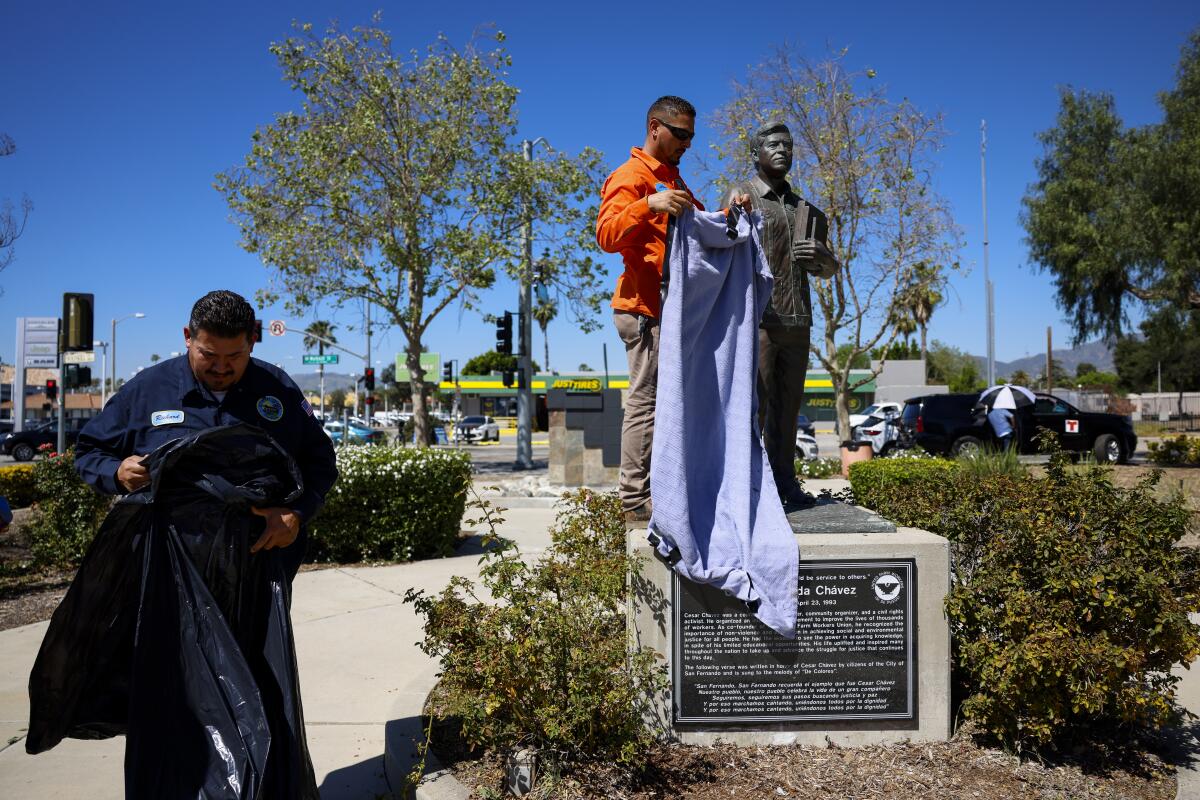
Workers for the city of San Fernando cover the statue at Cesar E. Chavez Memorial Park on Thursday.
(Kayla Bartkowski / Los Angeles Times)
It will serve as a memory of a tragic, tremendous moment in the history of Latinos in the United States, where we should be focusing our attention on a presidential administration that wants most of us gone but instead must deal with the fallout from the downfall of one of our own. It will challenge me anew to look past the big names of the past and highlight those whose stories aren’t nearly as known by the mainstream.
Seeing Huerta next to her abuser will forever remind me about how the now-95-year-old sacrificed her own mental health and safety in the name of something bigger than the two of them — a choice no one should ever have to make but one that she nevertheless did.
The photo will stand as the manifestation of the old newspaper adage that if your mom tells you she loves you, go check it out. No one should ever be above skepticism no matter how sanctified and righteous they may seem — that’s why the New York Times investigation crashed into the Chicano collective sense of self like a meteor. No one could’ve imagined that Chávez could’ve possibly done things so monstrous, but maybe we shouldn’t have built him up so much while he was alive and after his death in the first place.
My framed Chávez-Huerta memento will make me think of how the stories of sexual abuse survivors are still not heard enough or even believed. Even now, some Chávez defenders are casting doubt on the claims of Huerta and the three other women named in the New York Times story, questioning their motivations to come forward after decades of silence and decrying how their decision to do so has permanently tarnished the reputation of one the few nationally known Chicano heroes. In Huerta’s case, critics just don’t buy how someone who carried Chávez’s torch decades after his death could all of a sudden supposedly turn on him.
But as a Catholic who has long covered the Catholic Church sex abuse scandal, I know that every sexual assault survivor has their own journey of recovery. I also know that we must always seek the truth instead of living a lie.
And turning Chávez into a historical footnote is a lie. He long served as a moral exemplar; he should now serve as a cautionary tale known to all.
Erasing historic figures from the public sphere is an exercise in power going back to the pharaohs, a way rulers ensured future generations couldn’t learn about their enemies. The push to nix Chávez comes from the trend in recent years by progressive activists to remove monuments that hail problematic figures under the pretense that someone’s sins trump any good they might have done no matter how influential they were.
Again, all communities have that right to reexamine the past. But we can’t and shouldn’t disappear the full story of Chávez, as painful as it is. It’s the easy way out — and remedying wrongs is never easy.
If the photo in my book shelf was only of Chávez, I’d still keep it up. The good he did was really good — the bad he committed was as terrible as it gets.
Somewhere in between stands the story of us.