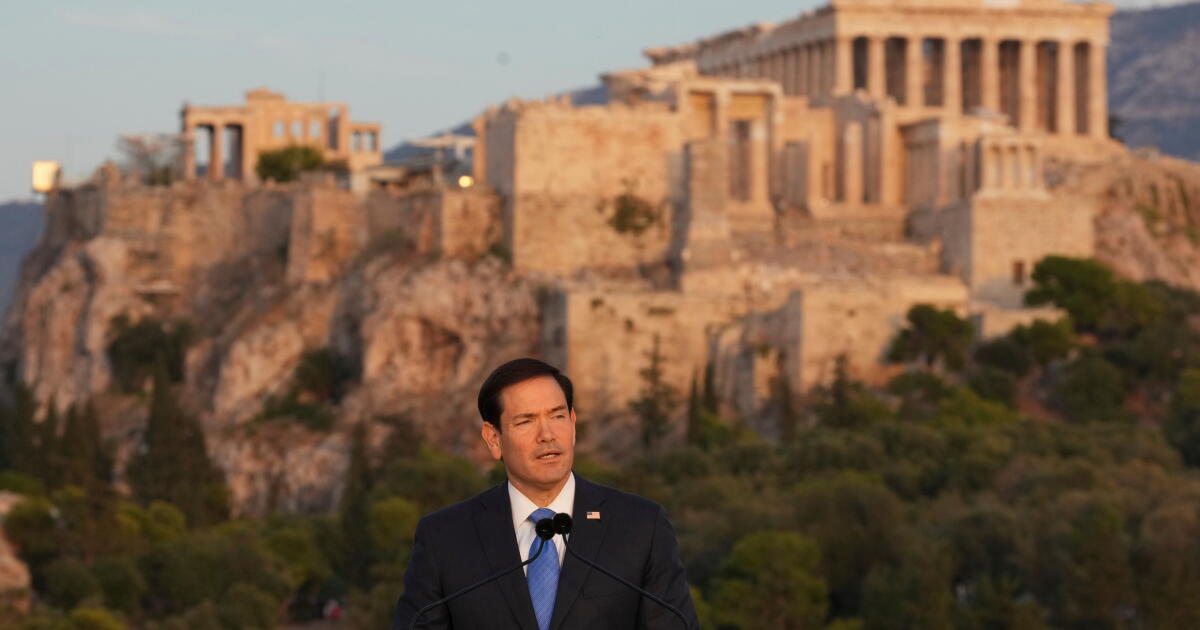
Rubio, in Greece, calls for the West to restore founding democratic principles and values
ATHENS — U.S. Secretary of State Marco Rubio called for the nations of the West to return to their civilizational roots and restore the values that drove the rise of Europe and North America to global dominance for centuries.
In Athens to discuss deepening economic, energy and security cooperation with Greece, Rubio delivered a speech later Wednesday near the ruins of the Acropolis, a widely recognizable symbol of the city’s ancient civilization associated with the creation of popular participatory government and the social contract.
Rubio aimed to remind listeners of qualities he says were born in Greece and later defined the West, such as curiosity, courage, ambition, a restless spirit of exploration and a drive to discover the unknown.
“It has become fashionable today to believe that enlightened foreign policy means prioritizing the ‘global community’ over one’s own people. And I think here, too, we have much more to learn from the men of Ancient Greece. They knew that there was nothing selfish or wrong about loyalty to your nation, nor anything selfish or wrong about fighting to defend its interests above all else,” Rubio said.
Rubio urges Europe to uphold its traditional values
“Today, we find ourselves at a crossroads,” he said. “The next decade will write the story of the next century. The course we take will determine whether the West maintains its place at the head of the world, or resigns itself to a future of atrophy, and servitude, and decline. We will either choose to act now or lose the choice to act at all.”
Rubio is seen by many as the gentle face of the Trump administration and has been frequently dispatched to clarify or otherwise address concerns about the president’s frequently undiplomatic statements.
Rubio, along with Vice President JD Vance, is seen as one of the leading contenders to assume Trump’s mantle at the top of the Republican Party, which faces stiff challenges in next month’s congressional midterm elections. Republican Party, which faces stiff challenges in next month’s congressional midterm elections.
The Trump administration has repeatedly accused countries in Europe of backsliding on their traditional values and democratic principles by stifling the free speech of conservatives and falling short on commitments to international partners like the United States.
Many of those countries have rejected the complaints and accused the U.S. under Trump of being guilty of similar behavior and worse with its staunch anti-immigration stance that some believe is racist.
Left-wing groups protest across Greece
Ahead of his visit to Athens, about 1,500 people gathered to protest Rubio’s presence and the war in Iran, chanting “American killers!”
The demonstration was organized by a communist labor union and other left-wing groups and was held ahead of extensive road closures planned in Athens. Organizers said similar protests were held in at least 12 other Greek cities. Police banned public demonstrations Wednesday in central.
Rubio seeks to reassure NATO allies
Rubio is on the second leg of a three-nation tour of NATO allies that has already taken him to Iceland and will end in Portugal on Thursday. The trip is aimed at reassuring U.S. partners that the Trump administration is committed to their success and security despite what has been an often brusque and sometimes rude approach to traditional friends that has stirred unease.
Rubio began emphasizing historical themes on Thursday, when he met Iceland’s foreign minister at the site of the landmark 1986 summit between former President Ronald Reagan and then Soviet leader Mikhail Gorbachev, a meeting that many believe marked the beginning of the end of the Cold War and was a catalyst for the eventual dissolution of the Soviet Union.
It remains unclear what impact Rubio’s visits will have, although on Tuesday in Reykjavik, he sought to reassure Iceland that President Trump’s administration has no designs on the island. Rather, he said the U.S. shares Iceland’s deep concerns about Arctic security as tensions between the U.S. and Russia rise in the High North and elsewhere.
Iceland has been uneasy about Trump’s intentions toward it after he posted a map showing the colors of the U.S. flag sprawling across all of North America and extending to Iceland and Greenland. That wariness has persisted despite an agreement last month to increase the U.S. presence in the neighboring Danish territory of Greenland that appears to have ended Trump’s demands for the U.S. to take full control of the island.
But after Rubio’s talks in Reykjavik, those tensions appeared to be on the wane. Rubio said the United States would not do anything in Iceland without Iceland’s consent.
Visit follows allegations of misconduct by U.S. ambassador
Before delivering his speech in Athens, Rubio declined to comment when he was asked about allegations of misconduct leveled at U.S. Ambassador to Greece Kimberly Guilfoyle.
At a joint news conference with the Greek foreign minister, Rubio said he would not address the matter while visiting a foreign country, but added: “Suffice it to say our embassy here is doing a great job. Our ambassador has been a strong ambassador here.”
The top Democrats on the Senate Foreign Relations and House Foreign Affairs committees, Sen. Jeanne Shaheen and Rep. Gregory Meeks, have initiated probes into claims reported last month by the Wall Street Journal that Guilfoyle acted improperly while serving as the top U.S. envoy to Greece.
The Journal reported that Guilfoyle told guests at a reception that the U.S. could undermine the Greek government if it chose to, promoted the business interests of one particular Greek construction and energy company, and allowed its lobbyist into private diplomatic meetings.
Guilfoyle, a former Fox News Channel host and California prosecutor who was once engaged to Trump’s son Donald Jr., has denied any wrongdoing, and Rubio has defended her before.
Lee writes for the Associated Press. AP writer Derek Gatopoulos in Athens contributed to this report.