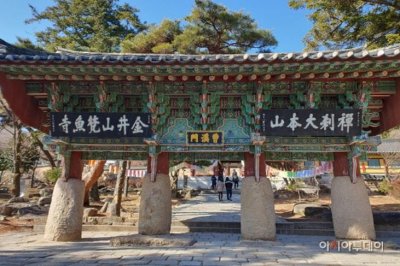
The Jogye Gate at Beomeosa Temple in Busan. The temple is known for its foreign visitor temple stay program and was previously visited by actor Chris Hemsworth during a documentary shoot. Photo by Asia Today
May 25 (Asia Today) — Buddhist temples in South Korea’s southeastern region are opening temple stay facilities to help accommodate foreign fans traveling to Busan for upcoming concerts by K-pop group BTS amid severe lodging shortages and complaints over soaring hotel prices.
The Korean Buddhism Culture Corps said Sunday that temple stay-operating temples in Busan and South Gyeongsang Province will provide lodging support for tourists visiting Busan for the “BTS World Tour Arirang in Busan” concerts scheduled for June 12-13.
Public concern has grown over accommodation costs ahead of the concerts as demand from domestic and overseas fans surged.
According to a February survey conducted by South Korea’s Fair Trade Commission and the Korea Consumer Agency covering 135 hotels and lodging facilities in Busan, average room rates during the concert weekend rose about 2.4 times compared with the weekends before and after the event.
The Busan city government has also been conducting inspections since May 13 targeting unfair business practices, including excessive room charges and possible violations of public sanitation and lodging regulations.
Alongside government measures, Buddhist groups said private-sector support was also urgently needed.
The Buddhist cultural organization and participating temples plan to use temple lodging rooms and available indoor spaces to provide safe and stable accommodations for visitors traveling to Busan.
Temples currently participating in the program include Beomeosa, Naewonjeongsa, Hongbeopsa and Seonamsa in Busan, along with Seongjusa and Daegwangsa in Changwon, Tongdosa in Yangsan and Pyochungsa in Miryang.
A representative from the Buddhist cultural organization said the effort was intended not only to provide lodging but also to allow foreign visitors to experience traditional Korean and Buddhist culture in a peaceful temple environment.
Temple stay programs have become increasingly popular among foreign tourists seeking cultural experiences in South Korea. Last year, temple stays attracted 349,236 visitors, including 55,515 foreign tourists.
Participants using temple stays during the BTS concerts will be offered accommodations, temple meals and simple cultural programs depending on conditions at each temple.
Organizers said visitors will also be required to follow temple rules, including check-in and check-out schedules and shared living guidelines, since temples remain active religious and monastic spaces.
The Buddhist organization and participating temples said they are also reviewing interpretation support and visitor guidance measures to help overseas guests stay comfortably.
“We hope to share the spirit of hospitality and generosity embodied by Buddhist temples with fans facing accommodation difficulties,” a representative said. “We want visitors to leave Busan with safe and warm memories.”
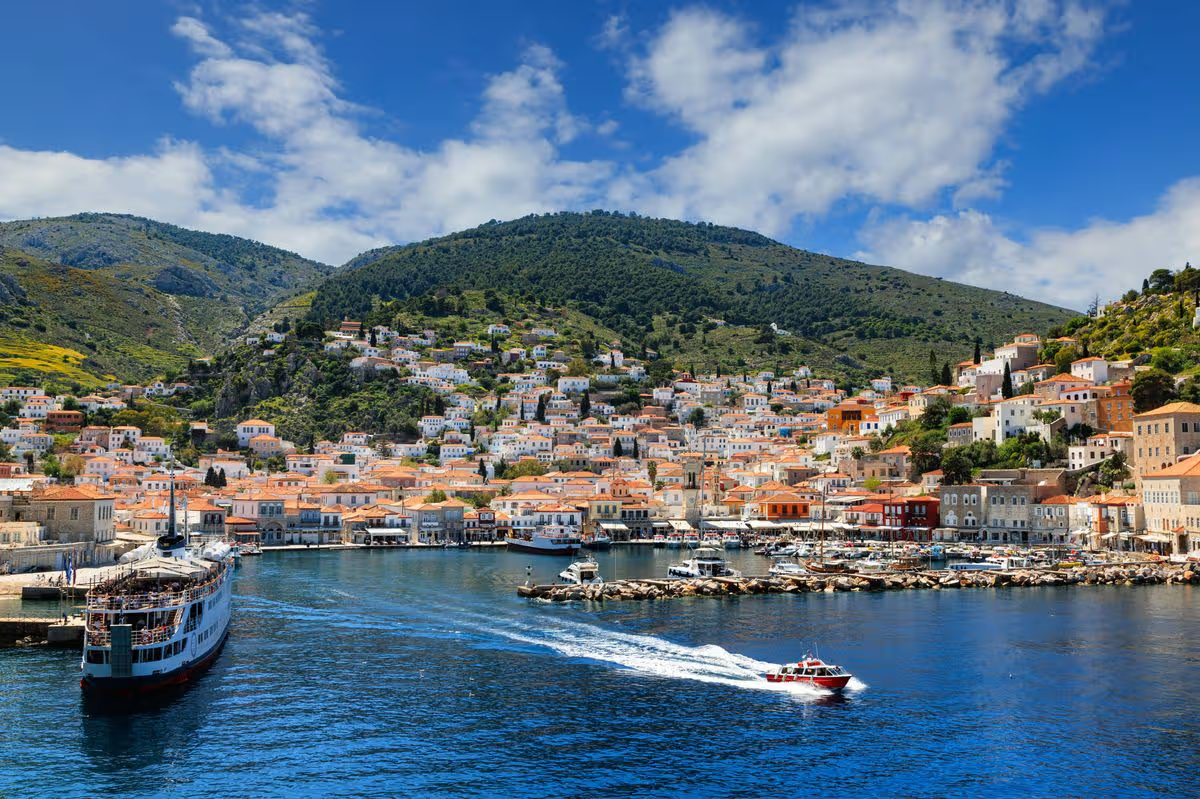
Millions of Brits head to Greece each year(Image: EdwardShtern via Getty Images)
The Foreign, Commonwealth and Development Office (FCDO) continues to caution travellers heading to Greece about the risk of “serious injury or death”.
The FCDO is tasked with issuing regular travel guidance for roughly 226 countries and territories worldwide. Updates from the FCDO cover information on safety and security, regional threats, health concerns, and more. The guidance highlights a popular holiday pursuit that has resulted in fatalities and severe injuries, with the Foreign Office warning: “Quad biking carries the risk of serious injury or death.
“You need specific travel insurance to cover quad biking, it is defined as an extreme sport and excluded on many policies. Always read the details of your insurance cover.”
Greece remains a favoured destination among British holidaymakers, with millions visiting annually. FCDO guidance adds: “Make sure you get full instructions and training before your activity.
“Insurance sold by the hire company usually only provides third-party insurance. It’s likely the company will charge you for any damage to the rental vehicle, and you may face arrest if you do not pay.”
Both drivers and passengers are required to wear helmets when using quad bikes and mopeds. Failure to comply could invalidate your insurance, and if police stop you, you risk being fined – with officers potentially confiscating your licence.
Earlier this week, a 42-year-old dad from the UK was killed while riding a quad bike in Greece. The man had been travelling with his 15-year-old son in Corfu when the vehicle veered off the road for reasons that remain unclear, according to local reports.
The collision reportedly occurred at around 2pm local time on Tuesday on the central rural road of Roda-Acharavi near Almyros. The teenager sustained serious injuries in the crash.
AUGUST flights don’t come cheap, but there are some serious savings to be found this summer as airlines slash prices to entice Brits who’ve been nervous about booking because of the Iran war.
Sun Travel has worked with Skyscanner to find some of the cheapest flights that are actually during the school holidays – with some as little as £23 each way.
Sign up for the Travel newsletter
Thank you!
You can visit beautiful Burano if you take a flight to Venice this August from £23 each wayCredit: AlamyNice is surrounded by beautiful seaside towns like Villefranche Sur MerCredit: Alamy
Follow The Sun’s award-winning travel team on Instagram and Tiktok for top holiday tips and inspiration @thesuntravel.
Working with Skyscanner, Sun Travel has crunched the numbers and discovered where Brits can find the cheapest flights that are actually in the school summer holidays.
Some destinations have dropped prices significantly since last summer including favourites like Venice and Nice.
Starting with Venice, an economy return flight starts from £46pp in August this year – which is down by 14 per cent from August 2025.
Famous for its waterways, the beautiful city is one of the most visited in Italy.
And if you travel out of the city, there are charming Italian seaside villages peppered along the Adriatic coast.
Don’t forget to stop by Burano an island in the Venetian Lagoon with pretty rainbow-coloured fisherman’s houses.
A little closer to home, return flights to the French city of Nice start from £48pp – which is a decrease of 19 per cent.
The city is perfect for Brits as it can be reached in as little as two hours and August has highs of 27C so it’s perfect for basking on its pretty beaches.
From Nice, it’s an easy train ride along the Cote D’Azur to some of France’s most beautiful seaside towns like Cannes, Villefranche Sur Mer and Antibes.
Escape central Berlin to Lake Wannsee for boat trips and swimmingCredit: Alamy
Return flights to the German city of Berlin start from £49pp this summer which is 10 per cent less than last year.
The city has plenty of history as well as vibrant murals and nightlife.
And while it isn’t very close to the seaside, Germany and neighbouring Switzerland which is easily reached by train, have stunning countryside and lakeside retreats that are the perfect temperature in mid-summer.
Although, just an hour’s drive from the city centre is Großer Wannsee – it’s a large lake and is actually considered one of ‘Europe’s largest inland lidos’.
It’s a popular summer swim spot and place for a summer daytrip.
When it comes to the flights with the biggest drop in prices return flights to Cape Town in South Africa are down 20 per cent with an average price from£689pp.
Holidays to Cape Town, Venice and Berlin are down from August last yearCredit: Getty
Top 10 biggest price drop destinations for return flights in August 2026…
Skyscanner has found the biggest price drop destinations for return flights in August 2026 compared to last year…
Cape Town – from£689pp (-20 per cent)
Las Vegas – from £585pp (-19 per cent)
Nice – from £48pp (-19 per cent)
Bordeaux – from £68pp (-18 per cent)
Florence – from £99pp (-17 per cent)
Geneva – from £74pp (-15 per cent)
Venice – from £46pp (-14 per cent)
Tirana – from £89pp (-12 per cent)
Osaka – from £748pp (-10 per cent)
Berlin – from £49pp (- 10 per cent)
Prices correct as of May 20 2026 and are subject to change
It’s not the warmest time of year to visit Cape Town, but in August visitors can enjoy whale-watching and views of Table Mountain.
It’s also one of the cheapest bucket list destinations, with everything from safari to vineyards and stunning seaside towns all easily reached from the South African capital.
Another destination that Skyscanner recommends as being cheap with affordable flights is Dortmund in Germany – with an average flight of £72.
The German city is famous for its football culture and highlights its huge Signal Iduna Park and the exhibits at the German Football Museum.
Thanks to its location, both Munster and Dusseldorf are around an hour in each direction by car for those who fancy other city daytrips.
Meanwhile, in the Calabria region in southern Italy, you’ll find the port city of Crotone– where return flights start as little as£62pp.
Crotone in Southern Ialy is famous for its floating fortress can be reached for as little as £31ppCredit: Alamy
It once a Greek colony that was the home of Pythagoras.
Visitors should head to Crotone’s harbour which is central to the city and a lively spot for local seafood markets and restaurants.
The Old Town is the spot for nightlife too, with plenty of bars and a pint can be picked up for only €3 (£2.59).
It’s known for its floating fortress off Capo Rizzuto.
Here are some of Skyscanner’s top tip and tricks for getting the best flight prices…
Laura Lindsay, Skyscanner Travel Expert said…
Book early “The most straightforward way is to book early. More available seats on any route means the balance of supply and demand is in your favour.”
Shop around Another way to get a good fare is by shopping around. This is particularly useful when you are trying to get a flight during a busier time like the school holidays.
Airline combination Combining two different airlines or two departure or destination airports could also mean a big saving.
Alternative destinations Considering alternative destinations is also a great way to grab a good deal and discover somewhere new into the bargain. If you’re even more flexible and can travel at different times, then you’re likely to see an even better saving.
Skyscanner savvy Skyscanner’s ‘everywhere’ search and ‘month view’ are all easy ways to do compare and contrast fares at a glance.
Go for the basics Any route which is well served and established is usually good value. For example, any route from the UK to Spain where many airlines compete for customers usually stays lower for longer as they keep prices low to encourage bookings.
Check live prices Checking live prices and staying flexible on where and when you travel can go a long way when it comes to finding better value. More importantly, travellers should stay informed and check the latest travel advice before booking.
IF you don’t fancy the faff of an airport this summer, why not pop over to one incredible coastline that’s mere hours away from the UK?
You can get to the beautiful French region of Normandy by ferry or the Channel Tunnel to explore its beaches and pretty fishing villages – so there’s no need to even set foot on a plane.
Sign up for the Travel newsletter
Thank you!
Normandy is hours from the UK with beautiful coastal spots like Mont Saint-MichelCredit: AlamyThe ‘trending’ destination has pretty fishing villages too – like BarfleurCredit: Getty
Follow The Sun’s award-winning travel team on Instagram and Tiktok for top holiday tips and inspiration @thesuntravel.
Airbnb has revealed the trending destinations this summer and for Brits, one spot that is increasing in popularity is Normandy.
It stated that not only is the French countryside in demand, but so are “rural coastal bookings”.
The Normandy region is generally much quieter than other tourist hubs in France like Paris, the Côte d’Azur, or the Dordogne.
If you’re tempted to visit, here are some places to consider – one Sun Writer discovered “village life” in peaceful Pourville.
She stayed in a beachside boutique hotel called Vue Sur Mer where guests can expect a basket of warm pastries, jams, juice and strong coffee to start the day.
The former fishing village is backed by towering chalk cliffs and has a pebble-sand beach perfect for a picnic, or having a paddle.
Pourville’s scenery even made it into artwork thanks to Claude Monet who painted ‘Cliff Walk at Pourville’ in 1882.
When it comes to sightseeing, a must-see along the Normandy coastline is Mont-Saint-Michel.
For Disney fans, the tidal island is said to have inspired the backdrop for Tangled.
Deauville is less rural but a glitzy town along the coastlineCredit: Alamy
It has a huge abbey at the very top and is surrounded by museums, shops and restaurants.
The island is best explored by foot and when the tide comes in, it’s cut off from the mainland.
Further down the coast, Barfleur is often considered one of the prettiest villages in France.
It’s a traditional Norman fishing port with granite houses and little restaurants that sit around the harbour.
Any fans of seafood will love it as Barfleur is where you can try moules de Barfleur – these are wild mussels which are usually accompanied with crusty bread and a glass of wine.
Or, if you’re after glitz and glamour, then a trip to Deauville could be on the cards.
The seaside town is a classic Norman resort with a huge beach and it even pulls incelebrityvisitors – the likes of Clint Eastwood and George Clooney have all been there.
On the beachfront is a huge casino with 300 slot machines as well as roulette and blackjack tables.
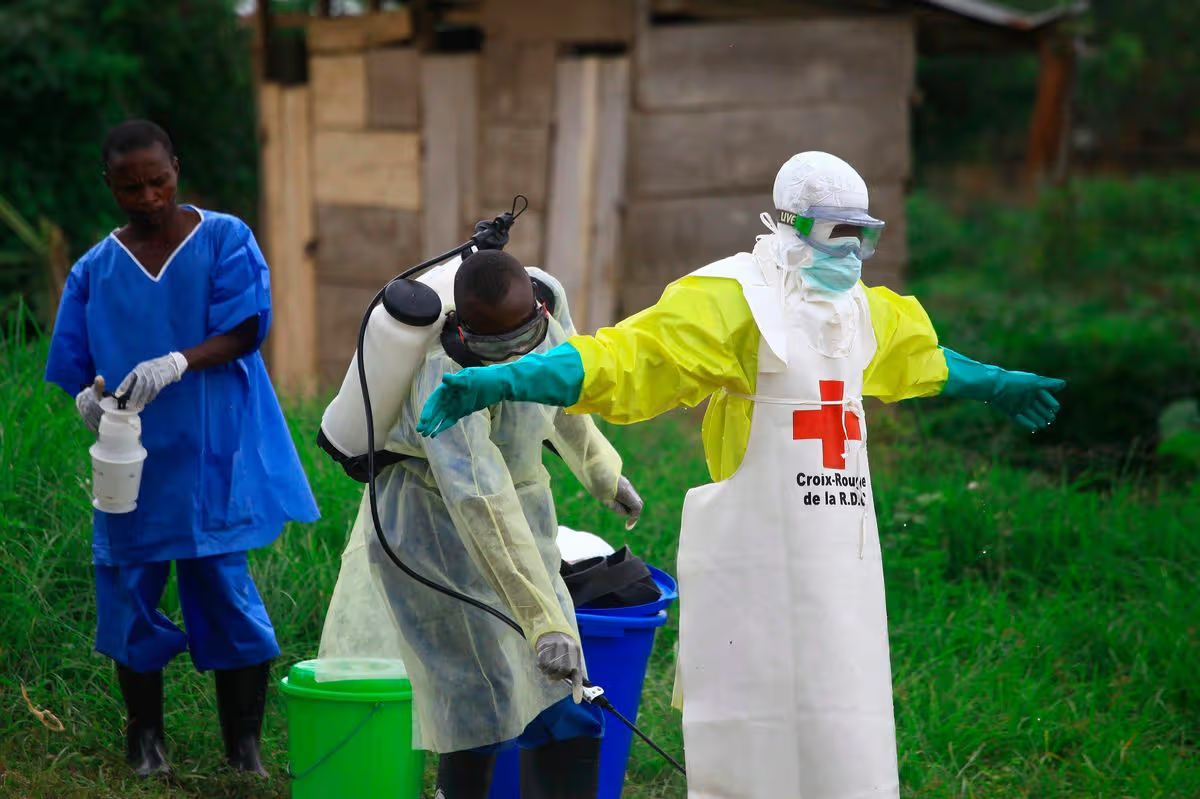
A health worker sprays disinfectant on his colleague after working at an Ebola treatment centre in Beni, eastern Congo, during an outbreak in 2018(Image: AP Photo/Al-hadji Kudra Maliro)
At least 80 deaths have been reported as a country battles an outbreak of a highly contagious disease.
The deaths were confirmed in the Democratic Republic of the Congo’s new Ebola disease outbreak in the eastern Ituri province, authorities said, as health workers raced to intensify screening and contact tracing to contain the disease. Officials first announced the outbreak on Friday, with 65 deaths and 246 suspected cases. Meanwhile, journalists in Ituri’s capital, Bunia, interviewed local people who recounted their fears and constant burials.
“Every day, people are dying … and this has been going on for about a week. In a single day, we bury two, three, or even more people,” said Jean Marc Asimwe, a resident of Bunia. “At this point, we don’t really know what kind of disease it is.”
Congolese health minister Samuel-Roger Kamba said late on Friday that there have been eight laboratory-confirmed cases, among them four deaths. Test results confirmed the Bundibugyo virus, a variant of the disease that has been less prominent in Congo’s past outbreaks.
This is the country’s 17th outbreak since Ebola first emerged in the country in 1976, the Associated Press reproted. Ebola is highly contagious and can be contracted through bodily fluids such as vomit, blood, or semen. The disease it causes is rare, but severe and often fatal.
The suspected index case in the latest outbreak is a nurse who died at a hospital in Bunia, Mr Kamba said, with the case dating back three weeks to April 24. He did not say whether samples from the nurse were tested, but said the person presented symptoms suggestive of Ebola.
DR Congo has experience in managing Ebola outbreaks, but often faces logistical challenges in getting expertise and supplies to affected regions. As Africa’s second-largest country by land area, Congo’s provinces are far from one another and mostly battling conflict. Ituri, for instance, is around 620 miles from the nation’s capital, Kinshasa, and is ravaged by violence from Islamic State-backed militants.
The disease is so far confirmed in three health zones in the Ituri province, including the capital city, Bunia, as well as in Rwampara and Mongwalu where the outbreak is concentrated.
Foreign Office advice for Democratic Republic of the Congo
As of Saturday afternoon, the Foreign, Commonwealth and Development Office had not given specific advice about travel to the Democratic Republic of the Congo in regards to the Ebola outbreak.
Its current advice, which it said remained valid on May 16, was that UK citizens should avoid travel to muliple parts of the country due to political instability.
It said: “If you are in North or South Kivu and judge it safe to do so, and if routes are available, you should leave. M23 rebels and Rwanda Defence Forces (RDF) have captured the cities of Goma and Bukavu and the surrounding areas in North and South Kivu. M23 rebels and RDF captured the city of Uvira in December 2025, and then withdrew from the city in January 2026, though clashes continue in the surrounding areas. The situation remains highly unstable and unpredictable. Routes to depart Uvira, Goma and Bukavu are limited and may change at short notice.
“The border crossings between Rwanda and the DRC at Gisenyi-Goma and Ruzizi-Bukavu could close at short notice. Goma and Bukavu airports have been attacked and commercial flights are no longer operating from the airports.
“Support from the UK government is severely limited outside Kinshasa. You should not assume that FCDO will be able to provide assistance to leave the country in the event of serious unrest or crisis.”
The FCDO advises against all but essential travel to:
The districts of N’djili and Kimbanseke in Kinshasa city south of the main access road to N’djili airport, in Nsele commune
The N1 road in Kinshasa Province, between and including Menkao to the west, Kenge to the east, the border of Mai-Ndombe province to the north, and 10km to the south
The FCDO advises against all travel to within 50km of the border with the Central African Republic and to the provinces of:
Haut-Uélé and Ituri, including the entire DRC-South Sudan border
North Kivu
South Kivu
Maniema
Tanganyika
Haut-Lomami
It also advises against all travel to the Kwamouth territory of Mai-Ndombe Province. This is between, and including, the towns of Kwamouth, Bandundu and the southern border of Mai-Ndombe province. Further, it advises against all travel to the province of Kasaï Oriental and against all but essential travel to the provinces of Kasaï and Kasaï Central and to Bangoka International Airport in Kisangani.
The Foreign, Commonwealth and Development Office (FCDO) has issued a warning to UK tourists
The FCDO issued an update about its travel advice for a certain country(Image: Getty)
The Foreign Office has warned Brits against “all travel” to a particular country due to “risks and threats”. Travellers are advised to avoid Russia entirely owing to the ongoing invasion of Ukraine.
In an update published on its website on May 5 and reconfirmed on May 14, the Foreign, Commonwealth and Development Office (FCDO) stated it “advises against all travel to Russia”.
It said: “FCDO advises against all travel to Russia due to the risks and threats from its continuing invasion of Ukraine.” These include:
Security incidents, such as drone attacks, and Russian air defence activity
Lack of flights to return to the UK
Limited ability for the UK government to provide support
The FCDO added: “There is an increased risk of British nationals being detained in Russia, including if the Russian authorities suspect you of engaging in or supporting activities against Russian law, even if activities took place outside Russia.
“Russia has a track record of targeting foreign nationals and holding them in detention as leverage over other countries. FCDO’s ability to assist you in these circumstances is extremely limited.
“There is also a high likelihood terrorists will try to carry out attacks, including in major cities.”
On its safety and security page, the FCDO noted that terrorist attacks have occurred across Moscow, St Petersburg and other Russian cities in recent years. This includes an attack at Crocus City Concert Hall in Krasnogorsk near Moscow in 2024 in which 145 people were killed.
Limited UK government support
While the British Embassy in Moscow and British Consulate in Ekaterinburg remain operational, the FCDO cautioned that the situation “could change at short notice”.
“In-person UK government support in Russia is limited,” it stated. “It is very limited in parts of Russia because of the security situation and the size of the country, particularly in the North Caucasus.”
Should you find yourself in Russia requiring assistance, you can ring the FCDO’s 24-hour helpline on +7 495 956 7200 and select the option for consular services for British nationals. Alternatively, you can contact the Russian emergency services on 112.
It’s also crucial to be aware that your travel insurance may be rendered void if you travel against FCDO guidance. For further details, visit the FCDO website here.