Foreign Office issues updated Thailand travel guidance for Brits on Monday
11:12, 12 Oct 2026Updated 14:38, 12 Oct 2026
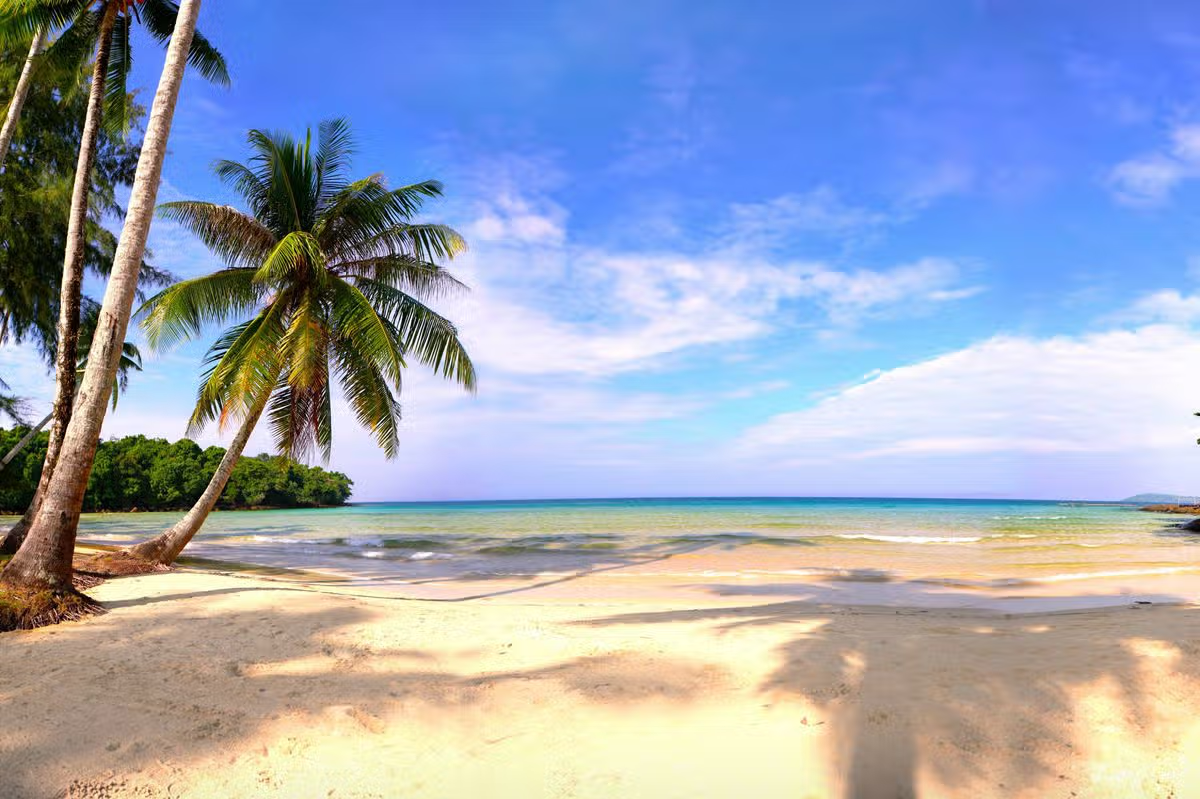
Thailand is hugely popular among UK holidaymakers(Image: ANDREY DENISYUK via Getty Images)
The UK’s Foreign, Commonwealth and Development Office (FCDO) has revised its travel guidance for those planning a trip to Thailand.
The South East Asian destination is growing increasingly popular with British holidaymakers, with over a million making the journey every year. On top of this, tens of thousands of UK nationals live, work, or retire in Thailand – in locations such as Bangkok, Chiang Mai, Hua Hin, and Phuket. To enter Thailand as a tourist, your passport must have an ‘expiry date’ at least 6 months after the date you arrive and have at least one blank page.
The FCDO warns: “You will be denied entry if you do not have a valid travel document or try to use a passport that has been reported lost or stolen.” As of September 15, 2026, if you enter Thailand on a British passport, under the visa exemption scheme, you can stay for up to 30 days for tourism only.
This does not extend to business travel, including attending conferences, meetings or other business activities. Those travelling for business purposes should secure the appropriate visa prior to departure.
New Foreign Office Thailand alert issued
New FCDO Thailand advice, issued on Monday, reads: “Visa-exempt entry for tourism through land-border immigration checkpoints is normally limited to two entries per calendar year. This restriction does not generally apply to arrivals by air.
“If you frequently enter Thailand as a tourist, immigration officials may ask for evidence of your onward travel, accommodation, or sufficient funds, and may refuse entry if they believe you are not a genuine visitor.”
All overseas nationals travelling to Thailand, whether by air, land or sea, are required to complete a digital arrival card online prior to their arrival. Travellers are able to register for an arrival card up to three days before they land.
Should you overstay your visa, you face a penalty of 500 Thai baht (around £11) per day, rising to a maximum of 20,000 baht (around £449). You also risk being detained, deported at your own cost, and banned from returning to Thailand for as long as 10 years.
Full list of outbreaks as Foreign Office-backed Travel Health Pro website revealed scores of new cases, including some deaths
12:57, 28 Sep 2026Updated 13:05, 28 Sep 2026
One in 150 people infected with WNV develop a more serious, potentially fatal illness(Image: Getty)
A ‘potentially serious’ infection outbreak has been reported in 16 European countries, sparking warnings about taking preventative measures. New figures released by the Foreign Office-backed Travel Health Pro website show that in 6 countries there have been serious numbers in the last month – including a number of deaths.
West Nile virus (WNV) is a type of flavivirus (like dengue or Zika) that can cause a potentially serious infection in humans and is spread by mosquitoes. Most people infected with WNV do not any have symptoms or experience a very mild illness and fully recover. If symptoms are present, they are usually mild; a flu-like illness with fever, headache, muscle pain and a red, bumpy rash.
However, about one in 150 people infected with WNV develop a more serious, potentially fatal illness, with a high fever, severe headache, neck stiffness, confusion, muscle weakness, trembling, convulsions and coma. Meningitis (inflammation of the protective lining surrounding the brain and spinal cord), encephalitis (brain inflammation) or acute flaccid paralysis (weak/floppy limbs) can also occur.
Latest outbreaks:
In 2026, up to 23 September, 4 locally acquired human cases of West Nile virus has been reported in Germany. Cases have been reported from Berlin, Leipzig Kreisfreie Stadt and Rhein-Pfalz-Kreis.
44 cases of West Nile virus, including 5 deaths, have been reported in the Netherlands. Cases have been reported from South Holland, Utrecht, North Holland, North Brabant, Gelderland and Overijssel provinces.
In France 117 cases of West Nile virus have been recorded in Provence-Alpes-Cote d’Azur, Occitanie, Ile-de-France, Auvergne-Rhone-Alpes, Nouvelle-Aquitaine, Pays de la Loire and Centre-Val de Loire.
North Macedonia has seen 69 locally acquired human cases of West Nile virus have been reported in North Macedonia, in 5 areas.
Up to 23 September, 2 locally acquired human cases of West Nile virus have been reported in Kosovo and 91 locally acquired human cases of West Nile virus have been reported in Romania, across 22 areas.
The European Centre for Disease Prevention and Control’s latest update shows that 86 areas affected by West Nile virus (WNV) have been identified in 16 countries across Europe. These are Italy, Greece, Romania, France, the Netherlands, Serbia, Spain, Croatia, North Macedonia, Belgium, Hungary, Austria, Germany, Kosovo, Albania and Cyprus.
Travel Health Pro said: “Some people, including older travellers, those with long term health problems and anyone with a weakened immune system (immunosuppression) are more at risk of getting seriously ill.
“There is no specific drug or treatment for WNV infection. Supportive care in a hospital is essential for people with severe WNV. While a bite from an infected mosquito is the commonest way to catch WNV, there are rare reports of non-mosquito spread, including during a blood transfusion or organ transplant.”
The only way to reduce the risk of getting infected is by avoiding mosquito bites as much as possible.
Key points to reduce insect and tick bites:
Avoid areas of stagnant or standing water, where mosquitoes are likely to breed.
Keep to footpaths and avoid long grass when walking to avoid tick bites.
Check body for ticks after outdoor activity and remove them promptly
Wear loose-fitting clothing, with long sleeves, long trousers, tucked into socks.
Clothing can be sprayed or impregnated with insecticide or purchased pre-treated to reduce biting through clothing
Use insect repellents on exposed skin
In areas with vector-borne diseases, use air conditioning where available or sleep in screened accommodation, under a mosquito net impregnated with insecticide.
Insecticide vaporisers can be used to inhibit mosquito bites and mosquito coils can be used outdoors (they are not recommended indoors).
For those staying long-term in areas with vector-borne diseases it is possible to reduce mosquito breeding sites around the home by removing any pools of water in ditches, plant pots, gutters, drains and rubbish collected in the area.
The Foreign Office is urging UK travellers to ‘avoid’
11:03, 25 Sep 2026Updated 11:07, 25 Sep 2026
UK travellers continue to be warned(Image: Daniel Garrido via Getty Images)
The Foreign, Commonwealth and Development Office (FCDO) has issued a stark warning to British holidaymakers, urging travellers to stay safe while abroad.
In a recent update on X, formerly Twitter, the FCDO said: “Free drinks aren’t worth the risk. To help reduce the risk of methanol poisoning abroad, avoid free cocktails or shots, unlabelled bottles, and unusually cheap or discounted drinks claiming to be brand-name alcohol.”
The FCDO is raising awareness following the deaths of several British travellers who consumed alcohol contaminated with methanol while overseas.
Kirsty McKie, 38, died in 2022 after inadvertently ingesting the substance while at home with a friend in Bali, where she had lived for eight years. As little as 10ml of methanol can result in blindness, while 30ml can prove fatal.
TravelAware warns: “In some parts of the world methanol products are sometimes illegally mixed with ‘real’ alcohol such as spirit-based drinks and cocktails.”
Holidaymakers are advised only to buy alcoholic drinks from licensed venues, bars and hotels, to avoid homemade alcoholic beverages, check bottle seals haven’t been tampered with, and look out for poor quality labels or spelling errors.
You should also get urgent medical help if you or anyone in your travel group falls ill after drinking alcohol. Early symptoms of methanol poisoning include impaired judgement, loss of balance, and drowsiness.
Between 12 and 48 hours after consumption, you may suffer abdominal pain, dizziness, hyperventilation, breathlessness, blurred vision and/or blindness, coma, and seizures. If you or anyone travelling with you experiences these symptoms, seek urgent medical attention.
Visual problems are a particularly significant warning sign, especially blurred vision, sensitivity to bright lights, and in some cases complete blindness. “Snowfield vision” (seeing snowy static resembling an old television) or tunnel vision may also occur.
If you experience any of these symptoms, seek urgent medical help.
The Foreign, Commonwealth and Development Office (FCDO) has updated its travel guidance for British nationals travelling to Thailand, with tighter visa-free stay restrictions for UK travellers coming into force on 15 September 2026, alongside revised weather warnings
The new rules came into force this morning(Image: Twenty47studio via Getty Images)
The Foreign Office has warned Brits to check their paperwork is in order as a country changes its entry rules.
As of today, Thailand’s entry system has changed. After two years running a generous scheme under which citizens of 93 countries and territories could enter visa-free for stays of up to 60 days, a harsher system has taken over. Effective this morning, the length of stay has been cut in half from 60 days to 30 days for many nationalities.
For US, UK, Australian and Canadian citizens, the principle remains straightforward: no visa is required for a tourist stay of up to 30 days in Thailand. However, the visa-free period has been halved from 60 to 30. If you want to stay in the country for longer than that, you’ll have to apply for an extension of up to 30 additional days. The Thai government has indicated that this should be granted.
Another major change is that the visa-free scheme now applies only to tourists. Those entering the country for work or other purposes now use the visa category corresponding to their activity.
The reform also reintroduces a restriction on land-border entries, with those using the 30-day visa exemption allowed only two land-border crossings per calendar year. Nationals of Brunei, Indonesia, Malaysia and Singapore are not subject to this limit.
Ahead of the changes coming into effect today, the UK’s Foreign, Commonwealth and Development Office (FCDO) issued updated advice to Brits, a record-breaking million of whom visited Thailand last year. The government warned of the consequences of overstaying your visa or visa-free period.
“If you overstay the period of your visa, you will get a fine of 500 Thai baht a day up to a maximum of 20,000 baht. You risk being:
held in detention
deported at your own expense
banned from re-entering Thailand for up to 10 years
“Conditions in detention centres can be harsh.”
Thailand relaxed its visa rules in 2024, expanding the number of countries that qualified for visa-exemption, while extending the maximum length of stay to 60, in a bid to boost its tourism sector post-Covid. Tourism accounts for as much of 20% of the country’s GDP.
However, the rise in visitor numbers has caused tensions in the country. Back in May government spokesperson Rachada Dhanadirek told reporters that while tourism provided “benefits, such as boosting the economy”, the former visa scheme had allowed people to “exploit” the system. Foreigners overstaying and illegally operating businesses in tourism hotspots, without the proper permits, is a particular concern in parts of the country.
The full FCDO advice reads: “From 15 September 2026, if you enter Thailand under the visa exemption scheme, you can stay for up to 30 days for tourism. If you entered Thailand before 15 September 2026, you will usually be allowed to stay for the period granted when you arrived. If you want to stay longer, you must get the appropriate visa before you travel or, if eligible, apply for an extension through the Thai immigration authorities.
“You may be asked to show that you meet the entry requirements. This could include proof that you have enough money for your stay (at least 10,000 Thai baht per person or 20,000 Thai baht per family) and evidence of onward or return travel. British nationals have been refused entry for failing to provide this evidence.
“If you overstay your permission to stay in Thailand, you could be fined, detained, deported or banned from re-entering the country. Make sure you understand the conditions of your stay and get any visa extension you need before your permission expires.”
Alongside the entry guidance, the Foreign Office has revised its advice on Thailand’s rainy season and the dangers posed by heavy downpours.
The rainy season generally runs from May to October across most of the country, and from November to March in Koh Samui and south-east Thailand. However, the updated guidance warns that “weather patterns have become increasingly unpredictable and periods of intense rainfall can occur across Thailand.”
It continues: “Heavy rainfall can cause flash flooding, landslides and disruption to transport, particularly in northern, north-eastern and mountainous areas. Conditions can change rapidly and may result in road closures and local travel disruption. Lakes, caves and waterfalls are particularly at risk of dangerous flash flooding.”
Holidaymakers should follow instructions from local authorities and keep a close eye on weather warnings from the Thai Meteorological Department.