NEW rules for Brits travelling from the UK to Ireland via the ferry have come into force today.
For the first time in over 100 years, passengers are required to carry a valid passport or risk being denied boarding.
Anyone travelling between the UK and Ireland will need to carry a valid passportCredit: AlamyPreviously travellers could take the crossing with a drivers license or bus passCredit: Alamy
Prior to today, passengers were not required to show a passport when taking the crossing.
Instead, they were asked to have another form of photo ID with a photograph like a driving licence or a bus pass.
Sign up for the Travel newsletter
Thank you!
Now, travellers have been told to carry a valid passport due to the UK Border Forceis tightening rules on “accuracy and integrity of passenger data before boarding”.
Routes affected will be between Britain and the the Republic of Ireland of which Irish Ferries operates two routes.
These go between Holyhead and Dublin, and Pembroke and Rosslare.
Another ferry enforcing these rules is Stena Line which has crossings between Holyhead and Dublin as well as Fishguard and Rosslare.
Irish Ferries explained: “This is a change to the current ID accepted and means that from 28 September, no other forms of photo ID will be accepted by Irish Ferries for any passengers, including Irish and UK citizens
“This is to ensure compliance with UKBorder Forcerequirements relating to the accuracy and integrity of passenger data before boarding.“
Previously, passengers didn’t have to carry their passports with them because of what’s known as The Common Travel Area (CTA).
The CTA is a passport-free zone involving the UK, Ireland, the Isle of Man and the Channel Islands dating back to 1923.
Operators have warned that no other form of ID will be accepted on the crossingsCredit: Alamy
British and Irish citizens don’t legally need a passport to travel between the two destinations.
But carrying passports has since became a requirement by airlines like Ryanair and Aer Lingus for passengers flying between the two destinations.
Appearing at an RHS event, Monty Don admitted he will have to find a new way to finance the maintenance of his two-acre garden at Longmeadow following his Gardeners’ World exit
Monty Don has admitted he may have to make a major change next year (Image: Dave Benett, Dave Benett/Getty Images for Killik & Co)
Television legend Monty Don has admitted he may be forced into making a major change at Longmeadow following his departure from Gardeners’ World. Monty, 71, is leaving the show after over 20 years of leading the programme.
However, during a talk at the RHS Malvern autumn show, Monty revealed his soon-to-be former employer, the BBC, had been contributing to the salaries of two gardeners who have worked at Longmeadow since 2011.
Speaking at the RHS event, Monty said the reason for having the team was so the garden could always look “camera ready” if he was away filming in another country, or working on another project.
With his Gardeners’ World exit in mind, Monty, who has lived at Longmeadow in Herefordshire with his wife Sarah since 1991, has said there will come a moment where he will need an alternative plan to keep Longmeadow in shape.
He said: “The BBC pays a contribution towards their wages. Not enough, but they do pay something, which is great. Obviously that contribution is going to go.
“I will have to think of ways – I can’t afford it unless we earn money from it – so I am going to think of ways of earning something from the garden, but I can’t do that until the middle of next year at the earliest.”
Monty, who announced his intention to leave Gardeners’ World in an Instagram video, said he had decided to step away from the renowned show as he felt it was “the right time for a change”.
As well as paying tribute to the “superlative BBC team”, he added: “I look forward to continuing to work with and for the BBC on other projects, as well as following new avenues. And of course, I will still be gardening, dog by side, here at Longmeadow.”
Monty’s exit has subsequently led to speculation about who would replace him, with plenty of candidates from the existing Gardeners’ World team.
Months prior to Monty’s announcement, as questions continued to be asked about how long he would stay on the show, Frances Tophill, 36, was asked how she would feel about potentially replacing him.
Although she has been part of the team for over a decade, Frances ruled herself out of following in Monty’s footsteps, with the latter taking over from Alan Titchmarsh in 2003.
Speaking to the Sunday Times, Frances admitted to having little interest as she saw her main job as being a gardener rather than a presenter.
She said: “I have a huge respect for Monty – it is such a generous thing to give your garden space to the nation and he does it so well. I hope he never leaves….Broadcasting is not my day job, my day job is being a gardener.”
Frances’ comments came after she got a taste of what life as the main presenter would be like when she found herself surrounded by people in a garden centre after deputising for Monty during one episode in 2023. She added: “That’s when I got a glimpse of what being Monty must be like… I don’t want that.”
Cape Canaveral Space Force Station is getting lasers that can zap drones intruding into its airspace. When installed, the new directed energy defense system will be part of a much larger effort to protect the spaceport against drone incursions, a spokesperson for Space Launch Delta 45 (SLD 45) told us.
The idea is to ensure the safety of launches and to keep prying eyes away from an installation full of secrets about America’s military and commercial space efforts. Companies like SpaceX, United Launch Alliance, Blue Origin and Relativity Space use the installation for space launches. The base defense modernization effort comes as the Cape Canaveral region is inundated with drone incursions. There were hundreds last year.
A SpaceX Falcon 9 rocket launches from Space Launch Complex 40 at Cape Canaveral Space Force Station, Florida, on May 29, 2026. (U.S. Space Force photo by Gwen Kurzen) Gwendolyn Kurzen
“As the world’s premier spaceport continues to support an unprecedented launch tempo for national security and commercial missions, securing critical launch infrastructure from low-altitude aerial threats remains a top operational priority,” the spokesperson explained. “The ongoing security modernization integrates detection, tracking, and defensive capabilities to include directed energy systems. These will provide security forces with real-time situational awareness and the necessary tools to safeguard personnel, launch complexes, and national security payloads.”
The spokesperson did not have a timeline for when the directed energy system will be operational. Florida Today was the first to report that lasers will make up this defensive system.
Col. Brian Chatman, who commands Space Launch Delta 45, told the publication that the facility is “bringing on a directed-energy system that can do a kinetic kill against UASs (Unmanned Aircraft Systems) that are coming into the area that are having nefarious intent.”
“The Air Force Research Laboratory [AFRL]-tested system has been proven to be able to safely bring down a drone,” Florida Today noted. “This directed-energy system uses lasers to shoot down any drone that flies into restricted areas.”
Chatman didn’t name the specific system to Florida Today and the SLD 45 spokesperson declined to say.
The following video shows one such AFRL-tested system that has been used in combat before.
Raytheon laser weapon demo: Drones don’t stand a chance
For the spaceport, being able to use lasers is even more important than it is for other locations needing protection from drones. That’s because the traditional method of jamming radio frequencies to interfere with drone connections to controllers could damage spacecraft.
“If you start blasting a bunch of RF energy you run into potential challenges,” Chatman explained. “You don’t want that.”
There is good reason for Chatman to be concerned about drones. The spaceport has been subjected to many unauthorized incursions, the spokesperson told us. However, there were no statistics immediately available on how many or whether they occurred during launches. There were 500 unauthorized drone flights over the adjacent Port Canaveral in 2025, Port Canaveral CEO Capt. John Murray said.
In addition, on Sept. 18, a Chinese tourist pleaded guilty to a federal misdemeanor charge after flying a drone in restricted airspace above NASA’s Kennedy Space Center (KSC) in late July. KSC is located across the Banana River from the space station.
It is unclear if the new laser system will also protect the skies over KSC. The spokesperson did not immediately know and is checking into it.
Cape Canaveral. (Google Earth)
That tourist, Xiaodong He, flew a drone that videotaped the installation, according to federal documents. The drone got within 1.56 miles of pad 39B, from where the next crewed lunar flight is expected to launch in 2028.
NASA’s Kennedy Space Center pad 39B. (NASA)
Encompassing about 25 square miles, Cape Canaveral Space Force Station is a large, unpopulated, open area with a long Atlantic Ocean shoreline. The station’s physical layout allows many vectors for drone incursions, and what’s housed there makes it a logical target for a nefarious actor.
The systems being prepared for launch and launched at the sprawling facility are extremely valuable and can take many years to build, costing billions. When they are out on the pad or being transported around, the rockets are massive tubes packed with high explosives that would cause a devastating secondary explosion if struck.
Even disrupting launches there due to a successful or even attempted attack could have major national security impacts.
The move to bring directed energy systems to protect the spaceport comes as the military is investing heavily in these systems to counter drones. Late last month, for instance, troops from the Joint Task Force-Southern Border (JTF-SB) employed an Army Multipurpose High Energy Laser (AMP-HEL) system during an operation dubbed Ardent Vanguard. The AMP-HEL was used “to engage and defeat three hostile UAS, determined to be such based on their use in direct support of activities posing a physical threat to U.S. military personnel and CBP [Customs and Border Protection] partners,” according to a media release at the time.
The shootdown was part of the U.S. government’s ongoing effort to counter drones being flown by Mexican drug cartels.
Joint Task Force – Southern Border personnel used the Army Multipurpose High Energy Laser system to engage and defeat a hostile drone. (U.S. Army Photo by Sgt. Daniel Huerta) Operation Ardent Vanguard
The military is seeking to expand its ability to counter drones with directed-energy weapons. In May, the Defense Department and Joint Interagency Task Force 401 selected five installations to participate in a directed-energy counter-unmanned aircraft systems pilot program required by the Fiscal Year 2026 National Defense Authorization Act.
“This initiative will accelerate the fielding and evaluation of advanced directed energy capabilities to protect critical infrastructure, military installations and homeland missions,” the Pentagon explained. “The locations were deliberately selected to support rigorous testing and operational assessments across diverse environments and mission sets.”
The Pentagon selected two “key southern border installations” for this program: Fort Huachuca, Arizona; and Fort Bliss, Texas. It also tabbed Naval Base Kitsap, Washington; Grand Forks Air Force Base, North Dakota; and Whiteman Air Force Base, Missouri.
Though the Pentagon is pressing forward with making directed energy a key part of counter-drone efforts, laser weapons have limitations. These include their short-term magazine depth being limited to how many successive shots they can fire before thermal loads require the system to cool down. Energy supply can also be a limiting factor. Additionally, laser systems don’t function as well in heavy cloud cover and other inclement weather.
You can see the Iron Beam’s first claimed kills in the following video.
A World First — Combat-Proven Laser Defense, Powered by Rafael
For the first time in history, high-power laser systems have been used to intercept aerial threats in combat. This unprecedented breakthrough took place during the Swords of Iron War — with Rafael’s advanced… pic.twitter.com/B3D6UdCJvE
— Rafael Advanced Defense Systems (@RAFAELdefense) May 28, 2025
At the same time, a laser weapon of this kind is very much a point-defense weapon, with its short range meaning that multiple systems will be needed to provide coverage of a significant area. In some situations, even a single, large military base like Cape Canaveral Space Force Station might require more than one to provide full defensive coverage.
In addition, there have been concerns about the safety of the systems and the authorities required to use them in the homeland.
Safety concerns about using directed energy weapons, and especially kinetic ones, to take down drones in the U.S. have been a major factor in why they haven’t been previously used in this role. Almost two years ago, officials at U.S. Northern Command (NORTHCOM), which has coordinating authority for counter-drone efforts in the U.S., said the use of such weapons was not yet on the table. The reason is that they can create dangerous or otherwise serious collateral effects that are less of a concern in a war zone.
That the U.S. Space Force is bringing in a laser system to protect some of the nation’s most important and secret military assets is a strong indication that these concerns are being overcome.
The White House signaled Friday night that CNN would be left off Air Force One for President Trump’s Saturday trip, the latest media restriction from the administration in an ongoing dispute with 1st Amendment implications.
The news organization was replaced by Real America’s Voice News, a conservative outlet.
The news came just after journalists from three news outlets that Trump banned last week from the White House grounds — CNN, MS NOW and Politico — returned to the executive complex with TV cameras, laptops and microphones in hand.
A judge temporarily struck down the ban in an overnight ruling early Thursday, but his decision didn’t directly address White House pool reporters. The networks continued to refrain from covering Trump as part of the pool, even as reporters from all three outlets were allowed back in the White House.
The temporary order from the judge mentioned only the White House grounds and said nothing directly about Air Force One.
Theodore Boutrous Jr., the news outlets’ attorney, did not immediately respond to an email and phone call requesting comment Friday night.
For a while during the day, the U.S. network video pool for the White House was back in operation for the first time since Trump banned the three news outlets in an extraordinary showdown over media access.
At noon on CNN, viewers could see Trump and Chinese President Xi Jinping touring the National Archives Museum along with their wives, Melania Trump and Peng Liyuan. The banner along the bottom of the screen read: “Trump and China’s Xi Visit National Archives.” It was a routine report from a state visit — but for the fact that CNN had not aired live video of Trump in several days.
“As of now, all systems are go,” said a person familiar with the pool, speaking on condition of anonymity because of the fluidity of the situation.
The pool consists of five major U.S. broadcast outlets that take turns shooting and sharing video. When the White House banned CNN — which belongs to the pool — from White House grounds, along with MS NOW and Politico, the other four pool providers declined to participate in a show of solidarity.
CNN was not commenting directly earlier Friday, referring instead to its editorial coverage. But Brian Stelter, the network’s media analyst, posted on X that CNN had a pool assignment at the National Archives event and that the White House had approved the network’s credentials.
The war against Iran exposed gaps in how the U.S. can provide effective, sustained air defenses for its foreign installations and there are major concerns about a future fight against a peer competitor like China or Russia. Drone incursions at home have raised alarms about domestic base protection as has the war between Russia and Ukraine.
Video captures the moment that several Iranian medium to intermediate-range ballistic missiles struck Muwaffaq Salti Air Base in Jordan overnight, killing at least two and injuring several other American Servicemembers. pic.twitter.com/cJz39E1LvP
“For decades, American air and space power has often operated from a position of sanctuary. Those days are over,” Air Force Chief of Staff Gen. Kenneth S. Wilsbach said during a keynote speech. “We can no longer treat point defense as a side hustle. We must make it a core function of air and space power.”
He acknowledged the widespread damage Iran caused to U.S. bases and suggested that lack of base defense played a large role.
“So, if we had more robust base defense, perhaps those bases wouldn’t have been as damaged as they were,” the general admitted. “Look at Israel; they have a significantly layered, very robust defense of their country, and they didn’t take that many hits. Very few, in fact, and that shows you what a good defensive system can do, which can help you to operate not quite with impunity, but almost, and you can just keep generating air power, and your defensive systems take care of the incoming.”
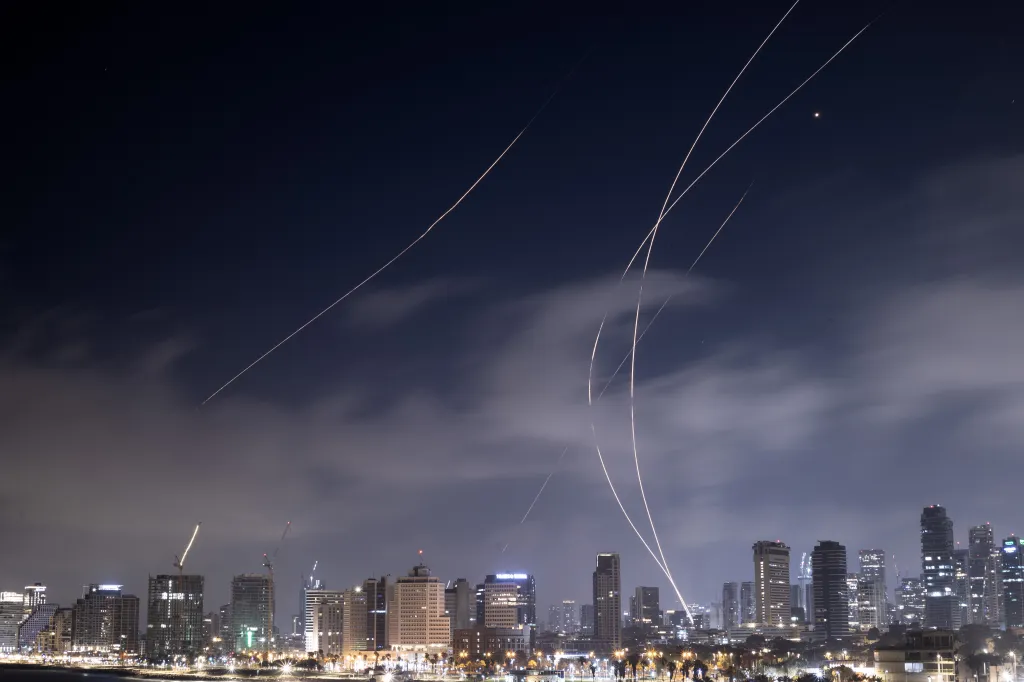
Israel’s ‘Iron Dome’ air defense system responds to incoming Iranian ballistic missiles as seen from Tel Aviv, Israel on June 18, 2025. (Photo by Mostafa Alkharouf/Anadolu via Getty Images) Anadolu
Wilsbach offered some concrete suggestions about how to make improvements.
“First, we will establish the point defense weapon system, bringing together kinetic and non-kinetic capabilities to secure our air bases,” the general said. He did not offer any specifics.
The Air Force currently has no such systems. Now it is set on changing that.
The Air Force is also looking at directed energy weapons like lasers for force protection and especially for defending bases overseas. While gaining traction across the services due in large measure to the much lower cost of delivering effects, these systems are still works in progress.
A U.S. Army Terminal High Altitude Area Defense (THAAD) in Guam. (U.S. Army)
It’s one thing to have equipment, but another to have experts that know how to use it, Wilsbach noted.
“Second, we have established a new career field of point defense airmen,” he added. “This new career field will be operational in two years. Together, these two new initiatives will strengthen our defenses, reinforce our ability to generate air and space power under fire, and protect our greatest advantage: our airmen and guardians.”
“Protecting the force and generating combat power are inseparable,” Wilsbach explained. “We need our airmen trained, equipped, and ready to fight from the opening moments of a conflict.”
“Don’t you think we ought to have them at every base?” he suggested when asked about point defenders during a media engagement at the symposium. “Because if every base is going to be threatened, we have to have somebody that knows how to defend it. So, obviously, that’s a long-term objective. But what I’ll tell you for right now is we’re going to develop the career field and push it forward to the critical bases that need protecting most, and then we’ll expand it beyond there.”
Airmen assigned to the 319th Reconnaissance Wing prepare to execute a Point Defense Battle Lab exercise on the flightline at Grand Forks Air Force Base, North Dakota, Feb. 13, 2026. (U.S. Air Force photo by Airman 1st Class Emma Teel) Airman Emma Funderburk
Though he wants the Air Force to come up with new defensive systems and personnel with the know-how to operate them, Wilsbach is not quite as sold on building out hardened aircraft shelters (HAS). This is his long-standing position that he reiterated on Monday.
“If you know where you’re going to fight from, hardened shelters aren’t that bad of an idea,” the general posited. “Deeply buried are even better. But if you are like us, and we don’t necessarily know where we’re going to fight from, if you build a hardened shelter and you don’t happen to be there, then you perhaps wasted that money.”
“So, given a resource-constrained environment, I would like to put my dollars in systems that can go anywhere in the world and protect you with basically the same level of security by shooting down incoming rounds versus making a hardened shelter that is impervious to an attack,” Wilsbach explained. “You have to put it 200 or 300 feet underground. Any hardened shelter that you show me that’s above the ground, I can blow up. So unless it’s really deeply buried, and then if it is, it’s expensive. And so that’s my logic: the best bang for the buck.”
A U.S. Air Force F-16 Fighting Falcon, assigned to the 480th Fighter Squadron, sits inside a hardened aircraft shelter during exercise Turbo Weasel at Spangdahlem Air Base, Germany, April 14, 2025. (U.S. Air Force photo by Senior Airman Demi M. Ebert) Senior Airman Demi M. Ebert
To speed up the fielding of defensive systems, the service is interested in building out a procurement process specifically designed to develop weapons and other equipment needed to defend bases.
“How do you make sure that [airmen] have the kit they need to do the job?” Air Force Secretary Troy Meink asked rhetorically at a separate symposium session.
The Air Force, he said, is considering creating a new base defense Portfolio Acquisition Executive (PAE). The service created PAEs at the beginning of the year as part of an overhaul of its acquisition process ordered by Defense Secretary Pete Hegseth.
“The creation of PAEs is a central element of that direction,” according to an Air Force memo on the topic. “By organizing acquisition leadership around portfolios of capability, rather than discrete programs alone, the Department seeks to improve integration, decision speed, and outcome-focused execution across the acquisition enterprise.”
(U.S. Air Force)
Meink acknowledged that there are challenges to creating a new PAE, most notably the overhead cost of establishing a new office with its associated personnel and infrastructure.
“Probably not going to do it right away, but obviously I think we’re on a path to something like that in the future,” the secretary suggested. “But there definitely has to be a continually increasing focus on making sure we can defend our airmen and guardians wherever they are in the world. This is not just an overseas problem; it’s a U.S. problem as well.”
As we noted earlier in this story, the U.S. is already facing a challenge defending against Iranian threats. A war with China would be more devastating and, when it comes to the Air Force protecting its bases, require more robust defenses and a lot more of them at many more locations. At the same time, the Air Force is still very early in the process of taking on more responsibility for protecting its assets.
For the Air Force, recognizing the problem and taking steps to fix it are important steps. Whether these are the right approaches is something we will keep an eye on.
A NEW train ticket rule has officially rolled out to make life much easier for travellers.
Passengers on Britain’s biggest train operators will now spend much less money when their train is cancelled.
A new train rule has come into force making life much easier for passengersCredit: PA:Press Association
For the first time, passengers left stranded at stations can use an alternative operator’s service to complete their journey free of charge.
The new rule which came into force on Sunday, September 20 hopes to end limbo at stations following cancellations and end the need for costly re-bookings.
Sign up for the Travel newsletter
Thank you!
Many regular travellers will be aware that this scheme already operates across all 13 publicly-owned operators, such as LNER, Southern, South Western Railway and Greater Anglia.
However, from now, Avanti West Coast, Chiltern Railways, CrossCountry and Great Western Railway will also be involved, offering more stability on a host of key intercity routes across the UK.
East Midlands Railway will also be joining the scheme at a later date.
The new scheme comes ahead of the establishment of Great British Railways (GBR) – a programme to transfer all rail services to public ownership and to create a “one-stop shop” for train travel.
Valid ticket holders can travel with another train operator on a direct or reasonable alternative route, but the service must depart within two hours before or after the original cancelled train.
To claim the new ticket, passengers will need to show their original ticket to customer support staff as a proof of purchase, and will not be required to download the new one.
Full list of operators taking part in the new scheme:
East Midlands Railway is expected to join the scheme at a later date:
c2c
Gatwick Express
Greater Anglia
Great Northern
LNER
London Northwestern Railway
Northern
Southeastern
Southern
Thameslink
South Western Railway
Transpennine Express
West Midlands Railway
Avanti West Coast (new)
Chiltern Railways (new)
CrossCountry (new)
Great Western Railway (new)
When the new scheme was unveiled, Rail Minister, Lord Hendy, said: “This is a simple, common-sense change that puts passengers first.
“No one should be left stranded because of a fragmented railway when their journey is disrupted.
“From this weekend, if your train is cancelled, you can get on another operator’s service and carry on your journey without paying again.
“We’re fixing the railway from the ground up, making it simpler, fairer and easier to use, as we move towards Great British Railways and put public service back at the heart of our railways.”
U.S. Space Force’s top officer has shared new details about his service’s use of electronic warfare capabilities during Operation Epic Fury against Iran earlier this year. This underscores how space is steadily becoming an arena where conflict actually occurs, and the implications this has for forces operating inside and outside of the Earth’s atmosphere.
Chief of Space Operations Gen. Douglas Schiess highlighted the actions of a member of the 42nd Electromagnetic Warfare Combat Detachment (EWCD) in support of Epic Fury during a keynote speech earlier this morning. Schiess’ remarks came at the Air & Space Forces Association’s (AFA) 2026 Air, Space & Cyber Conference, at which TWZ is in attendance. This is his first major engagement since taking over as head of Space Force less than two weeks ago.
A previously released picture showing a member of the 42nd Electromagnetic Warfare Combat Detachment forward-deployed somewhere in the Middle East in 2024. USAF/Senior Airman Zeeshan Naeem
“During Operation Epic Fury, our components, notably at U.S. Central Command and Space Command, with support from our components at European Command and Pacific Command, demonstrated that Guardians [the official term for uniformed Space Force personnel] are not supporting from the sidelines as a nice-to-have [sic], but we are delivering space power directly into the fight as a need-to-have,” Schiess said. “One of those impressive Guardians is Specialist Gray, who hails from Tampa, Florida. She joined the Space Force just two years ago, but listen to the impact she [has] made in her short term already.”
“She deployed to the CENTCOM AOR [Central Command area of responsibility] as a part of the 42nd Electronic Warfare Detachment [sic], and within hours of OEF kicking off, she received a top priority target package with one critical objective: reconfigure her weapon system and execute critical non-kinetic fires,” he continued. “She locked onto the target, optimized her weapon system, and waged electromagnetic warfare against a determined adversary. Even as ‘Alarm Red’ sirens were blaring, and incoming missiles targeted her site, she courageously held the line, protecting forces, denying adversary capability, and delivering space effects, until her commander had to literally pull her from the console to safety.”
“Specialist Gray is just one of the outstanding members of the entire enterprise of dedicated guardians, including the acquisition professionals that developed and fielded the weapon system that she operated, the intel Guardians that developed the targeting package that she used, and the cyber guardians who ensured communication, connectivity, and network defense for the command and control, the guardian instructors who trained her for combat, and the list goes on and on,” the Chief of Space Operations added.
Schiess did not name the system in question or elaborate further on how it was employed. However, previously released pictures of elements of the 42nd EWCD in the Middle East have shown personnel working with trailer-mounted multi-band antennas that have been associated in the past with variants of the Counter Communications System (CCS). CCS is a family of ground-based electronic warfare jammers primarily designed to disrupt enemy space-based communications capabilities. Prior to yesterday, CCS was the U.S. military’s only publicly acknowledged anti-satellite weapon. Space Force has now confirmed it also has weapons in orbit, which we will come back to later on.
Members of the 42nd EWCD pose in front of a trailer-mounted antenna at an undisclosed location in the Middle East in 2024. USAF/Senior Airman Zeeshan NaeemA picture released in 2020 showing members of the 4th Space Control Squadron standing in front of what is explicitly said to be an element of the Block 10.2 version of the Counter Communications System. USAF
The 42nd Electromagnetic Warfare Combat Detachment has been operating in the Middle East since at least 2024 under the umbrella of Space Force’s main headquarters in the region, U.S. Space Forces – Central (SPACECENT). President Donald Trump briefly called attention to the detachment’s “cutting-edge defense activities” during a Christmas Eve conference call with deployed service members last year.
“Sometimes we have to be within the footprint of the satellite, and so that’s why Guardians go into harm’s way,” Gen. Schiess did tell TWZ and other outlets at a roundtable after his speech this morning when asked for more details about the 42nd EWCD’s role in Operation Epic Fury, and what lessons Space Force has been learning from the conflict more broadly.
“Electromagnetic warfare was a big part of that, but also satellite communications,” he added. “The ability to keep communications, obviously GPS and PNT [positioning, navigation, and timing], were important there.”
“And then, really, missile warning and missile tracking was [sic] incredibly important. Both [Air Force Chief of Staff] Gen. Wilsbach and I talked about ‘Red Alarm’ situations,” the Chief of Space Operations continued. “Being able to tell our forces to be able to take cover was extremely important. And as we’ve seen from Ukraine to Iran, the amount of missiles and the amount of things, the folks that are doing that each and every day are incredible, and they are saving lives.”
Chief of Space Operations Gen. Douglas Schiess. USAF
Gen. Schiess’ anecdote about Specialist Gray and the 42nd EWCD did highlight how Iran, especially in the opening phases of the conflict earlier this year, was able to deal real blows to U.S. and allied facilities and forces across the Middle East. Iranian missiles, drones, and other capabilities were able to damage and/or destroy a variety of high-value assets, including aircraft and radars, and cause hundreds of casualties, as TWZ has drawn attention to on several occasions in the past. This has already been a sobering wake-up call with serious implications for potential future conflicts against larger and even more capability opponents, especially China.
“I think the whole joint force is learning a lot from Operation Epic Fury, the previous operation there, on exactly what needs to be in underground facilities, [and] what maybe can we do from remote locations,” the head of Space Force said at the roundtable today. “You could also look at what can we do from space to do some of those things? And so we’re looking at all those [lessons learned].”
Gen. Schiess mentioning subterranean facilities and remote operations is particularly notable. Even before Operation Epic Fury began, the U.S. Air Force had been working to expand options for directing operations in the Middle East from a command center in the United States. The service had also been looking to push certain command and control functions at Al Udeid Air Base in Qatar underground. Al Udeid was among the many bases Iran subsequently targeted.
For Space Force, operations against Iran have provided a broader opportunity for the service to demonstrate its active role in forward-deployed operations. That, in turn, has generated its own lessons learned beyond just steps needed to help better protect units in the field.
Then-Lt. Gen. Douglas Schiess meets with forward-deployed members of the 42nd Electromagnetic Warfare Combat Detachment in 2025. Schiess was head of US Space Forces – Space (S4S) and the Combined Joint Force Space Component Commander at SPACECOM at the time. Space Force
This extends to “reconstitution [of forces] in a combat environment, the logistics and the importance of that relationship with TRANSCOM [U.S. Transportation Command] and to be able to get supplies and replenishment into the theater,” Chief Master Sergeant of the Space Force John Bentivegna also said today, speaking alongside Gen. Schiess at the roundtable. That is “something we haven’t really worked on before. So definitely, it was a great lesson learned.”
Space-based capabilities including early warning, general intelligence gathering, weapons guidance, near-real-time communications, and more, are already absolutely central to U.S. military operations. America’s long-standing dominance in space is also steadily being eroded, with China, in particular, surging ahead in the deployment of new satellites to support a host of mission requirements, including intelligence-gathering and long-range targeting. The ability to leverage space is also proliferating to smaller adversaries, including Iran.
In addition, as mentioned, the space domain is no longer limited to just supporting operations within the atmosphere, but is a place where real engagements happen. The U.S. military is now capable of generating so-called counter-space effects using forces and assets within the atmosphere as well as in orbit, as was just disclosed yesterday.
Overall, Gen. Douglas Schiess’ comments today about the role played by Specialist Gray and the 42nd EWCD during Operation Epic Fury are indicative of not just what is to come in future operations, but how the Space Force is already engaged in combat missions now.
President Donald Trump on Saturday said he will form an “AI Force” and appoint an AI “czar” in a bid to control the harmful side of artificial intelligence, an industry he said will one day make up 25% of the U.S. GDP.
A major rule will come into force this weekend (Sunday, 20 September) for anyone travelling by train – and it’s good news, with the freedom to board other services
Train travel should be alot easier from this weekend(Image: Getty Images)
There’s nothing worse than your train being cancelled, even more so when you know the next one isn’t for another hour or two, or perhaps that was the last one of the day. Travellers risk being fined if they’re caught on board a railway line or route that differs from their original ticket, with others opting to fork out for a last-minute train ticket on another line, just so they can get home for the evening.
However, this travel dread is about to ease, as passengers will easily be able to board an alternative service with another train operator for free if their original train has been cancelled. The significant change will launch on Sunday, 20 September, in hopes of making rail travel easier, as more train operators are involved in the new scheme, as confirmed by the government.
While cross-operator ticket acceptance is already available across publicly owned train operators, from Sunday, four major railway companies will join the scheme: Avanti West Coast, Chiltern Railways, CrossCountry and Great Western Railway. This means that a total of 17 train operators will be part of the initiative from this weekend, with East Midlands Railway also set to join, although a date has yet to be confirmed.
What train companies are involved in the scheme?
c2c
Gatwick Express
Greater Anglia
Great Northern
LNER
London Northwestern Railway
Northern
Southeastern
Southern
Thameslink
South Western Railway
Transpennine Express
West Midlands Railway
CrossCountry
Great Western Railway
Avanti West Coast
Chiltern Railways
Rail Minister, Lord Hendy, said: “This is a simple, common-sense change that puts passengers first. No one should be left stranded because of a fragmented railway when their journey is disrupted. We’re fixing the railway from the ground up, making it simpler, fairer and easier to use, as we move towards Great British Railways and put public service back at the heart of our railways.”
What do I need to do?
If your original train and route are cancelled, you can simply use that same ticket to board another service with a rival railway operator included in the scheme. There’s no need to buy another ticket or to fork out for any additional fees. It’s important to note that the alternative train you’re boarding must depart two hours before or after your originally booked service. Additionally, the service must be a “direct or reasonable alternative route”.
Are there any other changes to train travel?
Elsewhere, new pay-as-you-go services will be launched across Greater Manchester, the Midlands and the south-east at more than 100 train stations by next year. This is due to a £156 million investment from the government as part of a ticketing scheme.
A new Great British Railways website and app are also in the works, in hopes of making train travel that much easier. Alex Robertson, chief executive of the independent watchdog, Transport Focus, said: “When passengers are delayed, they just want to get where they need to be, not worry about whether their ticket will be accepted on another train.
“This is a welcome change that we have long called for and should make it easier for people when services are cancelled. The key now is making sure passengers get clear information about their options whenever disruption occurs.”
Do you have a travel story to share? Email webtravel@reachplc.com
The head of Air Mobility Command (AMC) on Wednesday offered some new details about what went into repairing a KC-135 Stratotanker riddled with shrapnel holes from an Iranian attack. We have previously written about a couple of these jets damaged during Operation Epic Fury (OEF) as they came through RAF Mildenhall in the U.K. on their way back to the U.S. for comprehensive repair work. We are also getting new information of how AMC kept its fleet operating at such a prolonged high-tempo ahead of and during OEF.
A U.S. Air Force maintainer performs preflight maintenance on a KC-135 Stratotanker refueling aircraft at a base in the Middle East, April 30, 2026. (U.S. Air Force photo by Master Sgt. James Cason) Master Sgt. James Cason
“A KC-135 ops crew is in the jet,” he said. “KC-135 maintenance team is about to launch this jet. Unexpected Alarm Red [an attack warning]. Everyone jumps in a bunker.”
After the barrage, the airmen emerged from their bunkers and checked out the plane.
“That aircraft is smoking,” Tulley said. “There are holes in it, and it’s a fully loaded KC-135. Two hundred thousand pounds of jet fuel. Took 48 hours for that [fuel] to be drained out of that aircraft. In the meantime, first on the scene was I think the pro super [production superintendent] and the expediter. They immediately began to collect the fuel… They start to patch the holes. They start to fix all the systems. Long story short, they were eventually able to get that plane to make a transoceanic flight back home to be fully repaired.”
Tulley did not say where the attack took place. However, as we have previously reported, five tankers were reportedly damaged in an Iranian long-range strike on Prince Sultan Air Base (PSAB) in Saudi Arabia on March 14. That was later confirmed in a Department of War Inspector General report released earlier this week.
You can see two of the shrapnel-damaged KC-135s as they passed through the UK on the way home in the following photographs shared with us by aviation photographer Andrew McKelvey. We do not know if either of these is the one discussed by Tulley.
(Andrew McKelvey) (Andrew McKelvey)
Lt. Gen. Linda Hurry, Commander of Air Force Materiel Command (AFMC), followed Tulley’s comments with additional details about the repair work.
“I’ll pick right up on that because it was our aircraft battle damage repair team that was actually able to patch their aircraft back together to get it back to Tinker [Air Force Base in Oklahoma] that can put it completely back where it needed to be,” she noted. Tinker is home to the Expeditionary Depot Maintenance (EDMX), which is “responsible for maintaining the Air Force’s sole source for Aircraft Battle Damage Repair (ABDR) rapid repair capabilities for the entire tanker and bomber fleets,” according to the Air Force.
“So with Operation Epic Fury, we’re asking those questions: What can we sustain for how long? And it begs a question about regeneration,” Tulley further explained. “You know, our new teammates have regeneration as part of their doctrine, so readiness in contact is the way we’re approaching this. What can we do to improve how we generate capability while under fire, in contact, persistently in an extended or protracted conflict? Lots of great examples of work being done to get after this. General Hurry’s team has brought a lot of capability forward at Mildenhall Air Base.”
One example of how this has worked has been repairing damaged aerial refueling booms in the U.K. instead of all the way back to the U.S., Tulley highlighted. The booms, which extend from the back of tankers so that receiving aircraft can get their gas, can be damaged by the process, especially during combat refueling.
“I think we turned 30 booms instead of bringing them all the way back to the states,” Tulley noted.
A KC-135 refueling boom. (USAF)
Repairing battle damage is certainly a unique situation for AMC airman, but keeping hundreds of the command’s tankers and cargo aircraft moving at such a high rate prior to and during the war was a huge undertaking that was helped by new maintenance concepts. The Air Force sent maintainers and parts to bases in Europe to drastically speed up major maintenance that would have demanded the aircraft return stateside.
“We moved some maintenance actions forward, so they didn’t have to – the aircraft didn’t have to go all the way back to the states,” Air Force Chief of Staff Gen. Kenneth S. Wilsbach said during his keynote speech earlier this week. “We put some of them in Europe, so they could get through some normal safety inspections that were either due or deferred. Got those done, and the aircraft doesn’t have to go all the way back to the states. They can go somewhere in Europe, get the thing done, and then get right back to the flight. And so, those measures by Air Mobility Command paid dividends in the readiness of our mobility fleet.”
Air Force Global Strike Command (AFGSC), which maintains the service’s fleet of strategic bombers and its ICBM force, did something similar at RAF Fairford in the U.K., AFGSC commander Gen. Stephen L. Davis explained.
“It’s a complex problem,” said Davis. “I would say in the past we probably didn’t do this the right way. When we thought a conflict was kicking off, the first thing we do is start sending bombers forward, and that actually consumes our readiness. So I think we got it right during OEF.”
“We pushed maintainers and support personnel forward to RAF Fairford, and then we actually took the bombers, we loaded them up in CONUS [Continental United States]. We took them to the Middle East. They actually did a mission. They employed, deployed, conducted a combat mission, and then landed at Fairford. And then for the next, well, I guess they’ve been there for now six-plus months.”
“They’ve been conducting nearly daily operations out of there,” Davis proffered. “When bombers are back at home base, they build readiness. When we deploy it forward, they consume readiness. And then, as [Gen. Hurry] said, we’re getting great support in terms of parts, in terms of supplies, and in terms of forward depot support. So that fleet remains healthy.”
A U.S. Air Force B-1B Lancer at RAF Fairford, England, July 15, 2025. (U.S. Air Force photo by Tech. Sgt. Robert M. Trujillo) Tech. Sgt. Robert Trujillo
Being able to do as much repair and maintenance work as close to the front lines as possible will be hugely important in any future fight against China, and, unfortunately, repairing battle damaged aircraft will be necessary too. Clearly, the Air Force has learned some very important lessons from Epic Fury.
TRIPOLI: Operations were suspended at two oilfields and a pumping station after members of the security force charged with protecting Libya’s oil sector closed a valve on the main Hamada-Zawiya crude-loading pipeline, the National Oil Corporation said on Tuesday.
The NOC said it may declare force majeure if the valve remains closed or if other fields are subjected to similar forced shutdowns.
The company said production had completely halted at the Hamada and Tahara fields and at a pumping station. Libyan oil output has been subject to repeated closures for political and technical reasons since the 2011 uprising against Muammar Qaddafi.
In a statement obtained by Reuters, the Petroleum Facilities Guard, which provides security for Libya’s oil fields, pipelines and terminals, demanded that their agency be transferred “financially and administratively under the National Oil Corporation”.
They called on the prime ministry and the NOC to take urgent measures to complete the administrative and financial arrangements for this, and set a clear implementation timeline.
The agency currently operates under the defense ministry. The Guard said it would implement a partial production cut for one week as of Tuesday at several fields including Wafa, Al-Khamsa and El Feel, adding that a complete shutdown would follow if their demands were not met.
Oil production is Libya’s main economic source, representing approximately 90 percent of the economy of the entire country. “Shutting down oil fields and halting production operations at this critical juncture — as the world witnesses a rise in crude oil prices — constitutes a devastating blow to the national economy,” the NOC said in a statement.
Angel City and the Denver Summit played to a 3-3 draw at BMO Stadium on Friday.
Angel City (9-8-6) opened the scoring in the 45th minute when defender Sarah Gorden intercepted the ball and immediately played it to Maiara Niehues for a goal. The midfielder matched the club record with her eighth goal of the season.
Denver forward Yuzuki Yamamoto scored for the third straight game in the 49th minute with a shot from inside the box. A minute later, Lindsey Heaps scored her first goal for the Summit (8-8-7) on a rebound.
Janine Sonis added a long-range goal for the Summit in the 61st minute to give Denver a 3-1 lead.
On a breakaway in the 63rd minute, Angel City’s Sveindís Jonsdottir passed the ball to Prisca Chilufya for a tap-in. It was initially ruled offside but video review overturned the call.
Later, Denver defender Ayo Oke’s high boot in the box caught Angel City midfielder Ally Sentnor in the face. Sentnor converted on the ensuing penalty kick for the final goal in the 74th minute.
JOINT BASE ANDREWS, Md. — President Trump had been eagerly awaiting his trip to Texas for Republicans’ unusual midterm convention. But his new Air Force One had other ideas, at least for a short time.
The president arrived at Joint Base Andrews via Marine One on Wednesday afternoon for his scheduled departure to Dallas. But he was held on the helicopter for about 15 minutes as U.S. Air Force personnel were seen attending to Air Force One and an inflatable emergency slide that was seen deployed from the front right exit, across the plane from the door that Trump typically uses.
As Trump arrived at the base, the old blue and white presidential aircraft was seen moving from its hangar onto the tarmac a few hundred yards behind the new plane that Trump accepted as a gift from the Qatari government and had refurbished and painted red, white, blue and gold. The older plane’s front and rear steps were put in place, signaling the possibility that it would have to be used for Trump’s Texas trip.
Eventually, Trump emerged from Marine One and said the slide on the new plane was being tested.
“They want to make sure everything works perfectly,” the president said of the jetliner that Trump accepted as a gift from the Qatari government and had refurbished.
It was not immediately clear whether the slide was intentionally inflated for testing or whether it was an error that had to be assessed and corrected. But Trump said he was not worried. Asked whether he was satisfied that the plane was safe, he said, “Yeah, I am — or I wouldn’t be on it.”
Trump boarded shortly after as the crew continued to work. They appeared eventually to deflate, detach and cart away the deployed slide.
Air Force One, the designation for whatever aircraft carries a sitting president, took off for Dallas shortly after.
Barrow and Martin write for the Associated Press. Barrow reported from Atlanta. AP reporter Collin Binkley contributed to this report from Washington.
Massive forest fires have broken out in Turkiye’s popular tourist province of Antalya. Hundreds of firefighters are battling the blazes which can be seen from as far away as 70 kilometres.
The U.S. Air Force is seeking anti-aircraft gun system to help defend its air bases around the world from drones and cruise missiles. The Request for Information (RFI) about these systems, posted on the government’s contracting website on Thursday, is part of a larger Air Force effort to play a greater role in air base defense via ground-based air defenses (GBADs), a capacity traditionally performed by the Army. As a result, the Air Force currently has no such systems. Now it is interested in changing that.
The request comes as the war against Iran exposed gaps in how the U.S. can provide effective, sustained air defenses for its foreign installations and amid concerns about a future fight against a peer competitor like China or Russia.
“The Government is conducting market research to identify potential industry sources capable of providing solutions for a Ground-Based, Medium-Caliber Gun Weapon System that fires affordable munitions, enables defense against air and missile threats with an initial focus on subsonic cruise missiles (CM) and Unmanned Aircraft Systems (UAS) to provide persistent defense in support of [the] United States Air Force,” the RFI notes.
The RFI doesn’t stipulate what it considers a medium-caliber round; however, according to the Army, the list includes 20mm, 25mm, 30x113mm, 30x173mm and 40mm shells.
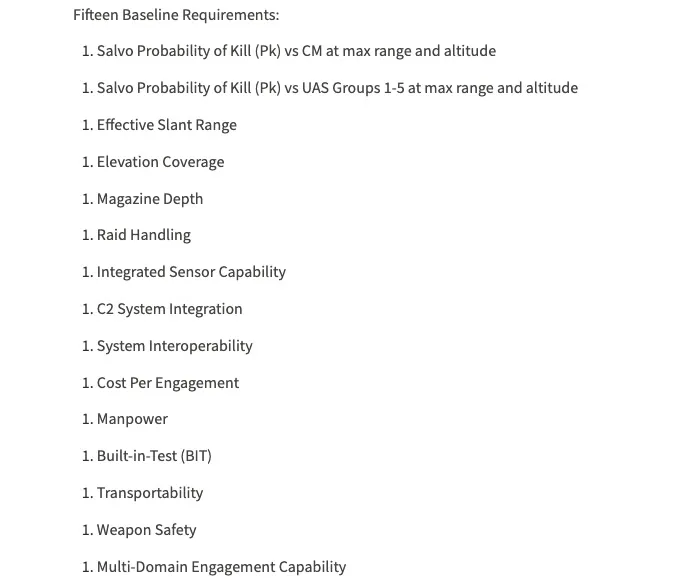
“To effectively assess and compare air defense weapon system performance, there are 15 critical baseline operational and technical parameters that must be analyzed in unison,” the RFI explains.
(Air Force Request for Information)
“These key metrics begin with the system’s Salvo Probability of Kill (Pk) evaluated against both Cruise Missiles (CM) and Unmanned Aircraft Systems (UAS) Groups 1-5 at maximum range and altitude, ensuring robust lethality against diverse modern threats,” the RFI notes.
A salvo probability of kill measures how effectively a salvo, as opposed to a single shot, defeats a target.
The following chart displays the weight, normal operating altitude and speed of the five drone group classifications.
(Congressional Research Service chart of Group 1 through 5 drones)
The Air Force wants this system to be “rapidly deployable, maintaining a lightweight, modular, and transportable footprint that can be swiftly projected into austere theater environments to meet emergent threats.” The RFI does not provide further details of how the Air Force is looking to transport these systems; however, the service relies on its fleets of C-130 Hercules, C-17 Globemaster III and C-5 Galaxy transport aircraft to move equipment. The size and weight of the systems determines which kind of aircraft can transport it.
These systems could also be moved by truck or ship or on their own if self-propelled, but those options also incur a cost in terms of the timeliness of delivery, and can be impossible for rapid global deployments.
U.S. Army Soldiers from the 1st Battalion, 7th Air Defense Artillery Regiment, 108th Air Defense Artillery Brigade, load equipment and trucks onto a C-17 Globemaster III with U.S. Air Force Airmen assigned to the 21st Expeditionary Airlift Squadron at an undisclosed location in the CENTCOM Area of Operations, Dec. 31, 2023. (U.S. Army photo by Sgt. Christopher Neu) Staff Sgt. Christopher Neu
A key point of evaluation will be the overall cost of the munitions. The Air Force wants to ensure that the shell’s velocity and terminal effects “are maximized without driving the cost-per-engagement to unsustainable levels or exceeding the physical constraints of the host platform,” the RFI states. We’ll discuss these factors in more detail later in this story.
The service is also looking for the integration of “the right mix of radar, electro-optical, infrared, or radio-frequency sensors—to ensure reliable target acquisition and tracking across varying weather conditions, environments, and countermeasure scenarios.”
As we noted at the top of this story, the Air Force is seeking to improve its organic ability to defend its bases. This has become “an increasingly high priority” for the service, Air Force Secretary Troy E. Meink told Congress on May 20.
“The Air Force is developing organic air and missile defense capabilities, including Counter-small Unmanned Aircraft Systems (C-sUAS) to defend our air bases in all theatres [sic],” Meink stated in his written testimony. “The fielding of the Air Base Air Defense Systems (ABADS) missile defense capability, including kinetic defenses, at overseas main operation bases contributes to joint layered defense but does not reduce the need for increased joint investment in air and missile defense. We will continue to work judiciously for the development and procurement of these critical defensive capabilities.”
(Written testimony of Air Force Secretary Troy E. Meink)
In its Fiscal Year 2027 budget request, the Air Force is seeking about $1.4 billion for a missile defense variant of the Air Base Air Defense Systems (ABADS), according to Air & Space Forces Magazine. In addition, the Air Force also requested $51.8 million in procurement funds for its Small Unmanned Air Defense Systems (SUADS) in Fiscal Year 2026, according to the Air Force Fiscal Year 2026 budget justification book.
The war against Iran and the Ukraine war have, in particular, illustrated the challenges of defending against drones and cruise missiles.
There are two facets to potential use of gun systems for base defense. The first is that in complex air defense environments, it provides an inner, last line of defense against incoming threats. If the outer layers fail to take down the target or that target is not considered a priority over others, a hard-kill gun system offers a predictable and relatively reliable fallback. The gun system would become even more important if interceptor stocks run low, even temporarily, and those weapons need to be rationed for higher-end threats. With the outer defensive rings collapsing, the inner becomes far more important.
For small drones, that interceptors would not be effective anyway, the gun system can take them down in localized air defense scenarios. Then there is also defending bases in lower threat areas where there are not additional layers of SAM systems. A gun system can provide a core aerial defense against lower-end, lower-density drone and cruise missile threats without costing huge sums of money or requiring a huge logistical footprint.
Beyond that, there is a direct cost comparison argument, but again, that is in a vacuum and a gun system cannot take the place of a multi-layered air defense system without inviting huge risk. Still, the engagement cost comparison is worth mentioning.
High-end, expensive, difficult-to-manufacture air defense weapons, like Patriot PAC-3 MSE, are clearly inefficient against drones. For instance, a mass-produced Iranian Shahed-136 can cost about $35,000 to $50,000, while a Patriot PAC-3 can run about $5 million and takes years to procure. By comparison, the cost-per-engagement efficiency of gun-based air defense systems, designed to defend against drones and subsonic cruise missiles, is far greater. One example of how this plays out is the cost of firing the Army’s Centurion Counter-Rocket, Artillery, Mortar (C-RAM) system. It is a ground-based version of the Phalanx Close-In Weapon System (CIWS) used on various U.S. and foreign warships, and is armed with a six-barrel 20mm Vulcan Gatling-type cannon firing M940 rounds. Those self-destructing rounds currently have a price tag of $80.70, according to the Army’s Fiscal Year 2025 budget request. This means a two-second burst from a Centurion, at a rate of fire of 4,500 rounds per minute, would cost just over $12,100.
C-RAM Test Fire
Again, this is not a strict apples-to-apples comparison, but it can become a bigger factor during prolonged conflicts when high-end weapons stocks begin to run short. It’s also worth noting that drone interceptors are a rapidly growing capability set that are a lower-cost option for swatting down one-way attack drones and even some cruise missiles. Systems like Coyote have been in service for years with the Pentagon and have been protecting bases overseas with strong results. Even cheaper systems are emerging out of lessons learned in Ukraine. All of these systems have their own advantages and disadvantages, but pairing them with a new gun system would likely have synergistic effects. Overall, deploying densely layered short-range air defenses is becoming increasingly important in its own right, at least in high-threat areas.
Ukraine has a great deal of experience with the costs and prioritization of air defense capabilities. The country faces daily attacks by Russian missiles and drones, which is causing mounting casualties and destruction. This ceaseless bombardment has almost completely depleted Ukraine’s supply of Patriot interceptors, leaving it largely defenseless against ballistic missiles. As we noted yesterday, Ukraine is also running short of air-to-air missiles its Air Force F-16s use to swat down drones.
EXCLUSIVE: Ukraine F-16 Pilots Rationing Missiles as Russian Attacks Intensify | NEWSMAX2
However, Ukraine has also relied heavily on a wide array of gun-based air defense systems, including the German-made Gepard self-propelled anti-aircraft guns (SPAAG). Based on the chassis of the Leopard 1 main battle tank, Gepards feature twin radar-aimed 35mm automatic cannons, mounted on a single turret. The German variant sports an S-band search radar and a Ku-band tracking radar. These radars are critical to the Gepard’s ability to locate, track, and engage targets at night and amid poor weather conditions.
The following video shows a Gepard blasting an Iranian-made Shahed-136 out of the sky.
A video reportedly showing two Russian Shahed-136 (Geran-2) loitering munitions being shot down by the Ukrainians with a German-delivered Flakpanzer Gepard self-propelled anti-aircraft gun (SPAAG) during last night’s attack in Odesa Oblast, southern Ukraine.… pic.twitter.com/OhH7vTultm
The Air Force force is also looking at directed energy weapons like lasers for force protection and especially for defending bases overseas. While gaining traction across the services due in large measure to the much lower cost of delivering effects, these systems are still works in progress. Gun-based air defenses, on the other hand, are mature and proven and modern precision-guided, programable ammunition makes them even more efficient and effective.
Beyond the cost, high-end air defense systems — including their component sensors — though portable, are generally fixed to a specific location. That makes them vulnerable to attack. This has been the case in both the war against Iran and Ukraine. The same concerns hold true of aircraft. Both conflicts have shown aircraft vulnerability to drones when parked out in the open. Ukraine’s Operation Spider Web attack on Russian strategic bombers last year in particular shed light on this issue, which we have been sounding the alarm a long time.
In addition to these challenges, the Air Force is also facing the headwinds of an overall lack of U.S. short-range air defense capabilities, a concern we have been highlighting for years. Currently, there are three gun-based SHORAD systems being fielded by the U.S. military. These include the aforementioned Centurion C-RAM systems.
The Army also uses the Sgt. Stout, an air defense system based on the 8×8 Stryker light armored vehicle. The Sgt. Stout has a turret that can be fitted with up to two four-round launchers for Stingers. Those launchers can also be swapped out for ones that can be loaded with a pair of millimeter-wave radar-guided AGM-114L Hellfire missiles. The turret also has a 30mm XM914 automatic cannon, which can fire proximity-fuzed airbursting rounds against drones and other aerial threats, and a 7.62x51mm M240B machine gun.
Soldiers assigned to 4th Battalion, 60th Air Defense Artillery Regiment conducted a live fire exercise with the SGT STOUT (Stryker A1 M-SHORAD) vehicle in Fort Sill, Oklahoma, Sep. 23, 2025. (U.S. Army photo by Cpl. Emaney Wilson) Cpl. Emaney Wilson
The Marine Air Defense Integrated System (MADIS) is armed with 30mm cannons and M240C coaxial machine guns in remote weapon stations (RWS). The RWS on one of the two vehicles is also configured to fire Stinger missiles for a spectrum of ground-based air defense scenarios.
U.S. Marines with 12th Littoral Anti-Air Battalion, 12th Marine Littoral Regiment, 3rd Marine Division, fire an XM914 30mm chain gun mounted on a Marine Air Defense Integrated System during a live-fire range at Camp Schwab, Okinawa, Japan, July 28, 2026. (U.S. Marine Corps photo by Lance Cpl. Skilah Sanchez) Lance Cpl. Skilah Sanchez
The Army may have additional gun-based systems on the way. In July, the service put out a request for information to companies that can provide a new gun-based air defense option, using a 50mm cannon system to track and defeat Group 1, 2 and 3 drones.
A few weeks later, Northrop Grumman introduced its Raid Hunter 50mm GBAD system, which it said “combines proven Chain Gun® technology, precision‑guided 50mm ammunition and a networked, interoperable system controller to deliver powerful protection against high-volume, mixed-threat aerial raids. It is designed to defeat a range of aerial threats including high‑priority cruise missile threats, unmanned aerial systems (UAS), and other advanced threats.”
We’re introducing Raid Hunter™, our newly named 50mm gun-based air defense system designed to defeat mass, mixed aerial raids with cost-effective interceptors and deep magazine effectors which can be delivered to the warfighter at scale. Learn more: https://t.co/gnOzpo0RA3pic.twitter.com/oTqORTG9Q4
There are foreign options should the Air Force want to go that route. For instance, German arms maker Rheinmetall makes the popular Skyranger 35 gun system, which is a turret that can fit on a wide array of armor hulls.
The Skyranger 35 “is equipped with a KDG 35/1000 revolver cannon in 35 mm x 228 caliber with a firing rate of 1,000 rounds per minute,” according to Rheinmetall, which began delivering these to Ukraine in January. “It has an effective range of up to 4,000 meters and a high degree of commonality with the Oerlikon Revolver Gun Mk 3. Thanks to AHEAD technology, the Skyranger 35 is airburst-capable. In the future, it will also be possible to equip it with modern guided missiles.”
It seems that Ukraine’s 1020th Anti-Aircraft Missile Regiment which belongs to the Ground Forces has taken delivery of the first Skyranger 35 SPAAGs mounted on a Leopard 1 chassis made by @RheinmetallAG.
Skyshield is the fixed placement cousin of this system and has been bought by a number of nations
Skyshield (Rheinmetall)
Rheinmetall Air Defence: Ahead – Highly effective, programmable ammunition
This is just one example of a large number of potential offerings that could fit the USAF’s interests, from both domestic and foreign origins.
As we discussed earlier in this story, the U.S. is already facing a challenge defending against Iranian threats. A war with China would be more devastating and, when it comes to the Air Force protecting its bases, require far more robust defenses. At the same time, the Air Force is still very early in the process of taking on more responsibility for protecting its assets.
Parties have until 5 p.m. Oct. 9 to submit their proposals to the Air Force for a gun-based air defense system. With limited options and the service pushing to address its growing desire for organic air defenses, it will be interesting to see who comes forward and what systems they offer. We will provide more details about this effort when they become available.
Haitian foreign minister says renewal is necessary to ensure safety ahead of elections scheduled in December.
Haiti’s Foreign Ministry has called on the United Nations Security Council to renew the mandate of an internationally backed security force meant to tamp down the powerful armed groups controlling parts of the country.
On Thursday, Foreign Minister Raina Forbin reiterated her view that the Gang Suppression Force (GSF) needed to be fully deployed to her country, with support from the international community.
Recommended Stories
list of 3 itemsend of list
Its mandate, however, is slated to expire on September 30, unless the UNSC acts to extend its mission.
“We need technical, financial, logistical and safety support that is up to the challenge,” said Forbin. “We must now move from solidarity to action.”
Her remarks came at a meeting of the Organisation of American States (OAS), focused on the continued gang violence in Haiti.
Forbin gestured to a pressing need in her country. This year alone, in the three months from April to June, an estimated 1,408 people were killed in Haiti, with 656 injured. Much of that violence was attributed to gangs.
Haiti is also pushing ahead with long-postponed general elections. Critics, however, fear that the violence could disrupt the elections and weaken public confidence in the outcome.
Political instability in Haiti has been heightened since the assassination of former President Jovenel Moise in 2021. Armed groups have flourished in the vacuum, assuming control over large swaths of the capital of Port-au-Prince and displacing more than one million people.
Authorities have struggled to address either the out-of-control violence or the deeper causes of instability in the country, including poverty and government corruption.
The upcoming elections, the first in a decade, are currently scheduled to take place on December 13. But officials have questioned whether they will take place, given conditions on the ground.
OAS Secretary-General Albert Ramdin said that the regional body would deploy an Electoral Observation Mission to help support a credible vote, urging greater assistance for Haiti’s provisional electoral council.
He added that about one million identity cards must also be produced and distributed before voting can take place.
“Haiti is at a critical juncture,” Ramdin said in a statement on Thursday. “Our responsibility is clear: to strengthen security efforts, advance electoral preparations, fulfill existing commitments and ensure that international cooperation translates into tangible improvements in the daily lives of the Haitian people.”
But international assistance efforts have also drawn criticism, with many Haitians sceptical of outside interference in their country.
Officials within such international forces have also bemoaned a lack of steady support. Before the GSF, Kenya had led a Multinational Security Support (MSS) to support Haitian police, only to withdraw in April, after failing to meet its funding and deployment goals.
The UN Security Council voted to create the GSF task force in October 2025 as a replacement for the MSS. The mission was given a 12-month mandate.
The GSF is authorised to pursue “counter-gang operations to neutralize, isolate, and deter gangs”, either independently or in cooperation with Haitian police and its military.
Human rights advocates, however, note that such international support has been lacking for Haitians fleeing the violence.
Many Haitians have been forcibly returned to the country after fleeing for safety. A UN official informed an emergency meeting of the UNSC last week that nearly 200,000 people have been sent back to Haiti during the first eight months of this year.
That amounts to a 20,000 increase over the same period last year.
WASHINGTON — Confronted by an intransigent Iranian government that has refused to back down in the face of a massive military campaign, President Trump appears to have settled on a dual-prong approach that combines economic pressure with the potential of a devastating escalation in force.
Having launched “Operation Economic Outcast” just last week to try to isolate Iran from its remaining global trade partners, the Trump administration also resumed strikes in recent days, prompting Iranian retaliation that has renewed concerns of an all-out regional war.
However, the combination of already intense sanctions on Iran and an off-and-on bombing campaign since the war began more than six months ago has not bowed the Iranian leadership and has left the administration struggling to find a way to wind down the conflict. Tehran has dug in its heels — to Trump’s frustration — as energy prices rise, the global economy roils and poll numbers on the administration’s handling of the war dip ahead of November’s midterm congressional elections.
Trump said Wednesday that he didn’t think the conflict would last “much longer,” but he again shrugged off suggestions that its unpopularity and high gasoline prices resulting from Iran’s chokehold on the Strait of Hormuz would affect the elections for Republicans.
“It doesn’t matter. And I’m not affected by the election,” he told reporters. “I’m not running. But my party is running, and I’m going to help my party. But I think my party respects the fact that we’re not allowing Iran to have a nuclear weapon.”
A regional diplomat briefed on the matter described the current impasse between Tehran and Washington as reflective of both countries’ domestic priorities: the midterm elections for Trump and Republicans and the internal crises within Iran.
Domestic issues are critical reasons why neither side is willing to blink first, said the diplomat, who spoke on condition of anonymity to discuss sensitive negotiations.
The diplomat said negotiations, including those between Iran and Oman or even Iran and the U.S., will not go anywhere without addressing the initial catalyst of war: Israel. And the diplomat was skeptical of the Trump administration’s new sanctions plan, saying the threats require more explanation than what the U.S. has provided so far.
The Trump administration’s economic isolation of Iran is off to a slow start
The administration’s new push for Iran’s economic isolation was announced with great fanfare last week and a dire warning for all remaining countries to cut off financial and trade ties with Iran or face U.S. retaliation — but the campaign so far has fallen flat.
Just one branch of an Egyptian bank in the United Arab Emirates has been targeted so far. For actual sanctions to bite, experts agree that they must apply to Iran’s main trading partners: mainly China but also India and Russia. But Trump is loath to target China especially as he is preparing to host President Xi Jinping later this month.
Trump also insists that the U.S. has control over the Strait of Hormuz, where one-fifth of the world’s oil transited before the war began. The strategic waterway has been a key pressure point for Iran, and reopening it fully has become one of the prime goals for the U.S. administration.
Ship traffic through the strait is well below pre-war levels due to the risk of attack if vessels don’t comply with an Iranian vetting regime near its coastline, which is in sharp contrast to the unhindered navigation before the war. There were 102 transits last week and 126 the week before, according to shipping data company Lloyd’s List Intelligence, compared with 130 or more per day before the war.
“As President Trump said, the strait is open and all mines have been cleared,” White House spokeswoman Anna Kelly said Thursday. “The naval blockade remains in full force and effect, and Operation Economic Outcast is underway to sever every remaining economic lifeline sustaining the regime.”
The White House has repeatedly touted the economic impact that the sanctions have had on Iran, citing its rampant inflation and the massive loss in the value of its currency. U.S. officials have described Iran’s financial system as “one big house of cards.”
Going forward, Secretary of State Marco Rubio said “the price” Iran will pay will be primarily economic, “but we reserve the right … to take military action when necessary — not just to protect ourselves but to prevent them from being able to threaten others as well.”
“They’re going to continue to feel the squeeze,” he told Fox News host Brian Kilmeade in an interview that aired Wednesday.
Treasury Secretary Scott Bessent this week likened Iran to a snake that has been decapitated but whose body is still writhing.
“We are burying the head of the Iranian snake,” he said Tuesday. “The snake doesn’t know it’s dead yet, but it will stop wiggling when the sun goes down. And so the Iranian regime — they are in demise, and they will figure it out.”
Combining military force and sanctions on Iran ‘is the only option,’ one analyst says
Complicating things for the U.S., Iran’s leadership has shown signs of divisions between moderates more open to a diplomatic solution and hardliners who want to press ahead with a more confrontational approach.
President Masoud Pezeshkian is one of the most prominent voices still calling for a negotiated solution. But the hardliners appear to have gained the upper hand, and Iran shows no sign of backing down. Tehran continues to lash out at U.S. interests and allies around the region in response to military strikes.
“This kind of a hybrid approach — the combination of military force, blockade and economic pressure — that is the only option that seems to be available to the United States at this moment,” said Hamidreza Azizi, consulting senior Iran analyst for the International Crisis Group.
Still, he said, “it’s been for a long time, but now maybe more than ever, a battle of endurance between the two sides.”
Amr Hamzawy, director of the Middle East program at the Carnegie Endowment for International Peace, pointed to two main reasons for the deteriorating situation.
“One, none of the two parties is satisfied with the outcome — meaning that the current situation does not serve U.S. interests well, and it does not serve Iranian interests well,” Hamzawy said.
The other reason is how leaders from both sides are perceived at home.
“The Trump administration is afraid of being portrayed in the U.S. as an administration that failed to end a military campaign successfully, and that’s going to impact the midterm elections,” he said. “And the Iranians, especially the Revolutionary Guard, are quite afraid of appearing as if they are submitting to U.S. sanctions with no actions on their side, which might hurt them domestically.”
Lee, Magdy and Amiri write for the Associated Press. Magdy reported from Cairo. AP writers Will Weissert in Washington and David McHugh in Frankfurt, Germany, contributed to this report.
The European Commission suspended imports of meat from Brazil on Thursday over concerns about antibiotic use, after Brasília failed to convince the EU executive that its products comply with European standards.
ADVERTISEMENT
ADVERTISEMENT
The move comes as Brazilian meat imports lie at the heart of opposition to the free trade agreement signed in January 2026 by the Commission with Mercosur countries — Brazil, Argentina, Paraguay and Uruguay.
EU farmers accuse Latin American producers of failing to comply with the bloc’s phytosanitary and food safety standards, arguing that this gives Latin American products an unfair advantage on the EU market.
“We have rules that ban antimicrobials or using antimicrobials for growth,” Commission spokesperson Eva Hrncirova said. “On the 3rd of September, the list of countries that basically comply with our rules on antimicrobials comes into application.”
The spokesperson added that Brazil was not currently on the list, meaning its imports were suspended as of Thursday.
No guarantees for beef
The suspension, which resulted from a vote by national experts in May, covers beef, poultry, eggs and honey.
Imports of some products could resume following an audit of poultry and honey, launched on the basis of written guarantees of compliance provided by Brasília. The audit is expected to run until the end of the week, although the conclusions will take longer.
Hrncirova said no such guarantees had been provided for beef, adding that they must cover the animals’ entire life cycle, which is naturally longer for cattle.
Brazil’s ambassador to the EU, Pedro Miguel da Costa e Silva, told Euronews ahead of the summer that technical discussions with the Commission were ongoing. However, Brazil ultimately failed to prevent the suspension from taking effect.
Trade in agricultural products was the most contentious issue throughout the 25-year negotiations over the Mercosur agreement.
The deal was provisionally applied in May after the European Parliament suspended the ratification process with a legal referral to the European Court of Justice.
Ukrainian F-16 pilots are facing such a severe shortage of air-to-air missiles that some daytime sorties have seen them rely solely on the fighters’ internal guns to engage Russian aerial threats, according to a journalist who recently spoke with a senior Ukrainian Air Force commander. Meanwhile, the lack of air-to-air missiles means that the available weapons stocks are now being rationed.
The disclosure provides a remarkable glimpse into the day-to-day reality of Ukraine’s F-16 operations. While the aircraft may be available, the pilots may be ready, and Russian drones and cruise missiles may be approaching, there may simply not be enough missiles on hand to arm the jets.
According to Newsmax journalist Shelby Wilder, the Ukrainian Air Force can find itself monitoring missile shipments as they cross the country’s border, with personnel counting not just the hours but the minutes until those weapons reach the aircraft. The concern is whether the missiles will arrive in time for the next major Russian aerial attack.
EXCLUSIVE: Ukraine F-16 Pilots Rationing Missiles as Russian Attacks Intensify | NEWSMAX2
The Ukrainian commander, who identified himself by the callsign “Phantom” and as commander of the country’s 107th Wing, confirmed the underlying problem when asked directly whether Ukraine was severely short of missiles for its F-16s.
“Yes, that’s true. Any aircraft without weapons is … useless,” Phantom said.
❗️The moment when a 🇺🇦Ukrainian F-16 fighter jet shot down a 🇷🇺Russian Kh-101 cruise missile at extremely low altitude pic.twitter.com/7zVujRkYaG
— 🪖MilitaryNewsUA🇺🇦 (@front_ukrainian) June 1, 2026
The fighters have become an important part of Ukraine’s layered air defense network, hunting Russian drones and cruise missiles while also providing a potential counter to Russian combat aircraft, and conducting air-to-ground sorties. Ukraine has operated the F-16 since the summer of 2024.
“We are focusing on defending our skies against Russian unmanned drones to protect our infrastructure inside the country,” Phantom said. “Our target priority is cruise missiles.”
Destroying as many incoming threats as possible before they reach Ukrainian cities and infrastructure requires missiles, with the F-16 primarily armed with the AIM-120 Advanced Medium-Range Air-to-Air Missile (AMRAAM) and the shorter-range AIM-9 Sidewinder.
Another live AIM-9L/M launch. This Ukrainian F-16 carries six Sidewinders. Ukrainian Air Force screencap
According to the new disclosure, those missiles have become a commodity whose availability can determine how a sortie is flown.
The F-16 carries an M61A1 Vulcan 20mm rotary cannon, but using the gun against an aerial target is fundamentally different from engaging it with a missile, and comes with its own risks, as we have explored before. This tactic is especially hazardous when going after small targets and especially slow ones, and it becomes even more dangerous at night.
Ukraine has already demonstrated that its F-16s can use their guns in combat. In May 2025, the Ukrainian Air Force said an F-16 pilot had destroyed three aerial targets and was engaging a fourth with the aircraft cannon before an emergency forced him to eject.
An armorer loads an F-16 with 20mm ammunition for its M61A1 cannon. Ukrainian Air Force screencap
One air-to-air weapon not mentioned by Phoenix is the laser-guided 70mm Advanced Precision Kill Weapon System II (APKWS II) rocket, now apparently also part of the arsenal. These rockets would offer the Ukrainian Air Force an extremely valuable, lower-cost option for engaging drones and subsonic cruise missiles.
Regardless, Phantom specifically called for additional air-to-air missiles, as well as interceptors for ground-based Patriot batteries.
“We require more means of protection, such as Patriot missiles and air-to-air missiles, AIM-9s or AIM-120s to our fleet,” he said.
Phantom’s message is that simply delivering more aircraft is not enough. Ukraine needs a sustainable weapons pipeline to keep those aircraft combat-effective.
This is increasingly becoming a wider problem across Ukraine’s air defense network. Patriot interceptors have been heavily consumed, with relatively few replacement missiles now trickling in, leaving Ukraine with limited ability to defend against ballistic missiles in particular. The strain is now spilling into the lower tiers, including the air-to-air missiles carried by F-16s. Ukraine’s continued consumption of interceptors is a major driver, but it is competing with the enormous demand generated by ongoing wars in the Middle East and a broader surge in demand for advanced air defense weapons around the world. With production struggling to keep pace, scarce interceptors are effectively being rationed across an increasingly crowded global battlefield.
“At least we need to try to increase the production, or at least to allow Ukraine to localize the production in Ukraine or other European countries,” he said.
That proposal reflects the fundamental vulnerability of a relatively small fleet operating in a high-intensity air war. Every missile fired at a Russian cruise missile or drone is one less available for the next engagement. A finite inventory therefore has to cover both routine air-defense missions and the possibility of much larger Russian attacks. At the same time, both the AIM-9 and especially the AIM-120 are used for Ukrainian ground-based air defenses too. The AMRAAM, in particular, is the effector for the NASAMS, which protects Kyiv, and other key objectives against cruise missiles and drones.
Air-to-air with two F-16s. The nearest jet carries a wingtip AMRAAM. Ukrainian Air Force screencap
The problem becomes even more acute because Ukraine cannot know precisely when the next major Russian strike will arrive.
That is why, according to Wilder’s account, the arrival of missile shipments is being followed with extraordinary urgency.
At the same time, Phantom welcomed the major technological leap that the F-16 represents over the Soviet-designed MiG-29s and Su-27s that formed the backbone of Ukraine’s fighter force.
“The F-16s in comparison with the legacy aircraft like MiG-29 or Su-27? This is kind of like a new technology,” Phantom said.
But sophisticated aircraft are only as useful as the weapons available to them.
Ukrainian F-16s have reportedly destroyed huge numbers of Russian drones and cruise missiles, and in July a Ukrainian F-16 was publicly identified by the U.S. Joint Chiefs chairman as having shot down a Russian fighter.
⚡️ CONFIRMED! On July 8, 2026, a Russian Su-35 multi-role fighter was shot down on the eastern sector!
Phantom also asked Ukraine’s Western partners to think beyond individual weapons transfers and toward production capacity.
He also urged the United States and European countries to do more to prevent Russia from acquiring components used in its own missile production through third countries.
“We need to make as much as we can to stop providing the parts, most technological parts to Russians, bypassing the direct sales, of course, through the third party,” he said.
An armed F-16 between sorties. Ukrainian Air Force screencap
Phantom argued that Russia continues to obtain sophisticated components through intermediaries and even ostensibly civilian products.
“It would not be a surprise that Russians [are] using the washing machine that they’re buying from the third party to use those smart details for building missiles,” he said.
His recommendation is tighter sanctions and enforcement designed to cut off Russia’s access to those components.
“Important is to sanction to stop Russia from being able to have access to those parts,” he said.
That, combined with missile shortages, could become an even bigger problem when Russia conducts another major aerial campaign against Ukraine, particularly as Moscow traditionally intensifies attacks against the country’s energy infrastructure during the winter months.