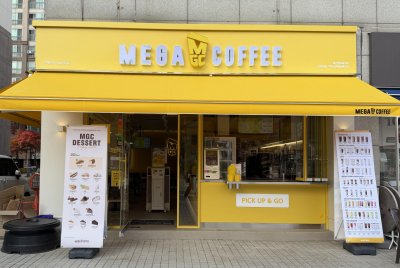
A store run by Mega MGC Coffee, which reportedly bid for Home Plus Express. Photo by MGC Global
SEOUL, April 1 (UPI) — South Korean discount chain Home Plus said Tuesday that a court has begun to review the sale of its neighborhood grocery store chain, Home Plus Express.
Home Plus, which is under receivership, said the court started the procedure of selecting a preferred bidder after receiving reports from its sales adviser, Samil PricewaterhouseCoopers.
“Prior to the March 31 deadline, multiple companies were confirmed to have participated in the bidding process to acquire Home Plus Express,” the firm said in a statement.
Home Plus did not disclose further details, including the number of bidders and their identities.
However, Mega MGC Coffee has reportedly presented a bid for Home Plus Express. The budget coffee chain, which is owned by MGC Global, operates nearly 4,000 stores across South Korea.
Both MGC Global and Home Plus declined to confirm the reports.
Following unsuccessful attempts to sell Home Plus as a single entity, the divestment of Home Plus Express has emerged as a key pillar of its rehabilitation plan. The unit generated $730 million in revenue in 2024.
The Express division has a network of almost 300 stores and most of them are located in high-density urban areas. Home Plus also runs more than 100 large-format outlets.
In 2015, South Korea’s leading private equity fund, MBK Partners, purchased Home Plus from Tesco in a landmark $5 billion deal. In recent years, the retailer has struggled amid pandemic-related disruptions and the rise of e-commerce giants.
Since early last year, MBK Partners has tried to dispose of Home Plus to little avail. As a result, the company has shifted its focus to the sale of Home Plus Express.
These stunning destinations are exempt from the new system launching in April.
14:45, 31 Mar 2026Updated 14:45, 31 Mar 2026
These countries will not use the Entry/Exit system(Image: Getty)
Following months of preparation, the new Entry/Exit System (EES) will finally be implemented across the Schengen area from April 10.
The new EES will require all non-EU nationals travelling to 29 European countries to register their biometric data, such as a facial scan and fingerprints, rather than receiving a traditional passport stamp. Numerous popular holiday destinations including Portugal, Italy and Spain will be impacted by the new system.
However, there are 14 countries (15 including the UK) outside the Schengen Area and therefore not implementing the new travel system.
Laura Evans-Fisk, head of digital and engagement at eurochange, anticipates a surge in travellers heading to non-Schengen countries as a consequence, reports the Express.
She said: “The introduction of this new border control system may be off-putting to some people who want to book last-minute trips this Easter, especially those who like to keep travel as fuss-free as possible.
“I think we should expect to see an increase in Brits travelling to countries that are exempt from the legislation over the next few months – including the Easter and summer holidays.”
For those looking to sidestep the hassle and make their travels a little more straightforward, Laura has identified three fantastic holiday destinations that will be unaffected by the EES, meaning British tourists can explore freely without the need to provide biometric data.
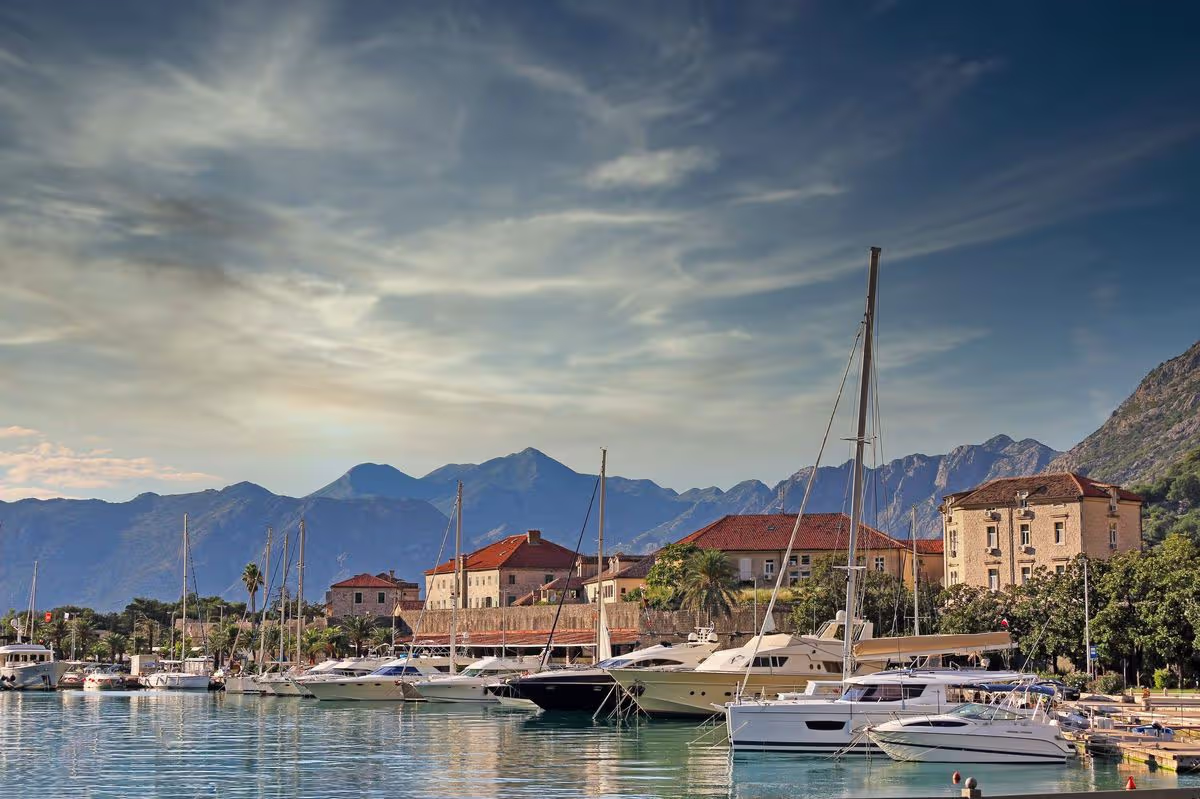
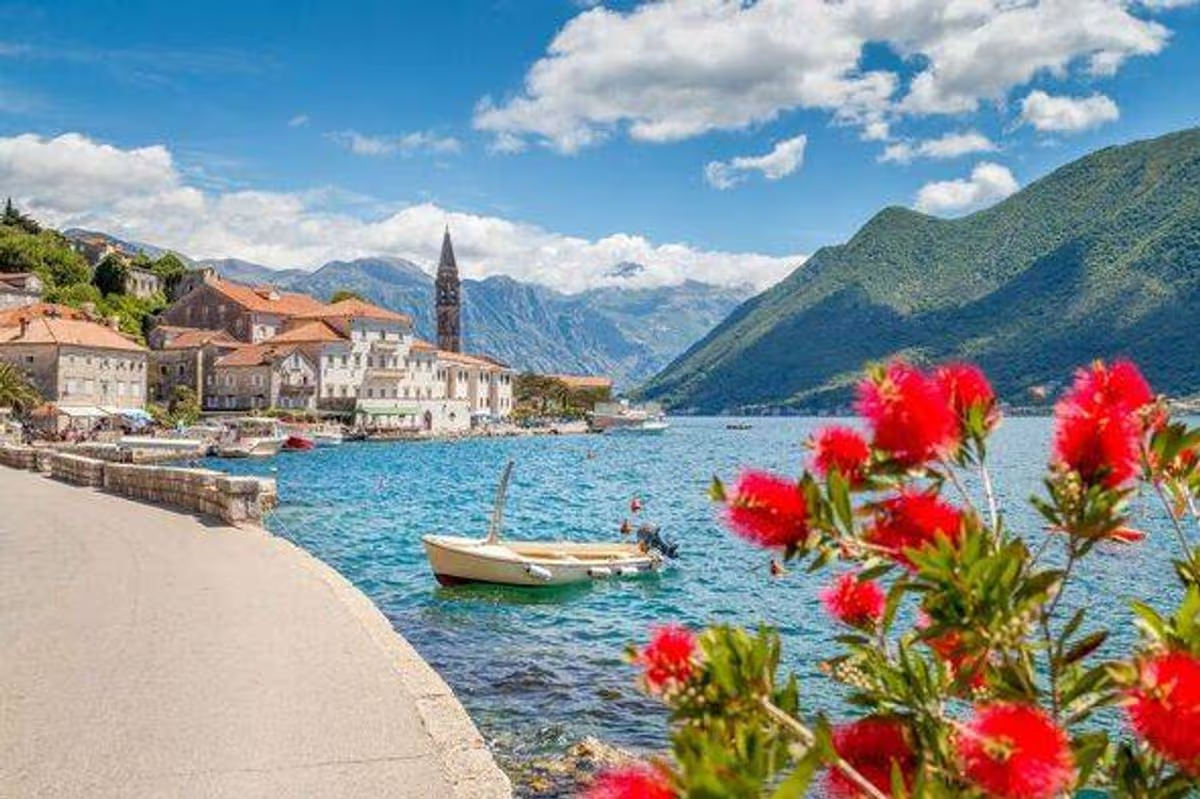
Kotor, Montenegro
She explained: “Montenegro is quickly becoming one of the most popular up-and-coming destinations in Europe. A less crowded alternative to Croatia, it offers similar quaint towns, gorgeous beaches and a stunning coastline, but it is around 20-30% cheaper.”
For instance, accommodation in Montenegro begins at £23 per person per night, while a three-course meal will cost you £31.78.
Kotor sits on the coast, boasting stunning beaches and a relaxed atmosphere, ideal for unwinding. Laura remarked: “This is a great spot if you’re after a chilled, slow-paced holiday, without having to pay huge prices.”
Tirana, Albania
This vibrant capital city is brimming with culture and a food lover’s dream destination. Laura noted: “One of the best ways to explore is by taking a stroll through the streets, following the eccentric street art, graffiti and murals.
“Remember to order Albanian favourites, Fërgesë Gjize (baked cheese with peppers) and Trilece (a tasty pie made with sponge cake and three different kinds of milk) for dessert.”
Sarajevo, Bosnia
Laura said: “It is one of the only places where you can visit a Mosque, a Catholic church, an Eastern Orthodox church and a synagogue in one place.
“Tucked inside a long, thin valley and surrounded by forested mountains, the city has a picture-perfect backdrop. Its broad mix of cultural influences means its architecture is also absolutely beautiful, and its restaurant scene is an eclectic mix of Turkish and Bosnian-inspired offerings.
“And, with prices averaging just £30 per person for a three-course meal, your money really does go far here.”
The city has seen a huge influx of new restaurants open in the first few months of 2026. From street food to Michelin-starred dining, there’s something for every foodie
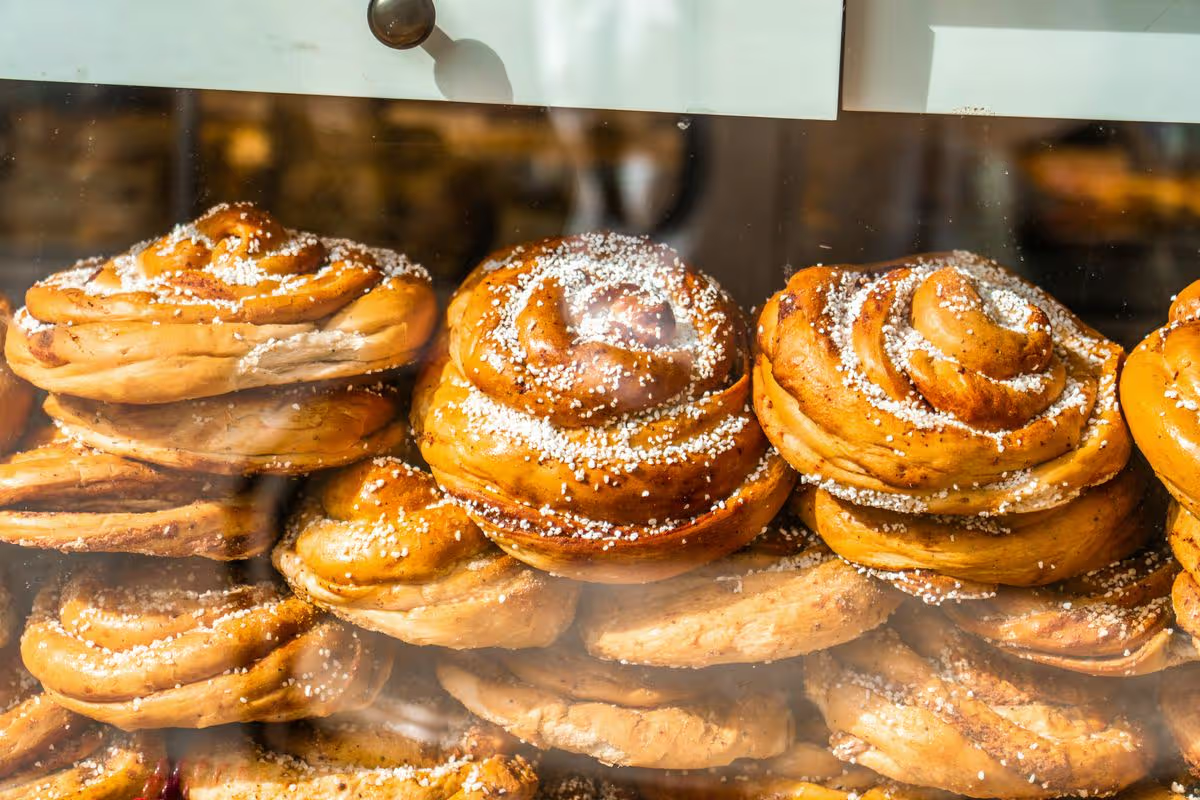
Freshly baked kanelbullar (traditional Swedish cinnamon buns) in a Gothenburg bakery window(Image: Getty)
Some people travel for culture, some for sandy beaches and sunshine, and others for culinary experiences. If you’re passionate about discovering exceptional dining spots, there’s one overlooked destination that deserves a place on your bucket list.
In the first months of the year, this Swedish destination has welcomed 20 new eateries to complement its already celebrated Michelin-starred establishments. Beyond its thriving food scene, this city also boasts a theme park, a warm café culture and genuinely beautiful streets perfect for exploring.
This remarkable city is Gothenburg, Sweden’s second-largest urban centre. Frequently overshadowed by its better-known counterparts Stockholm or Malmö, it absolutely shouldn’t be.
The city boasts five restaurants with a single Michelin star and one holding two stars. These establishments serve everything from Japanese cuisine to spectacular seafood dishes.
If you’re prepared to splash out on a truly memorable dining experience, the two-starred establishment Signum must feature on your itinerary.
The menu concentrates on seafood and fish complemented with produce grown in the on-site gardens.
All the ingredients are from Scandinavia, and a meal here will comprise 18 exquisitely crafted courses, all featuring seasonal produce.
If you’re the type who prefers to meander through the city, sampling local delicacies along the way, then you should schedule your visit for May.
Gothenburg is set to transform its iconic 19th-century fish market into a brand new seafood festival. The entire building, including its floating outdoor terrace, will be converted into a seafood extravaganza, with top-notch vendors showcasing their offerings, reports the Express.
Also launching in May is Vassen Market, a sprawling 6,500 square metre waterfront haven featuring street food, cocktails, live music, art pop-ups and even skateboarding.
Constructed entirely from recycled containers and encircled by verdant pocket parks, it’s the ultimate spot for a leisurely weekend stroll.
Later in the year, the Slakthuset district will play host to a three-day neighbourhood festival brimming with music, food and local beverages. Scheduled for July, this event perfectly encapsulates the relaxed community spirit of the city.
For those who prefer thrill rides over wine tasting, Gothenburg’s Liseberg is a must-visit. Opened in 1923, this theme park is the largest in Scandinavia and draws visitors from far and wide.
Boasting 42 attractions, there’s something to suit everyone’s tastes, promising an exhilarating day out. Just remember to don your most comfortable walking shoes, as the park spans a whopping 42 acres.
AN AIRLINE has returned to a major UK airport for the first time in two years.
ITA Airways has returned to London Heathrow Airport after two years and has launched a route to Italy.
Sign up for the Travel newsletter
Thank you!
ITA Airways is launching two daily flights from London Heathrow to Rome, ItalyCredit: Alamy
The Italian airline is operating two flights a day between the UK and Rome, Italy after securing slots from Lufthansa.
The flights from London Heathrow will depart each day at 10:30am, landing at 2:10pm and the second flight will take off at 4:30pm and arrive at 8:10pm.
Flights from Rome to Heathrow will leave at 7:50am and arrive in London at 9:40am and then at 1:50pm, arriving at 3:40pm each day.
A one-way flight in April costs as little as £57.45 with the airline.
The awards recognise destinations with a high volume of “above-and-beyond reviews and opinions from the Tripadvisor community over a 12-month period”.
TripAdvisor stated: “In Rome, you can drink from a street fountain fed by an ancient aqueduct.
“Or see the same profile on a statue in the Capitoline Museum and the guy making your cappuccino.”
Italy might be well-known for being the home of pizza and pasta, but more specifically a number of great dishes originated from Rome.
For example, Cacio e Pepe, spaghetti carbonara and tray-baked pizza were all created in the city.
Earlier this year, Rome was also named the best city for ‘noctourism’ by Radical Storage.
The luggage storage platform assessed over 50 destinations across four categories including experiences (such as the number of night tours) and natural factors (light pollution levels).
Rome came out on top scoring 6.07 overall out of 10.
The Italian capital scored particularly well in the experience category (9.2 out of 10), offering an impressive 305 night tours.
ITA Airways used to operate flights from London Heathrow but suspended operations due to high costs.
The airline also did not own its Heathrow slots, instead it was leasing them from Etihad Airways for around £3.3million per year.
The airline hasn’t flown from Heathrow in two yearsCredit: AlamyRome was named the best city in the world for food last yearCredit: Alamy
The airline’s return to Heathrow Terminal 2 has been made possible through its partnership with the Lufthansa Group, which means the airline has been given slots at the airport by Lufthansa.
According to Travel Weekly, the airline said in a statement: “The resumption of flights from Europe’s busiest airport – the most connected airport in the world – was made possible thanks to the co-operation with Lufthansa, which made the necessary airport slots available to ITA Airways.
“Connections between the British capital and Milan Linate will continue to operate via London City Airport.”
ITA Airways chief executive Joerg Eberhart added: “Today we celebrate a major milestone: our company is back at Heathrow, the UK’s only hub airport and the most connected airport in the world.
“Returning to Heathrow will bring many advantages.
“Thanks to the characteristics of the airport, we will be able to operate flights with larger aircraft and greater capacity, increasing both passengers and revenues.”
March 25 (UPI) — Dutch scientist Huub Lilieveld has been named the recipient of the 2026 World Food Prize Wednesday for leading a food safety movement across 113 countries.
For six decades, Lilieveld has researched and advocated for food safety, using scientific evidence to inform regulations and legislation across the globe. His work has culminated in establishing modern global food safety, security, trade and aid standards.
The World Food Prize Foundation is recognizing Lilieveld’s contributions with a $500,000 award.
“Lilieveld lives by his conviction that access to safe food is a universal right — a philosophy shared by the late Dr. Norman Borlaug,” Mashal Husain, president of the World Food Prize Foundation, said in a statement. “Through his lifelong commitment to harmonizing regulations, he has lowered trade barriers, prevented the unnecessary destruction of safe food, promoted innovative food safety technologies worldwide and reduced the risk of foodborne illness outbreaks.”
Foodborne illnesses kill 420,000 people annually. There are about 600 million cases of foodborne illnesses per year.
Lelieveld established the Global Harmonization Initiative in 2004, to connect volunteers and food safety experts around the world to combat safe food insecurity and improve the distribution of safe foods.
“Companies large and small, as well as all consumers are negatively affected by unjustified differences in regulations,” Lelieveld said in a statement. “The Global Harmonization Initiative, therefore, strives not only to reach scientific consensus but also to ensure that findings are accessible to everyone, requiring simplification without compromising scientific accuracy and translation into local languages.”
Founder of the Women’s Tennis Association and tennis great Billie Jean King (C) smiles with representatives after speaking during an annual Women’s History Month event in celebration of the 50th anniversary of Title IX in Statuary Hall at the U.S .Capitol in Washington on March 9, 2022. Women’s History Month is celebrated every March. Photo by Bonnie Cash/UPI | License Photo
This Morning star Sharon Marshall has spoken out for the first time, revealing she was taken to hospital in an ambulance after her severe hay fever saw her almost go into cardiac arrest
12:18, 25 Mar 2026Updated 12:18, 25 Mar 2026
Sharon Marshall reveals hay-fever led to her ‘going into cardiac arrest’
This Morning star Sharon Marshall has revealed for the first time her terrifying health ordeal, as she was carted off in an ambulance over fears she was in cardiac arrest – but she was actually suffering from hay fever.
Sharon, 54, spoke candidly about how her complex hay fever – which was misdiagnosed as adult asthma – once saw her collapse in the doctors office, which lead her to being rushed to hospital in an ambulance as paramedics feared she was going into cardiac arrest. The Queen of Soaps sat on the This Morning sofa today to reveal her complex health woes and how the ordeal unfolded.
Speaking to Ben Shephard and Cat Deeley on the This Morning sofa, alongside Professor Adam Fox, Sharon revealed she got ill when she was training to run the marathon and initially ruled out symptoms as being unfit. She recalled waking up in the middle of the night not being able to breathe – which Sharon didn’t realise was an asthma attack at the time.
**Ensure our latest headlines always appear at the top of your Google Search by making us a Preferred Source. **Click here to activate** or add us as your Preferred Source in your Google search settings.**
Sharon explained that the ordeal happened in the middle of the night so she decided to wait until the morning to see the doctor. She recalled: “I remember sort of waiting until nine o’clock, ringing the doctor’s surgery and they were like, ‘oh God, come in immediately,’ going out the flat and luckily a black cab came past, got me in the back, took me in and he helped me to the door. And I don’t really remember much past that because I just collapsed in the doctor’s surgery and I came round in the back of an ambulance.”
She continued: “I said, ‘Oh what’s happening’ and they said, ‘we’re taking you to hospital’ and my first reaction was, ‘will I be going back’ and I they said, ‘No probably not’ and I said, ‘well can I just go by the house and feed my cat’. And this lovely guy who was just saying: ‘You’re going into cardiac arrest, we’re trying to take you into hospital to save your life no you can’t feed your cat’.”
Sharon stayed in hospital for a week but doctors struggled to get to the root cause. Sharon was then diagnosed with adult onset asthma. She explained: “So for years and years, I started taking asthma inhaler and then every year, not realising pollen season would come around and I would start getting asthmatic again. I was on the strongest asthma inhaler every single day. I was going through an asthma inhaler set in a week – horrible steHowever, Sharon revealed that every spring she would continue to get “really breathless and really ill”. Sharon continuned to go to the doctors in search for more answers and even struggled to wak up the stairs in the doctor’s surgery.
At one point, Sharon was even tested for lung cancer. She revealed: “So every year it was just this terrifying thing of, ‘I can’t breathe’ – stronger and stronger steroids and asthma inhalers.” Sharon revealed a visit to the This Morning studios changed her health for good.
Sharon had come into the studio and struggled to breathe while having her makeup done, which saw the crew call a medic as she was going into another asthma attack.
She added: “And, lukcily, in the studio, doing an item about allergies was our lovely professor here, who was able to work out, ‘Oh there’s a time of year that this seems to be happening’.”roids, Mysoline [an anticonvulsant medication] and all these things.”
However, Sharon revealed that every spring she would continue to get “really breathless and really ill”. Sharon continuned to go to the doctors in search for more answers and even struggled to wak up the stairs in the doctor’s surgery.
At one point, Sharon was even tested for lung cancer. She revealed: “So every year it was just this terrifying thing of, ‘I can’t breathe’ – stronger and stronger steroids and asthma inhalers.” Sharon revealed a visit to the This Morning studios changed her health for good.
Sharon had come into the studio and struggled to breathe while having her makeup done, which saw the crew call a medic as she was going into another asthma attack.
She added: “And, luckily, in the studio, doing an item about allergies was our lovely professor here, who was able to work out, ‘Oh there’s a time of year that this seems to be happening’.”
Professor Adam then explained Sharon has seasonal allergic asthma. Professor Adam then explained: “So the problem isn’t chronic all the time asthma, it’s just that when your hay fever is bad enough, if you imagine the lining of your nose is connected to the lining of your lungs. So if your upper airway because of the hayfever is really angry, can send really angry signals down to your lower airway, your lungs, and give you what listens will be an asthma attack. And of course, that can be very, very severe.”
Professor Adam then explained: “So the problem isn’t chronic all the time asthma, it’s just that when your hay fever is bad enough, if you imagine the lining of your nose is connected to the lining of your lungs. So if your upper airway because of the hayfever is really angry, can send really angry signals down to your lower airway, your lungs, and give you what listens will be an asthma attack. And of course, that can be very, very severe.”
Professor Adam then explained Sharon was then treated using ‘desensitisation’, which is a treatment that retrains to immune system to tolerate pollen. Sharon said of the new treatment: “It’s miraculous, it’s completely life changing.”
Time Out has ranked the 51 most beautiful places in the world, and the top spot goes to Spain’s Picos de Europa mountain range that’s just a two-hour flight from the UK with Ryanair
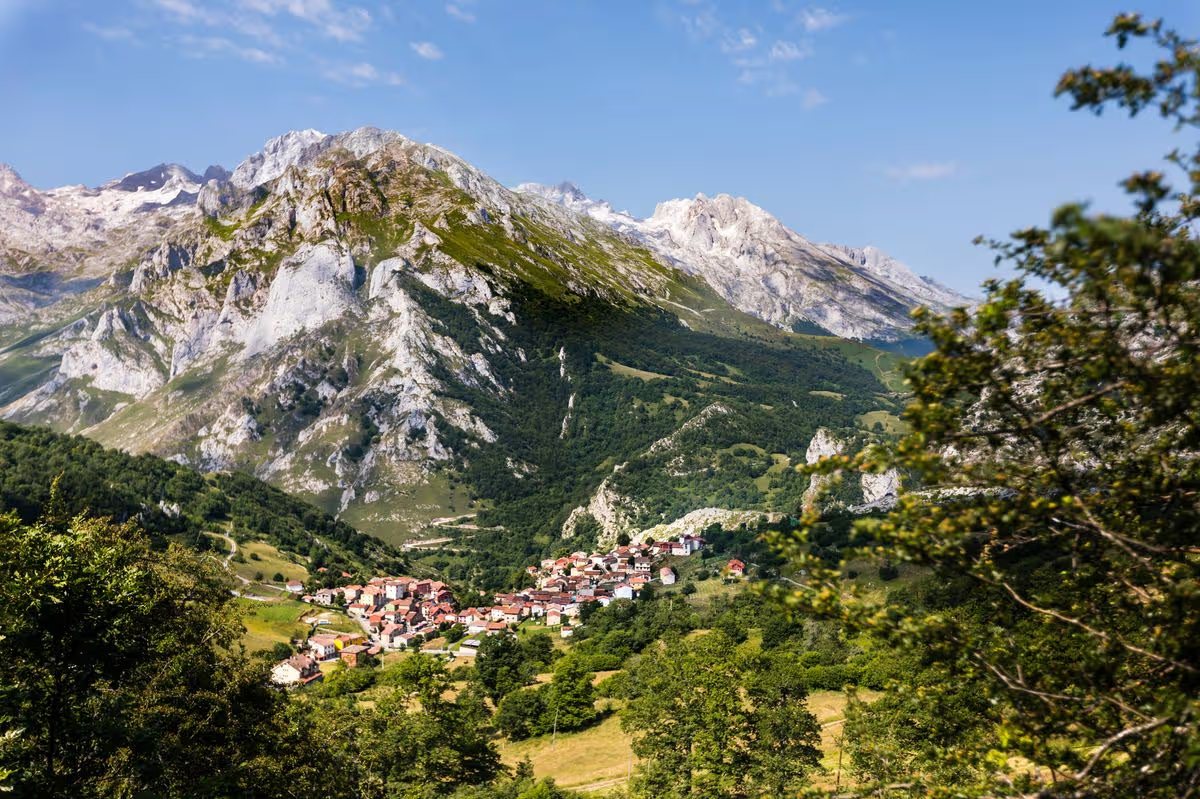
The Picos de Europa is in Spain and located just over 12 miles from the coastline(Image: Manuel ROMARIS via Getty Images)
The world is brimming with extraordinary destinations to discover, and pinpointing the most stunning is no easy feat, but Time Out has tackled the task.
The publication recently unveiled a list of the 51 most beautiful places in the world, featuring everything from lakes to beaches, National Parks, libraries, vineyards, and historic towns. Yet, claiming the number one position is a breathtaking mountain range that provides remarkable hiking opportunities, and it’s merely a two-hour flight from the UK.
The Picos de Europa in Spain is a striking, rugged limestone mountain range that soars to a height of 2,650 metres. Located just over 12 miles from the coastline, the mountains ascend steeply, forming deep gorges to discover, reports Express.
One route, the Cares Trail, ranks among the most sought-after walks in Spain, tracing a canyon and passing through craggy peaks and cascading waterfalls.
Spanning 13 miles in total, it’s not suitable for novices, though its gentle inclines make it achievable for walkers who can manage the distance. A straightforward choice is to board the Fuente Dé cable car, whisking you up the mountainside in moments and letting you relax and admire the verdant landscape below.
Upon reaching the summit, you can also explore additional hiking trails, including some demanding, steep climbs that provide spectacular vistas.
The mountains form part of the broader Picos de Europa National Park, and this region features the Lakes of Covadonga. These glistening blue waters are encircled by peaks and vegetation and resemble landscapes you’d encounter in Scotland or the Lake District, making it difficult to believe you’re in Spain.
This protected national park is abundant with wildlife, including brown bears, wolves, vultures, and eagles, and you’ll probably encounter mountain goats and vibrant butterflies amongst the limestone surroundings.
At the foot of the mountains, you can discover towns like the medieval Potes, brimming with centuries-old stone and half-timbered buildings and cobbled streets that lend it a rustic allure.
The town’s centrepiece is the Torre del Infantado, a 15th-century tower once the residence of medieval royalty, now a museum with a rooftop terrace providing sweeping views of the town.
Arenas de Cabrales on the park’s periphery is another favoured spot to stay. It’s renowned for producing Cabrales cheese, and has evolved into a gastronomic hotspot due to its plethora of acclaimed restaurants serving Northern Spanish cuisine.
Don’t expect to find paella on the menu. In this region, the dishes are hearty and rustic, such as bean stews and grilled meat, with ingredients sourced locally from the mountains.
The Picos de Europa is just under two hours from Santander Airport, and is serviced by airlines including Ryanair. Routes from the UK to Santander operate year-round from Edinburgh and London-Stansted, and seasonal flights operate from Birmingham and Manchester. Flights start from just £15 one-way and take 2 hours from the UK.
Got a story you’d like to share? Drop us an email at webtravel@reachplc.com
Locals in northern India have a growing concern over essential resources like water, fuel and food, that have become costly due to the US-Israeli war on Iran. The conflict has brought implications on oil and gas prices, which has also affected bottled water and food costs.
Jim Michaelian, the race car driver who helped launch the annual Acura Grand Prix of Long Beach, has died. He was 83.
The Grand Prix Assn. of Long Beach confirmed his death on Saturday, just weeks before this year’s race, which is scheduled for April 17-19.
Michaelian joined the Grand Prix Assn. of Long Beach in 1975, a then-fledgling competitive race, and grew it into one of the most popular street racing events in the world. The annual three-day event draws thousands of race car enthusiasts and brings tens of millions of dollars into the city of Long Beach.
“Jim was a leader of a small, passionate group who believed in the concept of bringing elite open-wheel competition to Long Beach in the 1970s,” said Roger Penske, Penske Corporation chairman, in a statement. “His vision and energy surrounding this great event remained boundless for 50 years.”
Penske Entertainment acquired the Grand Prix Assn. of Long Beach in 2024.
Michaelian was a competitive sports car racer for more than 25 years, competing in endurance events at tracks including Le Mans, Daytona Beach, Nürburgring, Dubai and Sebring in Florida. He told The Times in 2019 that he was still racing sports cars at 76.
“As long as I can achieve some level of success, I’m going to continue doing it until they tell me I can’t anymore,” he said then.
A native of Monterey Park, Michaelian (pronounced meh-KAY-lee-un) graduated from UCLA with a bachelor’s degree in physics. But he turned his attention to business and went on to earn an MBA there. Driven by a love of motor racing, Michaelian eventually talked his way onto the staff of the Long Beach Grand Prix.
He served as the association’s controller and chief operating officer before being appointed president and chief executive in 2001. During his 51-year tenure, Michaelian transformed Long Beach into an iconic stop in the world of motor racing.
A variety of races are run during the three days on the city’s seaside streets, culminating with a big-league IndyCar Series race Sunday. The races feature different types of cars, and one is for trucks, to appeal to a broad audience.
But the Long Beach Grand Prix is more of a festival that’s been built up around the racing. There are concerts, a lifestyle expo, a kids’ zone with go-karts and other activities, along with an array of food and drink spots, all centered on the Long Beach Convention Center and Shoreline Drive.
Michaelian said he kept the pulse of the crowd by constantly walking the track to monitor how the grand prix’s fans were enjoying the activities. He would survey for problems that might need fixing or whether changes needed to be made for the following year.
“Many young people don’t want to sit in the seats now,” he told The Times in 2019. “They’re out taking selfies, they’re chronicling their experience at Long Beach, and the only way to do that is for them to get around.
“So, if they’re moving around, I’m moving around” by creating more places where they can gather, listen to music and having food options nearby, he said then.
Last year, Michaelian was inducted into the Long Beach Motorsports Walk of Fame.
“Jim was a racer’s racer and a dear friend to IMSA and the motorsports community at large,” John Doonan, president of International Motor Sports Assn., said in a statement. “We will sorely miss his presence at Long Beach and racetracks everywhere.”
The Grand Prix Assn. of Long Beach did not release his cause of death.
Michaelian is survived by his wife, Mary, and his sons, Bob and Mike.
Former Times staff writer James F. Peltz contributed to this report.
Many years ago, I swapped languages with a young woman from Trieste. It was during one of our half-English, half-Italian practice hours that she introduced the idea of Trieste, on a map, as possessing the shape of a stomach. She described her city (which is also a province) as being suspended: pressed by the sea on one side, enveloped by Slovenia and the Karst hills on the other, with a short oesophagus attaching it to the body of Italy. She also suggested I read la Conscienza di Zeno – Zeno’s Conscience –Italo Svevo’s devilishly funny hymn to procrastination, self-delusion and walking around in search of a suitable cafe, and warned me about the ruffian wind.
It would be almost two decades before I finally visited Trieste, bringing with me enough anticipation to tempt disappointment (unfounded) and the itinerary of a food writer. I carried the image of a stomach too, fitting in so many ways for this remarkable food city, not least for making its geography vivid, which in turn explains so much about its history. Once a coastal fishing village, colonised by the Romans, raided by the Venetians, entrusted to the Habsburg monarchy in Vienna (for four centuries, which included a prolonged heyday), appended to the newly united Kingdom of Italy, fought over, briefly independent, handed back to Italy in 1954, from which point it developed into what is today one of the most outward looking and dynamic cities in Italy. Trieste, it seems, has digested and assimilated, meaning its complex history is reflected in the architecture, dialect, music, literature, sports, civic nature and multifaceted food culture: surely one of the most intriguing and rewarding in Italy.
True to Austro-Hungarian traditions: La pasticceria Pirona.Lunch is served at Clai.
Take the coffee culture, for example, the foundations of which were laid in 1719 when Charles VI declared Trieste a free port (and in effect the port of Vienna) and a customs-free zone. One of the goods that arrived was coffee beans, in particular from Ethiopia and Yemen, which in turn saw the creation of aromatic roasting and processing facilities – and the emergence of cafes themselves, many of them designed in the spirit of a Viennese Kaffeehaus. Later, when the railway connected Vienna with Trieste in 1850, these same cafes and pastry shops would serve the cosmopolitan population of a culturally magnetic city that many wanted to be part of. Several of the historic cafes still thrive, their literary connections intact – Svevo, Saba (Trieste poet in excelsis) Joyce, Mann, Rilke – comforting customers with coffee, strudel and no sense of rush, alongside them the economic and social powerhouse that is the Illy brand and a welcome wave of speciality coffee. The port of Trieste still handles 50% of beans entering Italy: it was and remains a city that tastes of salt and smells of coffee.
Buffet Clai, Trieste.
Another wonderful habit that robustly survives is femo un rebechin, which comes from the verb ribeccare, a typical espressione Triestina meaning to take another peck or bite: that is, to have a snack. The seaport had a burgeoning workforce whose need for a substantial mid-morning snack was met by boisterous and functional “buffets”serving il bollito misto: boiled pork served with potatoes, kraut, mustard and – a totem of Trieste – freshly grated horseradish; or stuffed in a bread roll, alongside soups, stews, goulash, cheeses and cured meats. Heaven! Buffets still punctuate the city and the habit of rebechin is like water, filling every gap and need, be that a prosciutto roll and a beer at 10am, or a glass of Friulian, Slovenian, Croatian or Austrian wine and tasty things on toast at 6.30pm. Trieste has a polyglot profusion of bars, bakeries, takeaways and restaurant-trattoria, some of which focus on the fish caught daily in the gulf, many on dishes whose roots trace back to middle European traditions, others on the superb produce that arrives from the mountainous region of Carnia, the larger Friuli Venezia-Giulia region, Slovenia … the world – Trieste is, after all, a gateway. After dinner, a chance to wander, to find another cafe, or the water’s edge, to look beyond the stomach, and out to sea.
Caffe Stella Polare, Trieste: ‘Literary ghosts contribute to the place’s popularity’.
A cherry wood bar, with white panels and a black granite top, runs the entire length of this old coffee shop. First opened in 1865, the cafe was designed, then redesigned, in the spirit of a Viennese kaffeehaus and decorated with gilded mirrors and Viennese stucco – some of which remains, with a line of tables and curveback chairs arranged opposite the bar. There is also an internal tea room for reading, meeting and gazing in the spirit of past patrons such as the writers Italo Svevo, Umberto Saba, James Joyce and Franz Kafka, whose literary ghosts contribute to the place’s popularity – as does its location on the corner between Via Dante and Piazza Sant’Antonio. I found the service best when standing at the busy, efficient bar, and their gocciato, an espresso with a generous drop of creamy foamed milk, an ideal way to start the day. Via Dante Alighieri, 14
For the smell of coffee and bread the address is Via Giusto Muratti 4d. Originally from Belgrade, Pedja Kostic spent three decades in Boston before opening the contemporary bakery Pagna, in 2022. Previously an Austro-Hungarian warehouse, the lofty space is now divided by a deep counter, the larger back section accommodating the mill, lab and ovens where the long-fermented breads are baked, the front section filled with tables for breakfast pastries, bread with honey or quince jam, filled focaccia, or cheese and wine in the early evening (the wine list is impressive, and largely natural). Pagna is also the place for speciality coffee, with blends from local roasters, such as Bianca Maria Maschio’s Bianca Tosta, and international roasters, including Drop in Stockholm. Via Giusto Muratti, 4/D
Antica trattoria Menarosti Established in 1903, Menarosti has been run by the Benussi family since 1974. The room, with its lace-edged white cloths, white chairs and white-cream tiles, has something of an elegant conservatory about it, while the paintings, ornaments and drinks cabinets give the space an idiosyncratic parlour-feel, but one in which everything has a purpose: of comfort and practised hospitality. The menu is a paean to the daily catch from the gulf of Trieste and the well-established habits of a great, unfussy kitchen. The menu changes daily but often includes granzievola (spider crab) cooked, shredded and returned to its fluted shell, a warm salad of molluschi, steamed mantis shrimps, a delicate three-fish risotto alla marinara, spaghetti with vongole lupino, gnocchi with cuttlefish ragù, a lightly battered fritto misto of calamari and anchovies, baked fish of the day, apple strudel, honey and amaretti semifreddo. There is an excellent wine list and a large selection of grappa. Via del Toro, 12
Da Pepi: ‘The oldest, and best known of the buffets in Trieste.’
The caldaia – the huge pan in which the various cuts of pork are boiled – takes pride of place on the counter at Pepi, the oldest and best known of the buffets in Trieste. When I asked a friend from Trieste if it was more popular with locals or tourists he looked annoyed, telling me Pepi, like all buffets, are a public service for anyone who is hungry. Established by Pepi Klajnsic in 1887, the buffet was originally known as Pepi S’Ciavo, for his nickname, Pepi the Slovenian, and has passed through various hands (of family and staff) since, each age leaving its mark on the wood-panelled decor. Pepi does a swift trade in takeaways, most commonly a roll stuffed with whatever cut of pork is desired – ribs, loin, ham, sausage, snout, tongue – plus a smear of mustard or a good amount of fresh horseradish. Cheese or hard boiled eggs are an alternative. The same cuts can be enjoyed sitting at one of the tile-topped tables: the ultimate pork platter, along with sauerkraut, potatoes, mustard (mixed with a dash of beer), and freshly grated cren (horseradish), or jota, bean and sauerkraut soup. Savings Bank Street, 3
L’Approdo The excellent and always bustling L’ Approdo, not far from the covered market, highlights another function of the buffet counter. That is the things on bread or toast – baccala mantecato (whipped saltcod), liptauer (an Austrian-style cheese and herb spread), sweet and sour sardines, the fried meatball and dough balls – in short a great number of tasty things with which to “Femo un rebechin” – have a snack – with a glass of wine at any hour you please, either at one of the tables, or standing outside. Via Carducci, 34
Get rare regional products at SET – an acronym for Sapori Eccellenti del Territorio.
If the weather allows, it is a good idea to get a table outside SET deli, and to order the orologio di formaggio. This tasting plate of cheeses could well include pastorut, a full-fat, soft, blue-veined cheese; pecorino with pear; goat’s cheese; or a compact and creamy mountain cheese called frant, with either a glass of Brežanka (an aromatic white originating from the Breg area) or a beer from a Dimont brewery, in the Carnia Valley. SET is an acronym for Sapori Eccellenti del Territorio, and the counter and shelves are filled with exactly that, with particular attention to traditional products at risk of disappearing in the Friuli Venezia Giulia region; look out for ricotta (which arrives daily from the Carnia valley), speck, horseradish, kraut, pesto with lard and herbs called varhackara, and cheese and potato cake, helpfully vacuum-packed, called frico. Via di Cavana, 13A
La pasticceria Pirona: ‘A cake and pastry shop from another time.’ Pirona, Trieste, Italy.
Not far from the magnificent ship-like covered market on largo Barriera Vecchia, La pasticceria Pirona is a cake and pastry shop from another time. Founded by Alberto Pirona in 1900, the shop has changed hands several times, but the art deco front with gold lettering on black lacquer and the cherry-wood fittings remain as they were when James Joyce (who lived a few doors down) called by for a bun. The cakes, pastries, sweets and preserves also remain true to Austro-Hungarian traditions: expect exceptional presnitz (a stuffed pastry ring filled with dried fruit, nuts and spices), an enriched Easter bread called pinza triestina, putizza (a ring of rolled, paper-thin dough layered with nuts and spices), apple or cherry strudel, Sachertorte, marzipan and – to bring home – finger biscuits embossed with the name Pirona. Via Largo Barriera Vecchia, 12
Caffe degli Specchi – designed by architect Antonio Buttazzoni, and a coffee house since 1839, this popular cafe has caught the attention of the Accidentally Wes Anderson brigade. Piazza Unità d’Italia, 7
Illy have several branches in Trieste (Illy CEO Riccardo is also the mayor) but the flagship cafe is on the seafront on via Gioacchino Rossini, 2 while the shop Incantalia (which also sells coffee accessories and food) is on via Luigi Einaudi, 2/A
La Bomboniera is a typical Austro-Hungarian patisserie dating back to 1836, in art nouveau style. Bring back a presnitz, a sturdy pastry ring filled with dried fruit. via Trenta Ottobre 3
La Bomboniera patisserie: go for the preznitz.
Antica Trattoria Saban – a trattoria whose menu celebrates the multicultural nature of Triestini cuisine – goulash sauverkataut, goose, pancakes … Via E. Comici 2
Ditta Emilio Cesca Casalinghi is a fabulous, ordinary, great-value houseware shop full of practical kitchen utensils. Grab yourself a cake tin, a horseradish grater and coffee cups. via Roma 10
VUD – for the most beautiful wooden bread and cheese boards. Via Diaz 15/a
Mercato Coperto, the historic Covered fruit and vegetable market – it looks like a steam ship from outside. Shop for a root of horseradish at via Giosuè Carducci, 36
La Bottiglia Volante – a relaxed wine bar (including, but not exclusively, natural wine). via Paganini 2c
Villanovich – another great speciality store with products from the mountains, paprika, and jars of horseradish and mustard. Via delle Torri, 1b
Salumeria Villanovich: regional products galore.
Melograno – for a good selection of gluten-free and vegan dishes, especially the pizza and cakes. Via di Cavana, 14
How to order coffee
For an espresso, ask for un nero, or un nero in b, if you want it served in a glass (bicchiere) rather than a cup. A decaffeinated espresso is un deca, or un deca in b. If you want a macchiato (an espresso with a little foamy milk), order un capo, or un capo in b, or a un capo deca, or un capo deca in b if you want decaf. If you do happen to order a macchiato, you will most likely receive an espresso with cold milk on the side. Meanwhile, what is considered cappuccino throughout Italy is practically nonexistent in Trieste, except in the ersatz form of caffe latte (which comes without foam) which is also known as latte macchiato. More typical, reliable and well-proportioned is a gocciato, an espresso with a generous drop of creamy, foamed milk.
Travelling to Trieste – and what to do when you’re not eating
Ryanair flies direct to Trieste daily from Stansted from £32 return in April (two hours and five minutes). Lufthansa flies from Heathrow via Frankfurt, from £184 return (shortest flight time four hours and 15 minutes). Train travel from London via Paris and Turin takes at least 14 hours 44 minutes, from £430 return. Or there are overnight ferries from Harwich to Hook of Holland (Stena Line, from £246 each way for car and two passengers), Hull to Rotterdam (poferries.com, from £454) or Newcastle to Amsterdam (DFDS, from £581), then a drive of about 14 hours.
Where to stay
In an 18th-century building five minutes from Piazza Unita d’Italia, hotel L’Albero Nascosto has spacious, art-filled rooms and one-bed apartments from £166 in April, including an excellent breakfast. Near Trieste’s ‘Grand Canal’, Residenza le 6A, is an elegant B&B with six doubles from €80 and a Vespa guests can borrow. (James Joyce lived nearby for more than a decade from 1904: check out his statue on the Ponte Rosso.)
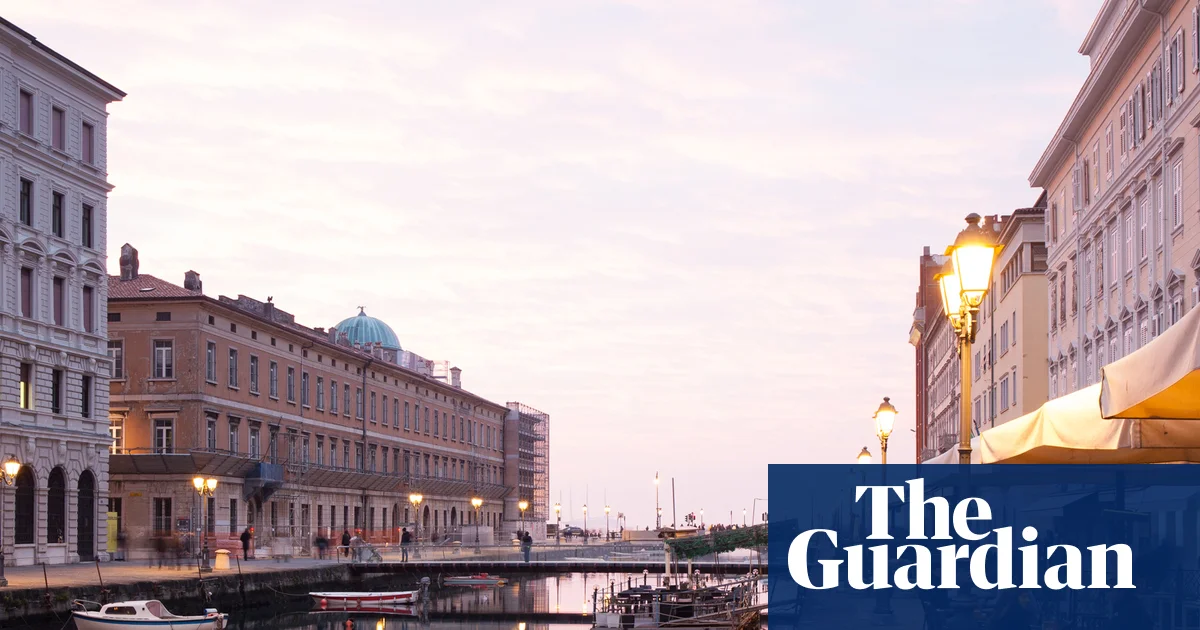
The stunning centre of city life is Piazza Unità d’Italia, Europe’s largest sea-facing square, with neoclassical palazzi on three sides and the fourth open to the Adriatic. The stone jetty to its right is Molo Audace: looking like a low pier – but with no railings or amusements – it’s where Triestini go for sea breezes, sunsets or to hang with friends on summer nights.
The square links two Triestes: to your right the Borgo Teresiano, the commercial quarter built under the Habsburgs, looking like a slice of MittelEuropa; to your left the older town of seafarers and fishers. Once-dodgy Via di Cavana is today pedestrianised and busy with pavement cafes and little restaurants.
The Revoltella Museum art gallery (€4.50, closed Tuesdays) is a short walk from Piazza Unità. I love its 20th-century works by Giorgio Morandi, postwar abstract pioneer Alberto Burri and Georgio de Chirico.
Barcoleta: boats sail past the Vittoria Lighthouse. Photograph: Stefano Rellandini/AFP/Getty Images
The world’s biggest sailing regatta comes to Trieste every October. The Barcolana sees the Gulf of Trieste filled with 2,500 sailing boats – a spectacle to watch from Piazza Unità or San Giusto Hill.
At VUD, on Via Daz by the sea, architect turned carpenter Filippo Mastinu makes sensuous chopping boards, toys and furniture in ash, acacia and oak. Up the street at Carta Straccia Lab, Alessandra Cuttone and Francesca Tonsi have been making quirky toys and decorations from papier mache since 2016. And round the corner at L’Angolo del Cuoio, shoppers can watch leather experts Anna Alberi and partner Valerio Saini making gorgeous belts, wallets and bags. On a parallel street is Knulp, a bookshop/cafe that has become a cultural hub, hosting painting and photography exhibitions and live music.
Things to do
You may have spotted the icing-sugar turrets of Miramare Castle (€12, grounds free) from the train. This was built for Austrian archduke Ferdinand Maximilian and his wife, Charlotte of Belgium, in 1854 and boasts a shocking pink throne room, impressive imperial kitchens and, in the grounds, a mini castle and the duke’s own bathing hut on the rocky shore.
A unique tram, built in 1902, links Trieste’s Piazza Oberdan to the town of Opicina, 330 metres above in the karst hinterland. Closed for years, it reopened to great fanfare in February 2025. (It is closed now but should reopen later in 2026.) Get off at Francesco I d’Austria Obelisk for great views and access to the 5km Strada Napoleonica walking trail to Prosecco (yes, where the wine came from, though most is now made in the hills near Treviso), with panoramic views over the Gulf of Trieste.
Grotta Gigante (guided tour €15), once the world’s largest visitable cave, is close by, with stalagmites that look like piles of plates. On a hot day it’s a welcome 11C inside.
Excursions run by Trieste Green include a farm-to-table tour with half-Australian, half-Triestina Alice – food you gather and cook varies by season, but May is good for wild asparagus. Another tour features a day with shepherd Antonič, walking in the hills, watching the milking and tasting his pecorino cheese.
James Martin has been vocal about his three stone weight loss and has even shared his favourite two-ingredient breakfast that he enjoys as part of his new diet
(Image: ITV)
Celebrity chef James Martin has shared his go-to two-ingredient breakfast following his impressive 3st weight loss, describing the meal as “simple and very tasty”.
The presenter of James Martin’s Saturday Morning on ITV recently travelled to Spain, gathering his favourite regional recipes for a new cookbook called ‘James Martin’s Spanish Adventure’.
The 53-year-old’s remarkable three-stone transformation has reportedly seen fish makeup 80 per cent of his diet nowadays, though he hasn’t given up his beloved butter.
He explained that the recipes featured in his books have been “specifically created” using ingredients they found during their travels. However, his absolute favourite dish can be whipped up at home using just two simple ingredients.
James revealed to Hello!: “Grilled tomatoes on toast. It’s very simple and very tasty. And the barbecued leeks with lardons and hazelnuts.”.
During an appearance on the Spooning with Mark Wogan podcast, James disclosed that his passion for motor racing motivated his significant weight loss, as he would “struggle to get out of them”.
He explained: “It comes down to the fact that I race cars, or I still try and race a few cars and I actually struggle to get out of them now. Getting in them, you kind of fall in them, but then you’ve got to get out of them and it just doesn’t look very good.” Nevertheless, it appears that another of his passions, butter, continues to feature prominently in his diet. The chef’s devotion to the dairy staple is legendary, having written an extensive 517-page tome on the subject.
Named ‘Butter: Comforting, Delicious, Versatile – Over 130 Recipes Celebrating Butter’, James joked that whilst others were releasing books on nutritious eating approximately five years ago, he’d “brought out a book on butter”.
The Home Comforts presenter’s weight loss wasn’t achieved through gym sessions, though, instead attributing it to his “farmer’s kid” upbringing, explaining that he enjoys “simple food” and “great ingredients”.
Indeed, he was candid about avoiding the gym, stating, “I don’t go”, and revealing that his weight loss simply comes down to being able to “get my a**e in and out of a car.”
He explained: “I’m a farmer’s kid, I like pure food, I like simple food and just love great ingredients. I like simple cooking, but also bringing out the flavour of the ingredients is more important than anything else.”
James is back on our screens today for Saturday Morning on ITV1 at 9.25am.
This place deserves far more recognition – it has amazing views, a real sense of community, and a fascinating history too.
Nicola Roy Multimedia content creator
04:01, 21 Mar 2026
This coastal spot is a true hidden gem(Image: Nicola Roy)
There’s genuinely nothing better than those first sunny spring days as we leave winter behind. It immediately makes you crave a visit the seaside, even if there’s still a slight chill and it’s not quite swimming weather yet.
Last weekend, I chose to take advantage of my renewed enthusiasm and positivity for life, and drove to a stunning coastal village that many people have never heard of. Admittedly it’s tiny, and there’s barely anything there, but there’s a welcoming pub and restaurant, breathtaking sea views , and it’s near to another popular seaside destination too. Lower Largo in Fife has a population of approximately 2,300, and it’s one of the most picturesque places I’ve seen.
The compact village overlooks Largo Bay, on the northern side of the Firth of Forth in Scotland. It required roughly an hour and a half to drive from Glasgow, and from Edinburgh, it’s just an hour’s drive away.
Largo is a historic fishing village, divided into two separate sections – Lower and Upper, with the small village of Lundin Links just to the left. Here, you won’t discover amusement arcades or crowds of holidaymakers, and it boasts a far more peaceful atmosphere than other coastal villages I’ve visited lately.
But don’t let the lack of attractions put you off. The more relaxed rhythm of life here was captivating, and already I’m eager for my next opportunity to return.
Waking up to those stunning views was an instant mood-booster, especially when the sun was shining brightly. The chilly temperature didn’t matter – the setting looked perfect, and the fresh coastal air felt wonderfully revitalising, reports the Express.
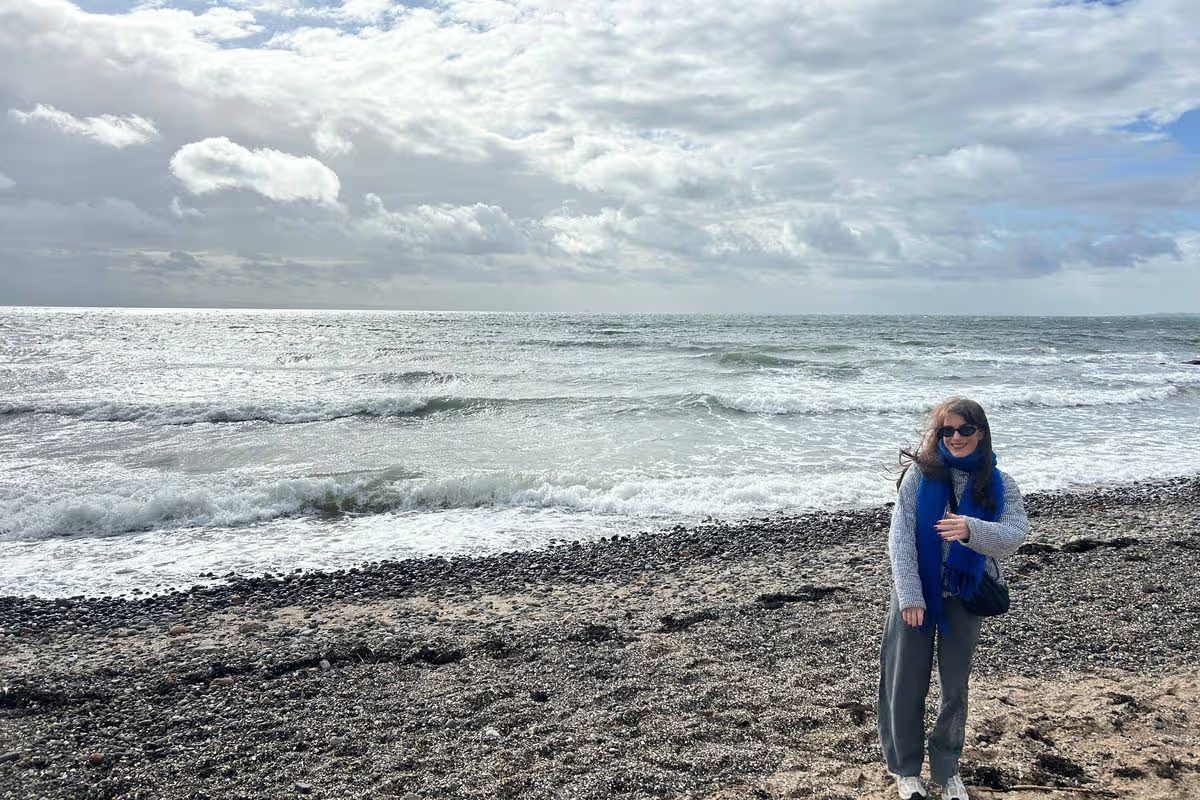
Lower Largo’s shoreline consists of sand and rocks, and it’s pristine. We noticed plenty of dog walkers enjoying the area, and even saw one brave soul taking a plunge in the sea, which must have felt incredible once she got past the initial cold shock.
The surrounding streets were equally delightful to explore. It’s fairly peaceful, meaning you’ll hardly encounter any traffic, but you will discover some impressively decorated front gardens. The nautical theme ran strong throughout, with garden gates featuring pirates, fish and mermaids.
We had breakfast at The Aurrie, a delightful cafe set within a converted church that offered such a warm and inviting ambience. Artwork from local artists lined the walls and was available to purchase, alongside an excellent range of hot dishes, coffees, and a cake display packed with tempting options. I chose the veggie haggis and potato scone roll with a flat white, and it was absolutely lovely.
During our visit, we also ate at The Crusoe, another wonderfully welcoming four-star hotel featuring a restaurant and pub. It serves all the traditional pub favourites you’d anticipate, from mac and cheese to fish and chips, and my entire family really enjoyed the experience.
Just over the way is the Railway Inn, another pub boasting a real fire that I didn’t manage to pop into, but my parents assured me it was fantastic and the ideal place for a post-dinner drink.
The pub enjoys a prime location right next to an impressive viaduct, now disused but still standing tall. It spans the Keil Burn, and was constructed to serve a section of the Fife Coast Railway Line. It’s been out of service since 1965 due to the reorganisation of British railways known as the Beeching cuts, but it remains a significant landmark and is well worth a look.
Another fascinating aspect of Lower Largo’s past is that it’s actually the birthplace of the man who inspired Daniel Defoe’s Robinson Crusoe – hence the hotel’s name.
Born in 1676, Alexander Selkirk was born in the village, and the house that now occupies his birthplace at 99-105 Main Street showcases a life-sized statue of him gazing out towards the horizon.
A signpost at the harbour points in the direction of the Juan Fernández Islands, some 7,500 miles distant, where he spent over four years shipwrecked.
I’m already looking forward to my next trip to Lower Largo. The overall atmosphere of the place was so welcoming, and it’s clear it has a strong sense of community.
It’s the ideal spot to enjoy a peaceful few days, but if you fancy exploring further afield, the beloved coastal town of St Andrews is just a 20-minute drive away.
While it’s best known for its golfing heritage and as the location where Prince William and Princess Catherine first crossed paths, there’s also a wealth of excellent pubs and eateries, bookshops and cafés to discover.
The travel expert previously shared his recommendations for a gorgeous yet affordable European summer holiday, and one place is well worth a visit.
Andrea Blazquez Editor of Spare Time and Nicola Roy Multimedia content creator
03:01, 21 Mar 2026
This article contains affiliate links, we will receive a commission on any sales we generate from it. Learn more
The gorgeous European gem is cheap too(Image: Getty)
If you’re still to book your holiday for 2026, Simon Calder is on hand to help with suggestions on where to go. The travel expert has previously spoken out about his favourite affordable spots to take a trip, and they’re all gorgeous too.
Simon highlighted Portugal, Bulgaria, Montenegro and Albania as some of the most stunning yet affordable holiday destinations. He said: “In Western Europe, it has to be Portugal and in Eastern Europe, Bulgaria – obviously a very popular package holiday destination.”
In fact, according to research in 2023 by holiday specialists Jersey Island Holidays, Montenegro topped the charts as Europe’s most affordable destination, reports the Express. Although this was a few years ago, the destination still remains very affordable.
For example, Brits can secure a seven-night break in an all-inclusive four-star resort in Herceg Novi next month for £419pp, including flights, according to Love Holidays.
The Iberostar Waves Slavija hotel, which is right by the beach, will only set you back £409 for seven nights — excellent value for money.
It’s cheap when you’re actually there too. According to Cost of Living, the average price of a beer in Montenegro is €2.50, which is around £2.15.
The average pizza costs €12, whereas pasta and meat dishes come in at around €15, according to Porto Montenegro. Flights in April start at just £16 one-way from Gatwick Airport.
But Simon Calder isn’t the only one singing the praises of this holiday destination, as travel bloggers at Wander-lush crowned Montenegro Europe’s most “underrated nation”.
Kotor Bay stands out as one of Montenegro’s most spectacular locations, and conveniently for tourists, the nearest city and airport is Podgorica.
The experts highlighted that whilst Kotor ranks among the most striking towns on Kotor Bay, if they “had to choose the most beautiful place in Montenegro overall, it would be the harbour town of Perast”.
Travel experts at Starsinsider agreed, declaring that Montenegro “is the most underrated jewel of the Mediterranean”.
In Podgorica, one of the top attractions is Saborni Hram Hristovog Vaskrsenja, a “beautiful and very impressive” church that’s “absolutely worth visiting”, according to some travellers on Tripadvisor.
Kotor Bay has earned praise on the platform as “the best coastal road in the world” and a “beautiful and peaceful” destination for a getaway.
“We fell in love with Montenegro. The water is so clear, the mountains come down to the water, and it’s stunning scenery.
“That said, what I love about it is that it’s so unspoiled. I sure hope it can stay that way. So peaceful and lovely,” one person shared in a review.
From factories to supermarket shelves, the Iran war is disrupting global supply chains.
First came the energy shock. Now, the Iran war is hitting something even more basic: Food.
With the Strait of Hormuz blocked, vessels are being rerouted and supply chains are under strain.
The disruption is pushing up the costs of almost everything from factories to supermarket shelves thousands of miles away.
The longer the Iran conflict continues, the greater the pressure on businesses and consumers worldwide.
The United Nations warns that rising food, oil and shipping costs could push an additional 45 million people into acute hunger – taking the global total above its record of 319 million.
There is no such thing as a day of rest for artist Kenny Scharf, not even Sunday. “I wake up super early. It’s still dark outside,” the Los Angeles native says.
Rising before the sun anchors his active day. “I always have to keep moving,” Scharf says. “Otherwise, I’ll get very depressed.”
An avid hiker and swimmer, Scharf, 67, also maintains a disciplined yoga practice and cycles daily from his Culver City home to his Inglewood studio. There almost everything serves as a canvas, including painted trash doubling as decor and the silkscreened couch on which he’s seated.
In Sunday Funday, L.A. people give us a play-by-play of their ideal Sunday around town. Find ideas and inspiration on where to go, what to eat and how to enjoy life on the weekends.
“I don’t like to waste good paint and silkscreen ink. Why wash it? We apply it everywhere until we use it up,” Scharf says.
Scharf, who grew up in the Valley before making his way to New York City, first gained acclaim in the ‘80s East Village art scene alongside his friends and contemporaries Jean-Michel Basquiat and Keith Haring, his former roommate. The trio also befriended Andy Warhol, who predicted Scharf’s fame.
Renowned for his self-coined “pop surrealism,” Scharf often populates his bold, colorful work with grinning cartoon faces, elastic blobs, and sci-fi creatures floating through cosmic landscapes. Anxieties about overconsumption and environmental degradation lie beneath the playfulness.
Like their creator, Scharf’s works are always on the move, either rolling down the street on the cars he’s painted — featured in his recently published book “Karbombz!” — or traveling to forthcoming exhibitions in Wuhan, Tokyo and Paris.
This interview has been lightly edited and condensed for length and clarity.
5:30 a.m.: Wake up and feed the cats.
My cats, Cutie and Socks — one’s a tabby and the other is a tuxedo cat — wake me up by mewing and walking on me. They’re like, “Hey, I’m hungry.” So I get up and crack open the cans. They like that disgusting, smelly canned food. And then they go out into the yard.
I got the cats because I went to New York for a show. I was gone for five days and I live next to a park, so there are a lot of animals. I came back and my entire house was overrun by mice. I was like, “What the hell am I gonna do? I need cats.” The mice are gone and now I have these cats. They’re so cute and so much fun. They take over my life.
6 a.m.: Detox
I make lemon and hot water. It’s a good way to start the day and clear out the toxins. Right now, I have a lot of citrus because Ed Ruscha’s studio is across the street from my house, and in the back of the studio he has a citrus farm. I go there, especially during this time of year, and get bags of citrus. It’s like a farm community in the middle of L.A. I love L.A. because you can surround yourself with trees and gardens and kind of pretend that you’re not living in a giant metropolitan area.
8:30 a.m.: Iyengar yoga
An Iyengar yoga instructor comes to my house. I find Iyengar is great for aging. You use ropes and gravity to hang and do different things, using your body weight so you can relax into the positions. I also have a swing to go upside down on. When people walk into my living room, they go, “What’s going on here?” because of the ropes on the wall.
In the summer, I’ll go to the beach in Venice and swim in the ocean. It’s wonderful when I’m out in the water. It’s cathartic and cleansing, and sometimes I see dolphins. I’ll go early in the morning before the crowds come.
11:30 a.m.: Mar Vista Farmers’ Market
It’s fun to go there with my daughter Zena, who’s a chef, and my grandkids. We stroll around and get food. All the food stands are delicious. I grew up here in L.A., so I’m into Mexican food. I don’t really want to eat American food. I’m not into hamburgers. I want all the stuff with the culture. I like hot and spicy.
I also buy apples and berries, whatever I can’t grow, because I grow my own food at home.
And I buy stuff from an Indian man who sells Chyawanprash, which is kind of a jam. It’s really concentrated and like an elixir. He also sells Shilajit, which almost looks like tar. You put a little bit under your tongue and it dissolves, and it’s got like every single mineral in it.
2 p.m.: Painting at the studio
I’m painting seven days a week, but I really love coming here on Sundays because nobody’s here and the phone doesn’t ring. Sometimes, my granddaughter, Lua, will come. She paints. Upstairs at the studio I have a little painting area with easels for my grandkids, but my grandson, Jet, isn’t that into painting. I do my work, and Lua’s up there keeping herself busy painting, and it’s great.
Kenny Scharf in his paint-splattered studio he bikes to every day.
(Myung J. Chun / Los Angeles Times)
5 p.m.: Hike
The easiest one is right behind my house. It goes up to the top of the Baldwin Hills Scenic Overlook where the [Culver City] Stairs go. It’s one of the best views in all of L.A. You can see from the airport to the ocean, downtown, Mount Baldy. You can see almost all the way to Palm Springs, Mount San Gorgonio. The view is amazing.
We also hike a lot in Kenneth Hahn [State Recreation Area].
My grandkids often like to go on a waterfall hike, so there are a couple in Malibu. There are also a couple over in the San Gabriel [Mountains]. We’ll get into the car and drive an hour and hike.
6:30 p.m.: Dinner at a restaurant
Zena, Lua and Jet live close to me, so we have dinner together at least three or four times a week. Because Zena’s a chef, we don’t go out to eat that often, but sometimes we go to a restaurant called Madre that I love. It’s on National [Boulevard]. The food is so good. They often have squash blossoms. They fry them and put a little cheese in them.
I also love Gjelina in Venice. Sometimes I take people from Europe there because it is quintessential California. All the food they make is from the farmers market, so you get a tomato salad with incredible tomatoes.
8 p.m.: Read
I just finished Patti Smith’s latest book, “Bread of Angels.” It’s beautiful. I love her. I saw her perform at Disney Hall recently, and she was selling this book. I actually saw her perform at the Santa Monica Civic [Auditorium] when I was 19. I’d been wanting to move to New York for a lot of reasons, but when I saw her performance, it was, “I’m moving there.” There was so much energy in her.
9 p.m.: Bedtime
Usually I’m in bed by 9 and asleep by 10. When I was young, I was very involved in nightlife. I was working in nightclubs, all of my friends were in nightclubs, so I lived that big time. But now I’m jaded. I don’t want to sound above it all, but I don’t see anything going on that I’m getting excited about the way it was. And I’m not a nostalgic person, so I choose not to go out. I’m happier getting a good night’s sleep.
It’s the perfect place for an Easter or summer holiday, as there’s so much to see and do, and it’s very easy to get around.
Nicola Roy Multimedia content creator
12:54, 18 Mar 2026
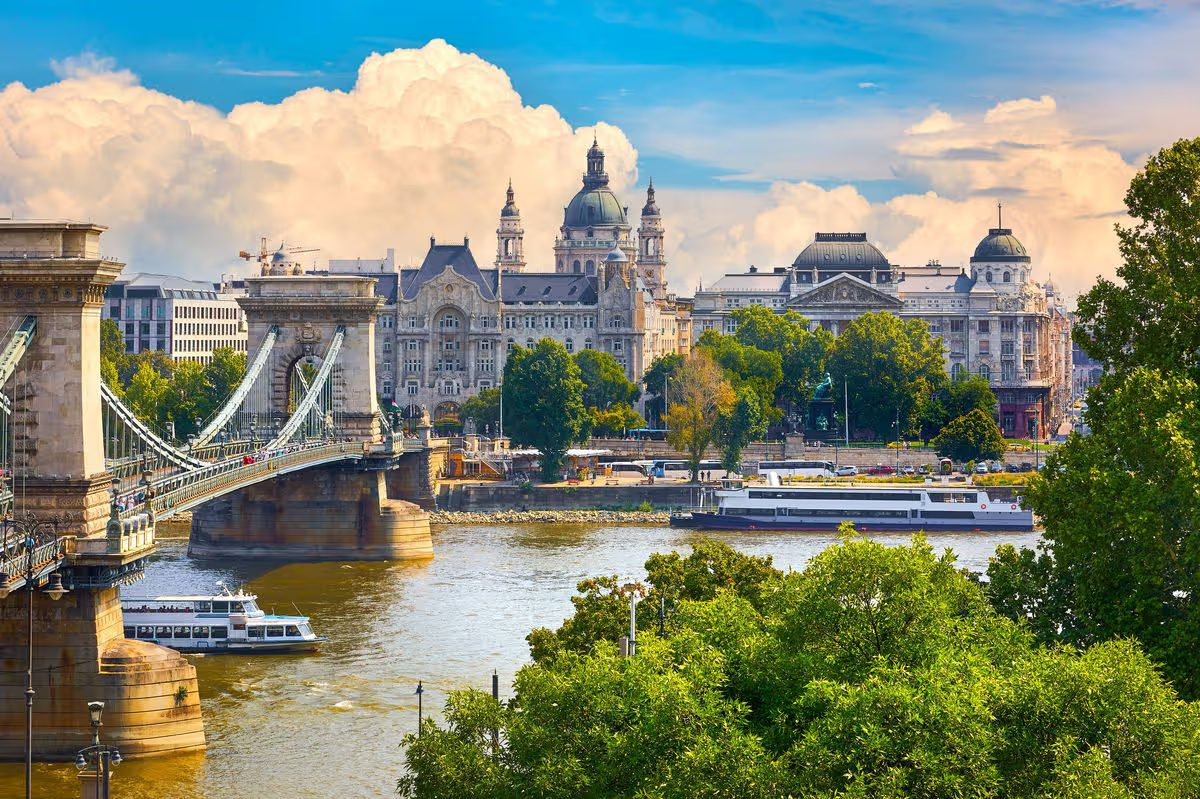
Budapest is home to the Danube river, a stunning place to walk(Image: Yasonya via Getty Images)
A stunning European capital has been crowned one of the most walkable, making it ideal for a summer or Easter break with countless attractions to explore. Better still, it’s affordable to reach, with UK flights available from just £19 in April.
Budapest in Hungary has repeatedly featured in conversations about great holiday destinations. There’s good reason for its popularity – getting around on foot is effortless, it’s steeped in fascinating history and brilliant attractions, plus the cuisine is great . In fact, travel experts at Freetour named it the top city to visit in 2026.
The specialists explained: “If there is one city that tops every travel ranking time and time again, it’s Budapest. The Hungarian capital claimed first place across all FREETOUR.com destinations in 2025, and 2026 is shaping up to be no different.”
They continued: “It has everything a curious traveler could want: the medieval Castle Hill and the ruin bars of the Jewish Quarter, fin-de-siècle thermal baths and street food at the Great Market Hall, the misty Chain Bridge at dawn and a symphony of lights over the Danube at night. Budapest is a city where every free walking tour feels like a genuine discovery.”
Budapest often appears in lists about the most pedestrian-friendly cities globally. In Guru Walk’s rankings last year, it secured second place, with Rome claiming the number one position, reports the Express.
The professionals noted: ‘Known as the “Pearl of the Danube”, Budapest blends imperial architecture with a vibrant cultural scene.’
Two of Budapest’s main attractions – St Stephen’s Basilica and the Houses of Parliament – are conveniently located just a 15-minute stroll apart. However, if you’re not keen on exploring entirely by foot, the city boasts an efficient public transport system, complete with trams, buses and metros.
Undoubtedly, one of Budapest’s standout attractions is the Szechenyi Thermal Baths. It’s one of the largest complexes in Europe, supplied by two thermal springs, with the indoor and outdoor pools tracing their history back to 1913.
The waters are rich in health-enhancing minerals and temperatures vary from a comfortable 27°C to a warm 38°C.
After your relaxing soak, you can indulge in Budapest’s lively street food scene.
Karaván, nestled in the heart of the Party district, is a must-visit for those eager to sample local delicacies, such as Lángos, a deep-fried flatbread garnished with garlic, cheese and sour cream.
Flights to Budapest start from just £19 from Gatwick in April.
It’s the perfect place if you like a combination of adventures and chilling out, taking in the gorgeous scenery.
Portia Jones Senior Journalist and Nicola Roy Multimedia content creator
12:54, 17 Mar 2026
This article contains affiliate links, we will receive a commission on any sales we generate from it. Learn more
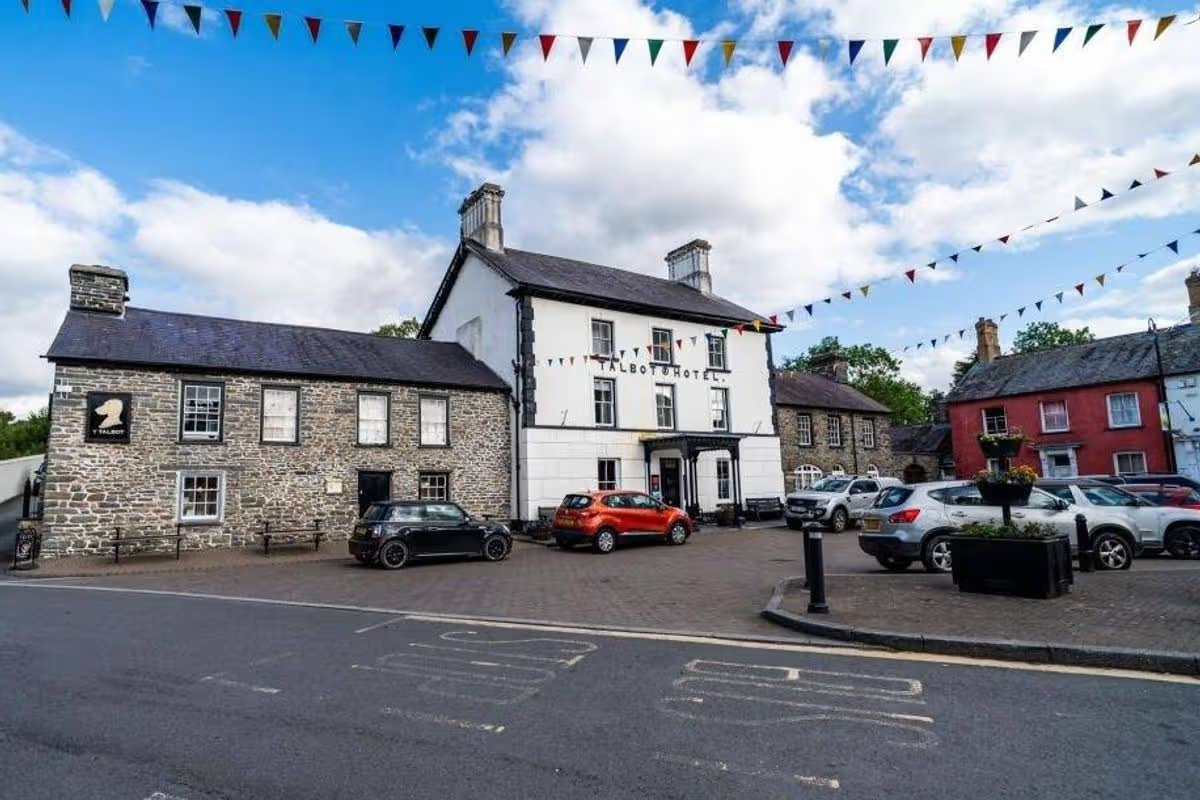
There are plenty of great pubs and restaurants in the town too(Image: Fine & Country West Wales, Aberystwyth)
A historic market town in the UK is definitely worth a visit this spring, as there’s so much to see and do there. It’s ideal for adventure seekers, and those who just want to walk around, eat good food and chill out.
Tregaron is one of Wales’s oldest market towns. It’s home to independent retailers, coffee shops, and the elegant Y Talbot, a grade II-listed hotel, pub, and restaurant, positioned right in the town square’s centre.
From here, you can embark on an exhilarating road trip along a former drover’s track that showcases hairpin turns through wild terrain.
The Abergwesyn Pass is a 20-mile single-track route stretching from Llanwrtyd Wells to Tregaron. Along this isolated road, you’ll encounter a notorious stretch called “The Devil’s Staircase”, reports Wales Online.
This appropriately named portion of the Abergwesyn Pass features hairpin curves and sharp climbs that aren’t suited to anxious motorists.
For adventurous drivers, you’ll love tackling one of Wales’ most isolated countryside regions, encountering sheep, gnarled trees and rocky formations along the way. It’s extremely steep, reaching a maximum gradient of 20.1%, and cuts through thick woodland towards miles of expansive, barren valleys, providing a descent that will push your brakes to their absolute limits.
Drive carefully and enjoy the scenery as you meander through the wilderness of the Cambrian Mountains, where you could potentially encounter nobody throughout your entire journey. You can also tackle this route by bicycle if your legs are ready for the test.
As well as the Abergwesyn Pass, Soar y Mynydd, Wales’ most isolated chapel, is worth the detour. This modest, whitewashed church was constructed in 1822 to minister to an extremely dispersed community of farmers.
Wandering through this tranquil location, you could easily assume the chapel has been deserted for years. Actually, visiting preachers travel from across Wales to hold services in Welsh.
It’s a serene spot for a picnic, as there’s often nobody else there.
Llyn Brianne Reservoir also deserves a stop to witness an enormous dam. You might be surprised to learn that this striking stone-built dam is Britain’s tallest, rising 91 metres (300 ft) above the River Tywi.
Containing an incredible 64 million cubic metres of water at almost 300 metres (990 ft) above sea level is a remarkable engineering achievement. Building work began in October 1968, with the dam constructed from crushed rock, larger stone, and clay sourced from the surrounding area.
After dark, it becomes a stargazing hotspot in the Cambrian Mountains, making it an excellent location for astrophotography.
Further south, beyond Llyn Brianne reservoir, lies the amazing RSPB Gwenffrwd-Dinas reserve. The reserve encompasses vital habitats of oak woodland, wet alder woodland, and scrubland, all defined by heavy rainfall and swift-flowing rivers.
These conditions are ideal for woodland birds, whilst also offering the perfect environment for significant lichens and bryophytes. Whether you begin or finish the route at Tregaron, you should make time to discover this small Welsh-speaking town. Here, you’ll discover a livestock market, the Tregaron Red Kite Centre and Museum, and locally sourced food and cask ales in a beautifully converted 16th-century Welsh inn.
Y Talbot is an independently owned hotel and Michelin Guide-listed restaurant with 2 AA Rosettes. This charming boutique hotel radiates a ‘cosy country inn’ atmosphere with its slate floors and inglenooks.
The location is said to be the final resting place of a circus elephant which perished in 1848 and lies beneath what is currently Y Talbot’s beer garden.
The establishment, run by head chef Dafydd, who trained under Marco Pierre White, showcases regional ingredients, including lamb, beef, and cheeses sourced from the Teifi Valley, fish from Milford Haven, and shellfish from Cardigan Bay.
Close by, you’ll also discover a neglected Welsh abbey where princes lie buried. Strata Florida Abbey near Tregaron is a remarkable location in Wales where history, royalty, and spirituality meet.
Established in 1201 by white-robed Cistercian monks, this hallowed ground was formerly among medieval Wales’s most vital religious and cultural hubs.
It also serves as the burial site of numerous Welsh princes, including the renowned Llywelyn the Great, who famously convened a council here to guarantee his son Dafydd’s position as the legitimate successor to the Welsh throne.
The Abbey was established as a major institution serving the indigenous population of Wales and Western Christianity through its affiliation with the pan-European Cistercian Order of Monasteries.
The carved west doorway into the Abbey remains standing in isolation and provides an eternal vista down the nave towards where the high altar formerly stood.
You can still see some of the decorated tiles that would have adorned the church floors, along with elaborate carvings throughout the site.
Since then, he’s featured across numerous television programmes including the likes of Housecall and Entertaining with James. In 2006 he joined Saturday Kitchen, presenting the weekend programme for a decade.
Tragically, she passed away before James appeared on one specific show that she was a “huge fan” of. In conversation with Candis magazine, he revealed: “Mum is my biggest fan and the most honest person I know. My granny, Marjorie, also watched everything I did.”
He continued: “She was a huge fan of Strictly and it’s a sadness to me that she didn’t live long enough to see me take part in 2005.”
James took part in the third series of Strictly Come Dancing, where he was paired with professional dancer Camilla Dallerup. He secured fourth place behind radio presenter Zoe Ball, with Olympian Colin Jackson finishing runner-up and cricketer Darren Gough claiming the Glitterball Trophy.
James, who grew up on a farm in North Yorkshire, attributes his culinary passion to his grandmother’s influence. In a 2011 Mirror interview, he recalled enjoying fresh produce from his grandparents’ allotment during his childhood.
The chef even credits his grandparents with nurturing his passion for cooking, backing him when he secured a position in a local kitchen before attending culinary school. He said: “My grandmother was a huge influence in my life and inadvertently inspired me to be a chef.
“She baked and cooked, and she was just wonderful. If I could be 10% of what she was, I’d be a lucky man.
“As a boy, my most vivid memories are of helping her dig up potatoes fresh from her allotment, then boiling them up with some mint. If someone asks you what your most memorable meal was, it’s seldom something you had in a restaurant, it’s what you ate at home as a kid, isn’t it?”.
He added: “I remember going shopping with her and watching her buy bacon and crusty white bread. You’d just see her backside as she disappeared into the shelf, reaching right to the back for the freshest loaf, squeezing them until she found it.
“When we got home she’d grill the bacon on one of those old enamel gas cookers with red buttons. It would take ages to warm up and cook, and the room would fill with the smell of cooking fat.”
James returns to television with James Martin’s Saturday Morning from 9.30am today (March 14). Joining him will be vocalist and television presenter Jane McDonald alongside chefs Judy Joo and Curtis Stone plus mixologist Merlin Griffiths.
POPULAR food influencer Eating With Tod has revealed he has asked his stunning girlfriend to marry him.
The social media star, who boasts over 2million followers, revealed he had popped the question to his rarely-seen partner Mea.
Sign up for the Showbiz newsletter
Thank you!
Food influencer Eating With Tod has revealed he’s asked his girlfriend to marry himCredit: InstagramReal name Toby, the social media star popped the question to partner MeaCredit: InstagramMea showed off her huge diamond ringCredit: Instagram
The influencer, whose real name Toby Inskip, took to Instagram to share their happy news.
The restaurant reviewer shared a slew of snaps from his romantic proposal, in Brazil, which included one of him down on one knee on a yacht.
Another photo saw Mea flashing her HUGE diamond ring for the camera, while another sweet snap saw the newly engaged couple posing for a romantic selfie.
Toby captioned the engagement announcement post with: “Cheers to the next chapter @mea_c.k – can’t wait for the next adventure with you ❤️
“Luckily the ring didn’t fall into the water… #engagement #wedding #brazil.”
Fans rushed to share their joy for the couple, with one posting: “Congrats you two!”
Another commented: “This is such wonderful news!”
A third said: “So awesome! Congratulations!!”
A fourth added: “Massive congratulations to you both!”
Mea also shared the sweet snaps and wrote: “03. 03. 26. Rio de Janeiro, Brazil, sailing between Christ the Redeemer and Sugarloaf Mountain Toby proposed.”
The social media star has a huge following Eating With TodCredit: Instagram
Toby’s new fiancee doesn’t appear a lot on Toby’s Instagram, and it is not clear on how long they have been in a relationship for.
Meanwhile, the social media star’s Eating With Tod channel is so popular that he is one of the biggest food influencers in the UK.
Toby’s content sees him reviewrestaurants from around Britain by trying out their different dishes and giving his opinion.
Toby is known for his love of foodCredit: Instagram
Fans posting about the event criticised it for overcrowding and overpricing.
It was noted that one stall was commanding £6 for a cinnamon roll, while another vendor was charging an eyewatering £13 for a burger.
Meanwhile, since rising to fame Toby has boosted his bank balance by working with huge brands like McDonald’s, Tabasco hot sauce and Gordon Ramsay Street Pizza.
Fans can also buy Eating With Tod merch which sees T-shirts being flogged for £25.
The Influencer Insider – Get all the gossip on all your favourite online stars
Want to know more about the influencer who faked cancer? Read all about Brittany Miller and her sham career here.
We have all the inside gossip about Ladbaby mum’s incredible weight loss here.
And talking of weight loss, we know all about what is going on with B&M queen Becki Jones, which you can read up on here.
If health influencers are your thing, then read this on the man behind Tonic Health and his dubious claims here.
A daily multivitamin may help slow biological aging, based on a study of people who took them for two years and whose DNA showed fewer changes over time than people who did not take the vitamins. Photo by Lawrence Looi UK & Ireland Out/EPA
March 9 (UPI) — A daily multivitamin may slow biological aging — the rate at which our bodies age on a cellular level — significantly, especially for people biologically older than their actual age.
Researchers at Harvard Medical School and Mass General Brigham found that daily cocoa extract and multivitamin slowed biological signals that are predictive of mortality, they write in a study published in the journal Nature Medicine.
Epigenetic clocks can estimate biological aging based on changes in DNA by looking at sites that regulate gene expression and change as people age.
By monitoring these signals, it is possible to track mortality and the pace of aging, as well as the predict it.
“There is a lot of interest today in identifying ways to not just live longer, but to live better,” Howard Sesso, lead author of the study,” said in a news release.
“This study opens the door to learning more about accessible, safe interventions that contribute to healthier, higher-quality aging,” said Sesso, preventive medicine specialist at Mass General and epidemiologist at the Harvard Chan School of Medicine.
Using data from the Cocoa Supplement Multivitamins Outcomes Study, the researchers analysed DNA changes in blood samples from 958 randomly selected healthy study participants who had an average actual age of 70.
The participants were randomized to take daily cocoa extract and a multivitamin, cocoa and a placebo, placebo and multivitamin or only placebo for two years, with researchers analyzing five epigenetic clocks in blood samples from the study’s start, at the end of the first year and at the end of the second year.
Overall, compared to the placebo-only group, those taking a multivitamin saw a statistically significant slowing of biological aging by about four months — especially for those who were biologically older than their age when the study started.
The researchers also found that cocoa extract had no effect on biological aging.
While the results are promising, the researchers concluded in the study that additional work is needed to better determine the clinical relevance of multivitamins on biological aging.
“We plan to do follow-up research to determine if the slowing of biological aging — observed through these five epigenetic clocks, and additional or new ones — persists after the trial ends,” Yanbin Dong, study co-author and researcher at the Medical College of Georgia, Agusta University, said in the release.
Bryan Cranston (R) and Frankie Muniz of “Malcolm in the Middle” greet the media during the Fox Upfront event in New York City on May 15, 2003. Cranston and Muniz are returning for a limited series sequel to “Malcolm in the Middle.” Photo by Ezio Petersen/UPI | License Photo
A quintessentially English village brimming with traditions, natural wonders and local delicacies is waiting to be explored – from historic caves and breathtaking views to the world-renowned cheese that originated there
The village still sells the original food (Image: travellinglight via Getty Images)
Nestled at the base of the picturesque Mendip Hills, this stunning village remains remarkably unchanged from decades past, preserved as the epitome of an English village.
Cheddar is famous for many reasons, all of which consistently attract visitors to its charming Somerset enclave throughout the year.
Packed with traditions, natural marvels and of course its regional specialities, it provides the perfect retreat from daily life into what resembles a storybook village.
From charming tea rooms to classic cottages, spectacular scenery and ancient caves, there’s far more to discover in Cheddar than initially apparent.
Following a visit, one person said on TripAdvisor: “This is a beautiful small place, with some great attractions and amazing local shops. So many places to eat and drink or buy local gifts like cider and cheddar. We would definitely come back.”
Best UK holiday cottage deals
This article contains affiliate links, we will receive a commission on any sales we generate from it. Learn more
Sykes Cottages offers a wide range of handpicked holiday homes across the UK and Ireland, from cosy countryside retreats to stunning coastal escapes. Prices start from £27 per night
Cheese
Naturally when you hear the village’s name, you immediately think of the cheese, and it’s no coincidence – the dairy product adopted the name of the village where it was first created.
The heritage of this globally celebrated cheese stretches back to approximately 1170, when it was crafted and aged in nearby limestone caves.
Due to their stable temperatures and humidity levels, they provided the ideal environment for cheesemaking until the technique was modernised.
Notably during the Second World War, milk production was commandeered by the government, resulting in standardised cheese, referred to as ‘government cheddar’ in the UK.
This led to the erosion of traditional cheddar production in regions like Somerset, meaning many of us have grown up without ever genuinely experiencing the authentic version.
When exploring the tranquil village, visitors can stop by The Worlds Oldest Cheddar Cheese Shop to sample some of the original recipes. Nearby sits the Cheddar Gorge Cheese Company, where guests can both buy and try ‘the only Cheddar made in Cheddar’.
Gorge and caves
The gorge is truly where Cheddar’s enchantment lies, comprising several caves, including Gough’s Cave. It has captivated human curiosity for generations and is thought to have been inhabited since Neolithic times at the earliest.
Cheddar Gorge stands as the UK’s largest and represents a natural monument that attracts over 50,000 visitors annually, all seeking a window into history.
Indeed, the location is so historically significant it yielded what remains the oldest complete human skeleton ever discovered in Great Britain, famously known as Cheddar Man, who dates back roughly 9,000 years.
Visitors have the opportunity to venture inside the caves, discover their hidden depths and even participate in rock climbing activities.
One said: “The caves were brilliant. Seeing where the Cheddar Man skeleton was found and then going deeper into Gough’s Cave was a wonderful adventure.”
They noted that the caves were “truly beautiful” and described the trek along the clifftops as an “awesome” experience.
The scenery is genuinely unlike anything else, featuring massive, soaring, dramatic cliffs that have established it as a global hotspot for caving and rock climbing.
Cheddar Gorge is an authentic haven for outdoor adventurers, combining natural beauty with thrilling activities, and naturally, plenty of heritage.
Breathtaking views
For the best vantage point in Cheddar Gorge, visitors can tackle the ultimate climb, which includes a 274-step staircase. Jacob’s Ladder is a must-visit for those exploring the area who want to experience it all from an elevated perspective.
The steps were built in 1869 to guide people upwards from the gorge base right to the cliff summit, and they remain in use to this day for the same purpose.
Based on visitor feedback, the trek is definitely worthwhile, offering the opportunity to enjoy sweeping views across Somerset and the Mendip Hills, with the possibility to climb even further, up an additional 48 steps.
Following the climb, one visitor said: “It’s steep, but it’s well worth climbing the 274 steps for the views you get when you reach the summit.
“Fortunately, there are two resting places on the way up (with information boards giving a history of the ladder and the flora and fauna around the steps) where you can admire the views across Cheddar and get your breath back. On the way down, you may be lucky enough to see one of the feral goats.”
Writer Catherine Usher travelled by train to the pretty town of Troyes in the Champagne region, discovering art, history and – of course – the best bubbly
This article contains affiliate links, we will receive a commission on any sales we generate from it. Learn more
Discover a relaxed and inviting city break, with no need to step on a plane(Image: Getty)
Troyes is only a 90-minute train ride from Paris but, compared to the capital, it’s a more compact and intimate location for a French mini-break. You’ll find atmospheric churches, attractive independent shops and chic museums, making it the ideal place to explore for a few days. Although it’s a very popular stop-off point for holidaymakers driving further south in France or onwards to Germany or Switzerland, a car isn’t a necessity. We travelled to Paris first via Eurostar –a much more environmentally-friendly option than flying – then took the train to Troyes. (It’s a 10-minute walk between Gare du Nord and Gare de l’Est in Paris.) Once in Troyes, we were able to explore much of the town on foot.
Troyes is a pretty city with lots of half-timbered buildings in the old town that were largely built in the 16th century. There are countless cobbled streets to wander down and the atmosphere is relaxed and friendly.
Two museums well worth taking a stroll around are the Musée d’Art Moderne and the Cite du Vitrail.
The Modern Art Museum , located next to the cathedral, is home to paintings by artists such as Henri Matisse and André Derain. The sloping ceilings on the upper floor make it feel cosy and visitors can enjoy a sense of proximity to the artwork.
The Cite du Vitrail is the stained glass museum and it is a wonderful, tranquil venue where you can immerse yourself in the elegance and beauty of stained glass. Located in an 18th century building, it explores stained glass from the Middle Ages to the present day and houses striking and memorable exhibits.
Making time for Champagne
Being in the heart of the Champagne region, discovering its most famous export is a must. Chassenay d’Arce champagne house in Ville-sur-Arce is about an hour’s drive from Troyes. It was founded in 1956 by five pioneers and the organisation is now made up of 130 families, with a focus on co-operation and knowledge-sharing.
Visiting its vast cellars and seeing how the bottles are produced is a real eye-opener, and the tasting workshop at the end of the tour is an obvious highlight for champagne connoisseurs and novices alike (see chassenay.com).
Troyes is a straightforward place to explore, but if you really want to find out about its history then a guided tour is a must. Hosted by Troyes La Champagne Tourisme, tours can be arranged for smaller or larger groups, of up to 30 people. Our host, Laura Dudek, was a well-informed, enthusiastic guide who tailored the experience to our interests, taking us to see many of the city’s ornate and impressive churches and cathedrals. For those who prefer to go it alone, you can explore with a City Pass, which includes an audioguide and admission to the museums.
Where to eat and drink
A flute of champagne is no doubt on the agenda for many visitors, and most of the bars and cafés have a variety of local brands to sample.
Octave is a sophisticated, rather understated restaurant located in the centre of Troyes with a beautiful courtyard, where you can enjoy dinner under the stars – usually joined by the friendly cat who lives nearby. The tapas style menu may look daunting at first glance, but the knowledgeable staff are happy to advise and we were very pleased with their recommendations.
For a speedy, fuss-free lunch while sightseeing, Tonton Farine is a welcoming bakery/canteen where everything is homemade. As it’s France, everything tastes more wholesome and delicious than a British equivalent. Most of the other customers looked like they were locals on their lunch break.
If you’re away from Troyes enjoying a champagne tour, Le Moussec in Les Riceys is a fabulous place to stop for lunch. The dishes are tasty and hearty, the restaurant is buzzing, which is always a good sign, and the staff are warm and attentive without being suffocating.
Where to stay
Two elegant boutique hotels, La Maison de Rhodes and Le Champ des Oiseaux, are located in adjoining medieval buildings and offer a combined 23 rooms. Owned and run by the same family, the welcoming hotels are a great base from which to explore the city.
Room categories and decor vary between the two properties, but guests share access to a range of amenities, such as a tranquil walled garden (we were getting Romeo and Juliet vibes), an outdoor heated pool and a small spa. The restaurant has an elegant yet homely ambiance and after your evening meal you can enjoy a nightcap in the moonlit garden. Once settled with a glass of wine, some nibbles and a book, it’s incredibly hard to drag yourself away.
How much does it cost?
Rooms at La Maison de Rhodes start from £245 and Le Champ des Oiseaux start from £174 per night on a B&B basis – see maisonderhodes.com. To book a tour of the town, see troyeslachampagne.com. Eurostar journeys between London and Paris start from £39 each way – see eurostar.com. Fares are all-inclusive with no hidden extras, children under four go free, and a Paris-London journey by Eurostar means 96% fewer CO2 emissions than travelling by plane.