The warning comes at a time of global turmoil

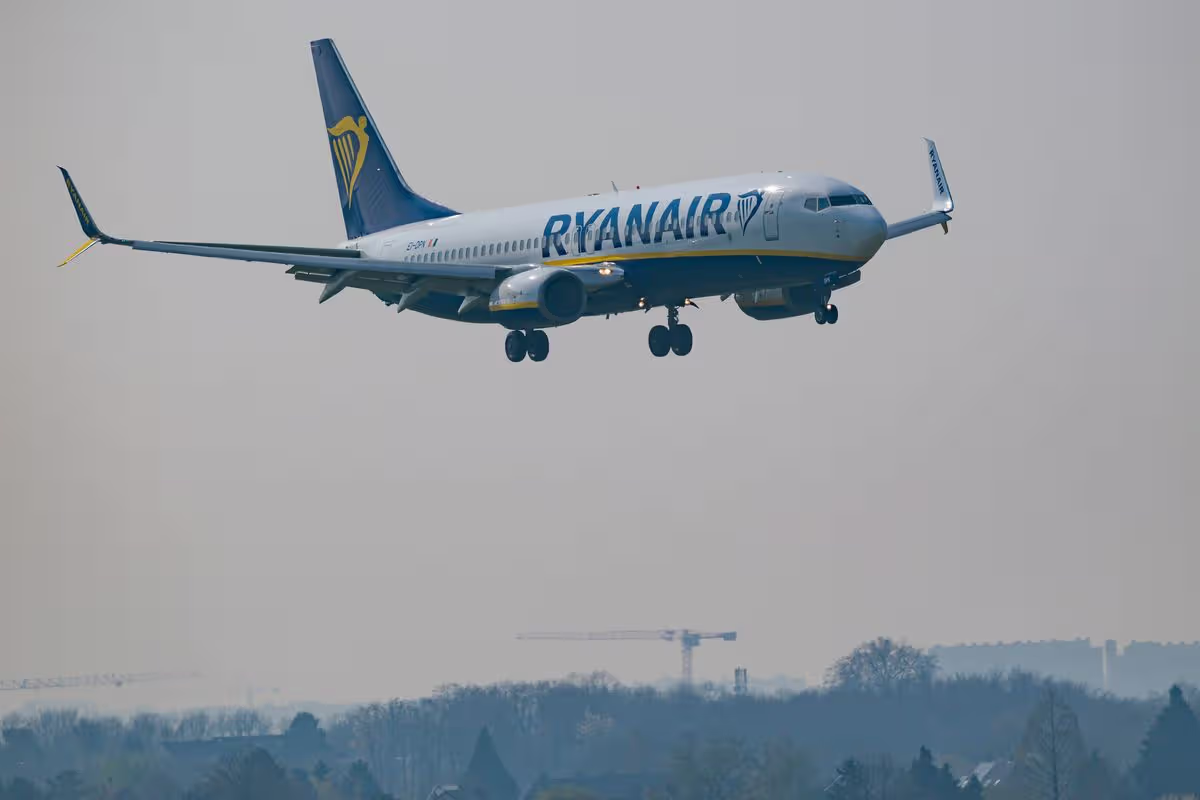
Ryanair has issued a warning to its customers(Image: Getty)
Ryanair has issued a warning to passengers hoping to fly in the days ahead. The budget airline has sent emails to travellers flying from the UK to large parts of Europe.
It cautions of ‘longer queues, particularly at busy airports’. The reason is the new Entry and Exit System (EES), which has been rolled out by the European Union (EU). It requires all travellers from the UK and other non-EU nations to be photographed and fingerprinted at EU airports and border crossings.
The objective is for the new system to replace manual passport stamping and more efficiently track the 90-day visa-free limit, but there have been accounts of it causing delays stretching to several hours at busy airports. It has even been temporarily suspended at times to clear the backlog.
In a message to customers titled ‘Important: Changes to Passport Control’, Ryanair says: “From 10 April 2026, the EU’s Entry/Exit System (EES) is in place at all Schengen Area external borders. As a result, passport control may take longer for some passengers.
“You are affected if you hold a non‐EU / non‐EEA / non‐Swiss passport (e.g. UK, USA, Canada, Australia), and are flying into or out of the Schengen Area.
“Commonly affected routes include flights between the Schengen Area and countries such as: UK, Ireland, Cyprus, Albania, Montenegro, Serbia, Türkiye, Egypt, Israel and others.
“At passport control you may need to:
- Scan your passport
- Provide fingerprints
- Have a facial image taken
These checks may cause longer queues, particularly at busy airports. Queues may form before security.
If affected, please:
- Arrive at the airport early to allow for queues
- Have your travel documents ready
- Follow signs marked EES / Passport Control
Those who are not affected:
- EU, EEA and Swiss passport holders
- Flights within the Schengen Area (e.g. Spain–Italy, France–Germany)
“If you are denied entry, this will be due to EU policy, not Ryanair’s rules.”
Greece has reportedly opted to pause the EES rollout following considerable delays. A statement on the Greek Embassy website and posts across official social media channels said: “In the framework of the implementation of the Entry/Exit System, as of 10 April 2026, British passport holders are exempt from biometric registration at Greek border crossing points.”
Airport representatives and the European Commission convened a meeting on Tuesday to address issues surrounding the system. Approximately 122 passengers were left stranded and unable to board their flight from Milan Linate to Manchester on Sunday, following severe hold-ups at passport control linked to the introduction of the EES.
The Foreign, Commonwealth and Development Office has confirmed that your details will need to be re-registered every three years. A statement also warned that travellers may face longer waiting times when entering or departing a country. It states: “The European Union’s (EU) Entry/Exit System (EES) started on 12 October 2025 This is a new digital border system that has changed requirements for British citizens travelling to the Schengen area.
The countries in the Schengen area are: Austria, Belgium, Bulgaria, Croatia, Czechia, Denmark, Estonia, Finland, France, Germany, Greece, Hungary, Iceland, Italy, Latvia, Liechtenstein, Lithuania, Luxembourg, Malta, Netherlands, Norway, Poland, Portugal, Romania, Slovakia, Slovenia, Spain, Sweden, and Switzerland.
READ MORE: ‘Our home burned down after moving in – we didn’t even have time to unpack’READ MORE: Brits flying to EU issued Defra warning after foot and mouth disease outbreak
The Republic of Ireland and Cyprus are not within the Schengen area, and therefore EES is not applicable when travelling to either of these countries. If you are travelling to a country in the Schengen area for a short stay using a UK passport, you may be required to register your biometric details, such as fingerprints and a photo, when you arrive. You do not need to take any action before you arrive at the border, and there is no cost for EES registration.
EES registration is replacing the current system of manually stamping passports when visitors arrive in the EU. EES may take each passenger extra time to complete so be prepared to wait longer than usual at the border.
“On your first visit to the Schengen area, you may be asked to create a digital record at the port or airport on arrival. You may be asked to submit your fingerprints and have your photo taken at dedicated booths. You don’t need to provide any information before travelling to a Schengen area country. The checks may take slightly longer than previously, so be prepared to wait during busy times.”
“If you enter the Schengen area through the Port of Dover, Eurotunnel Le Shuttle at Folkestone or Eurostar, St Pancras International, any EES checks will be completed at the border, before you leave the UK. You may also be asked to provide either your fingerprint or photo when you exit the Schengen area.”
“If you frequently travel to the Schengen area for work and/or leisure purposes, you must ensure that your total stay in the Schengen area is no more than 90 days in every 180 days. You must be aware of the penalty and enforcement approach for exceeding the immigration limit in any individual Member State you plan to travel to, or through.”