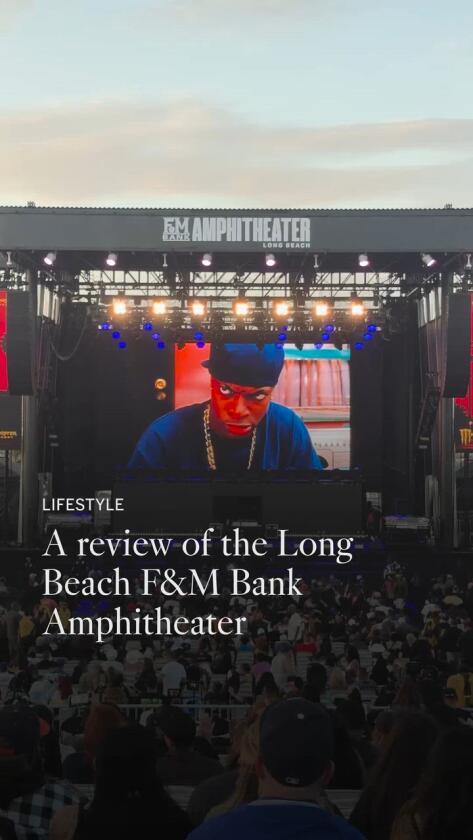
fm bank amphitheater

What it’s like to see a show at F&M Bank Amphitheater in Long Beach

When I pulled into the parking lot near Long Beach’s F&M Bank Amphitheater with just 30 minutes until the opening of the show on a recent Friday, my heart raced.

“Do you think we’ll make it in time?” I asked my boyfriend, worried.

We were heading to Ice Cube and Mike Epps’ “Everyday’s Friday” concert and comedy show — a celebration of the cult classic “Friday” movie franchise — so a huge turnout was guaranteed. And ever since F&M Bank Amphitheater opened earlier this summer, my social media feeds have been flooded with complaints about Long Beach’s new temporary waterfront venue. Concertgoers have cited uncomfortable seating, sky-high parking rates and long shuttle wait times.

  • Share via

Those comments swirled in my head as I hustled toward the shuttle pickup line near the Pike Outlets. But to my surprise and relief, a bus arrived within a few minutes. After a roughly 15-minute drive through mild traffic, we made it to the venue just in time to see Epps tease a few audience members during his opening comedy segment.

The 11,000-seat F&M Bank Amphitheater has gotten a lot of buzz in the two months it’s been open, with conversations surrounding its funding, noise concerns in the neighborhood and the purpose of the venue for the city of Long Beach. My mission was simply to see what it’s like to experience a show. The verdict? If you’re not expecting luxury and you arrive with a healthy dose of patience, it’s a treat.

Here’s a rundown, starting with getting to the amphitheater. Because the venue doesn’t have its own parking lot, the options are rideshare, the bus, e-scooters, bikes (with storage available at the venue), taking a water taxi ($5 per way) or paying $55 for reserved spaces, then taking the free shuttle.

Walking inside felt less like entering a temporary venue and more like stepping into a mini music festival. The pathway toward the security checkpoint was adorned with a bright abstract mural, hanging lights and swaying palm trees. A display of lowriders greeted us alongside a massive mural of iconic scenes from the film “Friday,” including Cube and Chris Tucker’s legendary Dammnnnn” moment. Deeper into the grounds, fans delighted in interactive art installations — from a replica of Pinky’s Records & Discs to Craig’s front porch. Nearby were even more classic lowriders that drivers made bounce and dance for the crowd. The layout made the space feel more expansive and interactive than just watching a performance.

The spacious F&M Bank Amphitheater felt like a mini music festival with food trucks, art installations and more.

The spacious F&M Bank Amphitheater felt like a mini music festival with food trucks, art installations and more.

(Daniel Rojas)

Food trucks and bars were scattered throughout, serving up tacos, burgers, hot dogs and other hand-held bites. I ordered a smashburger with fries — which was decent though the line moved slowly — and paired it with a cocktail, which was moderately priced by L.A. standards ($19 for premium liquor). Grab-and-go beers and seltzers were easily accessible although I didn’t spot any refillable water stations around the venue.

And a major thing to note is the venue’s only restrooms are Porta Potties. I was instantly grateful that I’d brought hand sanitizer as there weren’t any hand-washing stations near the entrance. Fortunately, a second portable toilet area deeper inside the venue had working sinks and held up well throughout the show.

Thousands of fans attended the "Everyday's Friday" event, which celebrated the "Friday" movie franchise.

Thousands of fans attended the “Everyday’s Friday” event, which celebrated the “Friday” movie franchise.

(Daniel Rojas)

Much like shows at the Hollywood Bowl, the concert kicked off a few minutes after 7 p.m. With our burgers and margaritas in hand, my boyfriend and I nestled into our seats in the center 300 section, which gave us a clear, unobstructed view of the stage. Thanks to the tiered bleacher-style seating, almost every seat in the house offers a great vantage point. The actual seats were hard and mildly uncomfortable, but we didn’t mind this because we stood up for most of the show. Some attendees opted to hang out at one of the many picnic tables sprinkled around the venue.

By the time Houston rap legend Scarface — who’s known for his use of heavy bass — hit the stage I realized just how crisp the sound quality was. Even when we left our seats for a quick bathroom break, I could still hear the music clearly. The sound combined with lasers and immersive backdrop visuals of scenes from the films elevated the show experience.

Construction continues on the F&M Bank Amphitheater

Thanks to the tiered bleacher-style seating, almost every seat in the venue offers a great vantage point of the stage.

(Eric Thayer / Los Angeles Times)

It’s difficult to ignore the picturesque views of the harbor and famed Queen Mary, particularly at sunset. (On certain concert days, the Queen Mary offers free admission.) It felt like the perfect setting for a show that celebrated the beloved film, its soundtrack and most importantly West Coast hip-hop culture.

About two-thirds into Ice Cube’s set, I noticed small groups of people sneaking toward the exit. Mindful of the online horror stories about post-show delays, my boyfriend and I decided to duck out early to beat the rush. By the time we made it outside, people were already power-walking toward an expanding line. Security seemed scrambled, first directing a large crowd of us to the far side of the pickup zone, which sparked confusion and frustration, then waving us back. Unlike the Hollywood Bowl, which has fleets of shuttles ready to go, F&M Bank Amphitheater’s shuttle operation felt a bit leaner. Still, a bus arrived within 10 minutes, and despite initially driving to the wrong drop-off spot, the driver quickly course-corrected and got us back on track.

V.I.P Records, a store that helped launch the careers of artists like Snoop Dogg and Warren G, had a booth at the event.

V.I.P Records, a store that helped launch the careers of artists like Snoop Dogg and Warren G, had a booth at the event.

(Daniel Rojas)

As an avid concertgoer, I enjoyed the overall experience at the F&M Amphitheater. It delivered on all the key elements I look for in a show: pristine sound, engaging visuals and a seamless entry. While the venue still has some post-show shuttle kinks to smooth out — an expected growing pain for a new space — it successfully turns a temporary layout into a lively entertainment venue that could soon evolve into a permanent “Long Beach Bowl.” For music lovers and promoters alike, that’s worth celebrating.
Source link

F&M Bank Amphitheater of Long Beach opens with views of the Queen Mary

A waterfront amphitheater roughly twice the size of the Greek Theatre and two-thirds the size of the Hollywood Bowl is set to open this week in Long Beach — and there’s a lot riding on its success.

City leaders hope F&M Bank Amphitheater of Long Beach, located next to the famed Queen Mary, will supplant declining revenues from oil extraction and lead to an uptick in tourism. Concert promoters, meanwhile, see it as filling an important gap in Southern California’s music venue market.

The temporary amphitheater, which has a maximum capacity of 11,000, is meant to be a precursor to a permanent “Long Beach Bowl,” which is being pitched as the largest waterfront venue on the West Coast. The site opens June 6 with a performance by native son Snoop Dogg, and is expected to last for up to 10 years.

The new amphitheater represents a years-long dream of Mayor Rex Richardson, who began championing an outdoor performance venue on the waterfront in 2023. Soon after the closure of Irvine’s FivePoint Amphitheatre in October of that year, he accelerated those plans by proposing this facility. The general feeling was that Irvine’s loss could be Long Beach’s gain.

“This will be a place where memories are made, where music brings people together and where our city shows up on the big stage,” he said during a January groundbreaking. “The amphitheater represents direction to invest in our city’s future, to embrace our creative economy [and] to shape how people experience Long Beach for generations to come.”

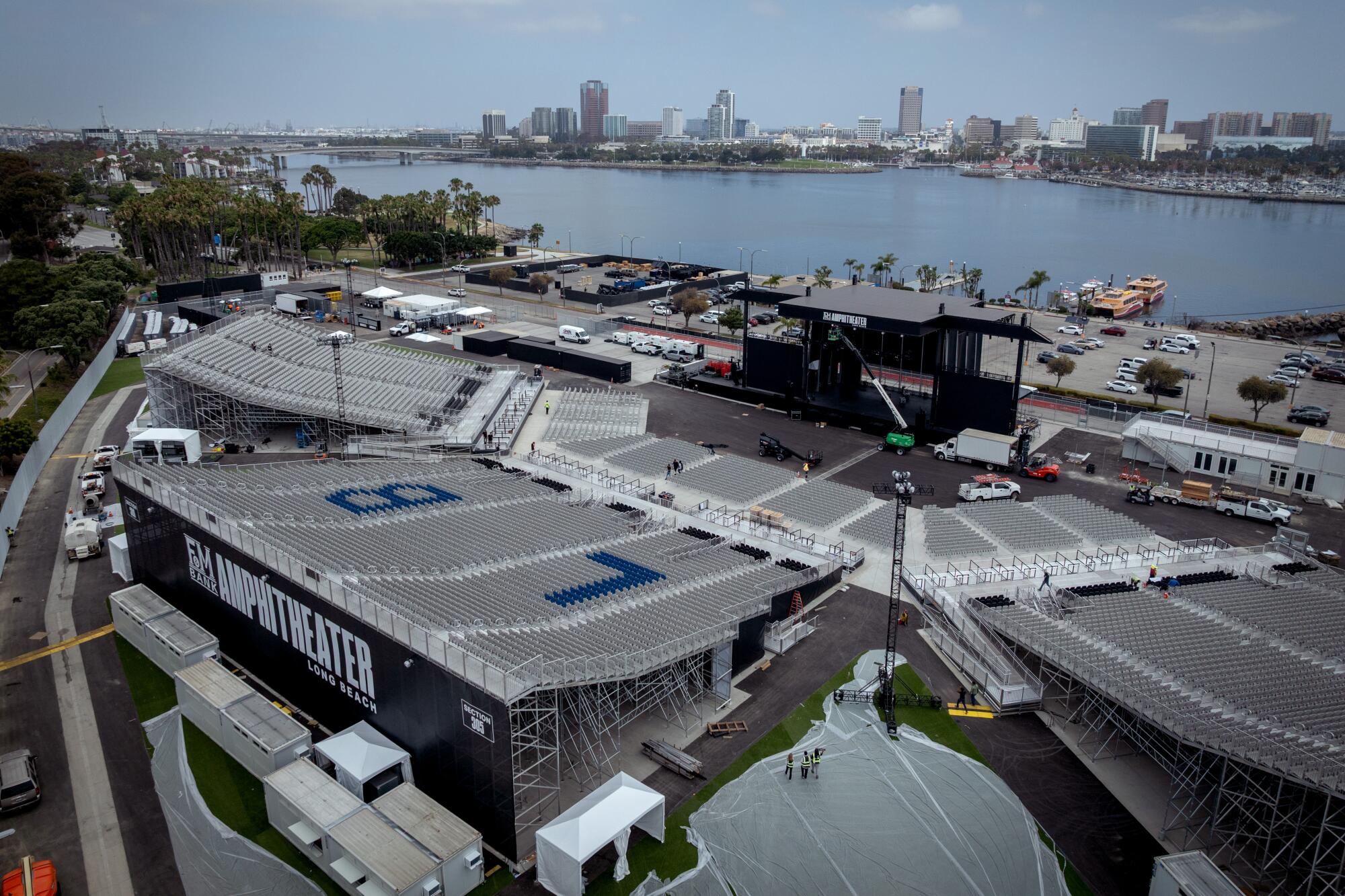
A view of the amphitheater from above, with the waterfront in the foreground.

Good vibes by the water is the driving energy behind the temporary venue.

(Eric Thayer / Los Angeles Times)

While Los Angeles and Orange County have no shortage of cavernous indoor arenas, the region has recently lacked a proper “summer shed” capable of hosting many national amphitheater tours, said Nick Storch, head of global artist development for booking agency Independent Artist Group. Those tours typically play venues larger than the Greek, Irvine’s Great Park Live or Costa Mesa’s fairgrounds-adjacent Pacific Amphitheatre, but smaller than the Hollywood Bowl.

Such tours, Storch said, are of “massive” importance to the concert industry. “With amphitheaters, it’s not just the music — it’s the experience of being outside and watching a concert, getting a bite to eat with your friends and all those kinds of things,” said Storch, whose agency’s clients Motley Crue and Five Finger Death Punch will perform at the F&M Bank Amphitheater in September.

“FivePoint was a great venue to help artists that are in that in-between stage, and not fully ready for arenas,” he said. “Long Beach having an amphitheater is going to grow the market again.”

Amphitheaters are also crucial to veteran artists with established fan bases. The long-running hard rock band Tesla — who also will perform at the F&M Bank Amphitheater in September — has not played a show in Los Angeles or Orange counties since the closure of FivePoint, which hosted the group twice.

Brian Wheat, the band’s bassist and manager, said he’s excited the new venue will help change that. “Sheds are great in the summertime, and outdoor summer gigs always create a great atmosphere for both bands and fans,” he said.

Much like the F&M Bank Amphitheater, FivePoint Amphitheatre was designed to serve as a temporary venue following the closure of Irvine Meadows Amphitheatre, which operated from 1981 to 2016. (From 2000 to 2014, it was known as Verizon Wireless Amphitheater.)

A view of seats leading up to a stage with a construction vehicle parked in front.

At 11,000 seats, the amphitheater is roughly two-thirds the size of the Hollywood Bowl. Its permanent replacement will be “architecturally iconic,” said Mayor Rex Richardson, while this temporary version is likened to a “summer shed.”

(Eric Thayer / Los Angeles Times)

From its opening in October 2017 until its closure, FivePoint hosted nearly 500 concerts, including artists such as KISS, Dave Matthews Band, Charlie Puth, Morgan Wallen and Luke Combs.

Venue operator Live Nation — which manages more than 300 facilities across the country — initially hoped to build a permanent amphitheater nearby, but scrapped those plans in 2023 after the Irvine City Council ended negotiations. Soon after, Live Nation announced the venue would shutter.

After learning of Live Nation’s fallout with Irvine, Richardson and members of his economic development team attended the final FivePoint concert, a performance by the Zac Brown Band, to “explore the feasibility if we were to do the same thing.”

Three months later, Richardson announced plans to build a temporary amphitheater in Long Beach to bridge the gap until a permanent facility — which he envisions as an “architecturally iconic and significant” waterfront venue akin to San Diego’s Rady Shell at Jacobs Park — can be permitted, financed and constructed.

The site’s location is central to its appeal, said Dan Hoffend, executive vice president of North American venues for Legends Global, the operator for F&M Bank Amphitheater. “If you sit in the very top row — what you would consider the worst seat in the house — it’s a spectacular view,” he said. “The Queen Mary is sitting there in all its glory. You’re looking across the harbor. What would be perceived as the worst seat is actually the best seat because you see it all.”

Two men sit on the top row of an amphitheater, chatting.

Long Beach Mayor Rex Richardson, left, and amphitheater general manager Tra Jones sit in the stands. Even from the nosebleeds, you still have a view of the waterfront at the F&M Bank Amphitheater.

(Eric Thayer / Los Angeles Times)

Tra Jones, general manager of the new amphitheater and a Long Beach native, said he’s striving to make it feel less stopgap and utilitarian than FivePoint.

“It doesn’t have a temporary feel at all,” he said. “We looked at all our surroundings and said, ‘What does this look like from a stylistic point of view?’ We leaned into the port/SteelCraft vibe — a very cool industrial look. When you walk in, you’re experiencing a vibe. That’s what we want to resonate with concertgoers coming here.”

The word “vibe” also pops up frequently in conversation with Richardson. Under his watch, Long Beach recently started branding itself as “Vibe City,” which he said is an attempt to encapsulate the charm of L.A. County’s second-largest city, and the state’s seventh-largest.

“Long Beach is special, but it’s hard to explain why if you haven’t been here,” he said. “Because you have to experience it for yourself, the best way to describe it is that it’s a vibe.”

Still, Richardson is aware that vibes can only go so far. During an April meeting with residents of downtown Long Beach, attendees were more interested in discussing homelessness and a recent uptick in traffic fatalities than how a new concert venue might add to the city’s cultural cachet. Some downtown residents have circulated a petition regarding noise-related concerns.

“The job of the mayor is to meet the needs of your residents today — keeping a roof over your head, making sure it’s safe to walk down the street, making sure you have access to amenities and services in your community — but also to think about the future,” he said.

That means finding a way to offset revenues from oil extraction, which currently finance many municipal services, and are projected to drop from more than $50 million annually to around $21 million by 2035. According to Richardson, the new amphitheater — managed by Legends Global, but owned by the city — will help cover that shortfall. The venue is projected to be profitable within five years and generate nearly $29 million in revenue by 2036.

An amphitheater is seen from above with an oil field in the background.

Oil revenues, which pay for city services, are projected to drop by more than half. The amphitheater is being pitched as a budget gap solution.

(Eric Thayer / Los Angeles Times)

“We were fortunate that revenue from oil provided a lot of our services and built our beautiful waterfront, but as California moves away from oil production, we have to plan a more sustainable future by investing in what we know will be here in the long haul,” Richardson said. “In order to do that, we have to invest in arts and culture and tourism.”

Richardson is betting on music at a time when other cities — including Los Angeles — are doubling down on sports, warehousing or data centers. The amphitheater is also meant to remind the world of the city’s impact on pop culture.

From War to Warren G and Sublime to Snoop, Long Beach has a rich musical history. The city hosted the first concerts by the Beach Boys and No Doubt, while Rock & Roll Hall of Famers Elvis Presley, the Eagles and Iron Maiden all graced the stage of the Long Beach Arena.

While that venue currently holds more conventions than concerts, Long Beach has hosted notable outdoor music festivals in recent years, including Warped Tour, Day Trip and Dreamstate. Richardson believes the success of those events helped prove the city’s viability as a concert destination.

“This is the first step toward a legacy of leaving our city in a more economically resilient position,” Richardson said. “At every big turn in our city’s economy, we’ve leaned on arts as a way forward, and this is no different.”

Bleacher seats spell out large letters L and B, for Long Beach, at the amphitheater.

Even the bleacher seats represent Long Beach pride at F&M Amphitheater.

(Eric Thayer/Los Angeles Times)

Source link