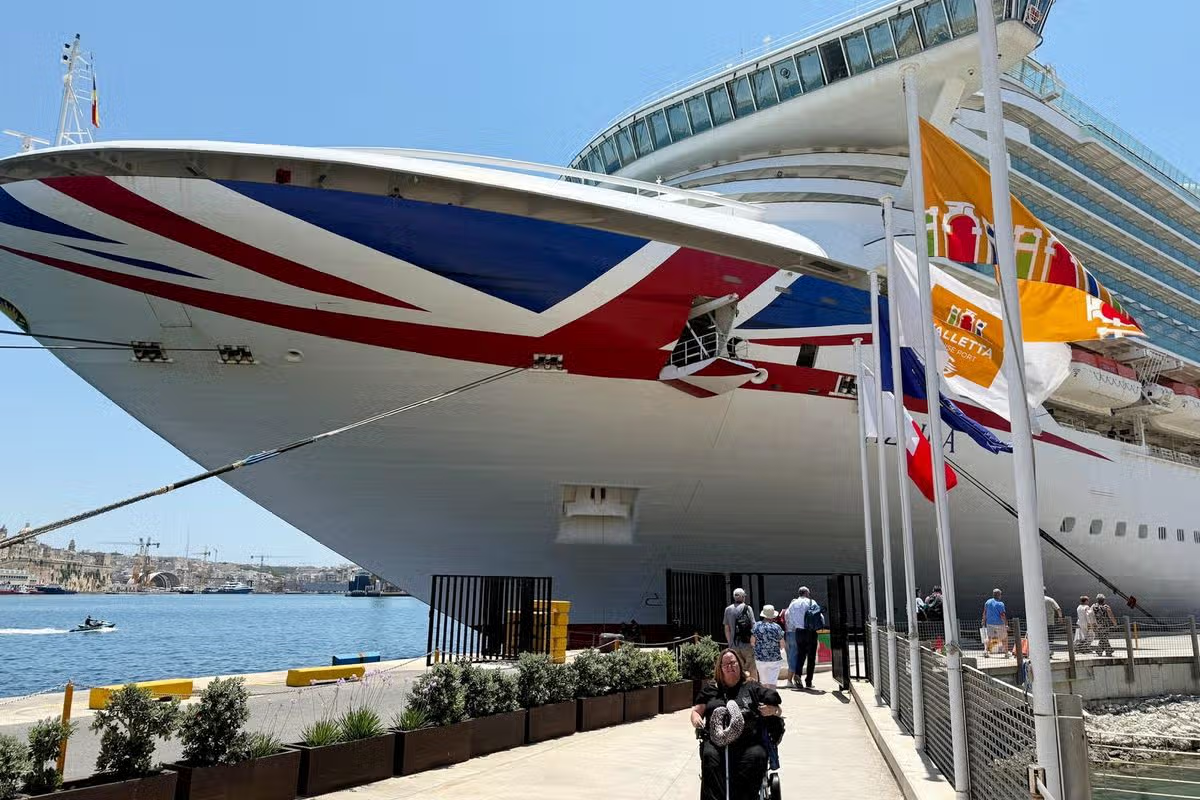
An ‘overpowering sewage smell’ was reported on board, along with flies seen around uncovered food. Passengers have been complaining about various stomach issues

Passengers on the P&O Azura fell ill(Image: SWNS)
A group of 12 passengers who fell seriously ill onboard a P&O ship are taking legal action after their dream Mediterranean cruise turned into a “nightmare” holiday from hell. The British passengers were struck down with gastric illness and flu-like symptoms while travelling around the Greek islands on the P&O Azura.
The holidaymakers, who paid up to £3,000 each, claim they encountered an “overpowering sewage smell” on board and raised concerns about hygiene in buffet restaurants where flies could reportedly be seen around uncovered food. Many were confined to their cabins during the eight-night voyage between May 28 and June 4 this year, while others were left hospitalised upon returning to the UK and some say they are still feeling the effects now.
The group, who had been celebrating a 60th birthday, have now instructed international injury lawyers to investigate their illnesses. Julie Stones, 53, from Bolton, was among those who says the cruise left her battling a catalogue of health problems.
She first became ill on June 2 with a sore throat and diarrhoea before her condition spiralled. She suffered vomiting, severe stomach pain, fever, headaches, dizziness, exhaustion, a persistent cough, and pain in her back and legs.
After returning home, she attended A&E, was diagnosed with a chest infection and later required further GP and hospital treatment. Julie, who has several underlying health conditions and uses a powered wheelchair, said she spent weeks largely confined to bed and relied on help from her husband and daughter.
Julie said: “This holiday was supposed to be a special celebration with friends and something I’d been looking forward to for months. Instead, it turned into a complete nightmare. It felt as though one thing after another kept going wrong and, as the holiday went on, I just got worse and worse.
“One thing that really stood out was the overpowering sewage smell near the Manhattan Bar. It was so noticeable that other passengers were commenting on it. I also had concerns about hygiene in the buffet areas. I remember seeing food left uncovered with flies around it and people entering the restaurant without sanitising their hands.
“Even after returning home, the symptoms didn’t go away. I’ve needed hospital treatment, GP appointments, and medication, but I’m still not back to normal. More than two months later, I’m still dealing with fatigue and headaches. I just want to understand what happened.”
Linda Chapman, from Bury, who was celebrating her 60th, also became seriously ill after developing symptoms on the final evening of the cruise. The mum and grandmother suffered chills, vomiting, breathlessness, wheezing, a sore throat, and a persistent cough.
Her condition worsened so badly after landing back in Manchester that she contacted NHS 111 and was taken to A&E, where she was prescribed antibiotics. Linda, who works as a housekeeper on an NHS stroke ward, was forced to take two weeks off work.
Linda said: “I remember being on the plane. The flight was only a few hours, but it felt like forever. People kept asking if I was okay and I must have looked as awful as I felt. I just kept telling myself that I’d be home soon and could finally go to bed.
“What I didn’t realise was that I’d end up spending weeks like that. In my view, hygiene onboard wasn’t up to scratch and the food often didn’t seem fresh at all, despite the cruise being very expensive. What did surprise me was just how ill I became. I was struggling to breathe and, combined with the stomach problems, I just couldn’t work out what was wrong with me. It was a very frightening and disorientating experience.”
Sharon Robinson, 51, from Wigan, was the first member of the group to fall ill. She initially believed she had a chest infection but later suffered stomach pain, nausea, diarrhoea, headaches, fever-like symptoms, and extreme fatigue.
Despite feeling unwell, Sharon tried to continue with the group’s planned celebrations but says she spent the rest of the cruise exhausted. Sharon said: “I’m unbelievably disappointed.
“Even though I felt awful, I kept trying to take part in as much as I could because I’d been looking forward to this cruise for a year. I was the first in our group to become ill, but after the first few days it felt as though everyone was dropping like flies.
“One thing that’s burned into my memory is the strong sewage smell onboard. It still makes me feel sick when I think about it. So many people in our group became unwell that it’s difficult not to have concerns about what caused it. I still feel very sad about the whole experience and I’m still suffering because of it.”
Jatinder Paul, the lawyer at Irwin Mitchell representing the passengers, said: “Cruise holidays should provide passengers with an opportunity to relax and enjoy their time away. However, they also involve large numbers of passengers sharing restaurants, bars and other facilities in confined space so robust hygiene measures are vital in helping to prevent illnesses from spreading.
“What’s particularly concerning for our clients is that so many from the same party became unwell, with several still having their lives affected by symptoms. Our clients understandably have questions about their illnesses and whether more should have been done to protect them.
“Nothing will make up for what they’ve been through, but we’re determined to provide them with the answers they deserve.”
P&O has been approached for comment.