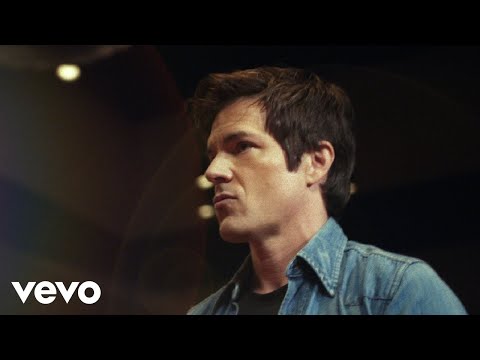
Brandon Flowers on ‘Thrasher,’ the Killers and his fave L.A. breakfast
Brandon Flowers stands onstage at the Ford Theatre wearing a sharp black suit and a bejeweled bolo tie and tells the audience about his cousin Bobby’s job parking cars in the 110-degree heat of the Las Vegas Strip.
“That was gonna be me in another life, only my big plan was to work at the Bellagio,” he adds. “Nicer place, more tips.”
As the frontman of the Killers, Flowers, 45, has spent more than two decades singing about the struggles and the temptations at the heart of the American dream. But on his new solo album, “Thrasher,” he trades the Killers’ gleaming, synth-laced rock for the crackling sound of hand-played country music.
He cut the LP at Nashville’s historic RCA Studio A, where country giants like Dolly Parton and Waylon Jennings once worked; not only that, but to accompany him he recruited veteran session players including David Rawlings, Bruce Bouton and 85-year-old Charlie McCoy, who played harmonica on George Jones’ immortal “He Stopped Loving Her Today.”

Yet for all its old-school country cred, “Thrasher” also emphasizes Flowers’ roots as a Vegas showman — his tremulous croon, his go-for-broke emotion, his almost preacherly understanding of how to take a crowd up (and up) and how to take it back down. Think Glen Campbell or Donny Osmond.
“Or Wayne Newton,” says Rawlings with admiration. The guitarist, known for his long collaboration with Gillian Welch, performed with Flowers at July’s Newport Folk Festival. “It’s really thrilling to see the way he inhabits this stuff onstage,” he adds. “I have such incredible respect for anybody who knows how to entertain at that level because it’s an absolute gift — and it’s really hard work.”
Flowers, who grew up in Las Vegas and Utah and who shares three sons with his wife, spoke about the album in his dressing room last month a few hours before the Ford show. A sequel to “Thrasher,” recorded during the same sessions, is due out next year.
The Nashville OGs who played on these records — do you think they were impressed by you?
I think they were refreshed. I think they didn’t quite know what they were getting into and were pleasantly surprised.
For you, it was a different way of working, right? These players are artists. But it’s also just another day on the job.
You feel that: “Charlie’s got to leave at 4 to go to the Opry.” He still gets his licks in.
I wonder what it would’ve sounded like to cut 10 Killers classics with this band.
Probably like the Traveling Wilburys or something. The second album has some of that DNA. This one was more of a narrative album — a lot of stories. The other one, it’s more in the romantic realm. I’m excited to get it out. I have another one cooking.
A third album?
Well, because they’re so efficient. It’s opened up a door for me that I feel like I’ll always be able to explore. If I have 10 songs, I can go to Nashville for five days and cut the whole thing. We do two songs a day, no problem.
You’ve said there’s this idea in rock music that making an album needs to feel like climbing a mountain.
I blame it on U2. You don’t feel like you’re doing it right if you’re not doing that. We really went into that on “Sam’s Town” — we climbed Everest, man. When we finished “Sam’s Town,” I remember the last day — it was like 6 in the morning, the sun was up and we were finally done. What a relief it was.
Now the veil has been lifted.
It doesn’t have to be like that.
Did you get a feel for Nashville as a town while you were there?
I got a breakfast spot: Cafe Roze. I don’t want to blow it up too much because I want to be able to get in. But you know Cafe Stella in Silver Lake? They used to have my favorite breakfast in the world: sourdough, soft scramble, prosciutto and Parmesan. And they have that exact thing at Cafe Roze — it’s like I’m transported back. I could eat it every day with a side of avocado.
“Thrasher” follows a number of country excursions by rappers and pop stars. Do you have any anxiety about being seen as a carpetbagger?
No, because I’m not trying to bulldoze my way into the world and open a bar in Nashville. This is an authentic part of myself — I have an education in this music. People have a lot of preconceptions about country music, especially lately. Everyone says the same thing: cold beer, dirt road, Friday night. But there’s such an art to the tradition — it’s a soulful artistic endeavor. I’m trying to come at it from that angle.
What’s your relationship with modern country music — Morgan Wallen and Miranda Lambert and the like?
I don’t have one. It’s more people that are on the fringes, I guess — Jason Isbell or Sturgill Simpson. I got Sturgill’s guitar player because I was a fan of that stuff.
Before I heard “Thrasher,” I expected kind of a stripped-down Isbell vibe.
I could see him doing “In a Heartbeat” or “Miss America.” But once we got to Nashville and got the guys in the room, it just got a little more pep in its step.
Does being embraced by the Nashville industry feel like a reasonable goal?
That’s a whole other nut to crack. You hear stories about Dwight Yoakam having a tough time — and he brought some heat. Or John Prine just because he was from Illinois and not from further south. I’m not gonna go on a campaign to prove how worthy I am.
You’ve been dinged by people who think you’re putting on an accent on this record.
I feel like this is more how I speak than maybe they’re accustomed to. I don’t know, I might’ve leaned in a couple times. There is a Utah accent — it was something I was embarrassed by when I was younger. But now I’ve lived there 16 years of my life total, so it just starts feeding its way back in.
Is your vocal approach different for country than for rock?
There’s more quiet in these songs — more room for the story to be told. In the rock band, I’m competing — everybody wants to be heard — whereas this one, there’s this beautiful thing where the guys don’t mind being in the background. They want to frame the picture, and I’m the picture.
Did you find yourself making more of an effort to enunciate?
I’ve always been cognizant of that. Just today, there was a band — I won’t say who it was — but I was interested in hearing their new thing, and I didn’t understand a word until the chorus. I was rooting for the guy the whole time, but it’s like: How can I fall in love with this if I don’t know what’s happening?

Brandon Flowers performs last month at the Ford Theatre.
(Rob Loud)
Got some questions about specific songs. “One of Us” is about your brother-in-law, which made me realize how few people write songs about their in-laws.
He passed away unexpectedly a few years ago. You know, I’m the youngest of six, and he married my oldest sister. She’s 17 years my senior, so when they got married, I was a kid — he became my big brother and was a masculine figure in my life and all that. There’s your family and then there’s your found family, and he’s part of my found family. I wanted to honor him, and this is my way of doing it.
I assume your sister’s heard the song.
Oh yeah. A lot of those moments happen on this record where I had to play the song for the person, and you just can’t help but be brought closer together. You’re taking part in their grief but we’re also celebrating him. It was beautiful.
“Miss America” is about another one of your sisters.
The one next in line.
She’s addressing an abusive ex, and you sing it from her point of view — from a woman’s perspective.
It just started like that. I don’t remember a moment of thinking: Am I gonna do this from the outside or am I gonna step into her shoes? Maybe it’s something to do with that Tom Waits song [“Christmas Card from a Hooker in Minneapolis”] — something about that maybe gave me permission.
Did you play “Miss America” for that sister?
It felt like the gentlemanly thing to do. If she’d said no, I would’ve been heartbroken because I think “Miss America” is gorgeous — I’m really proud to be part of it. But I would’ve honored her wishes.
In “An American Dream,” the point of view seems to keep shifting. At one point I think the narrator becomes Elvis Presley?
Chorus 1, I’m singing with this man that used to give me cigars and tobacco when I was a kid — we’re singing it together. Giving a 13-year-old Red Man tobacco — there was nothing shady about it, or nothing too shady — but it was still a wild move. Then Chorus 2, Elvis and I are both singing — I see it that way.
Which era of Elvis are you envisioning?
Whenever I think of him, I think of him in ’68. Nobody’s ever looked that good — it’s not fair.
You’re known for your flights of lyrical fancy: “Burning down the highway skyline in the back of a hurricane,” for instance, from the Killers’ “When You Were Young.” Did country music allow for those flourishes?
Verse 2 of “Does It Ever Cross Your Mind?” is a great example: “I could’ve been born in Bangladesh but I wasn’t / I was born here with just enough jelly beans in my basket to ask you to go wishing on a star.” That’s fun.
In “An American Dream” you say, “We blew through starlight on bricklayers’ knees.”
We’re performers, and we’re here to entertain you. But we’re working-class men, me and Elvis.
Some of these lines get at this crucial point that I think your music makes, which is that pageantry and sincerity can coexist.
I think people get confused a lot — they might look at a line like the one you just talked about and think it’s total bulls—. It’s annoying to me to read a review and see where they just don’t get it — and they think they’re the smart one. I saw someone talking about my tropes, and they brought up the Bangladesh line. I thought: What are you talking about? That’s the most left-field line.
You’re challenging the listener to accept that over the top doesn’t necessarily mean phony.
It’s so American to be over the top and to still have substance. That’s the chorus of “An American Dream”: “Gold and silver / God and glitter.” I guess I’m trying to spoon-feed it there a little bit.
Plenty of Killers songs involve people making bad decisions. How do you think about the degenerate’s place in country music?
It’s funny how people aren’t quite familiar with how wild it was. The same person in me that was excited about old Depeche Mode stories still gets excited about old George Jones stories. And a part of me yearns for that. But I keep it under wraps.
Your oldest son is 19, which means you became a dad at a fairly young age.
It was just par for the course. I grew up in an LDS family — my sisters were having kids when they were 17 and 18. So having Ammon at 26 — that was the oldest anyone had had their first child in my family. They were like, “Brandon might be gay.”
How did you reconcile the rock star and new dad halves of your life?
It sort of gave me a direction early on because I was a little bit teetering in those days. Who’s ready to have this wild fame brought on them at such a young age? We weren’t the Beatles, but “Hot Fuss” and “Sam’s Town” were really successful records — we went straight to arenas. It was tough to navigate, and family gave me an anchor.
Do you hear before parenthood and after parenthood in your music?
There’s a song called “Be Still” on the fourth record — a song to the kids. But I don’t know if the writing changed that much. Everybody was getting older in the band, so whatever happened, you can’t place the blame just on me.