Weekly insights and analysis on the latest developments in military technology, strategy, and foreign policy.
The latest addition to the Japan Air Self-Defense Force (JASDF) is, without question, one of the ugliest military aircraft to grace an apron today. With its enormous, bulged nose and other awkward protuberances, the Kawasaki EC-2 is, nevertheless, an important addition to the JASDF at a time when it faces increasing challenges from various sophisticated threats. The aircraft, which has generated much interest, took to the air for the first time today at Gifu Air Base, in the prefecture of the same name.
Derived from Japan’s indigenous C-2 twin-jet transport, the EC-2 is a standoff electronic warfare aircraft, the development of which began in 2021. Its primary role is to interfere with an opponent’s operations on the electromagnetic spectrum, from outside the range of air defense threats.
Specifically, the EC-2 is based on serial 68-1203, which was the third C-2 transport completed, before being modified for its specialist role.
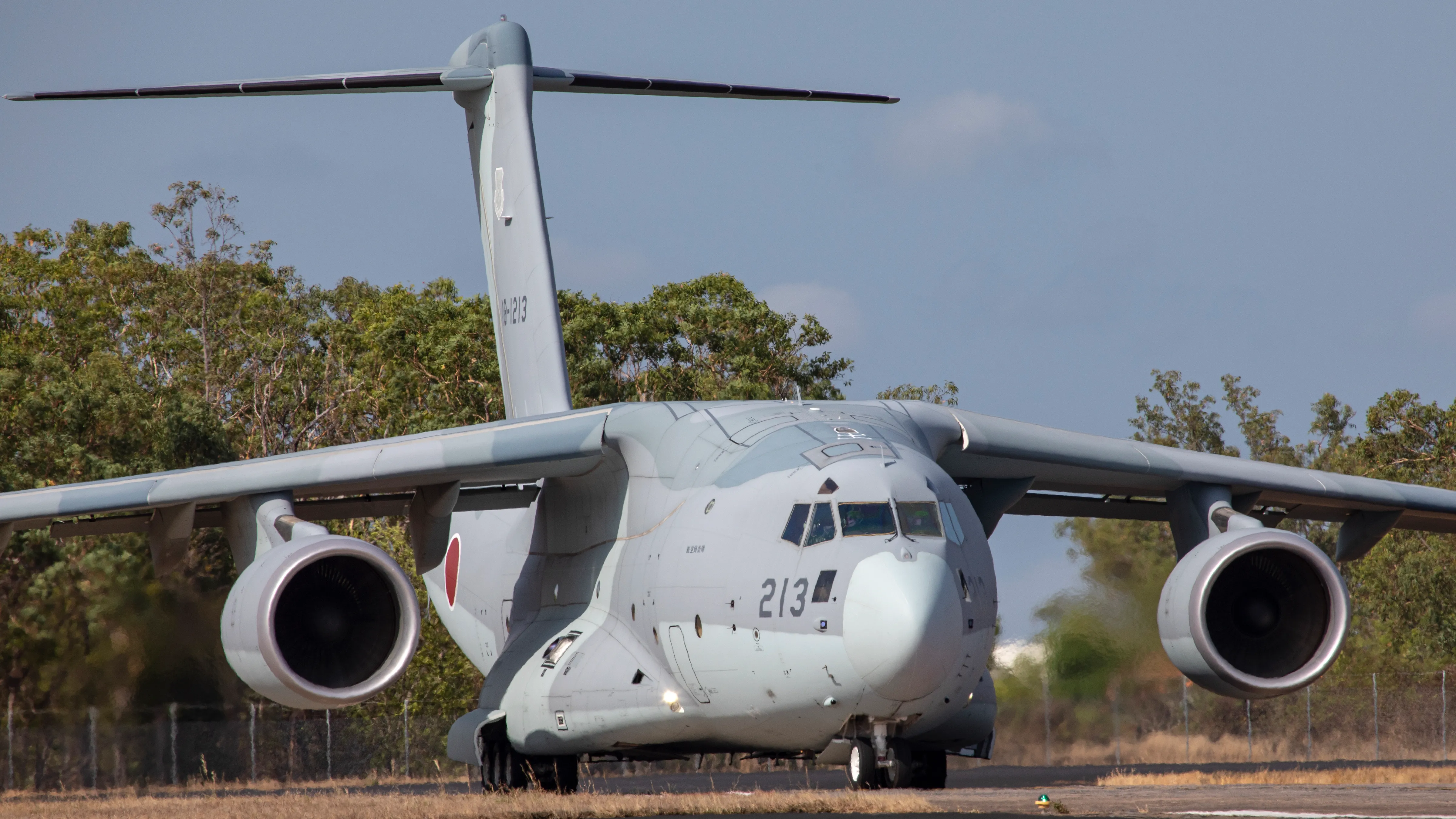
As for the C-2, this military airlifter sits somewhere between a C-17 and a C-130 in terms of size and capabilities. In fact, it is probably closest in most regards to the four-turboprop Airbus A400M, but is powered by a pair of General Electric CF6 high-bypass turbofans — similar to those on many 747s and 767s, for instance.
A standard Japan Air Self-Defense Force C-2 transport aircraft. Australian Department of Defense SGT Pete Gammie
Returning to the EC-2, this aircraft is the successor to the JASDF’s one-off and now-retired Kawasaki EC-1, which was converted from an existing C-1 transport airframe and was for many years operated by the Electronic Warfare Operations Group (Denshi Sakusengun) at Iruma Air Base, in Japan’s Saitama prefecture.
A series of photos shows the now-retired Kawasaki EC-1:
Gifu is home to the JASDF’s Aviation Development and Testing Group, which will put the EC-2 through its paces before it is approved for operational service.
Before its first flight, the EC-2 became a peculiar object of interest for spotters and locals alike, with photographers taking numerous shots of the aircraft as it underwent taxi trials at Gifu.
Prior to that, the EC-2’s appearance had only been publicly known thanks to a rendering released by the Japan Ministry of Defense.
Schematic rendering of the EC-2. Japan Ministry of Defense
Back in 2022, a spokesperson from the Japan Ministry of Defense’s Acquisition, Technology & Logistics Agency (ATLA) told Janes that the C-2 was selected as the platform due to its ability to carry a significant amount of equipment to enable it to conduct “effective jamming” from outside of the opponent’s threat envelope.
“[The] C-2 transport aircraft has been selected as the base platform after considering such factors as its flight performance, maximum payload, and cost,” the ATLA spokesperson said at the time.
“By choosing the C-2 as the base platform, we make use of the existing infrastructure of the C-2 and thus effectively and efficiently operate the new C-2-based standoff EW aircraft,” the spokesperson added.
Compared to the C-1, the C-2 has a significantly higher payload capacity. The new transport can carry a payload of nearly 80,000 pounds for a maximum takeoff weight of 310,000 pounds, as opposed to a payload of around 26,000 pounds and a maximum takeoff weight of 100,000 pounds for the older C-1. You can look at a very direct visual comparison of the C-1 and the C-2 here.
A Japan Air Self-Defense Force C-1 transport aircraft in 2017. The last examples of these aircraft were retired in March 2025. KAZUHIRO NOGI/AFP via Getty Images AFP Contributor
Reportedly, however, at least some of the equipment previously used in the EC-1 — including the J/ALQ-5 electronic countermeasures system — has been ported over to the new EC-2.
Like its predecessor, the EC-2 has a huge bulbous nose, but it also adds two large, bulged fairings in tandem on the top of the fuselage. Meanwhile, there are two other prominent fairings mounted on either side of the rear fuselage.
Very few details of other specific equipment have been released, but imagery of the aircraft confirms that missile approach warning sensors (MAWS) are installed around the fuselage as part of its self-defense suite.
In an operational context, the EC-2 would use its powerful jamming systems to disrupt enemy sensors — especially those belonging to air defense systems and communications — on the ground and in the air, from a long distance.
The details that have been released relating to the EC-2 refer to program costs. Namely, the FY2025 Budget Request notes that around $260 million was allocated to the development of the aircraft. This is part of a total of around $3.2 billion that is being spent to upgrade intelligence collection and analysis capabilities.
Reflecting the increased emphasis on electromagnetic spectrum operations, Japan plans to buy four EC-2s, compared to having just one EC-1 in the past.
The EC-2 is the second specialized variant of the C-2, after the RC-2 signals intelligence (SIGINT) platform, first flown in 2018 and now active with the Electronic Warfare Operations Group. This aircraft was converted from the second C-2, serial 18-1202, and was officially handed over to the JASDF in 2020.
The RC-2 also has fairings on top and on the sides of the fuselage, and atop the tail. The nose radome is enlarged, and there is an extensive under-fuselage antenna ‘farm.’
According to statements from the Japan Ministry of Defense, it seems the EC-2 and RC-2 will likely work in concert. Specifically, the RC-2 is part of a wider effort to “improve capabilities to gather electromagnetic information necessary for electronic jamming and electronic protection.” This suggests that the RC-2 will conduct regular peacetime missions to gather data on locations and types of threat emitters, as part of generating an electronic order of battle, with this information then being used to ensure the EC-2 is able to target specific emitters.
As part of its fiscal 2023 budget, the Japan Ministry of Defense received a little over $25 million to explore the missile-toting C-2 concept, with a plan to continue technical research until fiscal 2024. If judged successful, full-scale development would then follow. The current status of that effort is unclear.
One factor that has stood in the way of additional procurement is the very high cost of the C-2, with around $2.3 billion plowed into the development effort and each airframe priced at approximately $176 million, as of 2017. This means Japan has been buying these aircraft at a slow rate, with the aim of fielding a frontline fleet of 16. The high cost has also contributed to a failure to win any export orders, which, if secured, would have helped to bring down the price.
The EC-2 seen on its first flight earlier today, accompanied by a Mitsubishi F-2B chase plane:
However, there is clearly a need for the EC-2, and it seems likely that the program will yield further examples of the standoff jammer.
In the past, Japanese defense officials have described the regional environment as “severe” and increasingly complex.
After all, Japan faces an increasingly challenging security environment, with the key threats provided by Chinese, North Korean, and Russian military activity. China has intensified its air and naval operations in the East China Sea and the wider Western Pacific, including deploying aircraft carriers and conducting frequent patrols near Japan’s southwestern islands. North Korea continues to test ballistic missiles capable of reaching Japan, while Russian aviation activity around Japanese airspace has also increased, including joint patrols with the Chinese military.
Outside of Japan, this type of platform is of growing interest, with a number of significant active procurement programs. In the past, we have looked in detail at the U.S. Air Force’s EA-37B Compass Call, as well as its derivative for Australia, the MC-55A Peregrine.
The second MC-55A Peregrine for the Royal Australian Air Force arrived at RAAF Base Edinburgh, South Australia, last week. Dsperandio dean sperandio
While its bizarre appearance might be the most obvious feature of Japan’s new EC-2, this ungainly machine will play an important role in the modernization of the Japan Air Self-Defense Force, as it increasingly looks at how to dominate the electromagnetic domain.
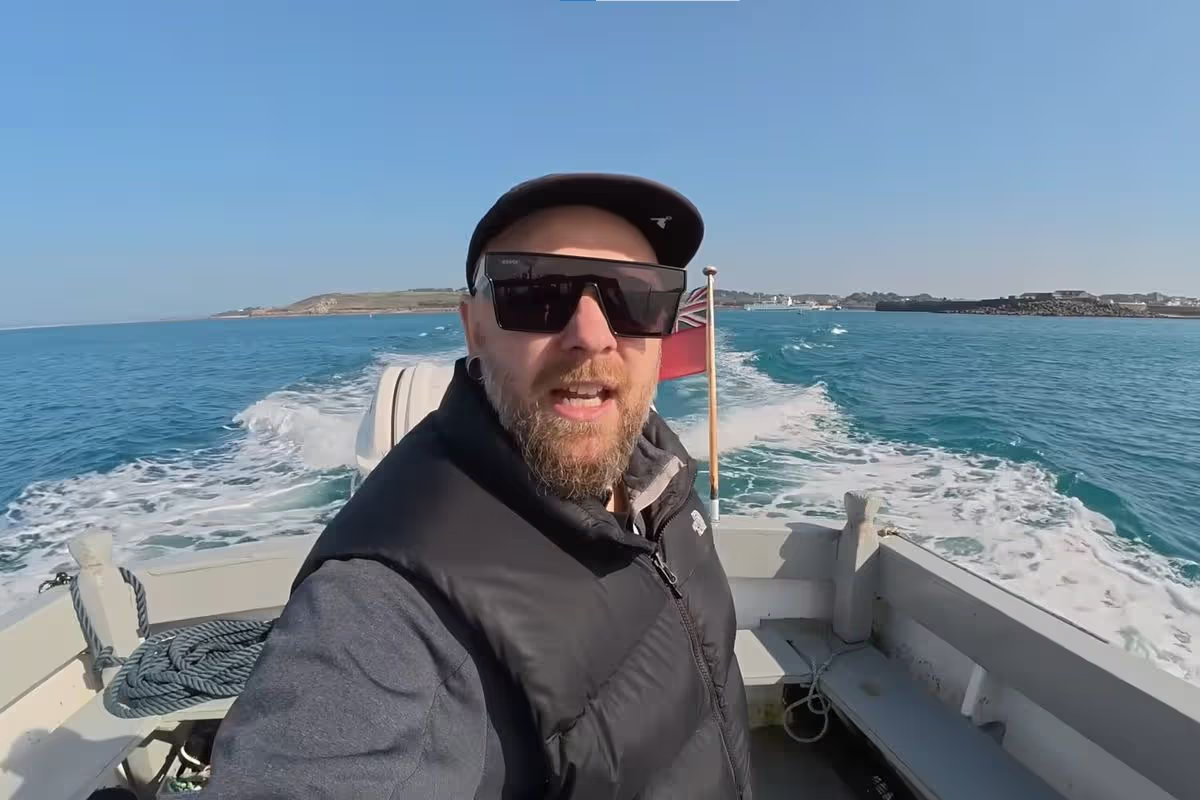
YouTuber Wendall flew to the Isles of Scilly off Cornwall and found stunning golden sandy beaches that he compared to the Caribbean, with experts also praising the remote islands as a UK paradise
YouTuber Wendall went to the Isles of Scilly(Image: YouTube/@WendallExplores)
A traveller who journeyed to some of England’s most isolated islands has insisted certain beaches rival those found in the Caribbean.
YouTuber Wendall, who shares content on the video platform through his eponymous channel, travelled to the Isles of Scilly. The Isles of Scilly comprise five inhabited islands including St Mary’s, Tresco, St Martin’s, Bryher, and St Agnes.
The Isles of Scilly are a compact archipelago situated just off the Cornish coast and have been recognised for generations as a location of significant interest and cultural value to the United Kingdom, reports the Express.
Whilst touring the region by boat, Wendall questioned the vessel’s operator about the standard of the beaches. He observed: “I’ve heard St Martin’s has got the nicest beaches.”
The boat operator responded: “It does have nice, golden, sandy beaches, yes. Nice golden sandy beaches.”
Wendall then remarked: “Caribbean-esque.”
Wendall isn’t alone in highlighting the Isles of Scilly’s beaches, with those at Tresco’s Pentle Bay also garnering considerable acclaim.
Specialists from GO Outdoors recently named Pentle Bay among the finest beaches to explore this spring, thanks to temperatures hovering around 10C and approximately 7.2 hours of daily sunshine.
This reputation is echoed in numerous Google Reviews. One visitor described it as “one of the most beautiful beaches I’ve ever seen,” while another called it a “mini paradise” and a “private gem.”
Discussing the subject, Calum Jones, author at GO Outdoors, commented: “As the days get longer and the weather warms up, spring is the perfect time to explore the stunning coastlines across the UK. From Druridge Bay Beach in the North East to Immeridge Bay in the South West, there are breathtaking beaches to discover all around the country.”
Beaches in this region are not the only ones to attract attention; Cornwall’s shores have also earned widespread acclaim, including Kynance Cove.
Located just a short drive from Falmouth, Kynance Cove has drawn comparisons to beaches on the opposite side of the globe in New South Wales, Australia.
Research conducted by Parkdean Resorts found that Kynance Cove boasts the whitest sand in the UK.
They stated: “Topping the list as the UK’s whitest beach is Kynance Cove in Cornwall. This Cornish cove boasts powder-soft sands made primarily of quartz, giving the beach its bright, white appearance. This breathtaking spot gives even Australia’s iconic coastline a run for its money.”
A COUPLE flew to the Alps for a day of skiing – which was still cheaper than a day out in London.
Hannah West, 39, and her husband Simon 52, flew to the French Alps to enjoy fondue and five hours of skiing.
Sign up for the Travel newsletter
Thank you!
Hannah West and her husband Simon decided to head skiing just for the dayCredit: SWNSThe couple claim it cost less than a fancy day out in London would have with a showCredit: SWNS
The duo, from Brighton, flew from Gatwick Airport to Geneva last month 6:10am and returned the same evening at 9:30pm.
The day trip included a day of skiing in La Clusaz – including ski gear hire – as well as some fondue, wine and desert.
Hannah said: “We got in five hours of skiing which I think is how much most people would do in a day anyway.
“The fact that we got to do that much skiing and it’s something we will never forget, I think it’s totally worth it.”
If the couple were to do another activity in the day, this could set them back anywhere between £30 and £100 each, and then, of course, add on having lunch out and getting London transport around the city.
It adds up quickly.
She also explained how she has seen a lot of people head off on city day trips, but “wanted to see if it was possible to do it for a ski trip”.
Full cost of the day ski trip vs day in London
Ski holiday
Return flights: £164.99 each
Ski day pass: £44.66 each
Ski gear: £22.75 each
Car hire: £30 each
Food and drink: £30.50 each
Airport car parking: £15.84 each
Fuel: £7.31 each
Tolls: £5.35 each
= £335.90 each
Day out in London
Return train tickets: £42.70 each
Unlimited Zone 1 and 2 travel: £8.90 each
Lunch out: £20 each
Attraction tickets: £30 each on average
Dinner out: £50 each
Drinks at a pub: £25 each
Best theatre tickets: £160 each
= £336.60 each
The couple from Brighton drove up to London Gatwick Airport and returned in the eveningCredit: SWNSThe even managed to enjoy fondue as well as skiingCredit: SWNS
Hannah said: “The whole day felt magical and I felt like I was beaming the whole time.
“I couldn’t believe it was possible, the whole day I was on a high. It was the best date day.”
“This is such a great opportunity to have an amazing date day with your partner – to do something you both really love together and have a really special day you’re going to remember forever.”
To save even more money, Hannah admitted that they could have booked their flights further in advance or booked as part of a group.
She added: “It’s not about replacing a week-long ski holiday, or am I suggesting this is something to do on a regular basis.
“But if you’re time-poor, or don’t have childcare for a week away, you can still have an amazing, special day together.”