Despite some irritating flaws, 2026 World Cup a rousing success
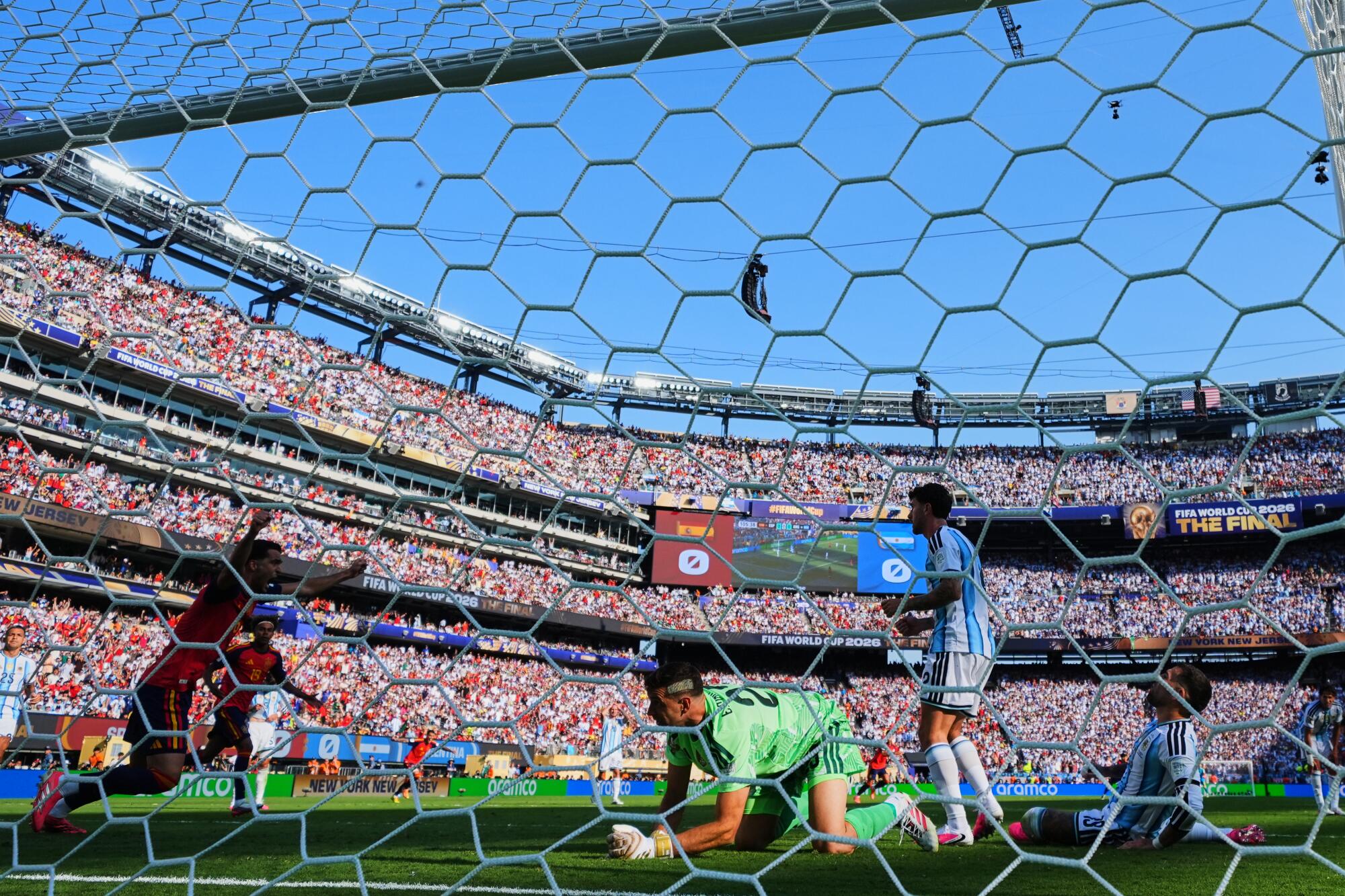
EAST RUTHERFORD, N.J. — The largest, longest and most complex World Cup in history came to a close Sunday, with Spain beating Argentina 1-0 in extra time. But FIFA president Gianni Infantino didn’t bother waiting for the final result before passing judgment on the tournament.
“By all means this World Cup has exceeded all expectations,” he said during a reception at Trump Tower two days before the final kicked off. “This has not just been the greatest FIFA World Cup of all time. It is the greatest human social and cultural event that mankind has ever witnessed.”
No, but it was pretty good, with FIFA emerging as the World Cup’s biggest winner, allowing Infantino to reportedly shore up support within the organization despite a number of norm-shattering decisions during the tournament.
Attendance topped 6.8 million, a World Cup record averaging more than 65,000 fans a game. FIFA estimated the cumulative global TV audience topped 5 billion people across linear television, digital streaming and social platforms while more than 1.8 billion people were expected to watch the final, according to the BusinessStats website, making it the most-viewed sporting event in history.

Argentina goalkeeper Emiliano Martínez reacts as Spain’s Ferran Torres scores during the World Cup final in East Rutherford, N.J., on Sunday.
(Julio Cortez / Ap Photo/julio Cortez)
Exact figures won’t be known for a few days.
Revenue for the four-year World Cup cycle is anticipated to reach $13 billion, making it the first $10-billion sporting event in history — bolstering Infantino’s case for reelection as FIFA’s president next year.
The final was among the most expensive U.S. sporting events of all time, with the get-in asking price for a single ticket on the secondary market peaking at about $7,400 three hours before kickoff and the average purchase price topping $10,800. One seat sold for $32,502, which is either a good thing or a bad thing, depending on whether you’re buying the ticket or selling it.
Inglewood’s SoFi Stadium hosted eight games, including two of the U.S. team’s three group-stage games and Spain’s quarterfinal win over Belgium. The matches had a total attendance of 561,656 people, about 99.6% of capacity — that’s more than each of the first three World Cups drew for the entire tournaments.

U.S. and Paraguay oversized flags are featured on the pitch before a World Cup group stage match at SoFi Stadium on June 12.
(Allen J. Schaben/Los Angeles Times)
Weather disrupted just a handful of matches, not the dozen or more that were feared, and the logistical nightmares of staging the 39-day tournament across three countries for the first time — the U.S. co-hosted the event with Mexico and Canada — never materialized. The expansion to 48 teams and 104 games, meanwhile, made room for a number of surprises that gave the tournament its life and sparkle.
Tiny Cape Verde, the second-smallest country to qualify for a World Cup, made a memorable debut, playing Spain to a scoreless draw in its opener, then taking Argentina to extra time before falling in the cruelest way possible, on an own goal, in the knockout rounds.
Norway, playing in the tournament for the first time this century, made it to the quarterfinals behind its hulking striker Erling Haaland, who quickly became a fan favorite while the team’s supporters saw their synchronized “Viking Row” celebration go viral.
Canada and Egypt both won World Cup games for the first time, advancing to the Round of 16, with Egypt becoming one of nine African teams to make it to the knockout rounds. Of FIFA’s six continental confederations, only UEFA, representing Europe, did better than Africa, sending 13 teams beyond the group stage.
Argentina’s Lionel Messi erased any doubt that he’s the greatest player in World Cup history — if not soccer history — by willing his team to the final and winning the Silver Ball, runner-up for the tournament’s most outstanding player. On Sunday, Messi was thwarted in his attempt to win a second straight World Cup and third Golden Ball, but he walked off the field at MetLife Stadium as only the second man to play in three World Cup finals.
And he finished his record-setting sixth tournament as the all-time leader in games (34), assists (12) and goal contributions (33), more than standing the test of time. Two of the players Spain started against Argentina in the final hadn’t even been born when Messi, 39, made his World Cup debut in 2006.
But if those were the highlights, there were also lowlights.
This was by far the most political World Cup in history and the first in which a host country, the U.S., was actively at war with a participating one, Iran.

Iran defender Ramin Rezaeian celebrates with teammates after scoring during a World Cup match against New Zealand at SoFi Stadium on June 15.
(Allen J. Schaben/Los Angeles Times)
That had all kinds of ramifications, starting with the State Department’s refusal to grant visas to more than a dozen members of Iran’s official delegation. Iran was also forced to move its base camp from Tucson to Tijuana, and though it played all its games in the U.S., it was denied permission to remain in the country after each match, an option granted to every other team.
Despite the harassment, Iran did not lose a game, playing to three draws despite having three goals — any of which would have sent it to the knockout rounds — erased by video reviews.
The State Department also denied entry to Omar Abdulkadir Artan, a decorated Somali referee, turning him away at Miami International Airport in June, citing “vetting concerns.” Artan, named Africa’s top referee last year, had a valid entry visa and was selected by FIFA to work the tournament last April.
Iran wasn’t the only team to have its World Cup ended early by technology. Although the video assistant referee (VAR) system was adopted primarily to alert the head official to potential clear and obvious errors or serious missed incidents, in this tournament it became intrusive, eliminating Croatia on evidence from a NASA-level ball sensor and costing Egypt what would have been a game-winning score for a perceived foul that took place nearly 100 yards from the goal.
Coaches and players are still allowed to make mistakes, but the technology now has referees making calls on things that are imperceptible to the naked eye, something critics say has removed any sense of judgment or nuance, robbing the game of much of its drama.
“Football is an art. That’s why we love it,” said Christina Unkel, a former FIFA referee and a rules of the game analyst for multiple TV networks. “When you do pursue black and white — objectivity is what they’re trying to get to, and I get it; they want to eliminate as much subjectivity as possible — what everyone is hating is this perfection thing.”
Then there was the official’s call that President Trump took credit for overruling from 2,800 miles away.
When striker Folarin Balogun, the U.S. team’s leading scorer, was given a red card in the second half of his team’s Round of 32 win over Bosnia-Herzegovina, he was immediately suspended from the Americans’ next elimination game with Belgium. But Trump admitted he phoned Infantino three times, lobbying for the suspension to be rescinded.

U.S. forward Folarin Balogun stepped on Bosnia-Herzegovina defender Tarik Muharemovic’s foot during a World Cup match and received a red card at Levi’s Stadium on July 1.
(Robert Gauthier/Los Angeles Times)
Less than 30 hours before the Belgium game, the card penalty was suspended and Balogun was placed on one year’s probation by FIFA’s disciplinary committee, marking just the second time in World Cup history that a player who received a red card was allowed to play in his team’s next game. The international uproar that followed overwhelmed the U.S. team, which played its worst game of the tournament against Belgium.
“I could almost see within my teammates a bit of nerves,” Balogun said in an interview with CBS, “because it’s something that is so unique.”
Trump, who was booed as he saluted the national anthem Sunday from a luxury box before the game, was booed again by the crowd of 80,663 when he strode onto the pitch for the awards ceremony afterward.
UEFA, the FIFA confederation in which Belgium plays, protested the decision to let Balogun play, saying it had “crossed a red line.” It was far from the only bright red line Infantino crossed in this tournament. And some of that line crossing could set dangerous precedents.
Allowing the U.S. to turn away the Somali official and limit the Iranian team’s time in the country, for example, could embolden future World Cup hosts to do the same. What’s to stop Morocco, co-host of the 2030 tournament, from banning officials and players from Algeria over the two countries’ territorial dispute in the Western Sahara? And if a red card is handed to a player from Spain, another 2030 co-host, would the Spanish prime minister call Infantino to try to get it rescinded? Despite FIFA’s insistence that the disciplinary committee works independently, many believe Trump’s meddling worked.
But as always with FIFA, money speaks the loudest, so Infantino’s norm-shattering behavior over the last year doesn’t seem to have cost him much support. The Guardian reported last week that as the World Cup neared its successful conclusion, nearly 200 of FIFA’s 211 member associations are endorsing Infantino’s bid for reelection to a fourth term as president next March.
Which is why Spain wasn’t the only winner in this tournament.