flags

What your hotel star rating REALLY means… the red flags to look out for & surprising destinations where 5* are £2k less

WE ALL know five-star hotels aren’t made the same – but how do you know which resorts really feel like top-end luxury, and which have some hidden catches?

For example, Grand Hotel du Cap Ferrat on France’s Cote d’Azur will set you back a £2,055 a night in September – while El Mouradi Palace in Tunisia will cost just £123 (including ALL your meals).

With decades of travel experience, The Sun’s Lisa Minot knows what to look for when it comes to a hotel’s star rating

Both are 5* but the difference in price is astonishing – and no surprise to a travel journalist like me.

Deciphering exactly how luxurious your five-star holiday resort is has always been a challenge.

The truth is, there is not one, single, global set of standards a hotel has to achieve in order to get that coveted top star status.

While 20 European nations have joined a group called the Hotelstars Union – including Greece, Germany and Austria – agreeing to adhere to a huge 247-point check list to harmonise standards, the likes of France, Italy and the UK are not members.

In Italy, the system is split across 20 different regional governments. In some parts of the country, a hotel can scoop a high star rating simply because it has a lift, a luggage room and a receptionist that speaks two languages.

The fact the rooms are unloved and wallpaper peeling would be irrelevant.

In France, the government enforces some of the strictest legal hotel regulations in the world.

To get five stars in France, a double room must be at least 24sq metres, feature air conditioning, high speed wifi, bathrobes and 24-hour room service.

In Tunisia, the Ministry of Tourism oversees ratings and a 5* property will generally be a sprawling all-inclusive mega resort with lots of amenities.

Because land and staff are relatively inexpensive, the hotels can look amazing with huge pools, private white sand beaches and marble-clad lobbies the size of football pitches.

The price of the five star Grand-Hotel du Cap Ferrat is not the same as other five star hotels Credit: Alamy
In Europe, what makes a hotel four or five stars can differ widely Credit: Alamy

But that all-inclusive buffet restaurant probably isn’t going to feature the same quality of food as the ultra-exclusive Four Seasons on the Cote d’Azur (think pizzas and pasta instead of lobsters and caviar).

And while the French hotel will be staffed by some of the most experienced hospitality professionals in the world, the same might not be said for the earnest, hardworking staff in Tunisia’s emerging tourist economy.

So how do you work out how 5* your holiday resort is?

Tour operators have been tackling the issue themselves – they don’t want to promise customers a 5* hotel in a non-European resort if, in reality, it is probably equivalent to a 3* in Europe.

Many will create their own ratings and often downgrade some hotels – TUI’s T system might decide that a 5* hotel in Egypt is actually a 4T based on the standards and facilities.

Jet2 has their own rating system, based on guest feedback, facilities, service and their team’s own in-person visits.

While that is a good start, what’s more important is to read the most recent reviews from real customers on websites like TripAdvisor, Feefo and TrustPilot – read as many of those as you can as a hotel may have had a good reputation five years ago but gone downhill since.

Look out for fakes though – if a hotel has a flurry of 5* reviews or multiple reviews using similar language, take that as a red flag.

And of course, look for reviews in The Sun’s very own travel section – our experienced journalists will give the verdict based on their own stays.

So next time you are browsing summer getaways, treat hotel stars like pirate maps – they are a rough guide, but you will need to do your own digging to find the real treasure.

WHAT THE STARS MEAN IN ENGLAND

AA Hotel Quality assessment and rating Credit: Alamy

England’s hotels are rated by VisitEngland or the AA (Automobile Association) using a standardised three to five star Quality Scheme with inspectors conducting annual, unannounced overnight visits to assess strict physical criteria, service levels and hospitality standards.

3 Stars:

Must have on-site dining options and offer a buffet breakfast with hot and cold options.

All bedrooms must have ensuite bathrooms, an iron and ironing board, space for guests to easily move around, good access to both sides of a double bed and individually-controlled heating systems.

You should also expect efficient service from approachable staff.

4 Stars:

All of the above is expected, as well as an elevated level of service where courteous, polite staff demonstrate good levels of service and in restaurants, can show they have good knowledge of the food and drinks on offer.

Room service should be provided and rooms have more space. Guests should be offered assistance with luggage.

5 Stars:

All of the above but staff should be anticipating guests needs to create unique and memorable experiences.

Impeccably-presented staff should be showing guests to their room and providing a full explanation of the hotel and room facilities.

There should be a 24hour return laundry service and at least one restaurant open to residents for all meals.

There should also be outstanding quality food and 24-hour room service with hot and cold options.

Breakfast should be served to the table.

Rooms should be spacious, double beds at least 5ft wide and air conditioning available.

WHAT THE STARS MEAN IN SPAIN

Each of Spain’s regions follow different rules Credit: Alamy

Like Italy, Spain doesn’t have a single national star rating system, each of its 17 autonomous regions (like Andalusia, Catalonia or Madrid) writes its own rules.

In the past, the rules were very focused on hardware checklists – the square metre size of rooms and corridors.

But now a more modern system allocates points for optional services like having a spa, pillow menu or valet parking.

3 Stars:

Rooms must be at least 15sq metres with a private ensuite bathroom of at least 4sq metres and include a telephone, television, and a safe either in room or at reception.

Central heating and air conditioning is required in all public areas – and in some rooms depending on the region.

Reception must be staffed at least 14hours a day with a phone number for overnight emergencies. Hotels must feature a bar or cafe.

4 Stars:

All of the above but rooms must be at least 16sq metres and feature air conditioning and heating.

Rooms must also feature a fully-stocked mini bar and an in-room safe.

Reception must be staffed 24/7 and staff should be multilingual, fluent in Spanish and English at an absolute minimum.

Luggage porter services and room service should be offered for a significant portion of the day.

5 Stars:

To gain five stars in Spain is legally-protected, very difficult to achieve, and heavily scrutinised by regional inspectors.

Rooms must be a minimum of 17sq metres with ensuites at least 5sq metres or larger.

Reception must be open 24/7 with dedicated concierge desk and valet parking.

Luxury room service must be available 24hours a day and the hotel should feature multiple premium dining options (including fine-dining or celebrity chef-backed restaurants) as well as high-end spa and wellness facilities and distinct luxury finishes.

Because the 5* category became so crowded, regions like Murcia and Andalusia created a special, ultra-exclusive legal tier 5GL (Grand Luxury) and to earn it, hotels must score hundreds of extra points by offering luxuries like private transfers, high staff-to-guest ratios and historic building preservation.

WHAT THE STARS MEAN IN GREECE

Greece has very strict rules for star rating Credit: Alamy

For decades, hotel stars in Greece were handed out by the Hellenic Chamber of Hotels and were based on strict criteria.

If you had a pool and a big lobby, you got five stars, regardless if the service wasn’t great.

But now the country has signed up to the Hotelstars Union, where hotels must meet a handful of strict, non-negotiable legal minimums plus amass a set number of points from a catalogue of luxury features.

3 Stars:

Reception must be open at least 10 hours a day, with a means to communicate 24hours and a comfortable lounge or waiting area.

Rooms must feature a desk and chair, colour TV with remote control, private safe and reliable wifi.

You should also expect a reading light next to the bed, a breakfast buffet and access to laundry / ironing services.

4 Stars:

All of the above plus reception available 16hours a day with a spacious seating area and dedicated lobby bar or cafe.

Rooms should be more comfortable with an upholstered chair or couch with a side table.

The hotels should offer a mini bar or 16hours of room service as well as premium touches like bathrobes and slippers.

5 Stars:

This tier must be audited by independent inspection bodies.

Reception must be open 14hours a day by multilingual staff that speak English.

A professional doorman or valet parking service is mandatory.

Guests must receive a personalised greeting – often a gift of local Greek products, fresh fruit or flowers in the room.

A safe, an internet device (on request) and a premium evening turndown service are also mandatory.

Food and drink must be available 24hours a day and the hotel should provide ultra-fast laundry services.

WHAT THE STARS MEAN IN TURKEY

Hotel stars in Turkey are managed by the Ministry of Culture and Tourism Credit: Alamy

All official star ratings are strictly controlled by the Ministry of Culture and Tourism and to get a star rating, hotels must pass a rigorous assessment with mandatory entry requirements and a specific points system to evaluate everything from staff training to physical infrastructure.

3 Stars:

The reception should have a formal lounge offering hot and cold drinks to arriving guests.

Public spaces – and rooms – should have air conditioning.

Rooms should also have a TV, hairdryer in the bathroom and direct-dial phone to reach reception.

The hotel cannot just serve breakfast and should have at least one restaurant or cafe on site for more comprehensive meal options.

4 Stars:

Hotels must have a second restaurant on the property that is required to serve at least five authentic Turkish dishes to promote local gastronomy.

The hotel must also provide a swimming pool, entertainment options and at last three distinct activities or facilities from a pre-approved government list – including Turkish baths, saunas and tennis courts.

Rooms must add premium touches including a stocked minibar, in-room safe and room service.

5 Stars:

To achieve 5* status in Turkey, hotels must legally feature an on-site men’s and women’s hair salon, local shopping arcade or market and offer 24hour room service.

The infrastructure of the hotel should be able to support large numbers of guests while maintaining luxury – think round-the-clock reception, multilingual concierges, valet parking, multiple fine-dining a la carte restaurants and spa complexes.

It’s important to know that a 5* rating doesn’t mean that the offering is always top notch – think local spirits and beers instead of premium brands.

For true luxury, look for hotels that offer Ultra All Inclusive, an industry shorthand for premium, imported alcohol and branded goods.

WHAT THE STARS MEAN IN TUNISIA

Tunisia’s star rating system was recently overhauled Credit: Alamy

Regulated by the Tunisian National Tourism Office (TNTO), for many years the star system was based heavily on grand architecture but a recent modernisation has seen the criteria overhauled to focus more on hygiene, safety and quality of service.

Four and five star hotels face unannounced inspections by the TNTO as well as inspectors acting as mystery guests.

It’s also important for guests to know that hotels must legally turn on their central air conditioning from June 15 to September 15.

If there’s a heatwave outside of those dates, the hotel isn’t legally required to turn its air con on.

Hotels also legally do not have to provide facilities year-round. In winter outdoor water slides and beach bars may be closed and entertainment cancelled.

3 Stars:

Rooms must be 13.5sq metres and feature a colour TV and private safe.

The hotel needs to have a reception staffed 12 hours a day, main restaurant, bar and wifi.

4 Stars:

Rooms must be 16sq metres. If the hotel has more than 30 rooms, the reception must be staffed 24hours.

The hotel must have multiple on-site facilities including an expansive outdoor pool, secondary bar, room service options and lifts if the hotel is more than two stories.

5 Stars:

Hotel must have premium furnishings, extensive grounds and flawless staff service.

Rooms must be a minimum of 24sq metres and guests can be expected to be pampered around the clock with 24 hour room service, dedicated concierge desk, porter and personalised guest greetings.

Source link

China stresses dialogue after South Korea flags illegal fishing

Fishing boats drag their nets in the Yellow Sea off Incheon, South Korea, 18 May 2026. Photo by YONHAP / EPA

June 26 (Asia Today) — China said Friday that it remains in close communication with South Korea over fisheries issues after President Lee Jae Myung called for stronger action against Chinese fishing boats accused of operating illegally in the Yellow Sea.

Chinese Foreign Ministry spokesman Guo Jiakun said maintaining stable waters and an orderly fishing environment between the two countries serves their common interests.

China consistently instructs its fishermen to operate in accordance with laws and regulations while also protecting their lawful rights, Guo said at a regular news briefing in Beijing.

“China and South Korea have a relatively mature dialogue mechanism on fisheries issues and maintain close communication on related matters,” Guo said.

He did not directly address whether the Chinese vessels cited by Lee had engaged in illegal fishing.

Lee raised the issue Wednesday during a visit to the Yeonpyeong Peace Observatory, where he received a briefing on waters near the Northern Limit Line, the de facto maritime boundary between South and North Korea in the Yellow Sea.

After being told that Chinese fishing boats had moved south of the maritime line, Lee questioned why they remained there despite being observed by South Korean forces.

He also asked whether South Korea should station enforcement vessels in the area.

“We have officially confirmed that they crossed the NLL,” Lee said. “I do not think we should simply leave this unattended.”

Lee ordered officials to take firm action, saying the visible presence of the boats during daylight hours showed the seriousness of the problem.

The Chinese government’s response largely repeated its previous position, emphasizing lawful fishing, the protection of Chinese fishermen’s rights and continued consultations with South Korea.

— Reported by Asia Today; translated by UPI

© Asia Today. Unauthorized reproduction or redistribution prohibited.

Original Korean report: https://www.asiatoday.co.kr/kn/view.php?key=20260626010009476

Source link

A watchdog report flags security risks in the IRS-ICE taxpayer data-sharing deal

A Treasury inspector general report raises concerns about Immigration and Customs Enforcement’s ability to safeguard taxpayer information after ICE and the Internal Revenue Service agreed in 2025 to share taxpayer data for the purpose of immigration investigations.

The recently released report provides the first official accounting of the scale of the IRS-ICE information transfer and documents security concerns surrounding an arrangement that has been the subject of multiple lawsuits and significant controversy inside both agencies.

The Treasury Inspector General for Tax Administration found that the 2025 data-sharing agreement between ICE and the Treasury Department — which allowed ICE to submit names and addresses of immigrants in the U.S. illegally to the IRS for cross-verification against tax records — resulted in inconsistent formatting in ICE’s data and the IRS’ matching criteria, which led to errors.

The deal led the then-acting commissioner of the IRS to resign.

The report says that after the agreement was signed, ICE requested address information on more than 1.2 million people, and that the IRS ultimately provided last-known addresses for about 47,000 people.

The inspector general concluded that the IRS’ automated matching process was flawed. Inconsistent formatting in ICE’s data led to questionable matches, including in cases in which incomplete or inaccurate addresses were labeled as valid, the report says.

Representatives from the Treasury Department and the IRS did not respond to a request for comment.

The plan to cross-verify tax and immigration data is part of President Trump’s agenda to secure U.S. borders and his nationwide immigration crackdown, which has resulted in deportations, workplace raids and the use of an 18th century wartime law to deport Venezuelan migrants.

However, this is not the first time it’s been revealed that tens of thousands of taxpayers’ information was revealed to ICE.

In February, a federal judge said the IRS broke the law by disclosing confidential taxpayer information to ICE, referring to the same 47,000 disclosures that the inspector general points out.

U.S. District Judge Colleen Kollar-Kotelly found that the IRS had erroneously shared the taxpayer information of thousands of people with the Department of Homeland Security as part of the 2025 agreement.

No recommendations were made in the new inspector general report, according to a letter by Nancy A. LaManna, deputy inspector general for inspections and evaluations.

“However, we plan to share some concerns we identified during our review with the DHS Office of Inspector General,” her letter says.

Hussein writes for the Associated Press.

Source link

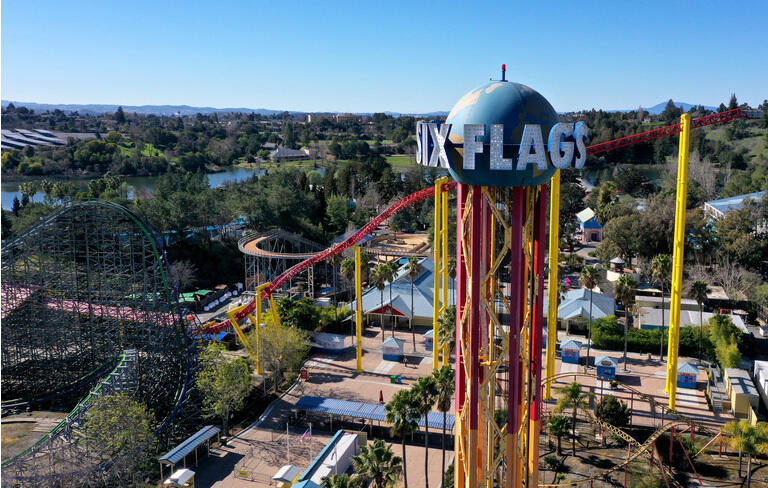
YouTuber banned from Six Flags for eating chicken nuggets

After eating a lot of fast food, some of it on roller coasters, YouTuber Allen Ferrell has been banned by Six Flags from all of its amusement parks nationwide. For life.

McDonald’s chicken nuggets were apparently an ultra-processed food item too far for the folks at Six Flags’ Cedar Point in Sandusky, Ohio.

“This guest has been banned from all Six Flags parks for life,” a Cedar Point spokesman explained in an email Thursday to Cleveland TV station WKYC. “Safety is a cornerstone of our business and we have zero tolerance for inappropriate and unsafe behavior.”

Zero tolerance for inappropriate behavior? Zero? Where’s the fun in that?

“Our ride safety policy strictly prohibits all loose articles on rides, including food which can become a choking hazard,” the spokesperson continued.

“I had no idea that eating a 10-piece chicken nugget on a roller coaster would be a national headline, but here we are,” Ferrell told Fox 8 News in Cleveland.

He said he gets the park’s point with the ban, even though he’s been going there since he was a kid and is a huge fan of the operation.

“I understand. And we kind of worked it out,” he told Fox 8 News. “They just don’t want other people getting hurt on the ride. But me personally, it was a really fun challenge.”

Ferrell’s shtick on social media is accepting challenges from his followers and then taping himself attempting to do what they propose. Eat a McDonald’s Big Mac inside a Burger King. Throw a plunger at a Target sign. Bowl blindfolded until he gets a strike.

“If anyone asks,” Ferrell tells one apparently bored ride operator in the video that documented this particular coaster crime, “I do not have chicken nuggets in my underwear.”

Ferrell decided to try the challenge on the park’s Millennium Force ride, a “looming giant amongst a park full of them,” a coaster that was “designed for the purpose of proving bigger is better.” A roller coaster that when it was created in 2000 “demanded an all-new category just to classify its one of a kind nature,” giving rise to the “giga-coaster.” According to Cedar Point, as all of this verbiage is, Millennium Force “shoots riders over hills, past lagoons and through tunnels, all at unthinkable speeds.”

The ride actually tops out at 93 mph, a speed often thought about on freeways in the Los Angeles area when traffic is going 8 mph. It’s quite thinkable to eat fast food in a car in L.A. But it turns out what was really unthinkable was Ferrell getting all 10 nuggets down the hatch before the Six Flags ride was over.

In the video, which had almost 800,000 views on YouTube as of Friday afternoon, he morphs from happy snacking dude to dude moaning in discomfort, struggling to shove nuggets in his mouth while unintentionally applying dipping sauce to his face via G-force.

“Oh, I failed,” Ferrell says, wiping off the face-sauce as the coaster pulls up to the platform and someone in line blurts, “Are those chicken nuggets?”

Turns out he snarfed seven of them, he confesses to the two guys in front of him in the coaster car. Ferrell said later that he was glad to be in the back row because it meant nobody behind him got sauced.

That said, watching the sweet-and-sour sauce flying in slow motion is actually quite amusing. But eating nuggets that have been in one’s underwear?

The perma-ban sounds like the least of his problems.

Source link