Fitness And Health

Thousands told to get vaccine before summer holidays as infections confirmed in UK

21 cases of the viral disease have been confirmed in the UK

People that are eligible for the Mpox vaccine in Northern Ireland are being urged to step forward before the summer holidays as 21 cases of the viral disease, formerly known as monkeypox, have been confirmed by the Public Health Agency in the last three weeks.

This is a significant rise as, according to the BBC, only nine cases of Mpox had been reported in Northern Ireland since 2023. The Public Health Agency is asking people to learn the symptoms, be vigilant about the signs and get vaccinated but not everyone will be eligible for the vaccine.

The main symptoms the Public Health Agency is urging people to keep an eye out for include rashes with blisters, aches, fever and swollen glands that can last for up to three weeks.

Doctors find a way of making us young again, eating like a Greek slashes heart disease risk, and cure for deadly cancer found at the bottom of the sea – all this and more in our science newsletter

According to the NHS, the first symptoms of mpox include:

  • a high temperature, or feeling hot, cold or shivery
  • a headache
  • muscle aches
  • backache
  • swollen glands
  • shivering (chills)
  • exhaustion
  • joint pain

The telltale sign of mpox is a distinctive rash which usually appears one to five days after the other symptoms. It can appear on any part of the body including the hands, soles of the feet, mouth or genitals.

The rash is sometimes mistaken for chickenpox. It starts with small raised spots that turn into ulcers or small blisters filled with fluid, the blister eventually forms a scab that later falls off.

Dr Rachel Coyle, Consultant in Health Protection at the PHA, said: “We want to remind those who are eligible to get vaccinated. Vaccination is available for those eligible in Northern Ireland through sexual health clinics, also known as genitourinary medicine or GUM clinics.

“While anyone can catch mpox, the majority of mpox cases in the UK are in gay, bisexual and other men who have sex with men (GBMSM).

“Therefore, those eligible for the vaccine include gay, bisexual or other men who have sex with men who have multiple sexual partners, and those who participate in group sex or attend sex on premises venues. Staff who work in these premises are also eligible.

“If you think you may be eligible and have not yet received your first dose or completed the course of two vaccines, contact your local GUM clinic and enquire about getting the vaccine.”

Mpox is passed from one person to another through any close physical contact with mpox rash, blisters or scabs. This can include during sexual contact or other skin-to-skin contact.

It can also be passed through contaminated surfaces like bedding or towels and through the coughs and sneezes of a person that has mpox if they are close enough to you.

Mpox is usually mild and can get better in a few weeks even without treatment. However, while you have symptoms you can pass on the virus to other people and some may be more vulnerable to more severe symptoms. This includes older people, young children and anyone taking medication that affects their immune system.

Source link

Dr Amir Khan asks does ‘anyone else have this’ after diagnosing himself

Dr Amir Khan has opened up about his own mental health, saying he has a “full-blown case”

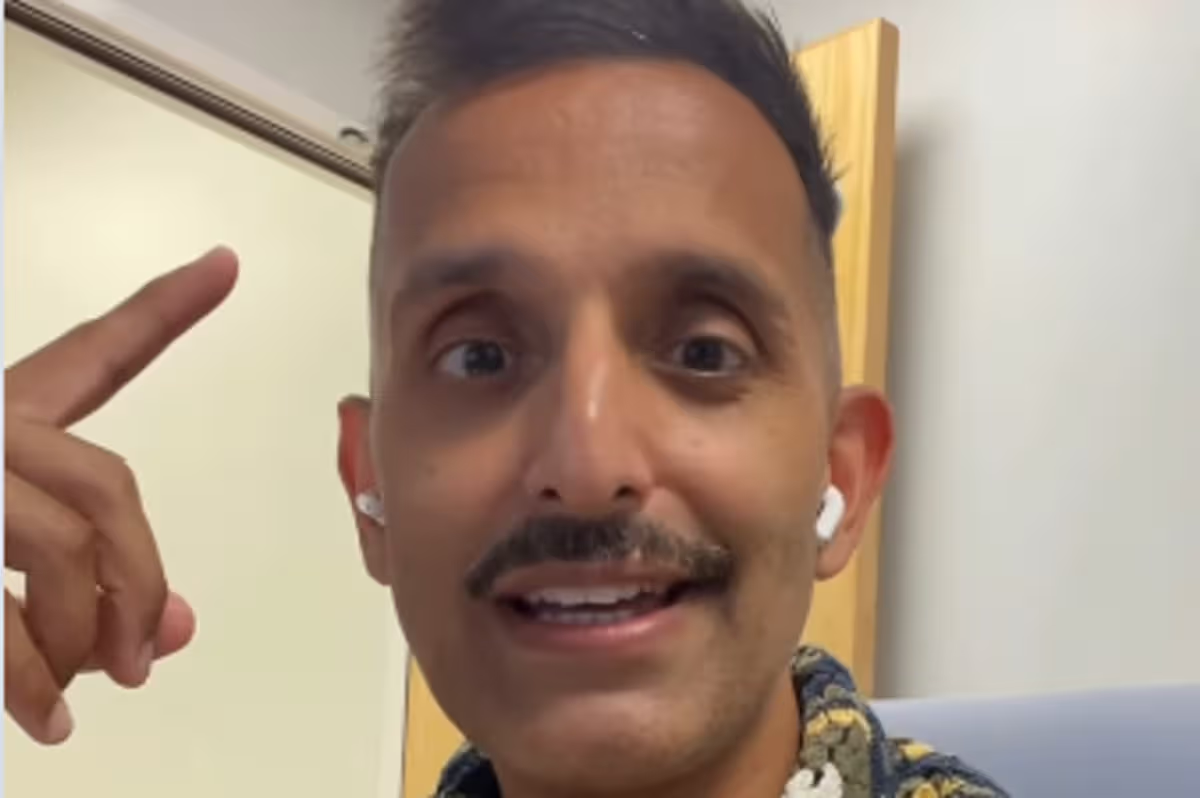
A doctor has asked if “anyone else has this”, revealing he’s diagnosed himself with a form of anxiety. Doctor Amir Khan, who is known for his appearances on ITV, opened up about something called anticipatory anxiety.

In a video uploaded to social media platform Instagram, the medical professional shared more about his experience. Speaking to his more than one million followers, he said: “I’ve diagnosed myself with something called anticipatory anxiety and I need to know if anyone else has this.”

He explained how this phenomenon causes his brain to prepare for the “worst case scenario”, which in reality, doesn’t happen. “You know, when you’ve got like a meeting coming up or you’ve got an awkward conversation with someone you just don’t want to have,” Dr Amir said.

“It could be, I don’t know your boss at work, a friend, a family member, literally anyone – a meeting normally for me. Well then my brain decides we’re not just going to have one conversation in my head with these people, we’re gonna have 47, it just replays conversations in my head and what they’re going to go like.

Content cannot be displayed without consent

“I’ll imagine them saying something awful. So I prepare my perfect comeback, then they say something even worse in my head, so I then prepare for that.

“Then I imagine myself calmly standing my ground, walking away with dramatic dignity, probably to a soundtrack that only I can hear. By the time I’ve finished, I’ve won an argument that never actually happened.

“Then the real conversation comes along and they’re lovely, they’re polite, we agree on things. The meeting lasts like just six minutes, so then it’s just a chat. And I come away thinking, ‘Why on earth did I spend two days emotionally preparing for that?’

“Well, that is anticipatory anxiety, and I have a full-blown case of it all the time.” He said this occurs when your brain starts worrying about something before it’s happened and because your brain’s threat system is trying to protect you, it “often throws in a bit of catastrophizing as well”.

Dr Amir said: “It’s trying to help me it, believes that if it rehearses every possible disaster, I’ll be ready for anything. But in reality most of those disasters, just don’t happen.

“So all that’s really happened is I put myself through stress, once in my imagination and then once again in real life, except the real life version usually turns out absolutely fine.” He added: “Please tell me this isn’t just me.”

He was met by support in his comment section with one person saying: “Omg Amir this is me! I drive myself mad doing it. Glad I’m not alone. Thanks.”

Another commented: “Yes! Amir you most definitely are not alone, this is so me.” And one person replied: “I do this too, it can be exhausting.”

Anticipatory anxiety is a recognised form of anxiety. On its website, Anxiety UK says: “Anticipatory anxiety is where a person experiences increased levels of anxiety by thinking about an event or situation in the future.

“Rather than being a specific disorder in its own right, anticipatory anxiety is a symptom commonly found in a number of anxiety-related conditions, such as generalised anxiety. Anticipatory Anxiety can be extremely draining for people as it can last for months prior to an event.

“The worries people experience specifically focus on what they think might happen, often with catastrophic predictions about an event. The nature of negative predictions about the event will be the difference between an anxiety level that is incapacitating or merely uncomfortable.”

The NHS lists common symptoms of general anxiety as:

  • Feeling tired, restless or irritable
  • Feeling shaky or trembly, dizzy or sweating more
  • Being unable to concentrate or make decisions
  • Trouble sleeping
  • Worrying about the past or future, or thinking something bad will happen
  • Headaches, tummy aches or muscle pain
  • Dry mouth
  • Pins and needles
  • Noticing your heartbeat gets stronger, faster or irregular, or you get short of breath when you start feeling anxious

It says that if you cannot tell if shortness of breath is from anxiety or if you are worried about any other symptoms, you should see a GP.

Source link

Brit badly injured in horror Australia motorhome crash

The 28-year-old was on a six-week trip when she was involved in an accident in the motorhome she had hired

A Brit’s dream holiday turned into a nightmare after a horror motorhome crash left her unable to walk. Emma Blood, 28, was travelling in Western Australia when the collision left her trapped, seriously injured and facing a year-long recovery.

The hospitality worker from Milton Keynes had travelled to Australia on March 19, 2026, with plans to spend six weeks exploring. Inspired by stories from other travellers, she teamed up with three women she had met through a travel group and hired a motorhome to travel around and live in while exploring the region.

Just nine days into the trip, on March 29, Emma and the three women were travelling towards Margaret River when she lost control of the motorhome, due to slipping on the Western Australia mud roads, and crashed into a tree. Two passengers suffered minor injuries, but Emma was trapped from the waist down in the wreckage and had to be cut free by firefighters.

She was then airlifted to Perth Trauma Hospital, where she spent 10 days before flying back to the UK to continue her recovery. She said: “There are still a lot of blank spaces in my memory, I’m not sure whether I lost consciousness or whether it’s just a trauma response.

“I recall the moment of impact, when the vehicle struck a tree on the driver’s side where I was sitting. The force of the crash pushed everything forward, and I ended up trapped from the waist down.”

While the other passengers escaped with relatively minor injuries, Emma suffered devastating damage to her leg. One passenger required stitches to her face, and another was left with a bruised finger, but Emma faced a far more serious outcome.

Emergency services were alerted after her phone automatically contacted them following the collision. Upon arrival, a fire crew had to cut Emma free before she was airlifted to Perth Trauma Hospital.

Doctors discovered she had broken her femur in three places. She underwent emergency surgery lasting around six hours, during which surgeons inserted an intramedullary nail – a metal rod fixed inside the bone with six screws to stabilise the fractures.

Emma said: “I remember being in and out of consciousness, having scans and being moved around the hospital. It felt like something out of 24 Hours in A&E or Casualty, being rushed about.

“One of the most difficult moments was definitely standing for the first time after surgery. It was terrifying because I had no control over my leg, at first they thought there could be spinal injuries but it turned out to be okay.”

Complications continued when doctors discovered her haemoglobin levels had dropped dangerously low, resulting in a blood transfusion several days later. Emma spent 10 days in the hospital in Australia before her father flew out to help bring her home.

She said: “I couldn’t have travelled back on my own, I needed someone with me the whole way. If my dad hadn’t come to pick me up, I would have had someone to take me who I didn’t know.”

After arriving back in the UK on April 8, she was admitted to Milton Keynes Hospital for around another week before continuing her recovery at home.

In the early stages of recovery, Emma could not move her injured leg without using a strap around her foot and required assistance with everyday tasks, including showering.

She said: “It felt like I had lost all independence. I have been told a full recovery could take up to a year, but I am making great progress.

“My older brother is helping me, he’s a sports physiotherapist and thanks to him I progressed from a walking frame to two crutches, and now I only rely on one.”

She spends time in the gym every day, rebuilding strength and mobility and recently celebrated a major milestone by getting back behind the wheel of a car.

She said: “Driving again was huge for me, both physically and mentally. Although the accident cut short my dream trip, I will go back to finish it.

“There is still a lot of trauma attached to what happened, but for now, I am going to focus on getting back to my full health and independence.”

Source link

Dr Amir Khan says this is why women have belly fat – and it’s ‘normal’

This is a “natural” part of being a woman, he said

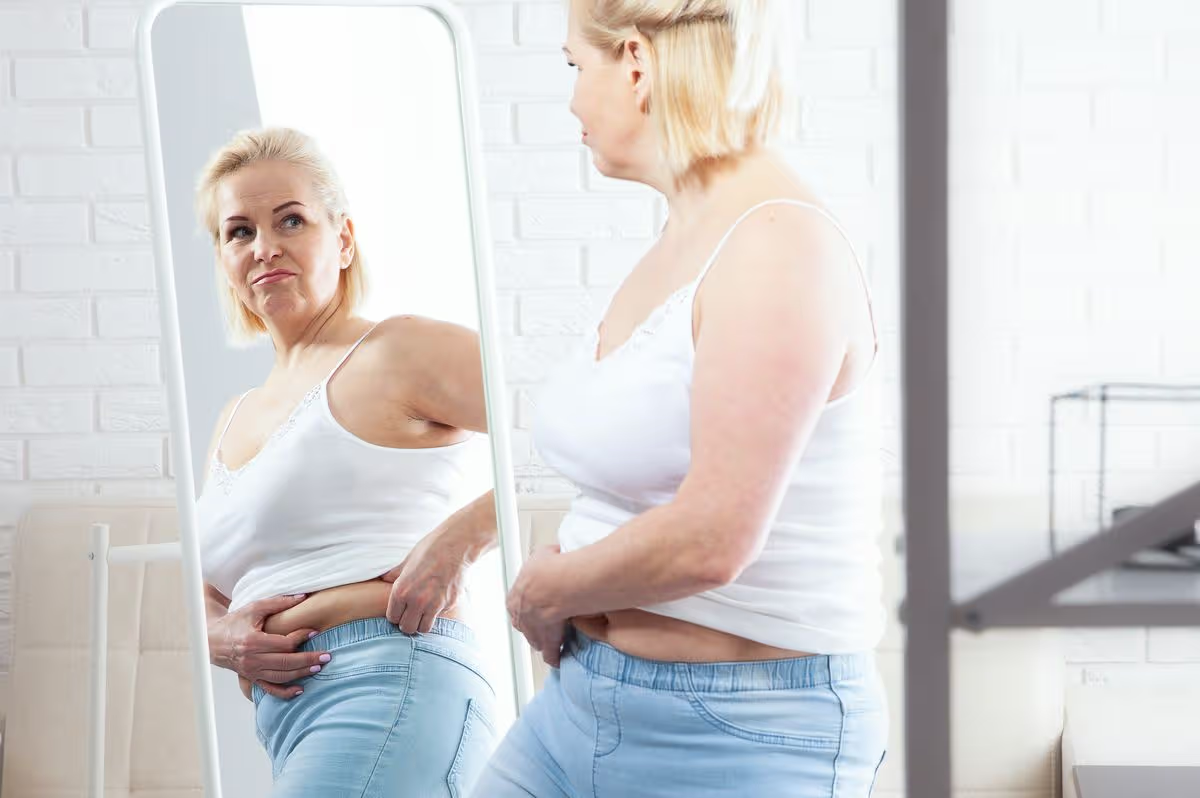
A doctor has revealed why women start to put on belly fat as they age, stating it’s a “normal” part of life. According to the expert, women can expect to see their weight fluctuate when they get older.

In a clip from his podcast No Appointment Necessary, shared to his Instagram page, Dr Amir Khan issued some reassurance about weight before and after the menopause. He explained how fat is distributed on the body differently as a result of this hormonal change.

Menopause is a natural life stage that typically affects women between the ages of 45 and 55. It happens when hormone levels in the body drop to a point where periods cease completely.

Forgotten immune organ can predict how long you’ll live, landmark trial crushes ‘undruggable’ cancers, and blood test can spot signals of Alzheimer’s early – all this and more in our latest science newsletter

As a consequence of these hormonal shifts, the body can experience a broad range of symptoms that can impact both physical and mental health. These include hot flushes, mood swings, and brain fog.

Content cannot be displayed without consent

However, it can also affect how your body stores fat. On the podcast, his co-host Cheery Healey said: “Lots of women find that when they go through perimenopause and menopause, they gain weight.”

Dr Amir responded: “So, before the menopause, fat distribution in women is usually around the hips, thighs, and buttock area. And that fat distribution is completely normal and healthy and women should have fat there, you don’t want to lose it.”

He explained why. “It’s really good for your fertility,” he said.

“It’s really good for your overall health. It is expected and needed.”

But after menopause, you might notice that you are more prone to weight gain around the tummy. Dr Amir continued: “After the menopause, as the hormones shift, things change.

“And that fat usually deposits around the tummy area and the hips as well and so people can refer to it as a ‘meno belly’. It’s not really a great term but it is just the shift of weight, really.”

He added: “Normal, natural, not the end of the world, part of being a woman, an adult woman.” His advice is supported by the NHS website, which says: “Weight gain during perimenopause and menopause is common.

“It often happens around the stomach and upper body.”

Other symptoms of menopause

The other symptoms of menopause, as listed by the NHS, include:

  • Changes to your periods
  • Hot flushes and night sweats
  • Sleep problems
  • Mood changes, poor memory and brain fog
  • Vaginal problems such as dryness, a burning feeling, irritation or itching in and around the vagina
  • UTIs (urinary tract infections)
  • A faster, slower or more noticeable heartbeat (palpitations)
  • Weakening bones (loss of bone density), which can lead to osteoporosis
  • Feeling the need to pee more or not being able to control when you pee (urinary incontinence)
  • Headaches and migraines that are worse than usual
  • Muscle aches and joint pains
  • Hair thinning or hair loss
  • Skin changes, including dry and itchy skin
  • Reduced sex drive (loss of libido)
  • Sensitive teeth, painful gums or other mouth problems

The health body says you should contact your GP if:

  • You think you have symptoms of menopause or perimenopause and want to know what your options are
  • You have symptoms like a fast heartbeat (palpitations)
  • You still have periods but your bleeding pattern has changed and you’re bleeding more, not less, than before
  • You have not had a period for 12 months or more, and you have any vaginal bleeding

The most commonly prescribed treatment for menopause symptoms is hormone replacement therapy (HRT).

Source link

‘Extreme’ health risk warning for popular Brit holiday destination

People visiting these islands could be at risk of high UV levels

People have been urged to take certain precautions as the ultraviolet radiation risk at a popular holiday destination area has been raised to “extreme”. Health officials in the Canary Islands have elevated the UV risk across several of the islands.

According to the Canary Islands Health Department, UV radiation levels are presently classified as “very high” across all islands. And Fuerteventura, Lanzarote and Gran Canaria have reached the highest “extreme” warning category.

Prolonged exposure to ultraviolet radiation can lead to serious health complications, including DNA damage, severe sunburn, allergic skin reactions, eye conditions and a heightened risk of skin cancer, including melanoma. Health experts also caution that UV exposure can suppress the immune system and even trigger the reactivation of viruses such as cold sores.

The alert particularly impacts those who spend lengthy periods outdoors, whether for work or leisure, as well as individuals with fair skin, light eyes or a family history of skin cancer. Children and older adults are also regarded as especially at risk.

As reported by Canarian Weekly on May 21, health authorities are strongly advising people to avoid direct sunlight between 11am and 5pm wherever possible, seek out shaded areas and wear protective clothing, wide-brimmed hats and approved sunglasses with UVA and UVB protection. The application of SPF 50 sunscreen is highly recommended, even on overcast days.

Authorities also issued a reminder to parents that babies under one year old should never be exposed directly to sunlight, as their skin is particularly sensitive and incompatible with most sun creams. The Canary Islands consistently record some of the highest UV radiation levels across Spain throughout the year, owing to their geographical position and climate.

How to apply sunscreen

The NHS warns that most people do not apply enough sunscreen. As a guide, adults should aim to apply around six to eight teaspoons of sunscreen if you’re covering your entire body.

READ MORE: Drivers in England urged to put ‘light coloured’ towel in their car from FridayREAD MORE: 5 UK areas issued with amber heat health alerts as heatwave warning upgraded

If sunscreen is applied “too thinly”, the amount of protection it gives is reduced. If you plan to be out in the sun long enough to risk burning, sunscreen needs to be applied twice:

  • 30 minutes before going out
  • Just before going out

Sunscreen should be applied to all exposed skin, including the face, neck and ears, and head if you have thinning or no hair, but a wide-brimmed hat is better. Sunscreen needs to be reapplied liberally and frequently, and according to the manufacturer’s instructions.

This includes applying it straight after you have been in water, even if it’s “water resistant”, and after towel drying, sweating or when it may have rubbed off. It’s also recommended to reapply sunscreen every two hours, as the sun can dry it off your skin.

Further to this, the NHS recommends you should do the following to stay safe in the sun:

  • Spend time in the shade between 11am and 3pm
  • Never burn
  • Cover up with suitable clothing and sunglasses
  • Take extra care with children
  • Keep babies under six months out of direct sunlight
  • Use at least factor 30 sunscreen – make sure to use enough and re-apply frequently

Source link

Hantavirus Tenerife travel update issued by World Health Organisation after cruise ship outbreak

The island is a popular holiday destination for Brits

The World Health Organisation (WHO) has moved to reassure concerned residents in Tenerife that they will not come into contact with passengers from a hantavirus-affected cruise ship due to arrive on the island. Nearly 1million people call the island home, which also serves as a major holiday destination for British tourists and visitors from across Europe.

The UN health body confirmed there had been six cases of hantavirus linked to the MV Hondius vessel, with four patients currently receiving hospital treatment. It revealed that a total of eight cases, including three fatalities, had been recorded — though one suspected case has since been ruled out after returning a negative hantavirus test.

Around 22 British passengers and crew members aboard the ship are due to arrive in Tenerife on Sunday, with plans to fly them back to the UK on the same day. Representatives from the UK Health Security Agency (UKHSA) and the Foreign Office will meet the MV Hondius when it arrives in Spain’s Canary Islands, with British nationals on board undergoing hantavirus testing before disembarking.

Those who test negative and show no symptoms will be transported directly to a specially arranged repatriation flight with medical staff on board. British citizens returning home will be required to self-isolate for 45 days and will be prohibited from using public transport to reach their residences. The WHO confirmed on Saturday that no symptomatic passengers were currently aboard the vessel. In a letter to the residents of Tenerife, WHO director-general Dr Tedros Adhanom Ghebreyesus acknowledged locals were “worried”.

READ MORE: Parents using baby product told to ‘stop immediately’ after urgent recallREAD MORE: Ryanair passengers with flights booked to Portugal issued EES update

The Ethiopian public health official described the virus as “serious” but stressed the outbreak was “not another Covid” and the “current public health risk from hantavirus remains low”.

He explained: “Spain’s authorities have prepared a careful, step-by-step plan: passengers will be ferried ashore at the industrial port of Granadilla, far from residential areas, in sealed, guarded vehicles, through a completely cordoned-off corridor, and repatriated directly to their home countries.

“You will not encounter them. Your families will not encounter them. Nearly 150 people from 23 countries have been at sea for weeks, some of them grieving, all of them frightened, all of them longing for home. Tenerife has been chosen because it has the medical capacity, the infrastructure, and the humanity to help them reach safety.”

Two British men are currently being treated for hantavirus in the Netherlands and Johannesburg, South Africa, while a third British man with symptoms is being cared for on the isolated South Atlantic island of Tristan da Cunha. The Foreign Office confirmed that a total of 30 passengers and crew aboard the MV Hondius are British nationals, with 22 still remaining on the vessel. The outbreak has been linked to a birdwatching trip in Argentina, which two of the passengers attended prior to embarking on the ship.

Source link