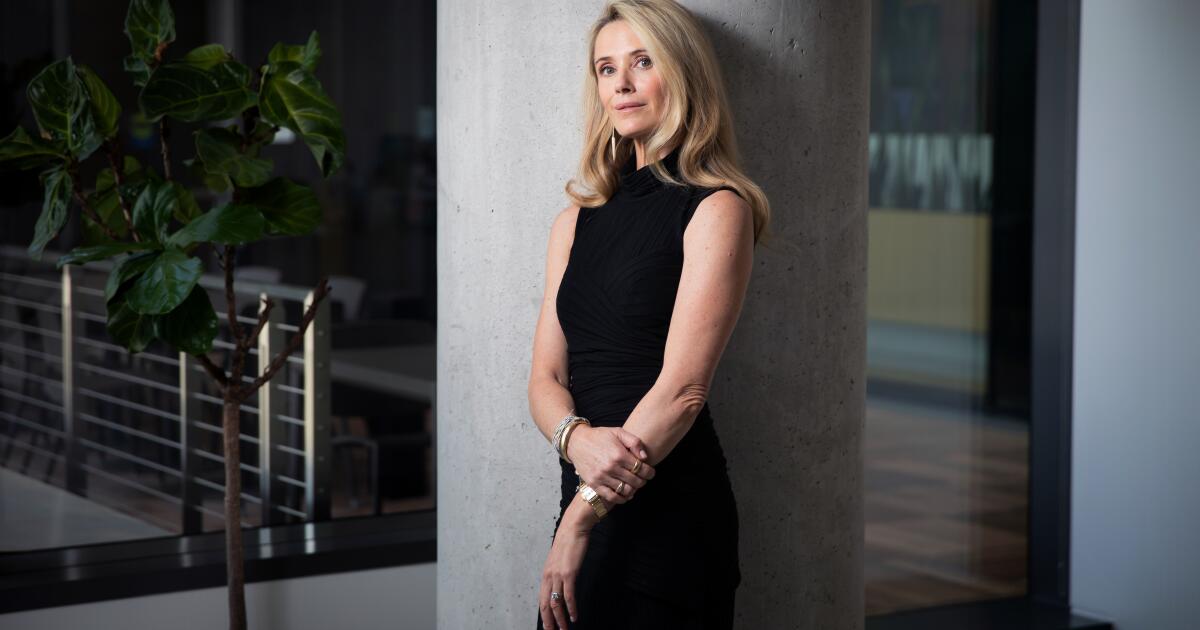
WASHINGTON — Jennifer Siebel Newsom has spent more than a decade cultivating an identity distinct from her husband, Gov. Gavin Newsom, as an active documentary filmmaker and gender equity activist with her own organizations, staff and salary.
The 51-year-old calls herself California’s “first partner,” a title she coined herself to signal an equal footing with the governor and gender inclusivity.
Her independent streak has generated her a steady income. She earns money from a set of organizations she founded or controls. They include the Representation Project, a nonprofit that advocates for gender equity through film and education programs; Girls Club Entertainment, a for-profit production company she owns that holds the copyrights to her documentaries; and the California Partners Project, a second nonprofit that works closely with her government office and receives donations solicited by the governor.
Since its creation in 2020, the California Partners Project has received nearly $5.1 million from so-called “behested payments,” raising alarms over the years about the influence large companies have amassed in Sacramento.
California law allows officials to solicit donations to specific charitable or governmental causes when the payments are reported within 30 days. The public donation system, however, came under scrutiny in 2020 when payments made at Newsom’s behest — to a variety of organizations, not just the California Partners Project — ballooned to an unprecedented $226 million to help fund the response to the COVID-19 pandemic.
With no limit on how much money can be donated by organizations or individuals at the behest of the governor, millions of dollars flowed in to prop up public services during the pandemic and fund Newsom’s favored programs, including an effort to address homelessness and a public safety campaign promoting the importance of wearing masks. The top donor of Newsom-behested payments in 2020 was tech giant Facebook, which gave $27 million for gift cards that went to front-line healthcare workers and for public health ads.
“It’s not illegal, but it certainly pushes the bounds of campaign finance law, and the first couple has been doing this for some time,” said David McCuan, a political science professor at Sonoma State University. “In this battle between Newsom and [President] Trump this makes their [the first couple’s] actions, these payments and the operation of the nonprofits a rich target for scrutiny.”
The Newsoms’ financial arrangements are now the subject of renewed scrutiny. The governor has accused the Trump administration — specifically, the FBI and the Internal Revenue Service — of questioning their friends and former employees about him and his wife. The governor said the probes are politically motivated, a personal vendetta because he’s considering a run for president in 2028.
Newsom said he and his wife have nothing to hide, and promised to release all of his recent tax returns — though he has not announced when.
In turn, the governor has demanded that the Department of Justice release all records pertaining to the probe.
“The American people deserve to know who ordered this abuse of power and how far it goes,” the governor wrote on social media last week.
“These are dark days in our nation’s history when the leader of the free world spews animus openly and without shame — aiming to silence and destroy not only his political opponents, but their friends, colleagues, and families,” Siebel Newsom said in a statement to The Times. ”My husband and I will continue to push back on this vindictive attack — and I certainly will not let this distract me from the important work ahead to protect the health, wealth, and safety of women and children and give California kids the best start in life. Together, we can set an example of strong leadership that protects people rather than preys on them.”
To better understand the finances, here is a breakdown of how Siebel Newsom’s company and nonprofits are working.
The Representation Project
Alongside the release of her first documentary, “Miss Representation,” in 2011, Siebel Newsom created her nonprofit, which originally shared the same name as her film. The organization licenses her films and reimburses costs to her production company.
The nonprofit earns some revenue from licensing the first partner’s documentaries for use in classrooms, college campuses and workplaces. Licensing for film screenings at schools starts at $49, while corporate licensing for her films starts at $995; purchase of screening rights also comes with curricula to facilitate discussions.
The Representation Project has earned more than $5.2 million in revenue from film screenings, licensing and speaking fees since 2011, according to a review of its tax filings.
The Representation Project is not required to disclose its donors but has received at least $2.6 million since 2014 from various charitable foundations that disclosed the gifts in their own tax filings. Several corporations that have had business before the state have donated to Siebel Newsom’s nonprofit, including Pacific Gas & Electric Co., AT&T and Kaiser Permanente.
Its past donors also include entrepreneur and progressive donor Susie Thompkins Buell, who is credited as a producer on several of Siebel Newsom’s documentaries, as well as the Marin Community Foundation and Onward Together, the political action organization founded by Hillary Clinton.
Four months after Newsom took office in 2019, the state Department of Education recommended that high schools screen two of his wife’s films, “Miss Representation” and “The Mask You Live In,” a move that has garnered criticism from conservative media outlets. The state said the films “can help facilitate a discussion about the impact of mass media and gender socialization on self-image and relationships with others.”
Though it does not specify where its films have been licensed, the nonprofit boasts in annual impact reports that its films and curricula have “reached over 2 million students” and “are being used in over 5,000 schools in fifty U.S. states.”
Since founding the Representation Project in 2011, Siebel Newsom has received more than $1.9 million in compensation from the nonprofit organization, according to a review of federal tax records. Her separately owned film production company, Girls Club Entertainment, has collected about $2.2 million in independent contracts from the nonprofit, records show.
Combined, the two streams of money total about $4.1 million flowing from the charity to Siebel Newsom personally or to entities she controls over the span of a little over a decade.
Her current annual salary is $161,250 for a 40-hour workweek, records show. Siebel Newsom earns income from both her production company and her nonprofit, according to state financial disclosures.
Jeff Tenenbaum, a nonprofit attorney with 30 years of experience advising nonprofit, tax-exempt organizations, declined to comment on Siebel Newsom’s specific case. But generally, he explained the legal framework that would apply to an arrangement like the one described in the filings.
Under federal tax-exempt organization law, he said, the “private benefit doctrine” governs whether a nonprofit’s overall activities unduly benefit any single individual — including through indirect payments to entities they own. The tax law asks whether too much benefit flows to one person or entity.
This is separate and distinct from the “private inurement” doctrine, which prohibits nonprofits from paying greater-than-fair market value compensation to insiders, including founders, and which requires that such compensation arrangements be approved by individuals with no conflicts of interest.
“Theoretically, a situation like this could raise some private benefit concerns,” Tenenbaum said, when the structure of the arrangement was described to him.
The doctrine does not prohibit all private benefit, he said, only what the federal tax code calls “impermissible” private benefit.
“There has to be too much benefit compared to the benefit to the public,” he said. Whether that threshold is crossed here, he said, would require a fuller review of the organization’s finances, contracts, and other considerations, including copyright ownership issues relating to the films produced.
Girls Club Entertainment
An actress and documentary filmmaker, Siebel Newsom founded her production company to develop independent films with a focus on combating gender stereotypes and empowering girls and women. She serves as the company’s chief creative officer.
She has written, produced and directed five films exploring themes of inequality and traditional gender roles. Siebel Newsom is best known for her 2011 documentary “Miss Representation,” which focused on the few and narrow representations of girls and women in American media.
Tax records show that the production company owns the rights to “Miss Representation” and has licensed the film to the Representation Project for a minimum of seven years for the purpose of distributing and screening the film in public. Costs associated with film production — including the writer, director and producer fees — have been reimbursed by the Representation Project, tax filings show.
Her latest documentary, “Miss Representation: Rise Up,” examines “the rising backlash against women’s progress and the hostile landscape of technology designed to harass and, ultimately, silence women.” The film premiered this month at the Tribeca Film Festival.
California Partners Project
In 2020, Siebel Newsom founded the California Partners Project, a nonprofit focused on improving gender equity in the workplace and the safety and well-being of children in online spaces. She does not collect compensation from the nonprofit or serve on its board.
It hosts an annual “gender equity summit” and provides resources for parents on issues such as social media safety and child mental health.
In the fall of 2024, Siebel Newsom and the California Partners Project hosted representatives from TikTok, Meta, Pinterest and other social media platforms for an event about children’s online safety. A day before the panel, state Atty. Gen. Rob Bonta took a more forceful tack to go after the tech industry by joining with 13 other states in a lawsuit against TikTok that accused the platform of exploiting young app users with its addictive features.
In September of 2024, the governor signed a bill to prohibit internet services and applications from providing “addictive feeds,” defined as media curated based on information gathered on or provided by the user, to minors without parental consent.
The California Partners Project also does not publicly disclose its donors in its tax filings, but much of the nonprofit’s funding appears to come from behested payments. Siebel Newsom does not receive a salary from the organization.
Since its founding, the Newsoms have steered more than $5 million to the nonprofit via behested payments, according to a review of the disclosures. While many donations to the California Partners Project come from charitable foundations, it also received hundreds of thousands from companies including Silicon Valley Bank, Pinterest and the charitable arm of Blue Shield of California.
Its biggest funder is the Federated Indians of Graton Rancheria, a Sonoma County tribe that operates a casino in Rohnert Park and spends heavily in state and federal elections. The tribe has given $2.3 million to the nonprofit since 2022. In June 2023, Newsom appointed tribal Chairman Greg Sarris to the University of California Board of Regents. Newsom has also supported efforts by the tribe to block a smaller tribe from building a casino in nearby Vallejo.
Blue Shield, which has reported giving $100,000 to Siebel Newsom’s nonprofit, also has a cozy relationship with her husband. The nonprofit health insurer was an early donor to Newsom’s 2018 campaign for governor and later received a $15-million no-bid contract to distribute COVID vaccines. State regulators in 2024 also signed off on the nonprofit’s request to restructure and establish a new parent corporation out of state, a move that raised alarm among healthcare advocates.
The California Partners Project did not respond to questions about its donors and spending.