Patrick Stewart’s best TV and movie performances: Star Trek to X-Men
Patrick Stewart was an imposing figure, on screens big and small, and on stage in the many theatrical productions he starred in over his long career. Depending on the role, his baritone voice could command a legion of Starfleet officers, superhero mutants or a royal court. The actor, who died Wednesday, will be best remembered for the iconic characters he portrayed, particularly in the “Star Trek” and “X-Men” franchises, but over the course of his career, he proved his versatility, playing comedic roles as brilliantly as his dramatic ones. Here, our writers detail some of his most memorable onscreen work.
‘Dune’ (1984)
Even in the wake of Denis Villeneuve’s mega-productions, David Lynch’s dreamy version has found its fandom of acolytes. To watch Stewart commit to the director’s vision is to wish he had more film opportunities outside the shadow of Capt. Picard. He’s playing Gurney Halleck (Josh Brolin does the role in the new movies), a war advisor to young Paul Atreides, and Stewart brings gruff family-friend vibes to his few scenes, which have become legendary in the Lynch pantheon. When Kyle MacLachlan’s Paul says he’s “not in the mood” for combat training, Gurney explodes at him: “Mood’s a thing for cattle and loveplay, not fighting!” Later, you can watch Gurney charging into planetary battle holding — what’s this? — a sweet-looking pug. They must be symbolic to House Atreides. The dogs don’t appear in Frank Herbert’s novel. Lynch just added them. It’s how I choose to remember Stewart. — Joshua Rothkopf

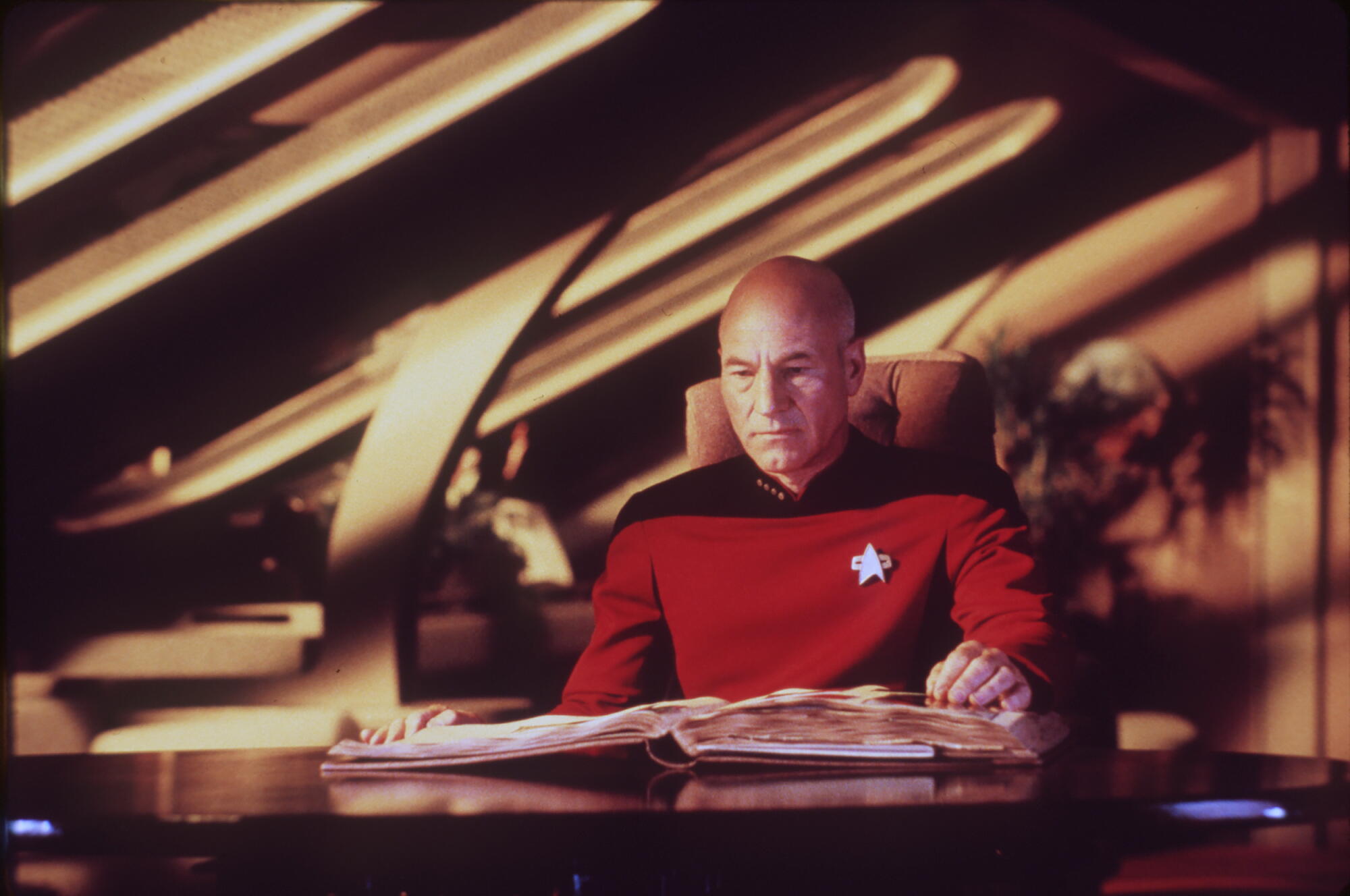
Patrick Stewart as Captain Picard in “Star Trek: The Next Generation.”
(Elliott Marks/Paramount)
‘Star Trek: The Next Generation’ (1987-1994)
Whichever captain in the “Star Trek” franchise you fancy — Janeway, Kirk, Sisko, Pike, etc. — Jean-Luc Picard was always in the conversation. He was serious, stern, smart, curious, with the hint of whimsy that it takes to soar among the stars with theoretical science and a diplomatic flair with alien races. Undoubtedly, Stewart’s Shakespearean training helped him look past the costumes, sets and CGI into the humanity of what the writers and Gene Roddenberry intended. Though “Star Trek” was set hundreds of years into the future, Stewart gave the character a sense of now, with some of the same problems we face today. Indeed, one of his most famous quotes from the show, from the fifth-season episode “The Inner Light,” embodied how he kept Picard in the present: “Seize the time … live now. Make now always the most precious time. Now will never come again.” — Jevon Phillips
‘Robin Hood: Men in Tights’ (1993)
My nascent cinephilia was nurtured by movies on VHS. One tape (and eventually DVD, then Blu-ray) we often found ourselves watching was Mel Brooks’ “Robin Hood: Men in Tights.” The spoof of early Hollywood’s swashbuckling action-adventure movies is one of the comedy titan’s most quotable films, thanks in large part to the timing of the cast. Stewart, in a cameo at the end of the film, plays a regal King Richard who returns from the Crusades to chastise his younger brother Prince John (played by a scene-stealing Richard Lewis). Stewart gets one of the film’s best jokes, delivering one final indignity to Prince John with the panache that only a formally trained actor of his caliber could. — David Viramontes

James Marsden, left, and Patrick Stewart in “X-Men.”
(Attila Dory / 20th Century Fox)
‘X-Men’ (2000)
Casting Stewart as Professor Charles Xavier in Bryan Singer’s “X-Men” must have seemed almost too easy. He looked remarkably like the bald, wheelchair-using Marvel comic-book character and had already spent seven seasons playing a similarly cerebral, principled leader as Capt. Picard on “Star Trek: The Next Generation.” But Stewart brought more to the role than a physical resemblance and a voice that could make a grocery list sound like a royal decree. As the powerful telepath who ran a school for young mutants and believed they could coexist peacefully with humans, his Xavier barely needed to raise an eyebrow to command attention, even when surrounded by characters who could sprout claws, control the weather and shoot beams from their eyes. Playing opposite Ian McKellen as Xavier’s old friend turned rival Magneto, Stewart brought a touch of Shakespearean gravitas to the fledgling franchise, returning to the role for seven more films over the next 22 years. He’ll reprise the role a final time in “Avengers: Doomsday” in December. — Josh Rottenberg

Patrick Stewart and Hugh Jackman in the film “Logan.”
(James Mangold / Marvel / Twentieth Century Fox)
‘Logan’ (2017)
Previous installments of the “X-Men” films are more typical of the superhero genre, with grand CGI battle sequences and a foe or foes that must be defeated. But “Logan,” which centers on the titular character, a.k.a. Wolverine (Hugh Jackman), is different, with a grounded, gritty story set in 2029 in the desert of Northern Mexico near El Paso. Logan is now a limousine driver addicted to prescription painkillers and he’s a caretaker, along with fellow mutant Caliban, for an elderly Charles Xavier. Ten minutes into the film, we see the professor not in his usual dignified manner, dressed in a sharp suit; instead, we see him thin and frail, in a dirty T-shirt, zooming around in circles in his motorized wheelchair repeating the lines of a Taco Bell commercial. Logan attempts to medicate him so that he and Caliban can rest, but Xavier fights him off, falls out of his wheelchair and has a telepathic seizure that begins to affect everyone around him. “What are you doing to me?” he whispers in a scared voice as Logan tries to inject him. It’s a scene that Stewart imbues with terror and sadness as we see the formerly stoic Xavier shrivel in his hospital bed, reminded of his ailments and his mortality. — Maira Garcia