fighter

Germany And Spain Launch ‘Team Gen 6’ After Europe’s Next-Gen Fighter Effort Collapses

In a significant development for Europe’s future air combat ambitions, Airbus is trying to restart the program to develop a sixth-generation combat jet, now under German and Spanish leadership. This comes less than a week after the Franco-German-led New Generation Fighter (NGF) effort effectively collapsed in its original form, amid acrimony between Paris and Berlin. The NGF was planned as the crewed centerpiece of the pan-European Future Combat Air System (FCAS), which Airbus, as the leading European aerospace corporation, now hopes to get back on track.

Airbus’s Defense and Space unit launched the ‘Team Gen 6’ initiative today with a message on X, declaring that it was “an exciting step for European sovereignty.” So far, eight German defense and aerospace contractors have signed a strategic positioning paper as part of the effort. Those firms are Autoflug, Diehl Defense, Hensoldt, Liebherr, MBDA Germany, MTU Aero Engines, and Rohde and Schwarz.

Reflecting the German-Spanish nature of the new program, those companies are now “closely integrated” with firms from Spain, comprising GMV, Grupo Oesia, Indra, ITP Aero, and Sener.

“While the development of the overarching [FCAS] ‘system of systems’ is progressing as before, the sixth-generation fighter aircraft integrated within it requires a new, agile industrial setup,” Airbus said.

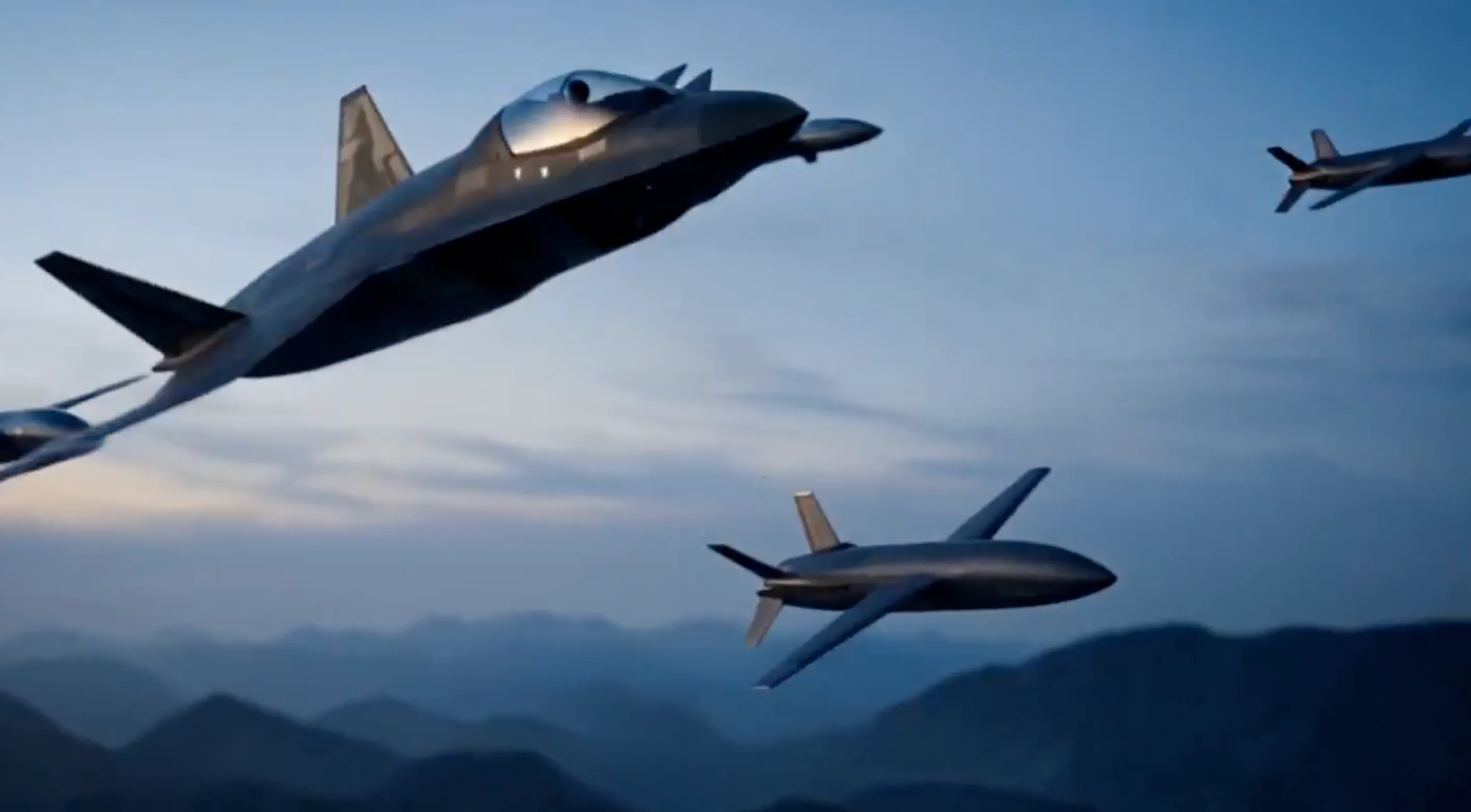
A screencap from an Airbus video showing a notional future fighter working with remote-carrier-type drones. Airbus screencap

“As Team Gen 6, we have the capabilities and the capacities. Now, we are looking for close alignment with policymakers and the air force[s] to drive forward a superior European air combat system for collective security,” the X post stated.

Airbus also presented a video showing a notional concept aircraft flying with multiple uncrewed platforms. While not too much (as in not much at all) should be read into this, the crewed aircraft features canard foreplanes, a chin intake, and an unusual cranked wing.

Speaking just ahead of the announcement, at the ILA Berlin airshow today, where TWZ was in attendance, Jean-Brice Dumont, head of air power at Airbus Defense and Space, said the company remains committed to delivering a sixth-generation combat jet. “There is a need for a bit of a reshaping and reconsidering the reality of today,” Dumont added.

SYMBOL - 10 June 2026, Brandenburg, Schönefeld: Federal Chancellor Friedrich Merz (2nd from left, CDU) and Jean-Brice Dumont (2nd from right), Head of Air Power at Airbus Defence and Space, stand in front of a drone during a tour of the International Aerospace Exhibition (ILA). Photo: Sebastian Gollnow/dpa (Photo by Sebastian Gollnow/picture alliance via Getty Images)
German Federal Chancellor Friedrich Merz (second from left) and Jean-Brice Dumont (second from right), head of air power at Airbus Defense and Space, stand in front of a drone during a tour of the International Aerospace Exhibition (ILA). Photo by Sebastian Gollnow/picture alliance via Getty Images

Dumont explained that the now-abandoned NGF was one of seven separate “pillars” of technology development being worked on under FCAS. As well as the crewed jet, pillars include powerplant, remote carrier vehicles, precision-guided weapons, and data connectivity.

“We have to consider safeguarding areas where it works, and how we reshape,” he added. “At the moment, we are going to seek guidance from our governments [on] what they want us to do. There has to be demonstrated an industrial feasibility of what is being asked — not only technical. That’s probably a lesson now,” Dumont added.

Dumont continued: “The world in 2026 is very different to the world of 2017 when the [FCAS] programme was launched. We have to accept that fact and reshape it — we need another way to get to the same goal, with faster milestones.”

“The problem we had is that we had drawn a line to 2040, and new technologies for everything,” Dumont added, referring to the goal of having the FCAS, including the NGF, in service by that date. “Today, you see demonstrations of connectivity, systems of systems and unmanned vehicles all around the world. The need is there, and in the countries that we are competing with, they are using it already.”

According to Dumont, the company has “put a number of options on the desk of our ministers and ministries of defense,” and is now awaiting further guidance from officials.

As the centerpiece of FCAS, in its original form, the NGF element was the most high-profile and challenging component of the project. However, it had long been dogged by disagreements over industrial workshare and leadership between Airbus and Dassault Aviation, which were the prime contractors for Germany and Spain, and France, respectively.

A 1:1 scale model of the NGF is unveiled at the Paris Airshow in 2019. Dassault Aviation

Dassault had demanded that it play the defining role in NGF, reflecting key requirements for the jet driven by the French Armed Forces. These included the ability to operate from aircraft carriers, and provision to deliver nuclear weapons. Germany or Spain needed neither of these functions.

Despite the disagreements that derailed NGF, Dumont argued that there had still been useful lessons learned from the FCAS program.

“What Phase 1A and 1B [of the program] have given is a very thorough analysis of the repartition of the work between the crewed and uncrewed platforms, and this remains. That kind of shapes what the manned aircraft will have to do.”

As an example of this work, Dumont pointed to ongoing work that will involve trials of a Eurofighter operating as a “command fighter” — a crewed jet that can operate in collaboration with drones, or what Airbus now refers to as uncrewed collaborative combat aircraft (UCCAs). The tests will see a Eurofighter fitted with a Rafael Litening 5 targeting pod modified to serve as the interface between the crewed jet and UCCAs. This should pave the way toward an in-service command fighter capability being introduced to the Eurofighter, something that will be incorporated in the sixth-generation combat jet from the outset.

Kampfflugzeug vom Typ Eurofighter mit Lenkbombe GBU-48 (Guided Bomb Unit 48) fliegt im Übungsgebiet im Rahmen der multinationalen Übung Green Flag West, am 08.05.2018. ©Bundeswehr
A German Eurofighter with a Litening laser targeting and reconnaissance pod on the centerline station. Crown Copyright

Initial trials will involve a Learjet test configured as a surrogate command fighter and flying with drones in an “enhanced teaming” mode. Airbus hopes to have the command fighter-configured Eurofighter ready for operational service in 2029.

“The demand from the customers is: be ready early,” Dumont explained. “This is not a contradiction to the Future Combat Air System challenge — it is the need to have our platforms evolved earlier than we had traditionally planned.”

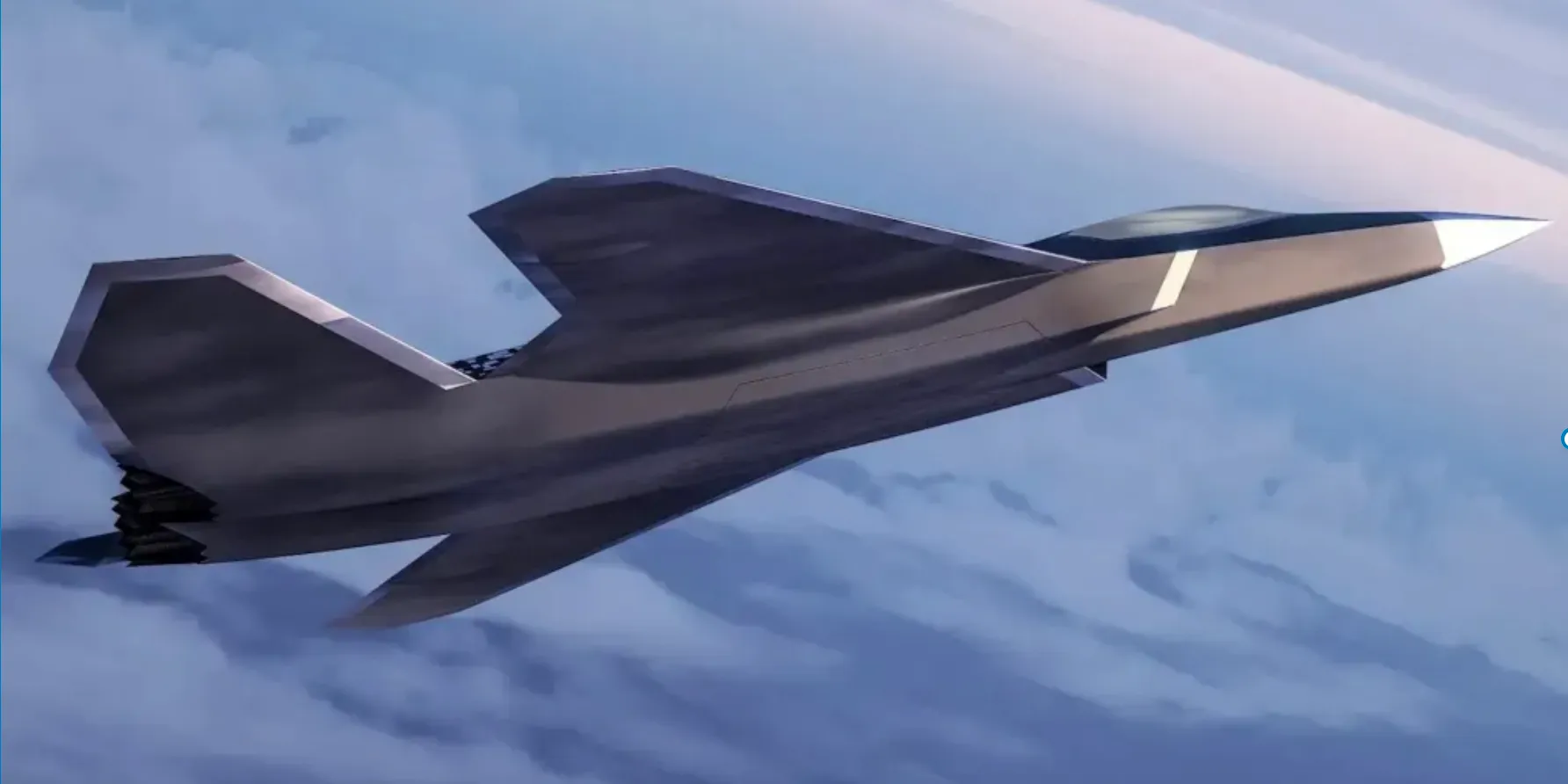
A model of a notional sixth-generation fighter displayed at ILA as part of a command fighter study by the German Aerospace Center (DLR). Thomas Newdick

The termination of NGF and the launch of Team Gen 6 leaves plenty of questions over the future of Europe’s air combat landscape.

TWZ spoke to Douglas Barrie, senior fellow for military aerospace at the International Institute for Strategic Studies (IISS) research institute in London, for his take on what might happen next.

On the matter of Germany and Spain now teaming up under the Airbus umbrella, Barrie said that the relationship makes a lot of sense, but its success is far from certain. On the one hand, the two countries already work together within Airbus, and both Germany and Spain are seeking a replacement for their Eurofighter fleets.

SONY DSC
A pair of Spanish Air and Space Force Eurofighters. Spanish Ministry of Defense

“In terms of Team Gen 6, I do wonder if there’s an element of trying to kind of scramble to recover something from the wreckage of NGF, as it were, that the collapse of NGF doesn’t signal the end of Spanish industrial interest in next-gen combat aircraft development,” Barrie said. “But if somebody asked me, do I think between Germany and Spain, they can put together a credible program if nobody else is involved? I think that the numbers would be very difficult to stack up.”

Putting the German and Spanish future fighter requirements together, the two countries might, at best, need to build 300 new combat jets, with a figure of 250 more likely, Barrie contended. Team Gen 6 would then face a real struggle to break even.

This reality will, Barrie believes, force Germany and Spain to look for other partners, which will likely come down to a choice between the British-led Global Combat Air Program (GCAP) and the Swedish next-generation combat aircraft program, led by Saab. Of these, GCAP has the Tempest crewed fighter as its centerpiece, and also involves Italy and Japan. Sweden’s crewed fighter requirements are less clear at this point.

A scale model of a possible Tempest configuration, in Italian Air Force markings. Leonardo

Building a role for Airbus in GCAP would be difficult at this point. With the industrial architecture already in place, bringing not one, but two more partners into that program would be disruptive, particularly in terms of timeline. Already, the Japanese in particular are concerned about the pace of the program, especially since the United Kingdom has not yet fully committed to it in terms of funding.

“My own view is that the United Kingdom remains committed to the program, but there are financial pressures elsewhere,” Barrie noted. “I think that the more likely outcome in all of this is a kind of German, Spanish, Swedish tie-up. The kind of requirements in some ways are aligned a bit better.”

This extends to the size of the aircraft, Barrie observed.

“The kind of aircraft that the Swedes seem to be thinking about, the crewed element is probably more of a bigger Gripen E/F, heading towards Typhoon, in terms of size. This is more in keeping with what the Germans and the Spanish seem to be looking for. Obviously, the United Kingdom and Japan, in particular, need something with longer legs and bigger internal payload, hence GCAP.”

The Saab Gripen E. Saab

“GCAP will be highly capable,” Barrie continued. “That will come with a unit cost to go with it. Maybe what the Swedes, the Germans, and the Spanish might do will be cheaper.”

Provided a German, Spanish, Swedish teaming arrangement could work, the resulting combat jet could still enter a space where it would face competition for important export orders from France, which looks set to continue the development of the Rafale, especially now that NGF has collapsed. Further competition could be provided by South Korea with further developments of its KF-21 and Turkey with the TF Kaan, although these are notably less-ambitious fifth-generation designs.

The Tempest, as currently envisaged, with its very different set of requirements, would not necessarily be a direct competitor to Team Gen 6, Barrie argued, since it would be a closer match to the F-47 in terms of size, capabilities, and cost. While the potential size of this market would be more limited, probably U.S. reluctance to export the F-47 would play in the Tempest’s favor.

An official rendering of the Boeing F-47. U.S. Air Force

As to the possibility of the United States offering a ‘watered-down’ export model of the F-47, Barrie considers this unlikely to generate much interest.

“Yeah, you can have a downgraded version of my super airplane — as a kind of marketing slug that hardly sells, does it?” Barrie continued. “Even if it’s 10 percent less capable, even if it’s 10 percent less expensive, it’s still a likely unit cost of $250 million or more, which is eye-watering.”

This leaves us with the French, and what they might be able to recover from NGF.

If France goes it alone with a sixth-generation combat jet, Dassault will likely be strongly backed by the French government, and the company has traditionally punched well above its weight.

In the medium term, Dassault has a healthy backlog of orders for the Rafale and is very much at the right end of the cost curve. Barrie considers that the Rafale will remain a profitable airplane for the foreseeable future, but at some point, France will need to think about a successor based on an all-new airframe. Industrially, France has the capability to go alone with this, but they would likely look to a partner or partners to come on board. The likelihood of those partners coming from Europe has now been reduced, but other possibilities might be found in the Gulf states.

A pair of Rafales from the Qatar Emiri Air Force. Dassault Aviation www.twz.com

Then there is the question of India, which may still buy more Rafales but which, in the fullness of time, is likely to look for a new-generation fighter, and could be a potential partner for France.

“I don’t see the Indians ever being fully committed to only one country,” Barrie continued. India has already hinted that it might want to try and join the pan-European FCAS or GCAP. Meanwhile, Russia has been a long-term military partner for India, and Barrie thinks that the recent appearance of a two-seat version of the Su-57 Felon may well indicate another effort to sell that fighter to India.

Imagery has emerged that appears to show a previously unknown two-seat version of the Sukhoi Su-57 Felon, Russia’s most modern and capable fighter. Provided the available photo is legitimate, and there is nothing obvious to suggest otherwise, at this point, the Russian development would parallel China’s work on a two-seat version of the stealthy J-20.
The previously unknown two-seat version of the Sukhoi Su-57 Felon, which appeared earlier this year. UAC UAC

Were India to continue its pattern of buying Russian combat aircraft, that would give any potential European partner serious pause for thought, based on the security implications. Meanwhile, India also remains committed to developing its own next-generation fighter.

What the NGF debacle has demonstrated is that any potential partner with France on its next-generation combat aircraft program will likely have to be happy taking a junior role, with Dassault calling the shots.

The collapse of the New Generation Fighter could well be a pivotal moment for European defense cooperation, but it does not signal the end of Europe’s sixth-generation combat aircraft ambitions.

Airbus’s Team Gen 6 announcement marks the start of a German-Spanish-led industrial approach that its backers hope will be more agile and less contested than its Franco-German-led predecessor. However, significant political, financial, and industrial challenges remain, including the search for a reliable partner, or partners. As with NGF, the success of Team Gen 6 will ultimately depend on whether European governments can align their strategic priorities and industrial interests to deliver a sovereign future air combat capability.

Contact the author: thomas@thewarzone.com
Thomas Newdick is a staff writer at TWZ, where he covers military aviation, defense technology, weapons systems, and international security. Based in Berlin, Germany, he reports on conflicts, military modernization efforts, and emerging aerospace technologies around the world, with a particular interest in airpower and its role in contemporary warfare. His reporting is informed by deep expertise in modern and historical airpower, particularly in Europe, with a focus on military aviation, air campaigns, and aerospace developments across the continent and beyond.


Source link

Inside the crowd drawn to Trump’s UFC fight night at the White House

One by one, the burly mixed martial arts fighters made their entrance past the solemn, hulking marble statue of America’s 16th president and jogged down the steps of the Lincoln Memorial to roars from thousands of fans drawn to the unusual sporting weekend marking the nation’s 250th anniversary and President Trump’s 80th birthday.

The news conference Friday night featured the fighters who are preparing to face off Sunday in the Octagon built outside the White House. But it was also a chance to see the UFC fans who have thronged to Washington and endured lightning, humidity and bugs.

Tracy Philbeck and his son Levi drove from Charlotte, N.C., with a group of friends to support their favorite fighter, American Justin Gaethje, in the upcoming lightweight title bout against Georgian Ilia Topuria.

“You will hear an eagle screaming when Justin Gaethje wins,” the elder Philbeck said with a chuckle.

David Halstead journeyed from Albany, Australia, to watch the sport he has loved for a decade. Halstead said Trump, who regularly attends the fights, “put UFC on the map.”

The UFC has said it spent $60 million on this weekend’s festivities, and the president has billed his birthday fete as “the greatest show on Earth.”

Not everyone agrees.

The Public Integrity Project described the event as a “private, commercial, corrupt use of our most sacred national monuments for private gain” in a lawsuit the watchdog group filed to try to stop it from happening on federal land. A federal judge ruled Friday that the White House was allowed to go ahead.

About 1 in 10 U.S. adults consider themselves mixed martial arts fans, according to Ipsos Sports polling conducted in February and March. That survey suggests MMA fans tend to be male and nonwhite. They are more likely to identify as Republicans than Democrats.

“One misconception is that everyone who watches UFC is a Trump supporter, but that’s not the case,” said Ricardo Rodriguez, 24, explaining that he loves the physicality of the sport. “People also expect a knockout every time.”

Ellie Louizes, who practices Muay Thai, or Thai kickboxing, and jujitsu martial arts, drove from Daytona Beach, Fla., with her boyfriend, Jacob Purvis.

Female fans of MMA are the minority. But Louizes said she knows a lot of women who get into watching the sport through their male partners. She said “female fighters are often way more aggressive” than the men.

Fans brushed off criticism

The fans at the Lincoln Memorial brushed off criticism about the bouts being held at the White House — on federal grounds owned not by its occupant, but by the American people.

Holding fights at the “people’s house,” Tracy Philbeck said, “goes back to the days of Teddy Roosevelt.”

President Theodore Roosevelt regularly held sparring sessions at the White House, though they were not formal, public prizefights. He was an enthusiastic amateur boxer who had boxed at Harvard and continued the sport throughout much of his life.

Boxing fans also make up a large part of the UFC’s fan base.

At a UFC-sponsored community event this week at the District of Columbia’s Midtown Youth Academy, the boxing gym’s executive director was helping out with a visit from UFC fighter Randy Brown, who sparred with more than a dozen local teenagers and preteens.

Gloria Lee said meeting the fighter was a big deal for kids at her gym. “It’s just been a thrilling week, and I was about to fall out when he came in the door!” she said.

Asked about her personal UFC fandom, Lee said she had not watched it much. But by the end of Brown’s visit, she got into the ring with the professional fighter and threw some slugs of her own.

Hussein writes for the Associated Press. AP writer Linley Sanders contributed to this report.

Source link

Franco-German Future Fighter Effort Collapses Over Irreconcilable Differences

The troubled pan-European Future Combat Air System (FCAS) appears to have lurched to an undignified — but predictable — end, at least in its current form. A flurry of media reports today indicate that France and Germany, the two major partners in the program, have abandoned their program to develop a crewed New Generation Fighter (NGF) aircraft together, a conclusion supported by a French diplomat who spoke to TWZ today.

According to sources including the Frankfurter Allgemeine Zeitung, German Chancellor Friedrich Merz has urged French President Emmanuel Macron to pull the plug on the NGF. The German newspaper cited unnamed government sources in Berlin. Reportedly, the French and German leaders concluded that the companies involved — Dassault and Airbus — have been unable to reach agreement on key aspects of the project, specifically relating to the jointly developed fighter jet.

Concept artwork of the NGF future fighter. Dassault Aviation

At this stage, it is reported that Merz and Macron cannot see a future for the NGF, although it is apparently still unclear whether the French government fully shares this assessment and is prepared to accept its consequences.

At this point, it should be recalled that there are at least three separate FCAS initiatives in Europe.

As well as the pan-European version headed up by France and Germany, with Spain and Belgium as junior partners, there is a rival British-led FCAS. This has the Tempest crewed fighter as its centerpiece, involves Italy and Japan, and is now more commonly referred to as the Global Combat Air Program (GCAP). Finally, the Swedish next-generation combat aircraft program, led by Saab, is also known as FCAS.

Returning to today’s developments, French officials are reportedly surprised by what they viewed as uncoordinated messaging from Berlin. From Paris’s perspective, it is the responsibility of political leaders to provide industry with clear direction.

French President Emmanuel Macron talks with Eric Trappier, Chairman and CEO of Dassault Aviation, after the unveiling of the full-scale jet fighter model of the Systeme de Combat Aerien Futur (SCAF), the French-German-Spanish new generation Future Combat Air System (FCAS), during the 53rd International Paris Air Show at Le Bourget Airport near Paris, on June 17, 2019. (Photo by BENOIT TESSIER / POOL / AFP) (Photo credit should read BENOIT TESSIER/AFP via Getty Images)
French President Emmanuel Macron talks with Eric Trappier, chairman and CEO of Dassault Aviation, after the unveiling of a full-scale model of the NGF at the Paris Air Show in 2019. BENOIT TESSIER/AFP via Getty Images BENOIT TESSIER

The French government is also said to be frustrated over what it sees as Germany’s increasing preference for national solutions, which threatens to sideline its own industrial input.

A French diplomat told TWZ: “The President of the Republic and the Federal Chancellor have held extensive and frequent discussions on ways to move forward with this important project for European defense. Both leaders expressed regret that the industrial partners have been unable to reach an agreement on the continuation of the project. The German authorities considered that it was not possible to exert further pressure on the companies involved. France remains convinced that Franco-German cooperation is essential both for our two countries and for our European partners in the fields of defence and security.”

The diplomat added: “The French authorities will continue to encourage our industries and armed forces to explore avenues for ambitious European projects that are consistent with our national security interests.”

According to reports, Macron and Merz discussed the future of FCAS last week, in the latest of several recent efforts to keep the program on track. At the same time, however, Merz had become increasingly vocal about his skepticism regarding the project’s prospects.

The FCAS program was launched back in 2017, with the primary aim of replacing France’s Rafale fleet and Germany’s Eurofighters.

A German Luftwaffe Eurofighter pair. Bundeswehr/Bicker A pair of Eurofighters from Tactical Air Force Wing 73 “Steinhoff” during air-to-air training. Bundeswehr/Bicker

FCAS was envisioned as a next-generation European combat air system entering service around 2040, spearheaded by the NGF crewed fighter. As of 2022, it was envisaged that “in-flight demonstrations” would be achieved by 2028 or 2029. 

Before long, however, the project was overshadowed by arguments over workshare agreements, and it is unclear how far the partners had got in terms of agreeing on NGF requirements and starting its design.

For a while now, there have been reports that Germany is exploring alternative paths, including the possibility of separating itself from France within the program entirely.

By February of this year, Merz was publicly raising doubts about the program’s viability, arguing that key issues had never been fully resolved during the planning phase. According to the German leader, Germany and France have fundamentally different operational requirements for a future combat aircraft.

Merz pointed to the specific French requirements that call for aircraft to be capable of carrying nuclear weapons and operating from aircraft carriers. Merz argued that Paris is seeking to shape the aircraft around French military requirements, which do not necessarily align with Germany’s needs.

PARIS, FRANCE - JANUARY 06: French President Emmanuel Macron (R) greets German Chancellor Friedrich Merz upon his arrival at the Elysee Palace on January 06, 2026 in Paris, France. Leaders from around 30 countries are gathering in Paris to discuss military support for Ukraine, amid ongoing negotiations on a US-brokered peace plan to end Russia's war in Ukraine. (Photo by Tom Nicholson/Getty Images)
French President Emmanuel Macron (right) greets German Chancellor Friedrich Merz at the Elysee Palace in Paris in January 2026. Photo by Tom Nicholson/Getty Images Tom Nicholson

“This is not primarily a political disagreement,” Merz said. “The real issue lies in the requirements profile. If we cannot reconcile those differences, the project cannot continue.”

Within France, Dassault CEO Éric Trappier recently declared the FCAS project dead if Airbus refuses to cooperate, while Macron continued to make efforts to resuscitate the program.

There are indications that Paris will still try to do its best to keep the program alive, and it remains possible that the broader FCAS architecture, or parts of it, could continue even without the NGF. FCAS has always intended to field families of drones, air-launched weapons, and potentially other aerial platforms, within an overarching ‘combat cloud.’

An Airbus concept showing an NGF connected via satellite-based Combat Cloud to Remote Carriers, as well as a variety of legacy combat and support platforms. Airbus

The German government considers that the “true essence of FCAS” should be continued as a European system of systems, according to the Frankfurter Allgemeine Zeitung.

FCAS System of Systems thumbnail

FCAS System of Systems


Whatever happens next, the program appears to be at a crossroads, and facing its biggest existential challenge yet.

It is highly questionable whether either France or Germany (even with Spanish industrial support and finance) could develop a fighter without the other major partner.

This could open the door to a radical reshaping of European combat air programs.

There have already been suggestions at the highest military levels that the British-led and Franco-German FCAS efforts could be fused in some way. However, it seems highly unlikely that all these partners could come together with agreement. Just as questionable is whether the GCAP effort would be able to admit new major partners at this late stage.

Then there is the issue of Sweden.

Last month, we reported on Airbus having raised the possibility of teaming with Saab on the manned tactical component of FCAS. That was one of the clearest indications yet that Airbus is actively exploring post-FCAS alternatives, or, at the least, a major overhaul of the program’s structure.

A Saab study for a supersonic uncrewed platform as part of its own FCAS effort. SVT screencap via X

Potentially, Airbus and Saab could now team up to develop a joint next-generation fighter, with their requirements likely to be more closely aligned than those of France. Germany and France also have a less urgent need for a sixth-generation combat jet, with Sweden only now introducing the Gripen E, and with Germany looking forward to receiving F-35s as well as more Eurofighters.

jAS 39 E
The first Gripen E for the Swedish Air Force. Saab SAAB

For France, losing its partners for NGF could be more critical, although it continues to work on advanced versions of the Rafale. In 2024, France also unveiled plans to develop a new uncrewed combat air vehicle (UCAV) that will complement the forthcoming Rafale F5 crewed fighter. The industrial side of the drone program will be headed up by Dassault, drawing upon its previous nEUROn UCAV demonstrator, which has already been used in trials with crewed combat aircraft.

France has unveiled plans to develop a new uncrewed combat air vehicle (UCAV) that will complement the forthcoming Rafale F5 crewed fighter, as part of a new-look French Air and Space Force. The industrial side of the drone program will be headed up by Dassault Aviation, drawing upon its previous nEUROn UCAV demonstrator, which has already been used in trials with crewed combat aircraft.
A Rafale accompanies a nEUROn drone during a test flight. Dassault Aviation/Anthony Pecchi Dassault Aviation/Anthony Pecchi

The F5 standard of the Rafale is planned to keep the multirole combat aircraft in frontline service until around 2060. That will at least give France some time to consider what to do about a future crewed fighter.

A French Air and Space Force Rafale C. Dassault Aviation

Drones are also increasingly part of the combat-air picture in Germany, too. Delays in fielding a sixth-generation fighter could be mitigated, to a degree, by Airbus developing combat drones. Airbus and Kratos are already pitching the stealthy XQ-58A Valkyrie drone to Germany, and Airbus has also been working on a stealthy CCA-like concept of its own, known as Wingman.

A rendering of the Airbus Wingman CCA-like drone. Airbus

In the background, the U.S.-made F-35 continues to expand its customer base in Europe. There is also the prospect that, in the future, the sixth-generation F-47 might also be offered for export in the region, although this might only be in a watered-down form.

Overall, though, the latest development is a poor reflection on Franco-German cooperation, which has singularly failed to come to agreement about what should be a flagship program, providing a cornerstone of efforts to strengthen Europe’s defense capabilities.

With the ILA Berlin airshow starting on Wednesday, this news could hardly be worse-timed. On the other hand, we may well learn more about Germany’s vision for its future combat aircraft program before the week is out.

Contact the author: thomas@thewarzone.com

Thomas is a defense writer and editor with over 20 years of experience covering military aerospace topics and conflicts. He’s written a number of books, edited many more, and has contributed to many of the world’s leading aviation publications. Before joining The War Zone in 2020, he was the editor of AirForces Monthly.


Source link

Katie Taylor: How iconic Irish fighter finally secured dream Croke Park bout

Still, 80,000 seats is a lot to shift and in today’s environment, only the top heavyweights, plus a handful of other stars including Saul ‘Canelo’ Alvarez and Naoya Inoue can hit such heights.

For Taylor, 39, and her team to have ambitions to command such an audience is evidence of the reverence in which she is held.

After Friday’s news conference, the Bray native and team set off on a four-day promotional tour around the island of Ireland, beginning in her home town.

It may be a farewell, but a test and not a testimonial is how Taylor wants to sign off.

The opportunity to regain the WBC portion of the light-welterweight title [which was made vacant after last year’s Serrano win] and retire undisputed is the dream.

But she has no designs on getting swept up in the emotion with undefeated Frenchwoman Flora Pili standing in her way.

The Croke Park door appeared shut when an agreement could not be reached between Hearn and stadium authorities three years ago, so what has changed?

With costs to hire the stadium “twice as much as Wembley” according to the Matchroom chairman, it was difficult to see how the impasse would be broken.

For the company there is “not a whole lot financially” to be gained, but just as the rematch between Carl Froch and George Groves at Wembley Stadium in 2014 proved a big night for Matchroom, 80,000 at Croke Park can do likewise according to Hearn.

“That a female is fighting in front of 80,000 people, I think it’s the greatest moment of our [Matchroom’s] boxing history,” he said.

“We’re not going to be making much money on the night, but this is about more than that. My dad [Barry, Matchroom founder and president] might kill me, but what does it really matter what we make on a night like this?

“What we leave with is something we’ll never forget and also it’s important for the brand of our business.”

Source link

Area 51 Mystery Aircraft Prompts Interest In “Christmas Tree” Stealth Fighter Concept

Yesterday, TWZ published an analysis of a thermal image purportedly showing a previously unseen advanced aircraft design, which appears to be a precursor to the U.S. Air Force’s forthcoming F-47 fighter from Boeing. The image, which went viral online and is from a video that has now been released, is said to have been captured near the U.S. military’s secretive Groom Lake test base, better known as Area 51. It turns out, as a number of our readers have pointed out, there may be some interesting similarities between this secret aircraft and a “Christmas tree” fighter design concept crafted decades ago by Darold Cummings, one of the top minds behind Northrop’s YF-23 Black Widow.

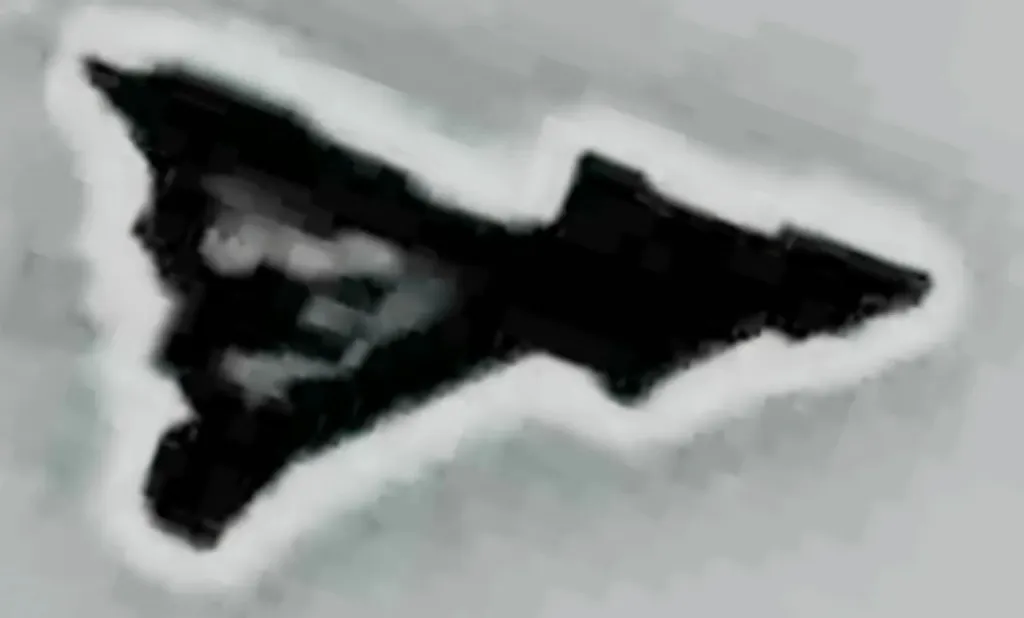
You can find our full initial assessment of what we may be seeing in the viral image, first posted online by the Project Fear YouTube channel earlier this week, here. What we saw initially, as shown below, appeared to feature what could be described as a “double arrowhead” profile to its forward fuselage. This is a very distinct design cue, but it could also be a result of the low quality of the image and the artifacts that come with consumer-grade thermal imagers, which was what the aircraft was recorded with.

A close-up look at what is visible in the viral thermal image. Capture via Project Fear

Project Fear has now released the full video it says it captured near Area 51, seen below, and it underscores the aforementioned points about image quality. So, it is possible the aircraft has a more traditional low-observable ‘shovel nose,’ instead. Nonetheless, the Christmas tree fighter is an interesting trip down lesser-known fighter development memory lane that is worth examining, in particular what such a unique nose configuration would provide an advanced fighter aircraft.

The full clip of the mysterious aircraft passing by starts at around 49:34 in the runtime of the video below if it does not automatically start playing at that point.

​We Filmed a Top Secret Craft Flying at Area 51 thumbnail

​We Filmed a Top Secret Craft Flying at Area 51


In a post on LinkedIn around the end of last year, Darold Cummings shared an intriguing blueprint of a relevant-looking advanced fighter concept, along with additional details about the design and its genesis. Cummings is currently the founder and president of ForzAero, but has an extensive resume in the aviation industry dating back decades. As noted, he was a key figure at Northrop in the development of the YF-23, which ultimately lost out to what became Lockheed’s F-22 Raptor. He also led the team at Boeing that developed the X-40A Space Maneuver Vehicle, which was used as a testbed in support of work on what evolved into the X-37B reusable spaceplane. He was Chief Engineer/Chief Designer of Rockwell’s Ranger 2000 Jet Trainer, as well.

“I was hired by Bob Sandusky in 1982 to be the Chief Configurator for the Northrop ATF [Advanced Tactical Fighter] program (YF-23). In early 1983 Bob said that Northrop had tried to develop a ‘4-spike’ (like the B-2) fighter, but it couldn’t be done, since a flying wing fighter was not possible,” Cummings wrote in his post on LinkedIn. “I told him I could design one, and he said to give it a try. The only way to accomplish this was with a series of highly swept (55 degree) surfaces over the entire length of the aircraft. The result was the DP-21, created in June of 1983.”

“4-spike” here essentially refers to the total number of radar cross-section hot-spots and where they are located, each pointing in a different direction in azimuth. The fewer ‘spikes’ a low-observable (stealthy) aircraft has, the easier it is to manage its radar signature, and to make it harder to detect and lock onto, but it’s also where those spikes are located that matter.

The blueprint of the DP-21 “Christmas Tree” fighter concept. Darold Cummings

A four-spike design like the B-2 critically has nothing from the head-on aspect, as well as from the rear, which helps immensely with survivability. These are the most critical signature areas, especially the front as the aircraft is heading into hostile territory. Also, because these are located along the path of flight, these spikes can stay consistent on a threat radar as the aircraft moves directly toward or away from the sensor, and are not fleeting in nature like those from the side. So a four spike aircraft would be very attractive for a tactical fighter meant to persist in contested territory.

“I never considered this to be a serious contender for the ATF program, as the aircraft was unstable beyond 10 degrees angle of attack!” he also noted.

“Back in 1983, the ‘Christmas Tree’ DP-21 would have been difficult to fly. However, with modern flight control systems, this design could be controlled, even at high angle of attack,” Cummings told TWZ directly today after we reached out for more information. “Low observability is always better served with long edges on the design, so the small arrow-shaped foreplane is not ideal, but it still has low RCS characteristics, just not the optimum.”

“Wing shaping is always a trade-off for maximizing LO. Most of the trades have to do with the leading edge contour, which is a large contributor to signature,” he continued. “The canard has to be designed to be ‘ported’ during penetration, as this minimizes the signature. On the YF-23, the V-Tail was ‘ported’ in penetration for the same reason. This is certainly possible with modern flight control systems.”

“Ported” in this instance refers to keeping the control surface locked in the same geometric plane as the wing while cruising.

A top-down look at the YF-23 during a flight test. USAF

We also asked Cummings directly whether it was possible his DP-21 concept had an influence on what is seen in the viral thermal image, assuming it is authentic. And we asked for his take on what impacts Boeing’s experimental X-36 and Bird of Prey designs may have had on the F-47, as well.

“My DP-21 aircraft image has been available publicly for quite some time, so it is possible it had some influence, but that is only speculation on my part,” he told us. “I believe the X-36 and Bird of Prey have both influenced the F-47 design. I have always been impressed by the X-36, as it seemed to be ahead of its time.”

Boeing’s X-36 demonstrator. NASA/Carla Thomas
Boeing’s Bird of Prey. USAF

“The Groom Lake images are truly intriguing,” he also noted. “It is a viable concept.”

“I think the main thing to remember is that NO ONE thought a 4-spike design (like the B-2) was possible, and my DP-21 was an example of how it was possible,” he added. “A 4-spike design for the F-47 would truly be impressive!”

An official rendering of the F-47. USAF

As TWZ already wrote yesterday, based on what is visible in the image:

“The image shows an exotic design by any interpretation. The aft-set lambda-type wings appear to have a camber and wingtip droop, as on the Boeing Bird of Prey demonstrator. There are very large canard foreplanes — a feature that appears prominently on F-47 renderings and which we have written in detail about in the past. The broad nose, too, is something that has been included in depictions of the F-47, although we have really no idea to what degree these are based in reality. It’s worth noting that in this new thermal image, it has a distinctive double-arrowhead shape, tapering in again in front of the canards. Even the canards themselves may have more than one plane, with the outer tips being drooped, matching similar architecture as the wing. The fuselage then tapers down in the center before the wing roots begin.”

“The aircraft is very likely to be tailless, a feature common to most sixth-generation concepts seen so far. However, since it’s seen from below, we cannot be sure about this aspect of its configuration.”

“As for the powerplant, it is most likely a twin-engine design, like the F-47, a theory reinforced by the sawtooth-type trailing edge. There is no obvious suggestion of any exhaust plumes, which seems odd, but that could be the result of the sensor being used in combination with the aircraft’s power setting at the time of recording, as well as general thermal signature reduction capabilities that are part of the design.”

“Soon after Boeing won the contract for the F-47, we looked at how it might have been influenced by the Phantom Works X-36, also a tailless-canard design.”

Another official rendering of the F-47. USAF

As mentioned earlier, the full video Project Fear released today does raise new questions about the exact profile of the front of the design seen in the footage. The idea of using a shovel nose profile on a stealthy aircraft dates back to Northrop’s Tacit Blue demonstrator, and it was found in its modern form the YF-23. It has since become common to see on low-observable (stealthy) designs, and has been notably present in official renders of the F-47 released to date.

Beyond the nose end, there are still some very broad similarities in the shaping of the wing and main body of the aircraft seen in the footage and Cummings’ DP-21 concept.

To date, there are no indications that an F-47 EMD prototype has flown. Air Force officials have said on multiple occasions now that first flight of the service’s new sixth-generation fighter is expected to come in 2028.

We do know that Boeing and Lockheed built flying demonstrator designs that fed into the Next Generation Air Dominance (NGAD) initiative, under which initial development of what has become the F-47 was carried out. Past reports have raised the possibility that there was a third NGAD demonstrator, which might have been built by Northrop Grumman. That company voluntarily dropped out of the NGAD combat jet competition around 2023, and is said to have been on the verge of being cut at the time.

As we noted yesterday, what is seen in the viral thermal image could be unrelated entirely to the F-47. The Navy has also been pursuing a carrier-based sixth-generation fighter, commonly referred to as F/A-XX, in recent years. There has been at least some crossover between F/A-XX and the Air Force’s NGAD effort. A rendering Boeing has shared of its proposed F/A-XX design looks very much in line with what has been shown of F-47 to date. Northrop Grumman is the other company currently competing to build the Navy’s sixth-generation carrier fighter, and has released its own renderings.

Boeing’s F/A-XX render. Boeing

In addition, it should be said that official F-47 and F/A-XX renderings released to date will have been carefully manipulated to maximize security of the programs, both of which remain highly classified, and to provide disinformation to adversaries.

As an aside, Darold Cummings also shared his take on a prospective navalized version of the F-47 in a separate post on LinkedIn last year. At that time he wrote:

“I received a DM asking if I had envisioned a Navy version of my recent F-47 fighter concept,  such as  the F-35A to F-35C approach. I recently completed my F-47 Navy version, which I call the F-47N. However, the approach I took was somewhat different: The F-35C used a larger wing for low speed lift, whereas I used my original F-47 wing planform, and added a canard for more low speed lift and control. The canard design (inspired by the X-36), coupled with the Multi-Axis Thrust Vectoring (inspired by the X-44), provided a very reasonable first cut at a Navy version. In general, a canard layout has been treated as adding more radar signature to a fighter. However, on the YF-23 we found that if the all-moving surface (it was a V-tail on the YF-23) was kept “ported”, in this case aligned with the wing plane during cruise, the impact on LO was not a large impediment to signature reduction. The ability to keep the canard ported is achievable using thrust vectoring for trim in cruise and penetration modes.”

Cummings’ interpretation of the F-47 design at that time notably did not reflect his previous DP-21 concept. The X-44 design he mentioned is also known as the Multi-Axis No-Tail Aircraft (MANTA), and was derived from F-22. At least to our knowledge, the MANTA never came to be. The designation was recycled for an entirely unrelated flying wing-type drone, the existence of which was first reported by TWZ.

Darold Cummings’ drawing of his notional “F-47N.” Darold Cummings
Renderings of the X-44A MANTA. Lockheed Martin/NASA

It’s also worth noting that the design in the newly emerged thermal video could be tied to one of many other programs, including uncrewed ones. Still, it is very much in line with what we would expect to see from a design related to the F-47 and it seems very likely this is the Boeing NGAD demonstrator, if the video is indeed authentic, which it appears to be.

It would be nice to say that we will have to wait and see whether this aircraft turns out to have a more traditional shovel-shaped nose, or even a mild Christmas tree-like design, but we may never see it again. Hopefully that is not the case, especially after the F-47 goes public, but the final design will have significant differences from its technology demonstrator forebears.

Special thanks to @ElectroFluidSys on X for bringing Darold Cummings’ posts on LinkedIn to our attention.

Contact the author: joe@twz.com

Joseph has been a member of The War Zone team since early 2017. Prior to that, he was an Associate Editor at War Is Boring, and his byline has appeared in other publications, including Small Arms Review, Small Arms Defense Journal, Reuters, We Are the Mighty, and Task & Purpose.


Howard is a Senior Staff Writer for The War Zone, and a former Senior Managing Editor for Military Times. Prior to this, he covered military affairs for the Tampa Bay Times as a Senior Writer. Howard’s work has appeared in various publications including Yahoo News, RealClearDefense, and Air Force Times.


Tyler’s passion is the study of military technology, strategy, and foreign policy and he has fostered a dominant voice on those topics in the defense media space. He was the creator of the hugely popular defense site Foxtrot Alpha before developing The War Zone.


Source link

Tom Aspinall: Eddie Hearn calls on UFC president Dana White to release fighter

Boxing promoter Eddie Hearn has called on UFC president Dana White to release Tom Aspinall from his contract and says the heavyweight champion is not being paid his worth.

Manchester-based Aspinall, 33, signed a “commercial and advisory” deal with Hearn’s new talent agency in March.

Aspinall has been the standout performer in the UFC’s heavyweight division in recent years, with seven of his eight wins ending in the first round.

Hearn is prepared to offer Aspinall higher earnings if the UFC allowed him to leave, as tensions continue to grow between himself and White, though it is unclear whether that would be in boxing or MMA.

Matchroom chairman Hearn is also willing to drop planned legal action over Conor Benn’s decision to leave his stable for White’s Zuffa Boxing promotional company if they release Aspinall.

Hearn, 46, previously described 29-year-old Benn’s departure as a “dagger in the heart”.

“I’ll walk away from all their problems they’ve got on the Conor Benn legal situation if they release Tom Aspinall,” Hearn said.

“And I will, in writing, it will be five or six times more money he’ll be making, but I will put in writing that Tom Aspinall will make a minimum of three times more than he will under his current contract.”

Aspinall remains under contract with the UFC and is one of its biggest stars.

Hearn has previously criticised the UFC’s pay structure and suggested leading fighters could earn considerably more elsewhere.

There is no indication the UFC would consider releasing Aspinall, but Hearn’s remarks have increased debate around fighter pay in mixed martial arts (MMA).

“I would like to propose that Dana White should be happy for Tom Aspinall, who is extremely unhappy, and he should release him of his obligations with the UFC,” Hearn added.

“And he should allow him to go out and make considerably more for himself and his family because that’s what Dana White’s all about, isn’t it? He’d be happy for Tom. So that’s what I would like.”

Aspinall has been dealing with eye problems since his title fight with Ciryl Gane last October had to be stopped because of repeated eye pokes.

He had double eye surgery in February and it is not yet certain when he will be able to return to action.

Hearn has been publicly feuding with UFC president White since the launch of Zuffa Boxing.

Aspinall became part of that war of words when Hearn suggested White “humiliated” him by not backing the fighter after the eye controversy.

Source link

Airbus Looks To Sweden’s Saab As Europe’s Sixth-Gen Fighter Plans Unravel

With the pan-European Future Combat Air System (FCAS), which is supposed to include a crewed New Generation Fighter (NGF) aircraft, mired in difficulty, Airbus has raised the possibility of teaming with Saab on the manned tactical component of it — the fighter. As well as France and Germany, Spain is a part of the pan-European FCAS as a junior partner, while Belgium has also joined it. The recent statements mark one of the clearest indications yet that Airbus is actively exploring post-FCAS alternatives, or, at the least, a major overhaul of the program’s structure.

Speaking on the sidelines of the Airbus Defense Summit at Airbus Defense & Space’s Manching site near Munich last week, that company’s CEO, Michael Schoellhorn, said that he was keen to cooperate with Sweden and Saab on a new fighter.

Concept artwork of the NGF future fighter. Dassault Aviation

Schoellhorn’s words were provided in an exclusive interview by Johan Wendel, a reporter and analyst for the Swedish Dagens Industri financial newspaper.

At this point, it’s worth recalling that the FCAS nomenclature is also used by the British and Swedish future combat air initiatives. The British effort is now mainly known as the Global Combat Air Program (GCAP).

FCAS System of Systems thumbnail

FCAS System of Systems


Noting that FCAS was in trouble in its current guise, he confirmed that Airbus has been in contact with both the Swedish and German governments on the issue, with “productive but confidential” discussions.

“We are open to a number of things. For Airbus, the crewed fighter aircraft is still an open question,” Schoellhorn told Dagens Industri, when asked if the company is considering developing a crewed fighter together with Saab.

The Airbus boss then reiterated that the company “will be involved in the development of a sixth-generation fighter aircraft.”

Schoellhorn recently visited Sweden and reflected that “Sweden and Saab are candidates with extensive expertise” in the field of fighter design and production. “We have difficulties that everyone knows about. That is why it is time to actively explore other options, which is what we are now doing,” he added, in reference to the FCAS program.

BRUSSELS, BELGIUM - MARCH 13: Michael Schoellhorn, CEO of Airbus Defence and Space, speak during a keynote conference at the inaugural edition of the Brussels European Defence Exhibition & Conference (BEDEX) on March 13, 2026 in Brussels, Belgium. The new BEDEX event has been created in partnership with the Belgian Ministry of Defence and Armed Forces to showcase the European and NATO defence industries, as Belgium and other European countries increase defence spending in response to the current geopolitical climate. (Photo by Omar Havana/Getty Images)
Michael Schoellhorn, CEO of Airbus Defense and Space. Photo by Omar Havana/Getty Images

As TWZ only recently reported, questions around FCAS continue to grow.

For a long time, tensions have been evident within the FCAS program, with its two main partners, France and Germany, increasingly at odds. German defense officials are reportedly frustrated by what they see as disproportionate French demands for control and workshare in the project. For a while now, there have been reports that Germany is exploring alternative paths, including the possibility of separating itself from France within the program entirely.

Within France, Dassault CEO Éric Trappier recently declared the FCAS project dead if Airbus refuses to cooperate, while President Emmanuel Macron has made efforts to resuscitate the program.

French group Dassault Aviation Chief Executive Eric Trappier poses in front of the full-scale model of the Systeme de Combat Aerien Futur (SCAF), the Future Combat Air System (FCAS) on the Dassault Aviation's static display during the International Paris Air Show on June 18, 2019 at Le Bourget Airport, near Paris. (Photo by ERIC PIERMONT / AFP) (Photo by ERIC PIERMONT/AFP via Getty Images)
French group Dassault Aviation Chief Executive Eric Trappier poses in front of the full-scale model of the NGF. Photo by ERIC PIERMONT/AFP via Getty Images

Now, Sweden, with its position as a builder of tactical aircraft in the West, has emerged as a possible lifeline for FCAS, something that Schoellhorn acknowledged to Dagens Industri.

“We will be involved in the development of such an aircraft. The structure within FCAS could be improved. That could lead to two fighter aircraft within FCAS, or to another form of cooperation, and Sweden and Saab are candidates with extensive expertise in this field.”

When asked whether this was an Airbus tactic to put pressure on Dassault, Schöllhorn pointed to “many” previous cooperations between his company and Saab.

“We are not flirting,” he added. “We want to build sixth-generation fighter aircraft as soon as possible. I do not want to see sixth-generation fighter aircraft bought from the United States, as Europe did with the fifth generation.”

Here, he pointed to the growing customer base for the U.S.-made F-35 in Europe and the prospect that, in the future, the sixth-generation F-47 might also be offered for export in the region, although this might only be in a watered-down form.

Shown is a graphical artist rendering of the Next Generation Air Dominance (NGAD) Platform. The rendering highlights the Air Force’s sixth generation fighter, the F-47. The NGAD Platform will bring lethal, next-generation technologies to ensure air superiority for the Joint Force in any conflict. (U.S. Air Force graphic)
A rendering of the U.S. Air Force’s sixth-generation fighter, the F-47. U.S. Air Force graphic Secretary of the Air Force Publi

Of course, GCAP, the British-led rival to FCAS, with the Tempest crewed fighter as its centerpiece, could be another option, but there are big questions surrounding the future of that program, too. As well as the United Kingdom, GCAP involves Italy and Japan.

An artist’s impression of the Tempest future fighter. BAE Systems

“We must act now,” Schöllhorn said, to prevent Europe from looking beyond the pan-European FCAS for its next crewed fighter.

“If we are to have something that can be called sixth generation and that is airborne before the 2040s, we have to act now. We are waiting impatiently to see what the politicians will decide. If we are still in limbo at the end of the year, that would be very challenging,” Schöllhorn added.

As for GCAP, in which Sweden previously had a limited involvement, before stepping away from it, Schöllhorn also refused to rule out rolling the different projects together.

“GCAP is an existing alternative that could be considered,” he explained. “The defense industry submits proposals; the politicians decide what is to be done.”

Then there is the drone issue, or, more accurately, the Collaborative Combat Aircraft, or CCA, issue.

While cooperative projects to develop fighters and their surrounding ecosystems have floundered, CCAs, as a concept, have forged ahead.

The Air Force’s Experimental Operations Unit, under Air Combat Command, concluded a critical exercise with Collaborative Combat Aircraft recently at Edwards Air Force Base, California, putting principles of the new Warfighting Acquisition System into practice. The exercise employed the YFQ-44A aircraft and represents a shift toward the new concept of earlier, operator-driven experimentation to inform tactics and procedures that will accelerate the delivery of this transformative capability to the warfighter.
The Anduril YFQ-44A is one of the first two aircraft ordered under the U.S. Air Force’s Collaborative Combat Aircraft program. U.S. Air Force U.S. Air Force photo by Ariana Ortega

“Everyone has seen the need for CCA. There is a European race underway to find the model for CCA in various European countries,” said Schöllhorn.

The Airbus CEO underlined the fact that the company is also developing combat drones and that future uncrewed fighters are part of the plan. “There will not be a one-size-fits-all solution,” Schöllhorn added. “Perhaps we should not all go into the same niche, such as air-to-ground. The goal is to deliver the versatility, but also the scale that Europe will need.”

Airbus and Kratos are already pitching the stealthy XQ-58A Valkyrie drone to Germany, and Airbus has also been working on a stealthy CCA-like concept of its own, known as Wingman. Meanwhile, Boeing Australia has teamed up with Rheinmetall, the largest arms manufacturer in Germany, to offer the MQ-28 Ghost Bat drone to the German military.

A rendering of the Airbus Wingman CCA-like drone. Airbus

Once again, Sweden could provide a key partner to Airbus on CCA-type developments, whether part of a broader FCAS effort or separate.

As we have reported in the past, Sweden is also moving ahead with plans for a new-generation combat aircraft, with Saab undertaking continued conceptual studies for future fighter systems. However, it remains unclear if there will definitely be a crewed successor to the Swedish Air Force’s current Gripen fighter, or if the ongoing studies will lead to a combat air ‘ecosystem’ comprised of different types of drones. A combination of crewed and uncrewed platforms remains possible, too.

A Saab study for a supersonic uncrewed platform with a weight of more than five tons, as part of its F-series. SVT screencap via X

Interestingly, Schöllhorn also put forward the possibility of Airbus working alongside Sweden for the airborne early warning and control (AEW&C) segment, specifically Saab’s GlobalEye aircraft.

“If we were to join forces, we could be a very capable team that could contribute many future capabilities,” said Schöllhorn of this idea.

The CEO noted that a NATO procurement decision on its future AEW&C platform is currently under review. Meanwhile, France has chosen the GlobalEye to replace its E-3F Sentry Airborne Warning & Control System (AWACS) fleet.

Only today, Canada announced plans to buy GlobalEye, ​rather than the competing Boeing E-7 Wedgetail, which has suffered from delays and cost overruns.

Saab currently installs the GlobalEye system on the Canadian-made Bombardier Global 6500 airframe, but Schöllhorn does not rule out the possibility of a new AEW&C aircraft based on an Airbus airframe. Here, the Airbus boss pointed to the ongoing program to furnish the Indian Air Force with AEW&C aircraft based on A320 airliner airframes.

Returning to the issue of a sixth-generation crewed fighter for Europe, whether Airbus and Saab ultimately forge a formal partnership, the broader situation is abundantly clear. With the pan-European FCAS stalled by political and industrial infighting, GCAP facing its own uncertainties, Europe’s future fighter landscape is at something of a crossroads. The pressure to deliver a credible European sixth-generation combat aircraft is intensifying.

Contact the author: thomas@thewarzone.com

Thomas is a defense writer and editor with over 20 years of experience covering military aerospace topics and conflicts. He’s written a number of books, edited many more, and has contributed to many of the world’s leading aviation publications. Before joining The War Zone in 2020, he was the editor of AirForces Monthly.


Source link

Two-Seat Variant Of Russia’s Su-57 Felon Fighter Materializes

Imagery has emerged that appears to show a previously unknown two-seat version of the Sukhoi Su-57 Felon, Russia’s most modern and capable fighter. Provided the available photo is legitimate, and there is nothing obvious to suggest otherwise, at this point, the Russian development would parallel China’s work on a two-seat version of the stealthy J-20. While the exact role of China’s two-seat J-20S remains the subject of debate, it is noteworthy that Russia’s use of dual-seat tactical jets is well-established, as is China’s, and that Sukhoi had previously drafted a two-seat Felon specifically for an Indian requirement.

The apparent first publicly available photo of the two-seat Su-57 appeared on the Fighterbomber Telegram channel, which has close ties to the Russian Aerospace Forces. The same account claims that the aircraft is now undergoing taxi trials.

With the unveiling of the two-seat variant of the Su-57- aka the Su-57D (?) – it appears that, following the J-20S (AS), there is now a second 5th-generation aircraft available in a two-seat configuration.

1. pic.twitter.com/JgThpiEdfA

— @Rupprecht_A (@RupprechtDeino) May 17, 2026

The most prominent modification to the aircraft is a redesigned forward fuselage, with a tandem two-seat cockpit that is broadly similar to that on the Su-30 Flanker family and on the two-seat Su-27UB Flanker-C. As on the Su-30, the rear seat is positioned significantly higher than the front one, providing a much better view forward from the rear cockpit.

The background of the photo has been blurred, so the location cannot be identified. Typically, tests of this kind would take place at Zhukovsky, near Moscow, the major hub for Russian experimental aerospace testing.

Russian air force pilots sit in the cockpit of a Russian air force Sukhoi Su-30SM fighter jet before departure on a mission at the Russian Hmeimim military base in Latakia province, in the northwest of Syria, on December 16, 2015. - Russia began its air war in Syria on September 30, conducting air strikes against a range of anti-regime armed groups including US-backed rebels and jihadist groups. Moscow has said it is fighting and other "terrorist groups," but its campaign has come under fire by Western officials who accuse the Kremlin of seeking to prop up Syrian President Bashar al-Assad. (Photo by Paul GYPTEAU / AFP) (Photo by PAUL GYPTEAU/AFP via Getty Images)
Russian pilots sit in the cockpit of a Su-30SM fighter in Syria in 2015. Photo by PAUL GYPTEAU/AFP via Getty Images PAUL GYPTEAU

Some reports suggest that this new version of the Felon is designated Su-57D or Su-57UB, but this remains unconfirmed. In a Russian aerospace context, the suffix D would normally denote long range, while UB signifies a combat trainer.

There have been suggestions that the two-seat Su-57 might have been built using an existing single-seat Felon airframe, namely one of the prototypes, T-50-5R.

With no previous reports that Sukhoi was actively working on a two-seat version of the Su-57, the aircraft’s appearance now is all the more intriguing.

However, back in 2023, details of a patent emerged for a “multifunctional two-seat low-observable tactical aircraft,” with plans published showing a two-seat Su-57. According to Russian media reports, the planned two-seat aircraft is intended for “acting as an airborne command post for network-oriented operations of mixed groups of aircraft.” This is a concept that actually dates all the way back to when the Su-30 was first drafted at the end of the Soviet era. At the same time, the patent points to the utility of such an aircraft for crew training. Regardless, the accompanying illustration looks very similar to the two-seat Felon we see in the image from Fighterbomber.

Federal Service for Intellectual Property

As far as the Russian Aerospace Forces are concerned, only 76 Su-57s (presumed to be single-seaters) are on order. This is a surprisingly low number, with Moscow instead having chosen to invest in the cheaper and well-proven Su-35S and Su-30SM/M2 families of tactical fighters. The Su-57 first appeared, then in T-50 pre-production form, a decade and a half ago.

The idea that Russia might be seeking a combat trainer to help convert pilots to the Su-57 seems very unlikely, especially considering the small number of frontline Felon fighters currently planned. Stealth fighters have dropped the two seat trainer companion concept from the Cold War era. The extreme focus of signature control, high cost of the aircraft, higher levels of automation, as well as enhancements in simulated training over the years, have spurred this.

It may be that Sukhoi is seeking to promote a two-seat combat version of the Su-57 as a direct successor to the twin-seat Su-30SM/M2. These aircraft are widely used by the Russian Aerospace Forces for both long-range air defense and ground attack/strike, two roles for which Russia has long prized having an extra crewmember on board.

Sukhoi T-50 and Sukhoi Su-30MK jet fighters of Russian Air Force fly in formation at MAKS-2013 International Airshow near Zhukovsky, Russia. (Photo by: aviation-images.com/Universal Images Group via Getty Images)
A Su-30MK demonstrator performs alongside a T-50 prototype at the MAKS 2013 International Airshow near Zhukovsky, Russia. aviation-images.com/Universal Images Group via Getty Images aviation-images.com

There is also the fact that the two-seat Su-57 is intended to operate alongside loyal wingman drones, specifically the Sukhoi S-70 Okhotnik-B (Hunter-B) flying-wing uncrewed combat air vehicle (UCAV).

The emergence of crewed-uncrewed teaming will be greatly enabled by a second person acting as a ‘mission commander’ of sorts. In this case, they would occupy the rear seat of the Su-57 and help control uncrewed systems, coordinating tactics with them near the forward edges of the fight. It is in this capacity that the two-seat version of China’s J-20 is widely expected to operate.

A pair of Chinese two-seat J-20S fighters, with serial numbers suggesting assignment to an operational unit. via X

There have already been signs that the Su-57 and S-70 programs are directly linked, including ‘loyal wingmen’ cooperative testing. A two-seat Felon would offer a much more suitable platform for this kind of teaming to be taken further. It is perhaps no coincidence that one of the vertical fins of the two-seat Su-57 carries the silhouette of an apparent S-70.

Первый совместный полет БЛА «Охотник» и истребителя Су-57 thumbnail

Первый совместный полет БЛА «Охотник» и истребителя Су-57


As well as the S-70, the tail marking also appears to show the Sukhoi Su-75 Checkmate fighter, the S-71 stealthy air-launched missile, and some other kind of munition, perhaps generic.

This marking may well suggest that the two-seat fighter is intended to work in conjunction with all of these platforms, to various degrees, forming a new family of Russian air combat systems. This would be in line with a similar kind of tail markings we have seen on single-seat Felons, including the aircraft that was involved during previous cooperative testing with the Okhotnik-B.

Of course, a two-seat Su-57 would potentially be able to provide the Russian Aerospace Forces with a platform that can undertake all these roles: long-range air defense, ground attack/strike, drone controller, and combat trainer.

The two-seat Felon is very likely also being aimed at the export market. There would also be a precedent here, in the shape of India.

Back in 2003, Russia and India signed a letter of intent concerning the joint development of the Prospective Multirole Fighter (PMF), commonly referred to in India as the Fifth-Generation Fighter Aircraft (FGFA).

In 2010, a contract was signed covering the preliminary design of the PMF, to be jointly developed by Sukhoi and Hindustan Aeronautics Limited (HAL) of India on the basis of what was then known as the T-50 — the prototype of the Su-57 Felon.

Notably, the Indian Air Force wanted a two-seat PMF.

It’s not clear how far Sukhoi progressed on a two-seat PMF to meet the Indian requirement, but the result would have looked very much like the two-seat Felon now apparently under test.

This was all academic, however, since India walked away from the PMF in 2018. This followed an embarrassing incident, in which the fifth prototype T-50 caught fire on the runway at Zhukovsky, reportedly in full view of an Indian delegation.

A Russian Sukhoi Su-57 fifth-generation fighter aircraft prepares to take off from the tarmac during Aero India 2025, a military aviation exhibition at the Yelahanka Air Force Station in Bengaluru on February 11, 2025. Air traffic is booming in India, even though only a tiny fraction of its people fly each year, and manufacturers are seeking lucrative deals at the flagship Aero India exhibition from February 10. (Photo by Arun SANKAR / AFP) (Photo by ARUN SANKAR/AFP via Getty Images)
A Su-57 prepares to take off during Aero India 2025 at Yelahanka Air Force Station in Bengaluru. An Indian Air Force Su-30MKI is seen in the foreground. Photo by Arun SANKAR / AFP ARUN SANKAR

Nevertheless, Moscow has continued to push the Su-57 for India, as that country struggles with acquiring new advanced fighters and fielding them in the required numbers.

At the same time, Russia has sought to kickstart the Felon program by finding other export customers for the Su-57E version.

So far, only Algeria has confirmed, via its state-run media, that it has bought the Su-57E, as we discussed at the time. It appears that two aircraft have already been delivered to the North African nation, out of a possible total of 14.

That creepy high pitched tone of Algeria’s Sukhoi Su-57E fighter jets. Algeria is currently the only country in Africa to operate 5th Gen stealth fighters. They have already received two Sukhoi Su‑57 aircraft and plans to acquire an additional 12 units. The Algerian Air Force is… pic.twitter.com/QLLDZNhaco

— Defense News Nigeria (@DefenseNigeria) March 16, 2026

Being able to offer a two-seat Felon could well attract more foreign interest, especially customers that might be looking to acquire members of the Su-30 family, or who might be looking to replace these same aircraft.

One of the first serial-production Su-57s is seen being built in 2020. United Aircraft Corporation

Potentially, Sukhoi might choose to combine the two-seat Felon with the improvements incorporated in the long-promised Su-57M. Also known as the ‘second stage’ Su-57, the Su-57M would be powered by the new AL-51F-1 (izdeliye 30) turbofan engine, replacing the current AL-41F-1, with increased thrust, lighter weight, and lower operating costs, as well as other advanced features. As you can read about here, Sukhoi has also unveiled a new type of thrust-vectoring engine nozzle for the aircraft, intended to improve the low-observable features of the Felon.

Still, adding another seat to the Su-57 will cause an impact on performance. Range could be decreased due to reduced internal fuel load, and the aircraft’s general performance, including speed and turning capabilities, could also suffer. Its radar signature, especially from the critical frontal aspect, will be affected as well. At the same time, the Su-57 is not a very low-observable aircraft, or even close to it. It was designed around a different philosophy than Western fifth-generation fighter aircraft, which took limitations in low-observable technologies and cost into heavy consideration. You can read more about this here.

The absence of Russian interest in buying more Felons has meant the Su-57M program has progressed only very slowly.

Getting more export customers would provide a huge boost to the Su-57 and would also help the Russian military.

Foreign investment is vital to speed the development of the Felon. The same was true in the late 1990s when India’s purchase of the Su-30MKI Flanker essentially secured the development of the multirole version of this fighter, which was only later acquired by Russia. On the other hand, any export customer would be taking a big risk due to the war with Ukraine and its impact on the Russian aerospace and defense industry, as well as its geopolitical standing.

While we await more imagery and details of the latest iteration of the Su-57 Felon, it is certainly noteworthy that a two-seat version of another fifth-generation fighter now appears to have broken cover.

Contact the author: thomas@thewarzone.com

Thomas is a defense writer and editor with over 20 years of experience covering military aerospace topics and conflicts. He’s written a number of books, edited many more, and has contributed to many of the world’s leading aviation publications. Before joining The War Zone in 2020, he was the editor of AirForces Monthly.


Source link