A breakdown of the teams and groups of the FIFA World Cup in Canada, Mexico and the US after the final playoffs.
Published On 1 Apr 20261 Apr 2026
Iraq’s qualification for the FIFA World Cup 2026 has completed the lineup of 48 nations for the tournament hosted by Canada, Mexico and the United States.
The Lions of Mesopotamia edged Bolivia 2-1 on Tuesday to win the second final of the FIFA Playoff tournament in Mexico. In the first final earlier, Democratic Republic of the Congo beat Jamaica 1-0.
Recommended Stories
list of 4 itemsend of list
In the other games, Turkiye, Bosnia and Herzegovina, Sweden and Czechia were the final four teams to complete the European quota of World Cup qualification.
Widely considered the most famous sporting event in the world, the 2026 FIFA World Cup will be its biggest ever. Forty-eight nations will play instead of the usual 32, with 104 matches in 16 venues across the three host nations.
Argentina will look to defend the trophy lifted by iconic captain, Lionel Messi at Qatar 2022. Cape Verde, Curacao, Jordan and Uzbekistan will make their debut.
The World Cup’s first game will be a throwback to 2010 when Mexico take on South Africa on June 11 in Mexico City in a replay of the tournament opener then. Football fans will hope the opening goal this year matches the screamer scored by Lawrence Tshabalala from the South African hosts then.
Mexico in group A – which includes South Korea and Czechia – will be one of the toughest of the 12 groups.
Team USA are alongside Australia, Paraguay and Turkiye.
Canada, too, face the challenging task of making it out of a group comprising Switzerland, Qatar and Bosnia.
Here’s a breakdown of the 48 teams in the 12 groups:
Intelligence briefings have warned of the potential for extremists and criminals to target the FIFA World Cup 2026 at a time when hundreds of millions of dollars of approved security funds have been delayed, causing United States preparations to fall behind.
The previously unreported briefings from US federal and state officials and FIFA, the international federation overseeing the World Cup, outlined the risk of extremist attacks, including attacks on transportation infrastructure and civil unrest related to President Donald Trump’s immigration crackdown.
Recommended Stories
list of 4 itemsend of list
The football World Cup, one of the globe’s biggest sporting events, will be held in June and July this year across three countries – the United States, Canada and Mexico.
While security at such events is always intense, US law enforcement officials have been on especially heightened alert since the start of the US-Israeli war on Iran, and have raised concerns over retaliatory threats.
Officials working to prepare for the World Cup in the US have increasingly sounded alarms in recent weeks over a stalled $625m in federal security grants for the event that were part of a Republican-backed spending bill passed in July 2025.
The Federal Emergency Management Agency, tasked with distributing the money, said in November that it was expecting to allocate the funds no later than January 30.
Following inquiries by Reuters this month after officials and organisers complained that they had still received nothing, FEMA announced on Wednesday that it had awarded the grants, saying the money would “bolster security preparations”.
With the first matches kicking off in Mexico on June 11 and then the US and Canada the next day, states and cities hosting the events are deep into planning, including how to safeguard from possible attacks. The delayed funding and threat warnings have compounded an already complex process, multiple officials involved told Reuters.
The grant money distribution process normally takes months, and efforts to buy technology and equipment can take even longer, according to Mike Sena, president of the National Fusion Center Association, which represents a network of 80 information centres across the US that facilitate federal, state and local intelligence sharing.
“It will be extremely tight,” he said.
A December 2025 intelligence report from New Jersey looking at potential threats to matches in the state – which will include the final – flagged recent domestic attacks, disrupted terror plots and a proliferation of extremist propaganda. The report also noted the possibility of spontaneous gatherings related to tensions between countries.
Another intelligence report, dated September 2025, described an online post appearing to encourage attacks on railroad infrastructure during the World Cup that said there were “plenty of opportunities for us to knock it off the tracks” and highlighted matches on the West Coast of the US and Canada. The documents were obtained through open records requests by the transparency nonprofit Property of the People.
Delayed funding risks lead to growing concerns, while ICE worries mount
Democrats have blamed outgoing US Department of Homeland Security Secretary Kristi Noem for delaying the release of the money. Under Noem’s leadership, the DHS also withheld hundreds of millions of dollars in homeland security funds last year from a dozen Democratic-led states and Washington, DC, while pressing them to increase immigration enforcement.
In response to a request for comment, White House spokesman Davis Ingle faulted Democrats for the delayed funding, citing disagreements over immigration enforcement tactics.
“The president is focused on making this the greatest World Cup ever while ensuring it is the safest and most secure in history,” Ingle said in a statement. “The Democrats need to stop playing games.”
Trump’s immigration crackdown has already cast a pall over the event and raised concerns about the presence of US Immigration and Customs Enforcement officers. Since Trump took office in January 2025, masked immigration agents have rounded up suspected immigration offenders in US cities and detained some tourists at airports.
That has coincided with a Trump-era dropoff in overall international visitors, according to US Commerce Department data. Early signs have, however, indicated still strong appetite for flight bookings and ticket sales for the tournament.
In a FIFA weekly intelligence briefing dated January 28, analysts warned that anti-ICE activism in US cities in response to immigration enforcement could lower the barriers “to hostile actions by lone actors or extremist elements”.
Trump has also placed full or partial travel bans on nationals of more than three dozen countries, including Iran, which is in talks with FIFA to move its matches to Mexico due to its current conflict with the United States. Three other countries whose fans face Trump travel bans – Haiti, Ivory Coast and Senegal – have also qualified for the tournament.
Security concerns extend to FIFA World Cup 2026 fan events
Several World Cup and state officials have said “FIFA Fan Festival” events are of particular concern. The events allow large numbers of people to watch matches together on open-air screens.
A Fan Festival event that had been planned in Liberty State Park in Jersey City for the duration of the tournament was cancelled unexpectedly last month and replaced with smaller gatherings.
New Jersey Governor Mikie Sherrill said at the time that many smaller events would allow more people in the area to enjoy the experience. Security concerns also factored in the decision, a person familiar with the planning said.
US Representative Nellie Pou, a Democrat representing a district in New Jersey that includes MetLife Stadium, one of the sites where games will be played, said that each of the World Cup’s 104 matches would be equivalent to a Super Bowl.
“Local government, local law enforcement, will certainly have their hands full,” Pou said. “They need every single dollar that they are eligible to receive, and they need it now.”
At the 2023 Women’s World Cup, 12 of the 32 head coaches were female, including England manager Sarina Wiegman.
“There are simply not enough women in coaching today. We must do more to accelerate change by creating clearer pathways, expanding opportunities, and increasing the visibility for women on our sidelines,” said Fifa’s chief football officer Jill Ellis.
“The new Fifa regulations, combined with targeted development programmes, mark an important investment in the current and future generation of female coaches.”
Fifa hopes these new regulations will see a rapid increase in female representation, including at the 2027 Women’s World Cup in Brazil.
Among some of the most high-profile female coaches is London-born Emma Hayes, who is joined by assistant Denise Reddy at the United States.
In 2024, Hayes told BBC Sport that a lack of female coaches in English football is “a massive issue” and urged the game’s administrators to “come up with more creative ways” to address it.
Other female English coaches at international level include Gemma Grainger at Norway, Casey Stoney at Canada and Carla Ward at the Republic of Ireland.
Canadian Rhian Wilkinson led Wales to their first major tournament at Euro 2025 last summer, while Dutchwoman Wiegman has guided England to back-to-back European titles and has been named the Fifa best women’s coach of the year on four occasions.
Wiegman was the only female coach in the quarter-final stage of the 2023 Women’s World Cup.
Speaking at that time, she said: “Of course what we hope is to get more female coaches at the top level and that the balance gets better than it is right now.
“Males are welcome too but if the balance is better than hopefully that will inspire more women to get involved in coaching.”
GENEVA — The public wrangling between Iran, FIFA and U.S. President Donald Trump over the narrative of playing in the World Cup shifted on Tuesday to Mexico where President Claudia Sheinbaum seemed open to a suggestion by Islamic Republic diplomats that Iran’s games in June be moved to her country.
The Iranian ambassador and embassy in Mexico City said the country was negotiating with FIFA to move Iran’s three group-stage matches from the United States to Mexico after Trump last week discouraged the team from attending the 48-nation tournament, citing safety concerns.
It was already unclear whether such talks were even happening before FIFA said such unprecedented changes in World Cup history were not planned to a match schedule agreed three months ago.
Sheinbaum was asked about it Tuesday during her daily briefing.
“They are discussing with FIFA whether it’s feasible because they were going to hold the [games] in the United States,” she said. “They are looking into whether they can hold [them] in Mexico, and we will inform you when the time comes. Mexico has relations with all countries in the world. We’ll see what FIFA decides and then we’ll announce it.”
In a statement, FIFA said it is “in regular contact with all participating member associations, including [the Islamic Republic of] Iran, to discuss planning for the FIFA World Cup 2026. FIFA is looking forward to all participating teams competing as per the match schedule announced on Dec. 6, 2025.”
The Feb. 28 start of U.S. and Israeli bombing of Iran that killed the Islamic Republic’s Supreme Leader Ayatollah Ali Khamenei and senior officials immediately cast doubt on the national soccer team going to play at least three World Cup games in the U.S., which is co-hosting the most watched global sports event with Mexico and Canada.
Iran’s soccer federation has not canceled its World Cup entry with FIFA, though official comments have variously suggested the U.S. is unable or unwilling to ensure the delegation’s secure arrival and accommodation.
Since last week, Trump has variously said “I don’t really care” if the Iran team comes, that it was welcome and would be treated like all players as stars, and that the players’ safety was at risk.
In comments posted late Monday on the embassy website, Iran’s Ambassador to Mexico Abolfazl Pasandideh urged FIFA to move the team’s games to Mexico, saying the U.S. was not cooperative on visas.
“We love the Mexican people very much and for us, the best situation is for our games to be held in Mexico,” he was quoted as saying by state-run news agency IRNA.
An Iranian government spokesman and the team itself have said in recent days it is up to FIFA and the U.S. to keep the team safe during the World Cup. The Iran team’s planned training camp is in Tucson.
Pasandideh’s embassy in Mexico City also posted a statement attributed to national soccer federation president Mehdi Taj saying Iran wants to move its group-stage matches out of the U.S.
“When Trump has explicitly stated that he cannot ensure the security of the Iranian national team, we will certainly not travel to America,” the statement said. “We are currently negotiating with FIFA to hold Iran’s matches in the World Cup in Mexico.”
Iran is scheduled to play New Zealand on June 15 and Belgium on June 21 at SoFi Stadium before finishing group play in Seattle against Egypt on June 26.
Moving the games would be remarkable less than three months before the World Cup and risks being judged a failure in the history of tournament hosting.
It also is not envisaged by Iran’s first opponent.
New Zealand soccer federation chief executive Andrew Pragnell said Monday: “I also don’t foresee it as remotely feasible” to move scheduled games to another country. Tens of thousands of tickets have been sold for Iran games, including to visiting fans who have booked flights to the U.S.
“By trying to move the match schedule, you actually create more problems down the track,” Pragnell told New Zealand media outlet Stuff, adding “I don’t think it’ll happen.”
The Belgian soccer federation declined to comment Tuesday.
Trump said last week that the Iran team was welcome at the World Cup despite the ongoing war in the Middle East but “I really don’t believe it is appropriate that they be there, for their own life and safety.”
Iran’s mixed signals include Sports Minister Ahmad Donyamali telling state TV last week that it was not possible to play “due to the wicked acts they have done against Iran.”
But after Trump’s post the national team said on Instagram that “no one can exclude” it from the tournament and a government spokesman in Tehran stressed it was the responsibility of FIFA and the U.S. as a co-host nation to keep players safe and secure.
“FIFA is the organizer of the World Cup,” Iran Foreign Ministry spokesman Esmail Baghaei said. “When warnings are issued at the highest level about the environment being unsafe for Iranian football players, this indicates that the host country apparently lacks the capacity and ability to provide security for such an important sporting event.”
Soccer is followed passionately in Iran, a nation of more than 90 million people which has qualified for seven men’s World Cups and each of the past four editions. The team is ranked No. 20 in the world by FIFA and behind only Japan from Asia.
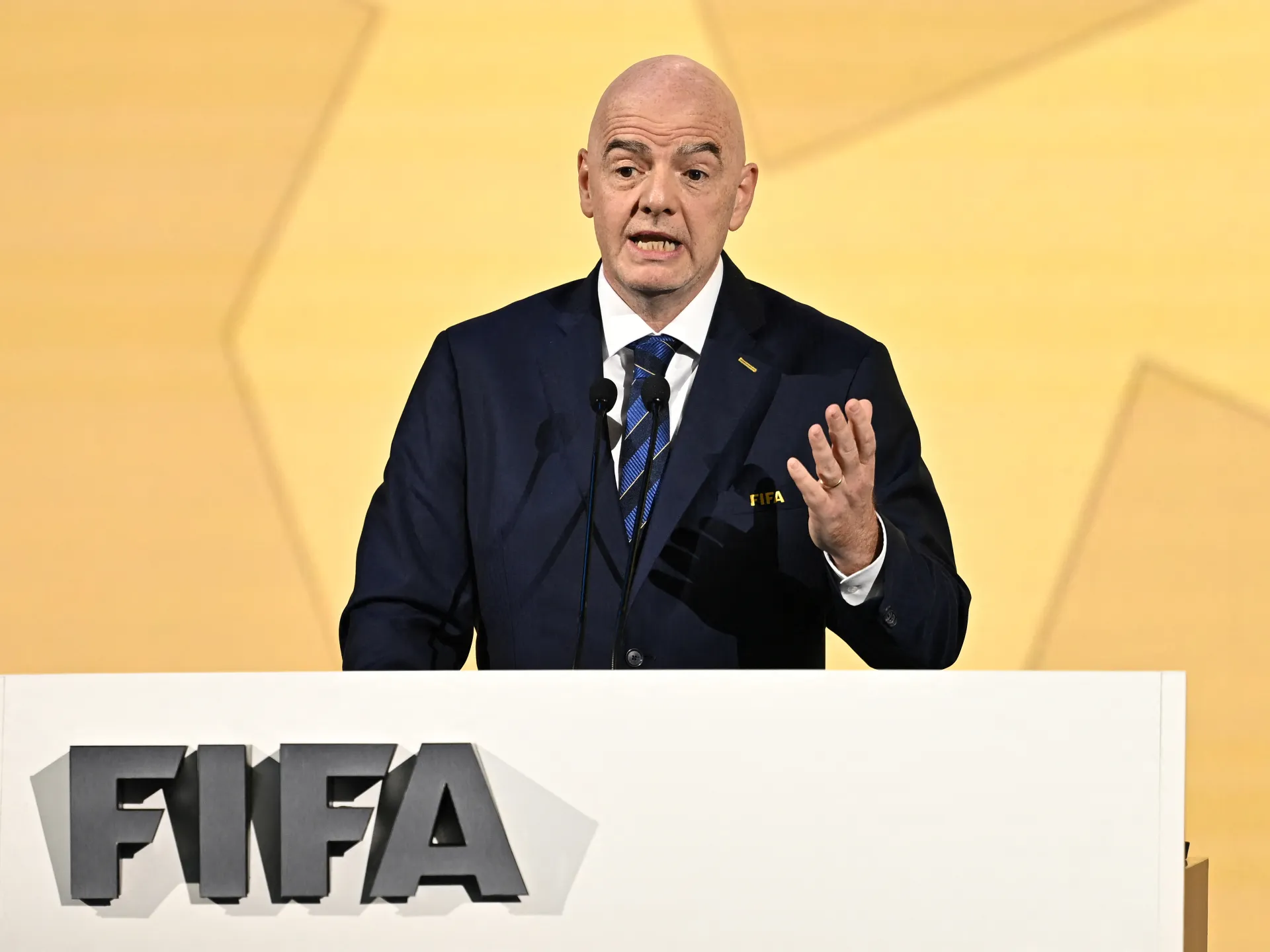
FIFA has not commented in recent days beyond an Instagram post by president Gianni Infantino last week that he’d received assurances from Trump that Iran was welcome at the tournament.
Dunbar and Pye write for the Associated Press. Amir-Hussein Rajdy in Cairo and Fabiola Sanchez in Mexico City contributed to this report.
The 2026 World Cup matches will be played as per schedule announced last year, the football organisation says.
Published On 17 Mar 202617 Mar 2026
The world’s top football organisation, FIFA, has said the 2026 World Cup matches will take place per the schedule announced last year, shutting down Iran’s hopes of having its matches moved from the United States to Mexico due to the ongoing US-Israeli war on Iran.
“FIFA is in regular contact with all participating member associations, including Iran, to discuss planning for the FIFA World Cup 2026,” the organisation’s statement said. “FIFA is looking forward to all participating teams competing as per the match schedule announced on 6 December 2025.”
Recommended Stories
list of 3 itemsend of list
Following the outbreak of the war on February 28, Iran’s participation in the games has been cast in doubt.
Last week, US President Donald Trump said Iran was welcome to come to his country for its matches, but added: “I really don’t believe it is appropriate that they be there, for their own life and safety.”
In response to Trump’s comments, Iran’s football team said in a post on social media that “no one can exclude Iran’s national team from the World Cup”.
More recently, on Monday, Iranian football chief Mehdi Taj said on social media that “when Trump has explicitly stated that he cannot ensure the security of the Iranian national team, we will certainly not travel to America”.
“We are currently negotiating with FIFA to hold Iran’s matches in the World Cup in Mexico,” Taj said.
Iran’s Ambassador to Mexico Abolfazl Pasandideh also condemned on Monday Washington’s “lack of cooperation regarding visa issuance and the provisions of logistical support” for the Iranian delegation.
The 2026 World Cup is set to be played in three countries for the first time ever: the US, Mexico and Canada.
The first game is scheduled for June 11, and will be played between South Africa and Mexico.
But when asked if Mexico could host Iran’s games, Mexican President Claudia Sheinbaum said on Tuesday that the country was prepared to host its first-round matches.
“Mexico maintains diplomatic relations with every country in the world, therefore, we will wait to see what FIFA decides,” Sheinbaum said.
Iran was the second Asian team, after Japan, to qualify for the World Cup, securing its place almost a year ago after topping its qualifying group.
They are currently scheduled to play New Zealand and Belgium in Los Angeles, and Egypt in Seattle.
A report on how Olympic organizers will tackle civil rights, homeless and human trafficking ahead and during the 2028 Games has not been made public by the city more than two months after it was filed and no date for its release has been set, leaving human rights advocates fearing the issues will not get the attention and funding they deserve.
Council president Marqueece Harris-Dawson, who chairs the ad-hoc committee on the LA28 Games, has not included the human rights report on the committee’s agenda. His office did not respond to requests for comment and Sharon Tso, the city’s chief legislative analyst, and Matthew Szabo, the city’s administrative officer, both said they have not seen the report and “nothing appears on the council file,” according to Tso.
The delay is limiting discussion on an important topic, said Stephanie Richard, a clinical professor who leads the Sunita Jain Anti-Trafficking Initiative at Loyola Law School, which released its own comprehensive report on human trafficking and the 2026 World Cup and 2028 Olympics in December.
“From an anti-trafficking perspective, this is a historic moment” she said. “Yet the public has no access to the draft.
“Without transparency, Los Angeles cannot responsibly prepare, and advocates cannot provide informed guidance. LA28 is setting a global precedent — one that currently lacks public accountability.”
LA28, the private nonprofit organizing committee for the 2028 Summer Olympic and Paralympic Games in Los Angeles, was responsible for developing a human rights strategy around the Games. Its report was due Dec. 31, a deadline it met, according to a spokesperson for the group. LA28 is not allowed to release the report publicly until the city does.
“As per our Games Agreement with the City, LA28 completed the Human Rights Strategy at the end of 2025,” said Jacie Prieto Lopez, the group’s vice-president of communications and public affairs, in LA28’s first public statement on the report. “We are now working closely with city leaders on next steps.”
What those next steps are and when they’ll be taken, no one seems to know.
FIFA is producing its own report on human rights and human trafficking around this summer’s World Cup, which will feature eight games at SoFi Stadium in Inglewood.
“In each host city, human rights teams are working towards tailored FIFA World Cup Human Rights Action Plans in consultation with local human rights stakeholders and in line with FIFA guidance,” a FIFA spokesperson said in a written statement. “Plans will be published ahead of the tournament. This work reflects a sustained and consistent commitment by FIFA to embed human rights considerations throughout the planning and delivery of the tournament.”
The FIFA report for Los Angeles isn’t expected to be released until May, according to sources close to the process not authorized to speak publicly, about a month before the tournament kicks off. Some of the other 11 U.S. host cities, among them Seattle and Houston, have already rolled out their own initiatives addressing the issue.
Richard, who was invited by the city to consult with LA28 on its study, said the release of both the Olympic and World Cup reports is important for Los Angeles because it allows for public comment and oversight.
Richard’s group has called on LA28 and FIFA to allocate between $2.75 and $3.1 million specifically for anti-trafficking implementation; to fund a public-awareness campaign and independent audits to ensure accountability and transparency; and to invest in long-term programs that extend beyond the two sporting events.
“One of the things our report starts from is the only evidence-based data connected to major sporting events is that labor trafficking increases,” Richard said. “Major sporting events requires an influx, a large influx, of workers, a lot of time immigrant workers who are highly vulnerable in the construction industry..
“Presumably a lot of these workers are brought in months ahead of time to do some of this work.”
Richard said the continued presence of federal immigration officers in Los Angeles adds another layer of complexity to the human trafficking mix.
In mid-February, nine state legislators signed a letter calling for LA28, FIFA and local officials to incorporate the recommendations made by Richards’ group into their own plans and to release the report publicly as “a critical step toward accountability.”
But when asked about the letter this month, the signatories contacted refused to comment. A spokesperson for assemblywoman Celeste Rodriguez, who represents the eastern San Fernando Valley, said Rodriguez was “unavailable to talk on this issue.”
Iran’s sports minister said his nation will not participate in this summer’s World Cup following the attacks on the country by the U.S., one of the tournament’s hosts.
The U.S. bombing campaign against Iran, which began two weeks ago, has triggered a region-wide conflict and killed more than 1,300 Iranians including Ayatollah Ali Khamenei, the country’s supreme leader, according to Iran’s U.N. ambassador Amir Saeid Iravani.
“Considering that this corrupt regime has assassinated our leader, under no circumstances can we participate in the World Cup,” sports minister Ahmad Donyamali said on state television Wednesday.
“Our players do not have security, and fundamentally the conditions for participation do not exist.”
Donyamali’s statement came just hours after FIFA president Gianni Infantino said he had received assurances from President Trump that Iran would be allowed to participate in the tournament, which will be played in the U.S., Mexico and Canada.
“President Trump reiterated that the Iranian team is, of course, welcome to compete in the tournament in the United States,” Infantino wrote in an Instagram post. “We need an event like the FIFA World Cup to bring people together now more than ever, and I sincerely thank the President of the United States for his support.”
Last year President Trump signed an executive order suspending visa issurance to nationals of 19 countries, including Iran, although the State Department can make exceptions for “participants in certain major sporting events” such as the World Cup.
Iran, which has played in the last three World Cups, earned its place in this summer’s tournament by dominating its group in the Asian confederation tournament. However it did not send a representation to a World Cup planning summit last week in Atlanta.
Iran was drawn into Group G for the World Cup and is scheduled to begin play June 15 against New Zealand at SoFi Stadium in Inglewood. Iran’s second group-stage game, against Belgium, is also scheduled for SoFi Stadium before the team finishes the first stage of the tournament against Egypt in Seattle.
According to The Athletic, no country has withdrawn from a World Cup after qualifying since the 1950 tournament in Brazil, when India, Scotland, France and Turkey pulled out, mostly over costs and logistical issues.
Donyamali did not say whether he has begun the formal process or withdrawing Iran from the World Cup but FIFA could be facing a time crunch if it had to replace Iran in the 48-team field. Article 6.7 of FIFA’s 2026 World Cup regulations states: ‘If any Participating Member Association withdraws and/or is excluded from the FIFA World Cup 26, FIFA shall decide on the matter at its sole discretion and take whatever action is deemed necessary. FIFA may decide to replace the Participating Member Association in question with another association.”
The most likely replacement scenario would have Iraq, the top non-qualifier from the Asian confederation, taking Iran’s place. Iraq is scheduled to play the winner of a Suriname-Bolivia playoff in Mexico later this month for a final World Cup berth but with airspace over the Middle East closed because of the war, the Iraqis are unsure how they will get to Mexico. Giving them Iran’s berth would solve that problem but it would create another; who would replace Iraq in the playoff against the Suriname-Bolivia winner? Based on the Asian qualifying tournament, the UAE would be the most likely candidate but it, too, would face travel concerns in getting to Mexico.
FIFA could leave those playoffs untouched and give Iran’s spot to Italy, which is ranked 13th in the world but must win a four-team UEFA playoff later this month to qualify for the World Cup. Basically FIFA can do whatever it wants.
FIFA regulations say that any team that withdraws from the tournament “no later than 30 days before the first match” will be fined and could face other “disciplinary sanctions” including expulsion from subsequent FIFA competitions. This summer’s World Cup kicked off June 11 in Mexico City and Toronto. The U.S. opener is scheduled for June 12 in Inglewood.
Earlier this week six members of Iran’s delegation to the Women’s Asian Cup were granted humanitarian visas and allowed to remain in Australia rather than return to Iran where they feared persecution for not singing the national anthem during the tournament.
Twelve days ago the U.S., a World Cup host country, launched a full-scale bombing campaign against Iran, a country that has qualified to play in the tournament. That’s never happened before.
Five days later, that same World Cup host began military operations inside the borders of Ecuador, another World Cup qualifier, half a world away. That’s never happened before either.
With the tournament scheduled to kick off in three months, those events have soccer scholar Jonathan Wilson questioning whether it’s wise for the World Cup to go on at all.
“It seems to me, for each passing day, it’s less and less likely that the World Cup can happen,” he said.
That take seems unduly alarmist said David Goldblatt, a British sportswriter and sociologist who is a visiting professor at Pitzer College in Claremont. Anything short of a full-scale war inside the U.S. would not be enough to pull the plug on the tournament now, he said. Especially with FIFA expecting revenues of as much as $11 billion.
“I mean, it’s not a good look,” Goldblatt conceded. “And certainly when set against FIFA’s official pronouncements on its role in encouraging world peace and cosmopolitan celebrations of a universal humanity, none of that sits terribly easily.
“But in terms of actually running the World Cup, I don’t think it’s going to make very much difference at all.”
However, with the Trump administration open to engaging in more international conflicts, there’s little doubt this World Cup, the largest and most complex in history, will also be the most political in history as well.
Complicating things further is the fact the current conflict in the Middle East hasn’t been limited to just the U.S. and Iran. Iranian missiles have hit both Qatar and Saudi Arabia, among other countries, and Jordan has fired on U.S. assets.
Those three countries are World Cup qualifiers as well.
The fate of a soccer tournament pales in importance to the death and destruction the conflagration in the Middle East has produced, of course. But the need for unity is the very reason there’s a World Cup in the first place.
When French soccer administrator Jules Rimet founded the tournament 96 years ago, he believed soccer could be a tool for international peace. And in the early years of the tournament, Rimet, FIFA’s longest-serving president and a talented diplomat, was able to limit the impact of geopolitics on the World Cup, watering down Mussolini’s influence on the 1934 World Cup, for example, and steering the 1938 tournament away from Hitler’s Germany.
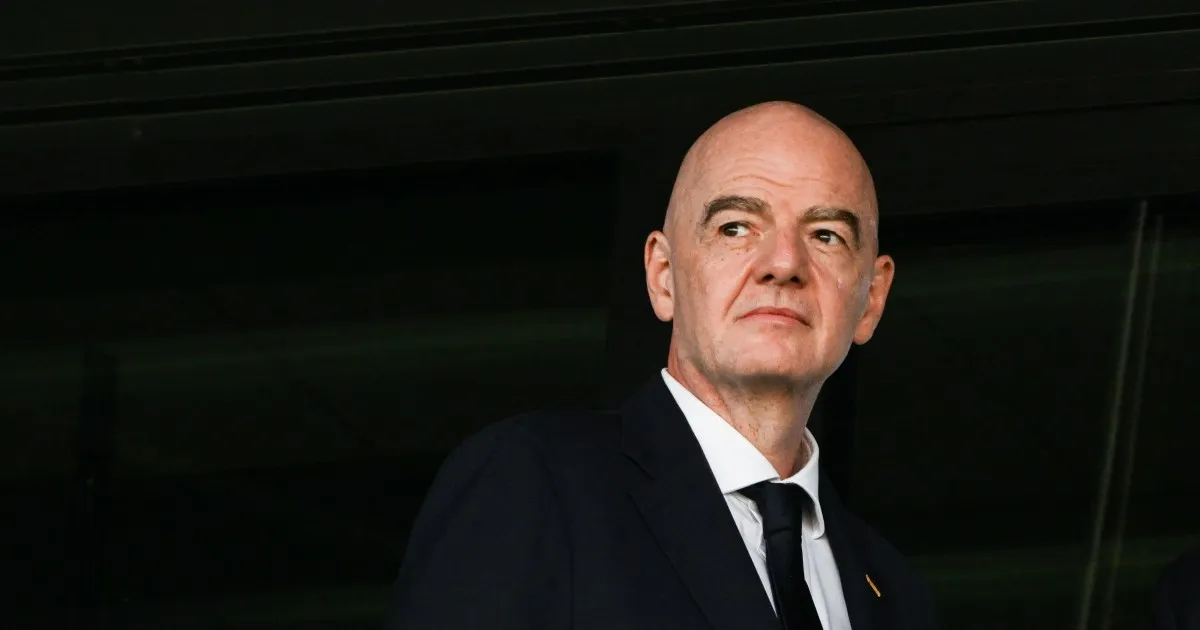
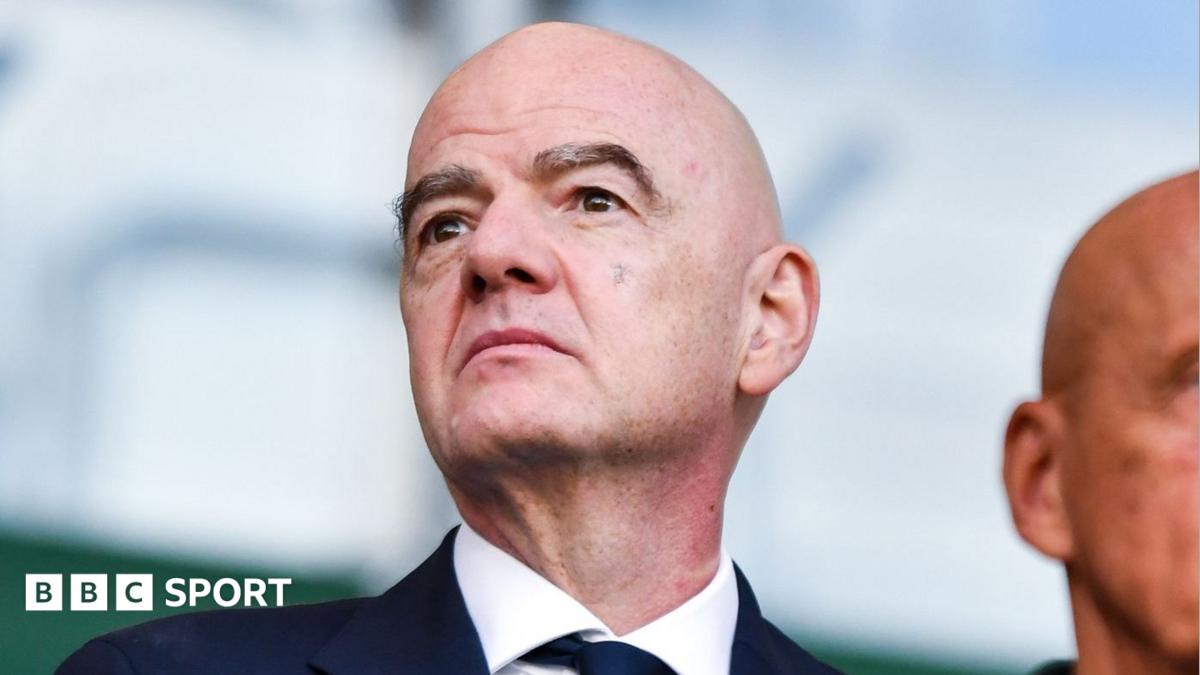
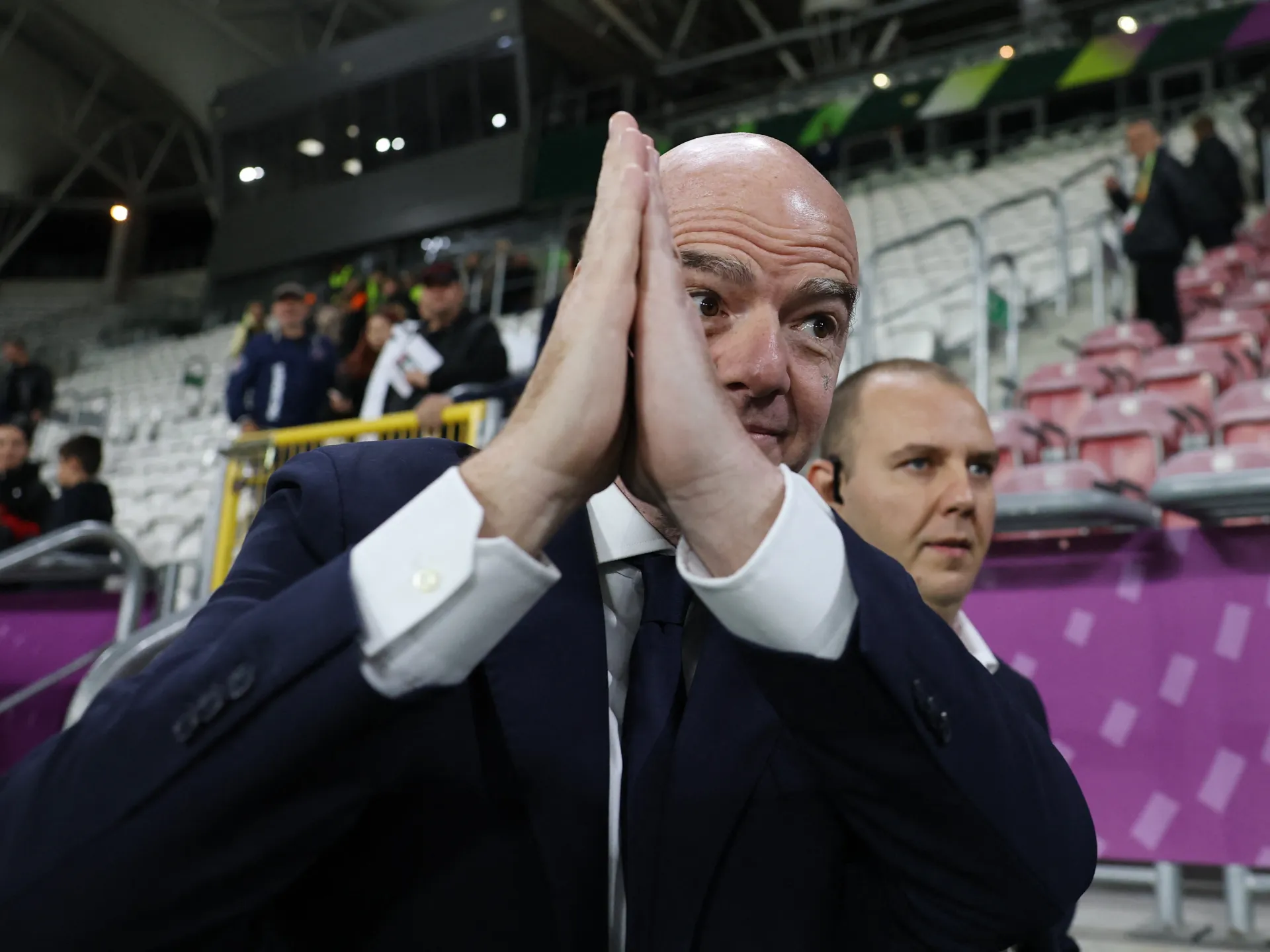
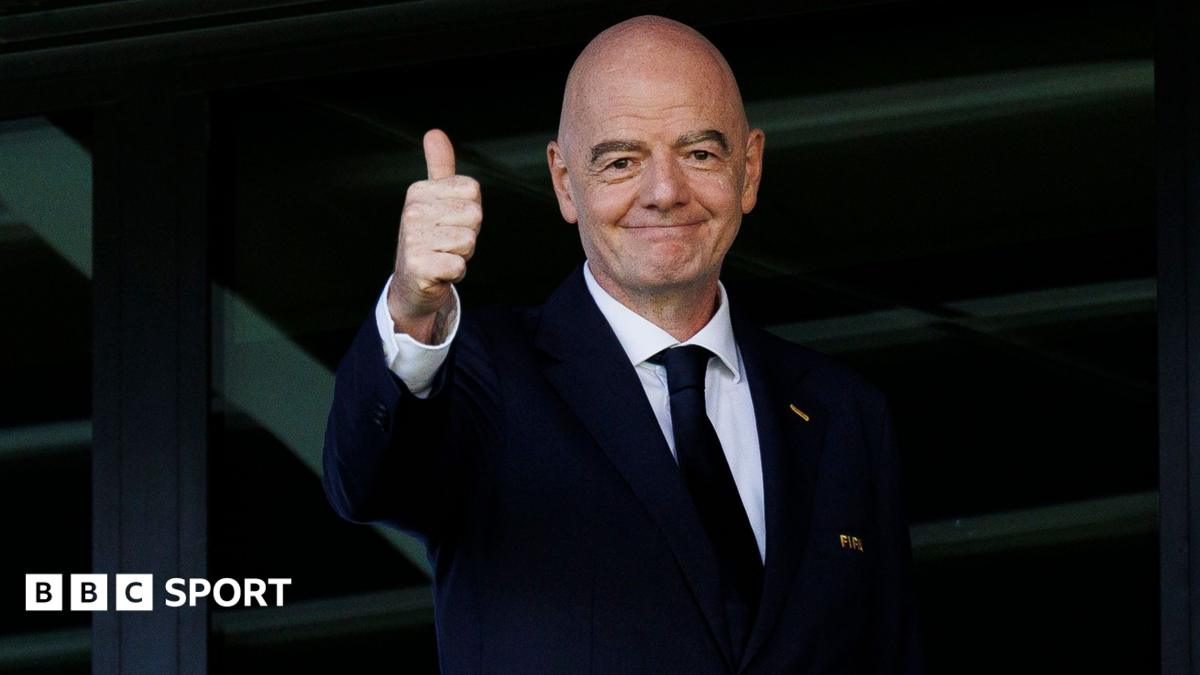
FIFA President Gianni Infantino has taken a far different approach, courting President Donald Trump’s support despite his growing number of global conflicts.
A week before bombs began falling on Iran, Infantino appeared at the inaugural meeting of Trump’s Board of Peace wearing a red cap with ‘USA’ on the front and the numbers ‘45-47’ — a reference to Trump’s non-consecutive presidencies. That act was so blatantly partisan, IOC president Kirsty Coventry said her organization would investigate whether Infantino, an IOC member, breached the terms of the group’s charter, which requires members to act independent of political interests.
FIFA president Gianni Infantino holds up a USA hat as he attends the inaugural meeting for the Board of Peace at the Institute of Peace in Washington on Feb. 19.
(Chip Somodevilla / Getty Images)
“Infantino has absolutely breached every FIFA protocol on neutrality,” said Wilson, author of “The Power and Glory: The History of the World Cup.”
“Absolute neutrality is always impossible and not desirable, but it has clearly gone way, way, way beyond. The peace prize looked grotesque at the time. It looks even worse now. And I can’t see how the future will look kindly on Infantino. I think Infantino has to some extent legitimized Trump.”
This is hardly new behavior from Infantino, who had close relationships with Vladimir Putin ahead of the 2018 tournament played in Russia and Qatar’s leaders ahead of the 2022 tournament despite their well-known human rights violations.
The list of countries Infantino is asking to overlook poor relations with the country hosting the majority of World Cup games this summer is growing.
Consider that Denmark, which administers Greenland, an autonomous territory Trump has also threatened to invade, can qualify for the tournament in a European playoff that will take place later this month. Then there’s World Cup qualifiers Haiti, Ivory Coast and Senegal, who aren’t at war with the U.S. but whose citizens have been banned from entering the country to cheer for their teams. That completely contradicts a promise from Infantino, who said “everybody will be welcome” at the 2026 World Cup.
“If I had a crystal ball I could tell you now what is going to happen,” Heimo Schirgi, the World Cup chief operating officer for FIFA, said Monday. “But obviously the situation is developing. It’s changing day by day and we are monitoring closely. [But] the World Cup will go on right? The World Cup is too big and we hope that everyone can participate that has qualified.”
Goldblatt, the Pitzer professor, said Infantino’s action are understandable since he has few cards to play against Trump.
President Trump speaks as he receives the FIFA Peace Prize as FIFA president Gianni Infantino applauds on Dec. 5 the Kennedy Center in Washington.
(Patrick Smith / Getty Images)
“What’s Infantino going to do? What levers can you pull?” he asked. “You can threaten to take it away. That’s not happening. Moral admonishment? Who’s going to take that from FIFA? It is a farcical idea that anybody thinks that the president of FIFA has any kind of collective moral authority or any role as a spokesperson for the progressive part of the world.
“They may fantasize that this is the case. But it is morally and politically absurd that any of us should expect that of these people. So if you are Infantino and that is the case, you know what works with Trump? What works is flattery. So of course he’s gone down that path.”
The games, Goldblatt said, will go on even if bombs are still falling. And that may not be an entirely bad thing.
“Football’s a great distraction. That’s partly why it’s so popular,” he said. “It will be virtually impossible, if the war continues, for that not to be a central element of like, the meaning and the purpose of what we’re all doing here.
“How we’ll feel and what it will look like, I don’t know. It will be very strange. Football is unpredictable and extraordinary. Something will happen that will warm our souls.”
⚽ You have read the latest installment of On Soccer with Kevin Baxter. The weekly column takes you behind the scenes and shines a spotlight on unique stories. Listen to Baxter on this week’s episode of the “Corner of the Galaxy” podcast.
Iran state TV presenter has threatened women’s national team for not singing anthem at opening AFC Cup match.
Published On 6 Mar 20266 Mar 2026
Share
The global representative organisation for professional footballers, FIFPRO, has urged governing bodies responsible for the 2026 Women’s Asian Football Confederation Cup to protect the Iran national team after they were labelled “wartime traitors” by an Iranian state television presenter.
Both FIFA, world football’s governing body, and the AFC have been called upon to “undertake all necessary steps to ensure the safety of Iran’s Women’s National Team players”.
Recommended Stories
list of 4 itemsend of list
The Iran women’s national football team players did not sing their national anthem before their Asian Cup opener against South Korea in Australia earlier this week.
Islamic Republic of Iran Broadcasting presenter Mohammad Reza Shahbazi said in a video that the players showed a lack of patriotism and their actions amounted to the “pinnacle of dishonour” in footage circulating widely on social media.
“Let me just say one thing: traitors during wartime must be dealt with more severely,” Shahbazi said.
“Anyone who takes a step against the country under war conditions must be dealt with more severely. Like this matter of our women’s football team not singing the national anthem … these people must be dealt with more severely.”
In a statement released on the social media platform X, FIFPRO released a strong and lengthy statement outlining its concerns.
“In addition to the dangerous situation the players would face if they return to Iran following the tournament, FIFPRO Asia/Oceania is deeply concerned by reports that Iranian state television has publicly attacked the members of the team for remaining silent during the national anthem before their opening match,” the statement read.
“Footage circulating online shows Mohammad Reza Shahbazi, a state TV presenter, calling for them to face the ‘stigma of dishonour and betrayal’.
“These statements significantly heighten concerns for the players’ safety should they return to Iran after the tournament.
“FIFPRO Asia/Oceania has once again written to the AFC and FIFA, calling on them to uphold their human rights obligations under the UN Guiding Principles on Business and Human Rights and FIFA’s Human Rights Policy and protect the players.
“We call on the AFC and FIFA to urgently engage with the Iranian Football Association, the Australian Government and all other relevant authorities to ensure that every effort is made to protect the safety of the players.”
The Iranian players stood in silence when Iran’s anthem was played at the Gold Coast ahead of their 3-0 opening loss to South Korea on Monday, though they sang and saluted before a 4-0 defeat by hosts Australia three days later.
The Reuters news agency has contacted both the Asian Football Confederation, the Iranian football federation and the team at the Asian Cup for comment.
Ahead of their game against Australia, Iran forward Sara Didar fought back tears and spoke about the war, while coach Marziyeh Jafari said her players were doing their best to focus on the tournament despite concern for their families back home.
Iran face the Philippines on Sunday in their final group match.