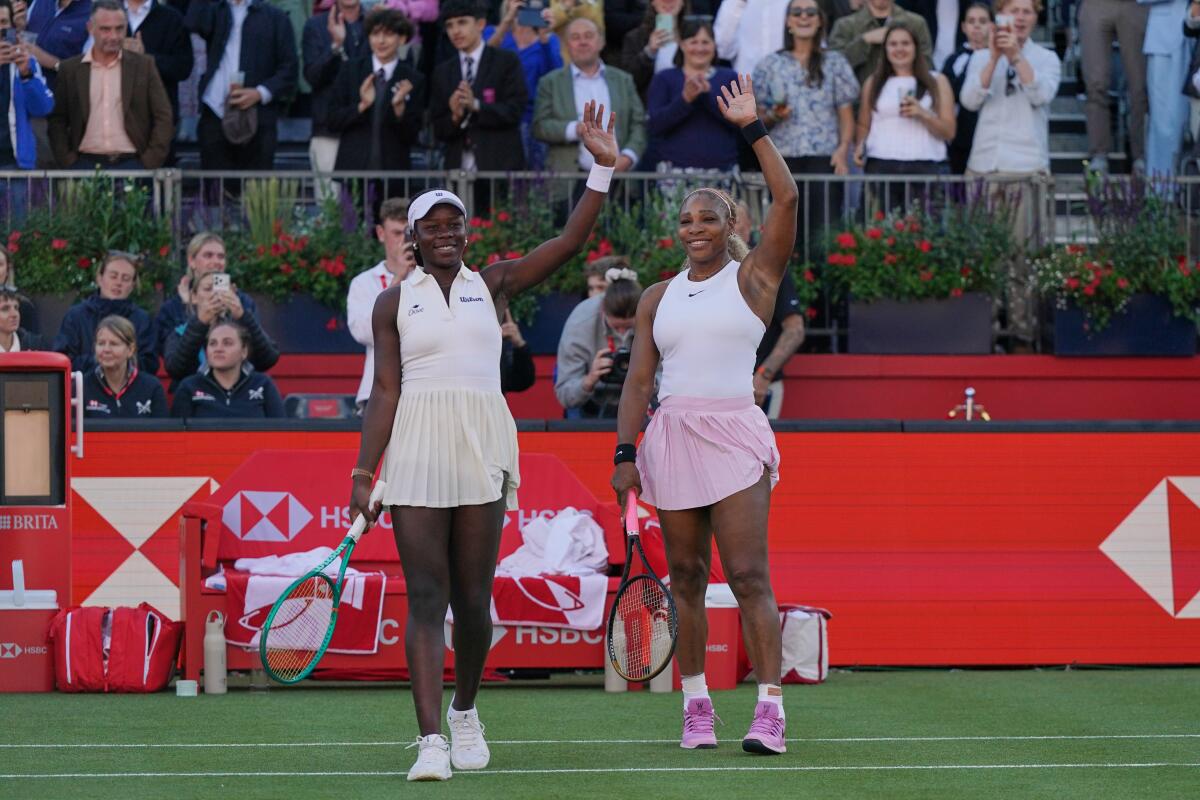
After almost four years away from the sport, the 44-year-old tennis legend made a triumphant return Tuesday at Queen’s Club in London. She teamed with Canadian teenager Victoria Mboko for a 7-6 (2), 6-2 victory against Nicole Melichar-Martinez of the United States and Erin Routliffe of New Zealand in an opening doubles match at the grass-court HSBC Championships.
Williams recorded service winners of up to 120 mph during her first professional match since the 2022 U.S. Open.
“It was so fun,” Williams said afterward in an on-court interview. “I had so much fun playing with Victoria. She really was able to hold up the team and really play big on the big points. I could really rely on her. We’ve never played together, but it just felt so natural playing with her.”
Williams has won 14 Grand Slam titles and three Olympic gold medals in doubles, all with sister Venus Williams as her playing partner.
Serena Williams and Victoria Mboko of Canada wave to the crowd after defeating Nicole Melichar-Martinez and Erin Routliffe on Tuesday at the Queen’s Club in London.
(Alberto Pezzali / Associated Press)
“I feel very honored to play with Serena,” Mboko said. “I had a lot of fun, if anything. We really did that out there. I’m so happy to be playing beside you. And we’re going for more.”
In September 2022, Williams had registered as retired with the International Tennis Integrity Agency.
Last December, however, Williams reentered the agency’s drug-testing pool, a move that led to speculation about a possible return for the 23-time Grand Slam singles champion. She announced her professional tennis return last week as a wild-card doubles entry at the Queen’s Club tournament.
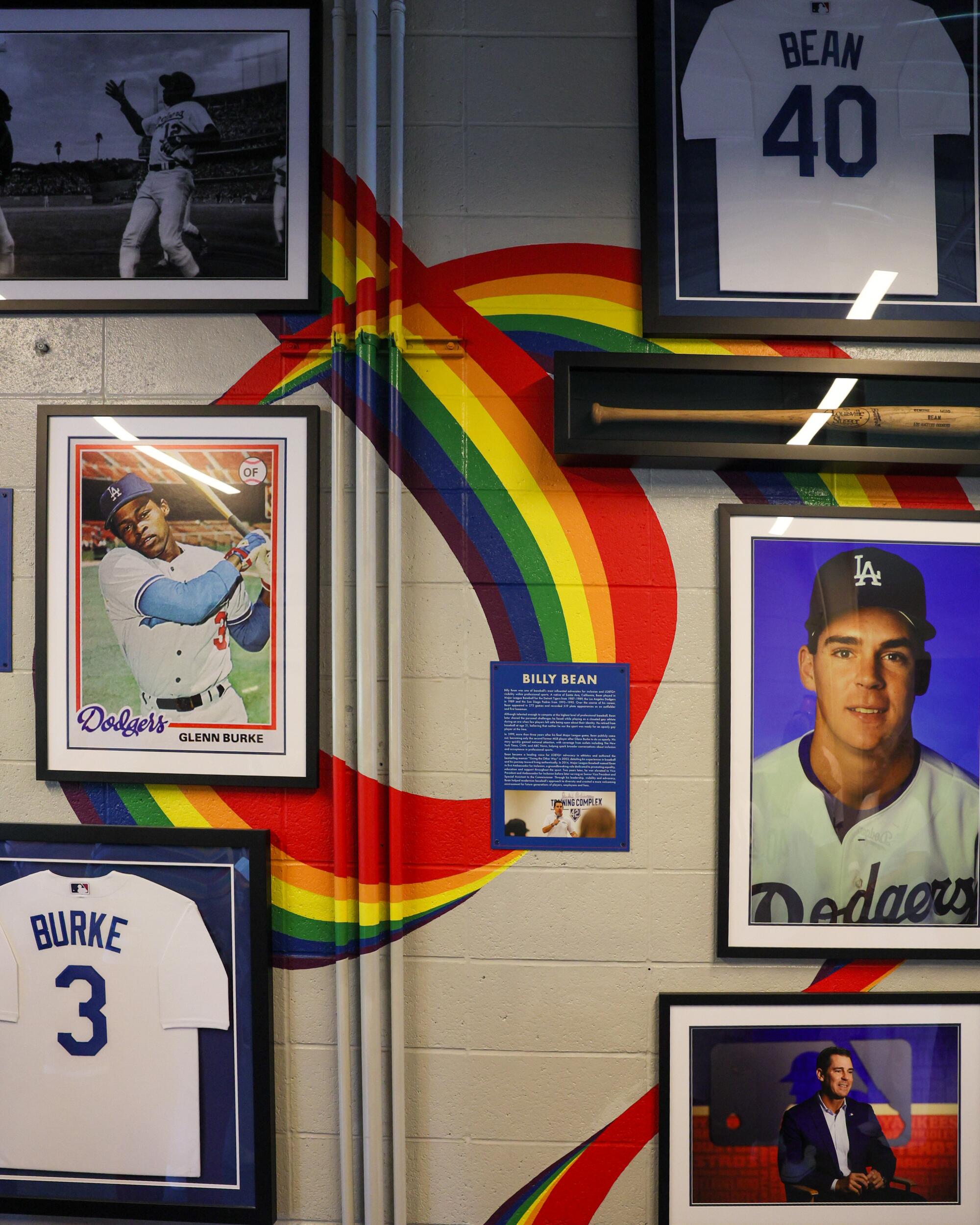
Because this time, with the newest historical exhibit at Dodger Stadium, the team got it right.
Amid all the historical installations and tributes in the open-air museum that is the Centerfield Plaza, and just a few feet from a Fernando Valenzuela mural, a new display honors Glenn Burke and Billy Bean, two former Dodgers outfielders who were the first and second professional baseball players to come out as gay.
It’s not a fleeting mention on Pride night, it’s a permanent record. A static reminder of progress made — and still to be made. And a much-deserved thank-you.
A wall inside Dodger Stadium honors former Dodgers and LGBTQ+ pioneers Billy Bean and Glenn Burke.
(Ronaldo Bolanos/Los Angeles Times)
“It’ll be here tomorrow, it’ll be here on the weekend and if you come next month, it’ll be here,” said the Dodgers’ team historian Mark Langill, who pointed to a spot just down the hall where in 1976 he was an 11-year-old getting Burke’s autograph.
Baseball is steeped in such history. The personal, the statistical, the societal. And the Dodgers’ is incomplete without their stories — Burke’s and Bean’s.
But the Dodgers have not, of course, always gotten this stuff right.
In 1978, they did Burke wrong, trading him — he believed — after management learned he was gay.
In his three seasons in L.A., Burke had proved himself a capable reserve outfielder who was popular with his teammates.
As far as we know, in 1977, he was the first guy to initiate a high five — spontaneously reaching above his head to slap hands with Dusty Baker after the home run that made Baker the fourth Dodger, along with Ron Cey, Steve Garvey and Reggie Smith, to hit at least 30 home runs that season, a MLB first.
Glenn Burke, left, goes to give a high-five to teammate Dusty Baker after Baker hit a home run in 1977. It is believed to be the first instance a high five was exchanged.
(Los Angeles Times)
There’s a fantastic photo of the historic high five included in the tribute to Burke and Bean, which is situated on a hallway wall beneath the left-field bleachers, beside the “Dodger Dugout” augmented reality photo booth.
Burke was also the first guy in that Dodgers clubhouse to crack a joke when the team needed it, his former teammate Rick Monday said.
“When called upon, he could play really well,” Monday said before the Dodgers took the field against the Angels on Friday, when the Dodgers and many of their rainbow-sporting fans celebrated the team’s 13th annual LGBTQ+ Pride Night. “And when we needed a moment of levity, Glenn was not afraid to come forward and put a smile on people’s face.”
But shortly before he died of AIDS in 1995 at 42, Burke published an autobiography, “Out at Home,” in which he described the team’s management being “afraid of my sexual orientation, even though I never flaunted it. To this day, the Dodgers deny trading me because I was gay. But it was painfully obvious.”
“Oh, what he had to deal with and keep it hid,” said Joyce Burke-Henderson, one of Glenn’s sisters at Friday’s pregame unveiling, where family members of both players gasped and cried and cheered the installation’s reveal.
“But as time went on, people did know. And then I think he came to the point where he just didn’t care and he just told it like it was.”
Joyce Henderson, sister of Glenn Burke, speaks about her brother during a ceremony honoring the former Dodger and LGBTQ+ pioneer at Dodger Stadium Friday.
(Ronaldo Bolanos/Los Angeles Times)
Burke came out in 1982, three years after playing his 225th and final big league game, in an Inside Sports article, “The Double Life of a Gay Dodger.”
“We just appreciate that now people are opening their eyes and just trusting in the Lord,” Burke-Henderson said Friday, “that things will go forward and work out and everybody will be loved regardless of their situation.”
The Dodgers first honored Burke in 2022, at their ninth Pride Night.
The next season, they made a mess of the Pride festivities, inviting and uninviting and then reinviting the Sisters of Perpetual Indulgence, a group known for its work in support of AIDS patients and whose members dress in drag, as nuns.
In 2023, the Dodgers also invited Bean — who was MLB’s senior vice president for Diversity, Equity and Inclusion. He appeared in a pregame ceremony on the field while protesters gathered outside the stadium.
Bean died the next year, at 60, 11 months after being diagnosed with acute myeloid leukemia.
Greg Baker, husband of the late Billy Bean, wipes away tears during a tribute honor Bean as a LGBTQ+ pioneer at Dodger Stadium on Friday.
(Ronaldo Bolanos/Los Angeles Times)
Once a Northeast Santa Ana Little Leaguer, Bean became valedictorian at Santa Ana High, played for Loyola Marymount and went on to appear in 272 big-league games — including 51 for the Dodgers in 1989 — before abruptly walking away from baseball in 1995.
It got to be too much, he’d explain later, continuing to hustle to keep his baseball career afloat while keeping his sexuality secret, acutely aware of the blowback he’d get if it got out.
“For nine years,” he told the New York Times, “I felt as though I had one foot in the major leagues and one on a banana peel.”
“When he left baseball suddenly, I knew something was wrong,” Bean’s mother, Linda Kovac, said Friday, pausing to wipe away tears. “He was playing very well, it wasn’t like he was kicked out or anything. And it just didn’t make any sense.”
When Bean finally told his family he was gay, in 1996 — three years before clueing in an unsuspecting public via a Miami Herald article — none of his loved ones blinked. That included his stepfather, Ed Kovac, the homicide cop and former Marine who’d had a partner on the force who was gay.
“He worked with someone that he respected, side by side, on criminal cases,” Linda said. “We’re still friends with that guy.”
Linda and Ed Kovac, parents of Billy Bean, hold hands in front of a tribute dedicated to their son at Dodger Stadium on Friday.
(Ronaldo Bolanos/Los Angeles Times)
Knowing someone — or of someone — who is gay or lesbian has long tended to dispel falsehoods and quell fears that might exist.
“One of the most important things any one of us can do in our community is be out, to be proud,” said Greg Baker, Bean’s husband. “The fact that someone can be out in a world that typically doesn’t have a lot of role models of the same ilk, it’s a brave thing to stick your neck out. It’s also very important.”
And it’s not a surprise, Baker said, that more athletes aren’t out in sports like baseball. Not with Gallup polling released last week telling us that with public acceptance of same-sex marriage and relationships in the U.S. has flattened after two-plus decades of growing support — down from 71% to about 65%.
“I want to thank the Dodgers organization,” Baker said. “It’s brave of them in this day and age to spotlight someone in our community when other organizations are trying to erase us.”
The Dodgers have done the opposite, putting up a permanent marker. A long time coming, a tribute to last.
THE UK’S biggest strawberry-picking field that spans more than 150 acres is an affordable day out.
A trip to a pick-your-own fruit farm is a wholesome activity that should be on everyone’s summer checklist.
Sign up for the Travel newsletter
Thank you!
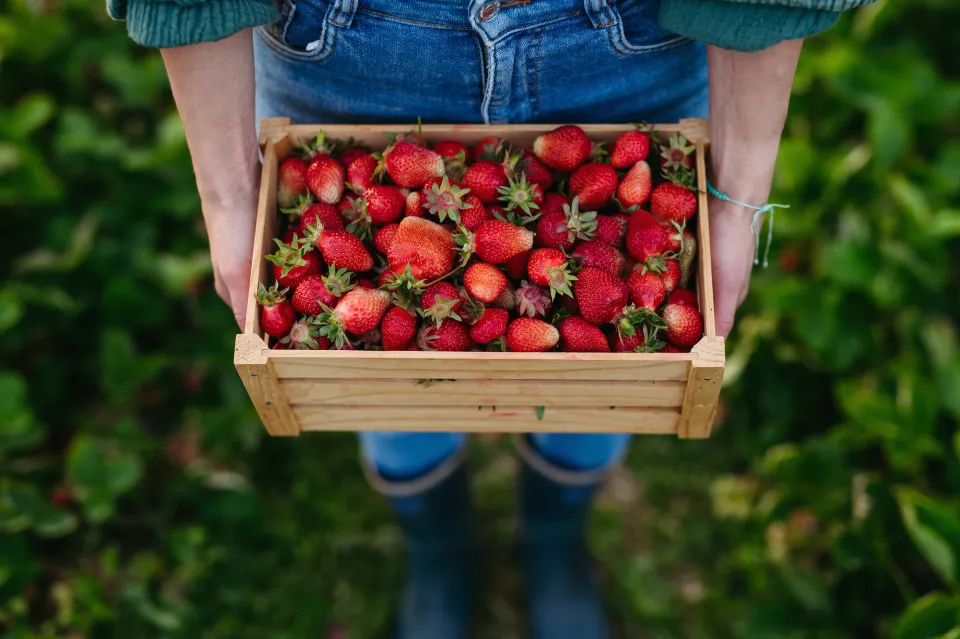
Strawberry picking is a sweet summer activityCredit: GettyGarson Farm in Surrey has the UK’s largest pick-your-own fieldsCredit: GARSON FARM
And a Surrey farm, 19 miles from London, boasts Britain’s largest strawberry picking field, with acres of plants to harvest your own fruity treats from.
Garson Farm in Esher has been growing crops for over 155 years and now welcomes visitors to have a field day picking strawberries every summer.
Open now for the season, guests can take to the expansive greenery and help themselves to the tunnel-grown strawberry plants.
Open rain or shine every day of the week, the farm costs just £2.50 per person to enter, while under twos go free, with bookings limited to eight tickets.
The farm is open from 9am to 6pm Monday to Saturday and 10am to 5pm on Sundays and the ticket price does not cover any crops picked during the outing.
While fruit fans can expect supplies of strawberries in the field to be booming in the height of summer, the farm warns that crops can be limited during the early season.
“The 2026 PYO season has begun with delicious early-season strawberries,” the Garson Farm website states.
“During the early season, crops may not yet be available in abundance. In this phase, we may need to rest the crops to allow them time to grow and produce more fruit.”
Typically, the UK’s strawberry season is between June and late August, with mid-July being peak time.
The farm also offers its pick-your-own deal for plenty other fruits and veggies when they are in season, although it’s just strawberries up for grabs right now.
There are apples, blackberries, carrots, broccoli, cucumbers, cherries, onions, plums and more growing in the fields – but the farm states that “these crops need more time to grow” for now.
Health workers wearing full personal protective equipment prepare May 23 to transport the body of an Ebola victim for a safe burial at Sofepadi Hospital in Bunia, Democratic Republic of the Congo. On Monday, hundreds of people in Kenya protested plans for a nearby field hospital to quarantine and treat Americans exposed to Ebola. Kenya has no Ebola cases thus far. Photo by Stringer/EPA
June 1 (UPI) — Hundreds of residents in central Kenya marched Monday in protest of plans for a U.S.-run field hospital in which Americans exposed to Ebola would be treated and quarantined.
Officers from the U.S. Public Health Service would run the facility at Laikipia Air Base near Nanyuki, Kenya. The hospital was supposed to open last Friday. However, a Kenyan court blocked that opening, with another hearing set for Tuesday, The Washington Post reported.
Kenya has had no cases of Ebola in this outbreak thus far, but there have been about 1,000 cases worldwide, with about 200 suspected deaths, mostly in the Democratic Republic of Congo. Kenya has increased screening and security measures to lessen the risk of the disease spreading to the country.
Nanyuki residents said the hospital facility would endanger the lives of those living nearby.
“If it is not good for America, why is it good for us? Why does the U.S. only care about itself?” Gibson Maina, 25, said to The Washington Post. “The moment we get sick people here, how sure are we that we will be able to contain the disease and that we will be able to survive it?”
The protests were largely peaceful with “localized disruptions,” Capital News in Kenya reported. The Post, however, said some demonstrators set fires and “clashed with the police.”
Officials have said the hospital would keep U.S. citizens with Ebola from returning to the United States for treatment. Katiba Institute, a constitutional rights advocacy group in Kenya, filed the lawsuit that blocked the facility from opening.
The Law Society of Kenya has also opposed the hospital, Capital News reported. Charles Kanjama, leader of the society, said that Ebola treatment centers should be closed to the outbreaks and not in countries with no cases.
“We owe patients human solidarity, but public health requires facilities to be placed near outbreak epicenters,” Kanjama said.
Sarah Korere, a local leader, also said such a hospital should be closer to the problem areas.
“As residents of Nanyuki, we have said we do not want the Ebola rescue center in Nanyuki,” she said to Capital News. “And it’s not just Nanyuki; we’ve said we do not want it in Laikipia, and not yet Laikipia, we don’t want it in Kenya.”
Kenyan Health Cabinet Secretary Aden Duale said any international agreement for Ebola treatment facilities must comply with Kenyan laws and public health protocols. The United States said in a statement last week that it was in talks with Kenyan officials after the lawsuit.