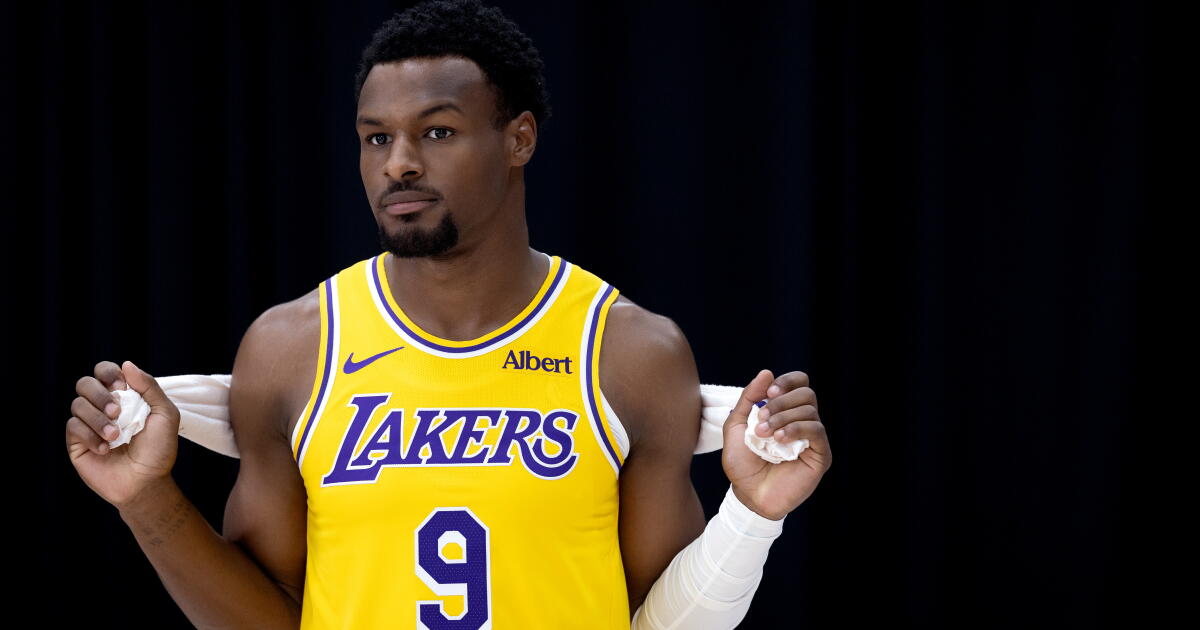
LAS VEGAS — The door opened for Arthur Kaluma to show his worth for the Lakers in the NBA Summer League on Saturday night.
He did so in a big way.
Kaluma had 34 points and five rebounds during the Lakers’ 91-70 win over the Dallas Mavericks at the Thomas & Mack Center.
He was 11 for 16 from the field and six for 10 from three-point range.
With Lakers rookie guard Cameron Carr unable to play because of a right thumb contusion, Kaluma took over the scoring role. Carr, the 24th pick in the NBA draft, is averaging 17 points per game.
“Cam doesn’t play tonight, so he gets a little bit more minutes, gets a couple more touches,” said Lakers Summer League coach Ty Abbott about Kaluma. “But he’s done a really good job of making the most of it when he doesn’t have actions run for him. So the way that he’s been able to stay ready, find windows for himself has kept him in a rhythm. So, on a night like tonight, when we can run some actions for him, he knocks them down and just plays out of his mind. It was great.”
Kaluma said he was “a little nervous” but his three-point shooting said otherwise.
“When [teammate] Jon Elmore came down and he pitched it back to me for a three … I just knew when it came off my hand it was cash,” Kaluma said. “So I said, ‘Yeah, I’m hot.’ It went on from there.”
Late in the fourth quarter, Kaluma lined up a three-pointer, setting his feet and scoring from 29 feet out. He flashed three fingers and smiled. His teammates on the bench stood and cheered, as did the fans.
“We have such a great group of guys this year at Summer League and going through this it’s hard to get that camaraderie with a group,” Kaluma said. “But I feel like everybody wants to see everybody succeed and I felt that tonight. I’m not going to lie to you. They tell me to shoot the ball. I passed up a couple of shots and they were mad at me the other day.”
Kaluma played for the South Bay Lakers in the G League last season. He averaged 14.6 points per game, 4.9 rebounds and shot 55% from the field, 37% from three-point range.
“The G can get grimey, you know what I’m saying? It’s a time where everybody is trying to fight for a position and there is a certain hunger that you have to have in order to be successful in the G,” Kaluma said. “And I feel like that drive that I had my first year in it pushed me into this summer to really get better and work on my game and come here and have the opportunity to perform.”
Kaluma wasn’t alone in helping the Lakers improve to 2-0 in Summer League play.
Adou Thiero ran the court, took a lob pass from Chris Mañon and threw down a two-handed dunk. He had another solid outing with 15 points and four rebounds. He shot just four for 12 from the field, but was a plus-15.
But the night belonged to Kaluma.
“I pride myself on the defensive end,” he said. “I know I got hot offensively, but the shot was just falling today, you know what I’m saying? My game is three-and-D. I lock-up on defense and I know I can hit open shots. I just got hot today and I’m not going to try to let it get to my head.”
McCulloch said: “If I were the secretary of state for energy security and net zero, I’d be looking closely at where’s my next source of energy security, and you’re standing on it.
“The wells are drilled, they’re hooked up. We’re just readying the systems. It will be ready for the 1st of October.
“Jackdaw will play a vital part of this winter’s gas supply,” he added, providing energy security, employment and taxation to the UK.
Environmentalists say Jackdaw will only produce 2% of the country’s annual gas demand during the lifetime of the field.
“It would be a huge betrayal of the British public for the UK government to approve new oil and gas fields at a time when ordinary people are suffering so much as a result of these record-breaking heatwaves,” said Tessa Khan, executive director of the campaign group, Uplift.
In response McCulloch said: “So we all watch the same news, and we see that.
“But what we’re saying is that Jackdaw should not take that on its shoulders, or it should take a very small portion of that.
“It’s a very, very small proportion of the total global emissions.”
Dodgers catcher Dalton Rushing spun to face home plate umpire Dan Iassogna, holding up his mitt with the ball inside.
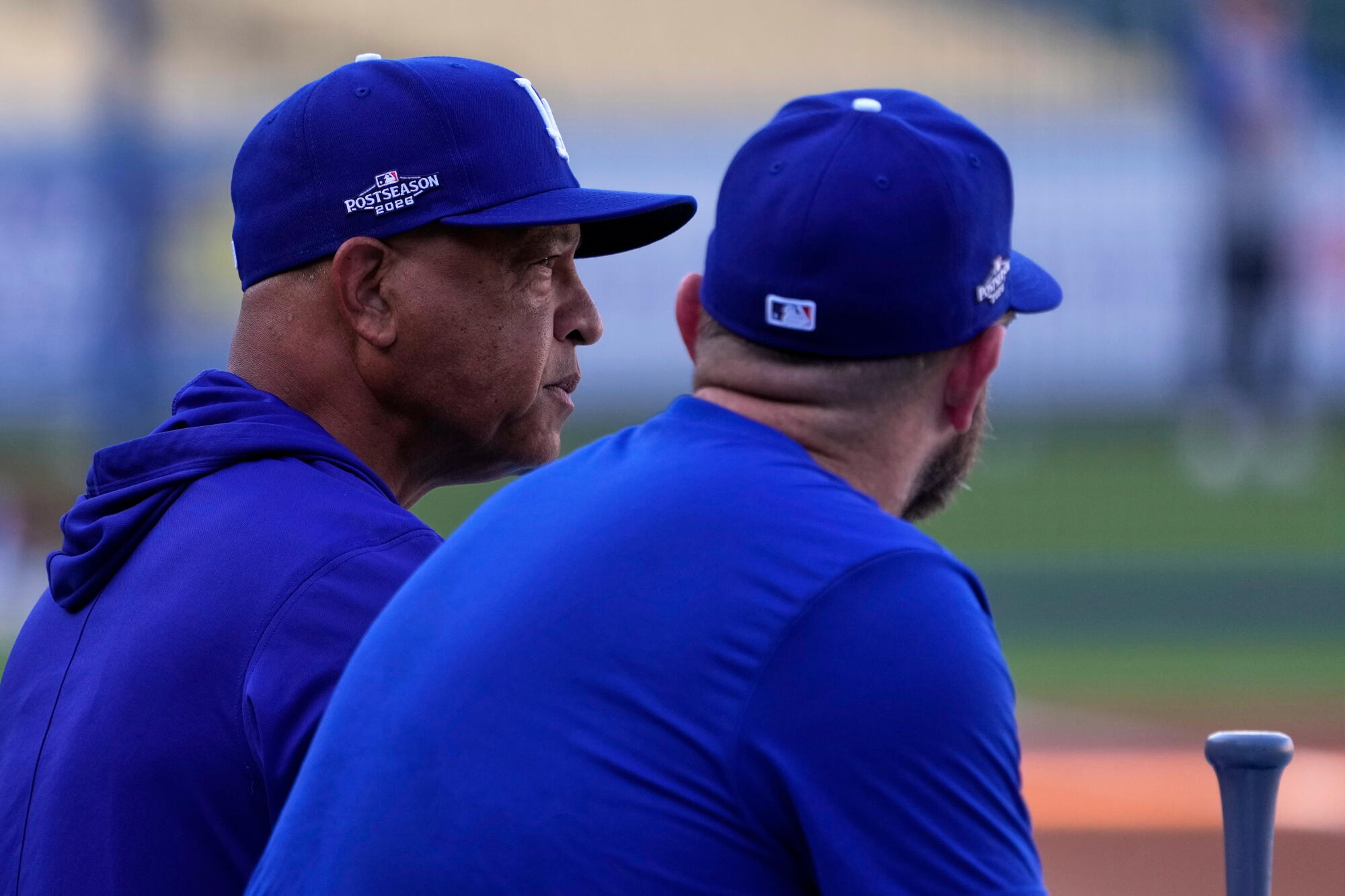
When that didn’t change the safe call, Dalton immediately pointed to the Dodgers dugout, mask in hand urging manager Dave Roberts to challenge.
Robert’s hands flew up to his ears, asking for a replay review.
The tension in Dodger Stadium broke with the announcement: “The catcher touched the runner’s hand before he reached the plate…”
The crowd’s applause drowned out the rest.
The go-ahead run had been on the line with that challenge in the Dodgers’ eventual 8-7 win over the Rockies in 11 innings. And it started a wild sequence to the Dodgers’ first extra-innings game of the season that ended with Rushing hitting a walk-off single to center field to score Teoscar Hernández.
That brawl with the Rockies — figuratively and almost literally — finished with the Dodgers becoming the first team to win 60 games this season.
“That’s a lot of wins,” Roberts said.
It looked as if the Dodgers would coast to the mark. Dodgers closer Tanner Scott took the mound in the ninth with a three-run lead. But after giving up an RBI double to Kyle Karros and a two-run double to Cole Carrigg the score was tied. Only a strong relay throw home by second baseman Miguel Rojas and a successful challenge prevented Hunter Goodman from scoring a go-ahead run.
In the bottom of the ninth, the Dodgers got runners on first and second with two outs. That brought up Andy Pages with two outs, but a successful Rockies ABS challenge confirmed a strikeout, sending the game into the 10th.
That ended the Dodgers’ streak of 91 games without extra innings, the second-longest a team has gone without playing an extra-inning game in the modern era, behind only the 2005 Red Sox (99).
The drama wasn’t over. Two batters into the 10th, the benches cleared.
With one out and Carrigg on third, Jake McCarthy hit a sharp ground ball to Dodgers first baseman Freddie Freeman, who stepped on the bag and fired home.
Rushing flung his body into the tag, but Carrigg was called safe.
Carrigg said something as began to walk away, and Rushing spun around.
As the two exchanged words, Dodgers reliever Edgardo Henriquez pulled his catcher away. But players from both dugouts and bullpens already began to spill onto the field.
Dodgers third baseman Max Muncy holds back Dalton Rushing after the Dodgers catcher got into a confrontation with Colorado’s Cole Carrigg in the 10th inning Monday.
(Ronaldo Bolanos / Los Angeles Times)
“I think that what happened is Carrigg said something aloud, not directed at Dalton,” Roberts said. “Dalton thought something was directed at him. We cleared the air. Basically a big misunderstanding.”
Said Rushing: “I didn’t mean any harm by the tag or the way I reacted to the ball. Made sure he knew that. Told him I was just reacting to the baseball. I don’t expect it to go any further.”
After a brief stoppage, Henriquez escaped without further damage. And the Dodgers got another shot, with Pages on second to start the inning.
Freeman’s groundout moved him to third. Then Mookie Betts drove him in with a comebacker over the mound and past flailing second baseman Edouard Julien.
Tucker then looped a single into no-man’s land. But the rally ended when Hernández’s liner up the middle landed in the glove of Rockies right-hander Jimmy Herget, who just entered the game, catching Kyle Tucker off first base for a double play.
In the 11th, Henriquez got out of the inning unscathed. He got Julien to pop out on a sacrifice bunt attempt and then started a double play himself. He punched the air as he walked off the mound.
“He’s calm in big spots, you’re starting to see it,” Roberts said. “He’s throwing strikes, throwing the breaking ball when he needs to and he’s now unfazed by certain moments and higher leverage. He’s a guy, certainly, we trust.”
In the end, Rushing — who already hit a pair of doubles and scored on Shohei Ohtani’s third-inning home run and fourth-inning two-run single — was the hero.
After Hernández made it to third on a sacrifice bunt by Tommy Edman, Dalton got the end of his bat on a changeup and sent it up the middle, just out of reach of a diving Julien.
“Infield’s in, they’re kind of doing you a favor,” Rushing said. “So move the ball forward, good things happen. And it wasn’t pretty, but it worked.”
Rushing’s helmet twirled in the dirt behind him as he jogged from first toward the center of the field, ready for the celebration that would meet him there.
“He plays with a lot of moxie,” said Dodgers starting pitcher Eric Lauer, who held the Rockies to three runs in six innings. “And he definitely doesn’t back down to anybody, and we love him for that. He’s a great guy that you want on your team.”
Dodgers star Shohei Ohtani rounds the bases after hitting a two-run home run in the third inning against the Rockies on Monday.
(Ronaldo Bolanos / Los Angeles Times)
Roster moves
Dodgers right-hander Evan Phillips is in line to make his first major-league appearance since May 2025. Phillips only made seven appearances last season, starting on the injured list with a strained rotator cuff before undergoing Tommy John surgery in June.
“It’s going to be a lot different tonight getting back out there in a competitive game, the full atmosphere,” Phillips said. “Really excited about that. I feel like probably the past two weeks or so I really took a good turn in my rehab, started bouncing back even better, pitching more like myself, feeling more like myself. So really just happy to carry that over to these games and see how the second half treats us.”
In a pair of corresponding moves, the Dodgers optioned right-handed reliever Paul Gervase to triple-A Oklahoma City and released left-hander Jake Eder.
The Dodgers also designated catcher Chuckie Robinson for assignment and added right-hander Carlos Duran to the 40-man roster. Both players are set to stay in Oklahoma City, with Robinson accepting his outright assignment.
The Lakers are trading center Deandre Ayton to the Washington Wizards for guard Jaden Hardy and two second-round draft picks, in 2031 and 2032, people not authorized to speak publicly confirmed to The Times on Friday.
Ayton had returned to the Lakers after an up-and-down first season with the team, picking up his player option for $8.1 million last Sunday. But he became expendable once the Lakers agreed to acquire 24-year-old center Walker Kessler from the Utah Jazz and sign him to a four-year, $130-million contract.
The Ayton trade leaves the Lakers in the market for a backup center. Several veterans including Jonas Valanciunas and Kevon Looney still are available.
The Lakers acquired Ayton before last season after the Portland Trail Blazers bought out his contract, signing him to a two-year, $16-million deal. He averaged career lows of 12.5 points and 8.0 rebounds last season, but shot 67.1% from the field while starting 72 games, both career highs.
The Wizards believe the 7-foot Ayton will be a good fit alongside centers Anthony Davis and Alex Sarr.
The 6-3 Hardy, who spent three-plus seasons with the Dallas Mavericks before being traded to Washington in February, averaged 9.2 points, 1.5 rebounds and 1.0 assists while shooting 42.4% from the field and 39.7% from three-point range last season.
SANTA CLARA — The U.S. cannot appeal Folarin Balogun’s red card and ensuing suspension for the Americans’ round of 16 match against Belgium, U.S. soccer officials confirmed.
FIFA rules governing the 2026 World Cup, first cited by the Athletic, state that “a sending-off automatically incurs suspension from the subsequent match. The FIFA judicial bodies may impose additional match suspensions and other disciplinary measures.”
The only instance in which the U.S. could appeal is if FIFA’s disciplinary committee decides to suspend Balogun for more than one game after reviewing the incident.
Broadcast commentators and fans immediately questioned the decision after Balogun was shown a red card during the U.S.‘s win over Bosnia-Herzegovina on Wednesday at Levi’s Stadium.
Balogun crashed into Bosnia’s Tarik Muharemović, landing his foot on top of Muharemović’s during the physical match. Muharemović hit the pitch, howling in pain, and was treated on the field. The referee used the video assistant referee to review the play and determined it merited a red card.
U.S. fans accustomed to appeals in the NBA and NFL suggested that an appeal include video of Lionel Messi receiving no discipline for stepping on an opponent’s calf earlier in the tournament.
The red card on the field, however, remains the final word barring any extra games added to Balogun’s suspension.
Through the first two games of this summer’s World Cup, the U.S. was about as perfect as a team could be. It won both games, never trailed, gave up just a goal and won its group handily, playing with a verve and confidence that erased all the doubts that had shadowed it coming in.
Then came Thursday.
With Mauricio Pochettino making a record nine changes to a lineup that had given the U.S. its most successful start to a World Cup in 96 years, the B team that closed the group stage at SoFi Stadium with a 3-2 loss to Turkey served to remind everyone how flawed this group can be.
The backline was porous, goalie Matt Turner gave up goals on the first two shots he faced and with the exception of midfielder Sebastian Berhalter, who had a goal and an assist, none of the starters really distinguished themselves. Whether any of that matters won’t be known until the U.S. next takes the field in the knockout rounds, facing Bosnia and Herzegovina on Wednesday in Santa Clara, Calif.
For Pochettino, whose contempt for convention has been a hallmark of his team’s World Cup run, clearing his bench and getting a U.S.-record 23 players on the field in the group stage was more more important than the result.
“The objective was to finish first and we are first,” he said. “Now it is the next stage and it is going to be a final. And we are ready. We are much better than before that game because we had players now with 90 minutes in their legs and performing and ready to help if we need from the beginning or from the bench. It’s all positive.”
Maybe. Sure, Christian Pulisic, who hadn’t played since the first half of the first game, got back on the field and looked good in a 32-minute cameo. But other than that the game was meaningless since the Americans had already won the group and qualified for the next round while Turkey was going home no matter the result.
The U.S. came in riding a huge wave of momentum, though, and that’s gone now, erased on Kaan Ayhan’s goal on the last touch of the game.
Does that matter?
“No,” captain Tim Ream said with conviction. “You just turn the page.”
The experience the role players got, he said, is more important than the final score.
“When we say it didn’t mean anything, it’s still a meaningful game, right? It’s a World Cup game,” he said. “So it gives everybody a taste of what life will be like if they are called upon and have to contribute.”
Midfielder Tyler Adams wasn’t so sure.
“I don’t know what it’s going to do,” he said. “I can’t predict the future. I don’t have an eight ball in front of me. We’ll see what happens.”
What Adams can say with certainty, however, is that in the future the U.S. will have no room for error. The games are all elimination matches now and 13 players on the U.S. roster, including Adams, have experienced that first hand, having lost in the round of 16 four years ago in Qatar.
Turner said it’s up to those veterans to impart that wisdom on the 13 who are playing in their first World Cup.
“You need to really take care of the boxes when it comes to knockout round. That’s the biggest lesson that we learned,” said Turner, who started all four games in the last World Cup. “It’s not necessarily how beautiful a style you play. The chances you create is important, [but] the way you defend your box is more important.
“Those games are going to be decided by one goal, they’re going to be narrow, and we’re going to have to be compact and be together, defensively, offensively, and take the chances when they come.”
The U.S. did little of that Thursday.
After a Berhalter corner set up Trusty for the first goal in the third minute, Turkey’s Arda Guler, a Real Madrid midfielder, tied the score seven minutes later, splitting a pair of U.S. defenders and running onto a pass from Kenan Yildiz in the center of the box, then lifting a shot over Turner.
Orkun Kokcu handed the U.S. its first deficit of the tournament when he found another big hole in the U.S. defense, redirecting a cross from Eren Elmali in from the center of the box to give Turkey a 2-1 lead.
Berhalter tied the score again four minutes into the second half, latching onto a loose ball at the top of the penalty area and one-hopping a right-footed shot just inside the near post. The game stayed that way until Ayhan, who came on with two minutes left in regulation, slid between two U.S. defenders to knock in the game-winner eight minutes into stoppage time.
For Berhalter, one of a record 21 Americans to get a start in this World Cup, Pochettino’s decision to clear his bench was not only a reward, it was preparation for what’s to come.
“It’s every little kid’s dream, across the United States of America, to play in a home World Cup. Just in a World Cup in general,” he said. “People made their debuts today, so congratulations everyone. This is what everybody looks forward to.”
More important, he added, “we know everyone’s ready to step up at any moment.”
Which is good because history suggests the road ahead is about the get a lot more challenging. The loss to Turkey was the Americans’ 10th straight to a UEFA team, running their winless streak against European opponents to 13 in a row.
Guess which continent Bosnia and Herzegovina, who the U.S. faces next, is from?
Sports editor Iliana Limón Romero contributed to this story.
Three-time U.S. Olympian Jenny Simpson collapsed during a community running event Tuesday in Raleigh, N.C., and still is receiving medical treatment a day later.
There are few available details about what happened to the 39-year-old retired athlete who won a bronze medal in the 1,500 meters at the 2016 Rio Olympics, or what her condition is. The incident occurred during a weekly gathering for local running enthusiasts at which Simpson served as the pace runner for a mile group.
At some point during the event, Simpson suffered what organizer Sir Walter Running described as a “medical incident.” She had no pulse for a brief period, according to media outlets, but it was restored with CPR and an automated external defibrillator at the track. Simpson was then taken to a local hospital.
“We are incredibly grateful to the individuals who responded immediately, as well as EMS and the medical professionals who handled the situation with such care, urgency, and professionalism,” Sir Walter Running said in a statement. “Jenny is receiving excellent medical care, and our thoughts are with her and her family.”
No further details have been released.
“We ask that you continue to continue to keep Jenny and her family in your prayers as we all hope for the very best,” the running group said.
An eight-time state champion (five in track and field, three in cross-country) at Oviedo High School in Florida, Simpson went on to star at Colorado as a two-time national steeplechase champion, a two-time national runner-up in cross-country and a three-time outdoor track and field All-American.
In addition to representing the U.S. at the 2008, 2012 and 2016 Summer Olympics, Simpson was the 2011 world champion in the 1,500 and finished second in 2013 and 2017. She also was the 2014 Diamond League champion in the same event.
Upon her retirement in 2024, Simpson and her husband, Jason, spent a year traveling in their 23-foot Winnebago Ekko motorhome and running with community members at events across the country. This year, Simpson was named Fleet Feet’s chief running officer and joined FloTrack’s broadcast team for Diamond League recaps.
The city witnessed Carl Lewis win four Olympic gold medals, cheered Valerie Brisco-Hooks’ historic golden double and watched Edwin Moses extend his 400-meter hurdles unbeaten streak. L.A. has history with track and field.
Now when Ato Boldon, a UCLA Hall of Famer and four-time Olympic medalist for Trinidad and Tobago, looks to this weekend’s L.A. Grand Prix and the city’s future with the sport, he wonders what it holds.
“I’ve always felt like L.A. needs a signature event,” Boldon said, “and with the Olympics coming up in two years, you look at the quality of this event this weekend, and you’re like, yeah, this is the kind of meet they should have all the time.”
At the halfway mark of the Olympic quadrennium, the USA Track & Field event serves as an important checkpoint for the sport’s hope to break out of the four-year popularity cycle.
The two-day event, which begins Saturday with the women’s hammer throw at the South Bay Athletic Club, features 18 Olympic or world champions competing primarily at USC’s Allyson Felix Field. Sunday’s marquee competition beginning at 1 p.m. will be televised on NBC.
With USA Track & Field building toward a home Olympics, L.A. has been a critical but stubborn market to conquer. Last year’s L.A. Grand Prix, which would have been the third edition of the meet, was canceled in April. The decision, USA Track & Field Chief Executive Max Siegel said, came down to another meet scheduled in the same venue within the same month.
But that competing event, part of Michael Johnson’s upstart Grand Slam Track league, was canceled only weeks before it was set to take place at UCLA’s Drake Stadium, leaving L.A. without a major track competition last summer.
“We knew last year when we canceled the meet that we had every intention leading up to the Olympics to be present in the L.A. market,” Siegel said.
The city knows great track. UCLA boasts legends such as Rafer Johnson, Jackie Joyner-Kersee and Florence Griffith-Joyner. USC, which boasts more Olympians than any other U.S. university, had athletes win nine Olympic medals in track and field at the 2024 Games in Paris, including double gold medals for Rai Benjamin in the 400-meter hurdles and 4×400-meter relay and a 4×100-meter relay championship for TeeTee Terry.
After Terry ran the second leg of the relay, Sha’Carri Richardson’s stare down at the end of her anchor leg became one of the iconic shots of the Paris Games, where 70,000 people packed Stade de France and millions more tuned in for one of the most-watched Olympics.
But the sport is back in the shadows like it always seems to be outside of Olympic years, said Boldon, now NBC Sports’ track and field analyst. There have been several attempts to penetrate the U.S. sports consciousness since the successful Paris Games. Reddit co-founder Alexis Ohanian launched Athlos, a women’s track and field meet that began in New York City in 2024 and added a stop in London to its 2026 schedule. Grand Slam Track, founded by the Olympic legend Johnson and touting major names including Gabby Thomas and Sydney McLaughlin-Levrone, filed for bankruptcy last year, after completing only three of four planned events in its first season, and is only now emerging from it.
This year’s inaugural USATF Tour aims to organize the fragmented sport by streamlining the calendar and working with existing event coordinators to provide resources, including prize money and travel for top athletes, marketing and drug testing. The tour, which was in College Station, Texas, last week for the Lone Star Grand Prix, has 17 events in 10 states.
American Tara Davis-Woodhall after winning the women’s long jump at the 2025 world championships in Tokyo.
(Ashley Landis / Associated Press)
“I feel like LA28 gives the country something to organize around,” said Siegel, who hopes track and field can rise to be among the five most popular sports in the United States. “People are paying more attention to athlete stories in anticipation of what’s going to happen on U.S. soil.”
There is no shortage of stories at the L.A. Grand Prix. Almost everyone who matters in American track and field will be there, Boldon said. Kenny Bednarek, the silver medalist in the 200 meters in Paris, will line up in the 100 meters against Botswana’s Letsile Tebogo, who took gold in the 200 in 2024.
Tara Davis-Woodhall, the reigning Olympic long jump champion, will compete in her signature event and race in the 100-meter hurdles for just the second time in the last five years. Her husband, Hunter Woodhall, will race in the 400 meters on Saturday, when Para athletes will be among those competing in the L.A. Distance Classic at Allyson Felix Field.
Richardson will run her first 100-meter race of the season. The 2024 Olympic silver medalist could be in line to end a three-decade gold medal drought in 2028. No U.S. woman has stood atop an Olympic podium for the 100 since 1996, when Gail Devers won in Atlanta.
Such a stacked field outside of an Olympic year on U.S. soil could be a sign of a changing tide for track and field, Boldon said. The L.A. Grand Prix is a gold-level event on the World Athletics Continental Tour, the second-highest tier of single-day international competition. As athletes vie for world ranking points, the event could be a true Olympic preview two years before the Games begin at the Coliseum.
“This,” Boldon said, “is not a normal week in our sport.”
After almost four years away from the sport, the 44-year-old tennis legend made a triumphant return Tuesday at Queen’s Club in London. She teamed with Canadian teenager Victoria Mboko for a 7-6 (2), 6-2 victory against Nicole Melichar-Martinez of the United States and Erin Routliffe of New Zealand in an opening doubles match at the grass-court HSBC Championships.
Williams recorded service winners of up to 120 mph during her first professional match since the 2022 U.S. Open.
“It was so fun,” Williams said afterward in an on-court interview. “I had so much fun playing with Victoria. She really was able to hold up the team and really play big on the big points. I could really rely on her. We’ve never played together, but it just felt so natural playing with her.”
Williams has won 14 Grand Slam titles and three Olympic gold medals in doubles, all with sister Venus Williams as her playing partner.
Serena Williams and Victoria Mboko of Canada wave to the crowd after defeating Nicole Melichar-Martinez and Erin Routliffe on Tuesday at the Queen’s Club in London.
(Alberto Pezzali / Associated Press)
“I feel very honored to play with Serena,” Mboko said. “I had a lot of fun, if anything. We really did that out there. I’m so happy to be playing beside you. And we’re going for more.”
In September 2022, Williams had registered as retired with the International Tennis Integrity Agency.
Last December, however, Williams reentered the agency’s drug-testing pool, a move that led to speculation about a possible return for the 23-time Grand Slam singles champion. She announced her professional tennis return last week as a wild-card doubles entry at the Queen’s Club tournament.
Because this time, with the newest historical exhibit at Dodger Stadium, the team got it right.
Amid all the historical installations and tributes in the open-air museum that is the Centerfield Plaza, and just a few feet from a Fernando Valenzuela mural, a new display honors Glenn Burke and Billy Bean, two former Dodgers outfielders who were the first and second professional baseball players to come out as gay.
It’s not a fleeting mention on Pride night, it’s a permanent record. A static reminder of progress made — and still to be made. And a much-deserved thank-you.
A wall inside Dodger Stadium honors former Dodgers and LGBTQ+ pioneers Billy Bean and Glenn Burke.
(Ronaldo Bolanos/Los Angeles Times)
“It’ll be here tomorrow, it’ll be here on the weekend and if you come next month, it’ll be here,” said the Dodgers’ team historian Mark Langill, who pointed to a spot just down the hall where in 1976 he was an 11-year-old getting Burke’s autograph.
Baseball is steeped in such history. The personal, the statistical, the societal. And the Dodgers’ is incomplete without their stories — Burke’s and Bean’s.
But the Dodgers have not, of course, always gotten this stuff right.
In 1978, they did Burke wrong, trading him — he believed — after management learned he was gay.
In his three seasons in L.A., Burke had proved himself a capable reserve outfielder who was popular with his teammates.
As far as we know, in 1977, he was the first guy to initiate a high five — spontaneously reaching above his head to slap hands with Dusty Baker after the home run that made Baker the fourth Dodger, along with Ron Cey, Steve Garvey and Reggie Smith, to hit at least 30 home runs that season, a MLB first.
Glenn Burke, left, goes to give a high-five to teammate Dusty Baker after Baker hit a home run in 1977. It is believed to be the first instance a high five was exchanged.
(Los Angeles Times)
There’s a fantastic photo of the historic high five included in the tribute to Burke and Bean, which is situated on a hallway wall beneath the left-field bleachers, beside the “Dodger Dugout” augmented reality photo booth.
Burke was also the first guy in that Dodgers clubhouse to crack a joke when the team needed it, his former teammate Rick Monday said.
“When called upon, he could play really well,” Monday said before the Dodgers took the field against the Angels on Friday, when the Dodgers and many of their rainbow-sporting fans celebrated the team’s 13th annual LGBTQ+ Pride Night. “And when we needed a moment of levity, Glenn was not afraid to come forward and put a smile on people’s face.”
But shortly before he died of AIDS in 1995 at 42, Burke published an autobiography, “Out at Home,” in which he described the team’s management being “afraid of my sexual orientation, even though I never flaunted it. To this day, the Dodgers deny trading me because I was gay. But it was painfully obvious.”
“Oh, what he had to deal with and keep it hid,” said Joyce Burke-Henderson, one of Glenn’s sisters at Friday’s pregame unveiling, where family members of both players gasped and cried and cheered the installation’s reveal.
“But as time went on, people did know. And then I think he came to the point where he just didn’t care and he just told it like it was.”
Joyce Henderson, sister of Glenn Burke, speaks about her brother during a ceremony honoring the former Dodger and LGBTQ+ pioneer at Dodger Stadium Friday.
(Ronaldo Bolanos/Los Angeles Times)
Burke came out in 1982, three years after playing his 225th and final big league game, in an Inside Sports article, “The Double Life of a Gay Dodger.”
“We just appreciate that now people are opening their eyes and just trusting in the Lord,” Burke-Henderson said Friday, “that things will go forward and work out and everybody will be loved regardless of their situation.”
The Dodgers first honored Burke in 2022, at their ninth Pride Night.
The next season, they made a mess of the Pride festivities, inviting and uninviting and then reinviting the Sisters of Perpetual Indulgence, a group known for its work in support of AIDS patients and whose members dress in drag, as nuns.
In 2023, the Dodgers also invited Bean — who was MLB’s senior vice president for Diversity, Equity and Inclusion. He appeared in a pregame ceremony on the field while protesters gathered outside the stadium.
Bean died the next year, at 60, 11 months after being diagnosed with acute myeloid leukemia.
Greg Baker, husband of the late Billy Bean, wipes away tears during a tribute honor Bean as a LGBTQ+ pioneer at Dodger Stadium on Friday.
(Ronaldo Bolanos/Los Angeles Times)
Once a Northeast Santa Ana Little Leaguer, Bean became valedictorian at Santa Ana High, played for Loyola Marymount and went on to appear in 272 big-league games — including 51 for the Dodgers in 1989 — before abruptly walking away from baseball in 1995.
It got to be too much, he’d explain later, continuing to hustle to keep his baseball career afloat while keeping his sexuality secret, acutely aware of the blowback he’d get if it got out.
“For nine years,” he told the New York Times, “I felt as though I had one foot in the major leagues and one on a banana peel.”
“When he left baseball suddenly, I knew something was wrong,” Bean’s mother, Linda Kovac, said Friday, pausing to wipe away tears. “He was playing very well, it wasn’t like he was kicked out or anything. And it just didn’t make any sense.”
When Bean finally told his family he was gay, in 1996 — three years before clueing in an unsuspecting public via a Miami Herald article — none of his loved ones blinked. That included his stepfather, Ed Kovac, the homicide cop and former Marine who’d had a partner on the force who was gay.
“He worked with someone that he respected, side by side, on criminal cases,” Linda said. “We’re still friends with that guy.”
Linda and Ed Kovac, parents of Billy Bean, hold hands in front of a tribute dedicated to their son at Dodger Stadium on Friday.
(Ronaldo Bolanos/Los Angeles Times)
Knowing someone — or of someone — who is gay or lesbian has long tended to dispel falsehoods and quell fears that might exist.
“One of the most important things any one of us can do in our community is be out, to be proud,” said Greg Baker, Bean’s husband. “The fact that someone can be out in a world that typically doesn’t have a lot of role models of the same ilk, it’s a brave thing to stick your neck out. It’s also very important.”
And it’s not a surprise, Baker said, that more athletes aren’t out in sports like baseball. Not with Gallup polling released last week telling us that with public acceptance of same-sex marriage and relationships in the U.S. has flattened after two-plus decades of growing support — down from 71% to about 65%.
“I want to thank the Dodgers organization,” Baker said. “It’s brave of them in this day and age to spotlight someone in our community when other organizations are trying to erase us.”
The Dodgers have done the opposite, putting up a permanent marker. A long time coming, a tribute to last.
THE UK’S biggest strawberry-picking field that spans more than 150 acres is an affordable day out.
A trip to a pick-your-own fruit farm is a wholesome activity that should be on everyone’s summer checklist.
Sign up for the Travel newsletter
Thank you!
Strawberry picking is a sweet summer activityCredit: GettyGarson Farm in Surrey has the UK’s largest pick-your-own fieldsCredit: GARSON FARM
And a Surrey farm, 19 miles from London, boasts Britain’s largest strawberry picking field, with acres of plants to harvest your own fruity treats from.
Garson Farm in Esher has been growing crops for over 155 years and now welcomes visitors to have a field day picking strawberries every summer.
Open now for the season, guests can take to the expansive greenery and help themselves to the tunnel-grown strawberry plants.
Open rain or shine every day of the week, the farm costs just £2.50 per person to enter, while under twos go free, with bookings limited to eight tickets.
The farm is open from 9am to 6pm Monday to Saturday and 10am to 5pm on Sundays and the ticket price does not cover any crops picked during the outing.
While fruit fans can expect supplies of strawberries in the field to be booming in the height of summer, the farm warns that crops can be limited during the early season.
“The 2026 PYO season has begun with delicious early-season strawberries,” the Garson Farm website states.
“During the early season, crops may not yet be available in abundance. In this phase, we may need to rest the crops to allow them time to grow and produce more fruit.”
Typically, the UK’s strawberry season is between June and late August, with mid-July being peak time.
The farm also offers its pick-your-own deal for plenty other fruits and veggies when they are in season, although it’s just strawberries up for grabs right now.
There are apples, blackberries, carrots, broccoli, cucumbers, cherries, onions, plums and more growing in the fields – but the farm states that “these crops need more time to grow” for now.
Health workers wearing full personal protective equipment prepare May 23 to transport the body of an Ebola victim for a safe burial at Sofepadi Hospital in Bunia, Democratic Republic of the Congo. On Monday, hundreds of people in Kenya protested plans for a nearby field hospital to quarantine and treat Americans exposed to Ebola. Kenya has no Ebola cases thus far. Photo by Stringer/EPA
June 1 (UPI) — Hundreds of residents in central Kenya marched Monday in protest of plans for a U.S.-run field hospital in which Americans exposed to Ebola would be treated and quarantined.
Officers from the U.S. Public Health Service would run the facility at Laikipia Air Base near Nanyuki, Kenya. The hospital was supposed to open last Friday. However, a Kenyan court blocked that opening, with another hearing set for Tuesday, The Washington Post reported.
Kenya has had no cases of Ebola in this outbreak thus far, but there have been about 1,000 cases worldwide, with about 200 suspected deaths, mostly in the Democratic Republic of Congo. Kenya has increased screening and security measures to lessen the risk of the disease spreading to the country.
Nanyuki residents said the hospital facility would endanger the lives of those living nearby.
“If it is not good for America, why is it good for us? Why does the U.S. only care about itself?” Gibson Maina, 25, said to The Washington Post. “The moment we get sick people here, how sure are we that we will be able to contain the disease and that we will be able to survive it?”
The protests were largely peaceful with “localized disruptions,” Capital News in Kenya reported. The Post, however, said some demonstrators set fires and “clashed with the police.”
Officials have said the hospital would keep U.S. citizens with Ebola from returning to the United States for treatment. Katiba Institute, a constitutional rights advocacy group in Kenya, filed the lawsuit that blocked the facility from opening.
The Law Society of Kenya has also opposed the hospital, Capital News reported. Charles Kanjama, leader of the society, said that Ebola treatment centers should be closed to the outbreaks and not in countries with no cases.
“We owe patients human solidarity, but public health requires facilities to be placed near outbreak epicenters,” Kanjama said.
Sarah Korere, a local leader, also said such a hospital should be closer to the problem areas.
“As residents of Nanyuki, we have said we do not want the Ebola rescue center in Nanyuki,” she said to Capital News. “And it’s not just Nanyuki; we’ve said we do not want it in Laikipia, and not yet Laikipia, we don’t want it in Kenya.”
Kenyan Health Cabinet Secretary Aden Duale said any international agreement for Ebola treatment facilities must comply with Kenyan laws and public health protocols. The United States said in a statement last week that it was in talks with Kenyan officials after the lawsuit.
There are plenty of compelling storylines involving Southland teams and athletes heading into the CIF state track and field championships this weekend in Clovis, perhaps none more enticing than Long Beach Wilson’s bid for the national record in the girls’ 4×400 relay.
Having just smashed Long Beach Poly’s 22-year-old California standard of 3:35.49 with their 3:33.83 clocking at the Southern Section Masters Meet in Moorpark last Saturday, the foursome of Brooke Blue, Brooklyn Fowler, Saniah Varnado and Clara Adams will try to go even lower.
Adams also established herself as the favorite to win the 400 meters at Buchanan High in Clovis — prelims are Friday and finals Saturday — after a blistering 51.98-second effort at the Masters Meet that broke the Southern Section record. The Bruins are vying for a fourth consecutive team title.
Servite won the boys’ team title last year and is well positioned to defend it if the Friars pile up points as expected in the relays and sprints, paced by junior Benjamin Harris, who anchored their nation-leading 39.70 clocking at the Arcadia Invitational, which broke the Friars’ own 4×100 state record. Harris remains the front-runner in the 100. His wind-aided 10.17-second timing in the 100 last weekend equaled the fourth-fastest time in state history.
Harris is the clear favorite since the last two state champions — Brandon Arrington of Spring Valley Mount Miguel (who reclassified from the 2026 to the 2025 recruiting cycle) and Concord De La Salle’s Jaden Jefferson (who graduated early) — are not in the field. Harris’ wind-aided 20.51 in the 200 two weeks ago also sets him up for a duel with Nicolas Obimga of Torrance (the wind-legal state leader at 20.66) and Elk Grove’s Cy Lugo (20.67), the Sac-Joaquin Section record holder.
In the 400, Servite’s Jaelen Hunter (whose 46.32 last spring was a state freshman record) will try to avenge his loss to Loyola’s Ejam Yohannes by 11-hundredths of a second at the Masters Meet.
Defending state 300 hurdles champion Jayden Rendon of Carson faces stiff competition in that event from state leader Brady Tse of San Jose Harker, Palm Desert’s Kingston Penny and Etiwanda’s Brandon Andrade.
Venice senior Lawrence Kensinger threw himself into the front-runner role with a personal-best and City Section record mark of 65-11 on May 21 and Sherman Oaks Notre Dame’s JJ Harel will try to repeat as high jump champion after clearing a state-leading 7-01 in the section finals two weeks ago.
Braelyn Combe beat Santa Rosa Montgomery’s Hanne Thomsen by five-hundredths of a second in a personal-best 4:35.64 in last year’s state 1,600 final and the Corona Santiago senior is favored to win that event again while attempting to become the first girl in state history to pull off a 1,600, 800 and 4×800 relay trifecta.
Irvine’s Summer Wilson, who broke the Woodward Park course record at the state cross-country finals in the fall and breezed to victory in the 3,200 meters at last week’s Masters Meet in a personal-best 10:14.25, is the co-favorite to win the eight-lapper Saturday along with La Jolla’s Chiara Dailey, the San Diego Section 800, 1,600 and 3,200 champion.
The Dodgers’ recent string of injuries continued Wednesday when left fielder Teoscar Hernández pulled up limping after trying to beat out a grounder to shortstop.
Once he was thrown out in the second inning of the Dodgers’ 4-1 win against the Rockies, Hernández took his time walking across the field back to the dugout.
The Dodgers announced that he sustained a left hamstring strain. Utility player Hyeseong Kim replaced Hernández in left field.
This series, as results went, was a success for the Dodgers. They swept the Rockies, outscoring Colorado 24-10 over the course of three games. But the injury losses dealt a blow.
Earlier this month, the Dodgers’ rotation bore the brunt of the injury bug. But recently, it has spread to the position players. Over the last week, three Dodgers position players have left games with injuries.
Last Friday in Milwaukee, third baseman Max Muncy was hit in the wrist by a pitch and sidelined for three games.
Utility player Kiké Hernández made his season debut Monday, after starting the season on the injured list while recovering from offseason surgery on his left elbow, and helped fill in for Muncy’s temporary absence. But Hernández logged just four at-bats before landing on the IL again, lifted from Tuesday’s game with a strained left oblique.
Even after tweaking his oblique in batting practice Monday, Kiké Hernández went four for four with two doubles and a home run as he played through the injury.
Teoscar Hernández’s hamstring strain came in the midst of a hot offensive stretch. Entering Wednesday, he had a 1.072 OPS in his last 13 games.
Manager Dave Roberts also pulled Shohei Ohtani from the Dodgers’ blowout win Tuesday, after he was hit on the right hand by a changeup. But that had more to do with the score, an opportunity to get Dalton Rushing more at-bats, and getting Ohtani ready for his start on the mound Wednesday.
For the second week in a row, Ohtani was in the batting order while also pitching. And for the second pitching start in a row, he gave himself run support with a leadoff home run.
This jumped off his bat at an exit velocity of 111.3 mph, according to Statcast, landing on the netting beyond the center field wall.
Shohei Ohtani runs the bases after leading off Wednesday’s game with a home run.
(Gina Ferazzi / Los Angeles Times)
His pitching performance was less straightforward. He held the Rockies hitless through six innings. But he still gave up a run, thanks to a total of five free passes (four walks and a hit batter).
Two of them set up the Rockies’ scoring opportunity. With runners on first and third in the fourth inning, the Rockies’ Willi Castro hit a grounder to the right side of the infield, pulling first baseman Freddie Freeman away from the base.
But second baseman Alex Freeeland, recalled Wednesday as the corresponding move as Kiké Hernández went on the IL, ranged to his left and dove to first base with the ball, beating Castro to the bag for the second out of the inning. Ohtani acknowledged Freeland with a point.
A run scored, but Freeland’s hustle set up Ohtani to get out of the inning without further damage.
The Dodgers held the Rockies hitless until the eighth inning, when Tyler Freeman hit a ground-ball single through the right side of the field off reliever Tanner Scott, in the midst of a scoreless inning.
Meanwhile, the Dodgers scored almost all their runs on homers, with Freddie Freeman and Andy Pages adding their own solo blasts after Ohtani, and Alex Call contributing an RBI single.
Pack up the car and get ready for temperatures in the upper 80s this coming weekend in Clovis and Fresno, where CIF state championships will be held in track and field and boys’ volleyball.
Buchanan High School is the site Friday and Saturday for the track championships, where City Section record-holder Lawrence Kensinger will try to win a state title in the shotput after his astonishing mark of 65-11 at the City finals broke a record established in 1973. Running events begin at 5 p.m. Friday to qualify for Saturday’s finals.
Servite sprinters will try to put on a show in the 4×100 relay, the 100, 200 and 400 races. Sherman Oaks Notre Dame high jumper JJ Harel will try to defend his state title. At the Southern Section finals, he cleared a career-best 7-1.
Fresno City College is the site for the volleyball championships on Saturday.
Tickets are available only through gofan.co.
This is a daily look at the positive happenings in high school sports. To submit any news, please email eric.sondheimer@latimes.com.
Maggie Graham scored in stoppage time to lift host Houston past Angel City for the Dash’s first victory in 51 days.
Graham fired a shot from just outside the box after a series of one-touch passes up the middle of the field. Houston (4-5-2) ended a six-game winless streak.
Kat Rader put Houston on the board in the 17th minute. Angel City (4-5-1) tied it nine minutes later on Maiara Carolina Niehues’ penalty kick.
Houston was without goalkeeper Jane Campbell after she sustained a head injury Wednesday against San Diego. In her place, Caroline DeLisle made her first career NWSL start.
Kaden Tennyson is a high school senior who works at an ice cream shop to make a few bucks to help pay for Uber drives and a veterinarian bill for his injured dog. He’s also a shotputter and discus thrower at Riverside Notre Dame.
He was suffering from a strained tendon in his right ankle resting at home when his ice cream manager called with a request for assistance.
“It was insanely busy,” said Tennyson, who is 6 feet 6 and 300 pounds. “I took an Advil and served birthday cake, brownie, chocolate fudge.”
There was no way Tennyson wouldn’t answer the call for duty.
“It’s my first job as a teenager,” he said. “It’s good for job experience.”
Tennyson never made it to the Southern Section track preliminaries after winning the league title.
“Every throw, it hurt badly,” he said. “I wanted to push through it.”
He made the decision to protect his future, so he passed on a chance to compete at Saturday’s Southern Section track championships.
He’s enjoyed much success in high school, on and off the playing field. He was back-to-back Skyline League champion. His best efforts were 51-10 in the shotput and 145-7 in the discus. He was admitted to 19 colleges. He was recognized by the Riverside Hall of Fame as a top scholar-athlete. He’s a two-time Principal’s Honor Roll recipient.
And yet, all that pales in comparison to what he has been forced to endure while his mother, Janet, twice battled cancer, affecting everyone emotionally and financially.
“As a mother, it’s been humbling to watch the kind of young man he has become through adversity,” Janet said in a letter she wrote honoring her son.
Fighting cancer is exhausting for everyone involved.
“We didn’t a spend a lot of time together, “ Kaden said. “She was mainly asleep. I wanted to be strong at home and not cry to make her sad. My friends helped a lot.”
Some of the senior activities Kaden hoped to participate in were lost for financial reasons, like going to the prom with his girlfriend.
He’s focused on the future.
“One of my dreams is to raise my own successful family,” he said. “In order to do that, you need to be successful yourself.”
He’ll take his 3.8 grade-point average and giant body to study buisness and compete in track and field at UC Irvine.
His mother is recovering. He intends to walk at graduation on June 5.
His mother says, “Kaden’s journey reflects resilience, family, perseverance and the reality that the effects of a serious illness don’t end when treatment does.”
Kaden’s smile continues. Maybe it’s because he works at an ice cream shop.
Asked he if he gets to sample the products, he said, “Sometimes.”
The Sparks are finally in the win column, but the outcome was in doubt late Friday night.
Behind double-digit scoring from all five starters, the Sparks had by far their best offensive showing of the season, shooting 63.8% during a 99-95 win over the expansion Toronto Tempo.
The Tempo didn’t make things easy, cutting the deficit to two points late and later trailing by just three with 31 seconds remaining and possession of the ball. Marina Mabrey missed a three-point attempt before late Tempo fouls gave the Sparks enough of a cushion to win.
Kelsey Plum nearly claimed a double-double with 27 points and nine assists, while Dearica Hamby had 19 points with seven rebounds and Nneka Ogwumike scored 20 points.
Erica Wheeler, who started in place of Ariel Atkins (concussion), scored 10 points with seven assists and was a plus-16 as the primary ball handler after starting the season two for 16 from the field. That freed up Plum to be in position to score, setting up a much more efficient Sparks offense.
Toronto was shorthanded in the frontcourt without starting center Temi Fagbenle (right shoulder), and the Sparks trio of bigs had a field day with 54 points in the paint.
The Sparks came out firing on Friday, opening with a 17-2 run.
The Tempo went on a 10-0 burst heading into the second quarter but the Sparks countered to maintain momentum and led 46-38 at halftime.
A Wheeler three-pointer early in the third quarter gave the Sparks a 20-point lead. The Tempo cut it to three midway through the fourth while Brittany Sykes (27 points, seven assists) sparked Toronto’s rally. The Tempo put up more shots than the Sparks, 70-58, largely because of a 10-2 offensive-rebounding gap.
Cameron Brink’s 10 points were the only ones provided by the Sparks’ bench, while the Tempo got 42 points from reserves.
Toronto was coming off its first win in franchise history on Wednesday when it defeated Seattle but struggled against a more complete offensive team in the Sparks.
In her return to Los Angeles after winning a national championship with UCLA this spring, Tempo rookie Kiki Rice netted 11 points.
Kate Martin made her Sparks debut as a developmental player with Atkins and Sania Feagin (lower left leg) unavailable and picked up one rebound in six minutes.
The Sparks will face Toronto again on Sunday at Crypto.com Arena.
HOUSTON — It was the perfect time for Shohei Ohtani to step up to the plate. The Dodgers’ offense was rolling again, ready to make a statement with a third-inning rally against the Astros. They loaded the bases and turned over the batting order.
Then Ohtani chased a sinker off the plate and chopped a slow bouncer to Astros third baseman Isaac Paredes, giving him an easy play at second. A far departure from the eye-popping exit velocities that Ohtani’s swing usually produces, the run-scoring grounder was soft enough to avoid a double play.
In the Dodgers’ 8-3 win Monday against the Astros, Ohtani’s hitless streak stretched to five games, his longest such skid since 2022, when he also went five games without a hit (May 24-28).
“I do feel like over the course of my career it’s just a reality that I’m not exactly hitting at the best of my ability at this time of year,” Ohtani said last week through interpreter Will Ireton. “At the same time, as a player, I do want to be better and get to that position where I’m feeling really good. It’s a balancing act of the two.”
The rest of the Dodgers’ offense finally broke out on Monday, against a snakebitten Astros pitching staff.
Alex Freeland ended the Dodgers’ homerless streak at six games with an opposite-field shot into the Crawford boxes in the second inning. Leading off the third, Kyle Tucker hit a solo home run of his own, giving the Dodgers their first multi-homer game in two weeks.
Seven Dodgers combined for 13 hits, with Freeland and Will Smith leading the pack with three apiece. Tucker and Freddie Freeman each contributed a pair of RBIs.
The offensive surge just didn’t extend to Ohtani.
Kyle Tucker hits a solo home run for the Dodgers in the third inning against the Astros on Monday.
(Tim Warner / Getty Images)
In contrast to his offensive struggles, Ohtani has been dominant on the mound. He earned a pitcher of the month award for the first time in his career Monday after recording a 0.60 ERA in five starts in March and April.
Unhappy with just one-sided success, however, Ohtani shook up his routine with early on-field batting practice Monday.
“Most of the times when he does this, it works,” manager Dave Roberts said.
Ohtani took on-field batting practice before Game 3 of the 2025 NL Championship Series and then hit three home runs in Game 4. He usually prefers the batting cages for his pregame BP. But Monday marked the second time this season that he moved his session to the field.
“If you hit a ball down the line the other way in the cage, it kind of looks like it’s a foul ball,” hitting coach Aaron Bates said. “Whereas on the field you can see it’s fair, you can kind of see the spin of the ball a little better. It just kind of changes up the environment a little bit. The depth perception, too, helps a lot.”
Hitting the ball the other way was one of Ohtani’s goals.
Dodgers starting pitcher Yoshinobu Yamamoto delivers during the first inning Monday against the Astros.
(Ashley Landis / Associated Press)
Amid his slow offensive start, Ohtani’s swing has become pull-happy. He’s been hitting the ball to the right side at 53.4% entering Monday, compared to 43.2% last season, according to Statcast.
“It’s more about timing and feel for him, backing up the baseball,” Bates said. “When he gathers correctly and hits through the baseball, obviously we’ve seen what he’s capable of doing. But just kind of managing his at-bats right now, trying to get to the big part of the park.”
For the first time since 2023, Ohtani is also balancing a full starting pitcher’s workload with his offensive responsibilities.
“It is easier to maintain something good when things are going well,” Ohtani said. “But when things are not going well, it’s not easy, in the sense that I have to make sure that I’m healthy and not overdoing it in terms of repetition. So while I’m working on certain things, it’s also a balancing act of making sure I’m not overdoing it physically and making sure that I’m healthy.”
No matter what, it’s going to take a greater physical toll. Case in point: after hitting on the field Monday, Ohtani also threw a bullpen session.
The Dodgers have tried to help him manage his workload by giving him days off from hitting on some of his pitching days. Those pitching-only days weren’t a regular occurrence when Ohtani was with the Angels, but now Ohtani is also preparing for what’s expected to be a deep postseason run.
The Dodgers have given Ohtani two pitching-only days already this season, but Roberts said he plans to have Ohtani hit when he pitches against the Astros on Tuesday.
“It’s doable,” Roberts said when asked about Ohtani trying to fix his swing while pitching. “The bottom line is, there’s no other alternative. He’s going to DH a lot. He’s going to pitch a lot. Now, how best we preserve him and keep him strong and healthy is the question.”
Ohtani’s search for his usual offensive production will continue at least another day. He drew two walks Monday. And the best contact he made was on a fly out to center field (91.2 mph exit velocity) in the seventh inning.
LOUISVILLE, Ky. — No trainer has won the Kentucky Derby more times than Bob Baffert. Among other living trainers, nobody has won the Derby more than Doug O’Neill.
Combined the two Southern Californians have eight Derby victories — Baffert (six) and O’Neill (two) — one more than the total for the other 15 trainers in the field.
And yet, O’Neill’s horse for Saturday’s race, Pavlovian, is a 30-1 long shot on the morning-line odds, and Baffert’s starters are 20-1 (Potente) and 30-1 (Litmus Test). Not the odds you’d expect to see if you were just looking at the trainers.
Both know it’s nothing personal.
“It’s a sign of how, really, the sport is all about the horse,” O’Neill said at his barn. “Whether you’re Bob or me or whoever, you’re only as good as your horse. Bob and I are bringing in some horses that don’t jump off the page number-wise. But I was very impressed with Potente’s work the other day.”
Potente’s trainer also understands the odds, noting this isn’t the first time he’s brought long shots to the Derby.
“I mean, I’d rather be here with a horse like American Pharoah or Justify,” Baffert said, referring to his Triple Crown winners from 2015 and 2018. “But then I’d be like Todd [Pletcher]. He’s getting sick. I said, ‘You’re sick because you’ve got the favorite [Renegade].’ When I had Pharoah and Justify, I got so sick. I was so stressed out.”
Baffert added he was thinking at the time, “It was a layup; I better win this.”
If those horses were layups, Potente is more like a three-pointer from Stephen Curry range, while Litmus Test is along the lines of Jerry West’s 60-foot shot in the 1970 NBA Finals.
Of Baffert’s 35 previous starters, three went off at odds of 55-1 or higher (they finished sixth, 10th and 17th), and three others were priced at 20-1 or higher. Two of those finished ninth (25-1) and 15th (27-1), but War Emblem won the 2002 race at 20-1.
O’Neill’s first victory, in 2012, was unexpected; I’ll Have Another was priced at 15-1. Four years later, Nyquist triumphed as the 2-1 favorite. Both horses were owned by J. Paul Reddam, as is Pavlovian. A win Saturday would make the duo just the fourth owner-trainer team to win the Derby at least three times.
“That’s very cool,” O’Neill said, noting that Pavlovian is in the same stall Nyquist occupied a decade ago. “A lot of great memories here.
“But you know, when you’re talking a 20-horse field, I like the way Paul puts it: When you’re one out of 20, you got a 95% chance of losing, right? So when you get lucky enough to win, and you’re part of that 5%, you pinch yourself to how lucky and how amazing that experience was and hopefully could be again.”
Pavlovian is an unlikely Derby horse, and not just because he’s trying to become only the fifth Cal-bred to win the race. It’s mainly because he raced exclusively against Cal-breds in seven of his first eight races and only won one.
The last of those races, though, was the Cal Cup Derby, and a strong finish encouraged O’Neill to try the Sunland Park Derby. With Edwin Maldonado riding for the first time, the son of Pavel won, and in the Louisiana Derby he led almost the entire race before Emerging Market passed him in the final strides.
“For him to put up a great fight with a top horse like Emerging Market, it was a huge effort,” O’Neill said. “And the nice thing there, too, we had extra timing between that race and the Kentucky Derby. Knock on wood, everything’s kind of coming together as we had hoped and prayed.”
While O’Neill never could have expected to be here with his Cal-bred, Baffert will start two of the myriad expensive colts his clients buy each year. Potente, the San Felipe winner and Santa Anita Derby runner-up, cost $2.4 million, more than double any other horse in the Derby. Litmus Test, the Los Alamitos Futurity winner who has disappointed in two starts this year, was purchased for $875,000.
“They’re going to have to improve a lot,” Baffert said. “Potente, we’re still trying to figure him out a little bit, what he wants to do, how he wants to run, but he’s a big strong horse. … He’ll get the mile and a quarter.
“And [Litmus Test] was running really well, and then he sort of took a step back on me, but I did ship him a lot, so that might have knocked him out a little bit. But now he looks good. He worked well here, so we’ll see what happens.”
Second scratch
Fulleffort was scratched Thursday because of a chipped bone in his left hind ankle. Trainer Brad Cox still has his two most accomplished horses running Saturday in Florida Derby winner Commandment and Blue Grass champion Further Ado.
The scratch puts the maiden Ocelli in the field in the No. 20 post position. Great White, who moved into the field Wednesday with the scratch of Silent Tactic, will now break from the No. 19 post.
Kentucky Oaks Day
The filly equivalent of the Derby, the Kentucky Oaks, will be run under the lights at 5:40 p.m. PDT Friday. Zany (4-1) is the morning-line favorite for trainer Todd Pletcher, but two Southern California horses should be strong contenders: Michael McCarthy’s Meaning (5-1), the Santa Anita Oaks winner, and Baffert’s Explora (6-1). McCarthy also will start Brooklyn Blonde (30-1).
LOUSVILLE, Ky. — Trainer Brad Cox will have to get by with two starters in his bid to win his second Kentucky Derby after Fulleffort was scratched Thursday morning.
The Daily Racing Form, which first reported the news, said Fulleffort has a chip in his left hind ankle.
“We’ll get that cleaned up and hopefully have a fresh horse for the fall,” Cox told FanDuel TV.
Cox still has two strong contenders in the race, Further Ado and Commandment, who are both 6-1 on the morning line. The trainer won the Derby in 2021 with Mandaloun but he didn’t know it until several months after the fact when Medina Spirit was disqualified after testing positive for a prohibited drug.
Fulleffort was coming off a strong victory in the Jeff Ruby Steaks on Turfway Park’s synthetic track. The colt has never run a race on dirt, but he’s bred to do so (sire Liam’s Map won the Breeders’ Cup Dirt Mile in 2015), and Cox had said he looked better training on it than he did earlier in his career.
Fulleffort’s withdrawal means Ocelli is now in the field in the No. 20 post position. Ocelli is winless in six starts, with his best showing a second in a maiden race last year. In his most recent race, the son of Connect finished third in the Wood Memorial. He will be ridden by Joe Ramos for trainer Whit Beckman.
There are two horses left on the also-eligible list, Robusta and Corona de Oro. If there are any other scratches before 9 a.m. EDT Friday, one or both will get into the field.
Weekly insights and analysis on the latest developments in military technology, strategy, and foreign policy.
The U.S. Navy says it is still aiming to see the AGM-88G Advanced Anti-Radiation Guided Missile-Extended Range (AARGM-ER) enter operational service this year. This is despite the announcement of a planned “strategic pause” in purchases of the missiles in the 2027 Fiscal Year. AARGM-ER is set to give Navy carrier air wings a critical boost in their ability to neutralize ever-more capable hostile integrated defense networks.
AARGM-ER has been in the works since the late 2010s. Northrop Grumman is the current prime contractor, through its previous acquisition of Orbital ATK. The Navy has ordered dozens of the missiles already. Hence, it was very surprising when the service’s latest proposed budget for the 2027 Fiscal Year, rolled out in full last week, included no request for funding to buy more AGM-88Gs due to the aforementioned pause. All of this, coupled with previous delays and technical issues encountered in testing, had prompted new questions about the future of the program.
An AARGM-ER seen under the wing of an F/A-18 Super Hornet during a test. USN
“U.S. procurements for the AARGM-ER program are planned to resume once the system has successfully completed all necessary testing and software updates. Our immediate priority is ensuring the weapon passes these rigorous testing milestones to achieve Initial Operational Capability (IOC) in September 2026,” a Navy spokesperson told TWZ. “After validating the software and testing, the plan would be to ramp up production to clear a backlog of over 150 missiles, with U.S. procurements officially restarting in FY28 [Fiscal year 2028]. In the interim, FY27 production will be allocated to Foreign Military Sales to fulfill our commitments to five signed international cases.”
The spokesperson did not name the foreign customers in question. However, Italy is a full partner in the development of the AGM-88G. The U.S. government has also previously approved sales of the missiles to Australia, Finland, and the Netherlands. Norway has publicly announced its intention to purchase AARGM-ERs, as well. The U.S. Air Force is also set to acquire these missiles. We will come back to this later on.
The AGM-88 family, also known as the High-speed Anti-Radiation Missile (HARM), traces its roots back to the 1970s. The AARGM-ER is a major redesign of the preceding AARGM variant, also designated the AGM-88E. The AGM-88G features a completely redesigned body optimized for high speed and range, as well as a new, more powerful rocket motor and control actuation system.
A graphic the Navy has previously released offering a general breakdown of the components of the AGM-88G AARGM-ER, including what it carries over from the preceding AGM-88E AARGM. USNAn earlier generation AGM-88 missile seen under the wing of a Navy F/A-18E Super Hornet. USN
Inside, the AGM-88G reuses the guidance and control systems from the AGM-88E. By extension, this means the AGM-88G retains the same multi-mode guidance capability of its predecessor, which includes a GPS-assisted inertial navigation system and a millimeter-wave radar seeker. The AARGM-ER’s primary target set is hostile emitters, especially air defense radars, but the guidance package is designed to allow it to find its mark even if they shut down and stop sending out signals to home in on. The AGM-88E also has a more general, secondary ability to strike targets on land or at sea, including by just being directed to hit a specified set of coordinates.
AARGM-ER is also sized to allow for internal carriage on F-35A and C variants. There are plans to eventually integrate it for external carriage on all three F-35 variants, as well as legacy F/A-18C/D Hornets, as well.
A picture showing a fit check to demonstrate the ability of the AARGM-ER test article to fit inside F-35A/C internal bays. Orbital ATK www.twz.com
As noted, the development of the AARGM-ER has had to contend with technical issues and delays over the years. Originally, the goal was to reach IOC on F/A-18E/F and EA-18G in Fiscal Year 2023.
“The AARGM-ER experienced significant delays as a result of rocket motor, structural, and software problems discovered during testing,” the Government Accountability Office (GAO) said in a report published in June 2025. “Contracting officials noted that the program worked with the prime contractor to investigate the root causes of the identified deficiencies and implement corrective actions, including changes in the production process.”
“The program is still experiencing production delays as well. Since our last assessment, program officials stated that testing issues, supply chain challenges, and construction delays for a new production facility slowed completion of the first two production contracts by 1 year,” GAO’s report added. “We have found that starting production before demonstrating a system will work as intended – which the Navy did – increases the risk of discovering deficiencies that require costly, time-intensive rework.”
“In FY25 [Fiscal Year 2025], the [AARGM-ER] program attempted three IT [integrated test] weapon employment tests using F/A-18F aircraft against a threat-representative integrated air defense land target at the China Lake Range in California,” according to a separate report from the Pentagon’s Office of the Director of Test and Evaluation (DOT&E), released in March of this year. “AARGM-ER successfully completed one of the three weapon events but exhibited performance discrepancies during the other two, to include one event during which range safety terminated the weapon after release. No further weapons employment testing was accomplished in FY25 pending implementation of updates required to address the problems that were identified.”
DOT&E warned in that report that the IOC schedule for AGM-88G could slip further to the first quarter of Fiscal Year 2027, which starts on October 1 of this year.
A US Navy F/A-18F Super Hornet fires an AGM-88G AARGM-ER over the Point Mugu Sea Range during a test. Northrop Grumman
Earlier this year, the Navy somewhat urgently put out a contracting notice saying it was exploring options for a new long-range anti-radiation missile. The stated requirements for this Advanced Emission Suppression Missile (AESM) were very much in line with how the AARGM-ER has been discussed in the past, with one notable exception: a new demand for the ability to engage targets in the air, as well as on the surface. You can read more about why that is significant here. With the Navy confirming that it is still pushing ahead on AARGM-ER, it remains unclear how exactly the service sees ASEM fitting into its broader plans. There does not appear to be any explicit mention of ASEM in the Navy’s latest budget request.
As noted, the U.S. Air Force is also in line to acquire AGM-88Gs. An AARGM-ER subvariant with “improved warhead/fuze” is set to serve as a bridge to the Stand-in Attack Weapon (SiAW), as well. Reportedly now designated the AGM-88J, SiAW is a derivative of the AARGM-ER being developed to provide a broader high-speed strike capability. The Air Force expects to primarily employ SiAW against time-sensitive and/or high-value assets on the ground, especially ballistic and cruise missile launchers, air and missile defense nodes, electronic warfare systems, and even anti-satellite weapons.
A SiAW test article. Northrop Grumman
Despite the Navy’s “strategic pause” with AARGM-ER, the Air Force is asking for more funds to purchase additional SiAWs in Fiscal Year 2027. The Air Force has said in the past that it has been targeting 2026 for reaching IOC with SiAW on the F-35A. SiAW flight testing to date, at least that has been disclosed, has involved carriage by F-16 fighters, and it is possible the missile could be integrated operationally onto that aircraft and others, as well. As an aside, Northrop Grumman has also been pitching a ground-launched member of the AARGM-ER/SiAW family, called the Advanced Reactive Strike Missile (AReS).
A SiAW test article is released from an F-16 fighter during a test. USAF
As mentioned, the Navy has made clear that procurement of AARGM-ERs for foreign customers through the FMS program is also continuing.
Time will tell whether or not the Navy can meet its IOC target for AARGM-ER by September, or the timeline slips into the next fiscal year. Still, the service looks to remain committed to the program, at least for the time being, regardless of its intent to put a year-long pause on buying more AGM-88G.