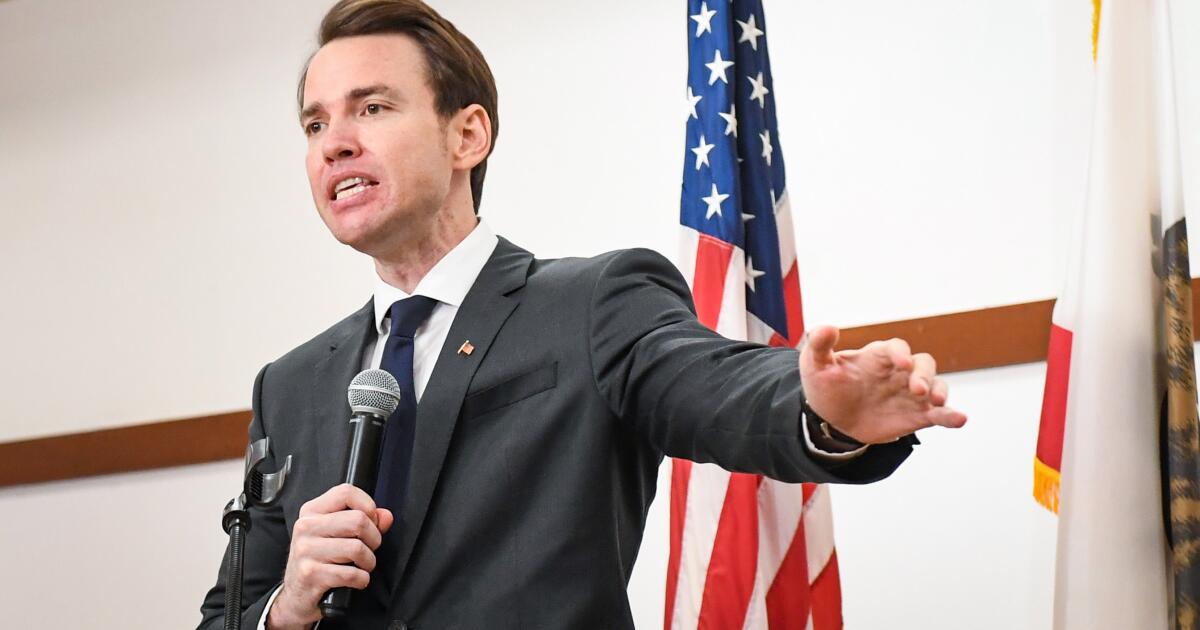
At a House Judiciary hearing on Wednesday, Atty. Gen. Pam Bondi was holding a document labeled “Jayapal Pramila Search History” that included a list of files from the unredacted Epstein archive accessible to lawmakers such as Rep. Pramila Jayapal (D-Wash.).
That means over the course of a year Bondi’s Department of Justice has made time to speak with Ghislaine Maxwell — the New York socialite who helped Jeffrey Epstein run his billion-dollar child-sex-trafficking operation — and it made time to surveil a Democratic lawmaker who conducts oversight as a member of the Judiciary Committee. But it has yet to meet with the victims of Epstein’s crimes who want to talk.
When she took office, Bondi promised us transparency. She didn’t promise we would like what we would see from her.
The general public’s awareness of Epstein’s heinous crimes came with political baggage. However at this point, the question we all should wonder is: How does redacting the names of the men who helped fund Epstein’s operation benefit either political party? It may be good for the rich and powerful men trying to avoid accountability, but it’s not exactly a campaign platform.
Yet here we are as a country, chained to the same vocabulary used during an election, so a conversation that should be about right and wrong is accompanied by poll numbers and analysis about the midterm elections. As if the Justice Department’s refusal to interview rape survivors is an inside-the-Beltway topic and not reflective of a larger moral crisis. We have seen Congress kept out of session to avoid voting on the release of the Epstein files; we have heard equivocation about whether Epstein was a pedophile. We know Epstein’s island was a place where evil resided.
The investigation, or lack of investigation, into Epstein’s fellow abusers should not be seen by anyone as a political quandary in which the object of the game is to keep your party in power. The fact that there is a Republican-vs.-Democrat divide on accountability for sex abuse reveals a national moral crisis. When the abuse of children is viewed through a partisan lens, how else can one describe this period in America?
Fifty years ago, when President Carter was tasked with healing the nation after the Watergate scandal, he told Americans in his inaugural address that he was leaning on his faith, and one prophet in particular.
“He hath shewed thee, O man, what is good; and what doth the Lord require of thee, but to do justly, and to love mercy, and to walk humbly with thy God?,” Carter said, quoting Micah 6:8. “This inauguration ceremony marks a new beginning, a new dedication within our government, and a new spirit among us all. A president may sense and proclaim that new spirit, but only a people can provide it.”
The Hebrew prophet Micah was from a rural area, not born into the wealth of the royal court. He was not being compensated by those who were. Instead, Micah reflected the voice of the people who were forced to live in poor conditions because of corruption. He described the actions of the morally bankrupt judges, political leaders and other elites in graphic, violent terms, condemning those “who hate the good, and love the evil; who pluck off their skin from off them, and their flesh from off their bones.”
This, he said, is what it is like being ruled by those who are not guided by what is good and what is evil, but rather what is most beneficial for themselves in the moment. When Micah spoke, it wasn’t about the latest poll numbers. His warnings about government corruption are not unique to any particular faith, nor are they married to any political party. They embody centuries of human history, a history that tells what happens to a society when power goes unchecked.
And be not mistaken, it was unchecked power — not any party affiliation — that provided Epstein and Maxwell with patronage. It was moral failure, not conservatives or liberals, that provided cover for their child-sex-trafficking ring.
So if for partisan reasons the abusers of children are not held accountable for their crimes, the language of politics fails us. The word for that is simply: evil.
The following AI-generated content is powered by Perplexity. The Los Angeles Times editorial staff does not create or edit the content.
Ideas expressed in the piece
The Department of Justice under Attorney General Pam Bondi has created a moral crisis by allowing the investigation into Jeffrey Epstein’s fellow abusers to become a partisan political issue rather than a matter of fundamental accountability and justice[3]. The DOJ has monitored a Democratic lawmaker’s access to Epstein files while reportedly meeting with Ghislaine Maxwell but declining to meet with Epstein survivors seeking to discuss their experiences[1][3].
Redacting the names of wealthy and powerful men implicated in Epstein’s crimes while exposing victims’ identities serves no legitimate governmental interest and only protects the rich and powerful from accountability regardless of political affiliation[3]. The failure to hold co-conspirators accountable after more than a year in office, combined with refusals to apologize to survivors, demonstrates a troubling prioritization of protecting certain interests over justice[3].
When child sexual abuse becomes filtered through partisan politics rather than evaluated on moral grounds, it reflects a fundamental failure of governance and represents a national crisis of conscience[3]. The politicization of this issue obscures what should be a universal principle: that accountability for crimes against children transcends party affiliation and election cycles[3].
Different views on the topic
The Department of Justice maintains that it records all searches conducted in its systems specifically to safeguard against the disclosure of victim information, suggesting that monitoring access to sensitive Epstein files serves a protective function rather than partisan surveillance[1]. Attorney General Bondi stated that the department has pending investigations in its office related to potential Epstein conspirators[2], indicating that prosecutorial work continues despite public criticism.
The release of Epstein files is an ongoing process requiring careful legal review to protect victims’ privacy and ensure proper handling of sensitive evidence[4]. The DOJ’s approach to redacting certain information may reflect legitimate institutional concerns about victim protection and the complexities of managing millions of declassified documents[1].
“Frankenstein” star Jacob Elordi, at 6 feet 5 easy to spot from across the ballroom, leaned down to hug Teyana Taylor, a supporting actress Oscar nominee for “One Battle After Another.” Nearby, her co-star Leonardo DiCaprio caught up with Steven Spielberg, who directed him 24 years ago in “Catch Me If You Can,” while “Sentimental Value” filmmaker Joachim Trier huddled with “One Battle’s” Paul Thomas Anderson, a fellow directing nominee. In the middle of it all, songwriter Diane Warren paused to take a selfie, still evidently enjoying the giddy thrill of being in a room full of fellow hopefuls even after 17 times.
In all, 203 of this year’s 230 Academy Award nominees gathered Tuesday at the Beverly Hilton Hotel for the annual nominees luncheon, a brief moment of campaign-free conviviality amid the churn of awards season. As flashbulbs followed the most famous faces, major stars like Timothée Chalamet, Emma Stone and Kate Hudson rubbed elbows and shared champagne toasts with lesser-known nominees from categories like animation, sound and live-action short before lining up for the annual class photo.
With the Oscars just weeks away on March 15, the long-running gathering — a ritual dating to 1982 and returning this year after being canceled in 2025 because of the Los Angeles County wildfires — offered the nominees a welcome stretch of easygoing mingling, largely free of competition. The reprieve is short-lived: Voting begins on Feb. 26, when the brutal math of awards season will reassert itself, meaning roughly 80% of them will head home on Oscar night empty-handed.
Kate Hudson, a lead actress nominee for “Song Sung Blue,” at the 2026 Oscar nominees luncheon at the Beverly Hilton Hotel.
(Kayla Bartkowski / Los Angeles Times)
For first-time contenders, the luncheon carried a particular rush. Christalyn Hampton, a co-director of the documentary short “The Devil Is Busy,” which follows a day at an abortion clinic in Atlanta, said she was excited to meet “Sinners” director Ryan Coogler, whose period vampire thriller leads the field with a record 16 nominations.
“We’re two African American directors nominated this year — I think that’s pretty historic,” said Hampton, a former professional dancer whose first directing credit has landed her an Oscar nod. “Flying back and forth from Atlanta has been a bit exhausting, but to be in this moment with all these incredible filmmakers — you can’t complain.”
Jacob Elordi, left, and “Sirāt” film director Oliver Laxe — two extremely tall nominees — at the 2026 Oscar nominees luncheon at the Beverly Hilton Hotel.
(Kayla Bartkowski / Los Angeles Times)
Still, even inside the awards-season bubble, the turmoil surrounding the movie business, the country and the world beyond it was hard to ignore. As attendees tucked into their chicken, more than a few discussions drifted to whether Netflix or Paramount would prevail in their attempts to acquire Warner Bros. and what either scenario might portend for the future of movies.
In her remarks, academy President Lynette Howell Taylor acknowledged the questions many nominees have been asking themselves amid industry contraction, political volatility and global conflict. “The art you create is vital,” Howell Taylor told the crowd. “I know many of us ask ourselves, ‘Should we be doing something else? Should we be doing something differently? Should we be doing more?’ The answer to that is personal. But what I do know is this: What you are doing is not easy and it is so needed.”
Teyana Taylor, nominated for supporting actress for “One Battle After Another,” at the 2026 Oscar nominees luncheon at the Beverly Hilton Hotel.
(Kayla Bartkowski / Los Angeles Times)
She praised the resilience of filmmakers who have endured strikes, dangerous political environments and even war zones. “To not make your films, to not tell your stories, is to give in,” she said. “And there is not one of you in this room who has been willing to do that.”
That tension was felt especially sharply by Sara Khaki, co-director (with Mohammadreza Eyni) of the documentary feature nominee “Cutting Through Rocks,” which follows the first Iranian woman elected as a councilwoman in a rural village. The weeks since the nomination, Khaki said, have been both “terrible and wonderful,” as her home country has been rocked by protests against the Iranian government.
Elle Fanning, nominated for “Sentimental Value,” at the 2026 Oscar nominees luncheon at the Beverly Hilton Hotel.
(Kayla Bartkowski / Los Angeles Times)
“What’s terrible is what we’re experiencing back home — the internet shut down, worrying about our loved ones,” she said. “What’s wonderful is what’s happening here. So it’s a mix of emotions, really.”
Another Iranian nominee was absent altogether. Mehdi Mahmoudian, nominated as a co-writer of director Jafar Panahi’s drama “It Was Just an Accident,” was arrested this month in Iran after signing a statement condemning the government’s deadly crackdown on protesters.
Actor Wagner Moura, nominated for “The Secret Agent,” and former AMPAS President Janet Yang at the 2026 Oscar nominees luncheon at the Beverly Hilton Hotel.
(Kayla Bartkowski / Los Angeles Times)
At each table, nominees were asked to fill out a card with a simple question: “What movie made you want to be part of this world?” After pondering for a moment, “Nomadland” Oscar winner Chloé Zhao, nominated in the directing category for the second time for the wrenching drama “Hamnet,” wrote down Hirokazu Kore-eda’s 1998 film, “After Life,” a quietly humane meditation on memory and meaning that felt closely aligned with her own filmmaking sensibility. The answers, Howell Taylor explained, would be used for “a special moment” during the Oscar telecast.
As in years past, the luncheon also came with a bit of gentle coaching about what to do — and not to do — should one’s name be called on Oscar night, including moving briskly to the stage, keeping remarks to no more than 45 seconds and not leaning into the microphone.
Directors Steven Spielberg, left, and Paul Thomas Anderson at the 2026 Oscar nominees luncheon at the Beverly Hilton Hotel.
(Kayla Bartkowski / Los Angeles Times)
Above all, Howell Taylor urged nominees to resist the temptation to thank everyone they’ve ever worked with. “You’ll forget someone and you’ll feel terrible,” she said.
Better, she suggested, to focus on what the moment actually means. “You are the show,” Howell Taylor reminded them. “It’s your speeches. This is an entertainment show millions of people will be watching, so let’s make the most of it.”
One in five tourists have confronted others for ruining their holiday photos at crowded landmarks like Time Square and Eiffel Tower
Crowded hotspots like Times Square can make it difficult to get a good photo(Image: Getty Images)
Times Square, the Eiffel Tower, and the Trevi Fountain have all been dubbed some of the most challenging places to get a good photograph when on holiday, mainly due to the amount of tourists.
A poll of 2,000 adults found that to combat the crowds, a determined 27% admitted to waking up earlier than 6 am to beat the rush at popular tourist spots and secure a crowd-free picture. One in five travellers also admitted they have queued for longer than an hour to get photos in certain spots, with the Taj Mahal in India requiring the longest waiting time.
Other iconic locations cited as near-impossible to photograph without getting other people in were the Mona Lisa, the Colosseum, and even Buckingham Palace. The Great Wall of China and Niagara Falls were also difficult to photograph without getting countless people in the background.
The study discovered 21% ‘hate’ when their shots get ruined by others lurking in the background, while 55% of travellers grumble about the difficulty of manually removing unwanted people from their images.
Still, over four in 10 (42%) said getting the perfect photograph for social media was a top priority when travelling. But as the survey shows, this can often be difficult so a fifth of holidaymakers have returned to revisit major attractions because they failed to good photo originally.
One in five have even told someone off for getting in the way of their photo, with 70% feeling frustrated by the issue.
The research was commissioned by Samsung to highlight the capabilities of their Galaxy AI on the S25 Series.
Annika Bizon, from Samsung, said: “Everyone wants to travel home with a photo that represents their incredible trip to some of the wonders of the world, but capturing the perfect snap can sometimes be near impossible.
“Galaxy AI features like Generative Edit can help time-strapped travellers who would prefer not to have to wake up before 5 am to queue for a photo, with just a speedy tap removing any unwanted guests.”
TOP 10 TOURIST HOTSPOTS HARDEST TO GET A ‘CLEAN’ PHOTO OF:
Times Square – New York City, USA
Eiffel Tower – Paris, France
Trevi Fountain – Rome, Italy
The Mona Lisa – Louvre Museum, Paris, France
Buckingham Palace – London, UK
Taj Mahal – Agra, India
The Colosseum – Rome, Italy
Great Wall of China (Badaling section) – Beijing, China