federal law

ABC files applications ‘under protest’ for early renewal of TV station licenses

Walt Disney Co.’s ABC has filed renewal applications with the Federal Communications Commission “under protest” after an order mandating a years-early review of the network’s eight television station licenses.

The criticism was part of the network’s applications for the FCC review, which were filed ahead of a deadline Thursday. In an objection to the early renewal, Disney’s New York station WABC called the FCC order “unlawful, arbitrary and unconstitutional” and said it was “legally indefensible.”

“The Commission had not demanded early renewal in over five decades,” the station wrote in its filing. “And it has never before demanded simultaneous license renewal applications from a group of stations commonly owned with a network as it has here. The order has no legitimate purpose.”

The licenses for the eight ABC-owned TV stations, including KABC in Los Angeles, were originally scheduled for renewal between 2028 and 2031.

The FCC order came shortly after ABC late-night host Jimmy Kimmel made a joke about First Lady Melania Trump looking like an “expectant widow” days before a gunman tried to breach the White House Correspondents’ Assn. gala last month that President Trump attended.

Trump has frequently threatened to have TV station licenses pulled when he is unhappy with their coverage, but the order is the first time the government has acted on his wishes, sparking anger from free speech advocates. The FCC has said the order is part of an investigation into whether Disney’s diversity and inclusion policies violate federal law and the agency’s rules against “unlawful discrimination.”

In its response, WABC said the “only plausible reason” to issue the order was to “punish the station for speech the government does not like.”

“The ultimate injury here is not to the station or its parent company. It is to the public,” WABC wrote. “When a broadcaster must weigh regulatory retaliation before making editorial decisions, the public loses access to journalism that is free from government influence.”

FCC Chairman Brendan Carr said in a statement Thursday that Disney filed its applications to renew its broadcast licenses only after the company was told its previous answers were “disingenuous, deficient and improper.”

“Contrary to Disney’s claim that the FCC called in their broadcast licenses for early renewal for no reason, the record shows something very different,” Carr said. “Broadcast licensees have a unique obligation to operate in the public interest. The FCC will follow the facts and law wherever they may lead.”

FCC Commissioner Anna M. Gomez, the panel’s only Democrat who has backed Disney in its fight, cheered the Burbank media and entertainment company’s filing, saying in a post on X that she was “glad to see them expose the FCC’s actions as nothing more than naked political retribution and an unlawful assault on free speech and a free press.”

Times staff writer Meg James contributed to this report.

Source link

Expected closure of Everglades detention center is no accident, environmentalists say

Environmental groups say that the timing of the expected closure of an immigration detention center in the middle of the Florida Everglades, likely in the next month or two, is no accident because it will come as their lawsuit challenging its existence returns to a federal judge who had previously ordered it shut down.

A federal appellate court decided last month to keep open the detention center nicknamed “Alligator Alcatraz,” for the time being, blocking a lower court decision ordering it to wind down operations. But the case was sent back to the lower court judge who now gets jurisdiction over the lawsuit as the litigation over the facility’s fate continues.

“Knowing that the same district judge who previously enjoined the operation would soon reassume oversight — the defendants are now effectively waving the white flag,” said Paul Schwiep, an attorney for the environmental groups that had sued, saying the facility’s construction hadn’t undergone a required environmental review.

When asked about the future of the state-run facility and its costs on Wednesday, Florida Gov. Ron DeSantis said that he hadn’t gotten any “official word” that federal authorities are going to stop sending detainees to the center.

But vendors who supply and help run the facility have been told that the closure could be as soon as next month, according to reports Tuesday by the New York Times and CBS News Miami. The Florida Department of Emergency Management, which operates the detention center, didn’t respond to an emailed inquiry on Wednesday. The Republican governor’s press secretary, Molly Best, referred questions about the facility to the state emergency management agency.

“We didn’t build any permanent facilities down there because we knew it was going to be temporary,” DeSantis said Wednesday at a news conference in Titusville, Fla.

DeSantis’ administration opened the facility in July to support the immigration crackdown by the administration of President Trump, who visited the detention center last summer. An attorney for two detainees has accused guards of severely beating and pepper-spraying detainees. Other detainees have said worms turn up in the food, toilets don’t flush and mosquitoes and other insects are everywhere.

“This monument to cruelty, waste and environmental and tribal lands abuse should have never been built,” U.S. Rep. Debbie Wasserman Schultz, a Democrat from Florida, said Tuesday.

Friends of the Everglades and the Center for Biological Diversity sued state and federal officials a short time after the facility opened, claiming the remote airstrip site in the Everglades wasn’t given a proper environmental review required by federal law before it was converted into an immigration detention center. U.S. District Judge Kathleen Williams in Miami agreed and ordered in August that the facility must wind down operations within two months.

The appellate court blocked the order, saying the Florida-run facility wasn’t under federal control and didn’t need to comply with federal law requiring an environmental impact review.

But the appellate court made clear that once Florida got federal reimbursement for the facility, it would have to comply with the federal environmental law, Schwiep said.

DeSantis said Tuesday that the state expected to be reimbursed by the federal government for $608 million, which has already been approved by the Federal Emergency Management Agency.

“There’s no negotiations on that,” he said.

Schneider writes for the Associated Press.

Source link

U.S. troops may sue military contractors for their injuries, Supreme Court rules

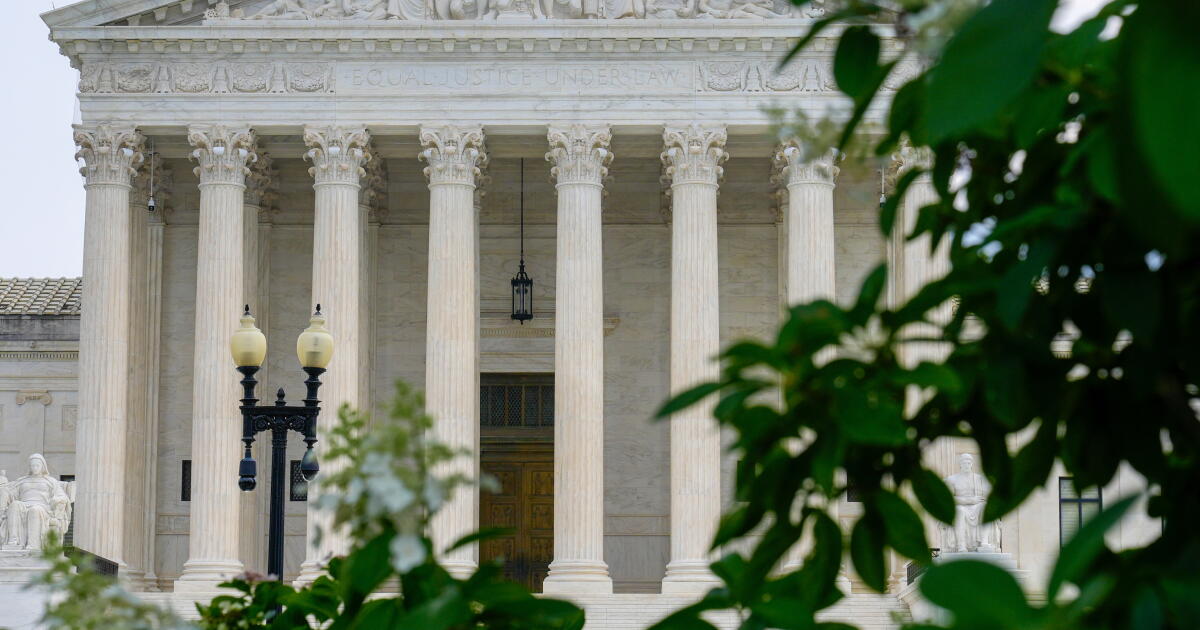
The Supreme Court ruled Wednesday that U.S. troops may sue military contractors for their injuries, siding with a soldier who was badly injured when a Taliban operative working at the Bagram Airfield detonated a suicide bomb.

Five soldiers were killed and 17 were wounded, including 20-year-old Winston Henceley, who suffered a fractured skull and brain injuries and is permanently disabled.

In a 6-3 decision, the court ruled that neither federal law nor the Constitution shields military contractors if their mistakes or negligence result in solders being injured in a combat zone.

Justice Clarence Thomas wrote the court’s opinion for an unusual majority that included Justices Sonia Sotomayor, Elena Kagan, Neil M. Gorsuch, Amy Coney Barrett and Ketanji Brown Jackson.

In the past, Thomas has objected to court precedents that prevented troops from suing the U.S. government for their injuries, including from medical practice.

And he said that rule should not be expanded to shield military contractors.

Justice Samuel A. Alito Jr. dissented, along with Chief Justice John G. Roberts and Justice Brett M. Kavanaugh.

“Because the Constitution gives the federal government exclusive authority over foreign affairs and the conduct of wars, federal law preempts all state law that substantially interferes with the Government’s exercise of those powers,” Alito wrote.

Hencely had tried to stop and question Ahmad Nayeb, an Afghan employee, as he walked toward soldiers who had gathered for a Veteran’s Day 5K race in 2016.

The Army concluded that Hencely’s intervention “likely prevented a far greater tragedy,” and its investigation concluded that the Fluor Corporation that had a contract to run operations at the base was primarily responsible for the attack.

The report said Fluor was negligent in hiring an Afghan who had been a Taliban operative, and it failed to closely supervise him.

But Henceley sued Fluor for his injuries; a federal judge in South Carolina and the 4th Circuit threw out his suit.

“During wartime, where a private service contractor is integrated into combatant activities over which the military retains command authority, a tort claim arising out of the contractor’s engagement in such activities shall be preempted,” the 4th Circuit said.

The court agreed to hear his appeal and overturn the 4th Circuit, clearing his suit to proceed.

Source link