featured

Putin’s Kuril Islands Visit Exposes Japan’s Russian Energy Dilemma

Japan’s protest over Putin’s visit to the Kuril Islands is loud because its response is capped: Tokyo cannot meaningfully sanction the one Russian energy relationship — Sakhalin-2 LNG — it now depends on more than ever, after the Strait of Hormuz closure gutted its Gulf oil access and made that supply a load-bearing pillar of its energy security through at least December 2026.

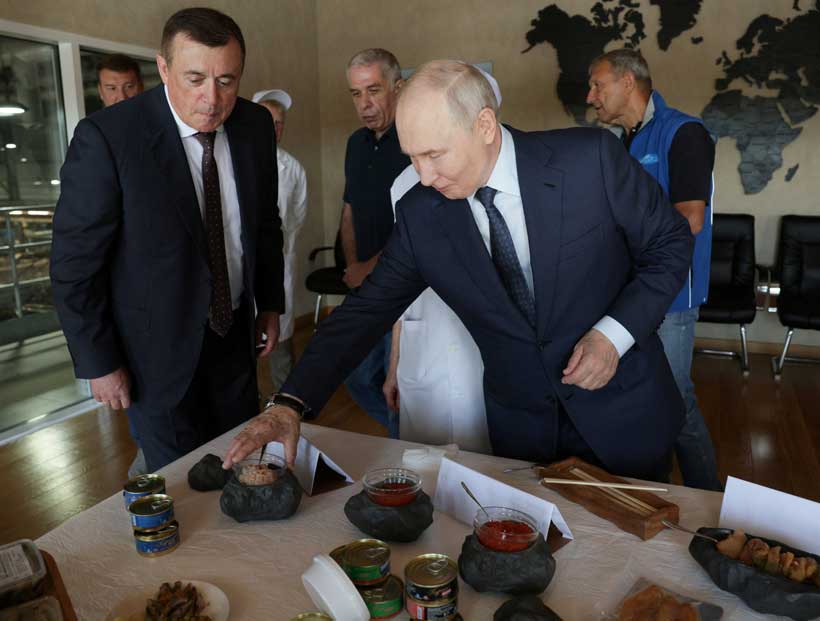
On August 13th, Vladimir Putin toured a fish-processing plant on Iturup Island, the largest of the four southern Kuril Islands Japan calls its Northern Territories, with Sakhalin’s regional governor at his side. It was his first visit there in twenty-six years in power. He called the islands’ status “enshrined” as a permanent outcome of the Second World War and pointedly invoked the late Shinzo Abe, who spent years personally courting him toward a peace treaty that never materialised. Tokyo’s response was immediate: Prime Minister Sanae Takaichi called the visit “absolutely unacceptable,” and her Foreign Ministry says an “additional sanctions package” is under consideration. What went unmentioned is that this same government told Washington, in writing, ten months earlier that a full ban on Russian LNG would be “difficult.” That contradiction, not the visit itself, is the story.

The dispute is old: the Soviet Union seized the four islands in the war’s final days, and the missing peace treaty has been Tokyo and Moscow’s unfinished business for eighty years. What is new is the energy math surrounding it. Sakhalin-2, the LNG project sitting directly across the strait from where Putin stood, supplied Japan roughly 3.6–3.9 million tonnes last year — about 9% of its total LNG imports, and enough to make Japan the project’s largest single buyer. The US Treasury sanctions waiver permitting those imports, along with the Gazprombank clearing that finances them, was just extended to December 18th, 2026, pushed back from an original June deadline. Washington’s stated reason was blunt: global supply is “constrained amid the continued closure of the Strait of Hormuz.”

BEHIND THE VISIT

Stay ahead of the geopolitical week.

MD Briefing delivers expert analysis across five global fronts — the Indo-Pacific, energy, geoeconomics, European security, and the Middle East — every Monday morning. Free.

That closure is the piece most coverage of the Kuril visit leaves out. Since February 28th, when the US and Israel launched their air campaign against Iran, the Strait of Hormuz has been effectively shut, with roughly 20,000 mariners and 2,000 ships stranded and Brent crude spiking to $126 a barrel at its peak. Around 90% of Japan’s crude oil and 11% of its LNG normally transit Hormuz. Tokyo has spent 2026 losing its largest energy artery to a war in the Gulf, which means Sakhalin-2 has quietly gone from “one Russian supplier among several” to one of the few pillars still standing under Japan’s winter power grid. Putin picked this year, not an arbitrary one, to make his sovereignty claim visible on the ground.

The waiver renewal is the tell. Washington and Tokyo did not merely tolerate the Sakhalin-2 exemption through the Ukraine-sanctions years — they actively rebuilt it in 2026, in the middle of the Hormuz crisis, explicitly carving out maritime transport, financial clearing, and joint-operations funding through the end of the year. Putin then chose that same window, with that same regional government’s leadership standing next to him, to plant a public flag on the neighbouring islands. He is not testing whether Japan objects. He knows it will. He is testing whether the general logic of sanctioning Russia survives contact with the specific, recently-renewed exemption that keeps Japanese lights on. Compare that to 2010, when Dmitry Medvedev made the first-ever Russian presidential visit to the same islands: Tokyo protested loudly, recalled its ambassador briefly, and moved on within weeks, because no comparable energy dependency was on the table at the time. The script is recognisable. The stakes underneath it are not.

Takaichi’s own words undercut her “absolutely unacceptable” framing before she said it. In October 2025, briefing President Trump on the LNG relationship, she told him directly that a total ban on Russian gas “would be difficult” — an unusually candid admission from a leader now weighing a fresh sanctions package over the same relationship’s home islands. A prime minister who has already told Washington, on the record, that cutting the energy tie is impractical cannot now credibly threaten it without the threat being understood, in Moscow as much as in Tokyo, as theatre. What remains available is a narrow band of symbolic measures — travel restrictions, asset freezes on individuals connected to the visit or the regional administration — that let Tokyo be seen to act without touching a single LNG cargo.

The standard objection is that Japan has options: JERA, its largest buyer, points to a 30–35 million tonne portfolio and spot-market access, and Tokyo Electric-linked utilities cite early-stage interest in the $44 billion Alaska LNG project as a long-term alternative. That is capability, not near-term relief. Japanese firms remain openly cautious about Alaska LNG’s cost and logistics, with no binding offtake timeline in sight, and the global spot market Japan would lean on is the same market already absorbing cargoes redirected from Hormuz-blocked routes — tighter, not looser, than in a normal year. Sanctioning the actual molecules, rather than a list of names, risks the electricity-price and blackout warnings Japanese officials themselves used to justify keeping the Sakhalin-2 waiver alive in the first place.

THE SCENARIOS

Base case (~55%): Japan announces a narrow, largely symbolic sanctions package — individual travel bans and targeted asset freezes tied to the Far East regional government — while explicitly leaving Sakhalin-2 supply and Gazprombank clearing untouched, repeating the 2010 script almost exactly. The December 18th waiver renewal proceeds quietly, folded into the broader Hormuz-driven energy calculus, and Moscow reads the episode as confirmation that its Pacific energy leverage over Japan is durable regardless of who occupies the Kremlin’s chair on any given August.

Downside case: domestic backlash — the same “hardened public sentiment” Takaichi herself warned the visit would produce — pushes her government into a genuine review of the Sakhalin-2 exemption as its December deadline approaches, right as Hormuz remains tight heading into winter and Asian spot LNG prices stay elevated from redirected Gulf cargoes. The result is Japan’s first real taste of sanctions-driven energy pain from the Ukraine-era regime, a burden that has so far landed almost entirely on European households rather than Japanese ones, arriving in the worst possible month of the heating season and forcing utilities into the kind of emergency rationing talk Tokyo has avoided since 2022.

Upside case: Tokyo treats the compounding shock — Hormuz plus the Kuril visit landing in the same year — as the forcing function it has lacked for three years, converting Minister Yoji Muto’s long-stated goal of “steadily reducing dependence” on Russian LNG into actual contracted volume rather than a talking point: accelerated Alaska LNG offtake commitments, expanded US Gulf Coast term deals, and a public timeline for winding down Sakhalin-2 purchases that uses the December waiver deadline as a hard exit ramp instead of an automatic renewal. Even here, the earliest realistic substitution volumes arrive on a multi-year timeline, not by next winter.

THE AFTERMATH

Putin’s flag on Iturup was never really a test of Japan’s territorial resolve — Tokyo’s position on the Northern Territories has not moved in eighty years and was never going to move now. It was a test of whether that resolve has any economic weight behind it at the one moment Japan’s alternatives are thinnest.

Watch for: what actually happens to the Sakhalin-2 waiver around December 18th, not the sanctions package announced this week. A quiet renewal, carved out exactly as before, will tell you Japan’s outrage and Japan’s energy security are now permanently on separate tracks — and that Moscow understands the gap between them better than Tokyo would like to admit.
Source link

The European Union Should Help Fund An Oil Pipeline from the Gulf to The Mediterranean

While the United States enjoys sufficient energy resources, thanks to shale oil, the European Union does not. To assure itself of the energy supplies in the Gulf that the European Union needs, the EU should consider assisting the Gulf States in the construction and operations of the pipeline. 

Building a large-scale, completely underground oil pipeline system from the Persian/Arabian Gulf oil fields to the Mediterranean Sea is estimated to cost between $40 billion and $60 billion and would take 5 to 7 years to complete. The exact metrics depend heavily on the chosen route, political alignment across transit countries, and the required total throughput capacity. 

Breakdown of Total Costs 

Modern mega-pipeline engineering over long desert and mountain distances faces massive cost drivers: 

Stay ahead of the geopolitical week.

MD Briefing delivers expert analysis across five global fronts — the Indo-Pacific, energy, geoeconomics, European security, and the Middle East — every Monday morning. Free.

· Construction & Trenching ($18B – $25B): Burying multiple large-diameter (e.g., 42 to 48-inch) pipelines entirely underground requires extensive trenching, rock blasting, and specialized anti-corrosion coatings. Global benchmarks show that large-scale overland pipelines average $8 million to $12 million per mile, but full underground burial heavily drives up labor and machinery costs.

· Pumping Stations & Terminals ($8B – $12B): Moving millions of barrels of crude daily across hundreds of miles requires heavily fortified pumping stations every 60–100 miles, alongside massive new storage and loading terminals on the Mediterranean coast. 

· Geopolitical & Geotechnical Risk Premium ($7B – $10B): Multi-billion dollar  contingencies are standard to absorb project snags, material inflation, and  complex international legal/right-of-way frameworks. 

· Security Infrastructure ($5B – $10B): Given the vulnerability of cross-border energy corridors, modern estimates for Gulf bypass networks integrate specialized defensive technologies (like automated drone surveillance or surface-to-air missile defenses) to protect critical facilities. 

Construction Timeline and Stages 

· Megaprojects of this length are restricted by a sequential project lifecycle that cannot easily be accelerated simultaneously: 

· Diplomacy & Right-of-Way (Years 1–2): Securing cross-border transit legal treaties (e.g., routing through Saudi Arabia, Jordan, Israel, or Syria/Turkey) and finalizing environmental impact assessments. 

· Material Procurement & Logistics (Years 2–3): Manufacturing and transporting millions of tons of high-grade steel line pipe and heavy industrial pumps. 

· Civil Trenching & Laying (Years 3–6): Heavy execution phase. Crews can typically lay roughly 1 to 2 miles of pipe per day per construction spread.

Multiple spreads working simultaneously across different geographic zones are required to finish within a 3-to-4-year active construction window.  · Testing & Commissioning (Year 7): Hydrostatic pressure testing of the lines to ensure underground integrity, followed by line fill and gradual commercial scale-up 

Proposed Alternative Routes 

Producers in the region actively advance or evaluate different variants of this corridor to bypass maritime chokepoints like the Strait of Hormuz: 

· The Mesopotamian Corridor (Iraq/Syria route): A ~1,500 km route linking the southern oil fields of Basra to Mediterranean ports like Baniyas, Syria.  While geographically direct, it remains vulnerable to high regional instability. 

· The Trans-Arabian Upgrades: Adapting or running parallel lines to existing corridors (like the Saudi East-West Petroline, which travels 1,200 km to the Red Sea) and extending them northward to Mediterranean Sea terminals. 

How Standard Micro-Tunneling Works for Utilities: When pipeline engineers hit a mountain or an environmental zone where they cannot dig an open trench, they use Micro-Tunnel Boring Machines (MTBMs) or Horizontal Directional Drilling (HDD). These systems are highly specialized to avoid the exact problems of passenger-sized tunnels: 

· Sized to the Pipe: Unlike a 12-foot-wide transit tunnel, an MTBM is built to the exact outer diameter of the oil pipe (typically 4 to 5 feet for a 48-inch line).  This means crews excavate 90% less rock and dirt.

· Pipe-Jacking Method: Instead of laying concrete tunnel walls and then trying to slide a heavy steel pipe inside later, MTBMs use a process called “pipe jacking.” Powerful hydraulic rams at the surface push the actual steel oil pipe directly behind the drilling head as it advances into the rock. 

· No Open Voids: Because the pipeline fits perfectly into the drilled hole, there is no empty space left around it. The pipe is completely surrounded by solid rock or stabilizing grout, eliminating the risk of dangerous, explosive gas pockets building up in an open tunnel. 

The Mountain Ranges the Route Must Clear 

· To get from the Gulf fields (like Ghawar in Saudi Arabia or Basra in Iraq) to the Mediterranean, a pipeline must breach the Syrian Desert and cross a series of rugged, geologically active mountain walls running parallel to the Mediterranean coast: 

· The Jordan Rift Valley & Dead Sea Fault: Before hitting the mountains, the pipeline must drop down into one of the lowest, most seismically active valleys on Earth (falling hundreds of feet below sea level) and then immediately climb back out. 

· The Judean Hills & Golan Heights: Depending on the exact coastal terminal, the line must climb over rugged limestone ridges ranging from 3,000 to 4,000 feet high.

· The Anti-Lebanon & Mount Lebanon Ranges: If the route takes a more northern path toward Syria or Lebanon, it faces severe alpine conditions with peaks soaring between 9,000 and 10,000 feet. 

The Geopolitical Treaties Required 

Building a multi-billion dollar piece of energy infrastructure across national borders requires an intricate web of international legal frameworks. Historically, cross-border pipelines are governed by Host Government Agreements (HGAs) and Intergovernmental Agreements (IGAs). 

To make a Gulf-to-Mediterranean pipeline a reality, several unprecedented breakthroughs would be needed: 

· Transit Fees and Tariffs: The countries hosting the pipeline but not producing the oil (like Jordan or Syria) must negotiate “transit fees.” These are typically paid in cents per barrel of oil that passes through their territory, providing them with billions in long-term revenue. 

To make a Gulf-to-Mediterranean pipeline a reality, several unprecedented breakthroughs would be needed: 

· Transit Fees and Tariffs: The countries hosting the pipeline but not producing the oil (like Jordan or Syria) must negotiate “transit fees.” These are typically paid in cents per barrel of oil that passes through their territory, providing them with billions in long-term revenue. 

· The “Right of Way” Guarantee: Sovereign nations must sign legally binding treaties promising that they will not shut off or seize the pipeline during diplomatic disputes. A famous historical warning is the original Trans-Arabian Pipeline (Tapline), which was repeatedly disrupted, sabotaged, and eventually shut down permanently due to border conflicts and transit fee arguments between Saudi Arabia, Jordan, Syria, and Lebanon. 

· The Abraham Accords Framework: If the pipeline takes the most geologically direct southern route to terminals in Israel (like Ashkelon or Haifa), it relies heavily on the long-term stability and expansion of the Abraham Accords. Saudi Arabia and Israel would need formalized economic treaties to protect a joint energy corridor from regional political shifts. 

· Joint Security Commands: Because a pipeline stretching thousands of miles across the Middle East is a prime target for non-state actors and drone strikes, treaties must establish a unified security framework. This allows military and intelligence sharing across borders to patrol the pipeline corridor with automated drone networks and satellite monitoring. 

Environmental Safeguards for Freshwater Aquifers The Jordan Valley and the surrounding mountain ridges contain critical freshwater sources, such as the Mountain Aquifer, which supply drinking water to millions of people in Israel, Palestine, and Jordan. A single major crude oil leak could seep into the porous limestone and permanently poison these non-renewable water reserves.  To mitigate this, engineers deploy an array of specialized defenses: 

· Pipe-in-Pipe Technology (Double Containment): In high-consequence water zones, crews do not use a standard single-wall pipe. They build a “pipe-in-pipe” system where the main 48-inch crude oil line sits inside a larger, secondary outer steel casing. The vacuum gap between the two pipes is monitored 24/7 for pressure changes; if the inner pipe leaks, the outer pipe captures the oil before it touches the soil. 

· Fiber-Optic Acoustic Leak Detection: Continuous fiber-optic cables are buried directly alongside the pipeline. These cables can “hear” the micro-acoustic vibrations and sudden temperature drops caused by a pinhole leak. This allows operators to pinpoint the exact location of a breach within meters in less than a minute. 

· Emergency Remote Isolation Valves: The pipeline is segmented by heavy-duty, automated shut-off valves. In flat areas, these are placed every 20 miles. In critical aquifer zones or steep mountain drops, they are placed every 1 to 2 miles. If the control center detects a pressure drop, these valves slam shut automatically via satellite command to trap the oil inside a small, isolated section, preventing millions of gallons from draining into the environment. 

Daily Revenue for Transit Countries 

· Transit countries like Jordan or Syria do not own the oil, but they make massive profits simply by letting it cross their land. These fees are negotiated as a tariff—a fixed dollar amount charged per barrel of oil moved. 

· Assuming a modern mega-pipeline with a capacity of 2 million barrels per day (bpd) and a standard international transit tariff of $0.60 to $1.20 per barrel, we can calculate the massive financial impact on a host country’s budget:

DAILY TRANSIT REVENUE ESTIMATE │ 

Pipeline Throughput Capacity │ 2,000,000 Barrels / Day 

Average transit tariff rate: $0.90 USD per barrel 

Daily Revenue Generated │ $1,800,000 USD / Day 

Annual Revenue Generated │ $657,000,000 USD / Year 

The Broader Economic Impact 

· Direct Budget Injection: For a developing economy like Jordan, an extra $650M+ per year in pure cash represents a massive boost to their national budget, easily funding large-scale public infrastructure or health programs. 

· In-Kind Energy Off-Takes: Rather than taking 100% of the payment in cash, transit treaties often allow host countries to take a portion of the payment in free crude oil. This allows them to supply their local refineries and secure cheap domestic gasoline without relying on volatile global energy imports. 

· Long-Term Economic Leverage: Hosting the pipeline transforms these non-producing nations into critical gatekeepers for global energy markets, giving them significant diplomatic leverage when negotiating trade and security deals with major global superpowers. 

Maritime Shipping Insurance & The Strait of Hormuz Bypass  The Strait of Hormuz is the world’s most sensitive maritime energy chokepoint. During periods of regional conflict, Lloyd’s of London and global marine underwriters designate

the Persian Gulf as a listed area (high-risk zone), triggering drastic shifts in shipping economics. 

· War Risk Premiums: When regional tensions spike, war risk insurance premiums for oil tankers navigating the Strait can surge from a baseline of 0.025% of the ship’s value to over 0.25% to 0.5% per voyage. For a modern $100 million Very Large Crude Carrier (VLCC), this adds an extra $250,000 to $500,000 in insurance costs for a single transit. 

· Bypassing the Chokepoint: Moving oil via the underground pipeline directly to the Mediterranean entirely eliminates the need for tankers to enter the Persian Gulf. Tankers load at secure Mediterranean ports (like Ashkelon, Haifa, or Baniyas) within standard, lower-risk European maritime zones. 

· Shipping Time Savings: Loading in the Mediterranean slashes the sailing distance to European and North American refineries by roughly 3,500 to 4,500 miles compared to sailing all the way around Africa or paying steep transit fees to use the Suez Canal. This reduces freight operating costs and completely erases the risk of a regional conflict stranding a fleet inside the Gulf. 

Naval Defense Infrastructure at the Mediterranean Terminal 

Because the new Mediterranean pipeline terminal would handle up to 2 million barrels of oil per day, it becomes a high-value strategic asset. Protecting it requires a multi-layered naval defense perimeter extending miles out to sea:

· Anti-Drone & Anti-Torpedo Netting: Heavy, underwater physical barriers and sensor nets are deployed around the loading buoys and piers to catch or detonate incoming unmanned underwater vehicles (UUVs) or loitering aquatic explosive drones. 

· Phalanx CIWS & Missile Batteries: The onshore terminal facility integrates close-in weapon systems (CIWS) and surface-to-air missile batteries (like Iron Dome or Barak MX systems) to intercept incoming rocket, drone, or anti-ship missile strikes launched from sea or land. 

· Active Naval Patrols: Host nations deploy continuous maritime security cordons using fast attack craft, sonar-equipped corvettes, and aerial reconnaissance drones to enforce a strict 5-to-10 mile exclusion zone around the offshore loading terminals, vetting every incoming commercial vessel. 

Conclusions 

With political tensions between the United States and the European Union increasing and confidence in the United States’ foreign policy falling, Europe needs to find and secure an energy source that is not dependent on either the United States or Russia.  An agreement, both economic and political, would in the long run make Europe independent from energy sources from either country. The idea of an overland pipeline to the Mediterranean is both economically and engineeringly possible. What is needed is the political will to make it happen.

Source link

To Beat a State-Capitalist Rival, Washington Became One: Inside the New Critical Minerals Race

On July 10, almost exactly a year after the Pentagon announced it was becoming the largest shareholder in MP Materials, the International Energy Agency put a number on what that deal was designed to prevent: $6.5 trillion in global downstream production now sits exposed to China’s rare-earth export curbs — restrictions currently suspended under an October 2025 truce that lapses again around October 2026. In the year between those two dates, Washington did not simply subsidize its way out of dependency on Chinese processing. It bought in: $400 million for 15 percent of MP Materials, a decade-long price floor for neodymium-praseodymium set nearly double the market rate, and a ten-year promise to buy everything a new Texas magnet plant produces. The Pentagon is now, functionally, a mining shareholder. The interesting question is not whether that has worked — MP’s private financing round attracted $1 billion from J.P. Morgan and Goldman Sachs within weeks — but what it costs to win a state-capitalist contest by becoming a state capitalist.

The stakes are structural, not cyclical. China controls roughly 70 percent of the world’s rare-earth and critical-mineral refining capacity, a chokepoint built over three decades while Western producers treated minerals as ordinary commodities rather than strategic assets. Beijing’s October 2025 tariff-war truce with Washington postponed, rather than cancelled, an expanded licensing regime that already cut U.S. yttrium imports from 333 tonnes to 17 tonnes in eight months — a squeeze aerospace manufacturers say could force production pauses. Washington’s answer has three parts: Project Vault, a $12 billion public-private stockpile signed by executive order on February 2, 2026, covering all 60 minerals on the USGS critical list; a fast-growing portfolio of direct government equity stakes in miners and processors; and a parallel push to sign allied-supply agreements with eight partners, including Australia, Japan, the UK and the UAE. Europe, meanwhile, is running a different playbook: a €3 billion RESourceEU plan, a joint-purchasing platform, and a stockpiling pilot — procurement and coordination, not ownership.

The MP Materials deal is the template, and its mechanics matter more than its headline. The Department of Defense’s July 2025 investment made it MP’s largest shareholder, attached a $150 million loan for expanding the Mountain Pass mine, and guaranteed a $110-per-kilogram floor price for NdPr oxide — a level industry analysts put at nearly double the prevailing market price — alongside a ten-year offtake covering the full output of a planned magnet facility in Fort Worth. Private capital followed the government’s signal almost immediately, which is precisely the point: Washington concluded that a guarantee was worth more to investors than a grant. That logic has since scaled. The administration has taken a $670 million stake in magnet producer Vulcan Elements, a 10 percent, $35.6 million position in Trilogy Metals, converted a renegotiated Energy Department loan into equity in Lithium Americas, and expanded the official critical-minerals list to include copper and metallurgical coal. Total direct equity commitments now exceed $1 billion, on top of Project Vault’s $12 billion stockpile.

The backlash has been immediate and specific, and it is worth taking seriously rather than waving off as sour grapes. Rival producers argue the price floor lets MP “undercut commercial bids, using federal subsidies to shield its margins,” while former White House and Pentagon officials warn the arrangement could “distort global NdPr pricing, crowd out innovation, and deter private investment in alternative supply chains” — in effect, recreating the very state-directed monopoly the policy exists to counter. That is the strongest objection, and it does not fully land: a government willing to take equity risk, rather than hand out grants, at least has an incentive to see the investment succeed and can in principle profit from the upside, which is the argument the Treasury and National Energy Dominance Council make for why this is smarter policy than Cold War-style stockpiling alone. But the objection identifies a real cost even if it doesn’t defeat the policy: an above-market, government-guaranteed price for one company makes every unsubsidized competitor in the same commodity harder to finance, which narrows rather than widens the eventual supplier base — the opposite of the diversification the strategy claims to deliver.

Stay ahead of the geopolitical week.

MD Briefing delivers expert analysis across five global fronts — the Indo-Pacific, energy, geoeconomics, European security, and the Middle East — every Monday morning. Free.

There is a second problem the price-floor logic obscures: capital committed is not the same as metal produced. The Center for Strategic and International Studies frames this as the difference between “distance” — how much progress has been announced — and “displacement” — how far supply chains have actually moved from their starting point. Japan’s experience with Lynas Rare Earths is the sobering comparison: fifteen years and $250 million of patient, low-drama investment before Lynas achieved the first commercial dysprosium production outside China, in 2025. Washington’s approach substitutes speed and scale for that patience, which may be the correct trade given the urgency, but it means the MP deal’s real test has not yet arrived — it arrives when the Fort Worth facility is supposed to reach full commercial output, not when Wall Street decides to match the Pentagon’s bet.

None of this is happening in a China-versus-America vacuum, either. The Democratic Republic of Congo has extended its cobalt export suspension specifically to tighten leverage over Chinese refiners, and Indonesia has repeatedly resisted pressure to loosen nickel export quotas, forcing processing onshore on its own terms. Producer states, not only the two superpowers, are now treating minerals as instruments of strategic leverage rather than commodities to be sold at whatever price clears the market. That reframes the whole contest: this is not simply Washington racing to catch Beijing, but a broader shift in which every government that sits on a mineral deposit is deciding whether to sell it or wield it.

Which is where Europe’s exposure becomes concrete. RESourceEU gives Brussels coordination and buying power, but no board seats and no offtake priority — and Chatham House’s own assessment is blunt that the UK and EU “cannot match the scale of what the US is attempting” and risk being “left behind” without equity of their own. That matters because Washington’s price floors do not stay domestic: a guaranteed $110/kg for MP’s output resets the benchmark every other buyer, including European manufacturers, has to price against, while offtake agreements tied to U.S. defense production can put European buyers behind the queue when supply tightens. The diversification Europe wants — away from dependence on Beijing — is real, but the replacement supply chain now runs increasingly through companies Washington part-owns and whose output is pre-committed to American industry first. Substituting one chokepoint for another is not the same as building a market.

What Happens Next

Base case (our estimate: roughly 55 percent probability). Washington’s equity-and-price-floor model extends to more minerals — copper and metallurgical coal are already on the list — and more companies, Project Vault’s stockpile builds through 2026–27, and the October 2025 China truce holds past its lapse date. Europe continues a purchasing-only strategy, remaining a price-taker on a benchmark increasingly set in Washington rather than Shanghai. This depends on Congress and private markets continuing to treat government equity as a credible signal rather than a fiscal liability, and on China preferring managed leverage over an open rupture.

Downside case. China allows the truce to lapse on schedule around October 2026 and resumes full licensing enforcement — already quietly restarting, according to recent customs-audit reports — before Vault-funded and MP-style projects reach meaningful output. Aerospace and defense manufacturers, already forced to ration yttrium and dysprosium at a fraction of pre-2025 volumes, face renewed production pauses in the exact window (2026–2028) when domestic capacity is still years from scale, exposing the gap between announced investment and actual tonnage.

Upside case. Government stakes prove to be a bridge rather than a permanent structure: MP, Vulcan Elements and Lithium Americas hit production targets on schedule, price floors become unnecessary as Japan’s Lynas eventually showed is possible after fifteen years of patient investment, and the eight-nation allied-supply framework matures into a genuinely plural, competitively priced market that Europe can buy into on equal terms rather than through Washington’s balance sheet.

The Pentagon’s bet on MP Materials shows that the fastest way to out-compete a state-directed rival was to become one — and by the only metric available so far, capital raised, that gamble is working. But capital raised is not resilience, and every mineral now being withheld or weaponized elsewhere, from Congolese cobalt to Indonesian nickel, shows the world’s supply chains are being redrawn along political lines everywhere, not simply rerouted away from Beijing.

Watch whether China lets its rare-earth export truce lapse on schedule around October 2026, and whether MP Materials’ Fort Worth magnet plant is producing at commercial scale when it does. If the truce holds and the plant delivers, Washington’s ownership model will keep expanding. If either fails, the U.S. will have discovered it bought a shareholding in a company, not a supply chain immune to the country it was built to out-manoeuvre.

Source link

G.R.L. singer Lauren Bennett dead aged 37 as bandmates pay tribute to star who featured on LMFAO’s Party Rock Anthem

An image collage containing 1 images, Image 1 shows Lauren Bennett in a pink "Staged" top

SINGER Lauren Bennett, who featured on the global smash hit Party Rock Anthem, has died aged 37.

The beloved Brit, formerly a member of American girl group G.R.L, was remembered as a “beautiful spirit” who “touched so many lives” by her old bandmates.

Brit singer Lauren Bennett has died aged 37Credit: Refer to source

In a joint statement, they wrote: “It is with great sadness that we share the passing of our beloved Lauren.

“Our hearts are broken, and we cannot begin to express how much she meant to us.

“We will forever cherish the love, laughter, and countless memories she gave us.

“Her beautiful spirit touched so many lives, and she will be deeply missed and forever loved.”

Lauren with G.R.L. bandmates Emmalyn Estrada, Natasha Slayton and Paula Van Oppen in 2015 Credit: Getty – Contributor
The Brit has been remembered for her ‘beautiful spirit’ Credit: Getty

“Rest peacefully, sweet Lauren. You will always be in our hearts. Your GRLS, Em, Tash, and P.”

Lauren shot to stardom as a member of The Paradiso Girls in 2007.

The group, a European spin-off of the Pussycat Dolls, disbanded in 2010 after their singles flopped in the charts.

But Lauren would go on to force a successful solo career, featuring on a remix of will.i.am’s I Got It from My Mama and later collaborating with CeeLo Green on Love Gun.

The highlight of her career came in 2011, when she featured on LMFAO’s worldwide No1 hit Party Rock Anthem, cementing herself as the next up-and-coming star.

More to follow… For the latest news on this story keep checking back at The Sun Online

Thesun.co.uk is your go-to destination for the best celebrity news, real-life stories, jaw-dropping pictures and must-see video.

Like us on Facebook at www.facebook.com/thesun and follow us on TikTok @TheSun.


Source link

The Multipolar Moment: Why Declining Hegemony Doesn’t Guarantee a Better World

The international order is falling apart, happening visibly, rapidly, and in ways that no longer surprise even the most committed defenders of the post-1945 liberal framework. The United Nations Security Council has not been able to do anything about the problems in Gaza and Ukraine. The group of countries known as BRICS is getting bigger. Now has nine members. Some countries in the Gulf are thinking about using a currency to price oil instead of using the US dollar. All of these things are putting a lot of pressure on the system that the United States has been in charge of.

Many people in the Global South think this is a thing. They do not think the United States has been fair in the way it has enforced the rules. They think the United States has only looked out for its interests and the interests of its friends. This is not a thing to say. The United States has been inconsistent in the way it has applied the rules about weapons, sanctions, and international crime.

The problem is that just because the old system is falling apart, it does not mean that something better will take its place. The question is not whether the United States is losing its power because it is clear that this is happening. The question is what will happen next. Will the new system be fair, more stable, and better at dealing with global problems?

The Architecture of Decline

Stay ahead of the geopolitical week.

MD Briefing delivers expert analysis across five global fronts — the Indo-Pacific, energy, geoeconomics, European security, and the Middle East — every Monday morning. Free.

The truth is that the United States has been losing its power for a time, but this has happened much faster since 2022. When Russia invaded Ukraine, it showed that big countries can still go to war with each other. It also showed that the United States and its friends cannot stop this from happening. The war in Ukraine has led to the use of financial sanctions in history, with over $300 billion in Russian assets being frozen.

This has made other countries want to reduce their dependence on the US dollar. They are afraid that if they rely much on the United States, they will be vulnerable to its power. According to International Monetary Fund estimates, the group of countries known as BRICS has expanded to include Saudi Arabia, the United Arab Emirates, Iran, Ethiopia, and Egypt. This group now accounts for over 40 percent of the economy. The Shanghai Cooperation Organisation has also gotten bigger. Now includes Pakistan, India, and Iran in addition to Russia and China. This organization is now the regional security group in the world. These changes are not just symbolic; they show a shift in where power is concentrated in the world.

New Poles, Old Problems

The problem with a world is that it does not necessarily mean that things will be more fair or more stable. In the century Europe had a multipolar system, but it still had many wars. The same thing happened in the 20th century. Just because there are powerful countries does not mean that they will behave in a certain way.

The problem with a world is that it does not necessarily mean that things will be more fair or more stable. In the century Europe had a multipolar system, but it still had many wars. The same thing happened in the 20th century. Just because there are powerful countries does not mean that they will behave in a certain way.

The Institutional Vacuum

The biggest risk of the situation is that the international institutions that we have will become useless. The United Nations Security Council has not been able to do anything about the security crises of the past few years. The World Trade Organization is also not working properly.

When powerful countries use these institutions for their purposes, it undermines their legitimacy. This is a problem because it means that smaller countries will suffer the most. The rules of law are only useful if they are applied equally to everyone.

The Global South’s Strategic Dilemma

For countries in the Global South, the transition to a world is a double-edged sword. On the one hand, it gives them space to maneuver and more access to financing for infrastructure projects. On the other hand, it also means that they will have to navigate a more complex and uncertain world.

The best way forward is to try to shape the transition to a world in a way that preserves the international institutions that we have. This means reforming the United Nations Security Council to make it more representative of the world. It also means strengthening the courts and the World Trade Organization.

Towards a Legitimate Multipolarity

This will not be easy. It is necessary. If we do not do this, we risk creating a world where might makes right. There is no shared set of rules to govern the behavior of states. This would be a disaster for everyone, for the smallest and weakest countries.

The multipolar world may signal the end of the order, but it does not have to mean the end of order itself. We have to work to create a system that is fairer, more stable, and more just.

Source link

Zelensky Pressures Belarus Over Support for Russian Drone Operations

Diplomatic sparring between Ukraine and Belarus escalated sharply on 19 June, when Ukrainian President Volodymyr Zelensky demanded that Belarus dismantle communications infrastructure allegedly used by Russia to extend the range of its strike drones. Zelensky has offered a week for such removals to take place, reportedly saying, “I am giving a week for it to be withdrawn; otherwise, we will do it ourselves.” This marks a severe deterioration in relations since Belarus allowed Russian forces to cross Ukraine’s northern border using Belarusian territory in 2022. Following Russia’s withdrawal from Ukraine’s northern regions, Belarus has not enabled further assaults from its own territory but has actively aided Russian efforts, in part, by allowing drones to operate over Belarusian territory to strike Ukrainian targets with less warning. These increased tensions follow recent statements from Belarusian President Alexander Lukashenko aimed at easing tensions, stating, “If Volodymyr Oleksandrovych was offended, I apologize to him for those words… Perhaps I shouldn’t have spoken so sharply about it. But, on the other hand, he should understand, as we often say: you get what you give.” As Zelensky applies pressure to Russia’s key European ally, Lukashenko’s response may determine whether his country will begin to withdraw support or play a larger part in this war.

Belarus’ Assistance in Putin’s Invasion

Belarus has played a vital role in Russia’s aggression since 2022, remaining one of Moscow’s most important enablers throughout the war. On the opening days of the conflict, 45,000 Russian soldiers crossed into the capital region of Kyiv. Since Russia’s withdrawal from northern Ukraine, Belarus has remained a tacit supporter of the invasion, finding auxiliary ways to support its key strategic ally’s actions in Ukraine without directly becoming involved itself. While weapons transfers and diplomatic support aid Moscow’s war effort, Belarus’ most valuable contributions come from two primary sources. First, Belarus’ expansive border with Ukraine. The two countries share a border that stretches over 1,000 kilometers. The existence of a Russian ally on Ukraine’s northern border introduces the risk of another attack from this direction, requiring the dedication of over 100,000 soldiers to the defense of a region that may not become active for the duration of the war. Second, neutral airspace was made available to long-range strike drones. Without this advantageous lane of attack, Russian drones, such as the Geran-2, must spend hours loitering over Ukrainian territory, where they are exposed to interception attempts while trying to reach their targets. Additionally, and central to Zelensky’s latest ultimatum, Belarus has reportedly allowed Russia to build a network of relays along Ukraine’s border to expand the range of its strike drones, allowing greater operational reach and improved resistance to electronic warfare.

Belarusian Capabilities

Threats made without the capability to enforce them are functionally pointless, suggesting that Zelensky believes Ukraine occupies a militarily advantageous position relative to Belarus. This warrants analysis of Belarus’ military capabilities to determine whether they pose a threat to Ukraine. As of 2022, Belarus reportedly maintained an active-duty army of approximately 48,000 soldiers, with inactive trained reserves and additional supporting personnel amounting to another 300,000 people. The country fields 1,200 main battle tanks and 3,400 other armored fighting vehicles, although it is unclear how many remain in active service. Many of these vehicles are of questionable utility, with Belarus operating mainly vintage Soviet equipment and few vehicles having been modernized to contemporary standards. The Belarusian Air Force fares slightly better, fielding 48 front-line fighter aircraft, of which 16 are new Su-30SM/SM2 airframes. The war and its rapidly changing dynamics have forced Belarus to invest in the modernization of its armed forces. However, in contrast to many Western modernization programs, which frequently involve high-value equipment deals, Belarusian efforts have focused more heavily on improving infantry capabilities. Belarus currently funds several programs for procuring modern armored vehicles and has recently made new equipment purchases from Russia, including the nuclear-capable intermediate-range ballistic missile known as Oreshnik. More transformative, however, are efforts to reform the country’s mobilization system and employment of experienced Wagner mercenaries to train Belarusian soldiers in drone-centric combat techniques. This could be interpreted either as an inability to afford more comprehensive reforms or as a deliberate shift away from traditional reliance on armored formations in favor of unmanned systems. Regardless of the motivation, these programs demonstrate substantive efforts to improve the military readiness of a vital ally to Russia.

Ukrainian-Belarusian Diplomatic Efforts

Zelensky’s demand follows months of escalating tensions between Belarus and Ukraine, contrasting Belarus’ traditionally ancillary role in Ukrainian foreign relations. Due to Belarus’ refusal to participate directly in combat operations, Kyiv had little incentive to press diplomatic issues and antagonize its northern neighbor. Until the recent flare-up, it was in Ukraine’s interest to keep Belarus on the sidelines while accepting the reality of Belarusian aid and weapons transfers that benefited Russia. Relations between the two countries followed a repeated cycle of saber-rattling, military posturing, de-escalation, and periods of calm. Lukashenko has repeatedly offered his services as a mediator between Russia and Ukraine, although Kyiv has rejected these offers because of Belarus’ close ties to Moscow. Tellingly, despite Belarus aiding its aggressor, Ukraine has maintained diplomatic ties with Minsk throughout the conflict. Lukashenko further offered to open bilateral talks with Kyiv in late 2025 in an attempt to reduce rising tensions. These efforts failed to bear fruit as relations deteriorated to their lowest point since the beginning of the war in May 2026. Following the construction of additional drone launching facilities in Belarus and an increase in Russian drone strikes, Ukrainian diplomacy shifted towards the application of direct pressure. Kyiv’s announcement that it had identified more than 500 strategic Belarusian targets in the event of conflict culminated in Zelensky’s ultimatum to dismantle Russia’s drone relay network within a week. The ultimatum suggests that Ukraine is abandoning its previous strategy of managing tensions with Belarus in favor of direct pressure. It also followed the largest Ukrainian drone strike on Moscow to date. Viewed in that context, Zelensky appears to be leveraging Ukraine’s growing long-range strike capabilities while simultaneously attempting to disrupt a component of Russia’s own drone warfare infrastructure.

Source link