European Commission President Ursula von der Leyen warned that the maritime drone was a ‘direct consequence’ of the Russia-Ukraine war.
Published On 5 Jun 20265 Jun 2026
A maritime drone has exploded in Romania’s Constanta port, with several other drones discovered nearby.
The Romanian Ministry of National Defence said on Friday that the drone had self-detonated at 10:30am local time (07:30 GMT). The incident is just the latest incursion along NATO’s eastern flank, raising concern over the increasing spillover from Russia’s war on Ukraine to neighbouring states that are part of the Western military alliance.
Recommended Stories
list of 3 itemsend of list
The drone exploded near an oil terminal, without causing injuries. Interior Minister Raed Arafat said the port was evacuated after the detonation, and residents along the Black Sea coast were warned to take cover as helicopters surveyed the area for other vessels.
Kyiv later said it had informed Bucharest that Friday’s incident involved a Ukrainian maritime drone that was knocked off course by Russian electronic interference.
“While carrying out missions in the Black Sea operational area, one of the Ukrainian Navy’s unmanned surface vessels came under the influence of the enemy’s electronic warfare systems, lost control, and ended up near the coast of Romania,” the Ukrainian navy said.
Romanian President Nicusor Dan noted on Facebook that this was the “second security incident this week on the Romanian seaside”.
Earlier this week, Romania’s navy detonated a Russian YaRM-type anti-landing mine that had drifted to its Black Sea shore.
Last week, a Russian drone crashed into an apartment building in Romania, increasing fears that the war started by Russia’s invasion of Ukraine in February 2022 increasingly risks spilling over to the region.
European Commission President Ursula von der Leyen warned on Friday that the maritime drone was a “direct consequence” of the Russia-Ukraine war.
“It is increasingly becoming a direct threat to countries on our Eastern border. Our solidarity with every Member State exposed to these threats is absolute,” von der Leyen wrote.
“And our response must match the urgency. Europe is investing massively in anti-drone capabilities, air defence and early warning systems,” she added.
Romania, which shares a 650km (400-mile) land border with Ukraine, has reported dozens of airspace breaches amid the four-year war, generally blaming Russia, and has asked NATO to help it bolster air defences.
The spillover of the war is also affecting non-NATO countries.
Azerbaijan’s Ministry of Foreign Affairs reported on Friday that five of its citizens were killed and three injured after attacks on two cargo vessels, which did not belong to Baku, in the Sea of Azov.
Kyiv said earlier that its drones had hit five ships in the ports of Mariupol and Berdyansk – which sits between Russia and the Russian-occupied eastern regions of Ukraine.
Commander of the Ukrainian drone forces, Robert Brovdi, asserted that the vessels were involved in “stealing” Ukrainian grain and transferring military cargo.
In a typical midterm year, Donna Layne casts her ballot long before election day.
But this time around was different for the 75-year-old Democrat. Late-cycle controversies and fear of a “wasted vote” leading to a lockout for Democrats in the race for California governor meant she didn’t make her final decision until Friday.
California Democrats have been wringing their hands for weeks about who would emerge as front-runners in the crowded race to replace termed-out Gov. Gavin Newsom. The sudden departure of high-profile candidate Eric Swalwell amid sexual assault allegations and California’s jungle primary system, which sends the top two vote-getters to the November general election regardless of their party affiliation, added pressure for Democrats to coalesce around candidates who had the best chance of advancing.
“I was concerned,” Layne said as she slid her ballot into a drop box. “I wanted to make my ballot count and I was afraid that there might be two Republicans because they had been polling pretty high, so I wanted to be strategic about it.”
On Friday morning, voters — predominately Democrats like Layne — trickled into the Orange County Registrar of Voters in Santa Ana to turn in their ballots. A few told The Times they frequently wait to vote until the days leading up to the election so they can watch all the debates and get the most up-to-date information about the candidates.
But most said they hung onto their ballots this year for far longer than usual.
As of Friday, 19% of California Republicans had already cast their ballot, compared with roughly 16% by the same time in the 2022 primary cycle, according to data from Political Data Inc.
An election worker separates ballots from vote by mail envelopes to be tallied at the Los Angeles County Registrar-Recorder/County Clerk Ballot Processing Center on Thursday in City of Industry.
(Gary Coronado/For The Times)
Meanwhile, only 14% of the state’s far-more-numerous registered Democrats have returned their ballots, down from 17% at this point in 2022. Only 29% of Democrats age 65 years and older — generally enthusiastic voters — had returned their ballots, down from 33% in 2022, data show.
But that doesn’t mean that Democrats will stay on the sidelines. Data show Democrats have started returning their ballots in earnest over the past several days, a trend that’s likely to continue through election day, said Paul Mitchell, the vice president of Political Data Inc.
“It’s the predominance of this fear that they’ve heard in the media — and that’s largely abated — that a Democrat won’t make it to the runoff,” Mitchell said. “In fact, there’s a growing sense that we could have two Democrats make the runoff, so that fear has — for the political class — gone away, but voters are still clinging to it.”
Democrat Xavier Becerra, the former Health and Human Services secretary, has risen steadily in recent polls, positioning him well to potentially advance to November. He was the leading candidate in a poll released Thursday by UC Berkeley’s Institute of Governmental Studies that was co-sponsored by the Los Angeles Times, garnering support from 25% of likely California voters.
Former U.S. Secretary of Health and Human Services and California Atty. Gen. Xavier Becerra, a front-runner in the race for governor, shares a light moment with supporters at the UFCW Local 1167 Union Hall in Bloomington, on Friday.
(Genaro Molina/Los Angeles Times)
Slightly behind with support from 21% of likely state voters was Republican Steve Hilton, a former Fox News commentator whom President Trump has endorsed. In third place with 19% support was another Democrat: Tom Steyer, a hedge fund founder and environmental activist.
With support increasing for Becerra, Hilton and Steyer since the last Berkeley IGS/Times poll in March, the survey provided the clearest indication yet that those candidates have separated themselves from the rest of the field.
Support for Riverside County Sheriff Chad Bianco, the only other major Republican candidate in the race, dropped 5 percentage points from the March poll to last week’s, putting him in a distant fourth at 11%. Former Democratic Rep. Katie Porter saw her support drop by almost half to 7%. Other prominent Democrats — San José Mayor Matt Mahan, former Los Angeles Mayor Antonio Villaraigosa and state Supt. of Public Instruction Tony Thurmond — were all in the low single digits, the poll found.
Republican candidate Steve Hilton speaks at a news conference outside the CIF State Track Championship in Clovis, where transgender athlete AB Hernandez will be was to compete Friday.
(Tomas Ovalle/For The Times)
Roughly a dozen registered Democrats interviewed by The Times said they cast their ballots last week for the person they thought would have the best chance of making it through the state’s jungle primary, even if it wasn’t their ideal candidate.
“I love Katie Porter,” said Connie Wadsley, 78. “I really do, but I just didn’t see her as being able to pull it off. I just don’t think society is ready for a woman governor as much as that pains me to say.”
In the end, Wadsley and her husband, Victor, cast their ballots for Steyer. Becerra, she said, is too much of a career politician for her liking, but Steyer impressed her with his promise not to take corporate money and his position on social justice issues.
“I think we need to shake things up in this state — in this nation,” she said. “Yeah, [Steyer] is a billionaire and I’m not really excited about that, but he truly seems to be spending his money on things that I feel are important.”
For some voters, the sheer volume of gubernatorial candidates — 61 in all — was off-putting. Some even organized gatherings with politically like-minded friends to discuss the best course of action.
“I think it was really overwhelming for a lot of people, especially when they got their ballot and saw all of those names,” said Linda Verraster, co-president of the Democratic Women of South Orange County. “There was this fear of making a mistake — air quotes — that would lead to two Republicans in the runoff.”
Gov.-elect Arnold Schwarzenegger, left, and Gov. Gray Davis joke with each other as Davis shows Schwarzenegger the governor’s private office at the Capitol in Sacramento on Oct. 23, 2003.
(Rich Pedroncelli / Associated Press )
The race seems somewhat reminiscent of the 2003 recall election when 135 candidates vied to replace then-Gov. Gray Davis amid the state’s energy crisis. Actor Arnold Schwarzenegger, a Republican, won decisively with roughly 48% of the vote.
But this race differs in a few key ways, experts say.
Mainly, while all of the top candidates have impressive resumes, there’s a lack of star power that could help propel someone to the forefront. Instead, Democrats “have an option of like moderate Dem to slightly less-moderate Dem,” said Matt Lesenyie, an assistant professor of political science at Cal State Long Beach.
“There’s a lot of people, but they occupy a very similar lane and I think that’s been a lot of the problem,” he said. “They’re loathe to really critique some of the foundational problems like a real ideological opponent would.”
Verraster put it even more simply: “There’s no unicorn.”
Still, she’ll be happy if either of the two Democratic front-runners — or both — make the ballot.
US-based investment firm Castlelake confirmed it is in the ‘early stages’ of weighing up a potential takeover offer for budget airline easyJet following recent speculation
The firm confirmed it is in the ‘early stages’ of a potential offer for easyJet (stock image)(Image: PAUL ELLIS, AFP via Getty Images)
A major investment firm has issued a statement and said it is considering a possible takeover bid for easyJet.
US-based Castlelake confirmed it is in the “early stages” of weighing up a potential offer for the budget airline following recent speculation.
The company stressed that “no approach has been made to the Board of easyJet” and warned there was “no certainty” that a bid would actually happen. Under takeover rules, Castlelake now has until June 26 to either announce a firm intention to make an offer or walk away.
The development comes just days after easyJet insisted it still plans to operate its full summer schedule despite fears over aviation fuel supplies linked to the Iran war.
EasyJet chief executive Kenton Jarvis said the airline had seen “absolutely no issues with fuel supply” at airports across the UK and Europe.
He told the BBC Today programme: “We’ve seen absolutely no issues with fuel supply at any of our airports in the UK, across Europe, or indeed beyond. We stay in very close contact with our fuel suppliers, airports, governments, and they are equally raising no issues looking forward.
“What is true is obviously there’s a lot less oil coming from the Gulf region, but fuel suppliers have successfully diversified with production increased in Norway, in West Africa, in the Americas. Refining capacity for jet fuel has also increased substantially outside of the Gulf region.”
The airline recently reported losses of £552 million for the first half of its financial year – a 40% increase compared with the previous year. Despite the losses, easyJet said demand for the summer holidays remains strong, with travellers continuing to book trips closer to departure dates.
Mr Jarvis said: “Demand seems to be very strong in what we call the late market. As we ran through April, demand was very strong for the month of April. We’re seeing it again in May.
“But as you look further out, people are more cautious. People are waiting and watching, but they are booking as as you approach, and I expect that strong late booking market to run through the summer.”
The airline has also faced disruption linked to the EU’s new biometric border checks. Mr Jarvis described delays caused by the entry-exit system as “completely unacceptable”.
“I’d encourage all the European countries is to use the flexibility that’s been given to them by the European Commission, that they can phase the introduction of this if they see queues in peak times,” he said.
“They can go back to normal border force control with stamping of passports, so they should use this.”
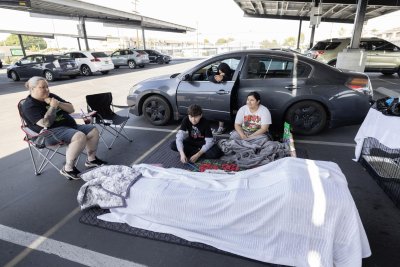
Andrea Luna, Jules Olivas, Joshua Olivas and Jessica Castro of Anaheim, Calif., shelter in their cars at the John F. Kennedy High School evacuation center on Saturday after leaving their home due to a chemical leak from a storage tank at the GKN Aerospace facility in Garden Grove, Calif. A failing 34,000-gallon tank of methyl methacrylate overheated, prompting tens of thousands of evacuations in the Garden Grove area. Photo by Ted Soqui/EPA
May 24 (UPI) — Tens of thousands of Orange County, Calif., residents remained evacuated Sunday as officials nervously watched the condition of a failing, 34,000-gallon tank containing dangerous chemicals.
Orange County fire officials said a visual inspection of the overheated tank in Garden Grove, Calif., late Saturday showed it has potentially developed a crack, which could reduce the possibility of a catastrophic explosion but increase the likelihood of a massive spill of liquid methyl metacrylate.
“Right now, we’re vetting and validating that information,” Orange County Fire Authority Interim Chief T.J. McGovern said in a video update of the tense situation at the GKN Aerospace facility, located about 33 miles southeast of downtown Los Angeles.
The discovery of a potential crack in the tank “could change the trajectory and our strategy for this event,” he said.
A crack in the tank “may avoid the two concerns that we all had,” Calif. State Sen. Tom Umberg told KCBS-TV. “One was an explosion, the other was a leak of liquid material vaporizing into a toxic fume, a toxic plume.”
California Gov. Gavin Newsom on Sunday transmitted a request to President Donald Trump to declare a federal emergency in support ongoing response operations in Orange County.
The request came a day after the governor’s proclamation of a state of emergency as officials raised the alarm about the possibility of a catastrophic explosion and a major release of toxins.
“California doesn’t wait for disaster to unfold, we act early to protect lives and communities,” Newsom said. “Working together with our local and federal partners, we’re strengthening our ability to respond quickly and effectively in Garden Grove and across the surrounding communities and ensuring that first responders have the resources they need to keep people safe.”
The state says it has already activated its emergency operations center, deployed mutual aid resources and has pre-positioned emergency personnel — including fire, law enforcement and medical teams — in the area around the GKN Aerospace facility, which is just 7 miles west of the Disneyland amusement park.
Nearly 50,000 Orange County residents remained under mandatory evacuation orders on Sunday as an interagency response team eyed the malfunctioning tank, which holds methyl methacrylate, or MMA, a flammable, toxic and highly volatile substance used in the production of acrylic plastics.
Residents were evacuated Friday after a chemical vapor leak was spotted coming from the tank, which has a malfunctioning valve and is unable to be neutralized. Officials say the valve has seized due to a chemical reaction with the MMA.
Water cooling by firefighters has so far kept the tank’s temperature stable and no injuries have been reported.
No unusual readings of toxic material have yet been detected in the area.
The evacuation zone is in a densely populated area of Orange County and has multiple public facilities including schools, hospitals, nursing homes, fire and law enforcement stations.
A unified command has been established between Orange County Fire Authority, Garden Grove Police Department and Orange County Health Care Agency to deal with the emergency.
JODIE Marsh was once one of the most photographed women in Britain, with her belt-braced boobs becoming one of the defining images of early Noughties celebrity culture.
Back when today’s reality stars were still in nappies, and the world had ‘It Girls’ instead of influencers, Jodie was everywhere – splashed across lads’ mags, starring in her own TV shows and commanding huge pay cheques at the height of her fame.
Jodie starred in a series of her own reality shows in the early NoughtiesCredit: PA:Press AssociationJodie arrives at Chelmsford Magistrates’ Court following assault chargesCredit: Louis Wood – Commissioned by The Sun
Jodie first shot into the spotlight, tipped as the edgy alternative to glamour queen Jordan – now known as Katie Price – with the pair locked in a fierce rivalry as they battled to become Britain’s biggest pin-up.
More recently, it appeared Jodie had finally found peace after quitting showbiz to run an animal sanctuary in Essex.
The model devoted herself to rescuing animals and regularly shared videos introducing followers to meerkats, foxes, lemurs and marmosets living at the farm.
But pals say a string of devastating events slowly pushed her into isolation.
Now the former Celebrity Big Brother star is facing assault charges following an alleged incident at her Essex animal sanctuary – as pals tell The Sun of their fears for the once larger-than-life star.
One friend told The Sun: “After her mum died, something in her just switched off.
“She became far more isolated, and it was worrying.
“The irony is she spent years desperate to be photographed and talked about, but now the last thing she wants is to be the centre of attention.”
Jodie was left heartbroken in September 2020 when her beloved mum Kristina died following a battle with cancer.
The 47-year-old previously spoke of her anguish after claiming her mum was sent home from the hospital during the Covid pandemic despite battling an aggressive cancer.
Friends believe the loss deeply affected the star, who became increasingly withdrawn from public life in the years afterwards.
A pal said: “She only wanted to be around her animals – they are the only thing that brings her any joy.
“She felt safe around them, so she stayed in her own little bubble. “
Three years later, Jodie put her £1.5million Essex farm on the market following bitter tensions linked to the sanctuary and the animals she kept there.
While many local families regularly visited the sanctuary with their children, Jodie also became embroiled in rows with neighbours.
She claimed Uttlesford Council’s refusal to grant a dangerous wild animal licence was unreasonable amid allegations she had previously taken a meerkat to the pub.
Jodie grew infamous for her barely-there boob-belt looksCredit: PA:Press AssociationPals close to Jodie says she only wants to be around her animalsCredit: InstagramJodie Marsh pictured with her mum, Kristina, who died after battling cancerCredit: InstagramJodie pictured with her beloved meerkat MabelCredit: John McLellan
Our source shared: “She fell out terribly with her neighbours and absolutely dreaded seeing them – she became convinced they all hated her too, and it caused a lot of anxiety for her.
“Ultimately, she just wanted to live in peace. Having tensions in a place that is meant to be your sanctuary is just the worst.”
An emotional Jodie later admitted she planned to “go far, far away” after the devastating blaze.
She said, “I don’t care about my house being destroyed; all I care about is losing two marmosets.”
A close pal explains: “The fire destroyed more than just the house, emotionally, that was the moment she completely unravelled.
“Behind all the glamour and bravado is somebody incredibly vulnerable and sensitive.”
Friends claim Jodie became increasingly isolated following the blaze and breakup of her most recent relationship.
They added: “Some of her friendships have fallen by the wayside because contact dwindled. Her older friends have been worried about her and did try and reach out, but not all of them heard back. She has a very small cirlce around her now. There was definitely some self-sabotage going on on Jodie’s behalf, although it’s not all on her.
“When Jodie is in a tough place, she does have a tendency to pull away, but her mates that have lost contact with her are still hopeful she will come back.”
Her last publicly confirmed partner was builder Mark, but the pair reportedly split in March 2024 after he struggled with the quiet lifestyle at the farm.
Jodie with previous boyfriend MarkCredit: jodiemarshtv/InstagramJodie in her glamour model heyday back in 2006Credit: PA:Press Association
A pal said: “She does struggle with loneliness, but she also struggles to trust people, so it’s a bit of a catch-22.
“A lot of people in her life have badly scarred her, so it’s understandable she has her walls up a lot of the time.”
Last month, Jodie appeared in court accused of assaulting a man at the sanctuary. Essex Police confirmed a woman had been charged following an alleged incident at the site.
The former reality star was also accused of using threatening, abusive or insulting words or behaviour to cause or provoke violence against the man and a woman.
Appearing at Chelmsford Magistrates’ Court, she pleaded not guilty and was told a trial would take place in May 2027.
With a potential prison sentence looming, Jodie previously claimed neighbours had trespassed onto her land and filmed her animals before posting edited clips online to make them appear “skeletal”.
Speaking about one alleged confrontation, she said: “I’m scared to sleep in my own house. I’m scared to go out.”
Now, friends fear the once vivacious glamour model has completely retreated from the world she once dominated.
One pal told us: “It’s really sad what’s happened to Jodie, and we all really feel for her.
“She’s deleted her Instagram and now fully blocked the outside world from her life. It’s just her and her animals now.
“She lived this mad showbiz life for so long, it’s like she became addicted to the chaos and forgot what being normal was like.
“People think the fame disappeared overnight, but the truth is it was a slow-motion car crash.
“It’s been very sad to watch, but the one thing about Jodie is she is made of tough stuff and, like she has in the past, she’ll likely pick herself back up again.”
When approached by The Sun for comment, Jodie claimed the biggest ‘nightmare’ for her over the last few years, beyond the fire, is that she has been ‘harassed and stalked’ by her neighbours.
She accuses them of trying to bully her out of her home.
“I find it hard to trust people but the circle I have around me now are amazing and worth their weight in gold,” she says. “I trust them with my life. Everyone who comes to my home never wants to leave because it’s magical here.
“The animals are all so special and my life revolves around them. It’s a shame people like my neighbours are trying to ruin it for me. But good always wins over evil and karma is real. I will come out on top. I always do. Watch me.
“I’m living my best life and my dream life and these people are obsessing over me. That can’t be a fun way to live (being obsessed with another human you don’t even know). I just want to be left in peace to run my sanctuary with my true friends and family.”
COMEDIAN Katherine Ryan has come up with a theory as to why Katie Price has fallen for the charms of estranged husband Lee Andrews – and it’s due to past ‘trauma’.
Katherine Ryan has suggested Katie Price is suffering from ‘rescuer syndrome’Credit: InstagramComedian Katherine has expressed her fears for Katie and her previous ‘trauma’Credit: Instagram
“So much unkindness around this story like so many of us haven’t also been bewitched by some bullsh*t,” the presenter wrote alongside the video featuring the former glamour model.
Within the footage, she told followers: “He’s been missing for five days. Katie doesn’t know where he is. She was a guest on Good Morning Britain.
“She was supposed to appear with him to address all these rumours that he’s a scammer and she appeared by herself, obviously, and she’s like, Lee’s stuck in Dubai, he can’t get out yet.
“People are being so unkind about it, they’re like, Katie is involved in this, there’s no possible way that someone can look past this amount of evidence into thinking that someone is this virtuous kind human being that she says he is.”
She continued: “I think what’s happened is this: she has a rescuer syndrome, for whatever reason.
“Being the firstborn, she’s very different to her brother and sister.
Katie Price was left to defend her husband on a GMB interview without Lee AndrewsCredit: ITVKatie fell for Lee Andrews and the pair married after just a weekCredit: mistraesthetics/Instagram
“She’s had trauma that mixes things up, but I think she’s also made so many romantic mistakes publicly that this one is so big, she’s fearing, oh, if this all comes out and he’s exposed as this scammer then I look stupider than ever, everyone’s gonna say I’m foolish.
“She cannot let that be true. So it’s a mix of like shame and loyalty. She just wants it to be true so badly that she’s constructed this reality where she’s hopeful.
“I think it’s a really sweet thing, like, yeah, it looks dumb to the rest of us. Yeah, she did not practice due diligence as she rarely does, because she married him after a week.
“All of that is bad. There are children involved in her life, she should potentially try to unravel herself from these romantic calamities and focus on her family, but she has said he makes her happy.
“She’s just so hopeful that it’s true. In the past, I’ve been in relationships not as bad as any of Katie’s, I don’t think, but some dodgy ones where when your friends and family start to express their horror that you are with this obvious loser.”
She admitted: “You just dig your heels in harder. You’re like, no, I can’t have this be untrue. I am going to show my loyalty. I’m going to sit here next to this man.
“I’m going to fix whatever problem he has. I’m going to show him enough love that all of these things that he says are true are magically going to be true.”
Concluding her opinion on Katie’s estranged husband’s whereabouts, she said: “Right now, he’s been missing for, I think, this is the sixth day, and she truly believes he’s maybe been kidnapped and hopefully this is the final straw for her.”
Fans commented: “Call me delusional, but I just feel sorry for Katie. It just seems like she just wants to be loved, and don’t we all.”
A second supported: “The amount of sh*t I have believed over the years from an attractive man is incredible.”
A third agreed: “I think you have hit the nail on the head. She has been treated so bad in relationships (we have all seen the documentaries). Someone has shown her love and she has gone with it.”
“I’ve always felt desperately sorry for her… She just wants to be loved,” echoed another.
Lee has disappeared without a trace leaving Katie ‘worried sick’Credit: InstagramThe TV star has expressed her concern for Katie over her missing husbandCredit: Getty
Singer Paloma Faith interjected: “I don’t know that it’s dumb I think I wanna give her a big cuddle and say it’s ok. Let’s get back to therapy (as I always have!) No one will rescue her until she rescues herself.”
Despite investor fears, private credit is far from a meltdown because not all risks are the same.
The cracks in the private credit market appear to be widening.
Private credit is a significant alternative to syndicated bank loans as a source of corporate capital provided predominantly by private equity (PE) firms. The market is heavily involved in financing data center capacity, which is burgeoning along with the demand for artificial intelligence. Investors fear that the artificial intelligence capital spending boom poses a threat to the software industry and may be creating a market bubble that leaves private credit funds overly exposed.
Yet there are reasons to believe the potential damage to the private credit market remains manageable and contained.
This article appears in the May 2026 issue of Global Finance Magazine. .
To be sure, when auto parts seller First Brands announced its bankruptcy late last year, which was financed by a credit fund sponsored by investment bank Jefferies Group, it raised alarms in some quarters. Underscoring the opacity of private credit, which is largely unregulated, were allegations that First Brands had borrowed against the same receivables more than once. Meanwhile, defaults elsewhere in the credit sector hit a record high in 2025, according to Fitch Ratings, reaching a 9.2% rate, more than double the 3.6% recorded in 2023. Default rates this January continued upward, reaching 9.4% before slightly easing in February to 5.4%.
As the First Brands financing reveals, banks as well as PE firms are involved in private credit, either by financing investment funds sponsored by Ares Capital, Antares, Apollo, Blackstone, Blue Owl, and the like, or via funds of their own. With pension funds, insurance companies, and increasingly, individuals investing in private credit, law firm Quinn Emanuel warned in a March client memo that the trend may pose systemic risk, even though private credit is still a relatively small part of the overall loan market.
“The result is a transmission chain that runs from the technology companies, through private credit originators, to the regulated banks that lend to them, to the insurers and pension funds that invest alongside them, and potentially to the retirement accounts of ordinary Americans,” the memo’s authors warned.
Only a minority of small corporate borrowers are in trouble, and companies with EBITDA of $25 million or less experienced significantly higher default rates—15.8%—than larger companies in 2025. Healthcare and consumer companies have higher default rates. Fitch also notes that realized losses for first-lien lenders have been limited, with most cases resulting in full or high-percentage recoveries.
Notably, private credit default rates historically tend to run higher than those on broadly syndicated loans, a trend some observers attribute to more customized, and sometimes distressed, lending terms. The January uptick was largely driven by “distressed” exchanges and payment-in-kind (PIK) interest, according to Fitch.
AI Anxieties
Alen Lin, Fitch Ratings
Concerns are growing about PE funds exposed to software. Investors worry that AI will disrupt the software industry, leading to defaults within portfolios of private-credit loans to the sector. But most such funds are diversified, and even those that aren’t may not be as vulnerable to disruption by AI as investors fear. That’s because the large language models underpinning AI require application program interfaces to operate, so software may still be needed to facilitate the technology’s use.
“Implementing AI still requires significant effort to get it to work in a particular environment,” Alen Lin, senior director of North America corporates, technology, at Fitch Ratings, told audiences at a recent webinar held by the firm.
Of course, much depends on the type of application involved. As Fitch notes, companies producing software that is either deeply embedded in enterprise technology systems, leverages proprietary data, or operates in more regulated industries like health care and financial services could benefit from the development of AI. By contrast, those producing software for applications that aren’t so embedded, such as digital content creation or certain types of analytics and visualization tools, are more exposed to AI disruption.
Even if the AI bubble bursts, that risk is unlikely to evaporate, Lyle Margolis, senior director in Fitch’s corporates group, where he manages its private credit business, said in an interview with Global Finance. “AI is here to stay and is going to be disruptive to certain segments of the software market,” he says.
Yet the risks may be overstated. Whether measured by leverage, interest coverage, or EBITDA, “the trends in the software sector have actually been somewhat positive,” he noted. Refinancing risk for the sector is relatively benign. And data-center build-out provides one of several “significant tailwinds” for private credit in the software sector, added Dafina Dunmore, Fitch’s senior director of North American non-bank financial institutions.
Another mitigating factor: Redemption risk, which can see large outflows of capital. However, it is limited largely to business development companies (BDCs), a more liquid, retail-oriented variety of private-credit investment vehicle. Blue Owl, for example, recently blocked redemptions at one of its BDCs and liquidated some others. And the $33 billion Cliffwater Corporate Lending Fund, the largest US private-credit interval received redemption requests on 14%.
Although defaults are rising for these portfolios, redemption risk isn’t a problem for most credit funds, because investors are locked in until maturity. In addition, stress is concentrated in direct lending: corporate loans that fund working capital and growth.
Hidden Risks
To be sure, many such risks may be hidden, given private credit’s opacity. Blue Owl’s exposure to software loans, among the highest in the industry, is roughly twice as extensive as its public filings indicate, according to a recent analysis by the Wall Street Journal. The paper also found other PE firms whose credit funds exhibit software exposure exceeding what’s publicly disclosed include Blackstone, Ares, and Apollo.
Investor worries may exacerbate Blue Owl’s redemption woes since its data center financing deals involve accounting practices that obscure the risk involved. The main source of concern is likely Blue Owl’s $27.3 billion financing of Meta’s Hyperion data center in Louisiana.
Yet, S&P rates the bond backing the deal, called Beignet, as Meta’s obligation, reflecting that it bears the risk of default. Indeed, investors seem to like that cash-rich Meta stands behind Beignet. The bond was recently spread over a bond financing the CoreWeave data center, which isn’t backed by the hyperscaler.
Still, some wonder if the risks are adequately priced into these issues.
Quinn Emanuel warns that the vagaries of Meta’s accounting treatment may lead to litigation between the parties over who bears the loss if AI fails to meet expectations and Meta chooses not to renew the lease. Blue Owl finances an Oracle data center in similar fashion, but that bond is trading at a discount to Meta’s, partly because Oracle doesn’t back it and partly because the ultimate tenant is less financially stable OpenAI.
“When we rate data centers, to some extent we look at the credit quality of the ultimate tenant,” says Victor Leung, vice president for project finance at ratings firm DBRS Morningstar.
This type of complexity led Quinn Emanuel to warn in its March 13 memo that, “the AI data center buildout—projected to require $5.2 trillion in infrastructure investment by decade’s end—has spawned complex financing structures that are generating significant litigation risk.”
Mark Koziel, CEO of the International Association of International Certified Professional Accountants and president-CEO of the American Institute of CPAs, says he would raise the issue of current accounting rules for such financing arrangements at an upcoming meeting with the Financial Accounting Standards Board. Also last month, the US Department of the Treasury said it would meet with industry and investor representatives to discuss private credit’s potential risk to the financial system.
Thus far, warnings of a private credit meltdown seem overstated.
Credit funds focused on asset-backed finance (ABF), which is based on the value of a borrower’s assets and is the fastest-growing sector in the market, are relatively immune to stress, thanks to their self-liquidating feature. In contrast to direct loans, principal on asset-backed financings is paid back during the life of the loan. As a result, ABF funds don’t face the same refinancing risk as direct lenders.
Sponsors of direct lending funds “don’t have the benefit of those cash flows directed to pay down the loans,” notes Fitch’s Margolies.
Apart from First Brands’ receivables deal with Jefferies, the ABF segment has yet to be fully tested. But a test may soon be underway: Beignet is also asset-backed. Or sort of.
Debt principal remains outstanding at each renewal point, so it isn’t completely self-amortizing. As a result, DBRS Morningstar’s Leung notes, “you face a risk that your facility will lose its source of revenue.” Hence, Meta’s guarantee that it will make up any loss facing investors if it fails to renew the lease and the facility’s residual value falls below a certain threshold.
That scenario is not far-fetched, Quinn Emanuel warns, noting that it’s expensive to convert an AI data center to general-purpose cloud computing or other uses: “If demand for AI computing contracts, these facilities may function as stranded assets with limited alternative use and depressed liquidation value.”
Finnish authorities scramble fighter jets; defence chief says false alarm but warns of potential repeats while Russian war persists.
Finland has stood down its defence forces after sounding an alarm over suspected drone activities in its airspace.
The authorities said on Friday that suspected drone activity above the Helsinki region no longer posed a threat and that the situation was returning to normal hours after launching an emergency response, including the launch of fighter jets and closure of the capital’s airport.
Recommended Stories
list of 4 itemsend of list
The alarm illustrates the tension stalking the region as Finland and the Baltic states eye Russian aggression and daily missile and drone attacks amid Moscow’s continued war on Ukraine.
The Helsinki City Rescue Department had warned the nearly 2 million inhabitants of Finland’s Uusimaa region to stay indoors starting about 4am local time (1:00 GMT), as fighter jets were scrambled. Helsinki’s airport was also closed for about three hours.
Later, President Alexander Stubb wrote on X that authorities had “demonstrated their readiness and capacity to react”, adding that the country was now facing “no direct military threat”.
Kimmo Kohvakka, director general for rescue services at the Ministry of the Interior, called the response a “precautionary measure” and said “daily life can continue.”
The incident arose amid growing concerns about regional spillover from the Ukraine war.
The Baltic states of Estonia, Latvia and Lithuania have reported a series of suspected Ukrainian drones headed for Russia entering their airspace, prompting domestic criticism over their ability to respond to military threats.
The situation has led to a full-blown government crisis in Latvia. Prime Minister Evika Silina resigned on Thursday after a coalition partner pulled support. The move followed the ousting of the defence minister after a drone crashed at a fuel storage facility.
In March, two drones crossed into Finnish territory and crashed after flying low over the sea and southeastern Finland.
Finnish authorities did not indicate the source of Friday’s drone activity.
However, defence forces operations chief Kari Nisula suggested that Finland had received information from Ukraine about drones potentially straying into the country, according to the Reuters news agency.
The military head added that there was no evidence that drones had entered Finland, but that such situations could happen again as long as Russia continues its war on Ukraine.
Prisoner swap
The incident in Finnish airspace unfolded as Ukraine maintained its drone attacks on Russian oil and energy infrastructure, and Kyiv continued counting the costs of a huge strike that killed two dozen people.
Russia’s Ministry of Defence said on Friday that its air defence systems shot down 355 Ukrainian drones targeting Moscow overnight, as well as the border regions of Belgorod, Bryansk and Kursk.
Among the targets was an oil refinery in the central city of Ryazan, about 200km (125 miles) southeast of Moscow, according to the commander of Ukraine’s drone forces.
Fire and a plume of smoke rise in the vicinity of the Ryazan oil refinery, May 15, 2026 [Reuters]
The attack killed three people and wounded 12, regional Governor Pavel Malkov wrote on Telegram. Two high-rise apartment buildings were struck, he said, while debris fell on the grounds of an industrial enterprise.
Meanwhile in Kyiv, the death toll from a Russian barrage on an apartment building on Thursday rose to at least 24 people, including three children, Ukrainian President Volodymyr Zelenskyy said. Forty-eight people were wounded.
Amid the ongoing violence, Russia and Ukraine have moved ahead with a prisoner swap that saw 205 POWs repatriated on each side on Friday. It was the first step of a swap that is planned to ultimately see 1,000 people on each side return home.
The two sides also conducted an exchange of those killed in the fighting, with Russia handing 526 bodies to Ukraine and receiving 41 in return. Both Kyiv and Moscow thanked the United Arab Emirates for mediating the swap.
Zelenskyy wrote on social media that most of the prisoners returned to Ukraine had been in Russian captivity since 2022.
“We will continue to fight for every single person who remains in captivity,” he said.
Choi Seung-ho, head of Samsung Electronics’ largest labor union, speaks to reporters Wednesday after a hearing on an injunction against a labor strike filed by Samsung at Suwon District Court. Photo by Yonhap
Samsung Electronics Co. and its labor union failed to reach a wage agreement Wednesday, raising concerns over a major strike later this month that could disrupt operations at the world’s largest memory chipmaker.
The breakdown came after two days of government-led mediation talks that had been viewed as a last-ditch effort to avert the strike scheduled for May 21.
Union and management have remained sharply divided over performance-based bonuses tied to the company’s earnings related to artificial intelligence (AI).
The union has demanded performance bonuses equivalent to 15 percent of operating profit, along with the removal of the payout cap and the formal institutionalization of the bonus system.
The management, meanwhile, proposed allocating 10 percent of operating profit to bonuses and offering a one-time special compensation package that it said exceeds industry standards.
“Because the differences between the labor union and management did not narrow, we requested mediation and waited for nearly 12 hours, but the proposal only worsened,” Choi Seung-ho, head of Samsung Electronics’ largest labor union, told reporters after the meeting at the National Labor Relations Commission office in the administrative city of Sejong.
Choi said some 41,000 unionized workers have expressed their intention to take part in the general strike, adding that the number could rise to more than 50,000.
“It is meaningless to wait any longer,” Choi said. “We do not plan to hold an illegal strike. We will proceed in a legitimate way.”
Choi added that the union now will focus on responding to Samsung’s request for an injunction restricting the union’s planned strike.
Later Wednesday, the Suwon District Court concluded a closed-door second hearing attended by about 30 people, including lawyers and officials from both sides.
During the hearing, the union argued that the strike would be carried out lawfully within a limited period and that it had no intention of illegally occupying company facilities, making an injunction unnecessary.
The court is expected to decide by May 20 whether to grant the injunction.
Following the breakdown in talks, Samsung Electronics expressed regret over the suspension of the mediation process, while pledging to continue efforts to engage in dialogue.
“The post-mediation process, which the government worked hard to arrange, unfortunately collapsed after the union declared negotiations broken down,” the company said in a press release. It, however, vowed to continue making sincere efforts until the very end to prevent the worst-case outcome from materializing.
The labor dispute at Samsung Electronics, the world’s largest memory chip maker and South Korea’s most valuable company, has raised concerns that a walkout could disrupt production and upend the semiconductor supply chain, as well as hurt the broader economy overall.
Observers say that if a full-scale strike takes place, losses to the South Korean economy, which is heavily dependent on exports, could exceed 40 trillion won (US$26.8 billion).
South Korea’s exports reached a record $219.9 billion in the first quarter of 2026, driven by strong global demand for AI data centers. Semiconductor exports were a major contributor, surging 139 percent from a year earlier to $78.5 billion as investment in AI-related servers accelerated.
Some observers have speculated that the government could invoke emergency arbitration powers to prevent further escalation.
Under South Korea’s labor laws, the labor minister may order emergency arbitration when industrial action is deemed likely to endanger public welfare or seriously harm the national economy.
If invoked, all strike actions would be prohibited for 30 days while mediation and arbitration procedures are conducted by the commission. Emergency arbitration powers have been exercised only four times in South Korea’s history.
A commission official declined to comment on the possibility, saying, “It is not something we are reviewing.”
Copyright (c) Yonhap News Agency prohibits its content from being redistributed or reprinted without consent, and forbids the content from being learned and used by artificial intelligence systems.















![Fire and a plume of smoke rise in the vicinity of the Ryazan oil refinery, May 15, 2026. [Supplied via Reuters]](https://i0.wp.com/www.aljazeera.com/wp-content/uploads/2026/05/2026-05-15T083203Z_1005115005_RC2K9LASNB6E_RTRMADP_3_UKRAINE-CRISIS-1778833986.jpg?w=640&ssl=1)