favor

California voters favor progressive candidates, split over democratic socialism, poll finds

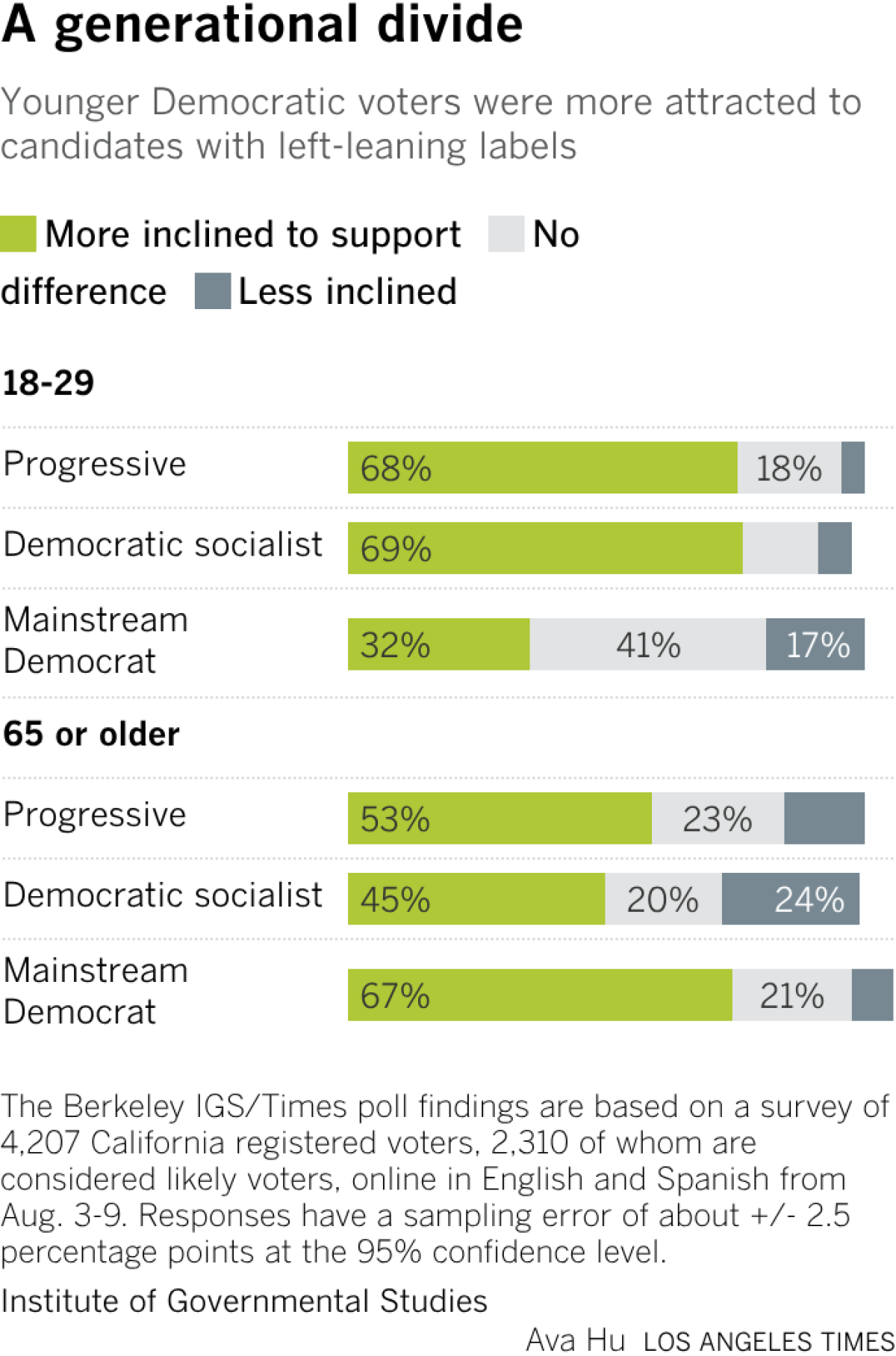
California voters are more inclined to back progressives running for office than mainstream Democrats, a new poll found, though a marked generational divide separates those who favor each camp.

Registered Democratic voters over 65 were overwhelmingly more inclined to support a candidate identified as a mainstream Democrat, whereas more voters under 40 favored those more aligned with the party’s left wing, including democratic socialists.

The results, from a new poll conducted by UC Berkeley’s Institute of Governmental Studies and co-sponsored by The Times, illustrate the highly visible midterm-season debates unfolding within the Democratic Party over age, ideology and the party’s future.

“There’s particular frustration among the younger voting population,” said IGS poll director Mark DiCamillo. “Their views of mainstream Democrats are not that positive, and that’s a long-term problem, I think, for the Democratic Party.”

The poll asked voters about how they perceived candidates described as a progressive, democratic socialist, mainstream Democrat, Republican and MAGA supporter. Voters were asked whether each label made them more inclined or less inclined to back a given candidate, or if they believed there was not much difference or had no opinion.

Among all California voters, a candidate described as “progressive” drew the broadest support — besting both mainstream Democrats and Republicans, as well as democratic socialists and members of President Trump’s MAGA movement. At 40%, support for progressive candidates registered just two percentage points above support for democratic socialists and within the poll’s margin of error, though fewer people felt negatively toward progressives than democratic socialists.

Among registered Democrats, the survey found 60% said they would be inclined to support a candidate identified as progressive; 58% felt the same when asked about a democratic socialist and 48% about a mainstream party member.

The polling offers a glimpse into how California voters feel about democratic socialism, the brand of liberal politics popularized by Sen. Bernie Sanders (I-Vt.) and New York Mayor Zohran Mamdani (D).

The views among all California voters were split, with 38% saying they would be more inclined to support a candidate labeled as a democratic socialist and 38% saying they would be less inclined. That makes the concept both more polarizing and more popular than the idea of a mainstream Democrat.

“To us, it’s honestly an incredibly good thing to hear that by and large, California voters see democratic socialism as a preferable option,” said Misha Kesselman, who leads membership coordination at the California Democratic Socialists of America.

“Being only two percent behind a progressive Democrat is the perfect place for us to be and for our organization to organize from,” Kesselman added. “I don’t see this as our ceiling; this is a great floor for us to start running from.”

Notably, more voters, 36%, said they were less inclined to support a mainstream Democrat than those who said they’d be more inclined, 29%. Twenty-seven percent showed indifference, however, possibly demonstrating that most voters would be fine supporting them in a general election, said Christian Grose, a political science professor at the University of Southern California.

The results could reflect a shift in labeling as much as in politics, Grose said, noting that most California Democrats now refer to themselves as progressive, a term that was not as popular 20 years ago, regardless of policy differences.

“Progressive Democrat in California has really in some ways become a mainstream Democrat, and then ‘mainstream’ is often associated with Washington,” Grose said, referring to the more moderate party establishment.

As the two parties compete for control of Congress in November’s midterm elections, the rise of democratic socialist ideas within the Democratic party has set off a debate among left-leaning leaders and voters about how best to counter Trump’s cultural dominance, appeal to disillusioned voters and create a winning presidential strategy for 2028.

The split does not fully fall along generational lines, but it often overlaps with the growing push by some younger candidates to oust veteran lawmakers, a debate over experience and seniority versus fresh blood.

Republicans have used the phenomenon as a key line of attack, as Trump and others have labeled Democrats as communists and extremists. In recent weeks, Trump argued that Democrats want to “destroy the traditional American way of life.”

“Sadly, young people have not been taught the truth about socialism and communism. It’s a dangerous road, and this is one of our efforts to make sure people know that,” House Speaker Mike Johnson (R-La.) said Saturday on Fox News, after launching a website last week dedicated to the idea that socialism and communism have failed.

Meanwhile, many establishment Democrats fear that a far-left candidate would be unable to win a general presidential election and worry a swing in that direction could jeopardize the party’s chances in 2028. House Minority Leader Hakeem Jeffries (D-N.Y.) said Sunday on NBC News’ “Meet the Press” that he does not support the Democratic Socialists of America agenda, further underscoring internal divisions.

Democratic socialism generally centers on an anti-capitalist agenda, including higher taxes for the wealthy and universal healthcare. Many progressive candidates support policy ideas backed by socialists but do not identify themselves as such.

A handful of high-profile progressive primary wins against Democrats backed by the establishment has supercharged the conversation in recent weeks, including this month in Michigan’s Democratic Senate primary, where progressive Abdul El-Sayed narrowly defeated a moderate opponent.

But progressives have lost elsewhere, including in Wisconsin, where democratic socialist Francesca Hong last week was defeated in the gubernatorial primary by David Crowley, the more moderate Milwaukee County executive.

California was not host to that type of showdown this year, and Democratic gubernatorial candidate Xavier Becerra, though progressive by national standards, was viewed by many left-leaning voters as a safer or more moderate primary choice. He faces Republican Steve Hilton in November.

In Los Angeles, however, the mayor’s race between incumbent Democrat Karen Bass and democratic socialist Nithya Raman is set to draw national attention. A handful of progressive candidates also advanced in House races, including Randy Villegas, who is challenging Rep. David Valadao (R-Hanford); Mai Vang, challenging Rep. Doris Matsui (D-Sacramento); and Angela Gonzales-Torres, challenging Rep. Jimmy Gomez (D-Los Angeles). Vang identifies as a democratic socialist.

The new polling also showed a generational divide among Republican voters: A higher share of older voters than younger said they would be more inclined to back a MAGA supporter, though all ages favored the Republican category over MAGA.

Seventy percent of GOP voters said a Republican label would make them more inclined to support a candidate, and 46% said the same of a MAGA label. Sixteen percent said they would be less inclined to vote for a candidate with a MAGA label and 29% said it didn’t make much difference.

Among California voters who eschew both the Democratic and Republican parties, either registered as no party preference or with other parties, a progressive candidate drew the most favorable reaction, but they also showed more support for a democratic socialist than a mainstream Democrat.

Those voters were not positively inclined toward right-leaning candidates, with 15% responding favorably to Republicans and 7% to MAGA.

In California, Democrats account for nearly 45% of all registered voters, compared to 25% who are Republican and almost 23% who don’t belong to either party, according the California Secretary of State’s office.

Whether voters’ shifting preferences for the progressive or democratic socialist labels translate into any different policy action from those who are elected is an open question, Grose said.

“The labels are changing things… but it’s not clear yet if it’s changing the actual ideology of voters and elected officials,” Grose said. “What the elected officials do in office who are Democrats, that remains to be seen.”

The Berkeley IGS/Times poll findings are based on an online survey in English and Spanish of 4,207 California registered voters from Aug. 3-9. The results are estimated to have a margin of error of about 2.5 percentage points in either direction in the likely voter sample, and larger numbers for subgroups.

Source link

FCC votes in favor of lifting limits on TV station ownership

The Federal Communications Commission voted 2-1 in favor of allowing TV station ownership groups to own more outlets, easing the way for more consolidation.

The Thursday vote that favored the change means companies can own local stations that cover more than 39% of the U.S. They could also own more than two stations in a single market.

The measure supported by FCC Chairman Brendan Carr will allow the agency to approve deals that put station ownership groups over the cap if the agency determines that they are promoting the public interest. Carr has said the agency would consider such issues as commitment to local journalism and “viewpoint diversity.”

“In my view, if you care about trusted sources of local news and information, you have to care about the future of local TV stations,” Carr said. “They are the economic engines that produce the paychecks for so many of the local journalists that remain in the business. So how can the FCC maximize the odds that those institutions continue to survive and hopefully thrive into the future? To start, we should stop hamstringing this one segment of the broader market with outdated restrictions.”

The station groups say the ability of tech companies such as Google and Netflix to reach every consumer in the U.S. puts them at a disadvantage. At the same time, streaming now accounts for more than 40% of all viewing, according to Nielsen, pulling consumers away from traditional TV. Television stations are also seeing their share of carriage fees from cable and satellite companies shrink due to cord-cutting.

Declining viewership and revenue have also made it more challenging to sustain multiple local TV news operations in a single market.

Anna Gomez, the lone Democrat on the commission, opposed the measure, saying the rule change will only help big firms get bigger and more powerful.

“Eliminating the cap does not free local broadcasters from economic pressure, it just changes who is doing the squeezing,” Gomez said in a statement issued ahead of the vote. “The large station groups positioned to grow even larger under this decision are not local broadcasters, they are national companies that own local stations and increasingly dictate what airs on them.”

The measure ending the cap limits also faced push back from consumer groups and state government officials who believe station consolidation will result in journalist layoffs and fewer voices for the communities they serve.

TV station owners and its lobbying group the National Assn. of Broadcasters have been clamoring for a change in the rule, citing the changes in technology that have occurred since the ownership limit. The 39% threshold was set in 2004 when streaming video was still a nascent business.

Jeff McCall, a professor of communications at DePaux University, agrees the current limit is outdated in the current media environment. “Local broadcasters are struggling in terms of audience and revenue, and this plan could give them some needed relief,” he said.

But McCall added that having the FCC decide who benefits from the rule change will face resistance.
“it will give the FCC wide discretionary powers and open up any decisions to second-guessing and, of course, court challenges,” he said.

There are also likely to be questions on how even-handed Carr will be when faced with a proposal that puts a station owner over the caps. The chairman has made his name by threatening to pull the broadcast licenses of TV stations that irritate President Trump with their coverage and commentary. Even Trump-supporting Republicans such as Sen. John Kennedy, R- La., have raised concerns the FCC’s scrutiny of broadcast content could be violating the right to free speech.

In April, the FCC called for an early review of the licenses for Disney’s eight broadcast TV stations, a day after Trump demanded that ABC fire late-night host Jimmy Kimmel over a joke about First Lady Melania Trump.

Carr also questioned whether ABC’s daytime show “The View,” where negative Trump commentary occurs often, should qualify as a bona fide news program that is exempt from giving equal time to qualified candidates.

Carr also believes large media companies such as Disney and NBCUniversal parent Comcast hold too much sway over the stations affiliated with their networks.

“New York and Hollywood interests have steamrolled those local TV stations and the broader media market in recent years in ways that run directly counter to the regulatory framework that Congress and the FCC put in place,” he wrote. “Their national programs naturally reflect the values of the New York and Hollywood executives that produce them. This power imbalance has contributed to a steady decline in locally produced news — and with it, a weakening of the public’s trust in the media.”

Earlier this year, a group of attorneys general filed suit to block Nexstar Media Group’s proposed $6.2-billion acquisition of Tegna, arguing it violates a 112-year-old U.S. antitrust law by knocking out a major competitor. The deal would give Irving, Texas-based Nexstar control of 265 television stations across the country, up from 164. And, in dozens of markets, including San Diego and Sacramento, Nexstar would own multiple TV network affiliates.

U.S. District Judge Troy L. Nunley issued a preliminary injunction in April that forbids Nexstar — which owns KTLA-TV Channel 5 in Los Angeles — and Tegna, from combining operations. Nexstar is appealing.

Source link

Ban on sex offenders running for office fails at California senate

California Democratic senators failed to advance a proposal Tuesday that would have barred registered sex offenders from running for office.

State Sen. Scott Wiener (D-San Francisco) voted against Assembly Bill 2753, while fellow Sens. Tom Umberg (D-Santa Ana) and Ben Allen (D-Santa Monica) abstained from a vote that ultimately failed 2-1-2 in the Senate Elections and Constitutional Committee.

The committee’s lone Republican, Steve Choi (R-Irvine), and Sen. Sabrina Cervantes (D-Riverside) voted in favor of the bill, which is likely dead because it failed to get support from a majority of the five-member panel.

AB 2753 could be reviewed in a floor session Thursday, but staff from the office of Assemblywoman Esmeralda Soria (D-Fresno), who authored the bill, are conceding that’s unlikely.

The defeat comes on the heels of unanimous support, including a 60-0 vote in favor on the Assembly Floor on May 7.

“I am deeply disappointed and disheartened after the Senate Elections Committee has failed to advance AB 2753, a bill that would have prohibited any registered sex offender in the State of California from running for local or state public office,” Soria said in a statement.

The bill’s wording said the legislation would “prohibit a person from being a candidate for, or elected to, any state or local elective office if the person has ever been required to register as a sex offender.”

Inquiries to the offices of Sens. Wiener, Umberg and Allen were not immediately returned.

Sex offenses in California are broken up into three tiers. First-tier offenses call for a minimum of 10 years placement on the sex offender registry. Second-tier offenses call for a minimum of 20 years and third tier crimes could result in a lifetime on the registry.

The types of offenses for each tier vary. Tier 1 offenses range from indecent exposure to misdemeanor child pornography and sexual battery. Tier 2 includes incest and penetration with a foreign object, and Tier 3 includes felony possession of child pornography, rape and pimping and pandering of a minor.

Wiener asked for amendments to the bill during the bill’s review and in the committee meeting, including that the lifetime ban only be applied to Tier 3 members.

He pointed to committee analysis of the bill that could affect so-called “Romeo and Juliet” couples — those close in age, for instance with one partner being 19 and the other being 17. If the younger partner sent sexually explicit digital content to the older partner (a misdemeanor), this law could ban the older partner from public office for life.

There were also concerns listed in the analysis that the registry, which dates back to 1947, could include LGBTQ+ offenders from decades ago who were convicted of offenses that are no longer crimes.

Wiener mentioned in the committee meeting civil rights strategist and fighter Bayard Rustin being placed on the California sex offender’s registry list after being arrested by Pasadena Police for having consensual sex with another man in 1953.

“Without the amendment contained in the analysis, I will be voting ‘no’ on this bill and recommending that the committee vote ‘no,’” Wiener said at the committee hearing.

He added that the sex offender list was “not punishment,” but instead “a tool for law enforcement to monitor who may potentially cause a risk.”

While Soria agreed to one bill amendment, she did not accept other provisions, including the elimination of lifetime bans on Tier 1 or 2 offenses.

“The bottom line is this: I was not willing to make additional amendments to this bill,” she said. “I made a promise to my community that I would do everything in my power to ensure they would never have to go through something like this again. Accepting additional amendments to this bill would have jeopardized that promise.”

Some of the impetus behind her bill revolved around the June 2 Fresno City Council election. Registered sex offender Rene Campos fell short of the necessary votes in his bid to run for Central Valley Council.

He was charged with possession of child pornography in 2018 and hosted his campaign kickoff in front of an elementary school.

Nelson Esparza, Fresno City Council President, spoke at the Senate Elections and Constitutional Committee meeting in favor of AB 2753.

“My office received dozens of calls from our residents asking how this could be allowed,” Esparza said of Campos’ candidacy. “AB 2753 closes this loophole.”

It’s unclear if this bill will be reintroduced next year at least at the Assembly level, as Soria is running for the state senate in November.

Source link

Voters Favor Kerry on Financial Issues

It is no secret that a lack of job creation has emerged as a pivotal election issue. But a new Los Angeles Times Poll suggests that Americans’ pocketbook concerns extend well beyond the labor market, and the public thinks that Democratic presidential candidate John F. Kerry would better look out for their financial futures than would President Bush.

Asked to name the candidate who would be “best at protecting the financial security of the average American,” 47% named Kerry, while 34% picked Bush.

Among independents, a group that could play a crucial role in determining the winner of the presidential election in November, the gap was even wider: 49% for Kerry and 26% for Bush.

Those polled also view the Bush White House as much more aligned with business interests than the interests of ordinary workers, and they express widespread doubts about the integrity of corporate America.

A 63% majority said the president was more concerned about corporations, while 21% said he was more concerned about workers. The view that the president sides with big business over rank-and-file workers has become more prevalent over time. In an August 2002 Times Poll, 55% felt that way.

The results suggest that the economic battleground in the presidential election campaign is taking an untraditional shape that transcends meat-and-potatoes issues such as employment and price levels. These days, people are also concerned about corporate scandal and the integrity of the financial markets — and the way their leaders are dealing with these matters.

“This poll tells me that Bush’s economic troubles are of the new post-inflation, post-unemployment form,” said Samuel L. Popkin, a UC San Diego political scientist and a Democrat.

It further indicates that “Bush hasn’t been able to convert military security into financial security,” he added.

The Times Poll of 1,616 adults nationwide was conducted between March 27 and March 30. The margin of sampling error is plus or minus 3 percentage points.

In the survey, 69% of those earning less than $50,000 a year saw the president as more concerned with corporations. That figure dipped to 56% among those earning $50,000 or more.

Follow-up interviews with some of those surveyed underscore that Americans have mixed feelings about Bush’s approach to corporate America and the economy.

Greg Voorhees, a registered independent from Bradenton, Fla., feels the economy has changed for the worse, with corporations aiming only for the bottom line, deserting employees for cheap labor overseas and paying top executives “millions and millions while their workers barely get the minimum wage.”

The Bush administration, he is convinced, has been too quick to craft policies that benefit corporate interests at the expense of the public. Ordinary Americans, the 51-year-old said, are not informed of the real agenda on matters ranging from energy policy to drugs and Medicare: The White House, he said, is “hiding something.”

But others disagree. Curtis Blevins, a warehouse worker in northeast Ohio, said he believed the president was helping regular employees by responding to the needs of large corporations.

“Ordinary people work for big business,” said Blevins, 38. “If he doesn’t help big business, ordinary people are out on their duff…. I’m an ordinary person. I work for a big company. The more he helps the big companies, the more we get to hire. The easier our jobs become.”

The poll suggests, however, that many Americans harbor strikingly negative feelings about big companies and those who run them.

Revelations of phony bookkeeping at Enron Corp., WorldCom Inc. and other companies first grabbed public attention more than two years ago. Since then, news of financial scandal has remained highly visible — most recently centering on the trials of Tyco International Ltd. executives accused of looting their company and of Martha Stewart, who was convicted of lying to investigators about her stock dealings.

Half of those polled said they would describe corporate fraud as “a widespread problem” in a system that is failing; 40% said only “a few corrupt individuals” engaged in such behavior. Three out of four Americans said they could trust executives “only some of the time” or “hardly ever.” Slightly fewer than 1 in 4 said they could trust executives most of the time.

Revelations of fraud also have affected personal behavior. Thirty-seven percent said they were less willing to invest in the stock market in light of the corporate scandals, while 31% said the revelations had not affected their willingness to invest. Many of the rest said they did not own stock.

Almost half of those surveyed — 45% — ranked economic issues as the most important problem facing the nation, about the same percentage that put security concerns at the top.

Democrats contend that the ongoing attention to corporate scandal aggravates public worries about financial security, in part because the series of high-profile frauds rattled the stock market and eroded long-term savings accounts for college and retirement. The scandals also raise questions about whether a greedy business elite operates on a different ethical playing field from the rest of society.

“Every day there’s a new scandal on television that makes our point,” said Jenny Backus, a Democratic strategist. “You want to have somebody looking out for the economy that makes sure that corporations play by the rules and stockholders are protected.”

But Republicans maintain that corporate corruption is not an issue that will harm Bush. They often point out that the president has supported Justice Department prosecutions of white-collar criminals and ultimately endorsed sweeping legislation for corporate reform.

“Voters don’t hold the commander in chief in a position of corporate leadership,” said Scott Reed, a Republican consultant. “It’s very difficult for Kerry in his campaign to tie this knot around Bush’s neck.”

Reed asserted that strong economic growth, combined with Bush’s “optimistic message of hope,” presents a winning case for the president when it comes to financial security.

*

(BEGIN TEXT OF INFOBOX)

Financial assessment

Q: ‘He would be the best at protecting the financial security of the average American’: Does this apply more to George W. Bush or more to John Kerry?

Neither 9%

Bush 34%

Kerry 47%

Both equal 2%

Don’t know 8%

Q: Do you think George W. Bush cares more about protecting the interests of ordinary working people, or more about protecting the interests of large business corporations?

Ordinary people 21%

Large corporations 63%

Both 8%

Don’t know 8%

Q: Have corporate scandals in this country made you more willing or less willing to invest in the stock market, or have corporate scandals not played a role in your investing in the stock market one way or the other?

Don’t invest 23%

More willing 6%

Less willing 37%

No role 31%

Don’t know 3%

*

How the Poll Was Conducted

The Times Poll contacted 1,616 adults nationwide by telephone March 27 through 30, 2004. Telephone numbers were chosen from a list of all exchanges in the nation and random digit dialing techniques were used to allow listed and unlisted numbers to be contacted. The entire sample of adults was weighted slightly to conform with census figures for sex, race, age and education. The margin of sampling error is 3 percentage points in either direction. For certain subgroups the error margin may be somewhat higher. Poll results may also be affected by factors such as question wording and the order in which questions are presented.

Source: Times Poll

Source link