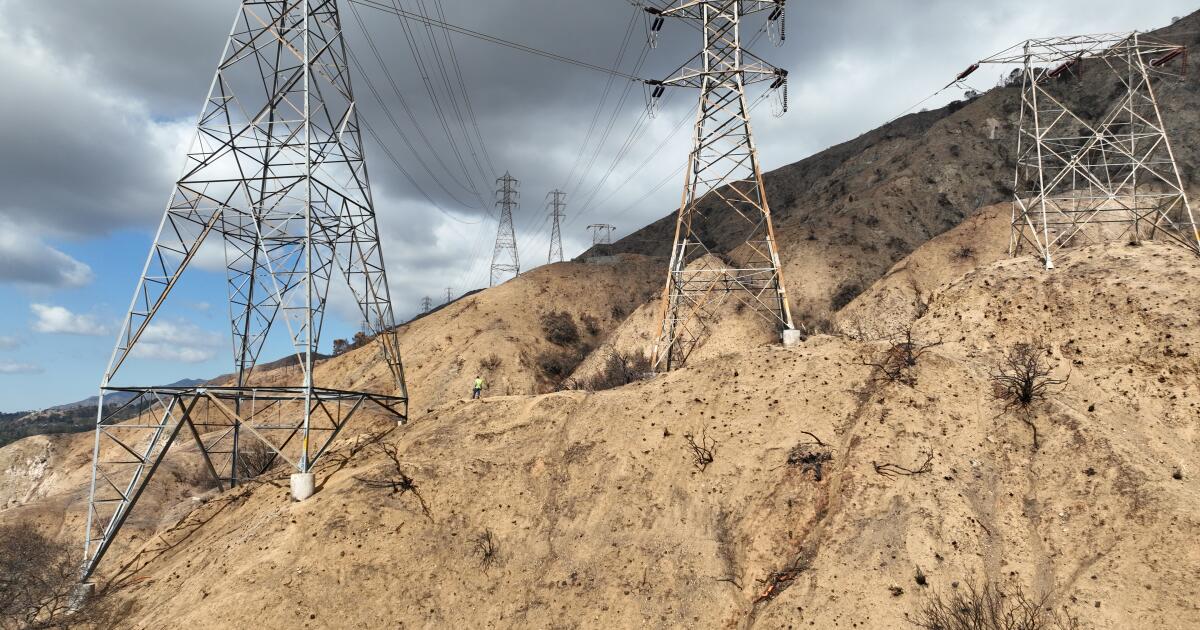
New surveillance footage and other evidence from Southern California Edison confirms that a century-old, idle transmission line that the utility failed to remove ignited last year’s deadly Eaton wildfire, lawyers for insurers said in a court filing.
Video obtained from a surveillance camera at Gerrish Swim & Tennis Club in Pasadena shows two bright flashes occurring in the location of the tower holding the idle line at 6:11 p.m. on Jan. 7, 2025.
The flashes correspond to the time that Edison recorded two faults, three seconds apart, on another transmission line more than five miles away, the lawyers said in the filing, citing new data provided by the utility.
Soon after the faults, residents nearby recorded videos of a fire burning at the base of the tower, which is known as M16T1.
“Southern California Edison has spent the last sixteen months attempting to forestall the inevitable legal consequences of razing a large swath of the communities of Altadena and Pasadena to the ground,” the lawyers wrote in the filing.
“The Eaton Fire could not have occurred if SCE had simply disassembled and removed Structure M16T1,” the lawyers added.
The lawyers filing the May 18 motion represent property insurers that paid tens of millions of dollars to residents who lost their homes. Their motion asks the judge to order a judgment in the insurers’ favor that would make Edison liable for the damage under inverse condemnation, a legal doctrine in the state constitution.
Courts have ruled that the doctrine requires private utilities such as Edison to pay for property they destroy, even if they haven’t been found to have acted negligently.
Kathleen Dunleavy, a spokeswoman for Edison, said the company did not learn about the existence of the swim club video until the lawyers submitted it in court with their filing.
“It’s very disappointing and inappropriate that this video was not produced in discovery,” she said. “We hope that video has been turned over to the appropriate authorities.”
Dunleavy said the company believes the lawyers’ motion “is wrong on the facts and the law.”
“We’ll respond more fully in our own court filing,” she said.
Attorneys for the insurers did not respond to requests for comment.
In a February 2025 letter to state regulators, Edison said it had detected a single fault on a line more than five miles away from Altadena about 6:11 p.m. on the night the fire ignited. It said the fault caused a brief surge of electricity on its four live transmission lines in Eaton Canyon.
The company said in the letter that it was looking into whether the power surge could have caused electricity to jump to the idle line that runs parallel to the live wires through a process called induction.
Pedro Pizarro, chief executive of Edison International, later said that a leading theory of the fire’s ignition was that the idle line became energized briefly through induction, sparking the fire.
At the same time, the company has not accepted blame for the fire, saying repeatedly that its own confidential investigation into the cause, as well as a separate inquiry by Los Angeles County and state fire officials, is continuing.
According to the court filing, evidence obtained by the lawyers shows that the company stopped using the transmission line in 1971 and designated it as “out-of-service.”
“The declaration of Out of Service shall only be used when the line … or piece of equipment is expected to remain permanently out of service,” Edison stated in an internal document known as a system operating bulletin, according to the filing.
Edison executives told The Times last year that they left the line in place because they believed it might be needed in the future.
“We have these inactive lines still available because there is a reasonable chance we’re going to use them in the future,” Shinjini Menon, Edison’s senior vice president of system planning and engineering, said then.
Dunleavy said Friday that the idle lines are kept in place for a variety of reasons, including to preserve the right of way Edison had obtained to construct them and to support future needs for more electricity as the state aims to meet its clean energy goals.
Last year, The Times reported that state regulators, knowing old electric lines posed hazards, proposed a rule in 2001 that would have forced Edison and other utilities to remove idle lines unless they could prove they would use them in the future.
Under pressure from Edison and the other companies, the rule was weakened to allow utilities to keep the unused lines in place until executives decided they were “permanently abandoned.”
In their May 18 filing, the lawyers said Edison executives had known about the risk of induction for more than 100 years. They cited a 1923 contract between Edison and Pacific Electric Railway Co. that said that “leakage of electricity or induction from or between” conductors was an inherent risk of operating multiple electrical circuits in proximity.
“That’s why SCE grounds idle lines and inspects them,” Dunleavy said of the risk.
Copies of Edison’s fault records from that night, its operating bulletin and thousands of other documents, including depositions, are sealed from public view under a protective order that Edison and lawyers for the victims asked the judge to approve last year.
The L.A. County district attorney is investigating whether Edison should be criminally prosecuted for its actions in the fire, the company said in an investor filing this year.
The fire killed at least 19 people and left thousands of families homeless.
A hearing on the lawyers’ motion is scheduled for Aug. 11 in L.A. County Superior Court.
Edison has offered to compensate victims of the fire who give up their right to sue the utility.
The company said last week that it had so far received more than 3,500 claims from about 10,000 people. It said it had extended nearly 1,900 offers to those people, totaling more than $650 million.
Many victims have refused the offers, saying they don’t fully cover their losses from the devastating blaze.
Edison has told its investors it expects to actually pay little or nothing for the fire because of a 2019 state law. The company anticipates that it will be reimbursed for its payments to victims by a $21-billion fund created by the law known as
Assembly Bill 1054.
The law shields utilities from the damages of fires sparked by their equipment as long as they follow certain requirements, including submitting a plan to state regulators for reducing the risk that their equipment sparks fires. Regulators review the plan and track whether the utilities are making progress in reducing the fire risk.
Since 2019, Edison has spent billions of dollars on making its lines safer, including by undergrounding them and installing insulated wires. Those costs continue to raise customer electric bills.
In the last 10 years, Edison’s rates increased by 101%, according to an April report by the public advocates office at the California Public Utilities Commission.
Despite the spending, Edison’s electric lines sparked more fires in 2024 than in 2019. The company blamed the increase on erratic weather that created more dried vegetation.