It’s the dead of night when the buzz of the engines of a series of Shahed-136 one-way attack drones breaks the silence. Carrying their lethal payloads the drones slip into the darkness with a distant supply base as their target. Tracking, identifying, and then destroying this swarm of drones is no easy task.
The unmanned aircraft system (UAS) threat environment is changing rapidly with an increasing variety of killer drones that demand differing methods of tracking and identification to engage and defeat them. Operational users are learning from rapidly-evolving- conflicts, and modern air defense methods increasingly rely on scalable, layered, and persistent sensing teams that can detect and track small, fast, low-altitude, and even swarming, aerial threats in all kinds of complex situations, on land or at sea.
A layered system is required to tackle the toughest drone threats. USAF
Ray Bischoff served active-duty with the U.S. Army for nearly 25 years, and he’s now the senior director of business development at Leonardo DRS, specialising in evaluating tactical formations and defensive requirements at all operational levels throughout the Department of War and allied nations. He is particularly focused on emerging threats from drones..
Bischoff spoke at length with TWZ’s Jamie Hunter about the use of tactical radar systems as part of a layered counter-drone system that is sufficiently versatile to tackle the toughest drone problems now, and what may come in the near future.
JH: Can you set the scene with regards to how you see the counter-UAS mission right now from a sensing perspective.
RB: The counter-UAS environment is changing and advancing very quickly. At the top level, we need to employ a variety of sensor systems – in this particular case we’re talking about tactical radars – but there are many other types of sensors, and at the highest end of the threat level it’s about connecting these together into a networked architecture.
Layering different systems in depth is vital, both from a communications architecture perspective and physically layering them in different places to protect different routes or avenues of approach, or sensitive facilities.
Look at the Strait of Hormuz, for instance, which is a vast area, with a layered and networked system to maximize the depth of coverage. The primary reason for this is that the biggest enemy in many situations like these is time. That networked architecture and having sensors in depth really gains you time, which gives you opportunities to make a better decision, time to reposition, to better evaluate. You need time to evaluate what different things in space are doing, where they’re going or where they’re coming from.
JH: When you say layered, are you talking about different systems that can look in different ways over different distances and systems in different positions that help you with that time element? What does layered actually mean?
RB: You can layer different types of sensors. Think of baseball. If all your players are home-run hitters, you probably aren’t going to do very well. You need to have different skills across your team to succeed, and it’s the same thing here. Layering of radar sensing bands, different types of technology such as electro-optic and infra-red that “see” in long, short and midwave, acoustic sensors, electronic warfare sensors to look for signals and other types of energy. It’s also about physically layering them in space, or depth.
Large drone swarms are particularly challenging to defend against. U.S. Army
We often see large exquisite sensors that have a lot of range and cover a large area. But this makes them susceptible to being targeted and destroyed. Layering sensors gives you redundancy, retaining the ability to defend. So, this is layering both in physical location, and in different types of technology.
This way, if one of your sensors is taken down by any means – for example by electronic countermeasures – your other systems can theoretically continue to operate. Just think how you can see, smell, touch, taste – it’s the same concept with layering different types of technologies, which is exactly what we at Leonardo DRS do and we integrate them so we can interact and share information to maximize the benefits of this layered approach. A team ultimately makes the sensors more effective across networks and architectures.
JH: Presumably you get good indicators on developments from the current operations in Ukraine. You already mentioned the Strait of Hormuz as well. What are the big lessons that you’re getting here about different types and sizes of drones?
RB: Without going into the details of combat operations, the bottom line is you have to advance your technologies at the rate or as close to the rate of the advancement of the weapons systems that are being utilized. We’re seeing a mixture of things when it comes to the UASs; that’s larger craft that are getting faster and can carry heavier payloads, or smaller ones with longer ranges that can move through areas almost undetected.
There’s been so much investment in UAS technology, and they are becoming cheaper and easier to manufacture. People can 3D-print these things in their houses now. So, looking at this from a sensing perspective, that layering is becoming increasingly important.
We are looking to do things to counter these developments, such as maybe elevate the sensors to “see” across the top of the trees or place a sensor down in a valley – so that adds layering in altitude or elevation to remove blind spots. Just like the military, if you’re setting-up a defensive position, you have to cover what we called “dead space” where you can’t see with eyes or sensors from ground level.
Leonardo DRS’ 202 Expeditionary Skid (U-KIT-0091) is based on the company’s Extended Multi-Mission Hemispheric Radar. Leonardo DRS
JH: Can we dig further into the role of tactical radars in counter-UAS, specifically Leonardo DRS’ 202 Expeditionary Skid, which I believe is based on your Extended Multi-Mission Hemispheric Radar [exMHR].
RB: Radars “see” things that are physically present in space and time, and that’s why they are such great tools in the counter-UAS kit bag of sensors. That said, some radars are affected by weather and other factors, some work better in particular environments.
The 202 Expeditionary Skid is a new system from Leonardo DRS that uses our long-range exMHR, which is a software-defined AESA [Active Electronically Scanned Array] pulse-Doppler radar. It operates in the S-Band and that’s a very reliable band for all weather conditions including strong performance in dust storms and rain. When you get into K, Ku, and X-bands, they typically have smaller beams and therefore greater accuracy, but they suffer in poor weather and can become extremely degraded. S-band radar suffers significantly less degradation in that environment.
The 202 Expeditionary Skid, also known as U-KIT-0091, has a single radar panel that has a search area of 90 degrees by 90 degrees, so we often mount them in groups of four to provide full 360-degree coverage. Each panel has a really fast scan rate, much faster than a traditional spinning radar set. Plus, having multiple radar faces to make up a complete system is much more survivable. They can also overlap their field of regard without impairing each other.
We have sought to provide a solution that marries an appropriate level of range, accuracy, capability, and performance, that can still be very flexible in its ability to relocate or change mission sets. This is designed to be extremely versatile, meaning that it operates in different environments quickly. U-KIT-0091 has been purposefully designed to be mobile in a compact system that can either be used by itself or networked and fused together with other systems. Back to the baseball analogy, this is the kind of guy you really want on your team because you can use them wherever you need them.
The radar or set of radars sit on a small skid system that can slide into the back of a pickup truck, into the back of a tactical vehicle, onto a trailer, you can set it just about anywhere and it occupies a four-by-four-feet position. It has its own power generation, its own positional information that works in denied environments, basically it’s capable of working by itself from the get-go. The best part is that it’s truly mobile – the operator doesn’t have to stop the vehicle to make it work. You can turn it on and set-off. It’s working. If you come to a stop, it’s still working. It can be mounted on a ship, it can be taken airborne by an aircraft, so it’s got land, sea, and air applications. We’ve installed these on all types of ground platforms, water-based platforms, on top of a building or some sort of structure and it’s already in service, but I can’t specify where. It tracks drones very well, but of course it can track just about anything that can exist in that space.
The 202 Expeditionary Skid U-KIT-0091 mounted in the back of a pickup truck. Leonardo DRS
JH: So you could strategically locate several of your radars to look in different directions or be positioned to look in a certain direction if you knew the expected paths that the threats would use?
RB: The system is designed exactly for things like that. Instead of putting all of your eggs in one basket, you disperse your eggs, and focus on different avenues or approach angles so that you can then have sensors strategically located where they can pick up these things and then as long as they’re networked back into weapons systems that have the overlapping fields of fire or bubbles – coverage areas – then you can protect your area.
Any time you can decouple a sensor from a weapon system or multiple types of sensors from each other, you stand a far greater chance of survivability and optimizing accuracy. If you put all your eggs in one basket, and if you lose that basket, you lose everything. In addition, if you separate sensors, you gain accuracy because you have different angles and you can leverage simple geometry.
JH: Could you depict what an end-to-end engagement might look like using your tactical radar.
RB: The radar sensors will typically be emitting energy as they search for objects in a particular space. If something is detected and determined to be a valid target then the data is sent from the radar to some type of a command and control system, which may well be receiving information from other complementary sensors too. It then fuses that data and passes it to an effector, whether that’s a non-kinetic or a kinetic system, for engagement.
Meanwhile, the radar continues to track and it can determine whether that object was removed or if its path changed, and so on and so forth. But you know, a lot of these radars operate in a way whereby they can be turned on or off by different sensors to avoid them having to constantly transmit energy, they’re very customizable to meet the requirements and the emissions that are needed, whether that’s air defense, counter-drone, etc.
They can operate independently too, maybe covering a small area that needs to be protected, and integrated with a localized weapon system, or, as I already explained, they can be networked into a much larger set-up, they are modular, open system architecture and easily incorporated.
Most customers tend to choose their own command and control systems, which is why the plug-and-play part of our system is so important. It really doesn’t matter what they want to partner it with, what we provide enables that very easily.
A counter-drone exercise run by the Joint Task Force-National Capital Region/United States Army Military District of Washington. U.S. Army/Sgt. Zack Stine
JH: To be clear, your tactical radars could be deployed to defend the entire eastern seaboard of the U.S., they could be positioned to defend an air base, or they could be used to defend a ship in the Strait of Hormuz.
RB: The architecture can scale geographically through a distributed, networked sensor approach. The specific coverage area depends on factors including sensor density, the threat environment, command-and-control integration, and the available effectors.
Customers can deploy multiple radars and feed them into a single command-and-control system, positioning sensors to optimize coverage for the operational need. For example, one radar set could cover a valley vulnerable to low-flying drone ingress, while another positioned on higher ground provides longer-range surveillance. The key is a modular capability that enables users to tailor coverage and layer sensors where they are most needed – without relying on one large radar system to see everything from a single location.
JH: I’m keen to know what you consider to be the most challenging drones to detect and track. Is the challenge the speed they’re traveling out at, maybe new low observable designs, or the fact they’re flying very low. What are the big issues you’re seeing?
RB: It’s really all of the above. The other really challenging problem is when something is flying very low to the ground. The lower they bring them in altitude, they are harder to track as an independent target.
The challenge with drone swarms isn’t detection – if you can see the drones, you can track them. The harder problem is managing those tracks, deciding which threats matter most, and assigning the right effector to each one.
If 100 drones are inbound, it’s not just about having 100 weapons available. It’s about coordinating a fast, cost-effective response across a large number of simultaneous threats.
Ultimately, pairing radars and electro-optical/infrared sensors together is the way to go, because each of those have their own strengths. One of those sensors is going to see the drone better than the other, plus you have the redundancy that at least a couple of them will “see” the threat and give you enough information in sufficient time to prosecute it. Fitting into that team, however it is constructed, is exactly how we position our 202 Expeditionary Skid U-KIT-0091 radar.
The Pentagon told industry leaders to “drive significantly faster, more aggressive delivery schedules and/or increased production for critical capabilities.” Deputy Defense Secretary Steve Feinberg said contractors have 21 days to submit plans on how they plan to achieve that. File Photo by Petty Officer 3rd Class Jonathan Sunderman/U.S. Navy
Aug. 8 (UPI) — The Defense Department is pressuring U.S. military contractors to produce weapons and munitions “significantly faster” as the country’s stockpile dwindles due to the Iran war, it was reported Saturday.
In a memo obtained by The Washington Post, the Pentagon told industry leaders to “drive significantly faster, more aggressive delivery schedules and/or increased production for critical capabilities.”
Deputy Defense Secretary Steve Feinberg said contractors have 21 days to submit plans on how they plan to achieve that.
“Years-long development cycles are not acceptable,” Feinberg wrote in the Wednesday memo obtained by The Post. “We must dramatically accelerate our program schedules and expand our production capacity now.”
Multiple news outlets reported this week that the United States had depleted much of its stockpile of long-range precision missiles in Iran.
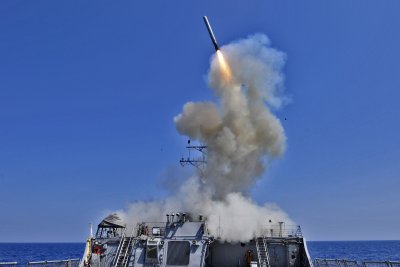
In just the first month of the conflict, the military launched more than 850 Tomahawk cruise missiles, alarming some Pentagon officials, The Post reported.
President Donald Trump on Thursday dismissed the reports, saying the United States has “massive amounts” of munitions.
“Additionally, large amounts are being manufactured and shipped to the U.S. as needed,” he wrote on Truth Social. Defense companies are building the largest number of plants and factories in our country’s history.”
“The ‘leakers’ of these treasonous statements are being hunted down,” Trump added. “Long-term jail sentences will be sought!”
Pentagon spokesman Sean Parnell said the military “has everything it needs to execute at the time and place of the president’s choosing.”
“We have executed multiple successful operations across combatant commands while ensuring the U.S. military possesses a deep arsenal of capabilities to protect our people and our interests,” he added in a statement to CBS News.
The achievement is breathtaking. Recognition is growing. The fastest known time is hers.
Ultrarunner Sophie Woods will have more to say after a few well-deserved full night’s sleep. For now, consider her unvarnished secret to traversing a mountainous 1,242-mile trail network through Italy, Slovenia, Austria, Germany, Liechtenstein, Switzerland, France and Monaco in 28 days, 17 hours and 59 minutes — nearly a week faster than anyone else has been known to do so.
“Just one step. That’s all you have to do. Just one step forward,” Woods said on Instagram.
Woods earlier reported the record time as 29 days, but corrected it in an email to The Times on Monday, saying she and her husband George “were all so exhausted they hadn’t calculated correctly.”
The Via Alpina course follows the length of the Alps with elevation equivalent to climbing Mount Everest a dozen times. The length is a nice round number in kilometers — 2,000. The total elevation climbed was roughly 110,000 meters, an average of 12,000 feet of daily vertical ascent per day.
Yet another number is equally impressive: Woods is 42 years old.
Woods, who competes using her maiden name Sophie Amy Grant, set off on July 4 in Trieste, Italy, and finished on the Mediterranean coast of Monaco. She endured heatwaves, storms, wildfires and a swarm of horseflies. She ran, climbed and hiked 14 to 18 hours a day, covering 40 to 50 miles before getting a few hours of sleep in a van, tent or occasionally a hotel room.
“I am ecstatic but knackered,” she told BBC Sport. “I’m really tired.”
She ate and drank what would be expected of someone exerting herself to the nth degree. Energy gels containing carbs, electrolytes and amino acids along with a sprinkle of caffeine were essential, but Woods also splurged on McDonalds and mounds of pasta when she met up with her husband, photographer Zoe Salt and dog Nila at day’s end. She estimated that she consumed close to 7,000 calories a day.
The first week was the toughest, with Woods describing her feeling “a thousand pulled muscles,” but by halfway through the journey she told Her Sports that “things still ache now, and by the end of the day my feet are definitely ready for a rest, but I currently only have one small blister on my heel, which I’m calling a huge win. All things considered, I’m feeling really good.”
Sophie Woods runs a route on Via Alpina at Klausenpass by Hotel Meiringen on July 20.
(Zoe Salt)
The previous fastest known time in the Via Alpina was 35 days, 21 hours by British runner Jake Catterall, 34, in 2024. Tessa Caspers, 33, set the fastest women’s time for the route at 38 days, 2 hours last year.
Catterall might need to update his website, which claims not only the Via Alpina record but others including an arduous mountain trek in North Africa and a 3,500-mile mad dash across the entire length of Europe, from Norway to Andalusia, Spain.
He knew all about Woods’ effort, however. On day 20 of her journey, Catterall met her in Switzerland after she had traversed “a particularly spicy descent on a sketchy section of via ferrata,” according to Woods’ Instagram.
“Safely back at base camp, she was met by a brilliant surprise,” the post read. “Waiting to cheer her on was @jakecatterall — the current Via Alpina FKT holder — who had gone out of his way on the journey to his own adventure just to support Sophie. It was such a thoughtful gesture, and one that gave everyone a real lift.”
FKT is short for the “fastest known time” that a person or small group achieves on a particular course, usually somewhere it would be difficult or impossible to host an actual race.
To submit an FKT, the route must be at least five miles long or have at least 500 feet of climbing. Some are very short — the Manitou Incline in Colorado is less than one mile long but climbs 1,900 feet and begins at 7,000 feet of elevation. Others such as the Via Alpina and the Appalachian Trail are thousands of miles long.
For verification, GPS information must be submitted to the FKT website. The route can be linked by uploading it to Strava, Garmin Connect or another online training platform. FKT has not verified Woods’ record yet.
Woods’ mark likely will be tested by another runner, although someone else her age and gender completing the Via Alpina in fewer than 29 days would be a challenging feat.
Woods is from New Zealand and she and her husband spent a decade in London before living in their camper van for years while traveling throughout Europe, finally settling in Andorra, a tiny principality situated in the Pyrenees mountains between France and Spain.
And it is there Woods will rest for a spell.
“I’m absolutely ecstatic,” she said on Instagram a day after she completed Via Alpina. “I still can’t believe that we did it.”
An airport has revealed an easy trick for a shorter wait at airport security
People could save time using the airport-approved tip (stock photo)(Image: Getty)
Holidaymakers can cut down the time they spend waiting at airport security using a little-known trick. The travel hack was shared by Manchester Airport, and it could be perfect for families ahead of the busy summer holidays.
According to Manchester Airport, there’s an easy way to reduce your queue time if you’re allowed to choose which lane to wait in. Posting tips for passengers online, the travel hub shared an ‘Ultimate Airport Guide’ on its website. There are various tips, covering everything from the best shoes to wear and how to decorate suitcases for maximum visibility.
In the ‘at the airport’ section of the guide, there’s a hack that could help passengers fly through security using ‘reverse psychology.’ Manchester Airport said: “If given the choice of security lanes, pick the left. Most passengers are right handed and will subconsciously prefer the right, making the left a little quieter.”
The airport added that customers can also pay to upgrade to FastTrack for a faster experience. “For just a few pounds, you can purchase FastTrack tickets to use the priority lane and avoid the queues before Security on your way out and Passport Control on your way in.” Many airports offer a similar experience, allowing passengers to pay to use FastTrack.
Elsewhere, London Stansted Airport offers the same security advice for passengers. The airport retierates: “If given the choice of security lanes, pick the left.”
The tip could be especially helpful when many passengers are travelling at the same time, such as during the school summer holidays. However, it’s worth noting that passengers don’t always get to choose their lane.
Nonetheless, they can help speed up the process by avoiding accessories that are difficult to remove. This makes the process faster for everyone.
Offering advice online, London Stansted Airport said: “To prepare your outfit for security, wear shoes that you can take off and put on easily. Avoid fiddley belts or fastenings in your clothes and excess jewellery. Try and keep your pockets empty of non-essentials.”
Despite this, passengers might still want to pack a few layers for later in their journey. The airport recommends packing items such as jumpers, which are easy to take on and off when the temperature changes.
The travel advice said: “Temperatures aboard flights can vary so wearing a few removable layers is advised. An extra jumper can always be used as a pillow if nothing else.”