farright

Brazilian government calls for probe into US funding of far-right causes | Elections News

A report stating that the Trump administration directed funds towards right-wing groups comes ahead of Brazil’s presidential election.

Brazil’s attorney general has called on law enforcement to investigate alleged efforts by the United States to interfere in the country’s domestic politics through the diversion of funds to far-right causes.

Attorney General Jorge Messias called for the probe on Thursday, one day after the British newspaper The Guardian published a story suggesting that the administration of United States President Donald Trump planned to award $1m to right-wing civil groups opposing the Brazilian Supreme Court.

Recommended Stories

list of 3 itemsend of list

Messias stated in a social media post that foreign meddling “cannot be tolerated” and that the report represented “an important alert for Brazilian sovereignty”.

“The information is especially serious in light of Brazil’s electoral process and the recent episodes of external pressure on our institutions,” the attorney general added.

The report comes amid a tense presidential election in which leftist President Luiz Inacio Lula da Silva is seeking re-election.

Lula has sought to focus attention on efforts Trump has undertaken to boost the prospects of far-right allies across Latin America, warning of threats to regional sovereignty.

Trump has endorsed multiple right-wing candidates ahead of elections across the region, sometimes hinging the possibility of economic support on the voting results.

He has also cultivated close relations with the family of former Brazilian President Jair Bolsonaro, who lost to Lula in the last presidential election.

Bolsonaro’s eldest son, Senator Flavio Bolsonaro, is a frontrunner in the race to challenge Lula this year. Recent polls have shown Lula and Bolsonaro virtually tied ahead of the first round of voting on October 4.

Flavio Bolsonaro met with Trump at the White House in May. He has promised closer ties with the US, while Lula has positioned himself as a critic of Trump’s interventionist approach to Latin American politics and security.

The Guardian report published on Wednesday states that the Trump administration sought to redirect $175m from the State Department’s human rights fund to various far-right causes around the world.

The recipients allegedly included groups advocating for white Afrikaners in South Africa that the Trump administration has falsely portrayed as victims of a “genocide” and efforts in Brazil to counter what the US called “lawfare and censorship”.

Brazil’s Supreme Court has been a subject of frequent criticism from the political right, both in Brazil and the US.

Much of that criticism stems from the 2025 conviction of Jair Bolsonaro for involvement in an alleged coup plot, designed to subvert his loss to Lula in the 2022 election.

Bolsonaro and his allies, including Trump, have depicted the case as an instance of political persecution.

Citing the trial, Trump last year placed 50-percent tariffs on certain Brazilian goods that he has since removed.

At the time, he announced the tariffs in a letter that denounced Bolsonaro’s prosecution. “The way that Brazil has treated former President Bolsonaro, a Highly Respected Leader throughout the World during his term, including by the United States, is an international disgrace,” Trump wrote.

The Trump administration also revoked the visas of Brazilian judicial officials involved in Bolsonaro’s case in an effort to have it tossed out. It also levied short-lived sanctions against Brazilian Supreme Court Justice Alexandre de Moraes, accusing him of “an unlawful witch hunt” against right-wing voices.

Bolsonaro was ultimately convicted and sentenced to a 27-year prison sentence in September 2025.

In June, one of his sons, Eduardo Bolsonaro, was sentenced to more than four years in prison after a court ruled he had lobbied for US interference in his father’s case.
Source link

France’s far-right National Rally gains ground in Senate vote | Elections News

The vote marks the first time the far-right party gained enough seats to form its own caucus.

France’s far-right National Rally (RN) party and its allies have secured a record 14 seats in the Senate, effectively quadrupling its number in the 348-seat chamber just months before a presidential election.

Sunday’s indirect election ⁠of senators marked the first time Marine Le Pen’s party won enough seats to form its own caucus.

Recommended Stories

list of 3 itemsend of list

“The results have exceeded our expectations,” Le Pen, the party’s leader and presidential candidate, said in a post on X.

“This is a historic victory, and a major milestone with the formation for the first time of a group in the Senate.”

RN entered the Senate for the first time with two seats in 2014, when it was known as the National Front, and won three seats in 2023.

It emerged as the single largest party in the lower-house National Assembly after President Emmanuel Macron called snap polls in 2024, though it fell well short of a majority.

Le Pen is preparing to run in next year’s presidential election when centrist Macron steps down.

RN president Jordan Bardella said the party’s senators would form an alliance with the Union of the Right for the Republic (UDR).

The right, centre and left-wing Socialists looked set to remain the three major forces in the upper house, according to initial results.

Source link

Protests in UK after arrest of far-right activist Daniel Thomas | Protests

Protesters gathered outside a police station in southern England after far-right activist Daniel Thomas, known as Danny Tommo, was arrested over a video appearing to show him slashing a migrant boat. He has since pleaded not guilty to two charges.

Source link

Dutch riot police break up violent far-right protest in The Hague | The Far Right News

Justice minister condemns ‘Hitler salutes, antisemitic slogans, violence’ at the anti-immigration rally.

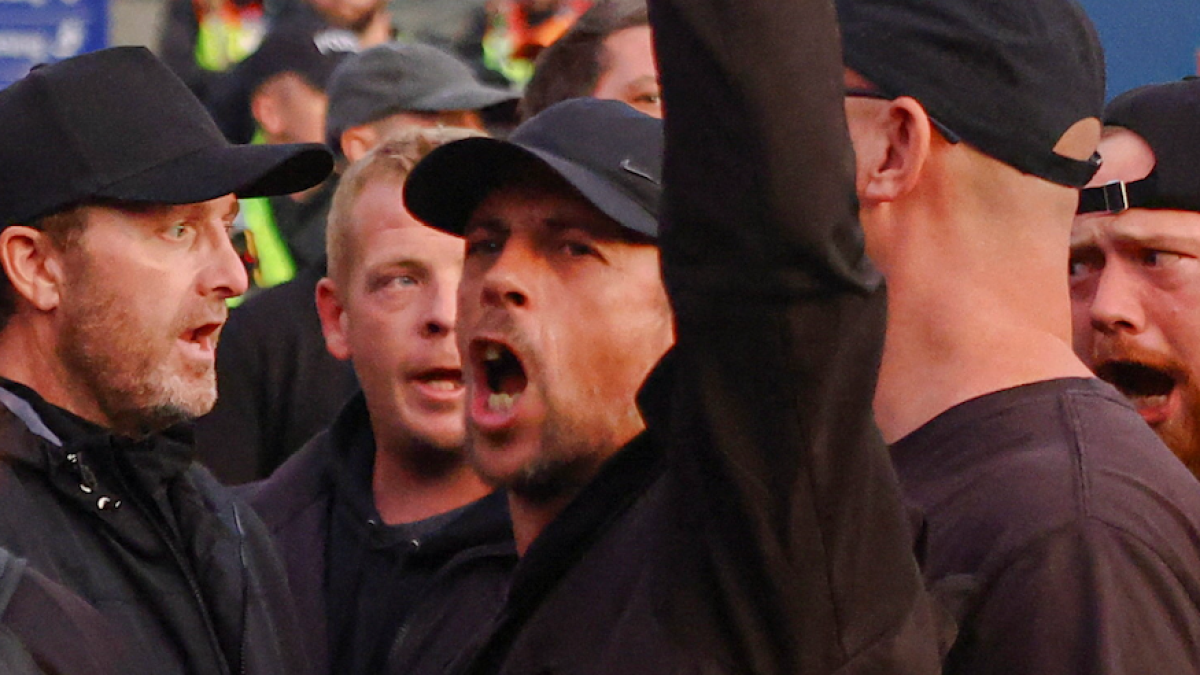
Dutch riot police have intervened at a protest against immigration and asylum policies after about 500 far-right demonstrators pelted them with projectiles and fireworks .

Police used baton charges and dogs to break up the demonstration in The Hague on Saturday, reported the AFP news agency.

Recommended Stories

list of 4 itemsend of list

Local authorities said the demonstration was ended because of continued violence, and protesters were escorted away from Malieveld park in the city centre.

Police said they arrested 24 people and deployed water cannon to disperse the rioters. Further investigations were underway, they added.

Prime Minister Rob Jetten said on X that the demonstrators deliberately sought confrontation with the police and chanted “abhorrent” far-right and antisemitic slogans

Justice Minister David van Weel condemned the violent scenes and slogans.

“Identical images from the Malieveld. Hitler salutes, antisemitic slogans, violence against the police and throwing fireworks at the riot squad,” he posted on X. “It is important that hardline action is taken against this.”

He also thanked police officers for helping to maintain the democratic rule of law.

The “Wij zijn het volk” rally, which translates to “We are the people”, was organised to protest against government policies in the Netherlands’, specifically on immigration.

The protesters had planned to march through The Hague, but local authorities banned it when violence began and ordered the demonstration to be broken up.

A child runs with the Prince's Flag with the symbol of the Dutch East India Company during a far-right demonstration in The Hague, Netherlands, September 19, 2026. REUTERS/Nicolas Economou
The Prince’s flag with the symbol of the Dutch East India Company during the far-right demonstration in The Hague on Saturday [Nicolas Economou/Reuters]

Someone at the rally was seen giving a Hitler salute, while a truck serving as a stage displayed a screen reading “The Netherlands is for the Dutch,” according to the country’s largest national news agency, Algemeen Nederlands Persbureau (ANP).

Protester Thijs Jansen, a 31-year-old mechanic, told AFP: “We’re losing our country. We’re literally losing our country to mass migration”.

Saturday’s unrest came a year after Dutch police used water cannon to disperse another anti-immigration rally in The Hague.

A police car was then set on fire in clashes between black-clad protesters and police, as the headquarters of the centrist D66 party were attacked. Its leader, Rob Jetten, is now prime minister.

Source link

Tens of thousands march across Germany to protest far-right party AfD | Civil Rights News

Protesters in about 20 cities, including Berlin, Hamburg and Munich, demand the banning of the Alternative for Germany.

Tens of thousands of people took to the streets across Germany to protest against the Alternative for Germany (AfD) after the far-right party won a state election by a landslide.

About 150,000 demonstrators turned out in roughly 20 cities on Saturday, including Berlin, Hamburg and Munich, in rallies organised by Pruef, a campaign group pushing for a ban on the AfD.

Recommended Stories

list of 3 itemsend of list

Protesters carried signs reading “Ban the AfD now” and “Democracy needs no alternatives.”

“A broad cross-section of civil society is taking to the streets to prevent the enemies of the constitution … from gaining government power,” said Christoph Bautz, head of Campact, another campaign group involved in the protests, which put turnouts at about 25,000 in Hamburg and 12,000 in Munich.

According to police, several thousand more joined separate demonstrations in Berlin.

The AfD held its own counter-rally in the German capital, attended by Kristin Brinker, the party’s lead candidate for Berlin’s upcoming regional election.

The protests follow a stunning result for the AfD in Saxony-Anhalt, a state in eastern Germany, where the party took nearly 44 percent of the vote on September 6 — far ahead of the roughly 17 percent won by Chancellor Friedrich Merz’s Christian Democratic Union (CDU), which has long dominated German politics.

The AfD, known for its anti-immigration stance and friendly posture towards Russia, fell just short of an outright majority and is now in talks with other parties to try to form a government, which would make it the first far-right party to lead a German state since the Nazi era ended in 1945.

AfD state leader Ulrich Siegmund called the result historic, telling supporters: “The people have made it absolutely clear that they finally want political change and, above all, they have shown that they want it with us.” He has since signalled openness to working with other parties, after previously saying he wanted to govern alone.

The AfD’s growing strength has deeply unsettled many Germans, given the country’s history and its commitment to never repeating it.

The party is projected to win 39 of 83 seats in the state parliament, three short of a majority. It now needs a coalition partner, though all mainstream parties have so far refused to govern with the AfD under a longstanding policy known as the “firewall.” The far-right party has never joined a governing coalition anywhere in Germany, at either state or national level.

The unease has fuelled growing calls to ban the AfD altogether, though that would be legally difficult in Germany, and Chancellor Merz has been reluctant to pursue it.

Source link