Hall of Famer Joe Torre passionate about going to bat for kids
Some people don’t need an introduction.
Joe Torre, for one.
You know him. Baseball icon. Hall of Famer. The only big leaguer with 2,000 hits as a player and 2,000 wins as a manager, he steered the New York Yankees to four World Series championships — and the Dodgers to consecutive National League West crowns and NLCS appearances in 2008 and 2009.
So you’re well-versed on Torre’s baseball bonafides, but you might not be aware of the most meaningful part of his legacy: He’s spent the past 24 years helping people who actually would need to be introduced to him.
Kids who are too young to know Torre the player, manager, color commentator — but who can, unfortunately, relate with what he went through when he was their age. Kids who, like him, are growing up afraid and anxious because of domestic violence at home, and who need what Torre didn’t have — somewhere safe to go to for help.
Since 2002, Torre and his wife, Ali, have been behind the expanding the Joe Torre Safe at Home Foundation. Across the nation, they’ve set up safe spaces in schools, specialized classrooms that feel more like living rooms and that are manned by professional counselors trained in domestic violence intervention.

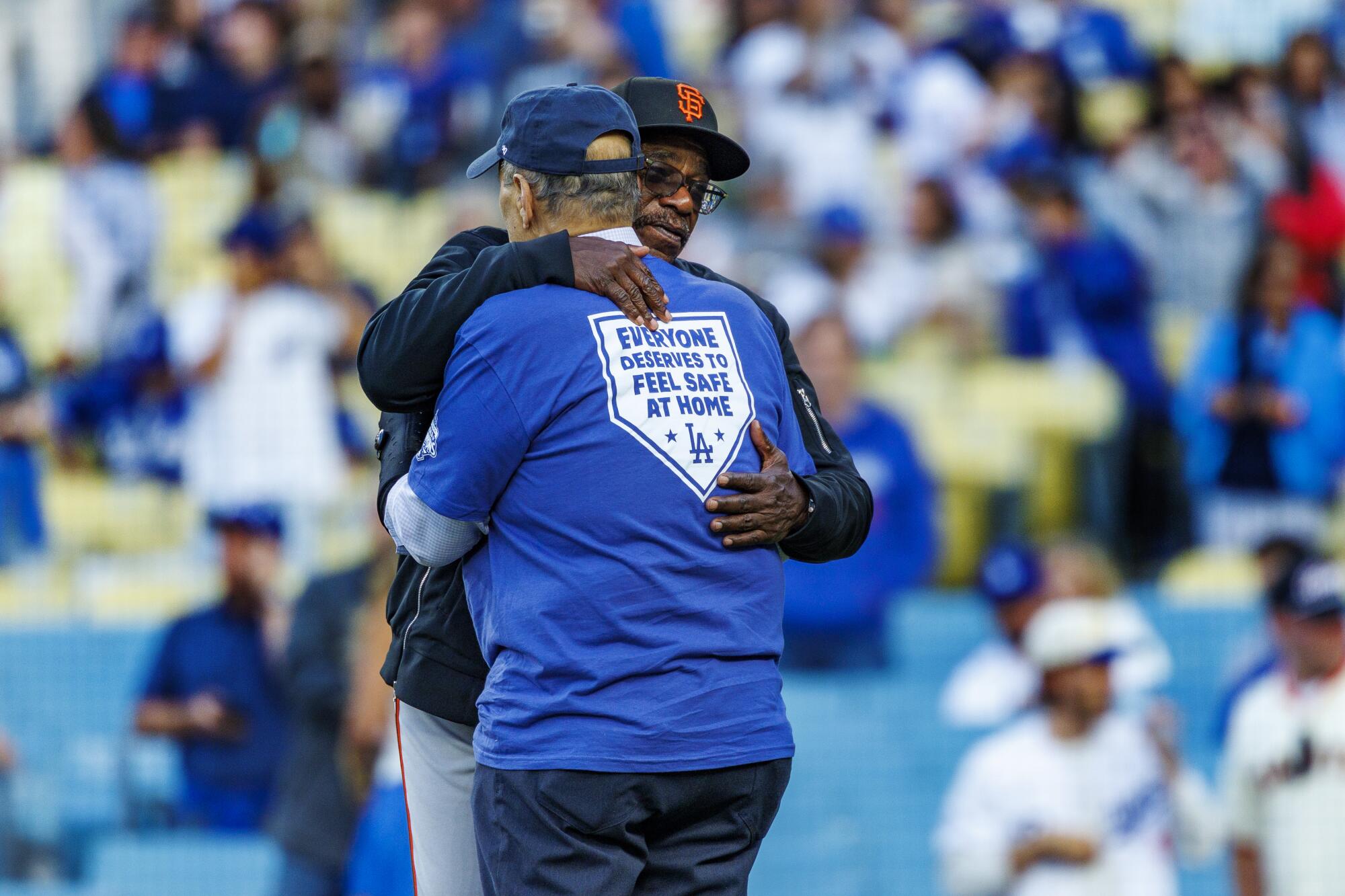
San Francisco Giants assistant manager Ron Washington hugs Joe Torre before a game at Dodger Stadium on May 14.
(Gina Ferazzi/Los Angeles Times)
They’re at schools in New York, Cincinnati, Tahiti and in L.A., at Bellflower Middle/High School and John Adams Middle School, John H. Glenn High and McKinley Elementary School, Palisades Charter High, Santa Monica High, Waite Middle School and Washington Preparatory High.
And they’re open to all, whether you’re a kid experiencing violence or you want to be able to help peers who are.
This past year, the foundation says it reached more than 28,000 students. And since it began, more than 425,000 young people, families, schools, and communities.
These Safe at Home spaces are all named “Margaret’s Place,” in honor of Joe’s mom, who was for years the victim of his father’s violent ire.
“It’s a tough subject to talk about,” Joe Torre said. “But you can’t run away from it.”
He did, though. He’s 85 now, but until he was 54, Torre didn’t reveal that baseball had been his refuge when he was growing up. He didn’t tell anyone that when he was a kid, if he saw his dad’s car in front of his house, Joe would go to a friend’s house and wait until he left for his job as a New York police detective. Joe didn’t share memories like he would later, of seeing his big sister, armed with a knife, standing between their mother and their father, who was going for his pistol.

St. Louis Cardinals third baseman Joe Torre poses swinging a bat prior to a game in 1971.
(Dave Pickoff / Associated Press)
He didn’t recognize what those traumatic experiences he’d tried to bury did to him, not until he started to talk about them.
“I thought I was born with this shyness and this nervousness,” Torre said before a Dodgers game in May, when the club introduced him and Ali and players and coaches wore T-shirts during batting practice that read: “Everyone deserves to be safe at home.”
“During my playing career,” Torre continued, “if we lost a game and I didn’t get any hits, I’d beat myself up. I was fortunate, I had a good career, but there was always something missing. I really probably could have enjoyed it a lot more than I did.”
That didn’t change until 1995, when he started talking about the domestic violence he experienced. He was surprised, he said, to find himself sharing his story, opening up for the first time at a “Life Success” seminar in Cincinnati, Ali’s hometown.
“Ali, she says, ‘You want to go to this Life Success symposium with me?’” Joe said. “And she’s eight months pregnant with our daughter and I’m not about to say no to anything she asks me to go. So we go in and they separate you, and they put you in groups of six strangers — and I’d just been named manager of the Yankees, so I’m very self-conscious.
“But after a day or so, you’re in it, you know? And then we went home and I called my sisters and asked them questions. Because they always tried to protect me, so I had to drag it out of them … ‘Did dad hit mom?’
“The biggest thing for me was knowing that my dad bringing fear down on the home was what caused my feelings that I was embarrassed to have. Once I went through that, I was able to go deeper.”

Yankees manager Joe Torre bumps fists with catcher Jorge Posada after a win in April 2004.
(Brian Kersey / Associated Press)
Speaking about what was previously unspeakable helped him cope with his trauma. He said it made him a more empathetic manager and a more confident man. It also made him want to speak out publicly and to encourage others to do the same, to break the cycle of silence.
So they’re getting the word out at — where else? — ballparks. There was the stop at Dodger Stadium in May, and before that, in 2025, seven major league teams had activations at games, as did 63 minor league clubs who hosted a “Safe At Home Awareness Game.”
Because often we do need an introduction, to connect kids with people who can keep them safe, who can assure them they’re not the only ones in their position.
“He’s talked about this many times: If he had access to a program like Margaret’s Place, he wouldn’t have felt like he had to carry this burden alone,” said Rose Robles, the foundation’s senior director of programs. “That was one thing he’s really stressed, he felt he was the only one that was going through this.
“And he would have had some options, some choices for how to respond to what he was experiencing and how to understand it. One thing that we say is that violence thrives in silence, and that is basically what he was experiencing.”
Forty-four percent of the kids Margaret’s Place counselors helped in 2024-25 were dealing with some form of violence at home. Twenty-seven percent have experienced some form of relationship or dating violence. They also help kids who’ve been exposed to community violence or other traumatic events, or who are grieving a traumatic loss.

Dodgers manager Joe Torre pauses for a moment while answering questions in August 2010.
(Jae C. Hong / Associated Press)
At Bellflower Middle and High School, Principal Jessica Cummings said a Teen Dating Violence Awareness Week and parent workshops focused on fostering healthy relationships increased awareness on her campus.
“We are grateful,” she wrote in an email, “for this partnership and the positive impact it has had.”
Of the students surveyed after receiving services, Safe at Home indicated that 99% reported feeling safer and 93% said they used the tools they learned in counseling.
Torre has absorbed decades of anecdotal feedback too — the knowing nods he sees in the crowd when he’s talked to groups of kids about this, the cameraman who slipped him $20 to put toward the foundation, the interviewer who shared his account of having grown up in a violent household.
“Anyone can become a victim,” Ali Torre said, “Our goal is to intervene and prevent. There are little boys we can have conversations with: ‘You don’t have to repeat the cycle.’ To little girls, ‘There’s an option for you…’
“And Joe has opened a lot of doors for us.”
When you think of Joe Torre, it’s as a former Dodgers skipper. A nine-time All-Star and the 1971 National League Most Valuable Player.
You should also think of him as a champion of children who now know that they aren’t alone, and that they have people who will go to bat for them.