Falcon

NASA launches Nancy Grace Roman Space Telescope via SpaceX Falcon Heavy rocket

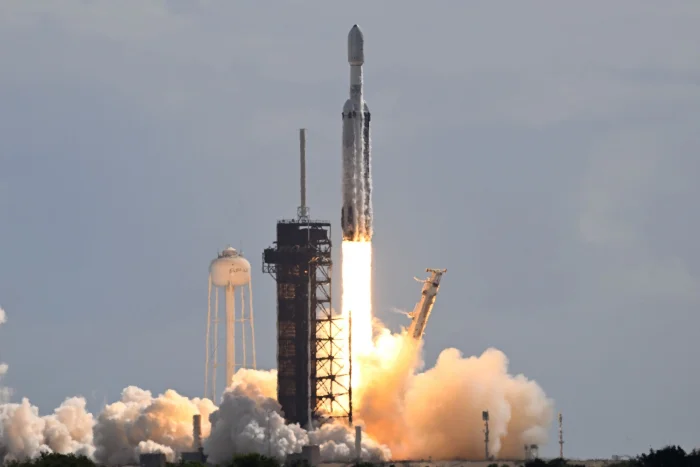
Aug. 30 (UPI) — NASA used SpaceX‘s Falcon Heavy rocket to launch the Nancy Grace Roman Space Telescope into space Sunday for a 1 million-mile journey to study some of the universe’s deepest secrets.

The rocket launched at 7:26 a.m. EDT from Launch Complex 39A at the Kennedy Space Center in Florida. The Falcon Heavy rocket separated 31 minutes into the flight and returned back to the launch site for later reuse.

There had been a 60% chance of favorable weather for the launch.

NASA Administrator Jared Isaacman called the launch of the telescope “exactly the kind of success story we want to see across NASA.”

“Delivered ahead of schedule and on budget, this mission reflects more than a decade of dedication from the NASA workforce and our industry partners. Now, Roman will give us a new atlas of the universe, push the boundaries of discovery, and demonstrate what is possible when America’s space program pairs bold ambition with disciplined execution.”

NASA said the telescope deployed its solar panels and lower instrument sun shade 1 hour and 23 minutes after launch. In the coming days, it will also deploy its high-gain antenna and a visor-like deployable aperture cover, perform two course corrections, and power on the Coronagraph Instrument.

In a few weeks, the telescope’s Wide Field Instrument — an infrared camera considered to be its primary instrument — will activate.

The Roman Space Telescope will travel 1 million miles in three months to reach its final orbit, a location called the second Sun-Earth Lagrange point. There, it’s expected to rapidly scan the sky and survey the universe about 1,000 times faster than the Hubble Space Telescope.

NASA said it expects to release its first images from the Roman Space Telescope in early 2027.

Source link

CrowdStrike outlines FY 2027 net new ARR of $1.350B-$1.359B as Falcon Flex ending ARR surpasses $2.29B (NASDAQ:CRWD)

Earnings Call Insights: CrowdStrike (CRWD) Q2 FY 2027
Management View

Seeking Alpha’s Disclaimer: This article was automatically generated by an AI tool based on content available on the Seeking Alpha website, and has not been curated or reviewed by humans. Due to inherent limitations in using AI-based tools, the accuracy, completeness, or timeliness of such articles cannot be guaranteed. This article is intended for informational purposes only. Seeking Alpha does not take account of your objectives or your financial situation and does not offer any personalized investment advice. Seeking Alpha is not a licensed securities dealer, broker or US investment adviser or investment bank.

Source link

SpaceX sets a rocket-reuse record with Falcon 9 launch

Aug. 25 (UPI) — In its 100th Falcon 9 launch of the year, SpaceX marked a record-setting 37 missions for the rocket’s first-stage booster, a reuse milestone.

The rocket launched early Tuesday from Cape Canaveral in Florida, carrying 29 Starlink internet satellites. There are already more than 11,000 Starlink satellites in orbit, making it the largest satellite constellation so far.

Falcon 9 rockets include extensive reuse of boosters, with nine of the company’s boosters making at least 30 flights. The one used Tuesday, B1067, entered service in June 2021. About 8.5 minutes after liftoff, the booster landed on a droneship in the Atlantic Ocean as the upper stage continued on to low Earth orbit.

Falcon 9 rockets flew 165 missions — all of them successful — in 2025. The reuse of the boosters makes the rockets cheaper and more efficient to use. While competitors have been working toward the same concept, SpaceX is so far the only one to manage it.

The next step for the company is the “megarocket” Starship, which is designed to be completely reusable multiple times a day. Only the Falcon 9 boosters are reusable.

Tuesday’s launch is expected to be the final one for Falcon 9 rockets in Florida. Kiko Dontchev, SpaceX vice president of launch operations, confirmed this in a social media post Tuesday.

“From here on, Starlink missions out of Florida will fly on Starship,” Dontchev wrote. “The West Coast team will continue regularly launching Starlink from Vandenberg.” This refers to Vandenberg Base in California.

SpaceX has not yet tested Starship in orbit. The next launch is expected in mid-September from Texas. If that one goes well, the next Starship launch will be from Florida.

“Once Starship is flying reliably several times a week, it makes sense to shift … production resources to Starship to get launch rate to several times per day,” SpaceX CEO Elon Musk said in a social media post Saturday.

Falcon 9 rockets launched for the first time in 2010. There have been nearly 700 launches since.

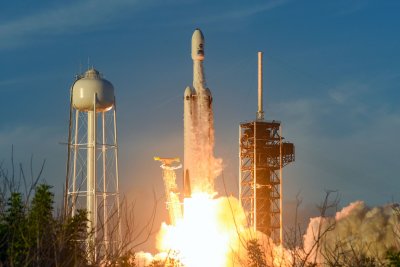
The SpaceX Falcon Heavy rocket launches the ViaSat-3 F3 satellite from Launch Complex 39A at the Kennedy Space Center in Florida on April 29, 2026. Photo by Joe Marino/UPI | License Photo

Source link