fairytale

Fairytale town dubbed ‘Cornwall on the east coast’ with pretty fishing harbour and no loud arcades

SCATTERED across the UK are a number of beautiful seaside towns and one has been described as looking like Cornwall – despite being over 400 miles away.

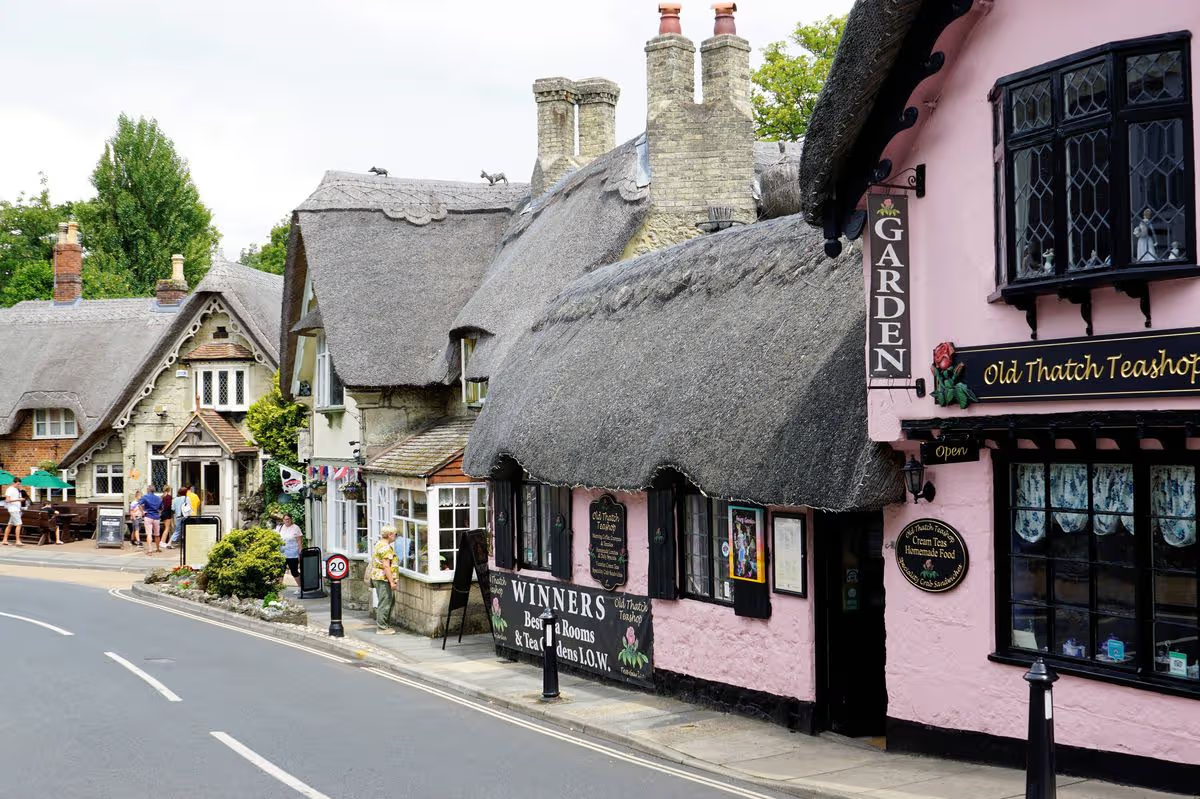
The village of Staithes was once the largest fishing port on the North East coast – it’s still used for fishing, but on a much smaller scale.

The fishing village of Staithes sits on the Yorkshire coastCredit: Alamy
It has boutique shops, a museum, pubs and cafesCredit: Alamy

It has pretty cobbled streets with a small sandy beach that sits inside its natural harbour and traditional seaside cottages.

Despite its position along the Yorkshire coastline, lots of people are saying looks like it belongs in the south.

One wrote on Tripadvisor that it’s the “Cornwall on the east coast”.

Another added that it’s a “place is for good old fashioned fun, no slot machines down here”.

SNOW WAY

All the best Xmas days out under £10 including FREE ice skating & Santa’s grotto


CHRIMBO WIN

Enter these travel comps before Xmas to win £2k holidays, ski trips & spa stays

Unlike other seaside towns and villages there aren’t any big piers or arcades.

If you visit during the colder months and need to warm up, then head to Dotty’s Vintage Tearoom for coffee, tea and cake.

There’s also the Royal George Pub, Captain Cook Inn and The Cod and Lobster seafood restaurant which sits on the very edge of the coastline.

The village has independent boutiques and its own museum too where visitors can learn about Captain Cook and the history of Staithes.

Most read in Best of British

You can easily visit other spots along the coast as Staithes sits between Whitby and Middlesbrough along the coastline.

One Sun reader said ‘there’s no place like Staithes’Credit: Alamy

It’s a popular seaside spot and was mentioned by Sun readers as one of their favourite underrated places in Yorkshire.

Sun reader Amy Stevenson said: “There’s no place quite like Staithes, it’s just so picturesque.”

Another mention was from Claire Allen who walked 4,000 miles around the UK coastline, raising money for Shelter charity.

Along the way visited over 1,000 coastal towns and villages – and Staithes is one of her favourites.

She told Country Living: “The view down to the village is almost enough to remember it by, but the narrow streets, pretty houses and a sheltered, sandy beach that’s as popular with fossil hunters as it is with families, put Staithes firmly at the top of the places-to-go-back-to list.

“There are pubs, cafes and tearooms, but not so many that it feels impersonal.

“I met a couple who were so taken with the place, that they’d spontaneously decided to extend their holiday.”

Here’s where to find the ‘best seaside town’ in the UK with a castle on the beach…

Bamburgh in Northumberland is constantly topping the rankings when it comes to the UK’s best seaside town.

The annual Which? ranking of seaside towns is created every year, with thousands of people surveyed about their experiences of UK beach holidays over the last year.

Once again, Bamburgh in Northumberland came top of the pile, making it four years in a row that the north east town has claimed the title.

Bamburgh is renowned for its stunning sandy shoreline, backed by the imposing ruins of its ancient castle.

One Travel Writer who visited said: “Visitors can take a dip in the fresh North Sea if they’re feeling bold, however I decided to simply dig my toes into the soft sand and take in the sights of Bamburgh Castle, which stands imposingly atop a hill behind the beach, creating a real life work of art.

“Making the scene even more idyllic is the small snack van, Bait at Bamburgh, tucked away in a car park behind the dunes.

“Its phenomenal crab crumpets are its signature dish, while local smoked Craster kippers are also on offer, providing beach-goers with delicious gourmet seafood treats plucked straight from the sea in front of them.

“The same locally-sourced produce can be found in places like the Potted Lobster, a relaxed bistro-style restaurant, whose freshly-prepared meals have earned it a place in the Michelin guide on four separate occasions.

“The Copper Kettle and Clock Tower tearooms serve similarly well-regarded fare. The former of the two describes itself as being “widely recognised as one of the finest Tea Rooms in the country” while the latter is part of the castle that draws people to Bamburgh from far and wide.

Plus, one Sun writer reveals more on the ‘prettiest town’ in Yorkshire where she grew up that southerners won’t have heard of.

And from someone who’s walked 10,000 miles through British countryside names their quaint English village that everyone should visit.

The fishing village of Staithes has been compared to the Cornish coastCredit: Alamy

Source link

Prague Christmas market named Europe’s cheapest with £2 pints and fairytale setting

Prague has been crowned the cheapest Christmas market destination in Europe with £2 pints and £74 hotels, and it’s also one of the most photographed festive spots on the continent

If you’re on the hunt for the ultimate Christmas market to explore this December, then you’re in luck. Hoppa has done the legwork for you and identified the most affordable destination to soak up the festive atmosphere.

The airport transfer experts have scrutinised dozens of European winter holiday spots, considering factors such as average accommodation costs, Tripadvisor reviews, and even the price of a pint.

And the European location that offers the best value for money this Yuletide is…Prague!

I agree with them after visiting the scenic city of Prague two years ago during the Christmas period. The Old Town Square has an iconic Gothic Church, a 20-Metre Christmas tree and is the most festive place I’ve ever experienced.

READ MORE: Charming UK town with vibrant Christmas market where you might even bump into a celebrity

It truly comes alive in December when the Christmas lights sparkle, locals sing traditional Czech carols and chalets sell everything from Trdelník (chimney cake) to hand-painted Czech Marionettes and puppets.

In addition to a visually stunning Christmas market, you’ll find an impressive 4,811 attractions to keep you entertained. With a score of 7.5 out of 10, the average cost of a 3-star hotel in Prague is a mere £74, and a pint will set you back just £2.17, according to secretldn.com.

The square is lined with eateries where you can sit back, enjoy reasonably priced food and drink, and indulge in some people-watching. Dinner with drinks typically costs between 250-400 CZK (roughly £8 to £14), with street food being even more affordable.

You can enjoy traditional dishes like Goulash, Svíčková (beef in cream sauce) or Vepřo knedlo zelo (pork, dumplings, sauerkraut) washed down with mulled wine, beer or Tatratea : A popular tea-based spirit.

In fact, the Christmas market is so picturesque that it’s been dubbed the most photographed Christmas market in Europe by various media outlets and Prague City Tourism.

There’s still ample time to visit – the market operates annually from late November until early January, transforming the square into a magical scene dominated by the towering Gothic spires of Týn Church and the Astronomical Clock.

One of the best aspects is that despite being only a two-hour flight from the UK, once you set foot in the Old Town Square, it feels as though you’ve travelled back in time. And you can get there for as little as £27 return (if you book well in advance), leaving plenty of spare change for a few £2 pints of beer.

The 10 most budget-friendly European winter getaway destinations:

Prague, Czech Republic.

Bansko, Bulgaria.

Sofia, Bulgaria.

Budapest, Hungary.

Tallinn, Estonia.

Kraków, Poland.

Tirana, Albania.

Belgrade, Serbia.

Bratislava, Slovakia.

Vilnius, Lithuania.

Source link

A winter tour of Luxembourg’s fairytale chateaux – on the country’s free bus network | Luxembourg holidays

The top of the tower had disappeared in the mist, but its bells rang clear and true, tolling beyond the abbey gates, over the slopes of frost-fringed trees, down to the town in the valley below. Final call for morning mass. I took a seat at the back of the modern church, built when the Abbey of Saint Maurice and Saint Maurus relocated to this hill in Clervaux, north Luxembourg, in 1910. Then the monks swept in – and swept away 1,000 years. Sung in Latin, their Gregorian chants filled the nave: simple, calming, timeless. I’m not religious and didn’t understand a word, but also, in a way, understood it completely.

Map of Luxembourg with castles marked and neighbouring countries shown

Although mass is held here at 10am daily, year-round, the monks’ ethereal incantations seemed to perfectly suit the season. I left the church, picked up a waymarked hiking trail and walked deeper into the forest – and the mood remained. There was no one else around, no wind to dislodge the last, clinging beech leaves or sway the soaring spruce. A jay screeched, and plumes of hair ice feathered fallen logs. As in the church, all was stillness, a little magic.

I’d come to Luxembourg by train, with the notion of finding a frozen fairytale. This tiny grand duchy, about the size of Dorset, has a ridiculous number of castles – as many as 130 (depending on your definition). It’s the legacy of being sited at the heart of western Europe, suffering centuries of incursions. Some of these castles have been restored for visitors; some are places you can stay at (with lower rates off-season). Add in rimy forests, chanting monks and the fact all public transport is free – maybe the most magical thing of all – and my hopes Luxembourg would make an atmospheric winter break were being fulfilled.

My walk ended at Clervaux Castle. It dates from the 12th century, but was destroyed during the second world war’s desperate Battle of the Bulge, which played out in these cold forests in December 1944. The castle has since been rebuilt and now houses the 1950s Unesco-listed photo exhibition The Family of Man. It was almost empty as I moved between the 503 images, taken by the most prestigious photographers of the age, depicting normal people in all life stages, the ordinary rendered extraordinary. There are no captions or locations; each photograph is its own whole story, containing multitudes. It was incredibly uplifting.

Clervaux Castle perched on a rocky promontory above the city, was destroyed during the Battle of the Bulge in the second world war and then rebuilt. Photograph: Pixelbiss/Alamy

You can’t spend the night at Clervaux Castle, but 10 minutes away by (free!) bus is Chateau d’Urspelt, where you can stay. When I arrived, this castle looked Disney-cute, fairy lights dripping from its white-washed turrets. Eighty years ago, it was quite different. The US 1st Battalion 110th Infantry had its HQ here in December 1944, before being overwhelmed by German forces. After the war, Urspelt fell further into ruin, until 2005, when a local entrepreneur decided to restore it and turn it into a smart hotel. I skipped the snazzy spa, and the ice rink sparkling in the courtyard, but relished a fruity Luxembourgish pinot noir in the low-lit bar, which hides like a speakeasy in the castle’s historic cellars.

One of the country’s most impressive castles is Vianden (less than an hour from Clervaux via a free bus), a beast of a bastion, lording over the River Our, on the German border. It was constructed between the 11th and 14th centuries on Roman foundations, altered multiple times, left to rot, then, from the 1970s, painstakingly restored to its medieval pomp. On a pallid winter’s day, it was crowd-free. I rattled around its vast state rooms and marvelled at the layered history visible in the visitor centre, which is built around past excavations.

It’s not just the castle that gives Vianden its fairytale feel. There’s the winding river, the tight-pressed wooded hills and the village itself, with its remnants of 13th-century walls and pretty, cobbled main street. I opted to escape reality entirely in the Ancien Cinéma cafe, a former movie theatre where you can grab a coffee, sit on a couch and watch whatever’s on the big screen, surrounded by film paraphernalia.

The Sherlock room at Château de Clémency. Photograph: Sarah Baxter

My final stop was a castle unlike any other. Chateau de Clémency, close to the Belgian border, is a five-room guesthouse and the 2025 winner of Luxembourg Tourism’s Best Host award. Dating back to 1635, it was only ever a small residential retreat, with no military function. When Pascal Zimmer – former judoka, self-taught tailor and architect, and restorer of historic buildings – bought it 20 years ago, it was a proper mess, in need of either demolition or renovation. He saw the property’s true value and he liked the staircase – “You could say I spent €400,000 on some stairs …” he confessed, pointing out the stone pleasingly worn by 400 years of footfall.

“When you think about castles, you think of Windsor or Versailles. But this is a Luxembourgish castle, not so expansive, not so well done; you can’t restore it in the same way.”

So, to that end, Clémency is Pascal’s own artistic vision. Each room has a different theme, from belle époque “Peggy’s” to the “Roaring 20s”. “Tribute” pays homage to the local steel industry on which Luxembourg’s wealth is built. “My father was a miner,” Pascal said. “He was a humble guy; he’d say all he wanted was a small, clean room. This is a small, clean room.” A patchwork blanket covers the bed, while the bathroom is black polished concrete, a nod to life underground. I stayed in “Sherlock”, a Holmesian fantasy suite; the lounge was a steam-punkish curiosity shop of moody portraits, scientific implements and stuffed cats.

There isn’t much to do in the town of Clémency itself, although that hardly mattered. It was only 40 minutes by public transport (did I mention: all free!) into Luxembourg City, a capital perched on a precipitous rock, like something from a storybook. It was a shorter hop to Bascharage, where I got cosy in D’Braustuff, a gemütlich brewery-brassiere serving Luxembourgish classics – I tucked into a hearty wäinzoossiss (traditional sausage). But when darkness fell, I was also content to stay in my castle with a book – the shelves were full of Agatha Christie and Conan Doyle – and enjoy an alternative winter’s tale.

The trip was provided by Luxembourg tourism board and Byway, which can arrange bespoke itineraries including Eurostar tickets, Interrail passes and accommodation. Château de Clémency has doubles from €99. Château d’Urspelt has doubles from €174

Source link

Woke BBC bosses could thwart fresh bid to finally get Fairytale of New York to Christmas No1

WOKE BBC bosses could thwart a fresh bid to finally get Fairytale of New York to the Christmas number one spot – 38 years after it was released.

The corporation’s radio stations refusing to play a newly released ‘live’ version of The Pogues’ Fairytale of New York because it contains the “cheap, lousy f****t” lyric.

A black and white image of a woman sitting at a piano with a man standing nearby and smoke rising from an ashtray.
The BBC is refusing to play a newly released ‘live’ version of The Pogues’ Fairytale of New YorkCredit: Unknown
Kirsty MacColl and Shane MacGowan dancing.
The popular Christmas tune features Kirsty MacColl and Shane MacGowanCredit: Redferns

The track by the Irish rockers, originally released in 1987, is one of several vintage festive tracks that only reached number two in the charts, despite becoming classic anthems

Another example is White Christmas by Wham! which was kept off the number one spot by Band Aid’s Do They Know It’s Christmas in 1984.

But fans finally got that to the top spot in 2023.

Fairytale has long been surrounded by controversy because it contains a perceived homophobic slur which has either been removed in some versions or not played at all.

CASH IN

Astonishing amount The Pogues make every year from Fairytale of New York


ALL TOGETHER NOW

Watch legendary band The Pogues reform a year after Shane MacGowan’s death

A music industry insider said: “It feels unfair that this live version which shouldn’t be edited has now been barred from the Beeb’s playlist.

“It’s an authentic performance of a much loved track by a much loved band and this move might be the measure that prevents it from getting to number one at Christmas, which is where it has always deserved to be.”

The original single was only kept from the top spot by Pet shop Boys classic Always On My Mind, which was a high-energy cover version of the Elvis Presley ballad.

Despite always making it into the top ten every Christmas, and featuring in the 2019 festive special of Gavin & Stacey, it’s never made it to number one.

The BBC were approached for comment.

Source link