A city break in Łódź, Poland’s capital of cinema and factories | Poland holidays
Sometimes travel delivers a real shock. I’m moving along the boulevards in the Polish city of Łódź, enjoying the excellent cafes and warm sunshine, when I spot the vans. They are parked up on the verge, with racks of clothing and heavily laden tables behind. I can’t resist a Sunday morning market and walk towards a group of men huddled around a car that is covered in blankets. And then it happens. They turn – and I see they are weighing pistols in their hands. I recognise the lean profile of a German Luger, and then the bulkier Colt 45.
There is a second of doubt. I hesitate. They replace the weapons on the display and walk away laughing. I approach. On the car roof is a row of dusty soldiers’ helmets. “We were repairing a pavement in the centre of town,” says the seller cheerfully, handing me a badge to inspect. “Imagine! For 80 years, all this stuff was just under our feet.”
It’s a Wehrmacht shoulder badge from Kuban 1943, a last-ditch post-Stalingrad action on the Crimean peninsula. Who wore this, I wonder? A veteran of the Russian front who almost made it home? Nothing is clear, except that in Łódź, the past is never far away.
I arrive the previous night, a little disoriented, whizzing past unlit buildings, huge brick structures like Victorian factories. “Are we in the city yet?” I ask.
The taxi driver gives me a quizzical look. “Yes, this is Łódź.” I note the pronunciation, like “wudge”. I glimpse five-storey blocks, tree-lined streets, a tramline. “I could never live anywhere else,” he adds. A huge blue graffito is caught in the headlights, like a monstrous alien creature.
“Why?” I ask, but we are already pulling up outside an immense red-brick building, my hotel, and he never answers my question. The reception area is huge, with a strange scalloped ceiling in red brick that hints at a previous incarnation as a factory.
This is my first visit to Łódź, a city about 75 miles (120km) south-west of Warsaw. My interest has been piqued by a list of notable people associated with the place. It features an astonishing number of Oscar-winning or nominated film directors connected to the city: Andrzej Wajda (The Promised Land), Roman Polanski (The Pianist), Paweł Pawlikowski (Ida), Agnieszka Holland (Europa Europa), Krzysztof Kieślowski (Three Colours trilogy) and Zbigniew Rybczyński (Tango).
But under the bonnet there is a vast array of talent in acting, production and technical excellence. The city’s film school is responsible, of course, but Łódź itself features as a setting, too, notably in David Lynch’s Inland Empire and Wajda’s masterpiece The Promised Land.
Łódź, I had decided, must be fascinating. Any visit starts with Piotrkowska Street, the longest shopping street in Europe at about 2½ miles. My guide, Anna, takes me through Plac Wolności (Freedom Square), where a dance festival is in progress, with hooded hip‑hoppers rubbing shoulders with troupes of line dancers and girls in colourfully embroidered traditional dress. This is a city where music and dance are never far away. We dodge down a side alley and emerge in a striking art installation – an entire street, Pasaż Róży (Rosa’s Passage), covered in mirrors by the artist Joanna Rajkowska. Back on the main pedestrianised route, the mix of ancient and modern continues: 19th‑century porticoed palaces adorned with colourful graffiti.
I ask Anna how Łódź fared in the second world war. “It was not too badly damaged,” she says. “Both the Germans and the Russians wanted the industry intact.”
There is no medieval heart, no ornate houses like in Wrocław or Kraków. What Łódź possesses is an impressive array of 19th-century factories, mostly textiles, built to show off their owners’ power, wealth and architectural aspirations. Now, this heritage has become a stunning example of urban regeneration.
We turn into OFF Piotrkowska, a complex of beautiful old textile mills reborn as a hive of small businesses. There are lots of vibrant restaurants and bars, but Anna wants to show me a shop that she likes: Pan Tu Nie Stał. “It was a saying in communist times: ‘You’re not in the queue.’ We said it to people trying to push in,” Anna says.
This is the spot to pick up a T-shirt featuring Soviet combine harvesters or some Czas Pokaże (Time Will Tell) socks. The shop says a lot about the Polish attitude to communist times: none of the maudlin ostalgie of East Germany; this nostalgia comes with healthy dashes of colour and humour.
It did all start, however, with a disaster. The old mills had survived two world wars, but died in the economic collapse after communism ended in 1989. “Everything closed down,” says Anna. “We call that time the transformacja. It was very hard.”
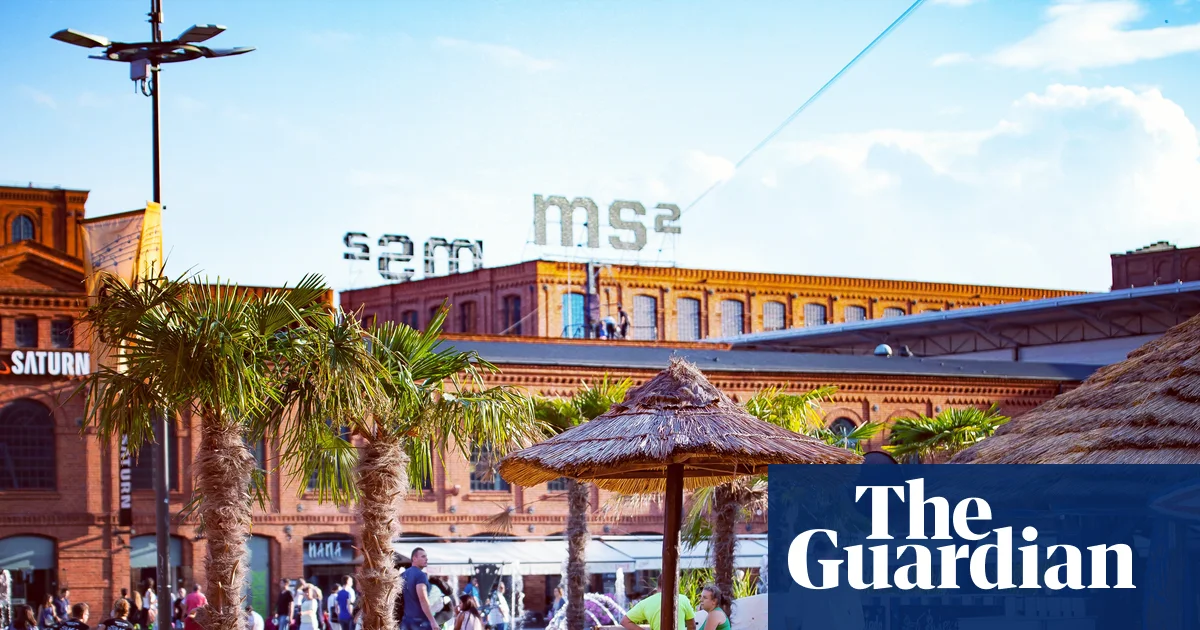
We stroll into the Manufaktura area, once the site of a vast textile business started by a local scrap metal dealer, Izrael Poznański, in 1872, and now another beautifully restored collection of red-brick buildings housing restaurants, bars, shops and the fascinating Museum of the Factory. Next door is the palace that Poznański built, a neo-baroque monstrosity of bulging wealth, now the city museum.
After the Congress of Vienna in 1815, Łódź became part of the Russian empire, a melting pot of German, Jewish, Polish and Russian influences. In the 1870s, Poznański was one of a group of men who saw the potential of steam power. They imported looms from England and were soon amassing unimaginable wealth, constructing a city of handsome red-brick factories, the core of which still remains.
The Museum of the Factory houses a collection of working looms that date back to the 1880s. Only four machines are ever turned on due to noise pollution laws – in the old days, one factory might have had hundreds. This was the city of the deaf, but the deafest of all were the bosses, oblivious to the terrible hardships of their workforce, from the founders through to their communist successors. When Wajda came to these mills in the early 1970s, planning The Promised Land, he needed to make only minor adjustments to start filming. The tired faces, the crashing looms, the heat and the dust – it was all very much like 1880.
Is that your favourite film, I ask Anna? She shakes her head. “Cold War by Pawlikowski,” she says. “I love that film.”
This 2018 masterpiece is the story of a tragic love affair conducted across the Iron Curtain in the years following the second world war. Based on the lives of Pawlikowski’s parents, it is dark and sensuous, full of great music and dance. Pawlikowski has used Łodż as a location.
We move on to the Museum of Cinematography, a tour de force that warrants some preparation (watch films by Polish directors). They have everything from early working equipment to props from the most recent Oscar triumphs. By the time I get to the end, I have only a few minutes to rush to the Central Museum of Textiles.
There I find a technician, Przemysław, about to start up a 1893 Greenwood loom. He’s a former policeman with a few tales to tell, but right now one question is bothering me. “Why did film-making succeed so brilliantly in this city of textiles?” I ask him.
He taps the cast iron loom and chuckles. “I’ll show you.”
With the flick of a switch, the loom begins to clank and turn. The noise is incredible. Przemysław is moving around, adjusting and calibrating, his face concentrated. I see the spools of thread begin to unwind, the shuttle dashing back and forth, the warp and weft rhythmically rising and falling. The different colours, each no more than a thin line, but magically coming together. And from the lip of the machine spills a beautiful multicoloured cloth.
Przemysław looks at me and raises a questioning eyebrow. “Like weaving a story, right?”
The trip was provided by the Polish Tourism Organisation, with Holiday Extras lending travel support in car parking, insurance, airport transfers and hotels