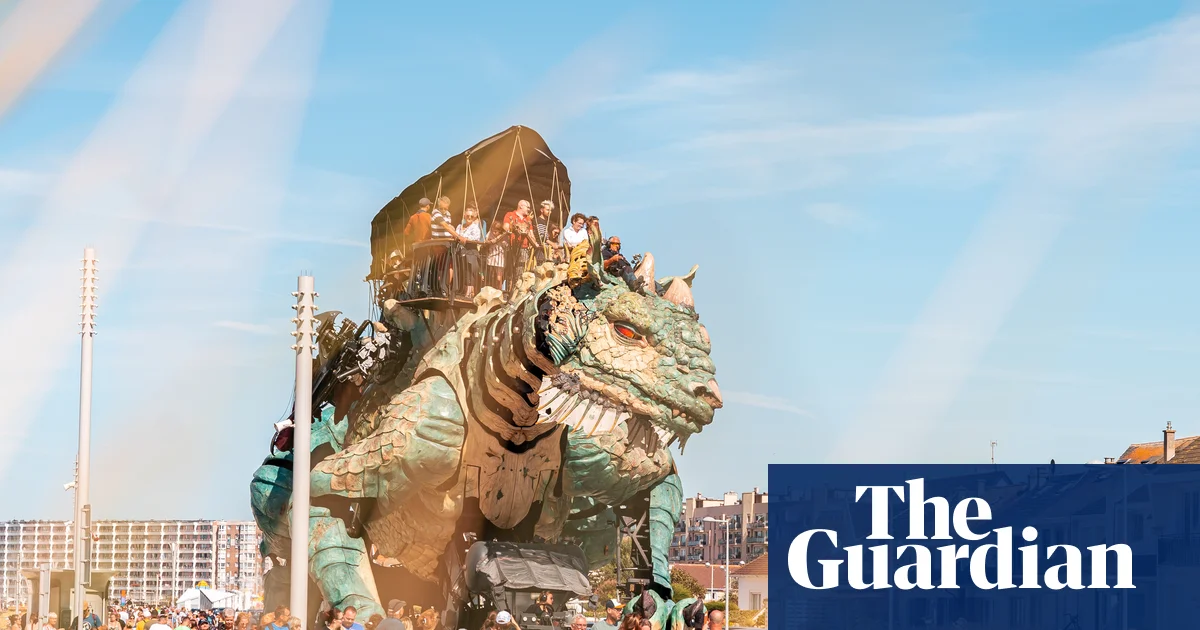
You don’t need to venture too far into France to find its wow factor. Indeed, within minutes of exiting the ferry or Channel Tunnel, you can be staring a fire-breathing dragon in the face. The Dragon de Calais is a 25-metre-long mechanical beast that stomps along the renovated sea front carrying 48 passengers on its back (adult ticket €9.50), emitting jets of fire, steam and water from its nostrils. It was created by the team behind Les Machines de L’île, a collection of steampunk wonders including a 12-metre elephant, in Nantes.
This year, Calais’ dragon is joined by Le Varan, a giant iguana that crawls around the town and the old fishing district with room for 25 passengers (adults €8.50). While you’re there, explore the beaches along the coast at Hardelot-Plage and visit the Chateau d’Hardelot, with its history of Franco-British relations.
Celebrate Monet in Rouen
Rouen cathedral, which Monet painted more than 30 times. Photograph: SC Stock/Getty Images
This year marks the 100th anniversary of Claude Monet’s death and many galleries and venues in Normandy and Paris have events planned. You don’t need to face the crowds at Giverny or the Musée d’Orsay to appreciate the great artist’s work, though. Instead, visit Rouen, where Monet found the ever-changing, silver-grey light on the intricate and imposing facade of the cathedral so inspiring he painted it more than 30 times (from the window of what was, at the time, a ladies’ undergarment shop opposite).
The Musée des Beaux-Arts de Rouen has the largest collection of French impressionist works outside Paris, including one of the cathedral paintings and works by Camille Pissarro and Alfred Sisley. While you’re there, explore the Boucles de la Seine natural regional park, where you can cycle between the loops of the River Seine through orchards and past the ruined Abbaye de Jumièges.
Visit a postman’s palace in Drôme
The Palais Idéal, created by Ferdinand Cheval. Photograph: DV Travel/Alamy
The Dauphiné region, close to Grenoble, combines breathtaking scenery and curious attractions. Chief among them is the Palais Idéal, a whimsical monument built over 33 years from the late 19th century by Ferdinand Cheval, a postman whose inspiration came from the travel journals and postcards he delivered on his 20-mile round. On the facade of the 10-metre-high palace, you’ll see mythical creatures and mysterious grottoes, Egyptian temples and Swiss chalets, while the small on-site museum recounts the stories of Cheval’s tragic life, and those who fought until the 1960s to have the structure recognised as a listed monument.
Nearby, explore the jaw-dropping Vercors mountains, with precipitous roads such as the Combe Laval route, which was chiselled out of the rock in the 19th century to transport timber. Also visit the fascinating Grotte de Choranche underground caves, with curious, spaghetti-like stalactites, and the town of Pont-en-Royans, where medieval houses hang high over a gorge.
Discover Brittany by bike
A cyclist on the Traversée Bretonne passes a chateau in Nantes. Photograph: Un Monde à Vélo
Cyclists have always been spoiled by the smooth, car-free cycle paths throughout France, and now the Traversée Bretonne, a new route through the heart of Brittany, offers a fresh challenge. Starting in the city of Nantes, the 14-stage route takes riders past the curious mid-century architecture of Saint-Nazaire (such as the Soucoupe, a sports centre shaped like a flying saucer), then on to the “Atlantic Riviera” at La Baule, with its belle époque villas and vast beach.
Further along, the lively city of Rennes is perfect for rehydrating: Rue Saint-Michel is nicknamed Rue de la Soif (thirsty street) because it has a bar approximately every 7 metres. The route finishes with a nice flat stage at Mont-Saint-Michel. traversee-bretonne.com
Celebrate figs in the Var
Figs for sale at the Fête de la Figue in the village of Solliès-Pont. Photograph: Laurent Parienti
Plan a late-summer sojourn in the Vallée du Gapeau, inland from Toulon, which is renowned for its fig orchards: local people say the trees like their heads in the sunshine and their feet in the water. At the end of August, the start of the harvest is celebrated with the lively Fête de la Figue in the village of Solliès-Pont. As well as the bountiful market, there are tours of the groves and a lively four-course dinner with music in the village’s main square.
While you’re there, hike in the wooded valley and admire the curiously shaped “elephant rock”. Visit the local olive oil mill at Moulin à Huile du Partégal (entry free) to explore its ancient grove and taste its oils; and stroll the unspoiled villages of Solliès-Ville and Solliès-Toucas. valleegapeau-tourisme.fr
Taste cheese in the Jura mountains
Cheese at La Maison du Comté. Photograph: Hemis/Alamy
To truly understand the flavours of French cheeses, it pays to visit the landscapes in which they are made. One of the most enchanting areas for a foray in fromage is the Jura mountains, the home of comté cheese. Here, as part of the Routes du Comté, you can visit the so-called cathedral of comté at the Fort Saint-Antoine (tour reservations essential, €11), where Fromageries Marcel Petite ages its 100,000 wheels of comté between the stone arches of a 19th-century military fort. Nearby, next to the Lac de Malbuisson, Restaurant du Fromage offers a comté and savagnin wine fondue in its Swiss-chalet-like surrounds.
An hour west, the town of Poligny is home to La Maison du Comté, a visitor centre dedicated to explaining how the cheese is made and infused with the flavours of the 130 plants from the spectacular landscape on which the cows graze. montagnes-du-jura.fr
Hunt for bric-a-brac in Normandy
A flea market in Honfleur. Photograph: Peter Andrew Richardson/Alamy
Take a road trip to the bucolic Perche regional natural park in southern Normandy, an area of rolling hills, cider farms and charming villages. It is ideal, too, for those who love hunting for vintage treasures and bric-a-brac. Near the towns of Bellême, Mortagne-au-Perche and along the D923 road between La Ferté-Bernard and Nogent-le-Rotrou, you will find many brocante shops and warehouses with artfully displayed items on offer.
The area is a popular weekend destination for Parisians, hence the abundance of good restaurants. In the village of La Perrière, La Maison d’Horbé B&B and wine bar (rooms from €142.50) is set in an antiques shop, while in Saint-Hilaire-le-Châtel, the Hotel les Prés has its own restaurant (rooms from €142). perche-tourisme.fr
Relive history in the Vendée
Cahriot racing at the Puy du Fou theme park. Photograph: Arthur Aumond
You need never utter the word Disney once you’ve discovered the Puy du Fou, a theme park like no other, in the countryside of the Vendée. With bombastic historical re-enactments of Viking invasions, Roman chariot races, medieval jousting and more than 2,500 actors across the park, many of the shows are big on wow factor.
Yet there are also experiences that evoke a quieter sense of wonder – walk through the cabins and hull of the 18th-century ship La Pérouse and see its myriad flora and fauna gathered from around the world, before it sinks in a storm in the South Pacific. Moving, too, is the Amoureux de Verdun experience, which puts you in the trenches of Verdun in the first world war, where actors play out a love story. Adult tickets from €47, puydufou.com
Swim in a tidal pool in Brittany
Saint-Malo’s Piscine de Bon Secours. Photograph: JJ Farquitectos/Getty Images
There are several tidal swimming pools along the Emerald Coast in Brittany. At Dinard, the Piscine de Mer overlooks the vast main beach, alongside stately belle époque villas and maritime pines; and from Saint-Malo’s Piscine de Bon Secours, you can walk at low tide to the island of Grand-Bé for a great view back to the walled town.
The Emerald Coast is good for hiking too, so make a point to stroll out to the dramatically perched Fort La Latte on the Cap Fréhel headland. dinardemeraudetourisme.com
Explore the wild Aubrac plateau
The volcanic landscape of the Aubrac plateau. Photograph: Hemis/Alamy
Many holidaymakers speed through the centre of France on the autoroute known as La Méridienne (A75), bound for busy beaches of the Med. Those who prefer more solitude, however, should exit sooner (exit 39 to be precise) and venture west on to the extraordinary, volcanic landscape of the Aubrac plateau. Here, stone-walled meadows abound with wild flowers and the buron huts that once housed cowherds and cheesemakers have been converted into welcoming rustic restaurants, such as the Buron de Born, serving local potato and cheese dishes such as aligot and truffade. At night, the total absence of light pollution makes it ideal for stargazing. tourisme-en-aubrac.com
Spring has arrived at Wicken Fen, one of Europe’s most important wetlands, and with it the first summer migrants. Chiffchaffs are usually the earliest, with their rhythmic song ringing out across the fens. Then, if the weather is mild, blackcaps and willow warblers might join them. Listen closely, especially early morning or at dusk, for the foghorn-like calls of the booming bittern across the reedbeds. There’s a pushchair- and wheelchair-friendly boardwalk around Sedge Fen, and wheelchair-accessible wildlife hides. Look out for the electric blue flash of a kingfisher, and male marsh harriers performing their dramatic sky-dancing flights as the breeding season gets under way, before the cuckoos arrive in late April. From £10 adults, £5 children (under-5s free), nationaltrust.org.uk
Artful planting in East Sussex
Spring evening at Petworth House. Photograph: Slawek Staszczuk/Alamy
When Dan Pearson created the landscape design at Goodwood Art Foundationsculpture park, which opened last May, he planned 24 seasonal moments to complement the art-dotted trails through woodland, glades and meadows. This is the first spring visitors will see his graphic plantings of daffodils and bluebells, cherry blossoms and the katsura grove coming into copper-coloured leaf. Over the Easter holidays, children can pick up a free Art in Nature pack to create rubbings and collages inspired by the shapes and textures.
There is artful nature of a different kind at nearby Petworth’s spring festival, with more than 100 pots of spring bulbs in flower, willow foraging and basket making workshops, and other garden-themed kids’ activities. Goodwood Art Foundation, £15 adults, under-18s free,goodwoodartfoundation.org. Spring festival at Petworth, from £21 adults, £10.50 children(under-5s free), 4-19 April,nationaltrust.org.uk
Feast by the sea in Kent
Morelli’s ice-cream parlour in Broadstairs. Photograph: Eye35/Alamy
From Italian small plates in Margate to Japanese ramen in Deal, the Kent coast has upped its foodie credentials. Dig in at the Broadstairs food festival, which pops up on the seafront over Easter (3-5 April). There’s a delicious lineup of chefs, street food stalls and local artisan producers, plus food-themed arts and crafts workshops, from chocolate lollipop making to screen printing napkins with fig, oyster, crab or seaweed designs. Broadstairs is a treat to eat your way around anytime, with seafood at Kebbells, tapas at Bar Ingo and, of course, a sundae at Morelli’s Formica-tastic ice-cream parlour. Free entry, 3-5 April, broadstairsfoodfestival.org.uk
Treetop thrills and stargazing in the Lake District
Go Ape high ropes course in Grizedale Forest. Photograph: Michael/Giant Peach
The deep dark woods at Grizedale Forest in the Lake District offer an action-packed day out for families, with Go Ape treetop thrills, adrenaline-pumping mountain biking and sculpture-filled walking trails (including a Gruffalo orienteering route and a Room on the Broom nature walk for Julia Donaldson fans). Now you can add stargazing to the list. The new Grizedale Observatory opened last May, the Lake District’s first public observatory and planetarium. There are family sessions every Saturday at 4pm, where budding astronomers can touch real meteorites and watch a show in the planetarium. Easter holiday events include Jupiter viewings, aurora nights and afternoon planetarium shows. Grizedale Forest, free (bar Go Ape), forestryengland.uk. Observatory events, from £13 adults, £8 children, grizedaleobservatory.com
See grand designs and baby lambs in North Yorkshire
Castle Howard. Photograph: Eye35/Alamy
Sir John Vanbrugh was a playwright with no architectural experience when he was commissioned in 1699 to build a massive new house for a fellow Kit-Cat Club member, the Earl of Carlisle. It would be fair to say that Castle Howard was a decent first stab. In celebration of the tercentenary of its creator, there are new tours giving unprecedented access to areas of the house, follies and monuments not usually open to the public. Plus you can meet baby lambs born on the estate at the magical Skelf Island adventure playground (4 and 5 April). Garden tickets, which include Skelf Island, from £17 adults, £8.50 children (under-3s free), castlehoward.co.uk
Woodland blooms in Cornwall
Magnolia at the Eden Project. Photograph: Douglas Lander/Alamy
Each year, six champion Magnolia campbellii are eagerly watched in six of the Great Gardens of Cornwall, including the Eden Project. The moment they come into full bloom (counted as 50 flowers), spring is declared to have officially arrived in England. This year it happened on 27 February. The Gulf Stream helps hurry the start of the season along here, and means you may see a few bluebells popping their heads up in the Easter holidays. Tehidy woods is famous for its carpets of bluebells – the first were spotted in early April last year. That will be just in time for fantastical theatre company Rogue Otherworld’s Wild Awake show, which weaves between the trees telling the story of the forest awakening, guided by the Wild Spring Hare. Wild Awake show, £10-£15 adults (pay what you can; under-3s free), 3-6 and 8-12 April, rogueotherworld.co.uk
Poohsticks in Ashdown Forest
AA Milne’s famous bridge in East Sussex. Photograph: Andrew Hasson/Alamy
It’s the 100th anniversary of AA Milne’s Winnie-the-Pooh this year, so good reason to follow the honey-loving bear and his friends down to the real-life Hundred Acre Wood in Ashdown Forest. Milne wrote the children’s classic at Cotchford Farm (now a holiday rental) on the edge of the forest, where he lived with his wife and his son, Christopher Robin. Follow the Pooh Walks (0.6 or 2 miles) from Gills Lap to trace out spots from the book, including The Enchanted Place, the Heffalump trap and Roo’s sandy pit. Don’t leave without playing a game of poohsticks on the Poohsticks Bridge. Pooh fans can plot a return trip for the summer holidays to catch The Big One Hundred celebration, which will include a giant puppet roaming through the woods, interactive performances and five new walking routes. Free, ashdownforest.org
A wild coastal walk in County Antrim
Gobbins cliff path, County Antrim. Photograph: Vincent Lowe/Alamy
The walkways, bridges and steps that make up the Gobbins cliff pathcling to sheer basalt rock, the waves crashing below. This elemental trail was built by the railway engineer Berkeley Deane Wise in 1902, and now can only be followed on 2.5hr guided tours, which have been paused since last year due to rockfall. They are due to restart on 20 March, and it’s a thrilling stop on the Causeway Coastal Route. Alternatively, the Blackhead Path is almost as dramatic and free, starting at nearby Whitehead. The route hugs the coast past smuggler’s caves and rocky coves, before taking the steep steps up to the clifftop Blackhead Lighthouse. A Mauds ice-cream at Coastal Coffee back in Whitehead is just reward for the climb. £22.75 adults, £16.50 under-16s(minimum 4ft tall, roughly seven years old), thegobbinscliffpath.com
Relive Springwatch in the Peak District
Padley Gorge. Photograph: Suxxes Photo/Alamy
Last year, BBC’s Springwatch was based at the Peak District’s Longshaw Estate. Over the weeks of live broadcasts, Chris Packham and Michaela Strachan spotted short-eared owls feeding voles to their chicks, kept an eye on pied flycatcher nests, and tracked hares, deer and a host of other wildlife across the estate’s habitats. The Padley Gorge and Burbage Brook walking route is particularly good in spring, winding past the pond to the ancient woodland of Padley Gorge, with its twisting oak trees and moss-covered boulders. Back out on the meadow, watch for birds of prey overhead – buzzards, red kites, peregrine and kestrels – and adders emerging from hibernation in the grass (so dogs need to stay on leads). Free,nationaltrust.org.uk
Go mudlarking on the Thames
Photograph: Julio Etchart/Alamy
For a hands-on dig into London’s history, try one of the Thames Explorer Trust’s In the Footsteps of Mudlarks tours. Normally anyone searching the river’s foreshore needs a permit from the Port of London authority, which has a waiting list running into the thousands. These two-hour guided tours give combers the chance to temporarily jump the queue, with archaeology experts on hand to help find and identify surface artefacts – maybe smoking pipes, pottery or even bones. Children over eight can join regular scheduled tours, while during the school holidays there are special family sessions (aimed at ages 5-12) meeting at the Brunel Museum in Rotherhithe. Children’s Footsteps of Mudlarks tour, £30 adults, £17 under-12s, on 4, 7, 9 April,thames-explorer.org.uk
Take a seabird safari in North Berwick
Gannets flying over Bass Rock. Photograph: Feldman1/Getty Images
Off the coast of North Berwick, the Bass Rock is home to the world’s largest colony of northern gannets. After spending the winter in warmer seas, the birds, with their distinctive black wingtips and yellow heads, return in February. Boat trips from the Scottish Seabird Centre restart in late March, and range from exhilarating RIB “seafaris” to gentler catamaran cruises, which loop around Craigleith (home to almost 10,000 breeding puffins) and Bass Rock, sometimes accompanied by dolphins and seals. Back on dry land, the centre has live wildlife cameras, as well as exhibits, games and films, or join a spring beach clean (10 April) along the sand. Boat trips, from £32 adults, £15 children (3 and under free); Scottish Seabird Centre Discovery Experience, £13.50 adults, £9 children (under-3s free), seabird.org
Join the Famous Five in Dorset
Swanage Railway and Corfe Castle, which inspired Enid Blyton. Photograph: Janet Carmichael/Alamy
“In the very middle … on a low hill, rose the ruined castle,” wrote Enid Blyton in the first Famous Five adventure, Five on a Treasure Island.Blyton holidayed for decades on Dorset’s Isle of Purbeck, and the imposing remains of Corfe Castle are believed to be the inspiration for Kirrin Castle. The most storybook way to arrive is in the vintage carriages of the Swanage Railway, which the author herself took, chugging through the countryside in a plume of smoke and steam. Try to catch the new Magic Faraway Tree film (out now) at a cinema to complete the Blyton jolly. Swanage Railway, from £14 adults, £7.50 children (under-5s free) one way, swanagerailway.co.uk
Iron age living at Loch Tay
Reconstructed roundhouses at the Scottish Crannog Centre. Photograph: PR
Back in the iron age, crannogs – roundhouse settlements built on artificial islands of stone and timber – would have been a common sight on lochs across Scotland. Their remnants have been remarkably preserved thanks to being buried beneath the cold, dark, peaty waters. The remains of 17 have been found in Loch Tay alone, and on its shores the Scottish Crannog Centre reconstructed these ancient structures in an immersive living museum, until it was destroyed by fire in 2021. It reopened nearby in 2024, and this spring will complete its first new crannog. To celebrate, join The Crannog is Hatching event on 4-5 April, exploring the traditions of birth and renewal, with springtime foods in the Feasting Hall. £15 adults, £10 children (under-5s free), crannog.co.uk
Dive into art near Edinburgh
Gateway pool was constructed with thousands of hand-painted tiles. Photograph: PA Images/Alamy
At the Scottish sculpture park Jupiter Artland, you can get a unique perspective on two of its works of art – by swimming in them. Joana Vasconcelos’s wiggling, vibrantly coloured Gateway pool and Charles Jencks’s Teletubbyland-like Cells of Life are open to bathers. Gateway is created from 11,366 hand-painted Portuguese tiles, and is bookable for half hour sessions from 2 April. Jencks’s lakes, surrounded by undulating grassy landforms, are open for swimmers every Sunday from 11am to 12pm (both over-3s only). There are pieces by Tracey Emin, Antony Gormley, Anish Kapoor and Andy Goldsworthy elsewhere in the 120-acre park, which is a half-hour drive from Edinburgh. Budding artists can also give it a go in the Make Studio, filled with materials – an invitation to get messy with paint, clay and more. From £11.80 adults, £7.50 children (3 and under free; swims included in ticket price but must be prebooked), jupiterartland.org
Find dragons in Caerphilly
The Great Hall at Caerphilly Castle. Photograph: Cadw Photographic Library/Crown
Wales’s largest castle, Caerphilly, reopened last July after a two-year, £8m renovation by Cadw, the Welsh government’s historic environment service. Built in the 13th century, the whole stronghold covers about 12 hectares (30 acres), with wide water defences, hulking great walls, stern-looking gatehouses and a leaning tower that’s even more leaning than Pisa’s (reputedly the result of gunpowder damage during the civil war). The most head-turning of the recent upgrades is the Great Hall dining room, now dressed for its medieval heyday. Elsewhere interactive exhibits bring the castle’s long history to life, and a family of giant, smoke-snorting (animatronic) dragons live in a lair beside the moat. £12.90 adults, £9 children (under-5s free), cadw.gov.wales
Ride a carousel in Flintshire
The Hawarden Estate. Photograph: Louise Roberts
On Saturday 4 April the grounds of the Hawarden Estate will be filled with vintage fairground rides for its Great Easter Show – the ferris wheel spinning, the carousel cranking out the waltz and squeals coming from the red-and-white-striped helter-skelter. Alongside there are circus skills workshops, a dog show, craft sessions and an egg-and-spoon race. If you miss out on the fete do not fear – the fun continues all season with a kids’ Explorer Club every Saturday and classes at the Walled Garden School (how to build a birdhouse on 7 April; a spring foraging walk on 11 April). There is also a self-guided explorer trail from the farm shop, with a 10-metre trumpet to blast and secret mirrors to spot among the trees. The Great Easter Show, £18.50 adults, £12.50 children (under-5s free; tickets include unlimited rides). The Walled Garden School events, from £30a person; Explorer Club, £10 a child (accompanying adults free), hawardenestate.co.uk
Highland tales in Inverness
An exhibition on Celtic music in the north tower at Inverness Castle. Photograph: John Paul
Sitting grandly on the banks of the River Ness, the red sandstone Inverness Castle isn’t really a castle at all: it was built in 1836 as a court and prison. There have been plenty of “real” castles on the strategic site since the 11th century, destroyed by everyone from Robert the Bruce to Bonnie Prince Charlie. This January, after a £47m redevelopment, it opened as the snazzy new Inverness Castle Experience, where visitors follow the voices of the seanchaidhean (Gaelic storytellers) to learn about Highland history and culture. Sure, there are clans and tartan, but also Celtic music, the sport of shinty and a tapestry created by more than 600 stitchers from across the Highlands and Islands. Finish on the rooftop platform looking out towards Ben Wyvis and the Highlands. £20 adults, £14 children (under-5s free),invernesscastle.scot
Cruise the world’s highest canal aqueduct in the Dee valley
Pontcysyllte aqueduct, north Wales. Photograph: Travelling Light/Getty Images
Standing 39 metres above the Dee valley in north Wales, the Pontcysyllte Aqueduct is the highest canal aqueduct in the world and, at 307 metres, the longest in Britain. It’s described in its Unesco World Heritage listing as “a masterpiece of creative genius”. See it up close on a 45-minute trip on board the Little Star, which departs from close to the Canal & River Trust’s Trevor Basin Visitor Centre five times a day from 1 April.Alternatively, walk across the towpath for free (you will need a good head for heights, although there are railings) and continue along the Llangollen canal to Llangollen. There, hike up to the ruins of Castell Dinas Brân overlooking the town, then pick up some homemade butter fudge at Cottage Cream’n’Candy. Trips on AngloWelsh’s Little Star, from £10.48 adults, £6.29 children, anglowelsh.co.uk
Hike the new Teifi Valley Trail
Poppit Sands, Pembrokeshire. Photograph: Robin Weaver/Alamy
West Wales has plenty of stunning walks, and these will be joined in April by a new waymarked route: the 83-mile (134km) source-to-sea Teifi Valley Trail. Designed as an eight-day hike, the route starts up at Strata Florida Abbey and follows the River Teifi downstream. For a lovely day walk, join it for the final leg at Cilgerran Castle, perched dramatically above the Teifi gorge. The path wiggles almost 8 miles through the Teifi Marshes Nature Reserve (kids can have a whiz around the willow maze), past Cardigan (lunch stop at Crwst), to the quaint village of St Dogmaels with its ruined Tironensian abbey. The finishing line is the dunes at Poppit Sands, where you can unlace boots and treat tired feet to a chilly dip. teifivalleytrail.wales
Car-free Cotswolds garden tour
Sezincote House in Gloucestershire. Photograph: Stuart Black/Alamy
The lively market town of Moreton-in-Marsh is the ideal jumping off point for a car-free Cotswolds jaunt – it’s only 1h 30min direct from London’s Paddington, or one change from Birmingham or Bristol. From there, strike out along the Monarch’s Way about 1.7 miles to Batsford Arboretum, home to the UK’s national collection of Japanese flowering cherry trees, with more than 120 covered in frothy blossom. Continue on to Bourton House Garden, which reopens for the season on 7 April, for perfectly clipped topiary and cakes in the tearoom. Finish the loop at Sezincote House and Garden, a little slice of India in the English countryside, with its water garden, elephant statues and stepping stones across a winding stream. Batsford Arboretum, from £10.90 adults, £3.15 children (under-4s free), batsarb.co.uk. Bourton House Garden, £10 adults (under-16s free), bourtonhouse.com. Sezincote House and Garden, from £9 adults (garden only), £3 children, sezincote.co.uk