Explainer

Bulgaria’s former President Radev wins election: All you need to know | Elections News

Bulgaria’s eighth parliamentary election in five years has concluded with former president Rumen Radev’s Progressive Bulgaria party emerging as the clear winner. Radev will be the next prime minister.

While pollsters predicted a win for Radev ahead of the election, they did not necessarily expect it to be such a large one.

Recommended Stories

list of 3 itemsend of list

With 98.3 percent of ballots tallied on Monday, official figures show Radev’s party taking 44.7 percent of the vote, and likely to secure roughly 130 of the 240 seats in parliament. The centre-left party has come in far ahead of rivals, raising hopes among voters for a more stable government after years of fragile coalitions and repeated votes.

However, questions remain over what Radev’s foreign policy will entail and what his election means for Bulgaria’s position within the European Union and NATO.

Here is what you need to know:

Who is Rumen Radev?

The 62-year-old served as Bulgaria’s president for nearly a decade before stepping down in January this year to launch his bid to become prime minister.

The former air force commander has positioned himself as an outsider, saying he wants to rid the country of its “oligarchic governance model”, amid widespread frustration with corruption and political turmoil that has gripped the country of 6.6 million people.

In 2025, Radev supported anti-corruption protests that brought down the conservative-backed government of former Prime Minister Rosen Zhelyazkov. He urged voters to turn out in large numbers to counter vote-buying.

At a pre-election rally on Wednesday last week, he pledged to “remove the corrupt, oligarchic model of governance from political power”.

epa12899730 Rumen Radev, leader of the Progressive Bulgaria (PB) coalition, casts his ballot during the parliamentary elections in Sofia, Bulgaria, 19 April 2026. Approximately 6.6 million voters are heading to the polls to elect 240 members of the National Assembly in an attempt to establish a stable coalition government following a period of prolonged political deadlock in the Balkan nation. EPA/BORISLAV TROSHEV
Rumen Radev, leader of the Progressive Bulgaria (PB) coalition, casts his ballot during the parliamentary elections in Sofia, Bulgaria [Borislav Troshev/EPA]

Radev’s stance on foreign policy has drawn attention in Europe, however.

Although he publicly condemned Russia’s 2022 invasion of Ukraine, he has also opposed providing military support to Ukraine and called, instead, for renewed, “practical relations with Russia based on mutual respect and equal treatment”.

Radev objected to a 10-year defence pact concluded between Bulgaria and Ukraine in March.

He has also called for the resumption of Russian imports to Europe, despite EU sanctions on Russian oil and a decision at the end of last year to cease all energy imports from Russia by 2027.

All this has led to critics labelling him “pro-Russian”. Radev, however, says he is merely taking a pragmatic approach.

“We are the only member state of the European Union that is both Slavic and Eastern Orthodox,” he said in an interview with Bulgarian journalist Martin Karbovski.

“We can be ‌a very important ⁠link in this whole mechanism … to restore relations with Russia,” he added.

Following the election, Russia congratulated Radev, welcoming his victory.

“Of course, we are impressed by the statements made by Mr Radev, who won the election, and by some other European leaders regarding their willingness to resolve problems through pragmatic dialogue,” said Kremlin spokesman Dmitry Peskov on Monday.

On Europe, some label Radev a eurosceptic, as he has criticised aspects of EU policy, including reliance on renewable energy and Bulgaria’s adoption of the euro.

At his campaign rally on Wednesday last week, he said: “The coalition-makers introduced the euro in Bulgaria without asking you. And now, when you pay your bills, always remember which politicians promised you that you would be in the ‘club of the rich’.”

Following his victory, he told reporters: “A strong Bulgaria and a strong Europe need critical thinking and pragmatism. Europe has fallen victim to its own ambition to be a moral leader in a world with new rules.”

Nevertheless, Radev has signalled his willingness to cooperate with pro-European parties on issues like judicial reform and has stated that Bulgaria will “continue on its European path”.

Following his win, European Commission President Ursula von der Leyen said: “Bulgaria is a proud member of the European family and plays an important role in tackling our common challenges.”

How significant is this result?

Since 2021, Bulgaria has been through multiple governments, many brought down by protests or parliamentary disagreements.

The election result places Radev’s party, with 44 percent of the vote, well ahead of the centre-right GERB party of former Prime Minister Boyko Borissov, which secured 13.4 percent of the vote, and the reformist PP-DB coalition, with 12.7 percent.

The margin between the parties is wider than pollsters predicted. On Friday last week, according to Bulgaria’s Alpha Research, Radev’s Progressive Bulgaria was projected to win, but with only 34.2 percent of the vote, followed by Borissov’s GERB-UDF with 19.5 percent. This led observers to predict that a coalition government would be necessary.

Despite securing a clear majority, however, Radev has yet to rule out creating a coalition with a smaller party to form a government.

“We are ready to consider different options so that Bulgaria can have a regular and stable government,” he told reporters on Sunday.

This latest election was called after former PM Zhelyazkov announced in December that his cabinet would resign, amid a looming no-confidence vote.

The election campaign centred heavily on cost-of-living pressures, corruption, and other economic concerns, with many voters expressing frustration at the lack of credible political alternatives.

What will Radev’s role as prime minister be?

Although Radev is best known for holding the title of president, that is a largely ceremonial role in Bulgaria’s political system.

The president serves as head of state, representing national unity and playing a role in foreign policy; executive power lies primarily with the prime minister and his cabinet.

The prime minister appoints his cabinet ministers, sets the government agenda, and is the key representative of Bulgaria in international affairs, including within organisations like the European Union and NATO.

The prime minister remains in office unless he chooses to resign or is removed in a no-confidence motion.

Source link

Iran war: What is happening on day 52 of the US-Israeli conflict? | Explainer News

Islamabad talks in limbo as Tehran says it will retaliate after US marines capture an Iranian-flagged ship near the Strait of Hormuz.

Donald Trump announced on Sunday that a second round of US-Iran talks is to be held in Pakistan on Monday – but Tehran has not confirmed participation, two days before a ceasefire deal expires.

The capture by US Marines of an Iranian-flagged container ship near the Strait of Hormuz on Sunday has further clouded the Islamabad talks, as Tehran has pledged to retaliate.

Recommended Stories

list of 4 itemsend of list

The attack came hours after President Trump announced he is sending a team to Islamabad for talks, while once again threatening to knock out Iran’s power plants and bridges if there is no deal. The ceasefire, which ended more than a month of war, expires on Wednesday.

Pakistan’s Prime Minister, Shehbaz Sharif, spoke on Sunday with Iranian President, Masoud Pezeshkian, as he reaffirmed his government’s readiness to mediate the conflict.

Here is what we know:INTERACTIVE-IRAN-DEATH-TOLL-TRACKER-APRIL-15-2026-1776273758

In Iran

  • ⁠Iran’s top ⁠joint ⁠military command, Khatam al-Anbiya, accused the US of ⁠violating the ceasefire by shooting at ⁠an Iranian ship in the Gulf of Oman and vowed ‌to retaliate.
  • President Trump ⁠posted on Truth ⁠Social on Sunday that US Marines ‌captured a vessel that tried to get past ⁠the American blockade on ⁠Iranian ports, adding that ⁠US forces ⁠stopped the ⁠ship by blowing a hole in ‌its engine room.
  • Iran ⁠executed ⁠two men convicted of cooperating with Israel’s Mossad ⁠intelligence service and planning attacks inside the ⁠country, the judiciary’s news outlet Mizan reported on Sunday.
  • French ⁠shipping ⁠company, CMA CGM, confirmed on Sunday that “warning shots” were fired at one ⁠of its ships in the Strait of Hormuz on Saturday. 
  • ⁠Iran’s ⁠armed forces turned back two tankers attempting ⁠to transit the Strait ⁠of Hormuz on Sunday after issuing warnings. The semi-official Tasnim ‌news agency said that was a result of the continuing US maritime ⁠blockade on Iran.
  • International flights from Mashhad airport in northeast Iran will resume on Monday, the civil aviation authority said.

War diplomacy

  • Iranian state media reported that Tehran had rejected new peace talks, citing the ongoing blockade, threatening rhetoric, and Washington’s shifting positions and “excessive demands.”
  • Iranian state media reported on Sunday that Tehran was not planning to take part in talks with the United States, hours after Trump said he was dispatching negotiators to Islamabad.
  • The US president posted on Truth Social ⁠on Sunday that representatives are going to Islamabad “tomorrow night” for Iran negotiations. “We’re offering a very fair and reasonable deal, and ⁠I hope they ⁠take it because, if they don’t, ⁠the United States ⁠is going to ⁠knock out every single power plant, ‌and every single bridge, in Iran,” ‌Trump ‌wrote.
  • Pakistan’s Prime Minister ⁠Sharif ⁠said on Sunday that he spoke with ⁠Iran’s President Masoud Pezeshkian about the conflict ⁠in the Gulf.
    Sharif posted on X that he shared insights with Pezeshkian regarding his recent ‌conversations with the leaders of Saudi Arabia, Qatar and Turkiye.
  • “I appreciated ⁠Iran’s engagement, including ⁠its high-level delegation to Islamabad for the historic talks, and ⁠recent discussions with Field Marshal Syed ⁠Asim Munir in ⁠Tehran,” Sharif said.
  • Turkiye’s Foreign Minister, Hakan Fidan, said on Sunday he was “optimistic” that a two-week ceasefire between Iran and the United States, which expires on Wednesday, would be extended, allowing more time for talks between the sides.
    Vice President JD Vance, second left, shakes hands with Pakistani Deputy Prime Minister and Foreign Minister Mohammad Ishaq Dar, as Pakistan's Interior Minister Mohsin Naqvi, left, Pakistan's Chief of Defence Forces Chief of Army Staff Field Marshall Asim Munir, third left, and Charge d'Affaires of the U.S. Embassy in Islamabad Natalie A. Baker, right, look on, as he prepares to board Air Force Two
    Vice President JD Vance led the US delegation for the first round of talks in Islamabad. They ended without a deal [Jacquelyn Martin/Pool/AP Photo]

In the US

  • Trump said on Sunday that the guided-missile destroyer, USS Spruance, fired on and seized the Iranian-flagged cargo ship, Touska, in the Gulf of Oman, and US Marines were “seeing what’s on board!”
  • The US president said Iran has committed a “serious ⁠violation” of the ceasefire ⁠but still thinks he can get a peace deal, ABC ‌News reporter Jonathan Karl posted on X on Sunday. Trump added that a peace deal “will happen. ⁠One way or another”.

In Israel

  • Argentine President Javier Milei, has reaffirmed his country’s support for the campaign against Iran, citing his government’s earlier decision to designate the Iranian Revolutionary Guards as a “terrorist organisation”.
  • Milei, who is visiting Israel for the third time since taking office, declared on Sunday that the joint US-Israel war against Iran was the “right thing to do”, as he signed on to the so-called Isaac Accords aimed at deepening bilateral ties between Israel and Latin American countries.

In Lebanon

  • ⁠The Israeli ⁠military on Monday warned residents in southern ⁠Lebanon not to move ⁠south of a specified line of villages or approach areas ‌near the Litani River, saying its forces remain deployed in the area during a ceasefire ⁠due to what ⁠it described as continued Hezbollah activity.
  • The Israeli army also said it had determined that an image circulating on social media showing a soldier in south Lebanon hitting a statue of Jesus Christ is authentic and depicts one of its troops.
  • The viral photo of the Israeli soldier hitting the Jesus statue with a sledgehammer has sparked outrage.
  • French President Emmanuel Macron is due to meet Lebanese Prime Minister Nawaf Salam in Paris on Tuesday. The announcement follows the killing of a French peacekeeper in Lebanon during the fragile 10-day ceasefire between Israel and Iran-backed militant group Hezbollah.
  • Israel’s Defence Minister Israel Katz said the military will use “full force” in Lebanon – even during the ongoing ceasefire – should Israeli troops face any threat from Hezbollah.
  • Lebanon’s military said it has reopened a road and bridge between Nabatieh and Khardali, which were damaged by Israeli strikes in the south.

Oil prices rise

  • Oil prices surged on Monday following the re-escalation of hostilities in the Middle East war However, lingering hopes that a deal to end the seven-week crisis continued to support equities, despite Tehran saying it was not planning to attend peace talks.

Source link

Can Hungary wean itself off Russian energy, as its new leader has promised? | Explainer News

Hungary’s newly elected leader, Peter Magyar, stormed to power last weekend after campaigning to, among other things, take a step back from Russia.

Instead, Magyar has promised voters he will steer Hungary back towards the European Union, following the 16-year rule of far-right Prime Minister Viktor Orban, who went to great lengths to deepen ties with Russia.

Recommended Stories

list of 3 itemsend of list

Under Orban, Hungary opposed most of the European Union’s stances against Russia and  blocked sanctions and obstructed military aid for Ukraine.

Above all, he and his Fidesz party entrenched Hungary’s reliance on Russian oil.

Now, following a massive electoral turnout and a landslide victory, Magyar – once a devotee of Orban and now leader of the centre-right Tisza party – has promised to end Russian oil imports by 2035. But how realistic a goal is that? And can he achieve it?

Magyar
Peter Magyar celebrates after Prime Minister Viktor Orban conceded defeat in the parliamentary election in Hungary, April 12, 2026 [File: Leonhard Foeger/Reuters]

How much does Hungary depend on Russia for energy?

Hungary has been central to keeping Russian oil and gas flowing into the EU, even as Europe and the US banned some imports and imposed sanctions on anyone paying more than $60 a barrel for Russian oil.

Following Russia’s invasion of Ukraine, the EU banned seaborne imports of Russian oil but kept land flows legal. That allowed Hungary to continue importing most of its crude by pipeline via Ukraine.

The EU first announced plans to phase out Russian energy imports in May 2022, shortly after Russia’s invasion of Ukraine. In December 2025, a binding agreement was made for member nations to completely phase out Russian oil and gas imports by late 2027. But, instead of diversifying from Moscow, Hungary increased its dependency.

According to a 2026 report by the Center for the Study of Democracy (CSD), Hungary had expanded its reliance on Russian crude from 61 percent in 2021 to 93 percent by 2025.

Much of the crude oil Hungary imports from Russia comes via the Druzhba pipeline. It is one of the key pipelines that ensures the continued flow of Russian crude to both Hungary and Slovakia. At 5,500 km (3,420 miles) long, it begins in Almetyevsk in western Russia and runs into Belarus. It splits at Mozyr, with one branch going to Poland and Germany and the southern branch goes through Ukraine into Slovakia, Hungary and Czechia.

pipeline
The Druzhba oil pipeline from Russia at the Danube Refinery in Szazhalombatta in Hungary, May 18, 2022 [File: Bernadett Szabo/Reuters]

In January, the section of the pipeline running through Ukraine suffered significant damage. Ukraine blamed a Russian airstrike – Moscow denies that.

Hungary and Slovakia have complained that Ukraine has been deliberately slow to repair the damage. As a result, in March, Orban vetoed a 90 billion euro ($106bn) loan from the EU to Ukraine until the pipeline reopens.

On Tuesday this week, Ukraine’s President Volodymyr Zelenskyy said oil will flow again through the conduit by the end of April as he expects the new Hungarian leadership to lift its veto on the loan by then.

As for gas, Hungary remains one of the most dependent EU member states on Russian natural gas, accounting for roughly three-quarters of its annual imports, the CSD report shows.

Since the start of Russia’s invasion, Hungary has imported an estimated 15.6 billion euros ($18.4bn) worth of Russian gas. Long-term contracts with Russia’s state-owned Gazprom, the continued reliance on TurkStream – a natural gas pipeline running from Russia to Turkiye – and “the weak use of alternative interconnectors have locked the country into Russia’s reconfigured gas export system”, the CSD report states.

Nuclear energy dependency is yet another issue. Hungary granted Rosatom, the Russian state nuclear energy corporation, the construction contract for the expansion of its Paks atomic plant, 100km (62 miles) southwest of Budapest on the Danube River. Russia, in turn, provided Hungary with a state loan to finance most of the development of new reactors. The European Commission approved the plan in 2017 and construction started in February.

Now, Magyar says he intends to reassess the project’s financing. But the Paks plant provides 40 to 50 percent of all electricity generated in Hungary. The expansion plans will increase that to between 60 and 70 percent, which would cut reliance on imported energy, but keep Hungary tied to Russia. 

According to a 2025 joint research paper by the Center for the Study of Democracy and the Center for Research on Energy and Clean Air, Hungary could potentially diversify its energy supply by importing non-Russian oil via alternative sources such as the Adria pipeline. It transports crude from the Adriatic Sea to refineries in Croatia, Serbia, Hungary and Slovakia. Their refiners, which are controlled by Hungarian oil and gas company MOL, are capable of processing non-Russian crude, the research paper said.

Russian oil has been coming in at a discounted rate as a result of Western sanctions, so any diversification will likely be more expensive.

Can Hungary wean itself off its dependence on Russian oil?

It won’t be easy, and Magyar knows it. “The geographical position of neither Russia nor Hungary will change. Our energy exposure will also be here for a while,” he said before last weekend’s election. And in an interview with the Financial Times, Magyar insisted that Russian imports should remain an option. “This does not mean that by ending dependence on someone you no longer continue to buy from them,” he said.

Magyar will seek to strike a balance between respecting current contracts with Moscow to ensure Hungary’s energy security, while establishing political distance, said Pawel Zerka, a senior policy fellow at the European Council on Foreign Relations.

“I would expect this government not to be pro-Russia in the sense of going to Moscow and keeping ties with the Russian government, but they don’t have easy options to replace Russian fuel with something else, especially considering the international situation with the Middle East,” Zerka said, referring to the closure of the Strait of Hormuz in the Gulf which has blocked the shipping of 20 percent of the world’s oil and LNG supplies.

Zerka added that the newly elected leader will not have political room to be particularly cordial with Russian President Vladimir Putin, considering the disapproval of Russia by his electoral base. A recent poll by the European Council on Foreign Relations shows that a majority of Tisza’s voters see Russia as an adversary or rival to compete with.

“It will be interesting to see how he combines this with energy needs,” Zerka said.

How does the EU view Hungary’s energy ties to Russia?

The strong energy ties between Russia and Hungary have long caused friction with the EU. Following Moscow’s invasion of Ukraine in 2022, the European bloc has worked to cut imports of Russian oil and gas. Budapest has done the opposite.

In January, the EU passed legislation to completely phase out Russian gas and LNG imports by late 2027.

Orban’s government had called for all restrictions on Russian oil to be lifted as a result of the global energy crisis triggered by the war in the Middle East. While Trump has made some concessions on Russian oil already loaded on tankers at sea – causing several heading for China to head to India instead – EU leaders have maintained they will hold firm on sanctions.

In the lead-up to last weekend’s election, Magyar’s manifesto called the dependence on Russian energy a “systemic risk” and he would wean Hungary off its reliance by 2035. But whether he can do that in time to beat the EU’s 2027 deadline is likely to provoke discussion in Brussels.

Source link

Iran war’s big winners: Wall Street, weapons firms, AI and green energy | Business and Economy News

The International Monetary Fund has downgraded its global growth forecast for 2026 from 3.3 to 3.1 percent, citing the impact of the United States-Israeli war on Iran and the shutdown of the Strait of Hormuz on the world economy.

The war has damaged energy infrastructure across the Gulf, while critical exports like oil, gas, chemicals and fertiliser remain largely stranded by Iran’s shutdown of the strait and the subsequent US naval blockade of Iranian ports.

Recommended Stories

list of 4 itemsend of list

In the worst-case scenario of a prolonged war, the IMF said global growth could fall to 2.5 percent in 2026, with low-income and developing economies hit the hardest by soaring commodity and energy prices. The global shipping and logistics industry is facing a separate crisis.

But every economic crisis also has beneficiaries: despite the dire macroeconomic outlook, some corners of the global economy are thriving on the uncertainty.

Here’s a look at five industries that are doing well either despite – or because of – the darkening economic outlook.

Wall Street investment banks

Global investors have been on a rollercoaster since the start of US President Donald Trump’s second term last year. The president’s erratic decision-making, where he often issues an ultimatum one day and then changes it the next, has led traders to coin the term “TACO trade”, where TACO stands for “Trump Always Chickens Out”.

The recent volatility has made some investors anxious, but it’s been a boon to investment banks, which make millions in commissions and revenue from the surging volume of trade, according to Sean Dunlap, a director of equity research at Morningstar Research Services.

“Clients want to reposition, so they trade frequently,” he told Al Jazeera. “Spreads tend to increase, which increases the profitability for trade intermediaries like banks.”

First-quarter results for 2026 – released this week – showed that Morgan Stanley reported a profit of $5.57bn, up 29 percent year on year, while Goldman Sachs reported a profit of $5.63bn, up 19 percent year on year.

JP Morgan Chase also reported major gains, with first-quarter earnings of $16.49bn, up 13 percent year on year. The banks all cited high levels of trading, deal-making, and “robust client engagement” as the reasons behind surging profits.

The boomtime for banks could reverse course, however, if volatility persists for too long, Dunlap warned, because investors may become increasingly cautious and less willing to borrow money to make trades.

Prediction markets

As mainstream Wall Street banks reap profits, the crypto-based prediction platform Polymarket has been earning upwards of $1m a day since the start of the month by letting users make peer-to-peer bets on everything from sports tournaments to elections.

Polymarket has been doing well since the start of the war, but it revised its fee structure on March 30 to cash in even more on its popularity.

Rival platforms like Kalshi, Novig and Robinhood also follow the same business model, but Polymarket has been the standout winner of 2026 because it controversially allows users to bet on the outcome of conflicts like the Iran war.

Polymarket revised its fee structure on March 30 to cash in on its popularity. The change has already netted the platform more than $21m in fees since April 1, up from $11.6m for all of March and $6.23m for all of February, according to DefiLlama, a website that provides data analysis for decentralised finance platforms.

If the current trend continues, Polymarket could make $342m in fees this year alone, according to DefiLlama’s analysis.

Anonymous users have also made millions correctly predicting the dates of major events like the US-Iran ceasefire, but the outcomes for rank-and-file users are typically less impressive.

Researchers found that the top 1 percent of Polymarket users captured 84 percent of all trading gains, according to a new report released this month analysing 70 million trades from 2022 to 2025. The returns are so high that US federal regulators have pledged to crack down on insider trading in prediction markets following suspiciously well-timed bets on Iran war outcomes.

Aerospace and defence

Unsurprisingly, the aerospace and defence industries are booming this year due to major conflicts in Ukraine, Iran, Sudan, Gaza and Lebanon and a surge in global defence spending.

About half of the world’s countries have increased their military budgets over the past five years, according to an April report from the IMF, which means they are also buying everything from drones to missiles — more than ever before. Demand is growing particularly fast in Europe, where NATO countries have committed to raising defence spending to 5 percent of gross domestic product (GDP) by 2035.

The defence industry has, in turn, seen major gains on the stock market. The MSCI World Aerospace and Defence Index – which tracks aerospace and defence stocks across 23 global markets – reported net returns of 32 percent year on year at the end of March.

The defence index outpaced the MSCI World Index, which tracks 1,300 large and mid-cap companies across the same 23 markets. The index, which gives a broader overview of global stock markets, reported net returns of 18.9 percent over the same period.

Artificial intelligence

Last year, the United Nations Trade and Development (UNCTAD) office predicted that the AI industry would grow from $189bn in 2023 to $4.8 trillion by 2033, and the Iran war does not seem to have dented the outlook.

“Despite the shocks from the Iran war, we’re still seeing resilience in a lot of sectors like artificial intelligence and renewable energy,” said Nick Marro, lead analyst for global trade at the Economist Intelligence Unit.

One metric for the AI boom has been the high volume of semiconductor chips still being exported out of East Asia, he said. At the top of the chart is chipmaking powerhouse Taiwan, which reported record-breaking merchandise exports of $80.2bn in March, up 61.8 percent year on year, according to EIU analysis.

The surge was led by exports to the US, which grew by 124 percent year on year, the EIU said.

Taiwan Semiconductor Manufacturing Company, the world’s top chipmaker better known by its acronym “TSMC,” on Thursday posted a net income of 572.8 billion New Taiwan Dollars (NTD) ($18.1bn) for the first three months of 2026 – up 58 percent year on year in NTD.

Another metric, initial public offerings or “IPOs,” also shows that the industry is confident for the moment, with industry leaders Anthropic and OpenAI both planning to go public this year.

Renewable energy

The Iran war has highlighted the need to transition from fossil fuels not only for environmental reasons, but also for reasons of energy security. The war marks the third major energy shock this decade, following the COVID-19 pandemic and the 2022 Russian invasion of Ukraine.

The Iran war has “boosted” renewable energy “given the urgency to switch away from fossil fuels and diversify towards renewable sources,” Marro of the EIU said.

Even before the Iran war began, the International Energy Agency reported that global governments were already taking active measures to invest in renewable energy for geopolitical reasons.

According to an IEA report released this month, “150 countries have active policies to advance renewable and nuclear deployment, 130 have energy efficiency and electrification policies, and 32 have policies to incentivise supply chain resilience and diversification across critical minerals and clean energy technologies.”

The Iran war has triggered another flurry of policymaking in Asia, which typically buys 80 to 90 percent of the oil and gas that transits through the Strait of Hormuz. Since the shutdown, the region has been struggling to find alternative sources of energy, forcing governments to deploy emergency measures like fuel rationing and price caps.

South Korea, Thailand, India, Cambodia, Indonesia, Vietnam and the Philippines have all announced a variety of measures from tax breaks for at-home solar panels to commissioning new renewable energy projects – and even restarting nuclear reactors.

The surge in policymaking has been good for the renewable industry. The S&P Global Clean Energy Transition Index, which tracks 100 companies that produce solar, wind, hydro, biomass and other renewable energy across emerging and developed markets, is up 70.92 percent year on year.

Source link

Iran war: What is happening on day 48 of the US-Iran conflict? | US-Israel war on Iran News

US–Iran talks gain pace as Pakistan mediates, with fresh optimism for a new round of talks in Islamabad.

Efforts to revive US-Iran negotiations are gathering pace, with Pakistan again having an important mediating role as its leaders hold high-level talks in Tehran and the Gulf.

Amid a renewed push to end the war, a Pakistani delegation, led by army chief Field Marshal Asim Munir is in Tehran. He is expected to relay messages from the United States, while Pakistan’s Prime Minister, Shehbaz Sharif, arrived in Saudi Arabia as part of a regional tour that includes Qatar and Turkiye.

Recommended Stories

list of 4 itemsend of list

Iran’s Foreign Ministry spokesman, Esmael Baghaei, said Tehran and Washington have remained in contact since talks in Islamabad ended on Sunday. On Wednesday, Washington signalled optimism about a new round of talks in the Pakistani capital.

But the diplomatic push comes amid increasing tension, as Iran warns it could expand its response to the US naval blockade beyond its own waters.

Divisions in Washington persist, with the US Senate rejecting a measure to limit the war without congressional approval.

Here is what we know:

In Iran

  • Hormuz tensions remain high: Adviser Mohsen Rezaei warned that Iran could target US ships, if Washington continues to enforce its naval blockade in the Strait of Hormuz. The warning comes as the US tightens restrictions on vessels linked to Iranian ports, with ships already being turned back amid the standoff.
  • Nuclear issue shows potential breakthrough: Analyst Abas Aslani says Tehran is open to nuclear transparency if Washington is serious about a deal, but new US sanctions and the blockade of Iranian ports are fuelling distrust.
  • “There is a sense of distrust, and at the moment, Iran is ready for every possible scenario, either progress in the negotiations or returning to the military conflict,” he told Al Jazeera.
  • Iran’s Foreign Minister Abbas Araghchi warned of consequences over US “provocative actions” in the Gulf and the Strait of Hormuz during a call with his Chinese counterpart Wang Yi.

War diplomacy

  • Round two of talks: The US is discussing holding a second round of peace talks with Iran and is optimistic about reaching a deal, the White House said.
  • China supports ‘momentum’ of peace talks: China’s Foreign Minister, Wang Yi, told his Iranian counterpart that Beijing “supports maintaining the momentum of the ceasefire and peace talks”.
  • Saudi crown prince, Pakistan PM meet: Crown Prince Mohammed bin Salman and Shehbaz Sharif met in Jeddah to discuss regional issues, including US-Iran negotiations. Talks hosted by Pakistan were a key focus, said the Saudi Press Agency.
  • US and Qatar: US President Trump discussed regional developments and energy concerns, specifically regarding the oil market and gas prices, with Qatari Emir Sheikh Tamim bin Hamad Al Thani.
Saudi Crown Prince Mohammed bin Salman meets with Pakistan's Prime Minister Shehbaz Sharif in Jeddah
Saudi Crown Prince Mohammed bin Salman and Pakistan’s Prime Minister Shehbaz Sharif in Jeddah, Saudi Arabia [Saudi Press Agency/Reuters]

In the US

  • US President Donald Trump has announced that Israeli and Lebanese leaders will hold direct talks later today – their first such contact in 34 years.
  • New oil sanctions: US officials targeted more than two dozen individuals, along with companies and vessels linked to the oil transport network of Iranian shipping magnate Mohammad Hossein Shamkhani.
  • US says 10 vessels blocked from Iranian ports: The US military’s Middle East command (CENTCOM) said 10 ships were stopped or redirected within the first 48 hours of a naval blockade, with none leaving Iranian ports.
  • US Congress divisions: The Senate rejected efforts to limit US involvement in the war and blocked measures targeting arms sales to Israel, though growing opposition signals shifting political pressure.

In Israel

  • ‘Identical’ goals: Israeli Prime Minister Benjamin Netanyahu said that Israel and the US are fully aligned in their objectives to contain Iran.
  • Ceasefire pressure, no halt in fighting: Despite pressure, Netanyahu said Israel would continue military operations.
  • End of Hezbollah: The Israeli prime minister said the country’s top priority in Lebanon was to secure the “dismantling” of Hezbollah, in its first direct talks with the country in decades.
  • “There are two central objectives: first, the dismantling of Hezbollah; second, a sustainable peace… achieved through strength,” he said.

In Lebanon

  • Relentless strikes continue: Air raids and shelling hit southern and eastern Lebanon, including Kafr Sir and Nabatieh, while a “triple-tap” strike in Mayfadoun killed four paramedics. Israeli vehicles and bulldozers remain active.
  • Lebanon’s Minister for Administrative Reform Fadi Makki said an Israeli attack that killed four paramedics in southern Lebanon was “a new war crime”.
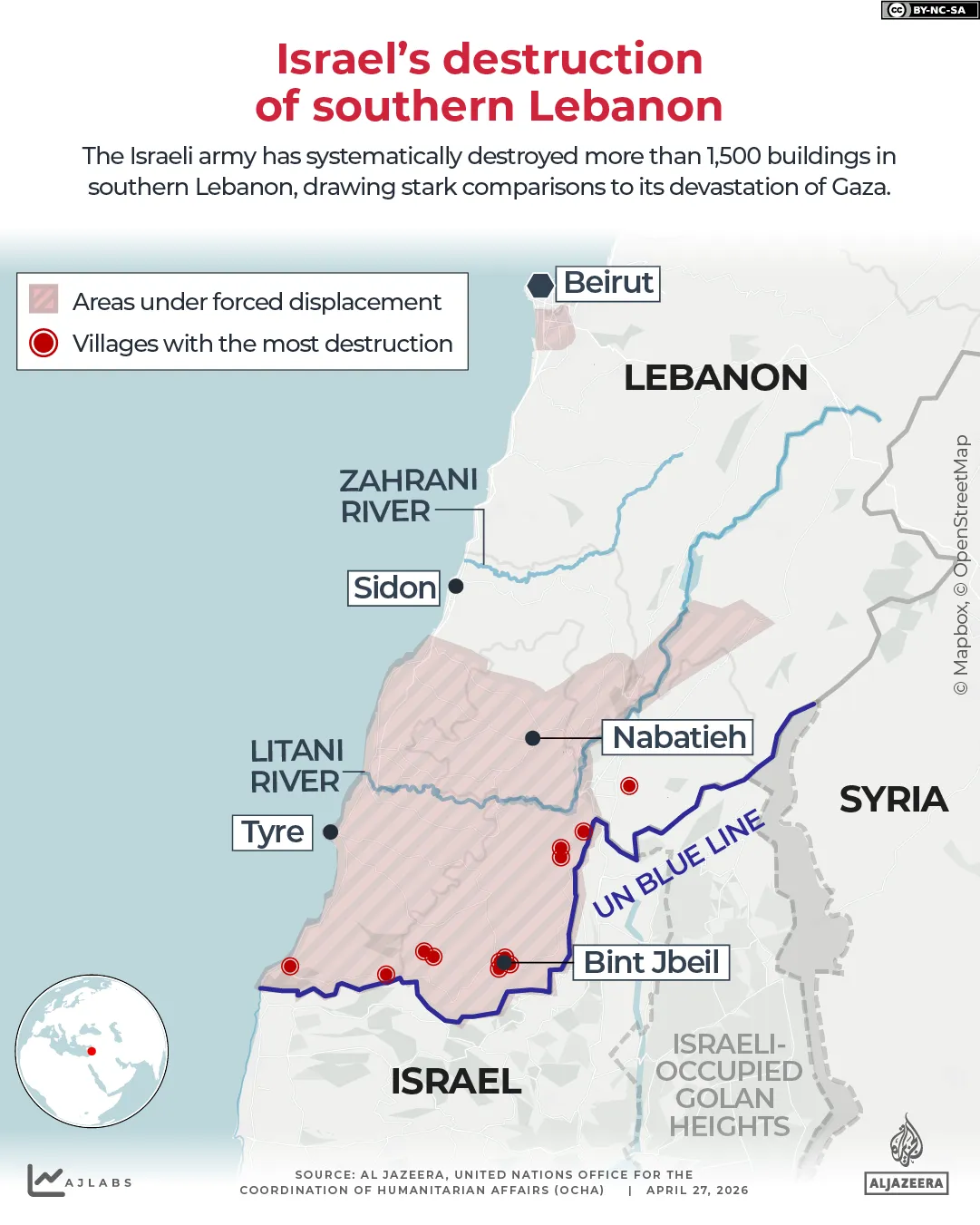
  • Rising toll: Israeli strikes have killed at least 2,167 and injured more than 7,000 people, according to the Lebanese Health Ministry. About 1.2 million people have been displaced since March 2. Israel has been accused of destroying homes in southern Lebanon, as happened in Gaza.
  • ‘Homes that no longer exist’: “Even if a ceasefire is reached, the reality on the ground is devastating.. entire communities along the border have been destroyed,” Al Jazeera’s Malcolm Webb reported from Beirut. He added that Israel has yet to secure its objective of controlling territory up to the Litani River.
  • Balakrishnan Rajagopal, the UN special rapporteur on the right to housing, has joined other UN human rights experts, calling for Israel to immediately stop its bombing of Lebanon. Rajagopal wrote on social media that the Israeli military is using the “same strategy” in southern Lebanon as in Gaza or the occupied West Bank.
  • Diplomatic tensions grow: Hezbollah has condemned US-hosted Israel-Lebanon talks as “shameful,” while a failed Senate vote to block bulldozer sales to Israel highlights increasing concern over civilian harm.
An armoured Israeli military vehicle operates inside Israel, near the Israel-Lebanon border
An armoured Israeli military vehicle near the Lebanon border [Florion Goga/Reuters]

Global economy

  • Growing hunger fears: The war could push millions more towards hunger as its economic fallout reverberates around the globe, the World Bank’s chief economist told AFP.
  • “You have about 300 million people who suffer from acute food insecurity already,” Indermit Gill said.  “That’ll go up by about 20 percent very, very quickly,” as knock-on effects grow.
  • Wall Street records: Major Wall Street stock indices finished at record highs on Wednesday following optimism about an accord in the US-Iran conflict.

Source link