SACRAMENTO — As Democratic leaders in California challenge President Trump’s latest effort to restrict the use of mail-in ballots, they also must grapple with a troubling development in the last election.
A significant number of mail-in ballots arrived too late to be counted in the Nov. 4 special election for Proposition 50, Gov. Gavin Newsom’s successful measure to reconfigure the state’s congressional districts, according to state data.
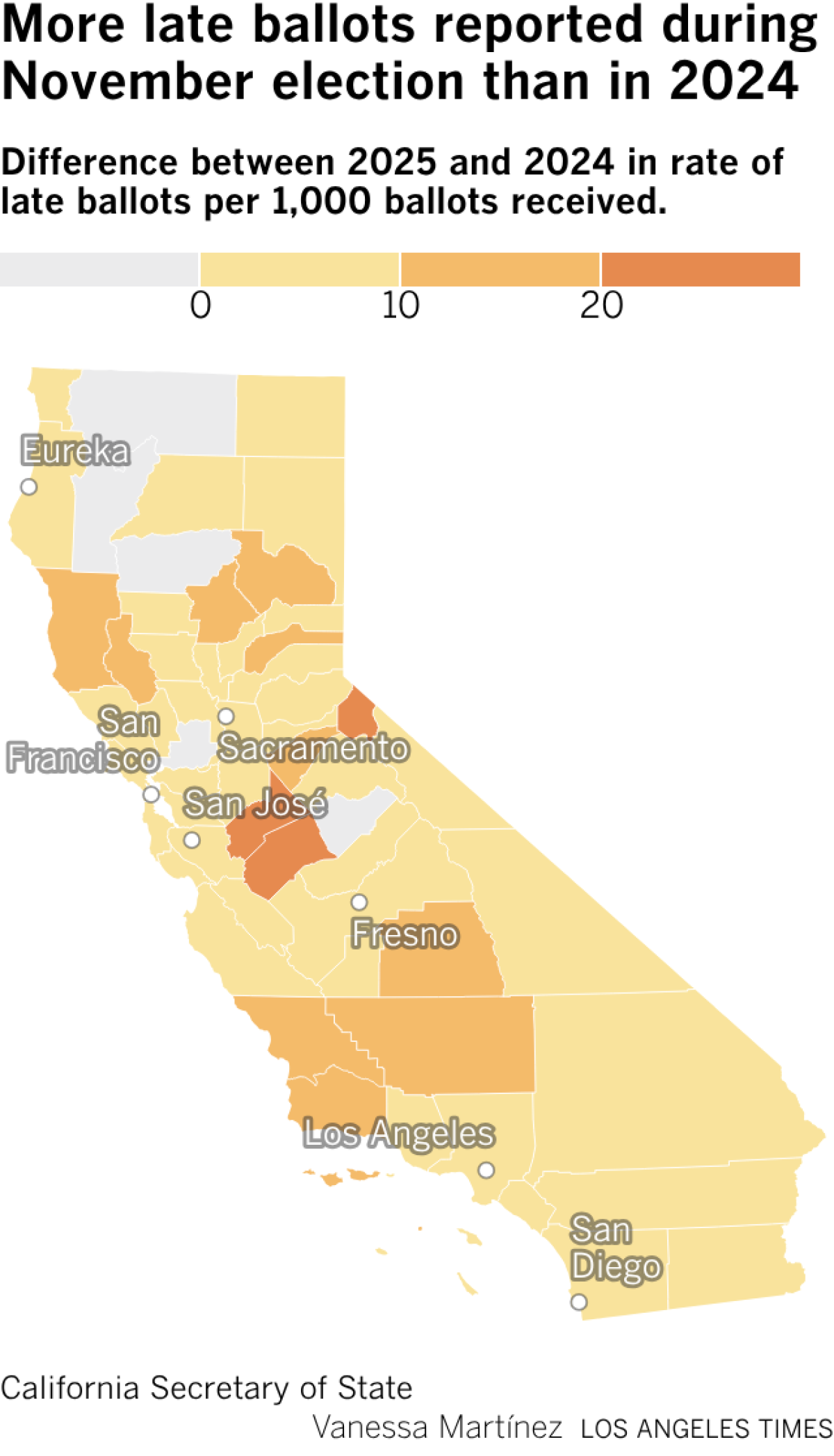
Ballots came in late at an average rate four times higher than that of the 2024 election, with rural counties seeing some of the biggest increases, according to a Times review.
“Something changed,” said Melvin E. Levey, who heads the Merced County Registrar of Voters. “We don’t like seeing late ballots and if someone has made the effort to vote, we want to count it.”
Merced saw almost a sevenfold increase in late-arriving mail ballots in the November election compared with the year before.
Vote-by-mail ballots are considered late if they are not postmarked on or ahead of election day or do not arrive within seven days of election day.
The issue appears to be linked to the U.S. Postal Service, which last year reduced the number of trips to pick up mail at post offices in mostly rural areas. Election officials warned before Nov. 4 that the Postal Service changes could delay the postmarking of ballots and lead to votes not being counted.
During the Nov. 4 election in California, an average of 8 out of every 1,000 vote-by-mail ballots were rejected by counties because they arrived too late, according to Secretary of State data. In the 2024 general election, which included the presidential race, an average of 2 of every 1,000 vote-by-mail ballots were rejected for being late.
In Kern County, for example, 3,303 mail-in ballots — or 1.95% of returned mail-in ballots — were not counted in the 2025 special election because they arrived too late. In 2024, that number was 332 — or 0.14%. And in Riverside County, 5,831 ballots — or 0.95% of those mailed in — were deemed too late to count, more than double the number of late ballots rejected in 2024.
Postal Service spokesperson Cathy Purcell recommended that voters mail their ballot a week in advance of when it must be received by election officials to ensure it arrives on time.
“You should never be mailing your ballot on election day,” Purcell told The Times.
Before last’s year’s special election, California Secretary of State Shirley Weber issued a similar warning about the delays. Anyone dropping off their ballot at a post office on election day should get it postmarked at the counter, she said.
“We don’t want anyone to just toss it into the mailbox as we have been able to do in the past and have it counted,” she said. “The Postal Service has said that they may not be counted in certain areas.”
California voter data expert Paul Mitchell expressed astonishment about the Postal Service’s guidance.
“We’ve had six, eight years of elections where people were feeling confident about mailing in their ballot,” said Mitchell, vice president of the voter data firm Political Data Inc. “Now the USPS is saying they have to mail it in a week early.”
“That is a dramatic change that can disenfranchise voters who are just following the same pattern that they’ve used in prior elections,” he added.
Democrats have been defending the vote-by-mail system in the face of Republican attacks. Trump recently signed an executive order to impose federal restrictions on mail-in ballots and, without evidence, has long criticized mail-in ballots as a source of fraud and a factor in his 2020 election loss to Joe Biden.
The Nov. 4 special election on Proposition 50 was the Democrats’ attempt to counter Trump’s push for Republican-led states, most notably Texas, to redraw their electoral maps to keep Democrats from gaining control of the U.S. House of Representatives in the 2026 midterms and upending his agenda. The ballot measure overwhelmingly passed.
Nearly 89% of votes in the Nov. 4 election were vote-by-mail ballots, according to Weber’s office. In addition to Proposition 50, tax measures were also on the ballots in some counties.
Postal Service changes
About a month before the Nov. 4 election, Weber and Atty. Gen. Rob Bonta held a news conference to encourage California voters to vote early because of service changes at the U.S. Postal Service.
Bonta told reporters that voters living 50 or more miles from six large mail processing centers in urban areas who mailed their ballots on election day would not have those ballots postmarked in time. The centers are in Los Angeles, Bell Gardens, San Diego, Santa Clarita, Richmond and West Sacramento, according to Bonta’s office.
The changes at the U.S. Postal Service are part of a 10-year plan that kicked off several years ago aimed at improving services and reducing costs at the independent federal agency.
In the 17 counties that are mostly or entirely within the 50-mile distance from the mail facilities, the average rate of late ballots doubled in the November 2025 election compared with the election the year before — from 2.5 per 1,000 ballots received in 2024 to 5.6 per 1,000 in 2025.
But in counties that are entirely or mostly outside of the 50-mile radius, the average rate of late ballots quadrupled — from 2 per 1,000 ballots received in 2024 to 9.3 per 1,000 in 2025, state election records show.
Similar complaints about late ballots because of the mail changes have been reported in other states, including in Snohomish County, Wash., according to the New York Times.
The U.S. Postal Services told the Times that there are “any number of factors” that may affect the timeliness of mail.
“The Postal Service has successfully delivered America’s election mail, and we are confident that we will do so again this year,” spokesperson Nikolaj Hagen said. “We rely on long-standing, robust and tested policies and procedures, which have proven successful in the secure and timely delivery of election mail.”
Hagen added that “adjustments to our transportation operations will result in some mailpieces not arriving at our originating processing facilities on the same day that they are mailed.”
Postmarks are generally applied at those processing facilities, Hagen said, so the postmark date may not reflect the date the mail was collected by a letter carrier, dropped off at a retail location, or placed in a collection box.
While the U.S. Postal Service uses postmarking as an internal tool to track the place and date the mail was accepted, outside entities also use the postmarks for their own purposes, including the Internal Revenue Service, which requires federal tax returns to be mailed by April 15.
Several U.S. senators, including Sen. Alex Padilla (D-Calif.), sent a letter in January to USPS Postmaster Gen. Dave Steiner warning that changes to postmarking will make it more difficult for people, particularly those in rural areas, to vote by mail and pay tax bills on time.
On Tuesday, Trump signed an executive order that seeks to put new federal controls on voting by mail in states, repeating his long-held but unsubstantiated claim that mail-in ballots are a source of widespread fraud in U.S. elections.
The order directs the U.S. Postal Service to take control of mail balloting by designing new envelopes with special bar codes that will allow the federal government to ensure that such ballots go out only to eligible voters.
States must follow the USPS process if they plan to use the federal mail system for sending or receiving ballots. They also must submit to the USPS lists of eligible voters in advance of such ballots passing through the mail system.
Separately, the Republican National Committee is challenging a Mississippi law that allows ballots that arrive up to five days after election day to be accepted and counted. The case was argued before the conservative-leaning U.S. Supreme Court in March.
Times staff reporter Kevin Rector contributed to this report.
UN experts say Israel ’emboldened by impunity’ for previous journalist killings in Lebanon, Gaza and the West Bank.
Published On 2 Apr 20262 Apr 2026
Three United Nations experts have called for an independent and thorough investigation into Israel’s recent killing of three journalists in Lebanon, denouncing the deadly incident as “another egregious attack on press freedom by Israeli forces”.
UN special rapporteurs Irene Khan, Morris Tidball-Binz and Ben Saul on Thursday noted that “journalists carrying out their professional duties in armed conflict are civilians and must not be targeted or made the object of attack”.
Recommended Stories
list of 3 itemsend of list
“The deliberate killing of journalists not directly participating in hostilities constitutes a serious violation of international human rights and humanitarian law and a war crime,” they said in a statement.
The Israeli military killed Al Mayadeen journalist Fatima Ftouni, her brother, freelance photojournalist Mohamad Ftouni, and Al-Manar’s Ali Shoaib in a targeted strike on their car in southern Lebanon on March 28.
Al Mayadeen and Al-Manar are pro-Hezbollah media outlets, and Israel accused Shoaib – without presenting any evidence – of being a fighter with the Lebanese armed group.
That claim was rejected by Shoaib’s colleagues as well as by the UN experts, who on Thursday also stressed that working for media outlets affiliated with an armed group does not mean journalists are directly participating in hostilities under international law.
“Israeli officials know this, yet they choose to ignore it – emboldened by impunity for their previous killings of journalists in Lebanon, Gaza and the West Bank,” they said.
In February, the Committee to Protect Journalists (CPJ) reported that Israel was responsible for two-thirds of all killings of journalists in 2024 and 2025.
More than 60 percent of the 86 members of the press killed by Israeli fire last year were Palestinian journalists reporting from the Gaza Strip amid Israel’s genocidal war in the coastal enclave, the advocacy group found.
After the killings in southern Lebanon last week, CPJ’s Middle East director Sara Qudah also warned that Lebanon is becoming “an increasingly deadly zone for journalists, despite their status as civilians who must not be targeted”.
“We have seen a disturbing pattern in this war and in the decades prior of Israel accusing journalists of being active combatants and terrorists without providing credible evidence,” Qudah said in a statement.
“Journalists are not legitimate targets, regardless of the outlet they work for.”
The UN experts also warned that Israel’s killing of Lebanese journalists is part of “an abominable push … to silence reporting on Israel’s current military action in Lebanon, and shut down news coverage of war crimes committed, just as it did in Gaza”.
At least 1,345 people have been killed and 4,040 wounded in intensified Israeli attacks across Lebanon since early March, according to the Lebanese Ministry of Health.
WASHINGTON — President Trump is threatening to deploy ground troops to seize critical oil infrastructure on Iran’s Kharg Island, a military gambit that experts say would risk American lives and could still fail to end the war.
If Trump wants to hobble Iran’s oil industry for leverage in negotiations, a better option might be setting up a blockade at sea against ships that have filled up at Kharg Island’s oil terminals, the experts said.
The island — located on the other side of the Persian Gulf from U.S. bases in Kuwait and Saudi Arabia — is the beating heart of Iran’s oil industry, through which 90% of its exports pass. It is important because Iran’s coastline is mostly too shallow for tanker ships to dock.
“Putting people on the ground might be the most psychologically compelling way of striking a blow at Iran,” said Michael Eisenstadt, a former U.S. military analyst who now directs the Military and Security Studies Program at the Washington Institute for Near East Policy.
“On the other hand, you’re putting your own troops at jeopardy,” said Eisenstadt, a retired Army reserve officer who served in Iraq. “It’s not far from the mainland. So they can potentially rain a lot of destruction on the island, if they’re willing to inflict damage on their own infrastructure.”
Seizing Kharg Island could escalate the conflict, said Danny Citrinowicz, an Iran expert at Israel’s Institute for National Security Studies.
He said Iran and its proxies — including Yemen’s Houthi rebels — could intensify their retaliation, including by laying mines in the Strait of Hormuz or striking targets with drones across the Arabian Peninsula, from the Persian Gulf to the Red Sea.
Commodities researchers and investment banks warn major retaliation could have lasting implications for energy prices and the global economy.
“It will be hard to take. It will be hard to hold,” Citrinowicz said of Kharg Island. “And it might damage the economy, but not in a way that will force the Iranians to capitulate.”
Trump says ‘maybe we take Kharg Island’
Trump is under growing pressure to end the monthlong conflict with Iran, which has attacked U.S. bases and allies in the region.
Iran also has largely closed the Strait of Hormuz, a narrow chokepoint through which 20% of the world’s oil normally flows, causing fuel prices to soar and other economic tumult.
Trump said in a social media post Monday that “great progress is being made” in talks with Iran to end military operations. But he said that if a deal is not reached “shortly” and the strait is not immediately reopened, the U.S. would obliterate power plants, oil wells, Kharg Island and possibly even desalination plants.
Trump has raised the idea of American forces seizing Kharg Island.
“Maybe we take Kharg Island, maybe we don’t. We have a lot of options,” Trump told the Financial Times. “It would also mean we had to be there (on Kharg Island) for a while.”
Asked about Iranian defenses there, he said: “I don’t think they have any defense. We could take it very easily.”
Secretary of State Marco Rubio said Friday that ground troops would not be needed to achieve the Trump administration’s goals. He did not repeat that assertion Monday after being asked about plans for U.S. ground troops, saying “the president has several options at his disposal” but diplomacy is Trump’s preference.
“Now, they are making threats about controlling the Hormuz Strait in perpetuity, creating a tolling system and the like,” Rubio told ABC’s “Good Morning America.” “That’s not going to be allowed to happen. And the president has a number of options available to him, if he so chooses, to prevent that from happening.”
U.S. has hit targets on the island crucial to Iran
The U.S. has already struck various targets on the island, including air defenses, a radar site, the airport and a hovercraft base, according to satellite analysis by the Institute for the Study of War and American Enterprise Institute’s Critical Threats Project.
Petras Katinas, an energy researcher at the Royal United Services Institute, said disrupting Kharg Island would not completely halt oil exports as Iran has other small ports. But it would reduce the oil revenue flowing to Iran’s government, “forcing flows through a much smaller, costlier and less efficient export system,” he said.
However, Tehran has too much at stake to surrender over a single asset, no matter how economically significant, said Citrinowicz, the Iran expert at Israel’s Institute for National Security Studies.
While occupying Kharg might offer Washington some leverage in any negotiations, he said the notion that control of the island could be traded for Iran’s stockpile of enriched uranium was far-fetched.
“It’s in no way a decisive blow,” Citrinowicz said.
U.S. troops face risk from Iran’s mainland if they tried to seize Kharg Island
A U.S. Navy ship carrying about 2,500 Marines recently arrived in the Middle East, while at least 1,000 troops from the 82nd Airborne Division are expected soon. Another 2,500 Marines are being deployed from California. The Trump administration has not said what all those troops will be doing, but the 82nd Airborne is trained to parachute into hostile or contested territory to secure key territory and airfields.
One of the reasons American troops would be vulnerable on Kharg Island is its close proximity — about 33 kilometers (21 miles) — to the Iranian mainland, from which missiles, drones and artillery could be fired. Despite continued U.S. and Israeli strikes, the Islamic Republic is still attacking targets across the region, including a Saudi air base hundreds of miles away where more than two dozen American troops were injured last week.
Even with American ships and planes providing support, there would still be a relatively short window of time to shoot down every drone or missile launched from the mainland at the island, Eisenstadt said.
“The coast tends to be mountainous, so the drones can come in through mountain passes where it’s hard for our radar to pick up,” he said. “And we don’t have the warning time.”
Eisenstadt says a sea blockade against ships carrying Iranian oil would be a safer strategy and achieve the same goal of controlling most of Iran’s oil industry.
“Throw up a quarantine that seeks to seize Iranian oil shipments that are exiting the Gulf,” agreed Clayton Seigle, an energy security expert at the Center for Strategic and International Studies. It could be done at a distance “outside the range of the lion’s share of Iran’s weapon systems.”
Seigle argued against destroying Kharg Island’s oil infrastructure, which Trump also suggested.
“We were supposed to be coming to the rescue of the people that had been rising up and protesting for a better future,” Seigle said. “So to cripple Iran’s revenue-generating potential for many years to come would definitely not work in that direction.”
Finley and Metz write for the Associated Press. Metz reported from Ramallah, West Bank.
We’re headed to the 25th edition of the festival, which returns to the Empire Polo Club in Indio on April 10-12 and April 17-19 with Sabrina Carpenter, Justin Bieber,Karol G at the top of the bill.
Our crew heading to the desert has literally decades of experience covering the festival, giving us unique insight into one of the world’s most famous music festivals.
So tell us — what do you want to know about Coachella? And what do you want to see from our live coverage in the field?
Are you heading to Indio or celebrating Couch-ella (and its more affordable beverage options) at home? Do you have tried-and-true tips you tell anyone when Coachella comes up in conversation? We want to know about them.
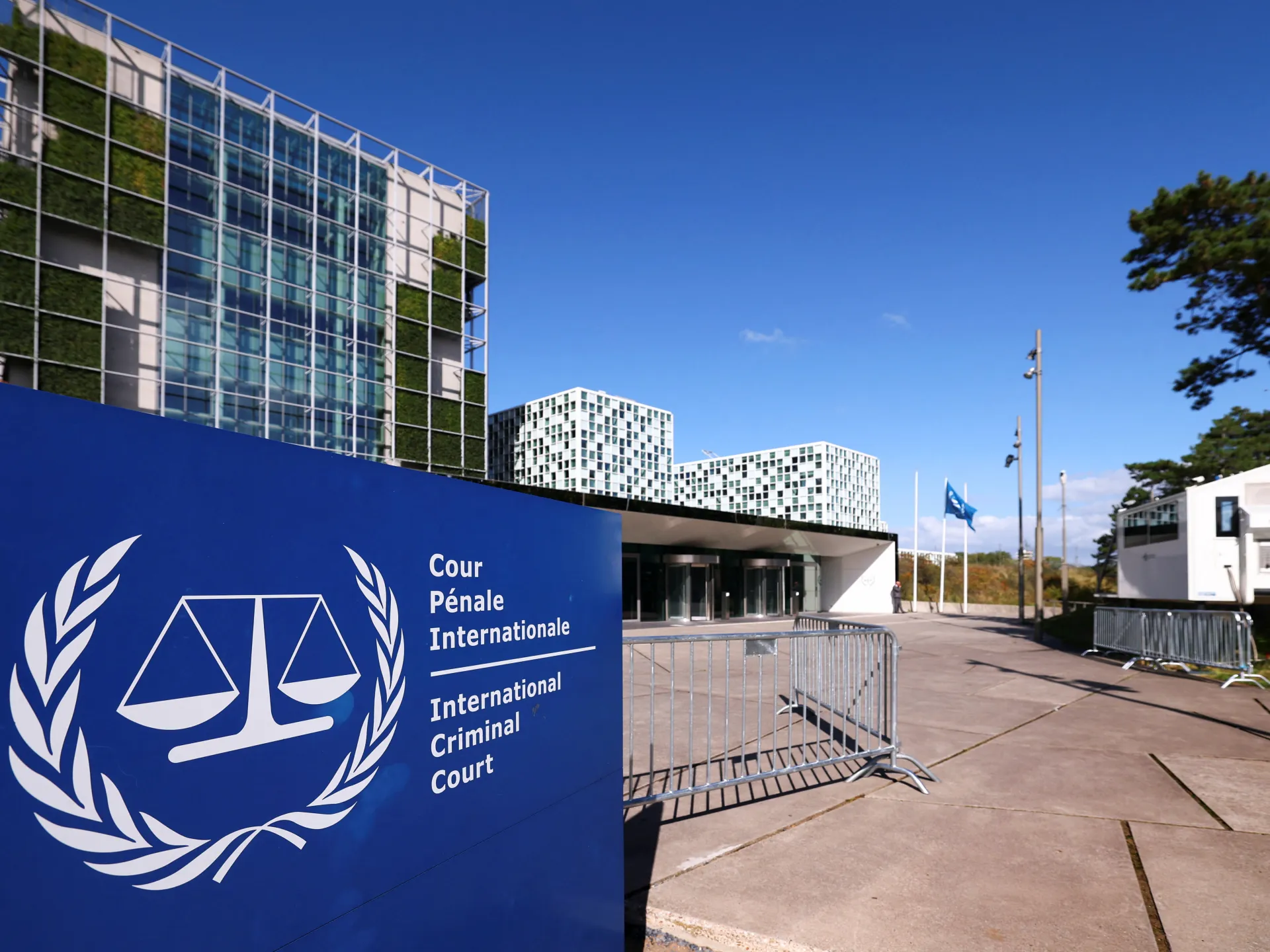
One week ago, several outlets reported on a consequential development in the disciplinary case regarding the alleged sexual misconduct by the International Criminal Court (ICC) prosecutor, Karim Khan. In a confidential report addressed to the Bureau of the Assembly of States Parties (ASP), the judicial experts tasked with assessing the United Nations probe’s factual findings unanimously concluded that no misconduct or breach of duty by Khan could be established under the legal framework.
It is now for the 21 ICC states represented on the bureau to decide whether to uphold or depart from the panel’s legal conclusion. If the bureau were to find misconduct of a less serious nature, it could impose sanctions on Khan. A finding of serious misconduct would lead to a plenary ASP vote on the possible removal.
A minority of bureau members have reportedly been pushing for the judicial experts’ report to be set aside and for the bureau to substitute its own conclusions for those of the panel. This would be a precarious step. We are concerned that it would undermine the quality of subsequent decisions in Khan’s case and seriously damage the integrity of the ICC’s governance framework. It would also raise serious questions about the state parties’ credibility and their commitment to the rule of law in governing the court.
This position is consistent with our unequivocal belief that there must be zero tolerance for sexual and other forms of workplace abuse in any organisation — public or private — especially those dedicated to international justice and the fight against impunity for the most serious crimes, and that accountability for any such abuse is non-negotiable.
At the same time, particularly in politically sensitive cases, strict adherence to due process, the highest standards of decision-making, and the rule of law is of paramount importance to prevent ill-founded decisions, political interference, and abuse of power. These convictions are not in tension. For us, the ends do not justify the means.
It is true that the bureau is not legally bound by the panel’s conclusions: the experts performed an advisory function, and their report is not formally binding. Their mandate was to assist the bureau in reaching a credible and well-founded decision on the legal assessment of the factual findings reached in the UN investigative report.
The question before the panel was strictly legal. It was to give a legal characterisation of facts established by UN investigators. Factual findings are distinct from the allegations or the evidence on which they are based, and, as far as can be judged from media reports, the panel did not cross that line.
Diplomats should refrain from assuming the role of judicial experts at this stage, particularly now that such judicial expert advice has been issued. As a political body, the bureau initially recognised that it was not well-placed to make this legal determination on its own — understandably so, given the risks of politicisation of the process and the diminished credibility of any outcome. It mandated a nonpolitical, quasi-judicial body — a panel of judicial experts with relevant subject-matter expertise and experience — to carry out that assessment. This was a sound decision.
The integrity of the court and of the Rome Statute system is at stake as never before. Given the seriousness and complexity of this matter, it was appropriate that the legal assessment be entrusted to an independent and impartial body of judicial experts. In politically charged contexts, such bodies are best placed to assist political decision-makers in reaching conclusions that are both well-founded and credible – and, as much as possible, insulated from political influence.
This is precisely what the bureau set out to achieve. It developed a novel procedure to be applied to this case and itself chose and appointed the judicial experts. As revealed by The New York Times, the panel was composed of three highly regarded senior judges with impeccable track records and experience serving on the highest national and international courts. Tasked with the legal analysis of the UN investigators’ factual findings, it did the job it was meant to do – where such findings had been made.
But now that the process has run its course and the panel has reached its conclusions after three months of intensive work, some states and rights advocates are ready to ignore them because they disagree with the result. Why pursue a quasi-judicial process in the first place if its outcome can so readily be dismissed?
We are convinced that, given the current stage and the nature of the process that was adopted to get there, the panel’s report should be accorded due deference by the bureau and taken seriously, not dismissed lightly, by ICC states. Should states substitute their own conclusions, however, the outcome would be even more problematic than if no panel had been established in the first place.
Disregarding the report will create the impression that the panel was only needed to assist states in reaching one specific conclusion. Can the impression be avoided then that the judicial expert panel’s report has lost all value in the eyes of assembly officials and bureau states, who had devised and supported this process, once its conclusions proved unwelcome? The spectre of a show trial looms large.
Furthermore, if states disagree with the panel, one must ask: based on what factual findings and based on whose legal analysis? The bureau would need a very solid foundation to depart from the judicial experts’ conclusions. But it can realistically neither conduct a follow-up investigation to collect additional evidence and analysis of facts to resolve the remaining uncertainties, nor engage in their legal consideration de novo.
In our view, dismissing the judicial expert report and substituting the bureau’s own judgement would be deleterious to the rule of law, due process, and the integrity of the legal determination as to the existence or otherwise of misconduct by Prosecutor Khan. It would also undermine the authority of the judicial panel mechanism now codified in the ICC rules for any such situations in the future.
Political decision-making should not be allowed to replace and displace a legal assessment carried out in accordance with the highest standards of judicial competence, independence and impartiality, which the political body itself insisted on upholding.
The implication that legal form was used merely as a cover for arbitrary power would be hard to escape. We fear that this would plunge the ICC system deeper into an already existing crisis, without offering the relief some may hope for. The ICC states know full well that this is a cost they cannot afford, particularly at this juncture.
The views expressed in this article are the authors’ own and do not necessarily reflect Al Jazeera’s editorial stance.
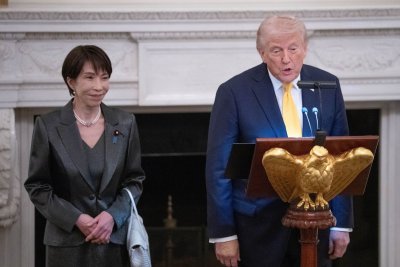
President Donald Trump (R) makes remarks as he stands with Prime Minster Sanae Takaichi of Japan during a dinner in the State Dining Room of the White House in Washington, DC, on Thursday, March 19, 2026. Earlier in the day, the President and Takeuchi exchanged views on Iran, energy, and issues in the Indo-Pacific region. Photo by Aaron Schwartz/UPI | License Photo
March 22 (Asia Today) — South Korea should maintain “strategic ambiguity” in responding to U.S. pressure over the Middle East crisis, experts said, as tensions surrounding Iran and the Strait of Hormuz intensify.
The call comes after Donald Trump urged allies including South Korea, Japan and European partners to play a greater role following U.S. and Israeli strikes on Iran, raising concerns in Seoul about balancing its alliance with Washington and broader diplomatic interests.
South Korean officials said they are taking a cautious approach and have not received formal requests from the United States regarding potential military deployment to the Strait of Hormuz.
The government is focusing on assessing the intent behind Trump’s remarks while weighing the risks of deeper involvement in the region.
The Strait of Hormuz, a critical global energy shipping route, has long been vulnerable to disruption. Analysts say any effort to secure maritime traffic would likely require multinational coordination rather than unilateral action.
Foreign ministers from the Group of Seven nations recently condemned Iran’s attacks on civilian infrastructure and said they are prepared to take steps to support global energy supplies, though the timing of any direct action remains unclear.
A Foreign Ministry official said stability in Middle Eastern shipping lanes is vital for South Korea and other major economies, noting that ensuring safe passage is a challenge that cannot be addressed by a single country.
Experts pointed to Japan’s approach under Sanae Takaichi as a potential model. Tokyo has prioritized its alliance with the United States while limiting direct military involvement, balancing energy security, international law and domestic public opinion.
Lee Ki-tae, a senior researcher at the Sejong Institute, said South Korea should similarly avoid automatic military intervention and instead preserve flexibility.
“Maintaining strategic ambiguity allows South Korea to uphold its alliance while avoiding immediate alignment with any one side,” he said.
Park Won-gon, a professor at Ewha Womans University, said logistical and political constraints also support a cautious stance. He noted that deploying naval forces would require parliamentary approval, a process that could take about two months.
He added that evolving and sometimes inconsistent messaging from Washington further underscores the need for careful deliberation.
THE Sun’s travel team are sharing the holiday destinations they’ll be heading to this summer to help you find the best deals to get away for less.
To do this, we have rounded up our absolute favourite spots for summer 2026, including family-friendly holiday parks, sunny Spanish resorts and the very best in cruises.
Bodrum in Turkey offers luxury-feel beach holidays for affordable pricesCredit: Getty
Whether you’re hunting for a cheap UK break or a dreamy island retreat, we’ve got your travel inspiration for 2026 sorted.
From Skegness to Seoul, here’s where the Sun Travel team recommend – and are actually heading to – as the weather hots up.
Caroline McGuire, Head of Travel – Digital
UK holiday – Butlin’s, Skegness
I am ashamed to say that in my nine years as a travel editor at The Sun, I’ve not yet made it to Butlin’s.
Well, not after this summer. I’m heading to their Skegness resort with a school mum and our kids, in the seaside holiday park’s 90th birthday year.
I’m not sure who is more excited – the adults or the kids.
My parents were camping-in-France-type people, so I never did any of the UK holiday parks growing up.
But now I have a kid of my own, the idea of free fairground rides, water slides and TV-quality evening entertainment is deeply appealing.
I’m particularly looking forward to the Masked Singer Live, and my son is very excited about the Maximum Pro Wrestling.
Plus, we’ve got the all-inclusive drinks package, which means we can sip on a cold wine and natter while the children tire themselves out with all the activities.
Given we’ve got the dining package too, it’ll be interesting to see quite how much we can see, do and eat in a 3-night break, without spending any extra money.
They’ve got 3-night breaks in May half term from £188 and the school summer holidays from £207.
Butlin’s in Skegness is an affordable option for the summer holidays, with breaks from £207Credit: Butlins SkegnessUK holiday park Butlin’s will be celebrating its 75th birthday in 2026Credit: Butlins Skegness
Medium haul break – Bodrum, Turkey
I’ve managed to visit a new part of Turkey each year since Covid ended, ranging from Istanbul and Izmir to the Turquoise Coast, and this year I’m ticking Bodrum off the list.
Turkey is one of my favourite countries to visit with my seven-year-old.
For a start, the food is so kid-friendly that eating out is a dream. Halloumi, olives, flatbreads, hummus, baklava… what’s not to love?
Plus, they’ve really nailed the all-inclusive hotel experience.
This year, we’re staying at the Titanic Luxury Collection Bodrum – a five-star property on the Pina Peninsula with 11 restaurants and its own white-sand beach.
Week-long, all-inclusive stays at this five-star resort start from £910pp with On the Beach.
Short haul break – Eurocamp: Les Prairies De La Mer Resort, France
Kate Moss, Elton John, Beyonce and Leonardo DiCaprio all love St Tropez, and it’s about to become even better-known soon, as the next White Lotus TV show is being filmed there.
But just 15 minutes down the road is Les Prairies De La Mer Resort – one of Eurocamp’s top holiday parks that they rate as five stars.
But when we fancy a bit of the A-List lifestyle, it’s super easy and cheap to get to either St Tropez or St Maxime
Forget Club 55 and superyachts, here it’s all about the park’s own beachfront cafe, mini golf and the two pools.
Oh, and an early morning walk to the on-site supermarket for freshly baked croissants.
But when we fancy a bit of the A-List lifestyle, it’s super easy and cheap to get to either St Tropez or St Maxime.
They’ve got 7-night breaks in May half term from £1,707 and school summer holidays from £2,349.
Alice Penwill, Travel Reporter
British seaside – Suffolk, UK
As much as I love going abroad, sometimes you can’t beat a British summer.
I’ll be visiting Suffolk later this year to explore its seaside towns and hopefully enjoy some sunshine along the way too.
I’ll head to Aldeburgh first to see its colourful homes and stretching shingle beach.
I’ll try a Noon Tart too – it’s a local delicacy, essentially it’s a savoury pastry made from smoked haddock, smoked cheddar cheese, cream, eggs, and mustard in a flaky pastry.
Half an hour away from Aldeburgh is Framlingham Castle, which was Ed Sheeran’s inspiration for his song ‘Castle on the Hill’.
Neighbouring seaside towns include Thopeness and I might even stop by my favourite place along the Suffolk coast, Southwold.
I’ve been going to Southwold for years, playing games at the arcades, crabbing off the pier and popping into its independent shops along the high street.
I’ll be staying at The Brudenell Hotel, which sits on the seafront of Aldeburgh, and offers rooms from £137 per night.
Aldeburgh in Suffolk is home to grand pastel houses and a stretch of pebbled beachCredit: Alamy
Short haul sunshine – Menorca, Spain
Lots of Brits head to the Spanish islands during the summer – and I hope to be one of them, although I’m going to one that has fewer crowds.
The island of Menorca, next to the well-known Majorca, welcomes much fewer tourists each year, making it an ideal place to relax – it’s even been called “Ibiza’s chilled-out sister”.
It’s easy to navigate too, as it’s much smaller, so it has short airport transfers, and is generally cheaper.
I’ve got my eye on Cala Macarella, a beach on the south of the island with white cliffs and turquoise waters.
Another spot that I’ve been told about is Cova d’en Xoroi, which is a bar that’s built into caves on the cliffs.
During the day, it’s a chilled bar, and in the evening, it holds sunset sessions with live music.
To make it easier, the likes of TUI and Jet2 organise package holidays.
You can book a 7-night room-only break at Menorca’s Colina Village from £262.26pp with TUI.
The Spanish island of Menorca has been dubbed “Ibiza’s chilled-out sister”Credit: Alamy
English adventure – Jurassic Coast, UK
In my 28 years of living in the UK, I’ve never taken a stroll along the Jurassic Coast, which is why I intend to head there this summer for a weekend away (at least).
Chesil Beach near Weymouth is the longest in the UK, stretching for 18 miles from West Bay to the Isle of Portland.
And I hope to walk the beach and stop by The Cove House Inn on the north of the Isle of Portland, which was named as one of the best beachside boozers last year by Big 7 Travel.
Lots of visitors compliment the views from the pub, which sits on the promenade, and some have even spotted dolphins and whales in the water there too.
Of course, the famous Durdle Door is another stop high up on my list, as is Kimmeridge Bay.
Premier Inn’s Weymouth hotel offers spacious, comfy rooms from just £57 per night.
Chesil Beach is the UK’s longest, stretching for over 18 miles along the Jurassic CoastCredit: Alamy
Lisa Minot – Head of Travel
Short haul success – Malaga, Spain
I’m heading to the southern Spanish gem of Malaga in early June for a long weekend.
The city ticks all the boxes when it comes to an easy-to-reach, reliably sunny destination that can combine a quick cultural hit with fabulous food and a captivating coastline.
And travelling in early June, hopefully, will mean fewer crowds while still benefiting from warm sunshine.
I’ll be ticking off big hitters like the Picasso Museum and the 11th-century Alcazaba palace, but also on the agenda will be some serious relaxation.
I’m staying 20 minutes from the city centre at the Higueron Hotel, Curio Collection by Hilton, set between the Mediterranean and the Mijas mountains.
Its rooftop pool and terraces will be perfect for sunbathing and cocktail sipping, and there’s a spa and superb sports facilities for some proper me-time too.
The glamorous hotel offers breaks from £184 per night, but its budget-friendly little sister, the Hilton Garden Inn Malaga, also makes for a fantastic stay from £95 per night.
The Sun’s Head of Travel Lisa Minot is choosing to spend a long weekend in sunny MalagaCredit: Alamy
French fancy – Bormes Les Mimosas, Cote d’Azur
It will come as no surprise to those who know me that, yet again, my priority this summer will be spending time with family and friends at my own caravan in the South of France.
I’ve visited Camp du Domaine in Bormes les Mimosas almost every year for the last 50 years, and this summer will be no different.
The site tumbles down pine-clad hills to its own gorgeous sandy beach, and days will be spent relaxing on those soft sands, swimming in the warm waters and cooking up a storm with the purchases bought in local markets, from fresh fish to ripe Provencale tomatoes and of course, the odd rose!
Set between Toulon and St Tropez, it’s a great site for those who have their own van or camper, but there are bungalows for rent too.
Another good bet nearby is the Eurocamp sites in Grimaldi and Frejus.
A basic pitch at Camp du Domaine starts from £28.50 per night, with options for one-bedroom bungalows starting from £60 per night. See campdudomaine.com.
The Sun’s Head of Travel Lisa Minot visits Bormes Les Mimosas every single yearCredit: Alamy
Long haul leave – Seoul, South Korea
I’m making my first trip to the current global capital of cool, Seoul, as Virgin Atlantic launch new direct services.
With all things K-culture from the massive success of K-pop to the likes of Squid Game and BTS, the city promises an irresistible blend of ancient palaces, surprising green spaces and intoxicating 24/7 high-tech culture.
Of course, top of the list will be visiting Olive Young, Korea’s biggest beauty store for skincare essentials.
But I’ll also find time to wander and window-shop in the wealthy neighbourhood of Gangnam, famously mocked in original K-pop star PSY’s signature tune.
And then there’s the exciting food scene – from spicy street food to Korean barbecue, I can’t wait to indulge!
Virgin Atlantic flights to Seoul start from £757 return.
Once you’re in Seoul, there are plenty of budget-friendly accommodation options.
A night at the glitzy Moxy Seoul Insadong starts from £100 per room, whilst backpackers love the H HOSTEL Itaewon (from £23) with its social rooftop bar.
Long-haul airline Virgin Atlantic are launching flights to Seoul, South Korea in 2026Credit: AlamyLes Prairies De La Mer Resort is in Grimaud, France – close to celeb hotspot St TropezCredit: Eurocamp
Jenna Stevens – Travel Reporter
British break – Cley next the Sea, Norfolk
I’m lucky enough to say that heading back home for me is like going on holiday.
North Norfolk is brimming with picturesque seaside towns and quaint fishing villages, so many that I’m yet to set foot in them all, despite growing up there.
This summer I’ll be heading east along the coastline to Cley next the Sea, a charming coastal village known for its seal trips, pretty marshland and its Grade II-listed windmill facing the sea.
Overnight stays are best taken in cosy pubs with rooms, which are abundant in the area
I’m looking forward to getting stuck into harvesting fresh samphire from the shores, then washing off my wellies and heading out to local restaurants to sample the seafood.
Cley is also home to quaint pottery shops and art galleries with work from local artists. Plus, the coastal walking routes are perfect for twitchers who want to spot species like marsh harriers and bitterns.
Overnight stays are best taken in cosy pubs with rooms, which are abundant in the area.
This makes evenings effortlessly easy, as you only have to head upstairs to retire after spending the night sipping Norfolk ales and chatting with locals.
Although if you want something truly special, you can choose to stay inside Cley Windmill itself.
Inside the mill, there’s a unique circular sitting room, decorated with antique furniture and an open fire, plus a dining room dating back to 1713.
Pair this with upper-floor bedrooms looking over the marshes, and you’ve got yourself a truly unforgettable staycation.
B&B stays at Cley Windmill start from £184 per night.
Or if you prefer a more rustic stay, you can go lakeside glamping close to Cley Marshes Visitor Centre from just £40 per night.
Cley next the Sea in Norfolk is ideal for a peaceful UK countryside retreatCredit: Getty
Euro city-break – Barcelona, Spain
Despite being one of Spain’s number one fans, I’ve somehow never made it to buzzy Barcelona.
I’m looking forward to heading there this summer to soak up the coastal city’s high-energy feel, whether its by boat trip, bicycle or bar-hopping.
This year marks Gaudi’s centenary: the anniversary of 100 years since the death of the famous architect.
To celebrate, the streets of Barcelona will be alive with various street celebrations, concerts and exhibitions taking place throughout the year.
Plus, the construction on the Sagrada Familia is set to wrap up in 2026, and with the completion of a spire back in February, the church building officially became the tallest in the world.
To add to the celebrations, Barcelona has been named the World Capital of Architecture this year.
Not only is there the impressive Sagrada Familia to admire, but I’m looking forward to ticking off Casa Milà and Casa Batlló, too.
Throw in some Spanish wine tasting and plans to eat my body weight in jamon and patatas bravas, and it’s fair to say I’m excited to finally experience Barcelona this summer.
City breaks to Barcelona are a very affordable option if you’re looking for a weekend away in Europe. TUI offer a 2-night stay in June at Hotel Acta Voraport hotel from just £266pp, and that’s with return flights included!
Barcelona has been crowned the World Capital of Architecture for 2026Credit: Alamy
Southern Europe scorcher – Quinta do Lago, The Algarve, Portugal
The Algarve has long been a popular destination for Brits seeking sunshine, and I’m excited to head to the sporty resort of Quinta do Lago to catch some rays myself.
If you’re a fan of golfing with gorgeous coastal views, it doesn’t get much better than Quinta do Lago.
The North, South and Laranjal golf courses are renowned for their manicured, championship-grade greens.
In fact, the South golf course at Quinta do Lago has hosted the Portuguese Open no fewer than eight times.
Plus, the sporty adults’ playground offers more than just golf, too.
Whether you’re into pilates, padel or Portuguese cuisine, there’s something for everyone.
I’m very much looking forward to rewarding myself for the workouts with a frozen cocktail and lazing out on the golden sands of Quinta do Lago beach.
A top hotel on the resort that balances stylishness and affordability is The Magnolia Hotel, which offers rooms from £138 per night.
Jenna Stevens, Travel Reporter
Quinta do Lago in the Algarve is a top destination for sports fans and fitness tourismCredit: Quinta do Lago
Cyann Fielding, Travel Reporter
Train trip – Disneyland Paris
A theme park is a great option for a weekend away, and that is exactly what I am planning with Disneyland Paris.
By the end of March, Disneyland Paris will have opened its newest land: World of Frozen.
Now, I may be 25, but nothing excites me more than seeing Olaf come to life, waddling around and making his cute chuckles.
The new land is meant to look just like the Arendelle Kingdom as well, so I am excited to feel as if I am stepping into the movie itself.
One of Disneyland Paris’ biggest appeals is its proximity to the UK and the ease of travel there.
I will take the Eurostar from London St Pancras, which alleviates the stress often felt when travelling through an airport.
By making this trip a weekend break, I don’t have to take any annual leave, so it is a win-win.
You can book a 3-night stay at the Staycity Aparthotels Marne La Vallee from just £229pp on Loveholidays – it’s only seven minutes from the attraction, and it has its own outdoor pool to cool off in, too.
Travel reporter Cyann Fielding is excited to meet Olaf at Disneyland Paris’ World of FrozenCredit: AFP
Atlantic adventure – The Bay Area, California, USA
I’m no newbie when it comes to California, having visited San Francisco twice, Yosemite and Los Angeles.
But I stand by the fact that the American state is one of the most exciting and diverse places to explore.
This summer, I will focus on the Bay Area, which comprises regions bordering San Francisco Bay, San Pablo Bay and Suisun Bay.
The different regions include Alameda, Contra Costa, Marin, Napa, San Mateo, Santa Clara, Solano, Sonoma, and San Francisco.
For this trip, I will focus on Marin — home to one of America’s 10 National Seashores — and Santa Clara, where you will find Silicon Valley and San Jose.
When people think of California, they often imagine LA and San Francisco, perhaps with chic surfer dudes.
However, this trip will focus on exploring the hidden parts of the Bay Area, including the location where George Lucas created Star Wars and Indiana Jones.
You can bag return flights to San Francisco from just £444 on Skyscanner, the cheapest deals are often found flying with SWISS airline.
California’s Bay Area is made of multiple regions including San Francisco and SonomaCredit: Alamy
Scottish summer – Glasgow, Scotland
Over the past few years, I have visited several destinations in Scotland and have to admit, they are to date some of the best places I have travelled to across the entire globe.
Scotland’s landscape is like nowhere else, and its cities are full of fascinating history and architecture.
That’s why this summer I will be heading to Glasgow. I haven’t visited before, so I am super excited to see how it compares to Edinburgh.
Glasgow Cathedral and Botanic Gardens are definitely at the top of my list of places to check out.
What is even better about this trip is that train operator Lumo has just launched a route from London to Glasgow – so no extra luggage costs for me!
Glasgow is full of affordable accommodation options, such as the ever-reliable easyHotel Glasgow City Centre from just £43 per night.
Travel Reporter Cyann Fielding is looking forward to visiting Glasgow this yearCredit: Alamy
Kara Godfrey, Deputy Travel Editor
Medium haul trip – Marrakech, Morocco
Despite being known for its affordable flights, easyJet has recently launched its new Luxury Collection holiday offerings.
So I’ll be trying it out for myself on a trip to Morocco, spending a few days in Marrakech.
I haven’t been to the city since 2018, and even then, it was on a budget, so I am excited to see the fancier side of it with a stay at the famous La Mamounia.
However, that won’t stop me from trying to hunt out a bargain in the souks, in the form of pretty kitchen bowls and candle holders.
And with 3 hr 40-minute flights and 25C weather in April? Sign me up!
You can fly to Marrakech from London from just £19.99 each way with easyJet.
Marrakech is under four hours’ flight from the UK and full of vibrant streets to exploreCredit: Alamy
Long haul adventure – East coast of Thailand
Twenty-one-year-old Kara’s biggest adventure was travelling to Asia, her first stop being a month exploring the popular Thai islands.
I’m as surprised as you are that, 12 years later, I have yet to return to the beautiful country.
So this summer, I have made it my mission to explore the parts that I forgot about as a budget traveller.
This time, I will be heading to the east coast, forgoing Bangkok and Chiang Mai for the nightlife of Pattaya.
Not only that, but my trip will also take me to Koh Chang, right by the Cambodia border.
Said to be less crowded and like going back to Thailand decades ago – I’ll be gorging on £1 Pad Thai and cheap Singha beers.
There’s plenty of luxurious hotels for affordable prices in Thailand, especially in Pattaya. Easy Planet Pattaya offers rooms from just £15 per night!
Deputy Travel Editor Kara Godfrey will explore Thailand’s less-crowded east coastCredit: Getty
Eurotrip – Bilbao, Spain
My love of a Spanish city was only further proven last year, after falling for both Seville and Madrid after spending a long weekend in each.
So this year I’m taking myself to Bilbao for a long weekend.
It is one of the closest Spanish cities to the UK – flights are just 1hr45 – and TUI has recently launched new city break packages too.
Great tapas will be on the menu, with some of the finest in Spain, as well as soaking up some culture at the famous Guggenheim Museum.
You can visit Bilbao with TUI for a 3-night city break staying at the Occidental Bilbao from just £280pp, including return flights.
Kara Godfrey, Deputy Travel Editor
Sophie Swietochowski, Assistant Travel Editor
Holiday at sea – Oceania Allura Cruise
I experienced Oceania’s glamorous Allura when she first debuted in the Med last year.
I loved her sleek cocktail bars and quality restaurants so much that I’m considering returning for a voyage in the coming months – only this time it’ll be for longer.
This summer, the 1,200-passenger vessel will be cruising between the Greek isles, sun-drenched shores of Croatia and bustling port cities in Turkey.
And with the temperatures likely to sizzle in the low 30s, there’ll be plenty of opportunity to take advantage of its sun decks.
Either flopped on one of the huge daybeds with an icy margarita, by the main pool or – my personal favourite spot – in the mellow spa at the back of the ship where you can watch the engines carve a foamy path in the sea.
In the evening, I’ll be making a beeline for Jacques, Oceania’s famous French restaurant that dishes up classics of beef tartare and wobbly cheese souffles.
I’ll be washing it down with a good bottle of red, obviously – just as the French would – before following it up with a dirty martini in Martinis.
I’ll take mine with Grey Goose, please.
A Greek island tour on Oceania’s Allura starts from £1,979 per guest for a 7-day voyage.
The most affordable Oceania cruise currently is a 7-day voyage from Rome to Barcelona, from £942 per guest.
Assistant Travel Editor Sophie Swietochowski was impressed by Oceania’s Allura cruise shipCredit: Oceana Cruises
American adventure – New York, USA
I could never tire of New York City. The Big Apple is a destination that will welcome you with open arms, whatever the weather – and one that feels endlessly full of possibilities.
I’ve returned almost every year for the past five years, and each time, I’ve experienced something new.
Things move at a fast pace, and museums, restaurants and attractions are opening on a weekly basis, making this city a revolving door of fun.
Sadly, many experiences here will burn a hole in your wallet, but there are ways of cutting back on spending.
Oyster happy hours are top on my list for summer, where participating restaurants serve up the fishy, and normally rather pricey, snack for around $1 a pop.
I’ll be scouring discount site Today Tix (todaytix.com) for bargain, last-minute tickets to Broadway shows.
And as for exploring? Some of the best activities in NYC are free.
Who can resist a stroll around Central Park? This lush, green space is so vast that it took me an hour to find my way out and back onto the urban streets on my first visit.
There are also free museum days, while trips to famous department stores like Macy’s needn’t cost you a penny.
That is, unless you fall in love with a stylish handbag or pair of shoes…
On the Beach offer week-long trips to New York, including return flights and a stay at a hotel in in Times Square, from £1,085pp.
New York has plenty of free activities and outdoor areas to be enjoyed in the summertimeCredit: Alamy
British break – Salcombe, Devon, UK
I’m already counting down the days until I return to the South West coast of England.
Cornwall is my usual haunt, and I know its windswept coastlines, sandy bays and rugged walking trails like the back of my hand.
So, I’m mixing things up a little this summer and moving a fraction to the east, where a gorgeous holiday home in Devon’s Salcombe is awaiting my arrival.
The scenery will be familiar, but – note to self – it’s cream first, then jam, on this side of the border.
On top of jaw-dropping views, Salcombe promises scenic adventures on the water.
The destination is a renowned sailing hotspot, hosting various dinghy races throughout the summer.
Boats can be hired for private excursions with or without a skipper, depending on your experience and knowledge.
The harbour town is also home to a rather charming gin distillery, which hosts tours and tasting sessions from £50pp.
Don’t fancy gin? There’s rum, too.
You can book a stay at The Sloop Inn, a charming 14th-century seaside pub with rooms, from just £88 per night.
Assistant Travel Editor Sophie Swietochowski’s choice of staycation is Devon’s SalcombeCredit: Getty
Ukrainian President Zelenskyy says Moscow and Tehran are ‘brothers in hatred’; claims Iran’s drones ‘contain Russian components’.
More than 200 Ukrainian military experts are in the Gulf region and wider Middle East helping governments in their defence against Iran’s drone attacks, Ukraine’s President Volodymyr Zelenskyy has said.
In an address to dozens of members of the United Kingdom Parliament in London on Tuesday, the Ukrainian leader said 201 Ukrainian anti-drone experts are in the region and another 34 “are ready to deploy”.
Recommended Stories
list of 4 itemsend of list
“These are military experts, experts who know how to help, how to defend against Shahed drones,” Zelenskyy said in his speech, referring to the Iranian-designed “kamikaze” drones that Russia has been using in its war against Ukraine since 2022.
“Our teams are already in the Emirates, Qatar, Saudi Arabia, and on the way to Kuwait,” the Ukrainian leader said.
“We are working with several other countries – agreements are already in place. We do not want this terror of the Iranian regime against its neighbours to succeed,” he said.
Last week, the Ukrainian leader said military teams had been sent to several Gulf states and Jordan.
Zelenskyy, who met with UK Prime Minister Keir Starmer and NATO chief Mark Rutte earlier on Tuesday, said Russia had received the Shahed-136 drones from the Iranians, who had “taught Russia how to launch them and gave it the technology to produce them”.
“Russia then upgraded them. And now we have clear evidence that Iranian Shaheds used in the region contain Russian components,” Zelenskyy said, describing the drones as designed for “low-cost destruction of expensive critical infrastructure”.
“So what is happening around Iran today is not a faraway war for us, because of the cooperation between Russia and Iran,” he said.
“The regimes in Russia and Iran are brothers in hatred, and that is why they are brothers in weapons. And we want regimes built on hatred to never win – in anything,” he added.
The Ukrainian leader then addressed his country’s newly developed prowess in drone warfare and manufacturing, claiming that 90 percent of Russian losses on the front lines in Ukraine are being “caused by our drones”.
Ukraine has moved on from making sea and aerial drones to producing interceptors that target drones, he said, adding that Ukraine is capable of producing at least 2,000 interceptors per day – half of which are required for its own defence and the remainder available for use by Kyiv’s allies.
“If a Shahed needs to be stopped in the Emirates – we can do it. If it needs to be stopped in Europe or the United Kingdom – we can do it. It is a matter of technology, investment, and cooperation,” he said.
While Ukraine has become one of the world’s leading producers of sophisticated, battlefield-proven drone interceptors, US President Donald Trump has said he does not need Ukraine’s help with countering Tehran’s drones targeting military targets in the Middle East.
After meeting with Zelenskyy at 10 Downing Street, Starmer said Russian President Vladimir Putin “can’t be the one who benefits from the conflict in Iran, whether that’s oil prices or the dropping of sanctions”.
During Zelenskyy’s visit on Tuesday, London and Kyiv signed a deal on a “defence partnership”, which is said to combine “Ukraine’s expertise and the UK’s industrial base to manufacture and supply drones and innovative capabilities”.
Defence official tells Congress that 47 alleged drug-trafficking vessels have been struck since campaign began.
Published On 17 Mar 202617 Mar 2026
The United States military has confirmed that at least 157 people have been killed in lethal strikes against alleged drug-trafficking boats off Latin America, described as a campaign of extrajudicial killings by legal experts.
Senior defence official Joseph Humire said that 47 “narco-trafficking vessels” have been struck in the Caribbean and Eastern Pacific since the campaign began in September, in a written statement to members of the US Congress.
Recommended Stories
list of 3 itemsend of list
Asked by lawmakers on Tuesday whether the quantity of drugs entering the US has gone down, Humire stated that the movement of drug-trafficking vessels had decreased by 20 percent in the Caribbean.
“We’ve measured the decrease in the movement of the vessels,” said Humire.
“But that’s a no in terms of the drugs actually getting into the US,” Representative Adam Smith responded.
Experts have expressed scepticism that the strikes are having any significant impact on the drug trade, and legal scholars have said that the campaign is a clear violation of international law and is blurring the distinction between armed conflict and criminal activity. Under international law, military force is permitted for the former, but not the latter.
The Inter-American Commission on Human Rights (IACHR) is holding hearings on the strikes, and advocates hope that the hearings could open the door to possible legal accountability for those responsible.
The Pentagon has shared videos on social media showing strikes on the vessels, but has provided few details about those killed or evidence of their status as drug vessels.
The administration of US President Donald Trump has embraced a militarised approach to combatting drug trafficking that has allowed the US to expand its military footprint across the region.
The US has stepped up collaboration with friendly governments such as Ecuador and threatened military strikes against countries like Mexico and Colombia if they do not do more to accommodate US demands.
“The US Navy at this point can’t even get anywhere close to the Strait of Hormuz without being attacked.” Experts are pouring cold water on Pete Hegseth’s claims that the US is working effectively to reopen the world’s most crucial shipping lane.