expert

As hantavirus outbreak unfolds on ship, CDC is absent

No quick dispatching of disease investigators. No televised news conference to inform the public. No timely health alerts to doctors.

In the midst of a hantavirus outbreak that involves Americans and is making headlines around the world, the U.S. government’s top public health agency, the Centers for Disease Control and Prevention, has been uncharacteristically missing in action, according to a number of experts.

To President Trump, “we seem to have things under very good control,” as he told reporters Friday evening.

To experts, the situation aboard a cruise ship has not spiraled because, unlike COVID-19 or measles or the flu, hantavirus does not spread easily. It has been health experts in other countries, not the United States, who have been dealing primarily with the outbreak in the last week.

“The CDC is not even a player,” said Lawrence Gostin, an international public health expert at Georgetown University. “I’ve never seen that before.”

Not until late Friday did CDC actions accelerate.

Health officials confirmed the deployment of a team to Spain’s Canary Islands, where the ship was expected to arrive early Sunday local time, to meet the Americans onboard. They said a second team will go to Offutt Air Force Base in Nebraska as part of a plan to evacuate U.S. passengers from the ship to a University of Nebraska quarantine center for evaluation and monitoring. Also, the CDC issued its first health alert to U.S. doctors, advising them of the possibility of imported cases.

At their first briefing, held Saturday by telephone only for invited reporters, officials pledged to be transparent in updating the public but said the media could not cite the speakers by name under rules set by aides to Health Secretary Robert F. Kennedy Jr. They did not directly answer a question about whether the U.S. passengers could leave the university medical facility when they wanted.

The CDC’s diminished role in this outbreak is an indicator the agency is no longer the force in international health or the protector of domestic health that it once was, some experts said.

The hantavirus outbreak is “a sentinel event” that speaks to “how well the country is prepared for a disease threat. And right now, I’m very sorry to say that we are not prepared,” said Dr. Jeanne Marrazzo, chief executive officer of the Infectious Diseases Society of America.

How the outbreak unfolded

Early last month, a 70-year-old Dutch man developed a feverish illness on a cruise ship traveling from Argentina to Antarctica and some islands in the South Atlantic. He died less than a week later. More people became sick, including the man’s wife and a German woman who both died.

Hantavirus was first identified as a cause of sickness of one of the cases on May 2. The World Health Organization swung into action and by Monday was calling it an outbreak. About two dozen Americans were on the ship, including about seven who disembarked last month and 17 who remained on board.

It’s WHO taking center stage

For decades, the CDC partnered with the WHO in such situations. The CDC acted as a mainstay of any international investigation, providing staff and expertise to help unravel any outbreak mystery, develop ways to control it and communicate to the public what they should know and how they should worry.

Such actions were a large reason why the CDC developed a reputation as the world’s premier public health agency.

But this time, the WHO has been center stage. It made the risk assessment that has told people the outbreak is not a pandemic threat.

“I don’t think this is a giant threat to the United States,” said Jennifer Nuzzo, director of Brown University’s Pandemic Center. But how this situation has played out “just shows how empty and vapid the CDC is right now,” she said.

Tumult under Trump

The current situation comes after 16 tumultuous months during which the Trump administration withdrew from the WHO, has restricted CDC scientists from talking to international counterparts at times and embarked on a plan to build its own international public health network through one-on-one agreements with individual countries.

The administration has laid off thousands of CDC scientists and public health professionals, including members of the agency’s ship sanitation program.

As this was playing out, Kennedy said he was working to “restore the CDC’s focus on infectious disease, invest in innovation, and rebuild trust through integrity and transparency.”

Waiting to hear from the CDC

The CDC has not been completely silent on hantavirus.

The agency on Wednesday issued a short statement that said the risk to the American public is “extremely low,” and described the U.S. government as “the world’s leader in global health security.”

Said Nuzzo: “Not only was that not helpful, it actually does damage because a core principle of public health communications is humility.”

The CDC’s acting director, Dr. Jay Bhattacharya, posted a message on social media that the agency was lending its expertise in coordinating with other federal agencies and international authorities. Arizona officials this week said they learned from the CDC that one of the Americans who left the ship — a person with no symptoms and not considered contagious — had already returned to the state. WHO officials said the CDC has been sharing technical information.

The CDC also is “monitoring the health status and preparing medical support for all of the American passengers on the cruise,” Bhattacharya wrote.

But federal health officials have mostly been tight-lipped, declining interview requests.

COVID-19 comparison

In interviews this week, some experts made a comparison with a 2020 incident involving the Diamond Princess, a cruise ship docked in Japan that became the setting of one of the first large COVID-19 outbreaks outside China.

The CDC sent personnel to the port, helped evacuate American passengers, ran quarantines, shared genetic data on the virus, coordinated with the WHO and Japan, held public briefings and rapidly published reports “that became the world’s reference data on cruise ship COVID transmission,” said Dr. Tom Frieden, a former CDC director.

Some aspects of the international response to the Diamond Princess were criticized, and it did not halt the outbreak or stop COVID-19’s spread across the world. But some experts say it was not for the CDC’s lack of trying.

“The CDC was right on top of it, very visible, very active in trying to manage and contain it,” Gostin said, while the agency’s work now is delayed and subdued.

Instead of working with nearly all of the world’s nations through the WHO, the Trump administration has pursued bilateral health agreements with individual nations for information sharing, public health support, and what it describes as “the introduction of innovative American technologies.” Roughly 30 agreements are currently in place.

That’s not sufficient, Gostin said. “You can’t possibly cover a global health crisis by doing one-on-one deals with countries here and there,” he said.

Stobbe writes for the Associated Press. AP writers Ali Swenson in New York, Darlene Superville in Washington and Susan Montoya Bryan in Albuquerque contributed to this report.

Source link

California abortion pill suppliers ready with Supreme Court workaround

The last time the Supreme Court threatened to end access to the country’s most popular abortion method, California’s network of online providers and their pharmaceutical suppliers scrambled to respond.

Now, with the fate of the cocktail used in roughly two-thirds of U.S. terminations once again in the balance, they’re not even breaking a sweat.

Dr. Michele Gomez, co-founder of the MYA Network, a consortium of virtual reproductive healthcare providers, said the supply chain is “ready to switch in a day” to an alternative drug combination.

“It’s not going away and it’s not going to slow down,” Gomez said.

On May 1, the 5th U.S. Circuit Court of Appeals ruled to block the drug mifepristone from being prescribed virtually and shipped through the mail, making such deliveries illegal across the country. On Monday, the Supreme Court stayed that decision, allowing prescriptions to resume until the court issues an emergency ruling next week.

Mifepristone is the first half of a two-drug protocol for medication abortion, which made up 63% of all legal abortions in the U.S. in 2023.

Between a quarter and a third of those abortions are now prescribed by healthcare providers over the internet and delivered by mail — a path Louisiana and other ban states are fighting to bar.

“Abortion access has gone up with all the telehealth providers,” Gomez said. “We uncovered an unmet need.”

But the cocktail’s second ingredient, misoprostol, can be used to produce abortion on its own — a method that’s often more painful and slightly less effective.

It would be easy for suppliers to switch to a misoprostol-only protocol — and much harder for courts to block it, experts said.

“We heard about this on Friday and organizations that mail pills were mailing misoprostol on Saturday,” Gomez said. “They already knew what to do.”

After the Supreme Court overturned Roe vs. Wade in 2022, California became one of the first states to enshrine abortion rights for residents in its Constitution and legislate protection for clinicians who prescribe abortion pills to women in states with bans.

Last fall, legislators in Sacramento expanded those protections by allowing pills to be mailed without either the doctor or the patient’s name attached.

But cases like the one being decided next week could still sharply limit abortion rights even in states with extensive legal protections, experts warned.

Even though California has built a fortress around its own constitutional protections of reproductive freedom, those [protections] become vulnerable to the whims of antiabortion states if the Supreme Court gives those states their imprimatur,” said Michele Goodwin, professor at Georgetown Law and an expert on reproductive justice.

Coral Alonso sings in Spanish as protesters rally on the three-year anniversary of the decision overturning Roe vs. Wade.

Coral Alonso sings in Spanish as protesters rally on the three-year anniversary of the U.S. Supreme Court decision overturning Roe vs. Wade on June 24, 2025, in Los Angeles. The ruling ended the federal right to legal abortion in the United States.

(David McNew / Getty Images)

Legal experts are split over how the justices will decide the medication’s mail-order fate.

“This is a case where law clearly won’t matter,” Eric J. Segall, a law professor at Georgia State University and an expert on the Supreme Court.

“In a very important midterm election year, I think there’s at least two Republicans on the court who will decide that upholding the 5th Circuit would really hurt the Republicans at the polls,” he said. “If women can’t get this by mail in California or other blue states where abortion is legal, it’s going to have devastating consequences, and I think the court knows that.”

But he and others believe it’s no longer a matter of if — but when and how — the drugs are restricted, including in California.

“This is curating a backdrop for a legal showdown that may surely come,” Goodwin said.

The court’s most conservative justices could find grounds to act in the long-forgotten Comstock Act of 1873. The brainchild of America’s zealously anti-porn postmaster Anthony Comstock, the law not only banned the mailing of the “Birth of Venus” and “Lady Chatterley’s Lover,” but also condoms, diaphragms and any drug, tool or text that could be used to produce an abortion.

Though it hasn’t been enforced since the 1970s, the antiabortion provision of the law remains on the books, experts said.

“The next move is with the Comstock Act, which Justices Alito and Thomas have already been hinting at,” Goodwin said. “In that case, it’s like playing Monopoly — we could skip mifepristone and go straight to contraception. The goal is to make sure none of that gets to be in the mail.”

That move would upend how Americans get both abortions and birth control, and put an unassuming L.A. County pharmacy squarely in the government’s crosshairs.

Although doctors in nearly two dozen states can safely prescribe medication abortion to women anywhere in the U.S., only a handful of specialty pharmacies actually fill those mail orders, Gomez explained. Among the largest is Honeybee in Culver City, which did not reply to requests for comment.

Even if the justices don’t reach for Comstock, a decision in Louisiana’s favor next week could create a two-tiered system of abortion across California and other blue states, experts said.

“The people this case hurts the most are the poor and the rural,” said Segall, the Supreme Court expert.

National data show that abortion patients are disproportionately poor. Most are also already mothers. Losing mail access to mifepristone would leave many with the more painful, less effective option while those with the time and means to reach a clinic continue to get the gold standard of care.

“There are fundamental questions of citizenship at the heart of this,” said Goodwin, the constitutional scholar. “Under the 14th Amendment, women are supposed to have equality, citizenship, liberty. It’s as though the Supreme Court has taken a black marker and pressed it against all of those words.”

For Gomez and other providers, that’s tomorrow’s problem.

“The lawyers and the politicians are just going to do their thing,” the doctor said. “The healthcare providers are just trying to get medications to people who need them.”

Source link

Travel expert Simon Calder predicts EU’s controversial EES system to be ‘put on hold’ for the whole summer

Simon Calder described the EU’s Entry Exit System (EES) as ‘passport roulette’

A leading travel journalist has suggested the European Union’s new Entry/Exit System (EES) could be put on hold for the entire summer following reports of chaos and significant delays at airports. Speaking on BBC Breakfast, Simon Calder – who has branded the system ‘passport roulette’ – acknowledged that while some locations had performed ‘really well’, others were ‘struggling’.

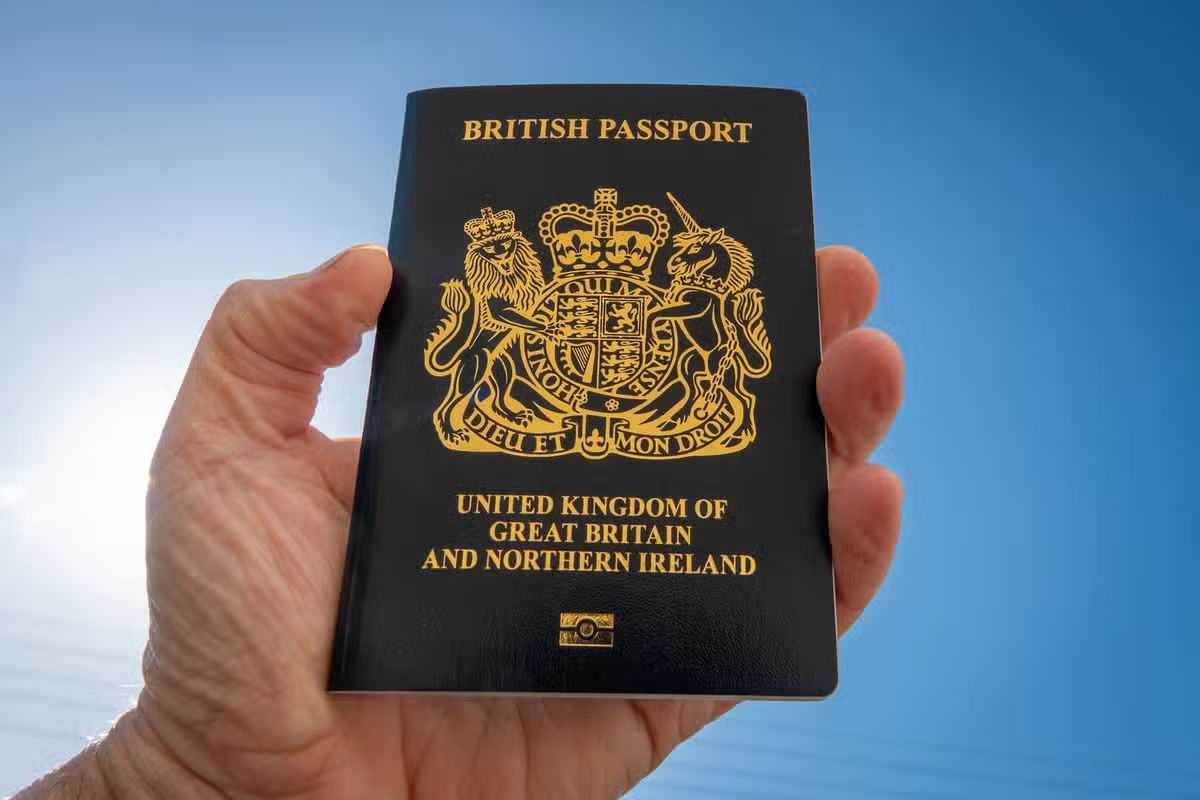
EES is an automated system gradually replacing the traditional passport stamp. It requires people from third-party nations such as the UK to have their fingerprints registered and photograph captured before entering the Schengen Area, which encompasses 29 European countries, predominantly within the EU.

For the majority of UK travellers, the procedure takes place at foreign airports. The system saw a soft launch in October 2025 and was meant to be fully operational across all borders by April 10, 2026.

Yet there have been numerous accounts of passengers missing flights and enduring lengthy queues at airports as systems buckle under the sheer volume of people attempting to register. Several countries have suspended EES at various points, with Greece postponing the system for UK travellers over the summer to enhance the travel experience.

Portugal has halted EES for extended stretches to ease travel to and from the country, with speculation mounting that Italy may do likewise. Mr Calder indicated it was not beyond the realms of possibility. “It was always going to be really exciting to see what happens when you roll out a digital borders scheme and you ask 29 national governments to implement it,” Mr Calder said. “They have all gone their own way.

“Some of them have done it really well. Others, well, they are still struggling and we might find that, actually, the whole scheme gets put on a sort of hold for the rest of the summer.

“That’s certainly what a lot of airlines and train operators would like, not to mention the Port of Dover, where they haven’t even started taking biometrics from motorists yet.”

READ MORE: Ryanair issues plea to ‘suspend’ EES rollout amid ‘missing flights’ warningREAD MORE: Ryanair issues warning to customers – and it’s not down to fuel crisis

What’s the problem?

Headlines were made in April 2026 when passengers travelling with both Ryanair and easyJet missed their flights from separate Milan airports owing to EES complications. Footage from one incident revealed a crowd gathering at Milan Bergamo, with exasperated passengers informing staff they had been held at the gate for over an hour, demanding to know what action to take.

It’s understood that approximately 30 passengers were left behind. Ryanair said in a statement: “Due to passport control delays at Milan Bergamo Airport on 16 April, a number of passengers missed this flight from Milan to Manchester.” One passenger claimed they were kept waiting until the aircraft had departed, only to then be informed they would need to arrange their own return flights. A number of travellers on a Ryanair service from Tenerife South to East Midlands on 10 April also missed their homeward journey, once again blaming hold-ups at passport control.

Ryanair recently issued a blistering statement on social media, demanding the EES rollout be postponed until September. The low-cost carrier tore into France, Portugal, Poland, Italy, Spain, and Germany for their failure to ‘ensure that adequate staffing, system readiness, or kiosks are in place’.

Content cannot be displayed without consent

Branding the system as ‘half-baked’, the Ryanair statement said: “Despite knowing for over three years that EES would become fully operational from 10 April 2026, France, Portugal, Poland, Italy, Spain, and Germany have failed to ensure that adequate staffing, system readiness, or kiosks are in place.

“As a result, passengers are suffering long passport control queues and, in some cases, missing their flights.

“Ryanair calls on these EU Governments to suspend the rollout of the EU’s passport control Entry/Exit System (EES) until September to ensure that passengers are not needlessly forced to suffer long passport control queue delays at European airports during the peak summer season.”

Source link

Travel expert warns passengers to check ‘PIR number’ if their suitcase goes missing

Chris Harrington, managing director at travel transfer company hoppa, has outlined what to do to give yourself the best chance at recovering your valuables, or, at least, getting some compensation for the loss

One of the most common travel nightmare scenarios tourists face is having their luggage go missing after a flight.

Mishandling checked-in bags costs airlines around £4.2 billion a year, according to aviation technology company SITA. If you’re one of the unlucky ones who ends up not finding your suitcase on the conveyor belt, here are the seven steps to take immediately, according to an expert.

Chris Harrington, managing director at travel transfer company hoppa, has outlined what to do to give yourself the best chance at recovering your valuables, or, at least, getting some compensation for the loss.

The most important thing, he says, is to act fast. He says: “Ultimately, the faster and more informed your response is, the better your chances of recovering your bag or at least getting clear updates on where it is.”

Chris advises heading straight to the airline’s service desk near baggage reclaim if you notice a missing bag – stressing that delays can reduce the chances of locating your bag quickly.

READ MORE: Ryanair passengers warned over type of bag you can never check inREAD MORE: UK tourists face travel disruption on May 12 as new strike action confirmed

From then on, it’s important to have your baggage tag and flight details ready, as they will help staff begin tracking your suitcase straight away.

You should also be as specific as you can when describing the missing item. “Details matter. Think about the colour, size, brand, and any distinguishing features like stickers or tags. Even better, show photos if you have them,” Chris continued.

And once your case is all documented and reported, never forget to ask for a Property Irregularity Report, or PIR number, as it is “essential for tracking your luggage and for any future claims.”

In the meantime, most airlines try not to leave customers empty-handed. “Some carriers will provide an allowance for essentials like clothes and toiletries,” Chris notes. “If they don’t, keep every receipt, as you may be able to claim those costs back later.”

Another essential step is to contact insurance companies early on, since many policies include cover for delayed luggage after 12 to 24 hours, but the expert recommends being prepared and checking exactly what evidence they require. If, after several days, nothing is found, it’s crucial not to give up.

“You should be following up regularly,” Harrington advises, adding that “after 21 days, luggage is officially considered lost under international guidelines.”

Thats the stage in which travellers are encouraged to put forward a formal claim – according to the Montreal Convention, which sets out airline liability in such cases.

Chris highlights that passengers may then be entitled to compensation of up to around £1,300 if they provide the right documentation.

To claim that sum, “you’ll need proof of your luggage and what was inside it. The more evidence you have, the stronger your claim.”

Source link

BBC star ‘cancels summer holiday’ as expert gives 2026 refund update

DIY expert Nick Knowles said he’s no longer going to Turkey as BBC Morning Live viewers told ‘it could see holidays in jeopardy’

A BBC travel expert has given an update to anyone with holidays booked or considering going on a foreign break this summer. On BBC Morning Live consumer champion Rebecca Wilcox told hosts Rav Wilding and Holly Hamilton how concern is growing from people with breaks lined up – as to if it could be cancelled, will they be charged more supplementary fees and will they be covered.

And during the section show DIY expert and guest Nick Knowles revealed his family has decided to cancel their holiday to Turkey amidst all the uncertainty. Host Helen said: “With this morning’s headlines showing oil prices at their highest level since 2022 there’s growing concern that airlines could respond by raising fares or even cancelling some flights.”

Ms Wilcox agreed and said: “It’s very worrying and and the number of headlines make us spike in our concern and I can see that the fuel price is going up making concerns go up and what we’re going to talk about today is how specifically that is going to affect the holiday pricing with airline fares because, of course, jet fuel, is integral for flying through the air.

“Jet2 has told us they are seeing an increase in holidaymakers leaving it to the very last minute to book their holidays, and that’s so they know the full cost of their trip at the time of purchase and that is due to the conflict in the Middle East.

“It tells us that there’s a real worry going on out there. People are quite hesitant to book, they don’t know whether they should go ahead with it. On Monday we heard the Prime Minister saying that airlines actually do have enough jet fuel at the moment but it could see holidays in jeopardy in the future and that depends upon how long this conflict goes on for which, of course, nobody knows.”

She said more people are considering whether to go ahead or just book a staycation in the UK instead. Presenter Holly Hamilton said: “Most people when you chat to them, it’s at the forefront of their mind about booking holidays and in some cases they are cancelling them. Nick you and I were chatting about it and you’ve cancelled your holiday.”

Nick Knowles said: “Yes a holiday in Turkey and we’ve decided to stay home. A holiday in the UK is more expensive than going abroad – so we’re going to go in the back garden and drink cocktails and sunbathe in the back garden. The trick is don’t tell anyone you’re not going away because then they’ll ring you and interrupt.”

Holly said, “Bad news, you’ve just told everybody.” Nick added, “I’m going to be in such trouble with my wife now.”

READ MORE: Martin Lewis warning for holidaymakers including Jet2, easyJet, TUIREAD MORE: Martin Lewis tells mobile users ‘type 5-digit code and screen grab result’ as thefts soar

Rav asked: “Can holiday companies just raise prices then?” Rebecca said: “I’m devastated that Nick is not going to Turkey – how is he going to get those new teeth he was talking about earlier? I’m joking, obviously his teeth are beautiful.” Nick interjected: “I’m going back to the same people who did my hair it’s fine.”

When can holiday companies raise prices

Rebecca said: “They can only raise their prices in specific circumstances because there is a law protecting consumers from these huge hikes in prices that they could add on for any random charges. This law is known as the Package Travel Regulation and it means we are protected.

“The surcharges they are allowed to add on are related to things like fuel cost increases, which we’re talking about today, transport taxes and fees and any fluctuations in the exchange rate movement. They have to say this in your T&Cs at time of booking so just c heck your terms and conditions.”

Holly said: “The people who have booked their holiday will be thinking ‘how much could they possibly add on?’ “ Ms Wilcox said: “Well, it is a limited amount they can add on before they give you the option of cancelling or a refund and that amount they can add on is 8 per cent. This 8 per cent is broken down into 2 sections because the holiday company has to swallow that first 2 per cent and then you as consumer will only pay 6 per cent and that’s of the total cost of your holiday package.

READ MORE: TV holiday expert Simon Calder gives holiday 2026 update and says ‘that is crazy’

“What does that look like for a holiday? So for instance if you’ve spent £1,000 on your holiday that’ll be an extra £60. A £3,500 holiday, another £210, and a £5,000 cruise that’s £300. They can only ask for this for up to 20 days before you travel and that’s why people are booking these last minute holidays because the time limit for that 6 per cent has already gone.”

Package holidays

Rav gave an example from a viewer, Jeff, who was due to pay the balance on his holiday – he’d booked the flights and the accommodation through the same agent and asked if his family would be able to get a full refund if they have to cancel our holiday because of the shortage. Ms Wilcox said: “This sounds like he’s booked a package holiday when he’s booked the flight and the accommodation together and that means you do have more protection and you should be offered a full refund and a suitable alternative if they make major changes.

“If it’s a flight only deal they must offer you a replacement flight or a refund. If they offer you a holiday voucher or credit with them instead of cash be really wary and think twice about doing it. They may lure you in by offering you something that’s supposedly more than what you spent so it looks like it’s of greater value, but I would say you’re more protected if you get the cash back.” She said there may be restrictions, there may be an end date on the credit and also the company could go bust.

She said getting travel insurance when you make the booking was vital as you’re protected from then until time of travel.

Source link

Travel expert warns against the worst aeroplane seats to avoid booking

A travel expert has shared the specific seats that passengers repeatedly regret choosing

Booking a flight is often a crucial element of holiday planning, yet there’s one detail that frequently gets overlooked. Where you sit on the aircraft might not seem particularly significant at first glance, but if you’re embarking on a long-haul journey, you could well end up regretting your seat selection.

Seasoned travellers will attest that choosing the wrong seat can quietly derail your entire flight. Whether it’s being left without meal options, battling to get comfortable, or enduring non-stop disturbances, your seat can fundamentally shape your experience at 30,000 feet.

With this in mind, Andrea Platania, travel expert at airport transfer platform Transfeero, has disclosed that there are several seats passengers consistently regret selecting – and they’re not always the obvious culprits.

11A and 11F

The first pair of seats Andrea cautions against are 11A and 11F. He explains: “Seats like 11A and 11F are often overlooked when people are booking, but they’re right in that middle section of the aircraft where you lose a lot of the small conveniences.

“They don’t seem bad on paper, but in practice, they’re some of the least rewarding seats to be in.”

Given that cabin crew generally begin service from either end of the aircraft, passengers in these seats may discover that popular snacks, meals or even beverages have already sold out by the time the trolley arrives at their row.

On top of this, you’re positioned quite a distance from the lavatory, and manoeuvring in and out of these seats can prove awkward.

30E and 30F

“Seats like 30E and 30F are usually located very close to the toilets, and that brings a lot of disruption,” says Andrea. “It’s not just about proximity, it’s about the constant movement around you.”

He added: “You’ll often have passengers queuing in the aisle, standing near your seat, and moving back and forth. It can feel like you’re sitting in a corridor rather than in your own space.”

30A and 30F

The primary concern with these seats is comfort, especially when it comes to stretching out and reclining. “On many aircraft, seats towards the back, such as 30A and 30F, can have limited or no recline,” Andrea explains.

“That’s something people often only realise once they try to lean back and it doesn’t move. If you’re on a flight where you’re hoping to rest or even just sit comfortably, not being able to recline makes a big difference. You end up feeling much more tired by the time you land.”

Those seated in these positions are also likely to be amongst the very last passengers to disembark the plane, which could spell trouble if you’re in a hurry to catch a connecting flight.

Source link

TV holiday expert Simon Calder gives holiday 2026 update and says ‘that is crazy’

Holiday guru said people were coming to him asking if they should cancel their holiday

TV holiday expert Simon Calder has given a key holiday booking update for anyone thinking of going away in 2026. People who have booked with jet2, easyjet and TUI have been told that the operators will not charge supplementary fees for fuel even though the Iran conflict has seen prices soar.

The ITV and BBC expert said people were coming to him and asking if they should cancel their holidays. The EU has said that travellers face major problems this year due to the Middle East crisis and the UK Government has said it is working with airlines to monitor the situation.

However, Mr Calder said it was a great time to get mega deals – with some offering loads off. He told GB News: “ Do not cancel your holiday. And if you haven’t booked any and you’re feeling nervous, well, please don’t. Now is a fantastic time to book holidays.

“I wish there wasn’t, but I was looking for instance last night. So, these prices still available. Luton to Mykonos. Okay. Now, beautiful Greek island and most fares in July and August on that route are £55 one way. That is crazy. It should be three times that. It’s a fantastic time to book.

“And you might think, well, yeah, I’ll book the flight and then it’ll be cancelled. But air passenger rights rules are so strong that if you are if your flight is cancelled, then it’s not your problem. It’s the airlines problem. They have to find you an alternative on the same day if at all possible. So, of course, I snapped up one of these flights and I’m just looking forward to it. I’ve been booking holidays like there’s no tomorrow because there’s so many great deals around.”

Content cannot be displayed without consent

He said that the current situation was leaving some people worried. He said:”Let me tell you first of all if you have booked a holiday – and I’ve had people it it takes me back almost to COVID – people saying I put this holiday the balance, is due I’ve got to pay you know a couple of thousand pounds should I just cancel the whole thing no go and have a lovely holiday in the UK.

“There will be some flight cancellations, and that is mostly big airlines like Lufthansa, which isn’t a holiday airline. They’ve cancelled 20,000 flights but they’ve done that basically because they were flights which they thought oh we’re not going to make any money out of that with fuel double the price it was so let’s just cancel those.

READ MORE: ‘Smell great on holiday’ with 89p Home Bargains item ‘ideal for travel kits’READ MORE: Jet2 issues new ‘suspended’ Greece holiday update for all passengers

“So they’ve taken those flights out. It’s not affecting anybody’s holiday that I know. We’ve had very very unhelpful warnings from European energy chiefs and from the prime minister saying, ‘Oh, you might have to think about your holiday.’No, you don’t. Just just plan your holiday as normal. There is a tiny chance that your flight might be merged with another flight. So, for example, and there is absolutely no plans for this, but if you look at easyJet from Gatwick to Nice, lovely destination, they got six flights a day.

“If they reduce that to four to save a bit of fuel. Well, it would be a slight nuisance for some people. They’d have to go at noon instead of 10:00 in the morning, but ultimately it’s not going to make any difference.

“Another real concern for lots of people is I could be stuck at the other end. Well, I actually put this to an airline boss yesterday and I said, ‘What what happens if you’re in Cyprus?’ Because with other destinations, if they run out of fuel in, I don’t know, Naples, that’s fine. You can just fly out with enough to fly back. Somewhere like Cypress, you can’t do that. And the boss said, ‘Well, it’s very easy. We’ll just do a pit stop in Athens on the way back’. So, there are lots of solutions. Do not cancel your holiday. And if you haven’t booked any and you’re feeling nervous, well, please don’t. Now is a fantastic time to book holidays.”

Jet2 has said holidaymakers are increasingly booking their trips at the last minute since the start of the Iran war amid increasing anxiety over the impact of the conflict and worries over jet fuel supply.

The firm said summer passenger number bookings so far are up 6.2%, thanks to growth across its airline and package holiday business, but in a sign of mounting nervousness among holidaymakers, it revealed the “booking profile has become increasingly close to departure” due to the Middle East war.

It said it is well protected from the fuel cost spike caused by the Iran war for the important summer season, adding it is “maintaining frequent dialogue with our fuel suppliers and airport partners on fuel supply”.

The group’s load factor – a key measure of how well it fills its planes – has remained flat year-on-year for its first quarter so far, though it said the conflict meant there was limited visibility for the peak summer season and beyond.

Its update followed a warning from Heathrow airport separately on Wednesday that it expects passenger numbers for the rest of the year to be affected by the situation in the Middle East.

Airspace closures following the outbreak of the war in the Middle East on February 28 have had a major impact on air travel, and while much of the region’s airspace has since reopened, many people are avoiding flying there because of the conflict.

A raft of European airlines have also recently alerted to impending jet fuel shortages within weeks, given the disruption to their main supply route through the Strait of Hormuz.

Around three-quarters of Europe’s jet fuel supply comes from the Middle East and travels through the crucial shipping route.

Steve Heapy, chief executive of Jet2, said: “Clearly, we continue to monitor the situation in the Middle East but remain focused on our medium-term goals.”

The group said it expects to report a drop in operating profits to between £435 million and £440 million for the past year to March 31, down from £446.5 million in 2024-25, but said this was in line with market forecasts.

It has increased its summer programme for 2026 by 7.7% to 19.9 million passenger seats.

Source link

‘I’m a travel expert, ditch these 3 popular UK destinations and go here instead’

One travel influencer has suggested three places in the UK which people should consider visiting instead of more popular destinations. “It’s not about skipping any of them… just travelling a little differently,” she said

The UK is full of incredible places to visit, from historic sites dating back thousands of years, to bustling towns and cities. Whether you want to spend some time in the countryside or on a beach, or if shopping in high-end boutiques and eating in Michelin-star restaurants is more your speed, we’ve got it all.

There are plenty of places in the UK which are famous across the world as destinations for tourists, from the ancient mystery of Stonehenge and the historic streets of Edinburgh, to the spectacular countryside of the Cotswolds and the iconic Big Ben. But what if you want something a bit more off the beaten path?

One travel influencer has suggested three places in the UK which people should consider visiting instead of the more popular destinations. Apryl, who has 47,000 followers on Instagram and regularly shares tips for travel in the UK, shared the advice on social media. Writing in the first slide of the post, Apryl said: “Three places everyone plans in England but I wouldn’t… where I’d go instead.”

Writing in the caption, she said: “Everyone goes to the icons, and you probably should too. But if you’ve already done them, or want something a little less crowded, here’s what I’d add to your England itinerary.” She added: “It’s not about skipping any of them… just travelling a little differently.”

Ely instead of Oxford

Firstly, she said people planning to visit Oxford should instead consider the Cambridgeshire city of Ely. She said: “Fewer crowds, cathedral views, medieval streets.”

Nestled in the Cambridgeshire countryside, the city’s most iconic feature is the spectacular Ely Cathedral, with its incredible octagonal tower. Tourism site Visit Ely describes it as “the destination city with something for everyone”.

It said: “From the monastic buildings of the city past, the vibrant food scene and the scenic majesty of the Riverside, Ely packs a great deal into a pocket city. With Ely Cathedral, independent shops around the city centre, places to relax and replenish both body and mind, there has never been a better time to enjoy this quintessentially English jewel in the heart of East Cambridgeshire. “

Hastings Old Town instead of Brighton Pier

Next, Apryl said people planning a visit to Brighton Pier should instead consider travelling 36 miles east to Hastings Old Town in East Sussex. Apryl said: “Fishing huts, antique shops, and a slower seaside.”

Hastings Old Town is famous for its 19th-century Net Shops, tall, black wooden sheds originally built to provide weatherproof storage for fishing gear. Today the huts are Grade II-listed, while one serves as a free museum.

The area itself comprises the part of the town of Hastings which existed before the 19th century. Today it is the easternmost valley of the current town.

Content cannot be displayed without consent

Chester instead of York

Apryl’s final tip was directed at people planning a trip to the historic city of York. She said people should instead visit Chester in Cheshire. She said: “Timbered streets, Roman walls, and fewer crowds.”

Steeped in history, Chester has the most complete city walls and the largest Roman Amphitheatre in the UK, as well as a 10th century cathedral. Chester Zoo is also home to 35,000 animals, and is reportedly the most-visited attraction in the UK outside London.

Visit Cheshire said: “Visit Chester, for its bewitching beauty and unique atmosphere which make it one of Britain’s most popular places for an unforgettable short break. The ancient city is a breath-taking experience with each chapter of Chester’s history etched into the very fabric of the city. Walk where Roman Legionnaires marched to war, Viking raiders wreaked havoc and Norman invaders conquered Anglo Saxons.”

Concluding, Apryl clarified she wasn’t suggesting people shouldn’t visit Oxford, Brighton, or York, but that they should consider other lesser-known destinations too. “Don’t cancel your trip… just try these too,” she said.

Source link

Holiday expert reveals the bad booking habits costing you HUNDREDS and the simple tricks to save money

I WORK in travel and look at holiday pricing data every single day – and there are a few patterns that I see constantly.

Small booking habits that feel completely normal, but quietly push prices up. We’re not talking about a few quid either. Get these wrong, and you can end up paying 20–30 per cent more for the same holiday.

Holiday Expert Rob Brooks sees countless holiday mistakes made – here’s how to avoid them Credit: Rob Brooks

Follow The Sun’s award-winning travel team on Instagram and Tiktok for top holiday tips and inspiration @thesuntravel.

Here are the three biggest mistakes – and exactly how to fix them.

Bad Habit No.1: Booking in the morning rush

This one surprises people the most.

Booking your holiday first thing – on your commute, before work, or when you sit down at your desk – feels productive.

But it’s actually one of the worst times you can choose.

According to the data, the most expensive time to book a holiday is between 9am and 10am.

In fact, booking in that window came in at around 30 per cent more expensive than the cheapest time of day, which is actually 2:47am.

And it makes sense when you think about it – because that’s a peak demand window when everyone is searching at once.

Flight prices react to this demand first, then package holiday prices follow.

So while you think you’re being organised… you’re actually booking at the busiest, and often most expensive, moment of the day.

In one example, I found a 5-night all-inclusive stay at the Catty Cats Garden Hotel in Turkey was priced at £133pp in the early hours – but just a few hours later, that had jumped to £165pp for the exact same holiday.

That’s a 24% increase (£64 more for two people) simply from booking later in the day.

A break to Antalya in Turkey increased overnight Credit: Getty

Bad Habit No.2: Waiting after finding a good deal

This is the classic “I’ll just check again later” mistake: you find a good price, but instead of booking it, you leave it.

You come back later. Maybe the next day. Maybe after asking a few people.

It feels like you’re being careful or thrifty, but the data shows the opposite.

Every search feeds demand into the system, demand pushes flight prices up, and flight prices push package prices up.

But the reality is: if you’ve found a good deal, it’s very likely other people have found it too.

So while you’re waiting, those seats and rooms are disappearing, filling up and pushing up the package cost pretty quickly.

In one real example, a luxury all-inclusive stay at the Titanic Deluxe Lara in Antalya,Turkey was priced at £558 per person.

But after waiting just 24 hours, that same holiday increased to £606 per person.

That’s an extra £48pp – or £192 more for a family of four – just for not booking when the price was lower.

Prices change, availability drops, and that deal you liked is gone forever.

Rob recommends putting flexible dates into the search bar to find cheaper deals Credit: Alamy

Bad Habit No.3: Being too rigid with dates and nights

This is where people leave the biggest savings on the table.

I see it every day: most searches are locked into the same dates, same duration, no flexibility.

But pricing doesn’t work like that – it fluctuates constantly based on demand.

Flight and hotel combinations are constantly shifting, and the price you see is based on very specific availability – not a fixed “cost” for that trip.

That means sticking rigidly to one duration can actually stop you from seeing better-value options.

One holiday to beautiful Corfu was cheaper by changing the dates Credit: Getty

Sometimes, adding or removing just one night can completely change the price – because it opens up different flight combinations or cheaper room availability.

In one search I did for a Corfu holiday, a 7-night stay was coming in at £874 per person.

But by simply increasing the stay to 8 nights, the price dropped to £720 per person for the same package.

That’s a saving of £154pp – or £308 for two people – just by adding one extra night.

It goes against what most people expect, but it shows how pricing really works.

You’re not just paying for nights – you’re paying for the combination of flights and hotel availability behind them.

Yet most people never check – they search once, see one price, and assume that’s what the holiday costs.

Good Habit No.1: Use price alerts instead of repeatedly searching

One of the easiest ways to save money is to stop manually checking prices over and over again.

Every time you search, you’re adding to demand signals – and you’re far more likely to miss the moment a price drops.

Instead, set up price alerts or track a holiday and let the price come to you.

That way, you’re not feeding the surge – and you’re ready to act when the price is right.

I sometimes see short-term dips of up to £50 per person on the same holiday when demand softens briefly – but these windows can last hours, not days.

The people who catch them aren’t constantly searching – they’re notified. But how do you actually do it?

At On the Beach, if you save a holiday, you’re automatically tracking it, and they’ll email you to let you know when the price changes.

On Google Flights, you can search your route, then just toggle “Track prices” – then you’ll get email alerts whenever fares move up or down.

On Skyscanner, hit the heart or bell icon on a flight, and it’ll notify you when the price changes.

It takes about 10 seconds – and it means you’re not guessing when to book.

The cheapest time to book is 2:47am, although you don’t need to wait up late Credit: Alamy

Good Habit No.2: The 33-day booking rule

There’s no perfect moment to book – but there is a bit of a sweet spot.

According to the data, booking around 33 days before departure can unlock savings of up to 10%.

That’s because it sits between two high-demand groups: early planners who book far in advance and last-minute bookers chasing limited availability.

In this middle window, demand is lower, and prices often reflect that.

Which means on a £700 holiday, that 10% saving means paying around £630 instead – a £140 saving for a couple without changing anything else.

It’s not about waiting as long as possible. It’s about timing it right.

Switching airports to fly to Majorca can make it cheaper Credit: Alamy

Good Habit No.3: Switch airports, not just dates

Most people have a “default airport” – the one they always fly from without really thinking about it.

But sticking to the same airport can quietly cost you more than you realise.

Flights to the same destination can vary massively in price depending on where you depart from – even on the exact same day, for the exact same hotel.

And often, the cheaper option is only a short drive or train journey away.

In one search I did this week for a family holiday to Majorca, the same 5-night stay at the Sea Club Mediterranean Resort was priced at £260pp flying from Manchester.

But switching to Liverpool Airport for the exact same trip brought the price down to £235pp.

That’s a saving of £25 per person – or £100 for a family of four – just by changing the departure airport.

It’s a simple check most people skip, but it can make a real difference to the total cost.

A Holiday Expert’s bottom line:

These aren’t big sacrifices, and you’re not downgrading your hotel or cutting your trip short. You’re just booking smarter.

But these small tweaks of timing, confidence and flexibility can easily save you hundreds over time.

And once you see how the pricing actually works, you won’t book the same way again…

Rob recommends letting the pricing guide your dates, so you can browse for the cheapest deal Credit: Alamy


Source link

I’m a travel expert of 30 years

THE conflict in the Middle East has had a far-reaching impact on the package holiday market.

Bookings have stalled as holidaymakers delay plans due to the uncertainty and those who are heading away are opting for last-minute trips.

I’ve been a travel expert for 30 years – so here are my tips on how to protect your holiday this year (as much as possible, that is) Credit: Dan Charity

There’s been an increase in demand for Western Mediterranean destinations like Spain and Portugal over the Eastern Med.

Ironically, that has led to some fantastic deals available on holidays to Cyprus, Turkey and Egypt – all of which are operating completely normally and where there are absolutely no safety concerns.

All of our main tour operators – including Jet2, TUI and easyJet Holidays – have not expressed any concern about trips in the short to medium term and are planning on running their summer schedules as normal.

But with airlines across the globe beginning to scale back flight schedules – removing unprofitable routes now jet fuel prices have soared – as well as others introducing surcharges there is a stark contrast between the two.

Read more on travel advice

SI YA

Can I cancel my Spain holiday? Latest Canaries advice after snow & cancelled flights


TRIP UP

The Sun’s travel experts reveal their best EVER holidays & how you can do them too

If you are looking to head away this summer and haven’t booked, now is probably the time to do it before prices start to rise.

Tour operators are desperate for us to get booking and you’ll see plenty of decent pricing and incentives.

Heading to Greece, Turkey, Cyprus and Egypt will be a good bet for those wanting to get a bargain – with demand for Western Mediterranean resorts high, prices could soon start to rise.

But what can you do to make sure your holiday is safe this year? While a lot of it is out of your hands, here are some ways to try and protect it as – much as possible.

Go for package holidays

Package holiday regulations do allow tour operators to add a surcharge to the cost of holidays already booked although it is extremely rare for this to happen.

Even then, the maximum they can charge is eight per cent of the holiday price.

Anything over that, and the operator has to offer you a full refund instead.

But what is clear is this is probably not the summer to do a DIY break.

Booking an ATOL-protected package holiday comes with lots of consumer protection you simply don’t get if you book each element independently.

Check your travel insurance

Most standard travel insurance policies exclude coverage for disruption tied to acts of war but it is still essential to take out insurance as soon as you book any trip as it offers vital protection in the run up to your trip such as sudden illness or the death of a close relative.

And of course, it provides essential medical cover should you fall ill or are injured on your trip as well as lost or stolen luggage and possessions.

Travel insurer Staysure revealed recently that the cost of a medical ambulance back from Spain this summer averages £37,853 from the Canary Islands, £22,930 from the Balearics and £25,583 from mainland Spain.

So it is still worthwhile buying a policy for medical protection alone.

And while travel insurance won’t cover you if your flight is cancelled, under UK/EU law your airline has a legal duty of care to you and must get you to your destination as quickly as possible.

In most scenarios, getting a refund on a cancelled flight would probably be the worst option as the airline then has no legal duty of care to you.

Read up on your rights should flights be cancelled and be prepared to fight for what you are due.

A credit card is a must in case of any last minute expenses Credit: Alamy

Opt for easy-to-get-home-from destinations

Many of us won’t want to give up the chance to soak up some Mediterranean sunshine this summer – and why should we?!

But making savvy choices on destinations could help protect your summer break.

If airlines do begin to trim schedules and cancel certain flights, it makes sense to choose airports where there are lots of daily flights.

Now is probably not the time to be booking a holiday to a destination that has just a single flight a week.

Booking holidays to our closest European neighbours – the likes of Spain, Portugal, France and Italy – also mean there are alternative ways to get home should flights be cancelled.

You can also look at other ways to holiday from the UK this summer without going near an airport.

There are lots of cruises that depart from UK ports including Southampton and London Tilbury that will sail you in style to the Mediterranean, Norwegian Fjords and beyond.

The boss of Brittany Ferries, Christophe Mathieu, has even said: “We make a clear promise to customers.

If you have booked with us, or are considering doing so, we will get you to a beautiful and safe holiday destination this year. Period.

“We will play no part in profiteering. The cost of our holidays rose by inflation earlier this year, and by inflation alone. There will be no further rises in the weeks or months ahead.

“Conflict or other global uncertainty should not be used as the basis for knee-jerk price hikes.”

Be prepared for unexpected expenses

Many travellers were caught short when airlines were forced to cancel flights to or through the Middle East at the start of the war.

For any trip, it always makes sense to have an emergency credit card for any unforeseen expenses that may occur. If possible, apply for one with an interest-free period.

Or look at a currency card like Currensea – this is a card that is linked to your bank account and takes out the payments via direct debit but avoids the high foreign exchange fees and doesn’t need to be pre-loaded like some other currency cards.

An alternative is to look at opening an account with a digital based bank account that you operate through an app on your phone like Revolut or Monzo.

Picking destinations like Spain where there are lots of flight options mean you have more choice if something goes wrong Credit: Getty

Source link

Kim Kardashian and Lewis Hamilton beach pics are hard launch of VERY different relationship, says body language expert

KIM Kardashian and Lewis Hamilton’s romantic beach pictures prove that they’ve hard launched a VERY different relationship.

Body language expert Judi James has revealed that Kim, 45, and Lewis, 41, appear to be the real deal with “genuine displays of intimacy”.

Kim Kardashian and Lewis Hamilton’s relationship appear to be the real deal Credit: BackGrid
Body language expert Judi James said the couple are showing ‘genuine displays of intimacy’ Credit: BackGrid
Kim appears to be taking the lead in the relationship, according to Judi James Credit: BackGrid

The happy couple, who went official with their relationship in December, packed on the PDA during their getaway in Malibu.

The Skims founder looked in her element as she enjoyed a surf lesson with her beau.

TV personality Kim showed off her incredible figure in a skintight wetsuit and a black bikini top.

The F1 star wore a pair of black shorts and a matching T-shirt.

They were seen all over each other as they struggled to keep their hands off one another.

Judi has now revealed that the beach snaps illustrate just how much this famous couple are compatible, despite fears that they were a showmance.

Even though it’s early days, Judi believes that their is already a strong level of trust between the pair.

She exclusively told The Sun: “They might have been seen on a couple of chaste-looking dates where Lewis’s body language primarily spelled out ‘gentleman’ but these photos and the video look like the hard launch of a more tactile, sexual and romantic relationship between Kim and Lewis.

“Kim’s leading the plunge here, swimming ahead of Lewis as he seems to be struggling to catch up with her and touch her.

“When they are together in the ocean there are signs of an uninhibited and playful, mutually clinging relationship with Kim encircling Lewis with her arms and throwing her head back with an open-mouth laugh of sheer pleasure, with her relaxed neck-baring a sign of strong levels of trust in the relationship.”

The expert insisted that Kim appears to be in charge of the relationship but also seem to be rather like-minded and on the same page.

“Kim does look like the leader in the body language stages here, at one point she stands with her feet slightly splayed and her back arched as she performs a preening, confident pit-bare gesture as she squeezes the water out of her hair,” Judi shared.

“Lewis’s response is reciprocal as he shows his admiration by placing one hand out and onto the upper part of her bum.

“During a playful-looking moment Kim turns her torso in towards his, pressing it against his torso in an intimate pose as she places one hand on his waist and here he responds with one hand curved right around the shape of her bum.

The pair seem to be mirroring each other in another sign that they’re in it for the long haul Credit: BackGrid
Despite showmance fears, the couple seem to already have strong levels of trust for each other Credit: BackGrid

“Kim and Lewis have dressed in coordinating swimwear here to signal they are a couple and their mirrored movements and poses at some points suggest a like-minded relationship too.”

Kim and Lewis packed on the PDA and were seen strolling along the beach and were pictured smiling and laughing together.

The lovebirds were then seen splashing about in the sea and were spotted with their arms wrapped around one another.

They appeared to be the real deal as they kept eye contact and smooched while riding the waves in the sea.

They were also seen showing off their surf skills during the sporty outing, with Kim jumping on top of the board, while Lewis kept an eye on her.

They seemed comfortable in each other’s presence as they clung to each other and rode the waves.

Last week, Kim sparked Kim rumours that she is moving in with Lewis as they went rug shopping in LA.

Lewis attempted to go incognito with black sunglasses and a baseball cap.

The two were seen heading back into a vehicle as they made their way home after the shopping trip.

Just last week, Kim made an 11,000-mile round-trip to spend 24 hours in London with Lewis.

She flew to the UK on her private jet to see her man in a bid to keep their long-distance romance alive.

She left Los Angeles last Monday and landed at Farnborough, Hants, at 4pm on the Tuesday before being chauffeured on a 90-minute journey to Lewis’s £18million home in Kensington, West London.

The couple stayed holed-up in his six-bedroom mansion while their security teams kept guard.

She then left on Wednesday afternoon, taking off from Oxford at 5.30pm to return to the US.

A source said: “Lewis and Kim are two of the busiest people in showbiz, but they are determined to do everything to see each other when they have any spare time.

“Kim spent Easter weekend with her family and then had a photoshoot in Los Angeles on Monday morning, then flew across the Atlantic to see Lewis.

“They didn’t have long together because she had commitments in the US to get back to, but it was quality time.”

Kim’s romance with Lewis became public knowledge after The Sun revealed she flew in from Los Angeles on her £100million private jet to spend an evening with him.

On January 31, the couple enjoyed a brief stay at the exclusive Estelle Manor in the Cotswolds, with insiders saying they had the spa to themselves, before enjoying a meal in a private room.

They made their public debut as a couple at the Super Bowl in February where they were spotted sitting together in a luxury suite.

They have since been seen together in Paris, the US and for several other trips.

Proving they’re the real deal, the sports star recently met Kim’s children while they were out in Tokyo ahead of the Japanese Grand Prix.

The couple were  joined by three of her children -Saint, 10, Chicago, nine, and six-year-old Psalm – while they were on spring break.

“It’s more than just a casual connection. It takes a lot to capture Kim’s interest and she’s definitely intrigued,” an insider told People.

“He’s just an easygoing guy with great energy.

“Her family likes him and Kim’s very into him. They are both busy with their careers, but see each other as much as possible.”

Lewis’s response is reciprocal as he shows his admiration by placing one hand out and onto the upper part of her bum Credit: BackGrid
Kim and Lewis were seen on surf boards together Credit: BackGrid

Source link

‘I’m a travel expert – 3 key checks to make under new EU rules before going to the airport’

The European Union’s (EU) Entry/Exit System (EES) has caused major travel disruptions across European airports, and a travel expert has issued three key checks every traveller should do

A travel expert said there are three key checks every holidaymaker should make before heading to the airport, following the new EU rules.

As of April 10, 2025, the European Union’s (EU) Entry/Exit System (EES) was fully implemented across European airports. It requires all Brits travelling to the Schengen area to “create a digital record” and register their biometric details, such as fingerprints and a photograph.

The new digital border system has replaced manual passport stamping, and after the initial registration, the EES remains valid for three years. While it’s only needed for the first arrival at the airport border in the Schengen area, it’s caused major travel chaos as thousands of British holidaymakers register with the new system, leading to significant queues and delays of up to four hours across European airports.

READ MORE: TUI travel update statements for all holidaymakers ‘due to travel’READ MORE: Latest Jet2 rules for flying with children and babies

Adam Edinburgh, Head of Travel and New Products at Post Office Insurance, told the Mirror: “Passengers may be impacted by facing longer queues initially due to biometric data collection, a process expected to take several minutes per person.

“Passengers should be encouraged to plan contingency options if travelling on a tight schedule (alternative routes or transport), as any teething problems or incomplete information could cause delays to miss flights, ferries, or connections.”

The travel expert also outlined three vital checks that Brits should do before heading to the airport, in a bid to make their journey as smooth as possible following the rollout of the EES. He advised:

  1. “Check your passport expiry date (must be valid for at least 3 months after your trip for EU countries)
  2. “Know your entry airport’s EES setup (expect biometric checks)
  3. “Keep essential travel documents easily accessible, including passports, travel insurance, accommodation confirmation, and proof of onward or return travel.”

Explaining exactly how the EES works, Adam said: “Travellers entering for the first time will undergo biometric registration at border kiosks or e-gates. This includes the system capturing a facial image, fingerprints (if visa-exempt), passport details, and entry/exit information.

“For subsequent visits, the process will be faster due to the data already being stored. It’s important to note that no pre-registration is required – registration happens at the border during your first entry. “

Countries in the Schengen area include: Austria, Belgium, Bulgaria, Croatia, Czechia, Denmark, Estonia, Finland, France, Germany, Greece, Hungary, Iceland, Italy, Latvia, Liechtenstein, Lithuania, Luxembourg, Malta, Netherlands, Norway, Poland, Portugal, Romania, Slovakia, Slovenia, Spain, Sweden, and Switzerland. The EES system is not required for travel into the Republic of Ireland and Cyprus, as they are not within the Schengen area, and Greece has relaxed its EU requirements for Brits, ditching the need for biometric details.

For travel insurance before your next trip, visit the Post Office website. Or visit the government website for more information on the new EES system.

Do you have a travel story to share? Email webtravel@reachplc.com

Source link

Cruise expert shares the five items you must leave behind on a cruise

If you’re planning a cruise holiday this summer, it’s crucial to know the prohibited items list – and one travel expert has shared five things that could be confiscated

Summer is just around the corner, and millions of Britons are busy planning their getaways. Cruises are a wonderful way to explore the world – but if you’re setting sail, it’s vital to know precisely what you can and cannot bring on board.

Packing can be a stressful experience – but knowing what’s permitted and what isn’t puts you one step ahead. Will Sarson, a travel expert with cruise operator Riviera Travel, has revealed the five items you cannot bring aboard a cruise to make your trip that bit smoother, reports the Express.

He said: “When packing for a cruise holiday, it’s important to do your research to understand the list of prohibited items. This can help better planning while packing and help avoid disappointment when items are confiscated.”

His first item to leave behind is alcohol. While not outright banned, many cruise companies have restrictions to prevent passengers bringing their own supply. He said: “Often, travellers are restricted to just a single bottle of wine or champagne – with potential corkage fees for drinking in public spaces.

“With so much alcohol available on board, we recommend leaving the bottles at home to avoid further costs and instead making use of the available liquor found throughout the ship and at varying ports across the world.” His second item to leave at home is your clothes steamer or iron.

Will explained: “Many cruise liners do not allow irons or steamers onboard as they pose a fire hazard. This is an item that constantly catches people out, with travellers forced to part ways with their iron or steamer.

“To avoid disappointment, it’s best to leave these items at home. Many ocean and river cruises have irons or steamers onboard that can be borrowed by guests during their stay.”

Similarly, candles and incense are prohibited owing to the fire risk they present. Cruise personnel will seize these straight away – so it’s advisable to leave them behind.

If you’re fond of your CBD oil, you’re in good company – it’s an extremely popular wellness product for assistance with muscle pain and mental health, but due to its varying legality worldwide, it’s forbidden on cruises. Will stated: “While the product is 100% legal for sale and tender throughout the UK, this is not the case in certain cruise ship stop-off destinations. As a result, the substance is not allowed on board the ship.

His final recommendation may seem entirely self-explanatory, but according to Will, a lot of people don’t realise their pets cannot come with them on their cruise.

He said: ” You’d be surprised at how many people try to gain access to their cruise alongside pets. Domestic animals are typically not allowed on cruises due to the allergy risk and general health and safety aspects that come with allowing cats or dogs on board.”

His final suggestion may appear completely obvious, but according to Will, many people don’t realise their pets cannot accompany them on their cruise.

He stated: “You’d be surprised at how many people try to gain access to their cruise alongside pets. Domestic animals are typically not allowed on cruises due to the allergy risk and general health and safety aspects that come with allowing cats or dogs on board.

“However, animals such as guide dogs are granted access due to the medical assistance they provide. If you’re a pet owner with a cruise holiday booking, it’s best to seek arrangements for your animals, as they generally won’t be allowed to join you on board.”

Source link