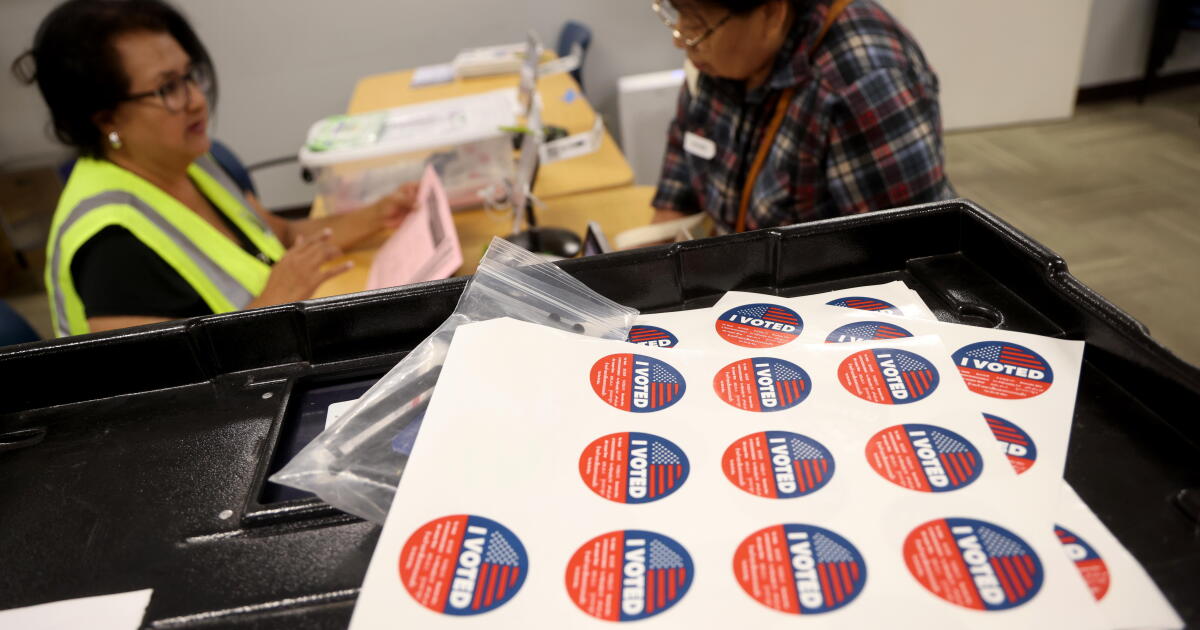
A campaign season of surprises peaks with Tuesday’s midterms
WASHINGTON — An acutely contentious and historically expensive midterm campaign barrels to a finish Monday, on the eve of elections that will set the nation’s course for the remaining half of President Trump’s second term.
Republicans are bracing for a backlash from voters as Democrats prepare for gains — but the magnitude of any “blue wave,” and whether it could sweep not only the U.S. House but also the Senate into Democratic control, will be the key question as Americans finish casting ballots Tuesday.
Early voting had already seen strong turnout, including among influence blocs such as Latino and Black voters. Candidates spent the weekend crisscrossing their states and pulling in surrogates to make a final push for voters still on the fence.
Capping a turbulent first half of Trump’s second term, the campaign has been defined by affordability and economic issues that have created headwinds for Republicans and spurred a possible turn toward Democrats by voters. And as Trump has pushed the limits of executive power, the midterms could act as a consequential check on his presidential reach.
In recent polls, voters have consistently put Democrats several points ahead on the generic ballot and given a historically low approval rating to Trump.
Eyes are now on Senate control, as an unexpected competitiveness by Democrats in a handful of red states has put the majority into play. It would require a “massive” wave for Democrats, but the fact that it is a possibility at all reflects an “extraordinary situation,” said Thaddeus Kousser, a UC San Diego political science professor.
With seven toss-up seats, tough math for Democrats and tough polling for Republicans, the outcome is far from certain. There may not be a large difference between the Democrats eking out enough seats for the majority or Republicans succeeding at holding it, said Charles Franklin, director of the Marquette Law School Poll.
“Just a little bit better night for the Democrats, and they pick up quite a number of these very close seats,” Franklin said. “Just a little bit better night for the Republicans, and Democrats fall slightly short in several of these competitive seats.”
The outcome in competitive races will not only set the dynamic between Trump and Congress for the next two years, but also hold signs for the 2028 presidential campaign. Both parties are closely watching how well Democrats can do in red states, how Republicans perform in Michigan and how far to the left Trump-voting districts swing.
The party out of power typically wins House control in midterm elections. This year, fatigue with Trump — fueled by the war in Iran, immigration policy, tariffs and other issues — merged with concern about prices, housing and AI issues to drive that movement toward the minority party, analysts said.
“This is an opportunity for the American people to try to put some brakes on the government,” said Todd Belt, a professor of political management at George Washington University.
The midterms are designed to function as a potential check on every presidency, said Christopher Warshaw, a Georgetown University public policy professor.
“The reason we have a democracy is in part because the out party does well in midterm elections,” Warshaw said. “That function of midterms is really important regardless of who’s in power.”
In many races, the quality of individual candidates also is poised to be a deciding factor, including in Texas, where Republican Atty. Gen. Ken Paxton has struggled to gain traction, and in Maine, where Democrat Troy Jackson has labored to confront Republican Sen. Susan Collins’ staying power.
The campaign has held significant twists, among them the unexpected death of Republican Sen. Lindsey Graham of South Carolina; the dropping out of Democrat Graham Platner from Maine’s Senate race; and the questions about the alleged involvement of operatives aligned with Democrat Mary Peltola’s campaign in the presence of a spoiler candidate on the Alaska ballot.
And Trump gambled on a largely dismissive approach toward voters’ affordability concerns; in recent days, he has also drawn attention with off-script comments at his rallies about Republican candidates’ rear ends and for lashing out at a reporter who questioned why he had canceled his final two rallies, which Trump later rescheduled.
Voter turnout could also have a significant effect on results; both parties have worked to reach independent voters while turning out their bases.
Across the country, nonpartisan groups are holding last-minute voting events, encouraging people to fill out their ballots. A hotline run by a nonprofit coalition organized by the Lawyers’ Committee for Civil Rights Under Law is receiving hundreds of calls a day about how to vote.
Brandon Waithe, 42, an Air Force veteran who has organized get-out-the-vote events through Project HALO, a voting initiative, said he hoped to help raise turnout.
He hosted a line dancing event in a Cleveland public plaza last month aimed at reminding people to vote — and to “tie some positive emotion to the act of voting,” he said.
“It’s like, ‘Ah, cool, all right, voting’s not so bad,’” Waithe said. “There’s no pressure. … We’re not telling you which party to vote for or which candidate. We’re just like, ‘Thank you for participating in voting.’”
The speed with which results are known Tuesday will partly depend on how large a blue wave might occur. The House majority could become clear Tuesday night, but the margin could take a little more time with swing races in slower-counting states such as California and Pennsylvania.
If the Senate majority comes down to Maine or Alaska and if those races are very close, the outcome will probably take some days to verify, Kousser said.
“What I’ve been telling people is you’re going to have to buckle up and wait,” he said.
And, of course, one of the few certainties of an election is that no one knows exactly what will happen. The electorate is volatile, said Sonoma State University political science professor David McCuan, and there are always wild cards.
“There will be a surprise on election night,” McCuan said.