Bending Spoons’ Playbook: Buy Low—and Hold
How Luca Ferrari’s permanent-capital model is transforming distressed digital brands.
Is it a private equity group with a twist? An “emergency room for critically injured tech companies,” as it was described by the Financial Times? Or is it simply a modern tech conglomerate?
How do you categorize a company that buys aging technology and digital brands—brand names like AOL, Vimeo, Eventbrite, WeTransfer, and more recently, Airtable—far below their peak value, overhauls and radically transforms them with a drastic turnaround, and then keeps them under the same umbrella to invest their profits in new acquisitions?
What it is, is a buy-and-hold investment and management company.
Bending Spoons SpA, an Italian company created in 2013 and recently listed on the Nasdaq, raised $1.68 billion with a total valuation of $18.4 billion and a current market value of $23 billion, and marked a 40% pop on its trading debut. For the second quarter, it reported $704 million in revenue and $177 million in net income, up 126% and 171%, respectively, from the second quarter of 2025.
It follows a highly unusual business model: buying distressed tech companies—or tattered internet businesses—at relatively low valuations, fixing them up through layoffs and reorganization, and then holding them rather than spinning them off or selling them separately to the market, as private equity groups typically do.
Bending Spoons has executed this strategy some 50 times since its creation. Funding for its activities comes from debt and from the profits of the acquired companies: the same ones it bought at low valuations, with seemingly no competition to acquire the brand.
All this was achieved as revenues increased fourfold from $387 million in 2023 to $1.3 billion last year, during which period it made 70% of its acquisitions. Ownership’s financial goal is an annualized return of 25% on invested capital, built on operational earnings alone rather than divestments, synergies between different acquisitions, or headcount reductions.
Meanwhile, debt, which financed 70% of the acquisitions that Bending Spoons made in the first quarter of this year, continues to pile up. In the last reported quarter, total debt was more than four times annualized EBITDA: hovering, in other words, between $4.3 billion and $4.4 billion, with a net debt of nearly $3.7 billion. The Canadian company Constellation Software Inc. has a similar business model, but carries less debt on its books, while Barry Diller’s People Inc.—formerly IAC Inc.—has followed a similar business model.
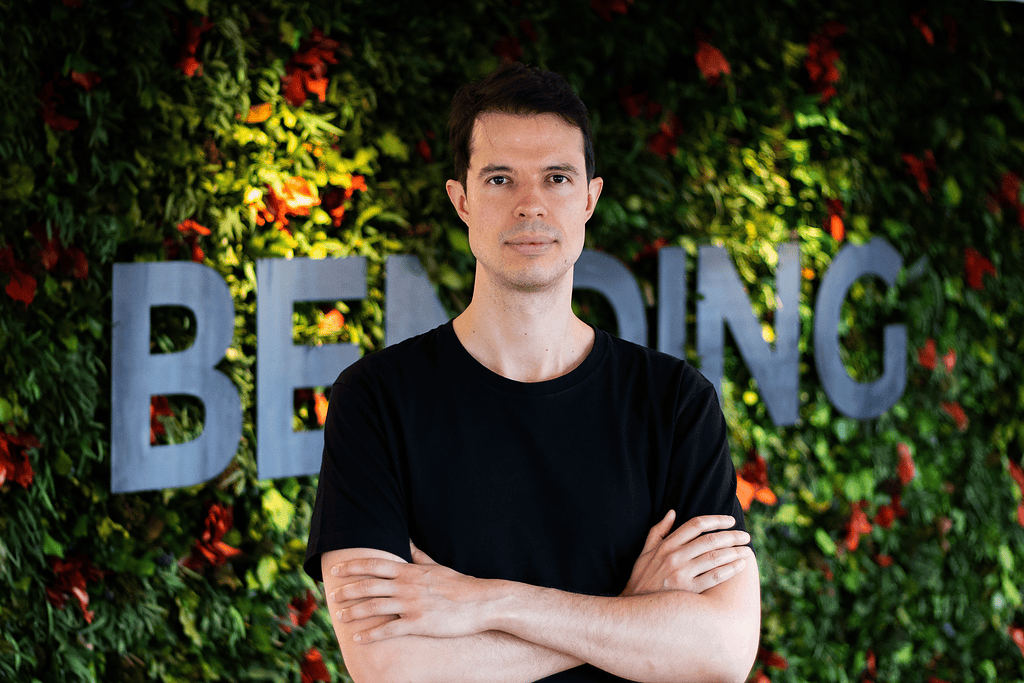
Luca Ferrari, CEO and one of four co-founders of Bending Spoons, described the model as a “deep transformation” because the acquired brands do not just go through layoffs but undergo radical structural reconstruction. The company’s name, an homage to the movie The Matrix, reflects the founders’ belief that mindset can transform reality, fueling their goal to achieve milestones that others might deem impossible.
In the prospectus for its Nasdaq listing, Bending Spoons mentions 1,000 potential targets. Its latest acquisition, announced this month, is Airtable, a “collaborative work management” software company, for $1.29 billion in cash. That represents a nearly 90% discount over Airtable’s highest valuation in 2021.
“The thesis of what we do,” Ferrari said, “is to integrate these companies very deeply onto our platform and rebuild them almost from the ground up: the technology, the product, the monetization, and big parts of the team. If we don’t see that we can make a big difference, we don’t expect to be able to make an appealing offer.”
A ‘Permanent-Capital Operator In A Tech Wrapper‘
Bending Spoons is not really a tech company, said Chelsea Michelle, founder of Elevated Business Advisors, who advises founders and family offices on capital strategy and acquisitions: “It is a permanent-capital operator wearing a tech wrapper, and the refusal to sell is the most important line in the model.
“Traditional private equity must manage every acquisition toward an exit multiple, which means dressing assets up for the next buyer. When you never plan to sell, you can optimize purely for cash generation and ignore the story entirely. That is a structural advantage, not a stylistic one.
“The model works because aging digital brands are systematically mispriced; sellers value them on declining top-line while a buyer at Bending Spoons’ scale values durable user bases that cost almost nothing to serve. The real risk is not the buying; it is the integrating. Most acquisitions fail to deliver expected value, and a serial acquirer that holds everything forever has nowhere to hide a bad integration. The integration discipline, not their deal flow, is what investors should watch after the Nasdaq listing.”
In a recent article in Barron’s, Henry Ellenbogen, CIO and managing partner of Durable Capital Partners and an investor in Bending Spoons before the IPO, pointed out an interesting angle on the company’s performance.
“When we first invested, Bending Spoons was making under $500,000 of EBITDA per Spooner, or employee,” he wrote. “Today, EBITDA is more than $1 million per Spooner. That speaks to the investment the company is making in the technology businesses it buys.
“Bending Spoons is centralized. Evernote [a company it acquired in 2023] has fewer than 20 people at the application level. We believe Bending Spoons’ revenue and EBITDA per employee will continue to compound, allowing the company to drive better organic growth and strong operating leverage. The market’s concern about software companies should allow management to buy higher-quality companies that fit its model at attractive prices.”
Currently, only 9% of shares in the company are available for trading, and the owners control the rest with a dual-class share mechanism.
On Wall Street these days, Bending Spoons’ stock gets four hold recommendations from analysts, one overweight, and six buy, but most of the banks it works with were involved in the IPO. Job applications are also strong; 99.9% of the 800,000 applicants for jobs as Spooners—the people running the acquired companies—were rejected.
Beyond the optimism about the stock’s performance and the company’s unusual business model, the future of Bending Spoons is tied to its long-term performance rather than its short- and medium-term performance, and whether its business model can and will be replicated. Time will tell.
Andrea Fiano is the editor-at-large. Contact him at afiano@gfmag.com.