Evacuations

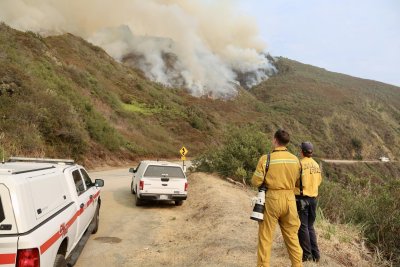
Quickly spreading wildfires trigger evacuations along Calif. coast

Firefighters survey smoke from the Plaskett Fire burning Saturday in California’s Big Sur region. The fire expanded to more than 15,000 acres and was only 1% contained on Sunday. Photo courtesy California Department of Forestry and Fire Protection

Aug. 30 (UPI) — A pair of wildfires burning along California’s Big Sur region expanded quickly over the weekend, jumping containment lines, closing roads and triggering extensive evacuations.

The Plaskett fire and the Timber fire have been burning for weeks in the rugged terrain of Monterrey and San Luis Obispo counties about 200 miles south of San Francisco.

But strong, gusty winds on Saturday sparked a rapid escalation, prompting officials to close the scenic State Hwy. 1 and issue a series of new evacuation orders after the Plaskett Fire jumped containment lines overnight.

That fire ballooned to nearly 15,500 acres and was only `1% contained as of Sunday afternoon, while the Timber Fire had spread to 24,700 acres and was 21% contained.

Firefighters fought to save structures near Sand Dollar and Plaskett Creek, executing “tactical firing operations overnight as the fire backed toward structures and residences,” according to the California Department of Forestry and Fire Protection, or Cal Fire.

The Plaskett fire crossed over the primary bulldozer containment line, officials said, even as ground teams supported by night flying helicopters fought to put out the “slop-overs.”

Monterrey County officials warned residents of Carmel Valley, Calif., to be ready for possible evacuation orders on Sunday as the fire advanced on the community. A mandatory evacuation order was issued later in day for an area southeast of Salmon Creek Trail and north of the San Luis Obispo County line.

The California Highway Patrol, meanwhile, closed Hwy. 1 just north of the county line, as well as further north at a location south of Little Sur River.

Source link
Is it safe to travel to Spain right now? Latest travel advice after earthquakes with evacuations and attraction closures

TWO earthquakes have rocked Granada, causing destruction across the region and the closure of popular attractions.

With a series of aftershocks also recorded, is it safe to travel to Spain? Here’s everything you need to know.

Vehicles and buildings were damaged following multiple earthquakes in Andalusia Credit: AFP
The first earthquake struck the region on August 15 Credit: AFP via Getty Images

Where are the earthquakes in Spain?

Granada in Andalusia has been affected by multiple earthquakes in the last five days.

The first earthquake hit the region over the weekend with a magnitude of 5.0 with its epicentre in Alhendín.

On August 15, a state of emergency was declared in the southern city as parts of buildings collapsed, rocks crushed cars and residents and holidaymakers were evacuated.

The tremor was felt across Andalusia and as far as Madrid, with locals reporting shakes in Malaga, Seville, Cordoba, Jaen and Almeria.

HOL YES

Cheap holiday destinations with 86p beers, £15 flights & £129pp package breaks


CHEAP AS CHIPS

10 UK summer holidays that are CHEAPER than a takeaway – all £12pp or less

It was then followed by a series of aftershocks.

On August 18 another powerful 4.6-magnitude earthquake hit Granada which left at least three people injured.

At the very centre of the earthquake was the small town of Gojar, a municipality around five miles south of the city of Granada.

Hotels and council buildings open to the public were forced to evacuate following the scare.

In a statement on X, the Granada City Council said: “In response to the latest seismic movements recorded in the province, the Granada City Council has agreed, as a preventive measure, to the temporary closure of all municipal buildings and facilities open to the public.”

One of the attractions that closed was parts of Alhambra, a fortress which is now a popular tourist attraction.

There was a second earthquake on August 18 and aftershocks Credit: Reuters

In Calle Navas, which is one of the most popular tourist streets in the city, bars were closed as authorities were concerned about falling debris.

Granada Cathedral remains closed while its exterior is examined.

Two 4 and 4.2-magnitude aftershocks also hit nearby Churriana de la Vega and Alhendín.

Is it safe to travel to Spain right now?

The travel advice for Spain remains unchanged. You can find all general information on the official FCDO website

Authorities have closed multiple attractions due to potential damage to the buildings Credit: AFP via Getty Images
Travel advice to Spain remains unchanged Credit: AFP

Are flights still going to Spain?

Yes, Granada Federico Garcia Lorca Airport remains open with flights operating as scheduled.

What if I have a holiday to Spain booked?

As the Foreign Office has not warned against travel to Spain, there are no special circumstances in place for holidaymakers to cancel their trip and receive a full refund.

Depending on what travel insurance you have, your policy might include natural disaster cover.

If so, your insurance policy should cover you for when you are unable to reach your holiday destination due to natural disasters, like wildfires and earthquakes.

So it is worth checking your travel insurance policy.

Can I cancel my trip?

If you want to cancel your trip or holiday, it is best to contact your airline and/or holiday provider.

Companies do not have an obligation to refund bookings unless Government advice changes.


Source link

Wildfire forces thousands of evacuations in Western Canada | Weather News

NewsFeed

A fast-moving wildfire has forced more than 20,000 people to evacuate parts of British Columbia’s Okanagan region in Western Canada. The Bald Range fire has grown to about 9,500 hectares, threatening homes and farms as firefighters battle blazes across the province.

Source link

Evacuations ordered as Guatemala volcano erupts | Volcanoes

NewsFeed

Guatemala’s Fuego volcano began erupting on Monday, prompting a nationwide orange alert and the evacuation of two nearby villages, with residents moved to temporary shelters. The highly active volcano’s deadly 2018 eruption has prompted renewed preventative measures.

Source link

Is it safe to travel to Greece? Latest holiday and flight advice as wildfires spark more evacuations

GREECE continues to be affected by the wildfires hat have already seen thousands evacuated across Europe.

A dry climate along with strong and high winds have been causing fires to spread quickly – so here is everything you need to know about the latest travel advice.

Hundreds of firefighters have been deployed to control the fires in Greece Credit: Reuters
Some of the biggest at the moment are in the regions of Boeotia and West Attica Credit: Reuters

Where are the wildfires in Greece?

Currently, some of the worst wildfires in Greece are concentrated around the regions of both Boeotia (Viotia) and West Attica, which is west of Athens.

Over the weekend, firefighters have been on the front line trying to control the blaze which has been picked up due to high winds.

Yesterday, two crew members onboard firefighting helicopters died as they collided while trying to extinguish the flames.

There are active fires near Agios Nektarios, Megara, and Mount Kithairon.

SUNNY STEALS

Sun-drenched European holidays with £1.50 pints and stays from under £9pp


HOL YES

Cheapest summer for holidays in YEARS – with August breaks still on sale for £188pp

It’s not just the mainland, as the Greek islands have been affected too.

Crete has seen huge fires, particularly in the Rethymno area, with thousands of residents and tourists being evacuated for safety.

On the island, more than 5,700 hectares of land have been burnt.

Fires have also broken out on the islands of Paros, Lesvos, Andros and Kalymnos.

Yesterday, a wildfire in the south of Kefalonia forced evacuations late at night as the fire spread through multiple villages.

Earlier in the week, a firefighter died after battling flames near the Peloponnese port town of Gytheio.

Helicopters have been dropping water to control the blazes Credit: REUTERS

Kyriakos Mitsotakis, the Greek Prime Minister, has warned of “extremely difficult” days ahead.

There is a further threat of more fires as wind gusts have exceeded 78mph in the last few days.

Is it safe to travel to Greece right now?

The UK Foreign Office (FCDO) hasn’t issued any specific warning regarding the wildfires in Greece, but does have some advice.

It does read: “There is a high risk of wildfires during the summer season from April to October. Ensure that your mobile phone is registered to receive emergency alerts to warn you of wildfires near your location.”

The advice from GOV.UK says:

“Wildfires are highly dangerous and unpredictable. The situation can change quickly.

The travel advice to Brits travelling to Greece remains changed Credit: REUTERS
But it’s important to be prepared in case of evacuation Credit: Reuters

“To avoid starting wildfires:

  • leave no litter, especially not glass which is known to start fires
  • make sure cigarettes are properly extinguished
  • do not light barbecues

“Causing a wildfire or a forest fire is a criminal offence in Greece – even if unintentional. If you see a fire, call the emergency services on 112.

“Be cautious if you are in or near an area affected by wildfires:

  • follow @112Greece for official updates
  • follow the guidance of the emergency services
  • call the Greek emergency services on 112 if you are in immediate danger
  • contact your airline or travel operator who can assist you with return travel to the UK”

Are flights still going to Greece?

Flights to airports such Athens International Airport and Heraklion in Crete remain unaffected.

If you are due to fly in and have concerns, it may be worth contacting your airline to check if they are operating normally.

Can I cancel my trip?

If you do choose to cancel your trip, it is best to contact your airline or holiday provider.

There is no obligation for companies to refund bookings unless government advice changes.


Source link

Fires in Spokane, Washington, burn 600 structures, force 60,000 evacuations | Climate News

A total of 1,000sq km (386sq miles) has burned across Washington state, and some of the fires have not been contained.

Wildfires in eastern Washington state have forced the evacuation of 60,000 people in the Spokane area and destroyed at least 600 homes, businesses and other structures, authorities said on Sunday.

The fires in and around Spokane, the state’s second-largest city, burned about 21 square kilometres (8sq miles) over the weekend and were among dozens of wildfires across the Western United States that stretched the ability of federal, state and local agencies to fight them.

Roughly 1,000sq km (386sq miles) have burned across the state, and some of the fires, including those in the Spokane area, have not been contained.

Fire and law enforcement officials said there had been no reports of injuries or people unaccounted for, but they stressed it was early in the response effort.

Videos from the Spokane area showed buildings on fire, black smoke billowing up near neighbourhoods, and the smoking ruins of homes, with only chimneys still standing. Several officials expressed concern that the area appears set to continue having dry weather in the coming days.

“We are not out of danger,” Senator Maria Cantwell said during a news conference with federal, state and local officials in Spokane. “The next couple of days will be challenging.”

Investigators have not determined how the blazes began.

Spokane was not the only region struggling to contain fires.

Crews using bulldozers and helicopters continued for a tenth day to fight a fire that has burned nearly 1,360sq km (525sq miles) of grassland in western Idaho and eastern Oregon. The area is home to cattle ranches, with authorities saying the fire is threatening more than 600 homes and 800 other structures.

In central Utah, a massive blaze more than doubled in size over the weekend, jumping from about 41sq km (16sq miles) to 145sq km (56sq miles) by Sunday morning. More than 100 cattle have been killed, according to local law enforcement.

Source link

France wildfires force mass evacuations from southwestern Gironde region

A road in Lege-Cap-Ferret in southwestern France is engulfed by an inferno late Thursday as a huge wildfire threatens the Cap Feret Peninsula, prompting authorities to evacuate tens of thousands of residents and holidaymakers. Photo by Damien Rembert/Gironde Department Fire and Rescue Service/EPA

July 24 (UPI) — Authorities in France’s southwestern Gironde region ordered tens of thousands of people to evacuate from the popular Cap Ferret peninsula vacation spot Friday in the face of an “XXL” wildfire threatening to cut off the promontory. As many as 2,000 escaped by boat.

French Interior Minister Laurent Nunez said 40,000 residents and tourists had been evacuated or were currently being moved from the cape, which is bordered by the Atlantic Ocean to the west and the Arcachon Bay to the east.

The fire has burned through at least 25,000 hectares after breaking out Wednesday in Saumos, a small town about 25 miles away to the northeast.

Authorities began evacuating of the town of Ares, south of Lege-Cap-Ferret on the Bay of Arcachon side of the peninsula after the fire picked up pace and intensity overnight, said fire and rescue chief Marc Vermeulen.

A local council member said 2,000 people had already made the 7.5-mile boat crossing to Arcachon on the southern side of the bay.

More than 800 firefighters from across France were battling the flames in an operation run out of a command center set up in a stadium in Le Porge, six miles northeast of Lege-Cap-Ferret.

Gironda Prefect Sophie Brocas said 53 homes and a campsite had been razed but that firefighters had managed to save 2,000 houses.

More than 23,000 people were also evacuated from homes, campsites, a nursing home and a summer camp due to another wildfire around Biscarrosse, about 15 miles south of Arcachon in the Landes department.

Landes prefect Gilles Clavreul said the fire was being fueled by a combination of winds of more than 30 mph and searing temperatures in the high 30s degrees Celsius.

Calling the situation very serious, President Emmanuel Macron said France had requested the European Union’s civil protection mechanism be activated, which would allow the deployment of firefighting aircraft from other members of the bloc.

“We will soon be able to count on reinforcements from two Croatian Canadair aircraft, two Portuguese Air Tractor planes, as well as two heavy Black Hawk helicopters from the Czech Republic and Slovakia,” he wrote in a post on X late Thursday night.

In Spain, authorities declared a national emergency Friday as they continued to battle three major wildfires west of Madrid in the areas of Villa del Prado and San Martín de Valdeiglesias, as well as Burgohondo in Avila province

Prime Minister Pedro Sanchez said Friday that many communities across Spain and beyond were being impacted by fires “ravaging thousands of hectares.”

“The government has deployed all available resources to halt the terrible fires that are currently affecting numerous areas: Avila, Leon, Toledo, Madrid, and other parts of Spain. We are living through a dramatic situation, not only in various Spanish provinces but also in regions of neighboring countries. Forest fires are ravaging thousands of hectares and affecting numerous communities,” he wrote on X.

“The government will stand by your side during the emergency and in the recovery,” added Sanchez.

Astronaut Buzz Aldrin walks on the surface of the Moon during the Apollo 11 mission on July 20, 1969. Photo by NASA/UPI | License Photo

Source link

Everything to know about travelling to France right now as heatwave wildfires spark evacuations and plane diversions

Wildfire in Pouzols-Minervois near Narbonne

THOUSANDS of people have been evacuated across the south of France due to huge wildfires across the region.

Along with flights being forced to divert, we’ve explained everything you need to know.

Wildfires have spread across the south of France, resulting in evacuations and flight diversions Credit: EPA
Smoke seen over Canet en Roussillon which was evacuated Credit: Alamy

What is happening in France right now?

Extreme temperatures in France have resulted in huge wildfires that have sparked evacuations.

Emergency services including water-dropping helicopters and firefighters have been deployed, with more than 3,000 people evacuated, after highs of 44C have been reported.

The blaze in France is believed to have been sparked by a discarded cigarette butt.

Officials have spent much of the summer battling with wildfires in France, with over 9,000 reported along the Mediterranean coast.

SPLASH IN

The best free water attractions in UK cities for kids to cool down in the heat


SPLASH OUT

Gorgeous free lido with sweeping city views is returning to UK this summer

Where are the wildfires in France?

The current wildfires have affected the towns of Sainte-Marie-la-Mer and Canet-en-Roussillon.

Three campsites popular with both locals and tourists were evacuated in response.

An airport in Perpignan was also forced to temporarily close with flights diverted to other airports such as Toulouse.

Two fires also broke out on the outskirts of Marseille, France’s second-biggest city.

Emergency services have been called in to tackle the blazes Credit: Reuters

Is it safe to travel to France right now?

All of France is safe to travel to, although the UK Foreign Office has some guidance regarding wildfires in the country.

It says: “Wildfires can start anywhere in France during the summer months, particularly along the Mediterranean coast and in Corsica.

“Fires have become more frequent because of drought and high temperatures.

“French authorities may evacuate areas and close roads for safety reasons.”

It also warns that anyone who causes a wildfire – even by accident – can face fines and even prison.

Anyone caught up in a wildfire should call fire services on 18 or emergency services on 112.

Source link