Oskar Eustis on why free Shakespeare in the Park attracts big money
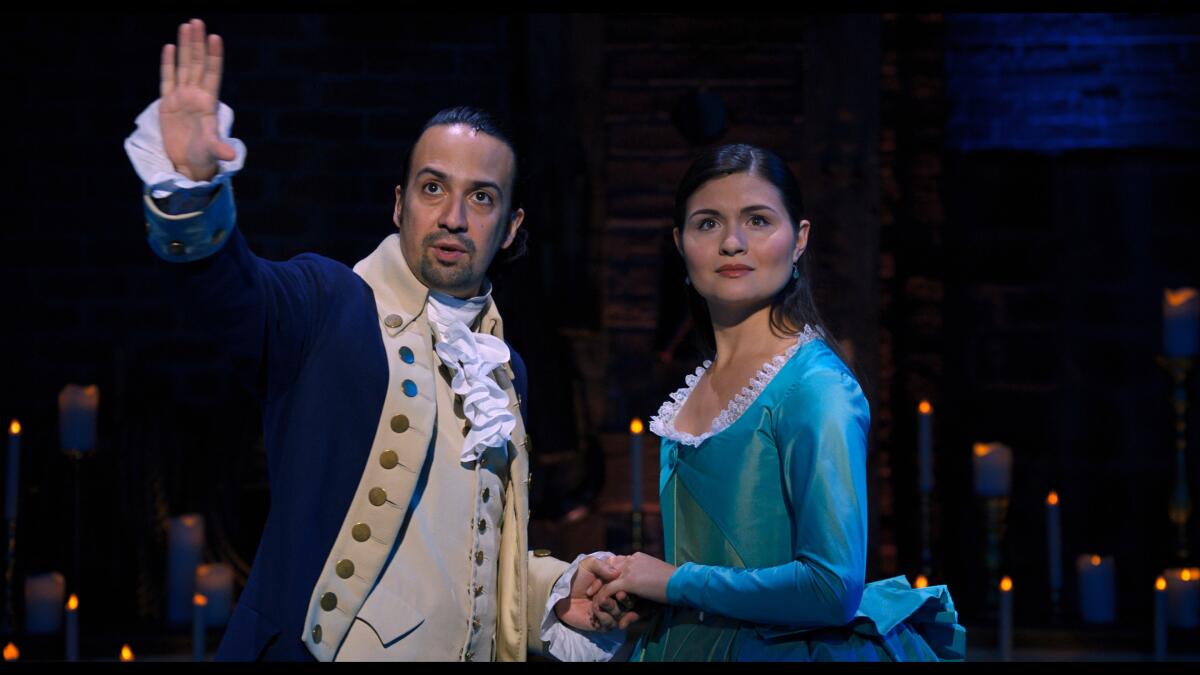
One of the most read — and debated — stories from the Arts team this week was an interview with Oskar Eustis a day after he announced that he would step down as the artistic director of the Public Theater in 2028. The New York Times broke the news July 22 in an interview with Eustis in which he also said that the American nonprofit theater movement was over.
I followed up in a phone interview the next day and asked him to explain what he meant, which he did, noting that the broad consensus that nonprofit theater mattered to the country — a belief held by national endowments, state arts agencies, public policy institutes and corporate philanthropic departments — had disappeared. So, too, have many of those very same agencies and their budgets that provided funding to the arts. The case for sustaining any particular theater now comes down to that theater and how relevant and necessary it can make itself to its surrounding community, Eustis said.
There is never enough room in an article when you’ve had a good conversation with someone, so I thought I’d use the newsletter to publish a bit more of what Eustis shared with me. I was particularly interested in something he said about the Public’s famed Shakespeare in the Park program, which is free and takes place every summer at the Delacorte Theater in Central Park. Since its inception, more than 160 productions have been staged, reaching more than 6 million people.
The free tickets the Public gives away for these shows are “the prime driver of our income at the Public, and this has been true since our founding,” Eustis told me.
That may sound counterintuitive, but it goes directly to the case Eustis is making for modern nonprofit theaters to be as relevant as possible to their communities. Ticket sales will never bring in the kind of money theaters need to sustain a robust slate of diverse programming — that will always have to come from donors. These very same donors, Eustis said, are the ones who feel most excited to be sitting among the citizenry in Central Park, watching the beauty of public art unfold in a joyous communal atmosphere.
“It’s not just when they make a donation that they get to see the show,” said Eustis of uber-wealthy donors. “They absolutely viscerally feel that — sitting in that theater when 75% of the audience hasn’t paid a penny to be there — they are getting to be part of their dream city. They’re feeling, ‘Oh, this is what New York is supposed to feel like.’”
By giving away free Shakespeare in the Park tickets, Eustis said, the Public is “making an unbelievably powerful case for why we need subsidy … and that’s why the money comes, because we are [showing] that democratic access is more fun for a better city.”
I like the idea of free theater being more fun, and rich people paying for the privilege of being a part of that fun when it is so removed from their cordoned-off daily lives. But I do worry that so much of what we now rely on culturally comes down to the whims and fancies of a handful of ultra-rich patrons. Newspapers are run by them, public school art and music programs rely on them, as do museums, symphonies, ballets and operas.
As Eustis pointed out, these donors no longer represent a broad consensus that is channeled into a civic vision via government support, but that is precisely why the situation feels so precarious. We might be one serious AI-driven stock market crash from artistic oblivion.
I’m Arts editor Jessica Gelt staring gloomily into the distance. This is your arts and culture news for the week.
The week ahead: A curated calendar
FRIDAY

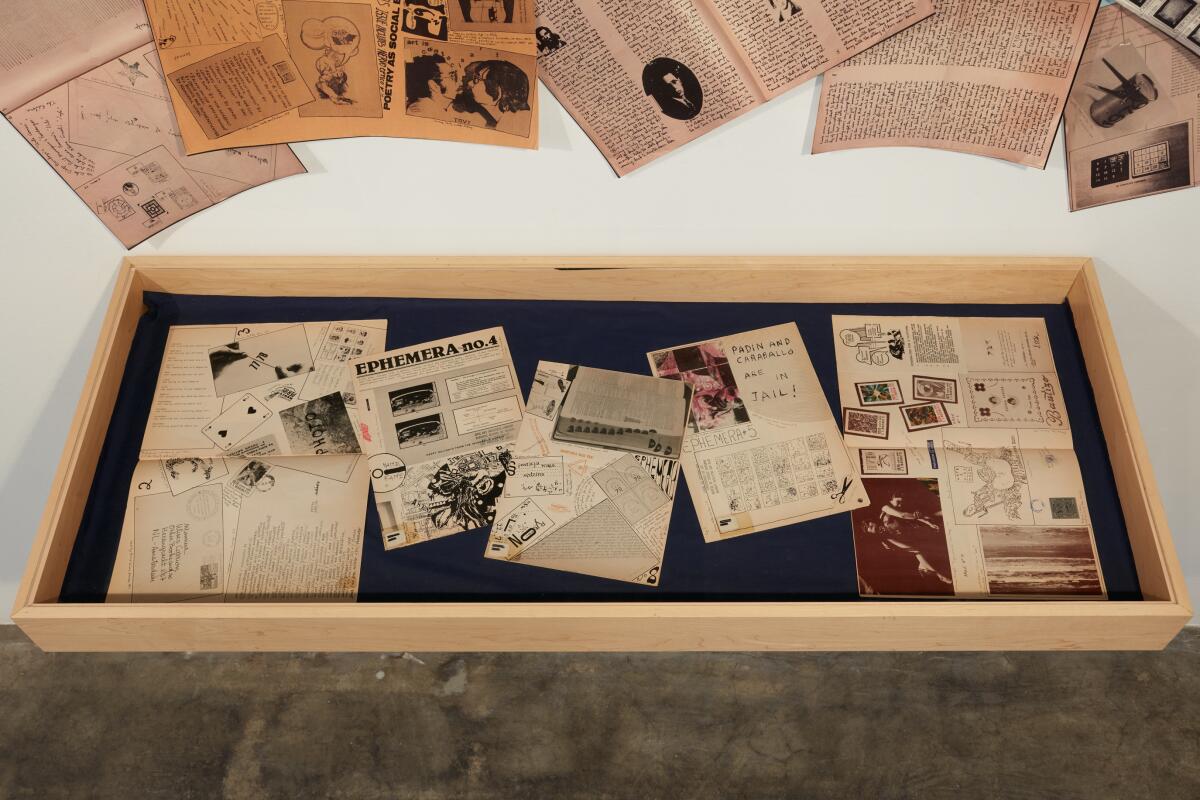
“Ulises Carrión, a bookwork in many places” exhibition at Joan Los Angeles.
(Evan Walsh)
Ulises Carrión, a bookwork in many places
The exhibition, in its final two weeks, examines the Mexican-born conceptual artist’s influence on reimagined systems of exchange through printed matter by artists, librarians, publishers and alternative spaces. The show focuses on Southern California in particular, spanning the 1970s, ’80s and ’90s, featuring artist books, correspondence, video and ephemera.
11 a.m.-5 p.m. Thursdays-Saturdays. Through Aug. 9. Joan, 1206 Maple Ave., Suite 715, Fashion District, downtown L.A. joanlosangeles.org
Puppet Up!
Brian Henson’s adventurous stage show featuring improv and sketch comedy with the iconic Henson puppets and puppeteers is back for a limited eight-performance run. Also on tap is “A Conversation With Brian Henson,” a live presentation by the Emmy-winning producer, director and puppeteer about the rich history of the Jim Henson Company, 2 p.m. Sunday at the Montalbán.
8 p.m. Friday; 3 and 7 p.m. Saturday; 5 p.m. Sunday; 8 p.m. Aug. 7; 3 and 7 p.m. Aug. 8; and 5 p.m. Aug. 9. Ricardo Montalbán Theatre, 1615 Vine St. puppetup.com
Tchaikovsky Spectacular with Fireworks
L.A.-based circus company Troupe Vertigo and the USC Trojan Marching Band join the Los Angeles Philharmonic, conducted by France’s Chloe Dufresne, for the 1812 overture — with pyrotechnics.
8 p.m. Friday and Saturday. Hollywood Bowl, 2301 N. Highland Ave. hollywoodbowl.com
SATURDAY

A scene from “Acquaprofonda” at the Aquarium of the Pacific.”
(Andres Leon for Long Beach Opera)
Acquaprofonda: A Deep-Sea Opera for Families
Long Beach Opera Education collaborates with the Aquarium of the Pacific for this free, family-friendly, 30-minute adventure about a young girl who finds an ailing whale and stands up for what’s right. Music by Giovanni Sollima, libretto by Giancarlo De Cataldo and English libretto by Elle Moody.
Noon and 3 p.m. Saturdays and Sundays, through Aug. 9. Aquarium of the Pacific, Honda Pacific Visions Theater, 100 Aquarium Way, Long Beach. longbeachopera.org
Boleros De Noche
The 10th annual celebration of romance, nostalgia and cultural pride features Puerto Rican singer iLe and a special performance by the L.A.-based trio Voz Bohemia.
8 p.m. Ford Amphitheatre, 2580 Cahuenga Blvd. East. theford.com
Free 4 All
Claremont Lewis Museum of Art opens its doors for this annual one-day takeover by local artists who will display their work with no fees to exhibit and no gatekeepers to choose whose work gets seen. With live music by the Kamran Curlin Trio, Home Again Home Again and Coupe Deville.
1-8 p.m. Claremont Lewis Museum of Art, 200 W. First St., Claremont. clmoa.org
People of Pompeii
A new comedy by Los Angeles Drama Critics Circle Award-winning playwright Bernardo Cubría, co-directed by Ellen Geer and Xochitl Romero, is set in Topanga Canyon itself and focuses on community in a time of climate catastrophe.
Through Oct. 4. Will Geer Theatricum Botanicum, 1419 N. Topanga Canyon Blvd., Topanga. theatricum.com
Two Gentlebots of Verona
The annual Actors’ Gang Free Shakespeare in the Park for Families features a cyber-inspired Shakespeare adaptation by Rynn Vogel, directed by Adam J. Jefferis.
11 a.m. Saturdays and Sundays, through Aug. 23. Media Park, 9091 Culver Blvd., Culver City; noon, Aug. 29-30. Buena Vista Branch Library, 300 N. Buena Vista St., Burbank. theactorsgang.com
SUNDAY
Sidney Jacobs & the Monsters
The jazz vocalist and his sextet perform original music with reimagined standards.
8 p.m. Sierra Madre Playhouse, 87 W. Sierra Madre Blvd. sierramadreplayhouse.org
St. Vincent with the Hollywood Bowl Orchestra
The six-time Grammy-winning singer-songwriter guitarist goes orchestral with the HBO led by conductor Jules Buckley.
7 p.m. Hollywood Bowl, 2301 N. Highland Ave. hollywoodbowl.com
TUESDAY
Louis Langrée
The French conductor leads the L.A. Phil in works from Felix Mendelssohn and Joseph Haydn on Tuesday at the Hollywood Bowl; two nights later, Langrée returns with pieces by Johannes Brahms, Georges Bizet and Louise Farrenc.
Mendelssohn & Haydn, 8 p.m. Tuesday; Brahms & Bizet, 8 p.m. Thursday. Hollywood Bowl, 2301 N. Highland Ave. hollywoodbowl.com

“Saint Luke” from Irmengard Codex shortly after 1053. German. Tempera colors, gold, and ink on parchment 22.2 × 18.7 cm (8 3/4 × 7 3/8 in.)
(Getty Museum)
The Making of a Medieval Manuscript
If you ever wondered how the beautiful manuscripts in the Getty’s extensive collection were created, this is the exhibition for you. Tools and materials used illustrate each phase of the process from parchment making, writing and illuminating through the final binding. Christian manuscripts from Europe, Armenia and Ethiopia, plus objects of Jewish and Muslim origin, will also be on display, along with a video component.
Through May 2, 2027. Getty Center, 1200 Getty Center Drive, L.A. getty.edu
WEDNESDAY

Kalean Ung as the Chanteuse in “The Comedy of Errors.”
(Mike Ditz)
The Comedy of Errors
Melissa Chalsma directs Indie Shakes’ production of the Bard’s wordplay and slapstick set in a Mediterranean port town, with an original score.
7 p.m. Wednesday-Sunday; through Sept. 6. Old Zoo Picnic Area, Griffith Park. indieshakes.org/free-shakespeare-2026
THURSDAY
Annie and the Caldwells/The Campbell Brothers
The Skirball concludes its 29th season of Sunset Concerts with this family-fueled pairing of disco soul and sacred steel gospel groups, respectively, plus DJ sets by Sonrisita.
7 p.m. Skirball Cultural Center, 2701 N. Sepulveda Blvd. skirball.org
JazzPOP 2026
The summer series marks its 19th season with three concerts showcasing West Coast creative jazz: Kasey Knudsen Sextet (Thursday); Malachi Whitson Quartet (Aug. 13); and Machado Mijiga Trio (Aug. 20).
8 p.m. Thursdays, through Aug. 20. UCLA Hammer Museum, 10899 Wilshire Blvd., Westwood. hammer.ucla.edu
— Kevin Crust
Retrospective
L.A. Times arts coverage from the the past …

Playwright/director Moises Kaufman of “The Laramie Project” was on the cover of Sunday Calendar, July 29, 2001.
(Irfan Khan / Los Angeles Times)
At the Heart of a Modern Tragedy
Sunday Calendar, July 29, 2001
NEW YORK — Moises Kaufman could not turn off the television. He could not put down the newspaper. Like much of America, he was mesmerized by the news of the horrific beating, robbery and eventual death in 1998 of Matthew Shepard, a gay university student attacked and left for dead by two young men near Laramie, Wyo.
“For the five days until he died, you couldn’t turn on a television or a radio and not hear about it,” says the 37-year-old playwright and director. “Matthew Shepard put a face on hate crimes. He was young, beautiful, starting his life. The nation as a whole said, ‘Oh, my God. What’s going on?’ ”
It was exactly the sort of question that Kaufman and his colleagues at the Tectonic Theater Project here try to ask, if not answer, onstage. So unlike much of America, Kaufman did not simply move on to the next news tragedy. The man who created the widely produced “Gross Indecency: The Three Trials of Oscar Wilde” had found his next theater project. READ MORE
— Barbara Isenberg
Culture news and the SoCal scene

Artist Betye Saar visits her pet tortoise named Ms. Rojo on Tuesday, Feb. 3, 2026, in Los Angeles.
(Jason Armond / Los Angeles Times)
Pioneering Los Angeles assemblage artist Betye Saar died Sunday, just a few days shy of her 100th birthday. The Times had the privilege of profiling her a few weeks earlier in a story that also included some wonderful photos of Saar still hard at work in her Laurel Canyon home studio. After Saar’s death, we published an obituary written by former Times columnist Carolina Miranda, and I put together a list of five of Saar’s most compelling works.
Watts Towers is poised to break ground in October on a $22-million campus renovation — the first such work done to the arts campus since it opened in 1970. The work is set to begin as funding for a 15-year project to preserve the towers themselves has dried up, with work about 90% complete. Community leaders say the situation represents the frustrating piecemeal approach taken over the years to preserve one of the city’s most important cultural landmarks. Times contributor Jane Horowitz has the scoop.

Evan Lugo (George Page), Sonya Cooke (Margaret Page), Zane Caputo (Abraham Slender), Zach Trent (Skateboard Fenton) and Heriberto Cruz Jr. (Doctor Cayo) in “The Merry Wives of Windsor Cove.”
(Elijah Waller)
“The Merry Wives of Windsor’” got a ’50s-themed SoCal beach blanket bingo musical makeover at UC Irvine’s New Swan Shakespeare Festival, and Times theater critic Charles McNulty was there to weigh in on the result. “The pastiche score, indebted to the pop charts of the 1950s, isn’t allowed to dominate,” McNulty writes. “As modern musicals go, this is a low-key affair. The comedy is still the thing in this frolicsome outdoor production, which takes place in the charming ambiance of the festival’s portable, mini-Elizabethan venue.”
McNulty also took time to praise the work of stellar older actors in a rare revival of Nöel Coward’s “Waiting in the Wings,” which is running in repertory at Will Geer Theatricum Botanicum through Oct. 10. The play, “which is set in ‘The Wings,’ a charity home for retired actresses, provides a feast for veteran thespians for whom it would be impolite to ask their age,” writes McNulty. “Led by Susan Angelo, Jan Wikstrom and Ellen Geer, this ensemble, under the direction of Willow Geer, diverts and distracts from the mustier aspects of Coward’s style.”
The Lucas Museum of Narrative Art announced its inaugural film programming, which is set to screen nonstop during museum hours in two dedicated 299-seat theaters. One theater will play mostly documentary films, and the other will be devoted to the more experimental aspects of the art form.

Alaska Thunderf— will play Mary Todd Lincoln in “Oh, Mary!” at the Ahmanson.
(Daniel Rampulla)
“RuPaul’s Drag Race” star Alaska Thunderf— will play Mary Todd Lincoln in Cole Escola’s Tony-winning comedy “Oh, Mary!” when it arrives at Center Theatre Group’s Ahmanson Theatre in the fall. Broadway star J. Harrison Ghee has been cast opposite Alaska in the role of her famous husband.
Enjoying this newsletter? Consider subscribing to the Los Angeles Times
Your support helps us deliver the news that matters most. Become a subscriber.

Joey McIntyre of New Kids on the Block performs during Audacy’s 11th annual We Can Survive at Prudential Center on Sept. 28, 2024, in Newark, N.J.
(Manny Carabel / Getty Images for Audacy)
The Wallis Annenberg Center for the Performing Arts announced some additions to its 2026-2027 season, including the world premiere of a new play, “Radio Galaxy,” written by Michèle Aldin Kushner, directed by Kimberly Senior and starring Joey McIntyre (yes, that Joey McIntyre) and Olivier Award winner Lesli Margherita. The show is about a 17-year-old from a working-class New Jersey town who wants to become an astronomer but must deal with the harsh realities of daily life, including his half-sister’s need for a bone marrow transplant. The show is scheduled for 18 performances in the Lovelace Studio Theater Nov. 6-22. Tickets are available here.
A few reduced-rate spots remain for Camp Build at the Gamble House in Pasadena, which runs from Aug. 1 to 5 for three hours each day. Two hours are devoted to learning the art and craft of woodworking, and a third hour is spent on activities inspired by nature and architecture in the historic home. The cost of the camp is assessed on a sliding scale according to income and need with four payment tiers ranging from free to $650. The remaining slots are in the second tier, which costs $350.
— Jessica Gelt
And last but not least
Want a glimpse into the hedonistic L.A. of yore? Check out this story about Eve Babitz’s personal letters. It will not disappoint.